
GDP Unemployment and Inflation Measuring Economic Performance Importance


- Slides: 39
GDP, Unemployment and Inflation Measuring Economic Performance
Importance of Macroeconomic Measurement: �Describes and gives the causes of current economic conditions �Compares economic conditions over time �Provides a basis formulating public policies to improve economic performance
Macroeconomic Goals �Full Employment (as measured by unemployment) �Price Stability (as measured by inflation) �Economic Growth (as measured by GDP)
GDP Defined �Gross Domestic Product is the total market value of all final goods and services produced in the economy in one year. �The economy is defined as all goods and services produced within the borders of the United States, regardless of who owns the means of production.
Gross Domestic Product � GDP is a monetary value – 2012 GDP was $17, 420, 000, 000. 00 (adjusted for inflation) � Sale of final goods is included � Sale of intermediate goods excluded � Avoids double counting ▪ The “value-added” approach
Final and Intermediate Goods �Final Goods and Services ▪ Are not used as inputs into the production of another good or service ▪ Are bought by their final users
Final and Intermediate Goods �Intermediate goods ▪ Are used as inputs into the production of another good or service ▪ Examples ▪ Intermediate goods – windshields, gearboxes, batteries ▪ Intermediate services – banking and insurance services bought by a car producer
Final and Intermediate Goods �How to tell ▪ Look at who buys it and for what purpose ▪ Example: electric power ▪ Intermediate when bought by car producer ▪ Final when bought for your home
What GDP Includes (Two Approaches that will be equal) �All the income earned in the country during the year (wages and salaries, interest, corporate profits, etc. ) OR �All the spending in the economy during the year (consumer spending, investment spending, government spending and net exports)
What GDP excludes � Secondhand sales ▪ Do not represent current output � Purely financial transactions ▪ Public transfer payments (Social Security) ▪ Private transfer payments (money and gifts) ▪ Securities transactions ▪ Stocks (dividends and brokerage fees are counted) ▪ Private bonds (interest payments are counted) ▪ Public bonds (interest payments are transfer payments)
What GDP does not include �Non-market production (housewives, etc. ) �Changes in product quality/disproducts �Unreported tips or sales �Barter activity �Illegal activities “Underground Activities may be as much as 15% of GDP!”
Unemployment �Criteria for Success: ▪ Define the labor force and the unemployed ▪ Identify how unemployment rates are calculated ▪ Identify the natural rate, average rate and highest recorded rate of unemployment in the U. S. ▪ Explain why unemployment figures might be misleading ▪ Describe the 4 types of unemployment and give examples of each
Unemployment The Labor Force: All adults 16 and older who are able and willing to work. The Unemployed: The percentage of the labor force that is without a job.
Unemployment Insurance �A government program �Your employer contributes on your behalf �Acts as an income replacement program for a limited time should you become unemployed through no fault of your own
Unemployment Figures �How unemployment rates are calculated – Bureau of Labor Statistics �Natural Rate of Unemployment �Average rate �Current rates �Highest recorded rate
Why unemployment figures you hear may be misleading: �Unrealistic wage expectations �Discouraged workers (jobless) are not counted �All part-time workers are considered fully employed
Types of unemployment ▪ Frictional – temporarily between jobs ▪ Structural – mismatches between job seekers and job openings ▪ Cyclical – too little spending in economy so lay offs occur ▪ Seasonal – due to change in weather
Inflation �Criteria for Success: ▪ Define inflation, deflation and disinflation ▪ Explain why we measure inflation ▪ Identify different types of inflation ▪ Explain how to measure inflation ▪ Evaluate the effects of inflation on different groups within an economy
Inflation �A general rise in the level of prices ▪ Does not mean all prices are rising at the same time ▪ Not the result of a one-time shock
Deflation �Opposite of Inflation ▪ A general decline in the level of prices ▪ Rarely occurs ▪ Indicates a serious recession
Disinflation �The better option ▪ A decrease in the inflation rate ▪ Generally a sign of a healthy economy
Why we measure inflation �One of our economic goals is to achieve price stability �Nominal vs. Real Income – inflation allows us to know if our ability to buy goods and services is going up or down
Types of Inflation ▪ Demand-Pull: Spending increases faster than output can keep up with – “too many dollars chasing too few goods ” ▪ Cost-Push: results from an increase in costs that cause producers to produce less ▪ Expected Rate (1 -2%): caused by rising resource costs ▪ Hyperinflation: extremely rapid rise in prices, very rare
Measuring Inflation � Price Index: a comparison of the general level of prices in a given year with the prices of an earlier year � Consumer Price Index (CPI) ▪ The most widely reported measure of inflation for cost of living ▪ Measures a market basket of about 300 goods and services purchased by an urban family of four �Producer Price Index (PPI) ▪ Reports on resource prices to producers ▪ A leading indicator of consumer prices
Effects of Inflation �Groups that are hurt: ▪ Lenders ▪ Savers ▪ Anyone on a fixed income �Groups that benefit: ▪ ▪ Borrowers Business Owners of Real Assets Federal Government
The Business Cycle Putting GDP, Unemployment and Inflation together and creating a picture of economic conditions.
Economic Growth �Historically, we have experienced tremendous growth ▪ Technological Progress ▪ Rapid increases in productive capacity ▪ Achieved the highest standard of living in the world
Economic Growth ▪ Long-run growth has not been steady ▪ Interrupted and complicated ▪ Caused by unemployment and inflation
The Business Cycle Defined The recurrent ups and downs in the level of economic activity that extends over several years.
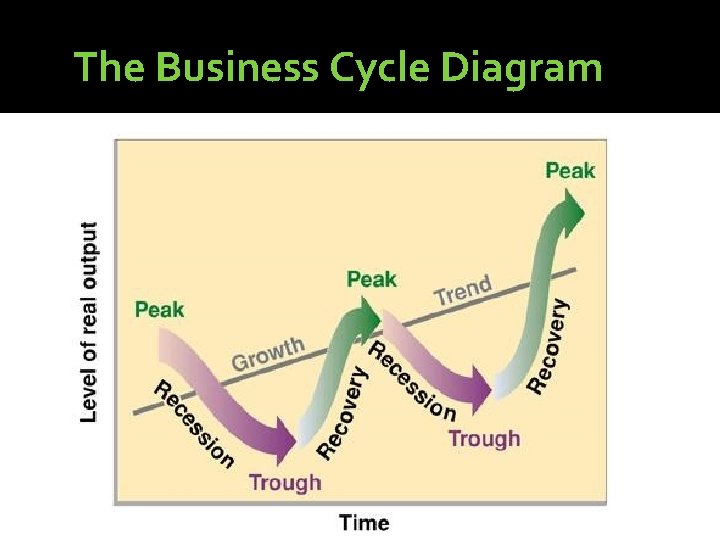
The Business Cycle Diagram
The Phases of the Business Cycle �Vary greatly in duration and intensity
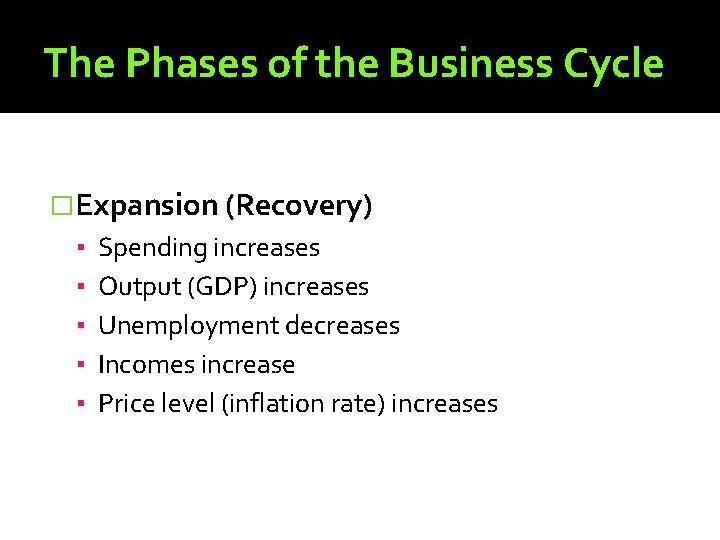
The Phases of the Business Cycle �Expansion (Recovery) ▪ Spending increases ▪ Output (GDP) increases ▪ Unemployment decreases ▪ Incomes increase ▪ Price level (inflation rate) increases
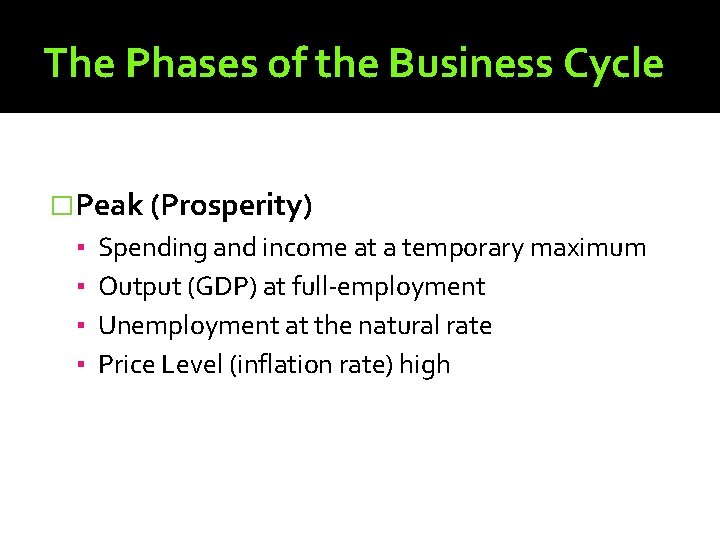
The Phases of the Business Cycle �Peak (Prosperity) ▪ Spending and income at a temporary maximum ▪ Output (GDP) at full-employment ▪ Unemployment at the natural rate ▪ Price Level (inflation rate) high
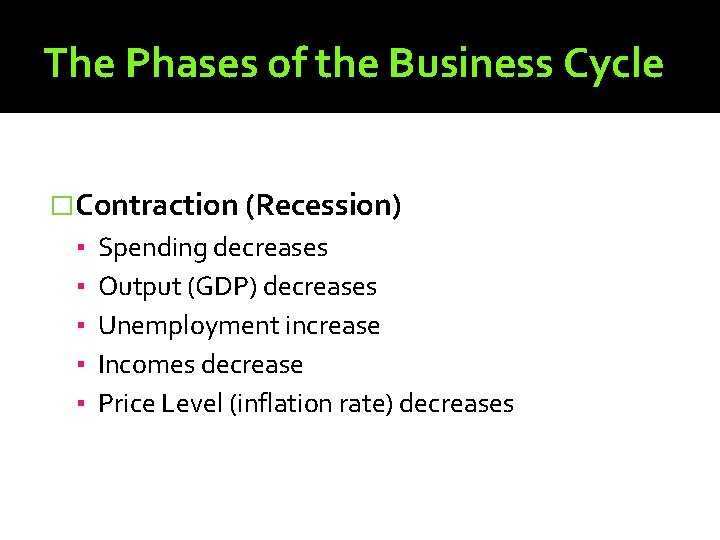
The Phases of the Business Cycle �Contraction (Recession) ▪ Spending decreases ▪ Output (GDP) decreases ▪ Unemployment increase ▪ Incomes decrease ▪ Price Level (inflation rate) decreases
The Phases of the Business Cycle �Trough (only if very prolonged, becomes depression) ▪ Spending and incomes bottom out ▪ Output (GDP) at lowest levels ▪ Unemployment at highest levels ▪ Price Level (inflation rate) at expected rate
What causes Business Cycles? �External Causes ▪ Population changes ▪ Inventions/innovations ▪ Wars/political events
What causes Business Cycles? �Internal Causes ▪ ▪ Consumer spending Investment spending Government spending Net exports (exports – imports)
Measuring Economic Performance Essay �Research current levels of GDP, unemployment and inflation (cite your sources!) �Evaluate the data you find, and determine the current state of the US economy. �Draw and label a business cycle diagram and indicate where the US economy is based on your analysis of the current data. This will count as a test grade!!!
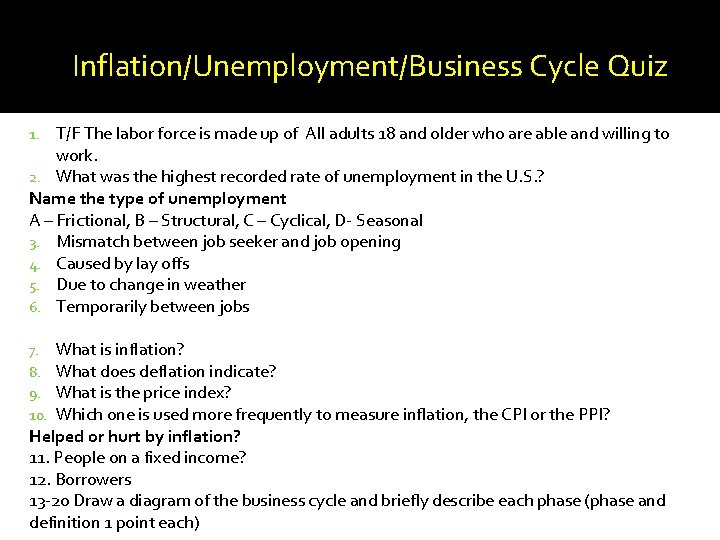
Inflation/Unemployment/Business Cycle Quiz T/F The labor force is made up of All adults 18 and older who are able and willing to work. 2. What was the highest recorded rate of unemployment in the U. S. ? Name the type of unemployment A – Frictional, B – Structural, C – Cyclical, D- Seasonal 3. Mismatch between job seeker and job opening 4. Caused by lay offs 5. Due to change in weather 6. Temporarily between jobs 1. What is inflation? What does deflation indicate? What is the price index? Which one is used more frequently to measure inflation, the CPI or the PPI? Helped or hurt by inflation? 11. People on a fixed income? 12. Borrowers 13 -20 Draw a diagram of the business cycle and briefly describe each phase (phase and definition 1 point each) 7. 8. 9. 10.