
GDCP2010 Scientific literacy and contextbase Koos Kortland Freudenthal

GDCP_2010 Scientific literacy and context-base Koos Kortland Freudenthal Institute for science and mathematics education – FIsme University of Utrecht PPT FIsme
Introduction | Contexts | Problem-posing approach | Authentic practices | Conclusion Introduction • Scientific literacy Is “the capacity to use scientific knowledge, to identity questions and to draw evidence-based conclusions in order to understand help make decisions about the natural world and human interactions with it” (OECD | UNESCO, 2003) Key concepts, skills, issues… as “a key outcome of education by age 15 for all students” • Decision-making about socioscientific issues Stand-alone units as an add-on to traditional science curricula Element of context-based science curricula Characteristic: to present the science knowledge as relevant for decision making in personal, social and/or scientific contexts 9/25/2020 PPT FIsme 2
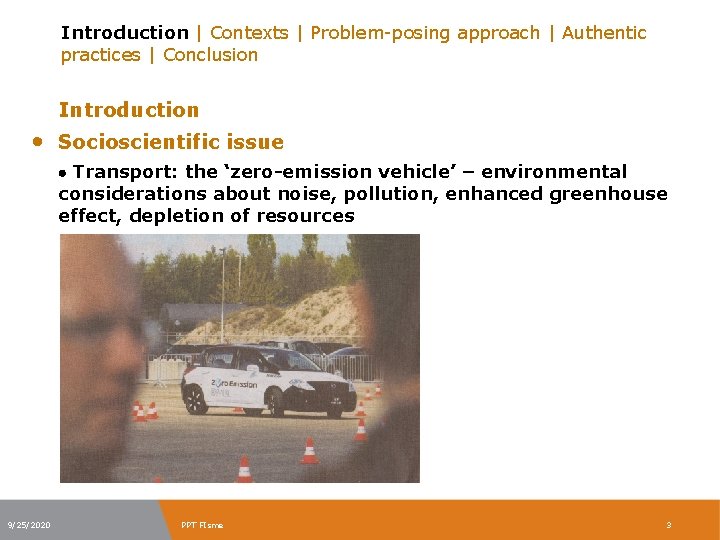
Introduction | Contexts | Problem-posing approach | Authentic practices | Conclusion Introduction • Socioscientific issue Transport: the ‘zero-emission vehicle’ – environmental considerations about noise, pollution, enhanced greenhouse effect, depletion of resources 9/25/2020 PPT FIsme 3
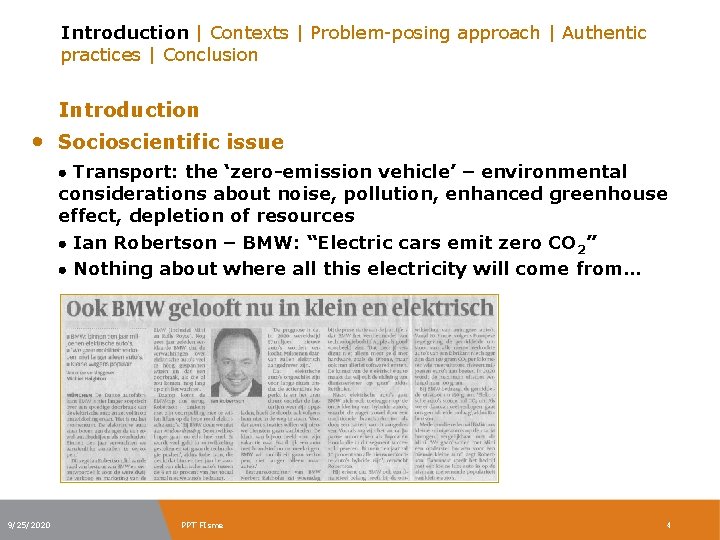
Introduction | Contexts | Problem-posing approach | Authentic practices | Conclusion Introduction • Socioscientific issue Transport: the ‘zero-emission vehicle’ – environmental considerations about noise, pollution, enhanced greenhouse effect, depletion of resources Ian Robertson – BMW: “Electric cars emit zero CO 2” Nothing about where all this electricity will come from… 9/25/2020 PPT FIsme 4
Introduction | Contexts | Problem-posing approach | Authentic practices | Conclusion Introduction • Socioscientific issue Transport: the ‘zero-emission vehicle’ – environmental considerations about noise, pollution, enhanced greenhouse effect, depletion of resources Ian Robertson – BMW: “Electric cars emit zero CO 2” Nothing about where all this electricity will come from… • Debate Lacking in the article, and in the debate at large: a critical reflection on why we might need electric cars, and under which conditions such cars might be a solution for which problem • Life roles Decision making in a socioscientific issue as a citizen and as a (future) consumer 9/25/2020 PPT FIsme 5
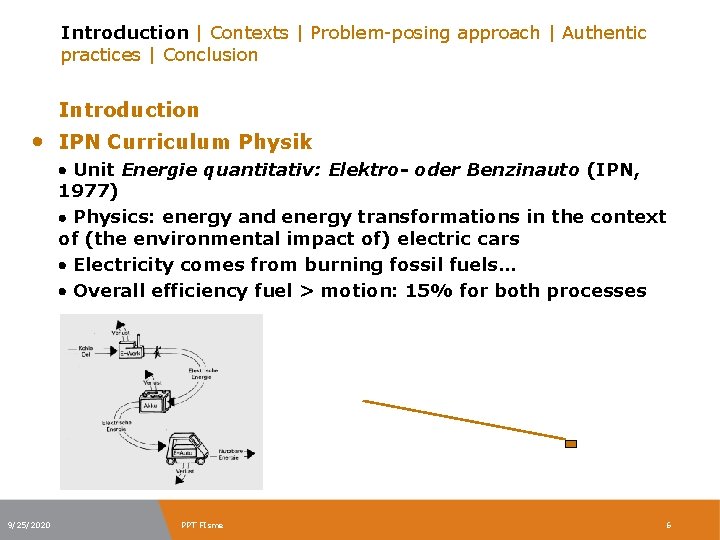
Introduction | Contexts | Problem-posing approach | Authentic practices | Conclusion Introduction • IPN Curriculum Physik Unit Energie quantitativ: Elektro- oder Benzinauto (IPN, 1977) Physics: energy and energy transformations in the context of (the environmental impact of) electric cars Electricity comes from burning fossil fuels… Overall efficiency fuel > motion: 15% for both processes 9/25/2020 PPT FIsme 6
Introduction | Contexts | Problem-posing approach | Authentic practices | Conclusion Introduction • IPN Curriculum Physik Unit Energie quantitativ: Elektro- oder Benzinauto (IPN, 1977) Physics: energy and energy transformations in the context of (the environmental impact of) electric cars Electricity comes from burning fossil fuels… Overall efficiency fuel > motion: 15% for both processes • Relevance The unit concerns “eine Frage die Schüler […] in der Regel interessiert, die […] in der Öffentlichkeit diskutiert wird, and die in Zukunft (und damit besonders für die heutigen Schüler) wahrscheinlich an Bedeuting gewinnen wird” 9/25/2020 PPT FIsme 7
Introduction | Contexts | Problem-posing approach | Authentic practices | Conclusion Introduction • Learning in contexts Problem: didactical frictions between context and science knowledge • Problem-posing approach Problem: global and local content-related motives for science knowledge extension • Learning in authentic practices Problem: inducing a motive for developing a meta-cognitive (decision-making) tool • Conclusion A design tool for the teaching-learning about socioscientific issues In search of (design criteria for) didactical quality 9/25/2020 PPT FIsme 8
Introduction | Contexts | Problem-posing approach | Authentic practices | Conclusion Learning in contexts 1 9/25/2020 PPT FIsme 9
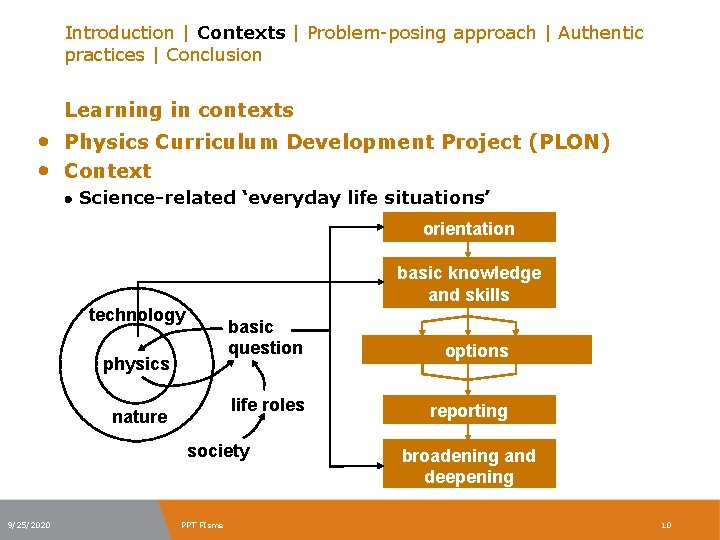
Introduction | Contexts | Problem-posing approach | Authentic practices | Conclusion Learning in contexts • Physics Curriculum Development Project (PLON) • Context Science-related ‘everyday life situations’ orientation basic knowledge and skills technology physics nature basic question options life roles reporting society 9/25/2020 PPT FIsme broadening and deepening 10
Introduction | Contexts | Problem-posing approach | Authentic practices | Conclusion Learning in contexts • Physics Curriculum Development Project (PLON) • Context Science-related ‘everyday life situations’ • Claim Relevance > positive impact on interest, motivation and understanding science knowledge < learning theory? • Aims Acquiring science knowledge (further education, job) and functioning in ‘life roles’ (consumer, citizen) • Problem Didactical frictions between context and science knowledge (in retrospect) 9/25/2020 PPT FIsme 11
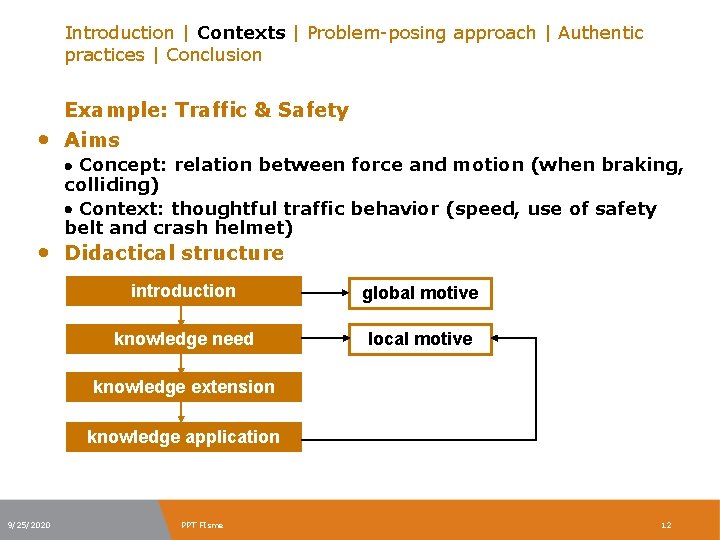
Introduction | Contexts | Problem-posing approach | Authentic practices | Conclusion Example: Traffic & Safety • Aims Concept: relation between force and motion (when braking, colliding) Context: thoughtful traffic behavior (speed, use of safety belt and crash helmet) • Didactical structure introduction global motive knowledge need local motive knowledge extension knowledge application 9/25/2020 PPT FIsme 12
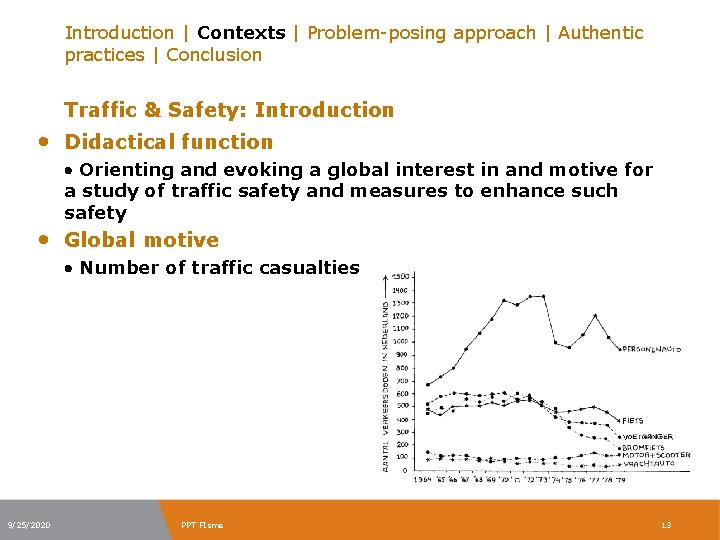
Introduction | Contexts | Problem-posing approach | Authentic practices | Conclusion Traffic & Safety: Introduction • Didactical function Orienting and evoking a global interest in and motive for a study of traffic safety and measures to enhance such safety • Global motive Number of traffic casualties 9/25/2020 PPT FIsme 13
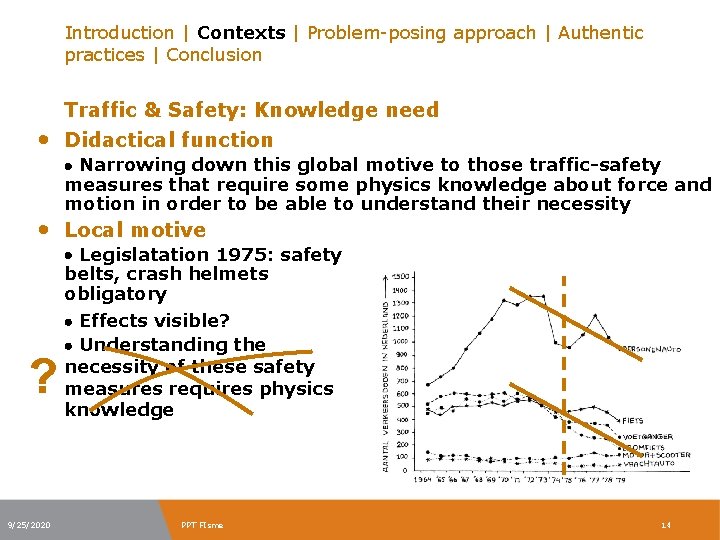
Introduction | Contexts | Problem-posing approach | Authentic practices | Conclusion Traffic & Safety: Knowledge need • Didactical function Narrowing down this global motive to those traffic-safety measures that require some physics knowledge about force and motion in order to be able to understand their necessity • Local motive Legislatation 1975: safety belts, crash helmets obligatory ? 9/25/2020 Effects visible? Understanding the necessity of these safety measures requires physics knowledge PPT FIsme 14
Introduction | Contexts | Problem-posing approach | Authentic practices | Conclusion Traffic & Safety • Didactical friction Transition phase 1 > 2 – introduction > knowledge need: for the contextual aim (thoughtful traffic behavior) no physics knowledge (force and motion) is required – the obvious effect of safety measures is enough • Actual local motive Understanding of the effect of safety measures, not their necessity 9/25/2020 PPT FIsme 15
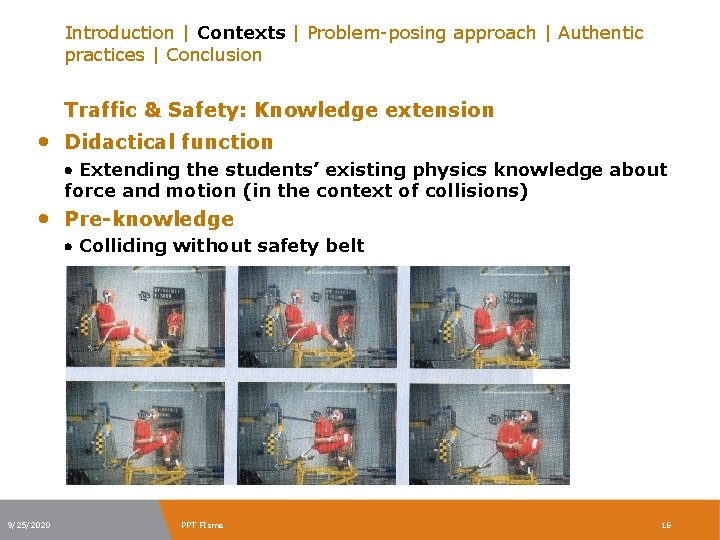
Introduction | Contexts | Problem-posing approach | Authentic practices | Conclusion Traffic & Safety: Knowledge extension • Didactical function Extending the students’ existing physics knowledge about force and motion (in the context of collisions) • Pre-knowledge Colliding without safety belt 9/25/2020 PPT FIsme 16
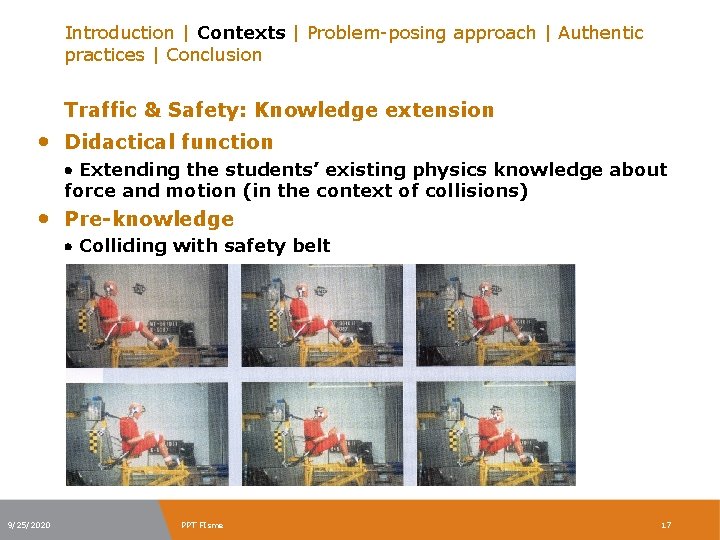
Introduction | Contexts | Problem-posing approach | Authentic practices | Conclusion Traffic & Safety: Knowledge extension • Didactical function Extending the students’ existing physics knowledge about force and motion (in the context of collisions) • Pre-knowledge Colliding with safety belt 9/25/2020 PPT FIsme 17
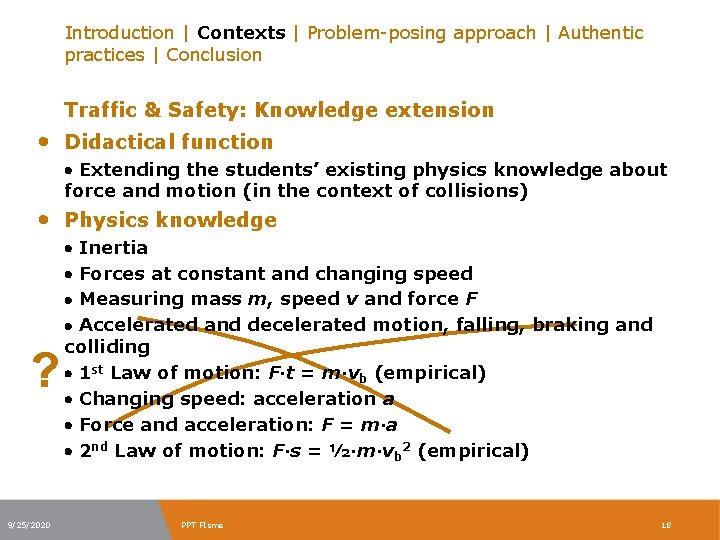
Introduction | Contexts | Problem-posing approach | Authentic practices | Conclusion Traffic & Safety: Knowledge extension • Didactical function Extending the students’ existing physics knowledge about force and motion (in the context of collisions) • Physics knowledge ? 9/25/2020 Inertia Forces at constant and changing speed Measuring mass m, speed v and force F Accelerated and decelerated motion, falling, braking and colliding 1 st Law of motion: F·t = m·vb (empirical) Changing speed: acceleration a Force and acceleration: F = m·a 2 nd Law of motion: F·s = ½·m·vb 2 (empirical) PPT FIsme 18
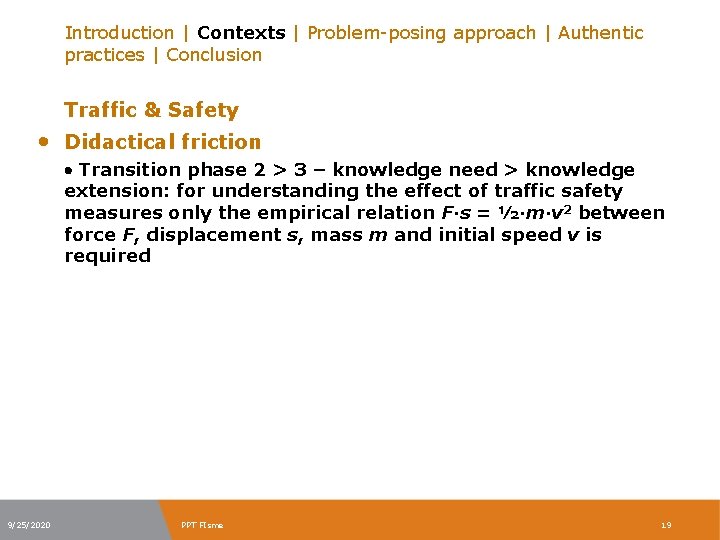
Introduction | Contexts | Problem-posing approach | Authentic practices | Conclusion Traffic & Safety • Didactical friction Transition phase 2 > 3 – knowledge need > knowledge extension: for understanding the effect of traffic safety measures only the empirical relation F·s = ½·m·v 2 between force F, displacement s, mass m and initial speed v is required 9/25/2020 PPT FIsme 19
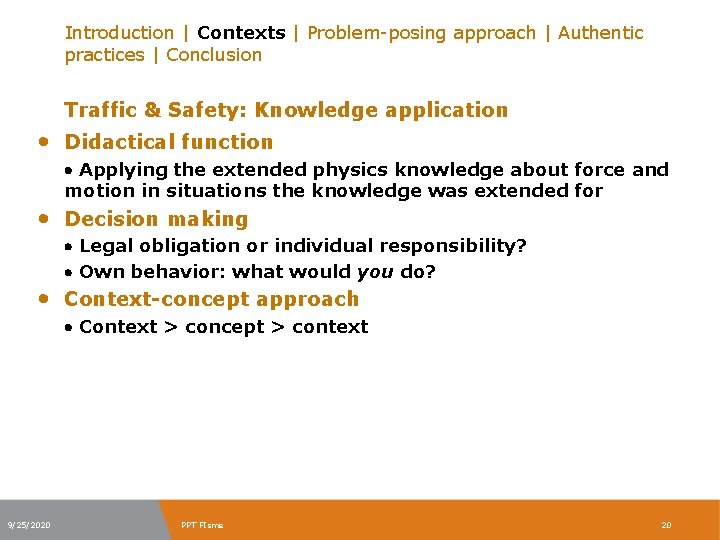
Introduction | Contexts | Problem-posing approach | Authentic practices | Conclusion Traffic & Safety: Knowledge application • Didactical function Applying the extended physics knowledge about force and motion in situations the knowledge was extended for • Decision making Legal obligation or individual responsibility? Own behavior: what would you do? • Context-concept approach Context > concept > context 9/25/2020 PPT FIsme 20
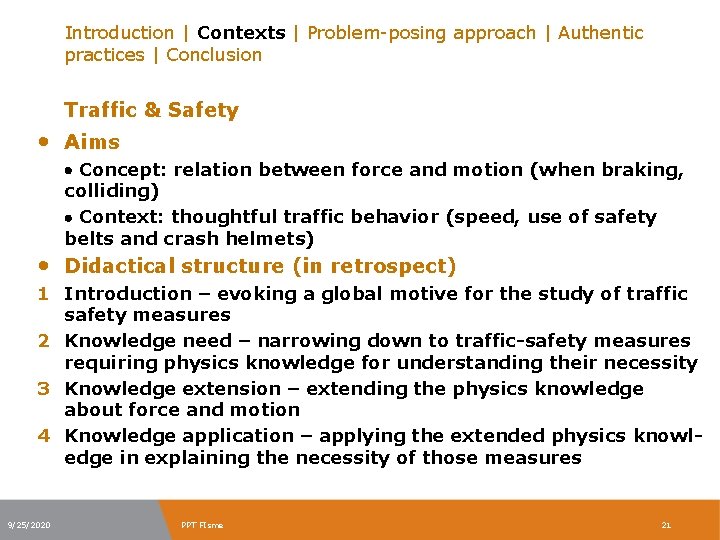
Introduction | Contexts | Problem-posing approach | Authentic practices | Conclusion Traffic & Safety • Aims Concept: relation between force and motion (when braking, colliding) Context: thoughtful traffic behavior (speed, use of safety belts and crash helmets) • Didactical structure (in retrospect) 1 Introduction – evoking a global motive for the study of traffic safety measures 2 Knowledge need – narrowing down to traffic-safety measures requiring physics knowledge for understanding their necessity 3 Knowledge extension – extending the physics knowledge about force and motion 4 Knowledge application – applying the extended physics knowledge in explaining the necessity of those measures 9/25/2020 PPT FIsme 21
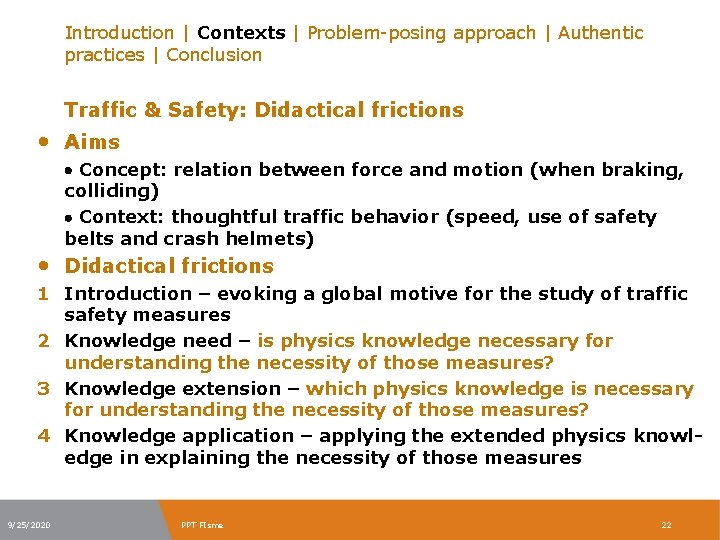
Introduction | Contexts | Problem-posing approach | Authentic practices | Conclusion Traffic & Safety: Didactical frictions • Aims Concept: relation between force and motion (when braking, colliding) Context: thoughtful traffic behavior (speed, use of safety belts and crash helmets) • Didactical frictions 1 Introduction – evoking a global motive for the study of traffic safety measures 2 Knowledge need – is physics knowledge necessary for understanding the necessity of those measures? 3 Knowledge extension – which physics knowledge is necessary for understanding the necessity of those measures? 4 Knowledge application – applying the extended physics knowledge in explaining the necessity of those measures 9/25/2020 PPT FIsme 22
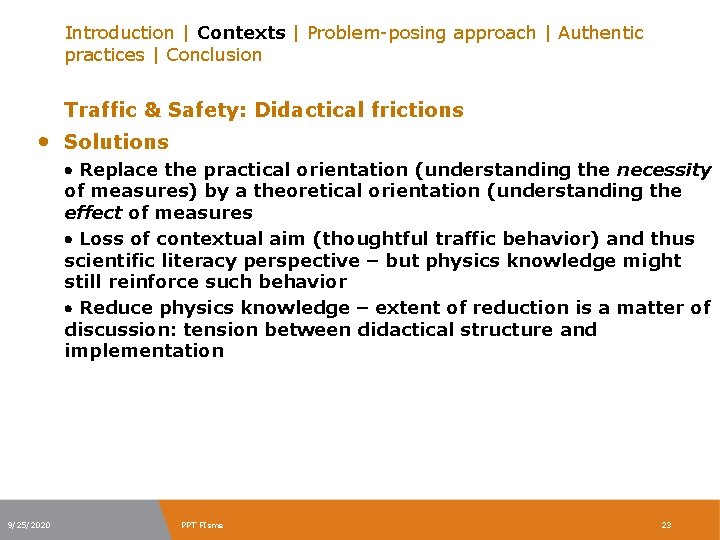
Introduction | Contexts | Problem-posing approach | Authentic practices | Conclusion Traffic & Safety: Didactical frictions • Solutions Replace the practical orientation (understanding the necessity of measures) by a theoretical orientation (understanding the effect of measures Loss of contextual aim (thoughtful traffic behavior) and thus scientific literacy perspective – but physics knowledge might still reinforce such behavior Reduce physics knowledge – extent of reduction is a matter of discussion: tension between didactical structure and implementation 9/25/2020 PPT FIsme 23
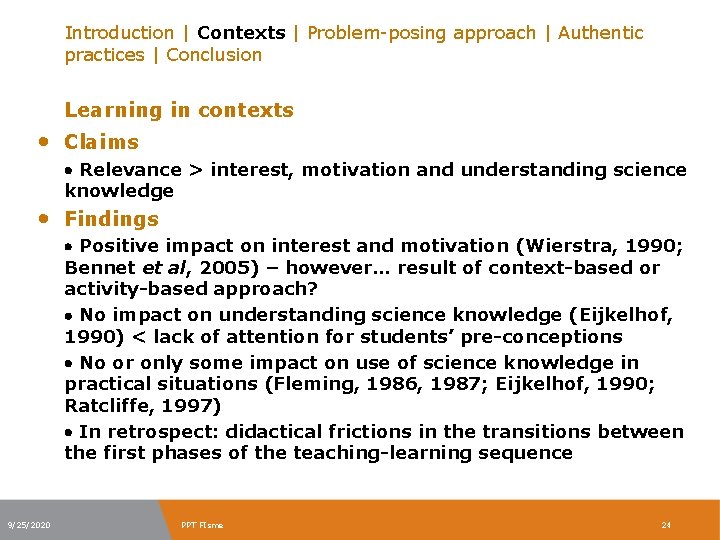
Introduction | Contexts | Problem-posing approach | Authentic practices | Conclusion Learning in contexts • Claims Relevance > interest, motivation and understanding science knowledge • Findings Positive impact on interest and motivation (Wierstra, 1990; Bennet et al, 2005) – however… result of context-based or activity-based approach? No impact on understanding science knowledge (Eijkelhof, 1990) < lack of attention for students’ pre-conceptions No or only some impact on use of science knowledge in practical situations (Fleming, 1986, 1987; Eijkelhof, 1990; Ratcliffe, 1997) In retrospect: didactical frictions in the transitions between the first phases of the teaching-learning sequence 9/25/2020 PPT FIsme 24
Introduction | Contexts | Problem-posing approach | Authentic practices | Conclusion Problem-posing approach 2 9/25/2020 PPT FIsme 25
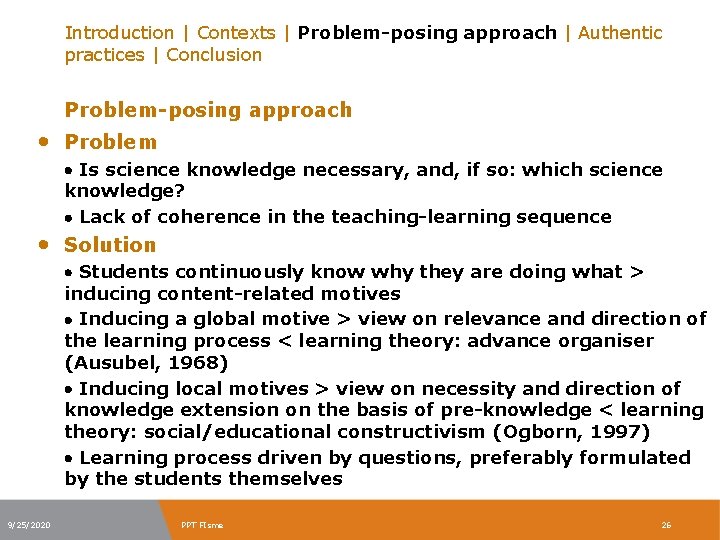
Introduction | Contexts | Problem-posing approach | Authentic practices | Conclusion Problem-posing approach • Problem Is science knowledge necessary, and, if so: which science knowledge? Lack of coherence in the teaching-learning sequence • Solution Students continuously know why they are doing what > inducing content-related motives Inducing a global motive > view on relevance and direction of the learning process < learning theory: advance organiser (Ausubel, 1968) Inducing local motives > view on necessity and direction of knowledge extension on the basis of pre-knowledge < learning theory: social/educational constructivism (Ogborn, 1997) Learning process driven by questions, preferably formulated by the students themselves 9/25/2020 PPT FIsme 26
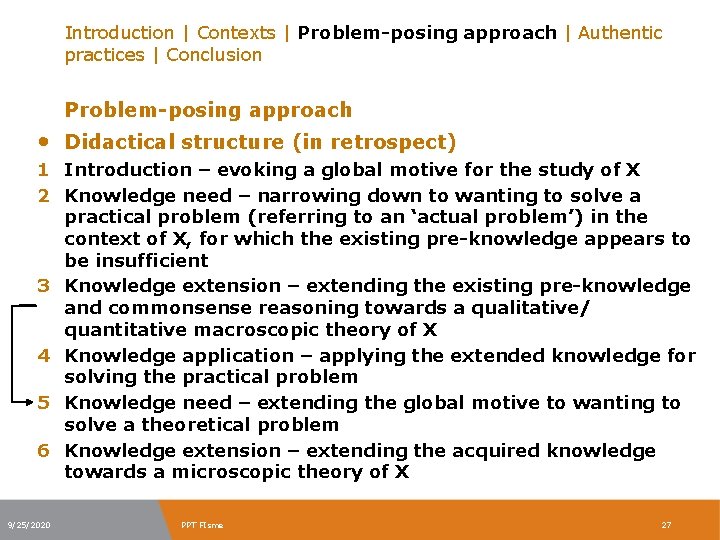
Introduction | Contexts | Problem-posing approach | Authentic practices | Conclusion Problem-posing approach • Didactical structure (in retrospect) 1 Introduction – evoking a global motive for the study of X 2 Knowledge need – narrowing down to wanting to solve a practical problem (referring to an ‘actual problem’) in the context of X, for which the existing pre-knowledge appears to be insufficient 3 Knowledge extension – extending the existing pre-knowledge and commonsense reasoning towards a qualitative/ quantitative macroscopic theory of X 4 Knowledge application – applying the extended knowledge for solving the practical problem 5 Knowledge need – extending the global motive to wanting to solve a theoretical problem 6 Knowledge extension – extending the acquired knowledge towards a microscopic theory of X 9/25/2020 PPT FIsme 27
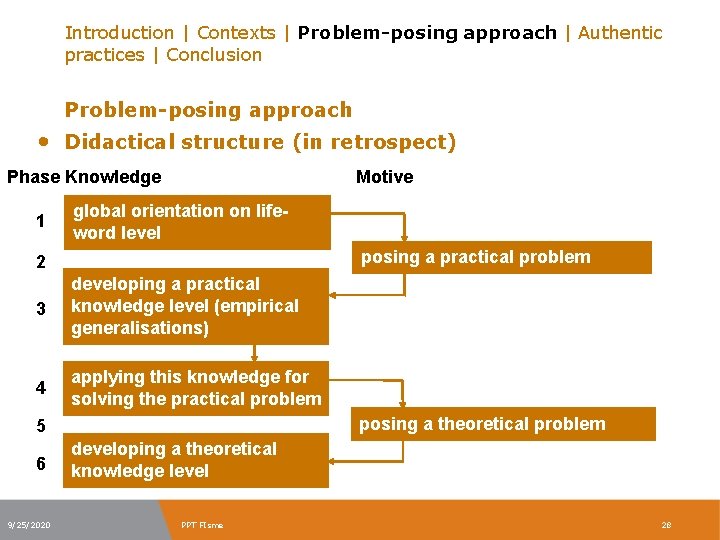
Introduction | Contexts | Problem-posing approach | Authentic practices | Conclusion Problem-posing approach • Didactical structure (in retrospect) Phase Knowledge 1 Motive global orientation on lifeword level posing a practical problem 2 3 developing a practical knowledge level (empirical generalisations) 4 applying this knowledge for solving the practical problem posing a theoretical problem 5 6 9/25/2020 developing a theoretical knowledge level PPT FIsme 28
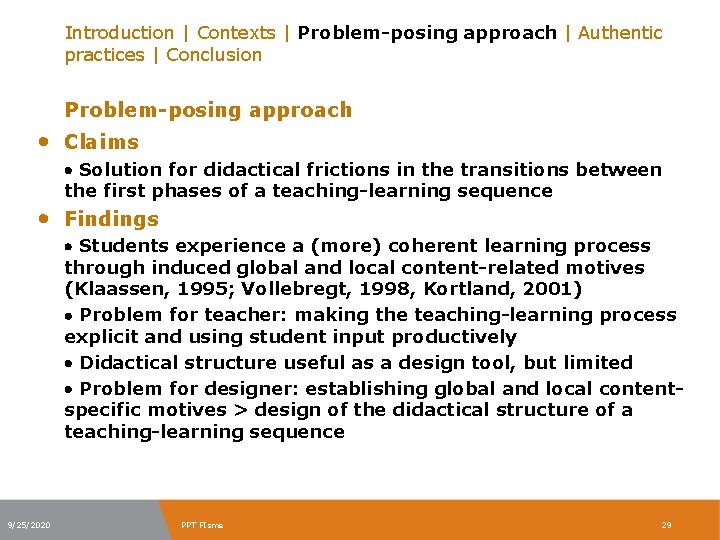
Introduction | Contexts | Problem-posing approach | Authentic practices | Conclusion Problem-posing approach • Claims Solution for didactical frictions in the transitions between the first phases of a teaching-learning sequence • Findings Students experience a (more) coherent learning process through induced global and local content-related motives (Klaassen, 1995; Vollebregt, 1998, Kortland, 2001) Problem for teacher: making the teaching-learning process explicit and using student input productively Didactical structure useful as a design tool, but limited Problem for designer: establishing global and local contentspecific motives > design of the didactical structure of a teaching-learning sequence 9/25/2020 PPT FIsme 29
Introduction | Contexts | Problem-posing approach | Authentic practices | Conclusion Learning in authentic practices 3 9/25/2020 PPT FIsme 30
Introduction | Contexts | Problem-posing approach | Authentic practices | Conclusion Learning in authentic practices • Problem Establishing topic-specific global and local contentrelated motives > design of the didactical structure • Solution Context > authentic practice: group of professionals with shared goal and means < learning theory: culturalhistorical approach (Vygotsky) Goal: solving a practical/theoretical problem > global motive Means: characteristic work procedure with input of functional science knowledge > local motives for knowledge extension Simulation: educationalised authentic practice 9/25/2020 PPT FIsme 31
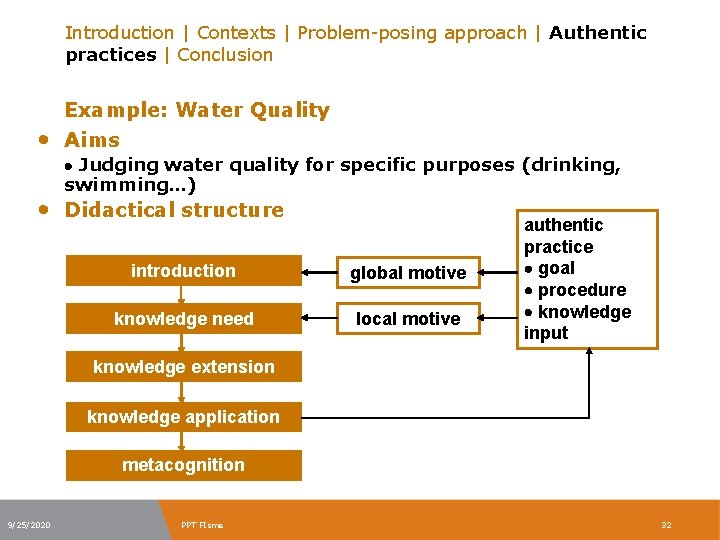
Introduction | Contexts | Problem-posing approach | Authentic practices | Conclusion Example: Water Quality • Aims Judging water quality for specific purposes (drinking, swimming…) • Didactical structure introduction global motive knowledge need local motive authentic practice goal procedure knowledge input knowledge extension knowledge application metacognition 9/25/2020 PPT FIsme 32
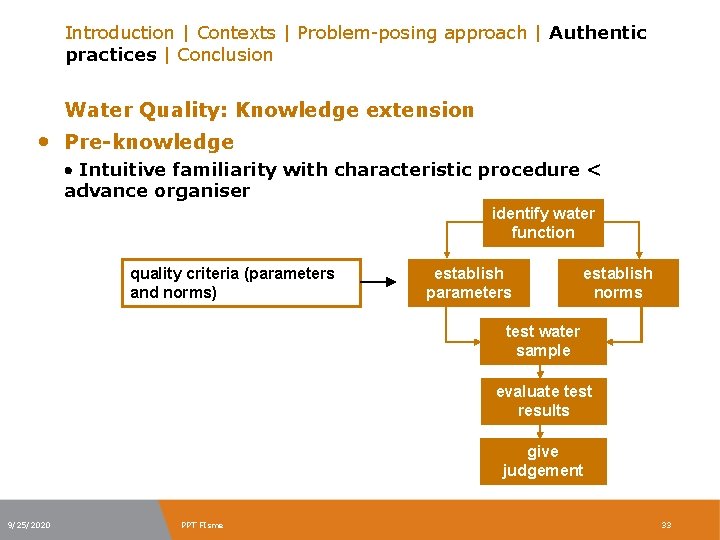
Introduction | Contexts | Problem-posing approach | Authentic practices | Conclusion Water Quality: Knowledge extension • Pre-knowledge Intuitive familiarity with characteristic procedure < advance organiser identify water function quality criteria (parameters and norms) establish parameters establish norms test water sample evaluate test results give judgement 9/25/2020 PPT FIsme 33
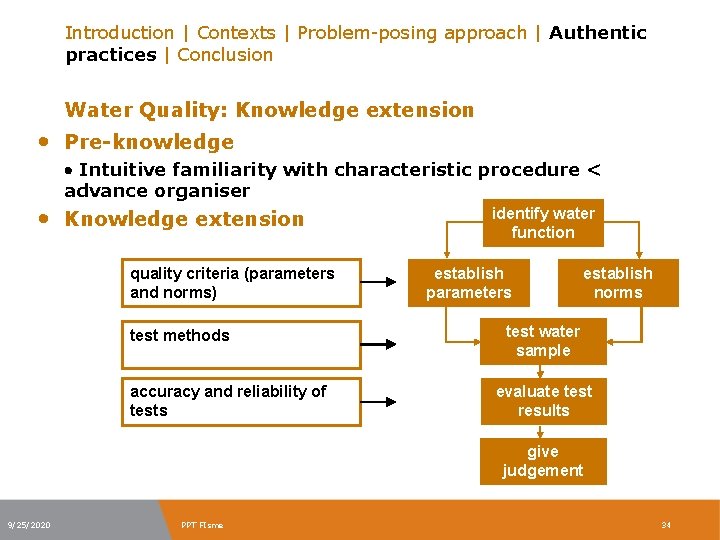
Introduction | Contexts | Problem-posing approach | Authentic practices | Conclusion Water Quality: Knowledge extension • Pre-knowledge Intuitive familiarity with characteristic procedure < advance organiser • Knowledge extension quality criteria (parameters and norms) test methods accuracy and reliability of tests identify water function establish parameters establish norms test water sample evaluate test results give judgement 9/25/2020 PPT FIsme 34
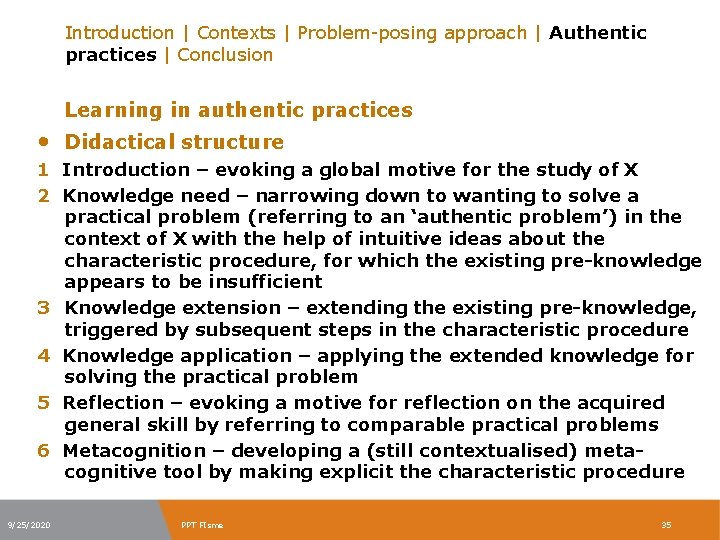
Introduction | Contexts | Problem-posing approach | Authentic practices | Conclusion Learning in authentic practices • Didactical structure 1 Introduction – evoking a global motive for the study of X 2 Knowledge need – narrowing down to wanting to solve a practical problem (referring to an ‘authentic problem’) in the context of X with the help of intuitive ideas about the characteristic procedure, for which the existing pre-knowledge appears to be insufficient 3 Knowledge extension – extending the existing pre-knowledge, triggered by subsequent steps in the characteristic procedure 4 Knowledge application – applying the extended knowledge for solving the practical problem 5 Reflection – evoking a motive for reflection on the acquired general skill by referring to comparable practical problems 6 Metacognition – developing a (still contextualised) metacognitive tool by making explicit the characteristic procedure 9/25/2020 PPT FIsme 35
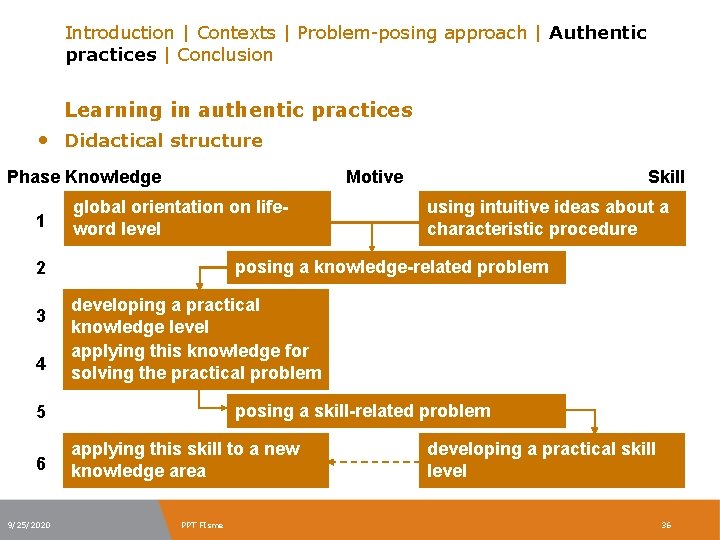
Introduction | Contexts | Problem-posing approach | Authentic practices | Conclusion Learning in authentic practices • Didactical structure Phase Knowledge 1 Motive global orientation on lifeword level 4 developing a practical knowledge level applying this knowledge for solving the practical problem posing a skill-related problem 5 6 9/25/2020 using intuitive ideas about a characteristic procedure posing a knowledge-related problem 2 3 Skill applying this skill to a new knowledge area PPT FIsme developing a practical skill level 36
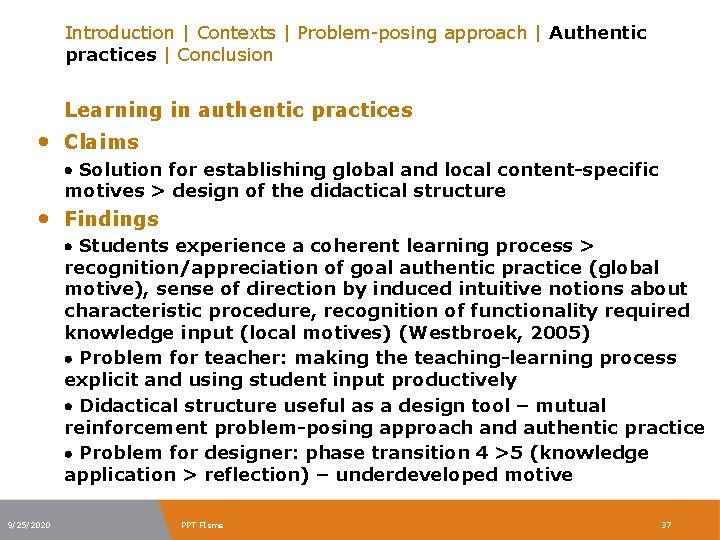
Introduction | Contexts | Problem-posing approach | Authentic practices | Conclusion Learning in authentic practices • Claims Solution for establishing global and local content-specific motives > design of the didactical structure • Findings Students experience a coherent learning process > recognition/appreciation of goal authentic practice (global motive), sense of direction by induced intuitive notions about characteristic procedure, recognition of functionality required knowledge input (local motives) (Westbroek, 2005) Problem for teacher: making the teaching-learning process explicit and using student input productively Didactical structure useful as a design tool – mutual reinforcement problem-posing approach and authentic practice Problem for designer: phase transition 4 >5 (knowledge application > reflection) – underdeveloped motive 9/25/2020 PPT FIsme 37
Introduction | Contexts | Problem-posing approach | Authentic practices | Conclusion Learning in authentic practices • Mutual reinforcement Authentic practice inspires/supports designer in creating a problem-posing teaching-learning process, if students… • Conditions Appreciate the goal of the authentic practice > global motive for ‘wanting to learn something’ Are able to roughly identify/recognise the characteristic procedure on the basis of their intuitive knowledge > advance organiser Know about the required science knowledge in a vague sense, but not in its specific details > local motives for knowledge extension as input into the characteristic procedure Recognise the characteristic procedure as useful for other authentic practices > local motive for developing a metacognitive tool 9/25/2020 PPT FIsme 38
Introduction | Contexts | Problem-posing approach | Authentic practices | Conclusion Learning in authentic practices • Problem One-sided character of (educationalised) authentic practices: professional/vocational – making ‘stuff’ • Solution Life world practices > scientific literacy: decision making on socioscientific issues Scientific practices > scientific literacy: knowledge about nature of scientific knowledge 9/25/2020 PPT FIsme 39
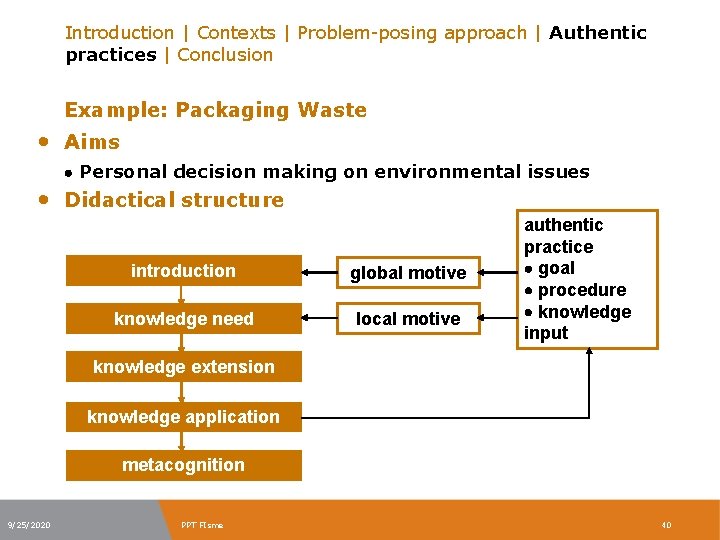
Introduction | Contexts | Problem-posing approach | Authentic practices | Conclusion Example: Packaging Waste • Aims Personal decision making on environmental issues • Didactical structure introduction global motive knowledge need local motive authentic practice goal procedure knowledge input knowledge extension knowledge application metacognition 9/25/2020 PPT FIsme 40
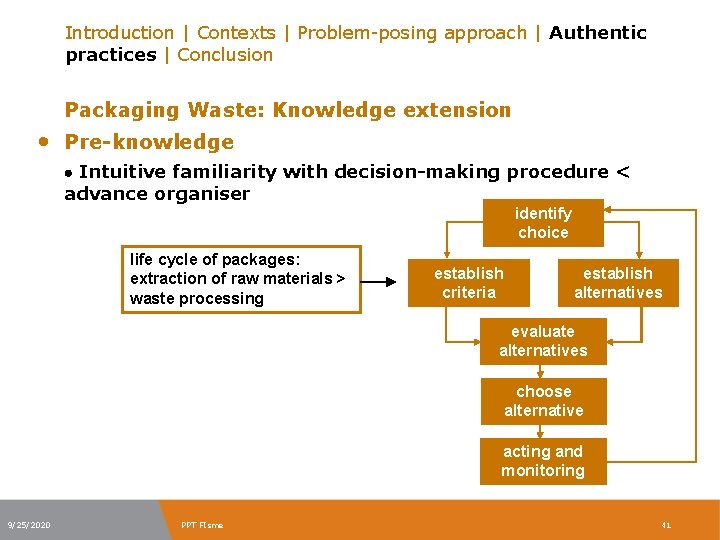
Introduction | Contexts | Problem-posing approach | Authentic practices | Conclusion Packaging Waste: Knowledge extension • Pre-knowledge Intuitive familiarity with decision-making procedure < advance organiser identify choice life cycle of packages: extraction of raw materials > waste processing establish criteria establish alternatives evaluate alternatives choose alternative acting and monitoring 9/25/2020 PPT FIsme 41
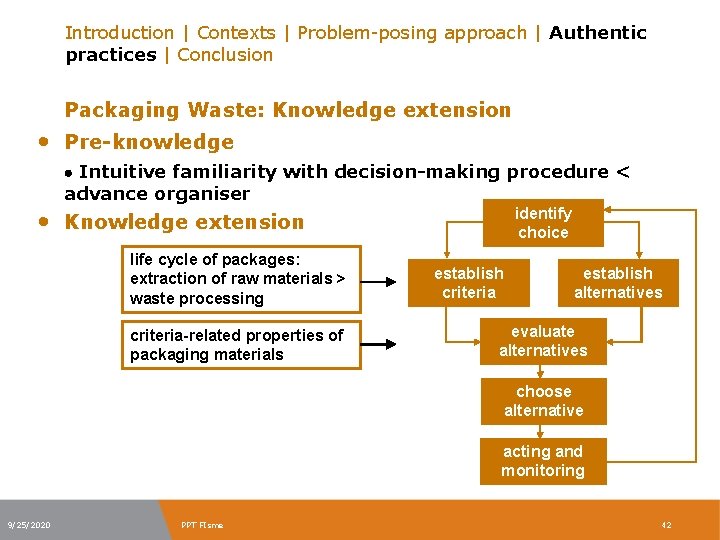
Introduction | Contexts | Problem-posing approach | Authentic practices | Conclusion Packaging Waste: Knowledge extension • Pre-knowledge Intuitive familiarity with decision-making procedure < advance organiser • Knowledge extension life cycle of packages: extraction of raw materials > waste processing criteria-related properties of packaging materials identify choice establish criteria establish alternatives evaluate alternatives choose alternative acting and monitoring 9/25/2020 PPT FIsme 42
Introduction | Contexts | Problem-posing approach | Authentic practices | Conclusion 9/25/2020 PPT FIsme 4 43
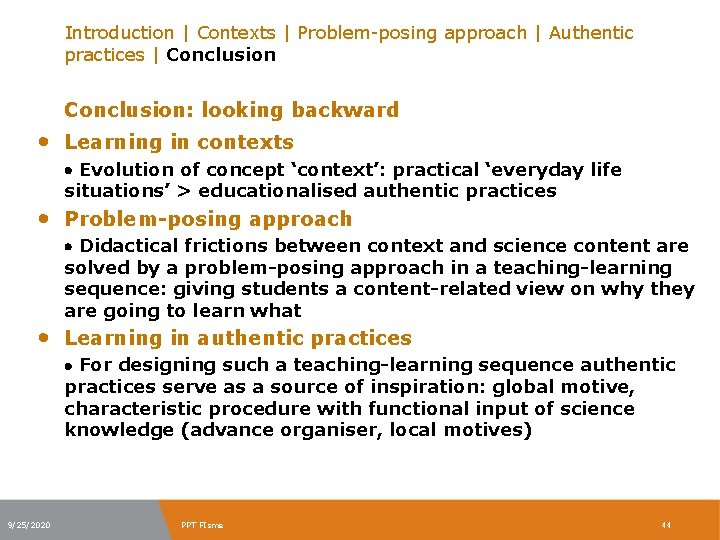
Introduction | Contexts | Problem-posing approach | Authentic practices | Conclusion: looking backward • Learning in contexts Evolution of concept ‘context’: practical ‘everyday life situations’ > educationalised authentic practices • Problem-posing approach Didactical frictions between context and science content are solved by a problem-posing approach in a teaching-learning sequence: giving students a content-related view on why they are going to learn what • Learning in authentic practices For designing such a teaching-learning sequence authentic practices serve as a source of inspiration: global motive, characteristic procedure with functional input of science knowledge (advance organiser, local motives) 9/25/2020 PPT FIsme 44
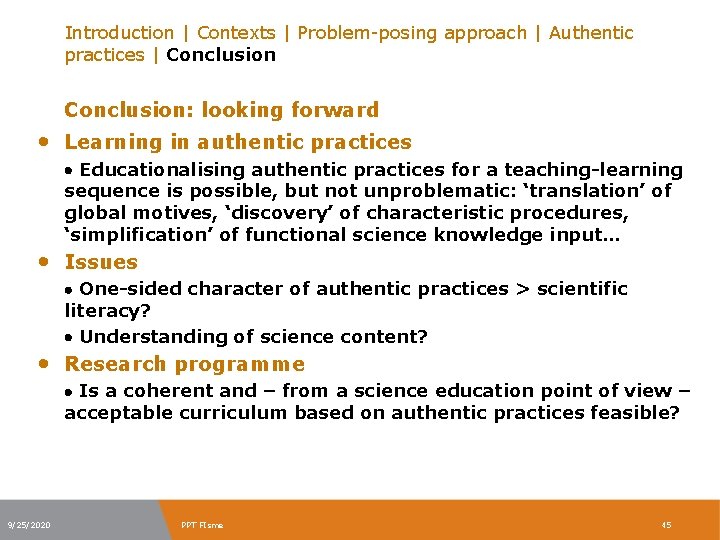
Introduction | Contexts | Problem-posing approach | Authentic practices | Conclusion: looking forward • Learning in authentic practices Educationalising authentic practices for a teaching-learning sequence is possible, but not unproblematic: ‘translation’ of global motives, ‘discovery’ of characteristic procedures, ‘simplification’ of functional science knowledge input… • Issues One-sided character of authentic practices > scientific literacy? Understanding of science content? • Research programme Is a coherent and – from a science education point of view – acceptable curriculum based on authentic practices feasible? 9/25/2020 PPT FIsme 45
Introduction | Contexts | Problem-posing approach | Authentic practices | Conclusion: Scientific literacy • Focus on didactical quality Design tools: problem-posing approach and learning in authentic practices > coherent didactical structure • Pitfalls Wrong global motive: why should we learn this? Wrong sequence: concept > context (context as appendix) or context > concept (no closure) Wrong life-world problem: solvable with commonsense knowledge Wrong science content: non-functional science knowledge Wrong conceptual development: no productive use of preknowledge and no attention for conceptual problems Wrong closure: no metacognitive (decision-making) tools Wrong teaching-learning activities: no active involvement Wrong age group: students over 15 9/25/2020 PPT FIsme 46
Introduction | Contexts | Problem-posing approach | Authentic practices | Conclusion: Scientific literacy • Aims “The capacity to use scientific knowledge, to identity questions and to draw evidence-based conclusions in order to understand help make decisions about the natural world and human interactions with it” (OECD | UNESCO, 2003) Key concepts, skills, issues… as “a key outcome of education by age 15 for all students” • Interpretation Quite ambitious… Focused design research effort… Learning from past experiences… 9/25/2020 PPT FIsme 47
Introduction | Contexts | Problem-posing approach | Authentic practices | Conclusion: Scientific literacy • Socioscientific issue Transport: the ‘zero-emission vehicle’ Learning from the past instead of reinventing the wheel Unit Energie quantitativ: Elektro- oder Benzinauto (IPN, 1977 > 2010) Update context and didactical structure 9/25/2020 PPT FIsme 48
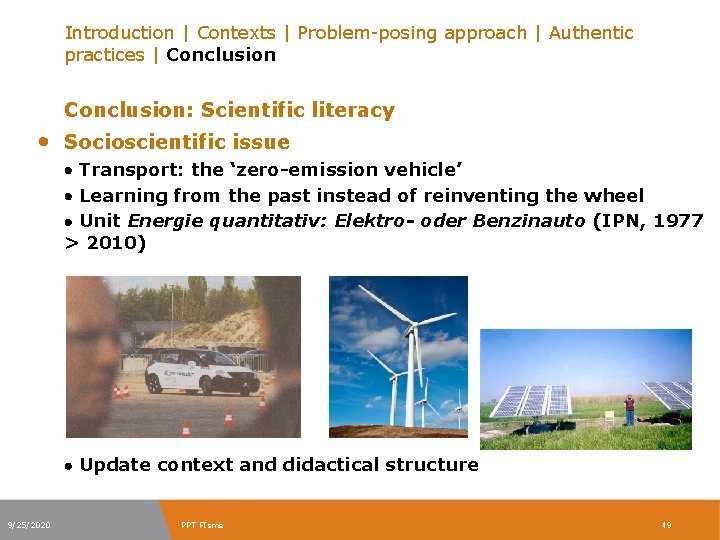
Introduction | Contexts | Problem-posing approach | Authentic practices | Conclusion: Scientific literacy • Socioscientific issue Transport: the ‘zero-emission vehicle’ Learning from the past instead of reinventing the wheel Unit Energie quantitativ: Elektro- oder Benzinauto (IPN, 1977 > 2010) Update context and didactical structure 9/25/2020 PPT FIsme 49
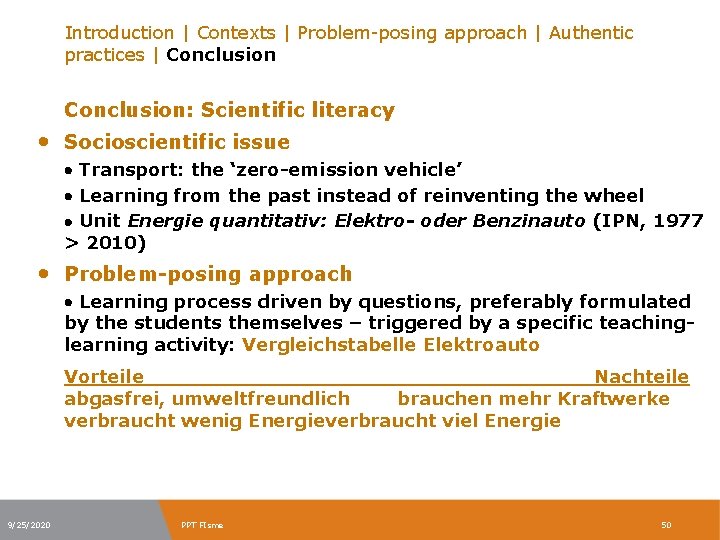
Introduction | Contexts | Problem-posing approach | Authentic practices | Conclusion: Scientific literacy • Socioscientific issue Transport: the ‘zero-emission vehicle’ Learning from the past instead of reinventing the wheel Unit Energie quantitativ: Elektro- oder Benzinauto (IPN, 1977 > 2010) • Problem-posing approach Learning process driven by questions, preferably formulated by the students themselves – triggered by a specific teachinglearning activity: Vergleichstabelle Elektroauto Vorteile Nachteile abgasfrei, umweltfreundlich brauchen mehr Kraftwerke verbraucht wenig Energieverbraucht viel Energie 9/25/2020 PPT FIsme 50
Introduction | Contexts | Problem-posing approach | Authentic practices | Conclusion Acknowledgements Harrie Eijkelhof Piet Lijnse Kees Klaassen Hanna Westbroek Astrid Bulte Helmut Mikelskis and many others… 9/25/2020 PPT FIsme 51
- Slides: 51