
GCSE Support Event JCQ and Grading Regulations for






- Slides: 21
GCSE Support Event JCQ and Grading
Regulations for Controlled Assessment • Please be familiar with guidelines • JCQ Key documents • Instructions for teachers on the conduct of controlled assessments • Malpractice • Access arrangements
Other important issues • • • Guidance on feedback to candidates Secure storage of work How candidates can access mark bands Random Sampling Teacher authentication
JCQ Key documents • https: //www. jcq. org. uk/examsoffice/coursework/instructions-for-conductingcoursework-2018 -2019 • https: //www. jcq. org. uk/exams-office/nonexamination-assessments/instructions-forconducting-non-examination-assessments • https: //www. jcq. org. uk/examsoffice/information-for-candidatesdocuments/infor
JCQ Key documents (continued) • https: //www. jcq. org. uk/exams- office/malpractice/suspected-malpracticein-examinations-and-assessments-201718 • https: //www. jcq. org. uk/exams-office/nonexamination-assessment
Instructions to teachers • Teachers must ensure that they use the correct task for the year of submission. Supervision – • Centres must ensure that candidates comply with the regulations for controlled assessments – https: //www. jcq. org. uk/exams-office/informationfor-candidates-documents/infor
Secure storage • Please ensure secure storage of candidates’ work
Malpractice awareness Malpractice can take place at two levels: • Centre staff • Candidates Examples • Pre-release (must not conducted as a mock examination) • Breach of security • Deception • Improper assistance to candidates • Failure to co-operate with an investigation • Maladministration
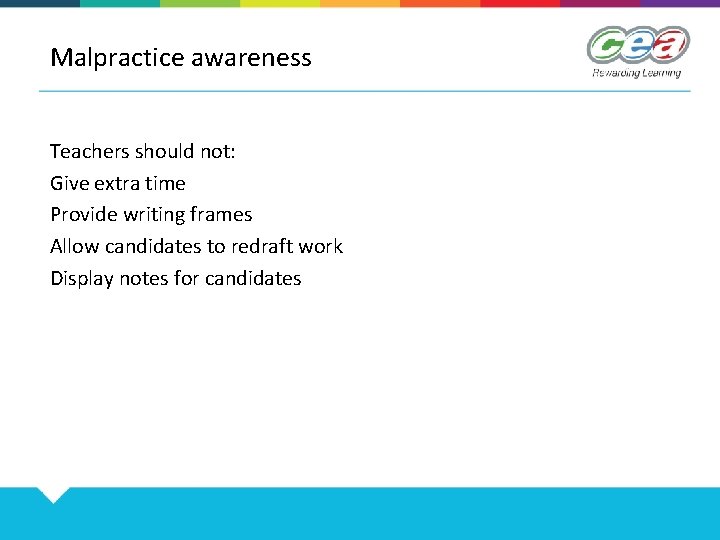
Malpractice awareness Teachers should not: Give extra time Provide writing frames Allow candidates to redraft work Display notes for candidates
Uniform Marks Scale Please refer to our website for explanation of Raw to Uniform mark conversions for unitised qualifications. • This document explains how raw marks are converted to uniform marks for unitised qualifications. • Use this link to access the document on our website. • http: //ccea. org. uk/qualifications/adminhelp/resul ts_information/uniform_marks_scale
Awarding Grades in CCEA Revised GCSE Qualifications – First Teaching September 2017 Kevin Henderson Technical Manager
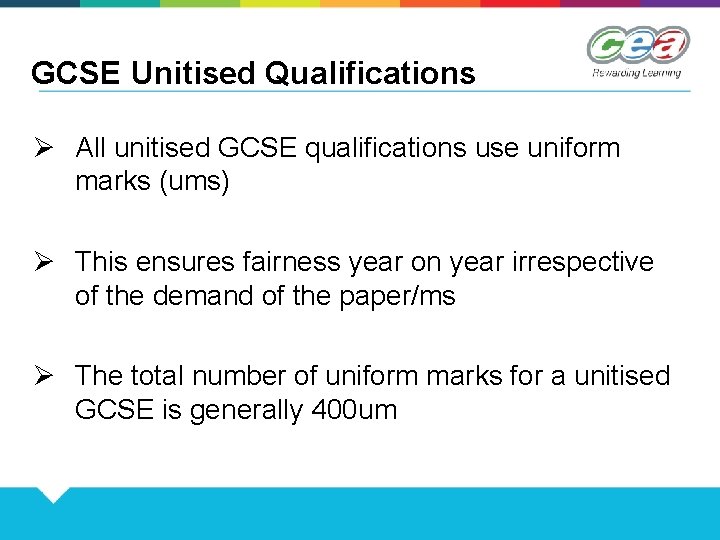
GCSE Unitised Qualifications Ø All unitised GCSE qualifications use uniform marks (ums) Ø This ensures fairness year on year irrespective of the demand of the paper/ms Ø The total number of uniform marks for a unitised GCSE is generally 400 um
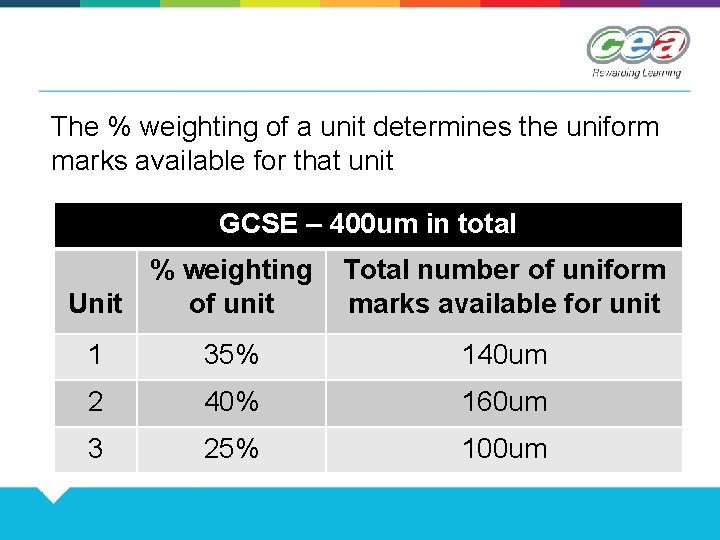
The % weighting of a unit determines the uniform marks available for that unit GCSE – 400 um in total % weighting Unit of unit Total number of uniform marks available for unit 1 35% 140 um 2 40% 160 um 3 25% 100 um
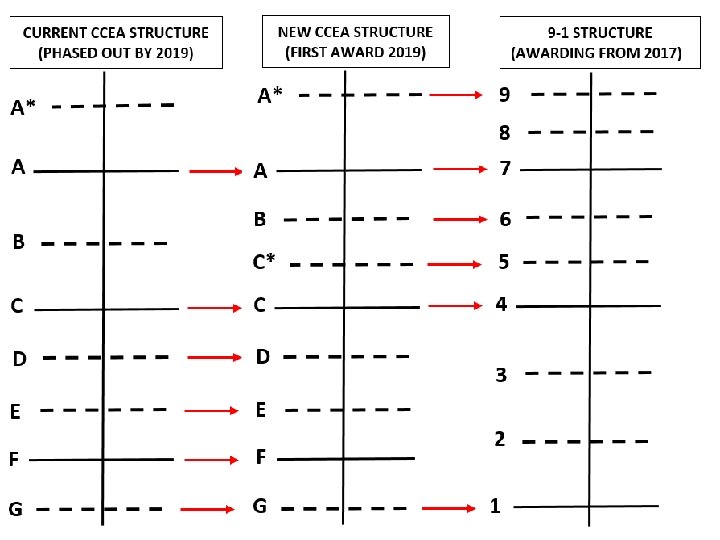
Revised GCSEs – New Grades
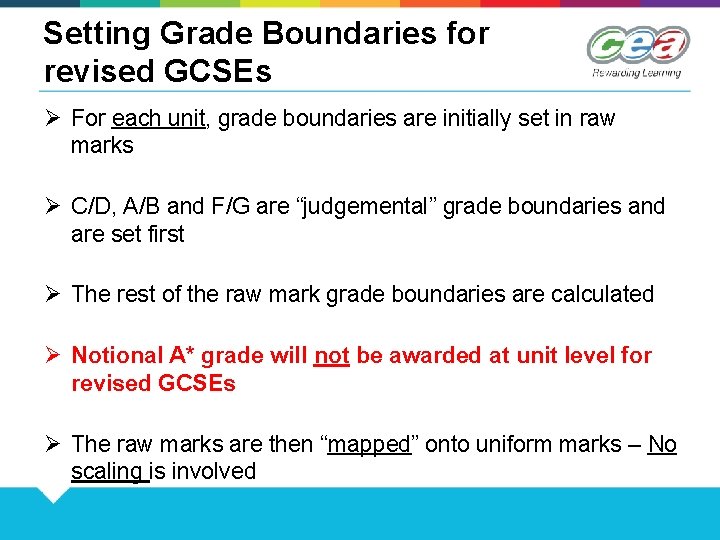
Setting Grade Boundaries for revised GCSEs Ø For each unit, grade boundaries are initially set in raw marks Ø C/D, A/B and F/G are “judgemental” grade boundaries and are set first Ø The rest of the raw mark grade boundaries are calculated Ø Notional A* grade will not be awarded at unit level for revised GCSEs Ø The raw marks are then “mapped” onto uniform marks – No scaling is involved
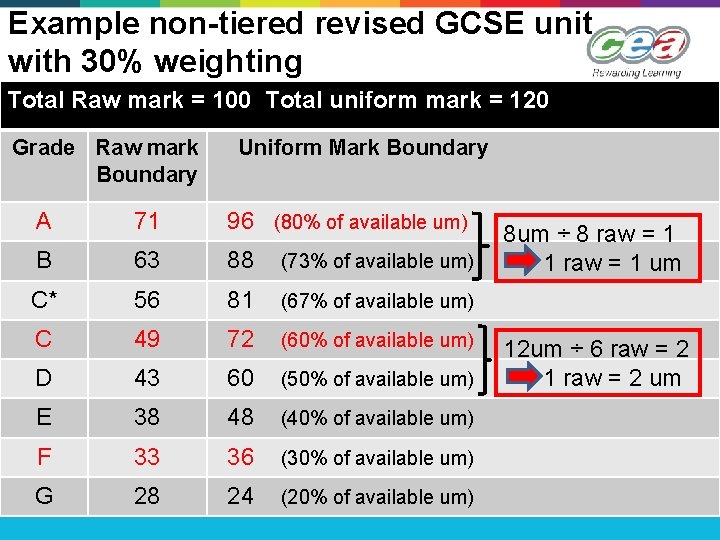
Example non-tiered revised GCSE unit with 30% weighting Total Raw mark = 100 Total uniform mark = 120 Grade Raw mark Boundary Uniform Mark Boundary A 71 96 (80% of available um) B 63 88 (73% of available um) C* 56 81 (67% of available um) C 49 72 (60% of available um) D 43 60 (50% of available um) E 38 48 (40% of available um) F 33 36 (30% of available um) G 28 24 (20% of available um) 8 um ÷ 8 raw = 1 1 raw = 1 um 12 um ÷ 6 raw = 2 1 raw = 2 um
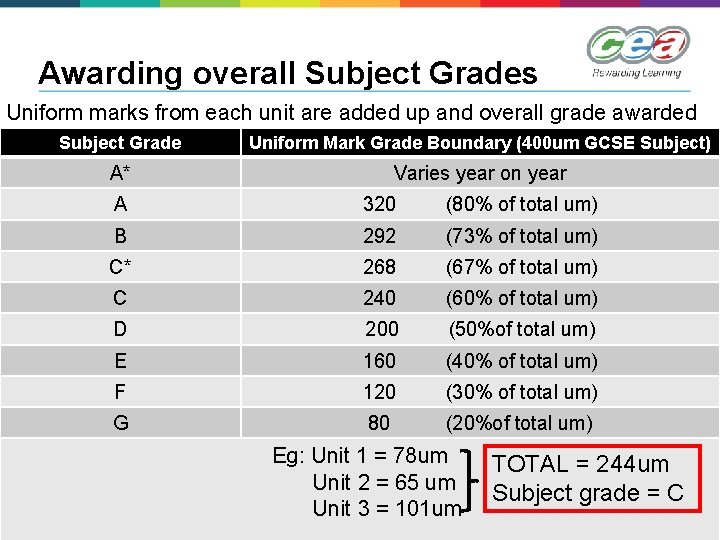
Awarding overall Subject Grades Uniform marks from each unit are added up and overall grade awarded Subject Grade Uniform Mark Grade Boundary (400 um GCSE Subject) A* Varies year on year A 320 (80% of total um) B 292 (73% of total um) C* 268 (67% of total um) C 240 (60% of total um) D 200 (50%of total um) E 160 (40% of total um) F 120 (30% of total um) G 80 (20%of total um) Eg: Unit 1 = 78 um Unit 2 = 65 um Unit 3 = 101 um TOTAL = 244 um Subject grade = C
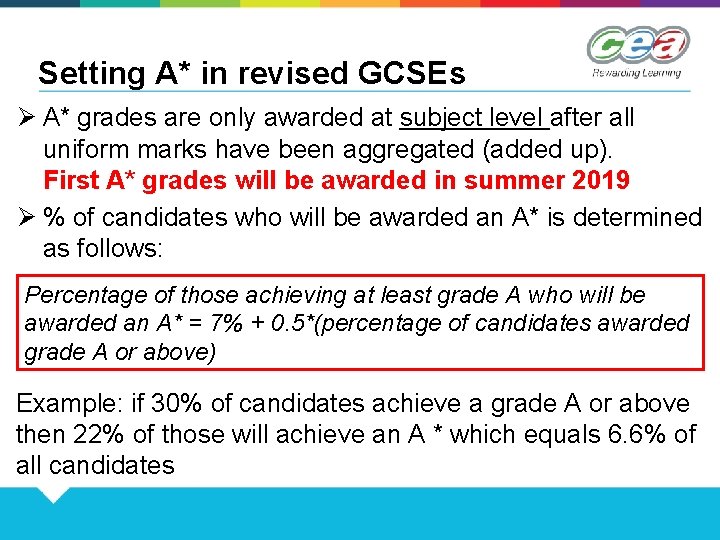
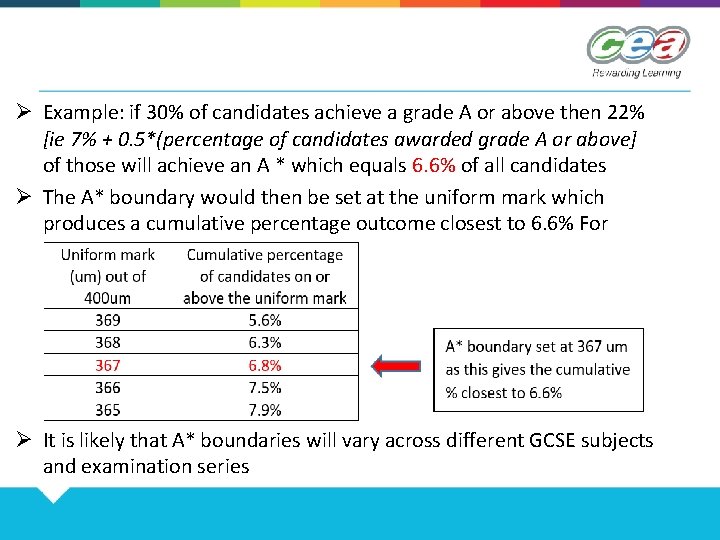
Setting A* in revised GCSEs Ø A* grades are only awarded at subject level after all uniform marks have been aggregated (added up). First A* grades will be awarded in summer 2019 Ø % of candidates who will be awarded an A* is determined as follows: Percentage of those achieving at least grade A who will be awarded an A* = 7% + 0. 5*(percentage of candidates awarded grade A or above) Example: if 30% of candidates achieve a grade A or above then 22% of those will achieve an A * which equals 6. 6% of all candidates
Ø Example: if 30% of candidates achieve a grade A or above then 22% [ie 7% + 0. 5*(percentage of candidates awarded grade A or above] of those will achieve an A * which equals 6. 6% of all candidates Ø The A* boundary would then be set at the uniform mark which produces a cumulative percentage outcome closest to 6. 6% For example: Ø It is likely that A* boundaries will vary across different GCSE subjects and examination series
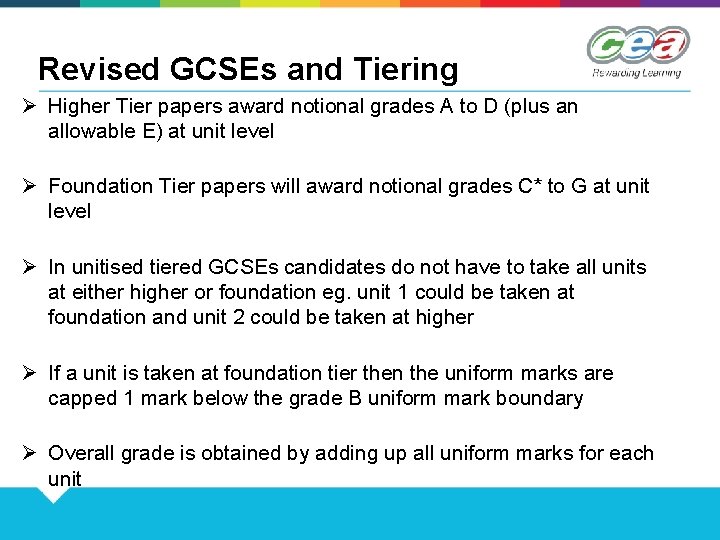
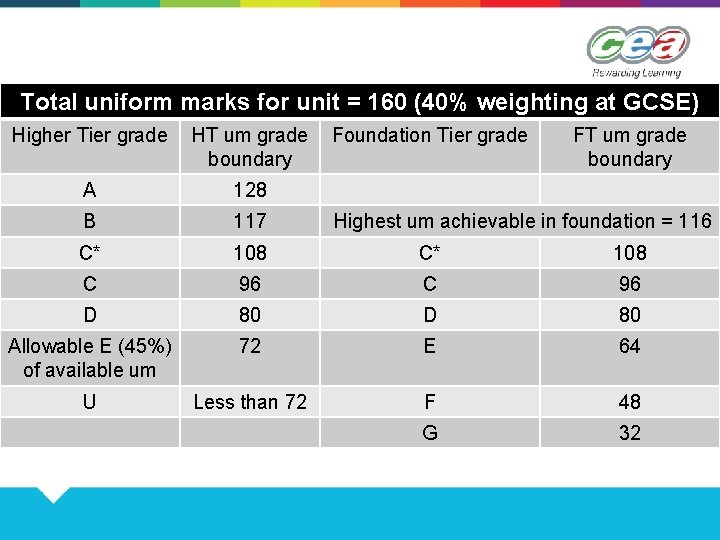
Revised GCSEs and Tiering Ø Higher Tier papers award notional grades A to D (plus an allowable E) at unit level Ø Foundation Tier papers will award notional grades C* to G at unit level Ø In unitised tiered GCSEs candidates do not have to take all units at either higher or foundation eg. unit 1 could be taken at foundation and unit 2 could be taken at higher Ø If a unit is taken at foundation tier then the uniform marks are capped 1 mark below the grade B uniform mark boundary Ø Overall grade is obtained by adding up all uniform marks for each unit
Total uniform marks for unit = 160 (40% weighting at GCSE) Higher Tier grade HT um grade boundary Foundation Tier grade FT um grade boundary A 128 B 117 C* 108 C 96 D 80 Allowable E (45%) of available um 72 E 64 U Less than 72 F 48 G 32 Highest um achievable in foundation = 116