
GCSE Statistics Scatter Graphs Spearmans Rank correlation coefficient
- Slides: 8
GCSE Statistics Scatter Graphs Spearman’s Rank correlation coefficient
January 2022 Learning Objectives • Calculate Spearman’s Rank Correlation Coefficient • Use Spearman’s rank correlation coefficient as a measure of agreement or for comparisons of the degree of correlation • Interpret correlation as a measure of the strength of the association between two variables, including Spearman’s rank correlation coefficient for ranked data
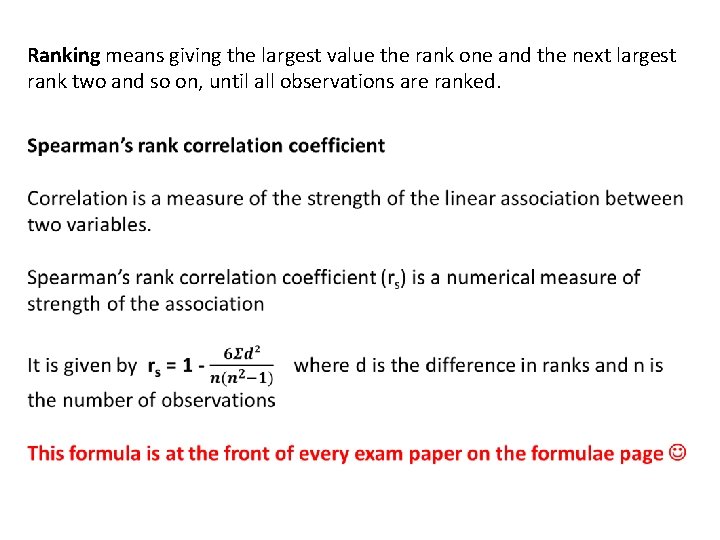
Ranking means giving the largest value the rank one and the next largest rank two and so on, until all observations are ranked.
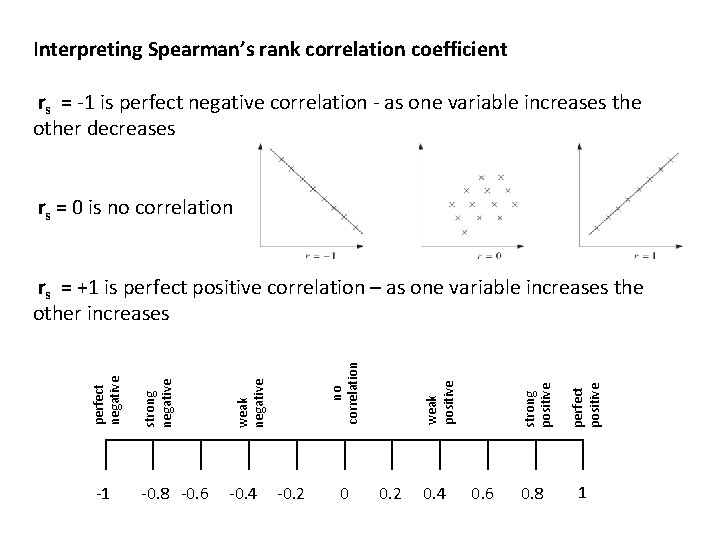
Interpreting Spearman’s rank correlation coefficient rs = -1 is perfect negative correlation - as one variable increases the other decreases rs = 0 is no correlation -1 -0. 8 -0. 6 -0. 4 -0. 2 0. 4 0. 6 0. 8 perfect positive strong positive weak positive no correlation weak negative strong negative perfect negative rs = +1 is perfect positive correlation – as one variable increases the other increases 1
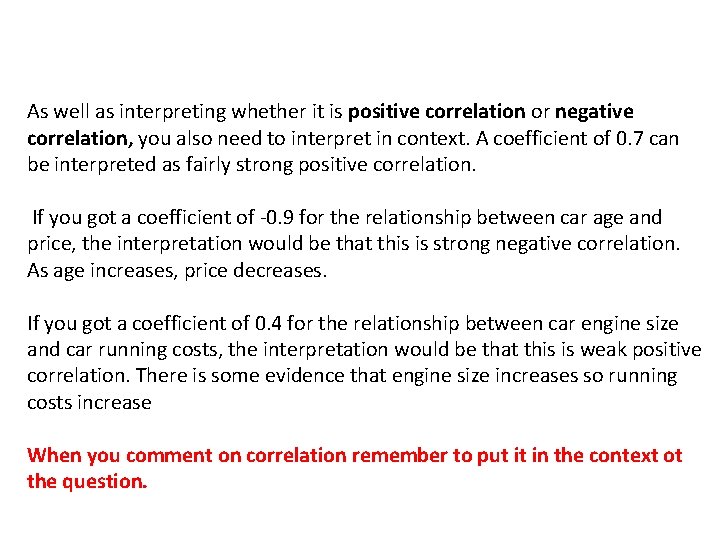
As well as interpreting whether it is positive correlation or negative correlation, you also need to interpret in context. A coefficient of 0. 7 can be interpreted as fairly strong positive correlation. If you got a coefficient of -0. 9 for the relationship between car age and price, the interpretation would be that this is strong negative correlation. As age increases, price decreases. If you got a coefficient of 0. 4 for the relationship between car engine size and car running costs, the interpretation would be that this is weak positive correlation. There is some evidence that engine size increases so running costs increase When you comment on correlation remember to put it in the context ot the question.
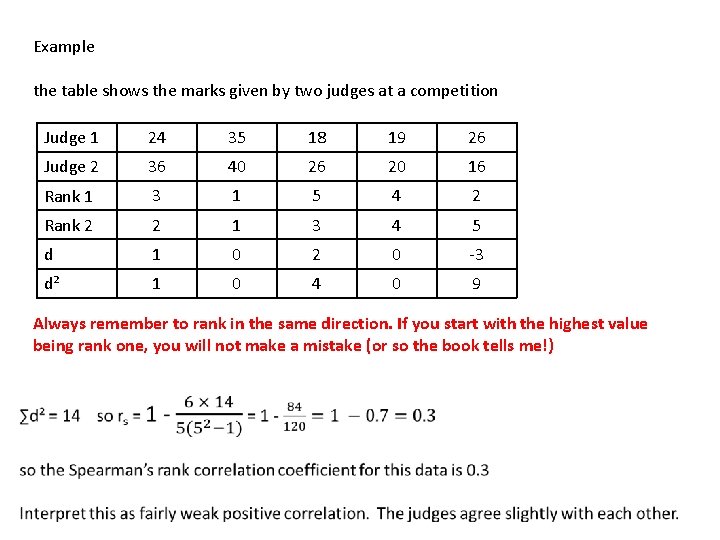
Example the table shows the marks given by two judges at a competition Judge 1 24 35 18 19 26 Judge 2 36 40 26 20 16 Rank 1 3 1 5 4 2 Rank 2 2 1 3 4 5 d 1 0 2 0 -3 d² 1 0 4 0 9 Always remember to rank in the same direction. If you start with the highest value being rank one, you will not make a mistake (or so the book tells me!)
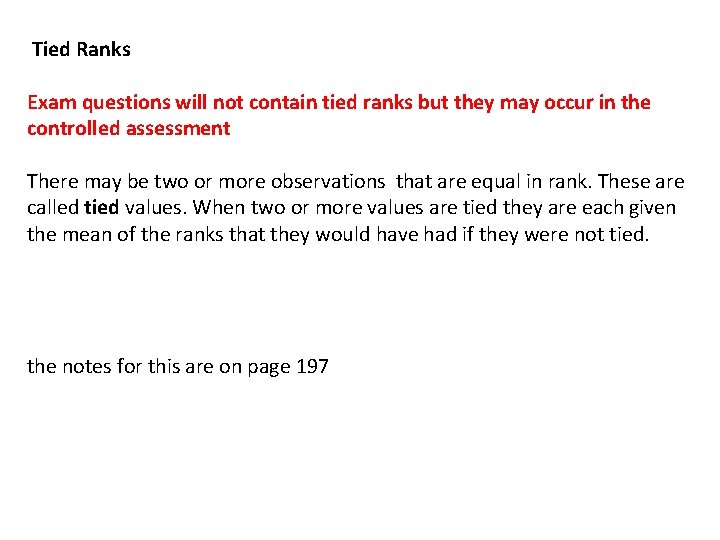
Tied Ranks Exam questions will not contain tied ranks but they may occur in the controlled assessment There may be two or more observations that are equal in rank. These are called tied values. When two or more values are tied they are each given the mean of the ranks that they would have had if they were not tied. the notes for this are on page 197
Your turn exercise 5 H page 198 exercise 5 I page 201 draw tables to show the ranking and subsequent calculations to obtain full marks