
GCSE SPORTS PSYCHOLOG Y ANALYSIS Pulse raiser What







- Slides: 12
GCSE SPORTS PSYCHOLOG Y ANALYSIS
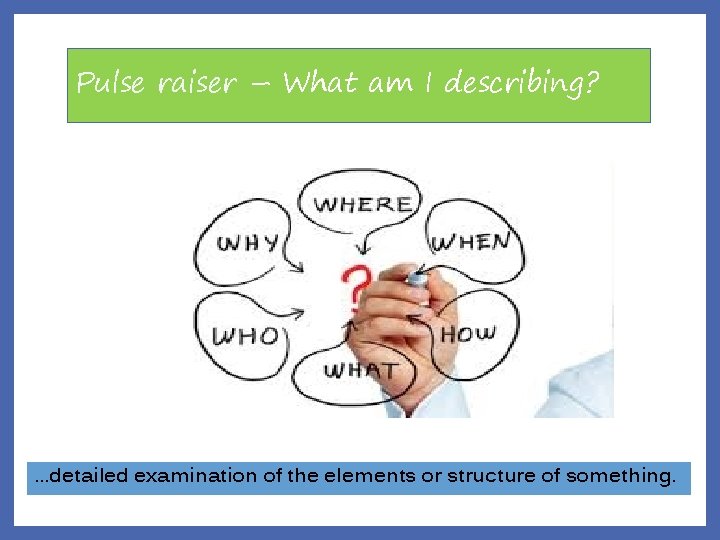
Pulse raiser – What am I describing? …detailed examination of the elements or structure of something.
Analysing Sports Psychology ü Memory TASK 4 Thinking ladder! Analysing AO 3 • Compare and contrast performance and outcome goals. Write a comparison paragraph.
COMPARE … • Performance goals are personal standards to be achieved. The performer compares their performance against what they have already done or suggests what they are going to do. There is no comparison with other performers. For example, a 100 m runner may aim to achieve a personal best in a race. In contrast outcome goals focus on the end result. They usually involve comparison with other competitors. The performance standard may not be that important. It is the outcome that matters. For example, a 100 m runner may wish to win the race. It is possible to combine performance and outcome goals by setting yourself the goal of beating your personal best and winning a race. However, it is generally accepted that beginners/less ability performers may be better avoiding outcome goals as they depend on other factors (other competitors) that we cannot control and failing to achieve them may be demotivating. On the other hand, elite performers tend to be more driven towards winning and therefore outcome goals may increase their desire to succeed. Elite athletes would still use performance goals to help motivate and achieve their goals.
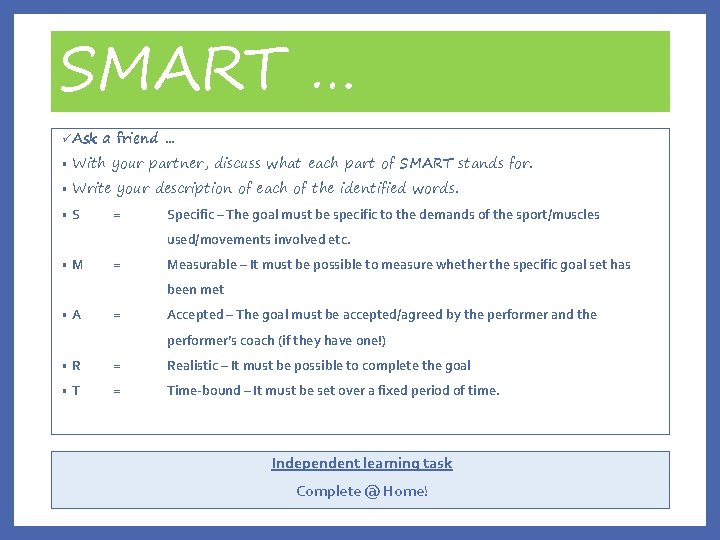
SMART … ü Ask a friend … • With your partner, discuss what each part of SMART stands for. • Write your description of each of the identified words. • S = Specific – The goal must be specific to the demands of the sport/muscles used/movements involved etc. • M = Measurable – It must be possible to measure whether the specific goal set has been met • A = Accepted – The goal must be accepted/agreed by the performer and the performer’s coach (if they have one!) • R = Realistic – It must be possible to complete the goal • T = Time-bound – It must be set over a fixed period of time. Independent learning task Complete @ Home!
TESTING– 20% of your time! • Session 4 onwards • As you approach your exam date you should be spending more and more time on the testing phase • Entry level testing: • Exit level testing: • AO 1 (Knowledge and understanding) • AO 2 (Application) • Easy, quick quizzes which test aspects of knowledge. • AO 3 (Analysis &Evaluation) • Longer exam questions including 6 and 9 mark questions. • These should be completed within 4872 hours of revising a topic and then repeated regularly to keep your memory fresh! • • Simple facts, key terms and definitions. Complete entry level testing within 24 hours of revising a topic to anchor learning in your memory. DO THIS IN SILENCE TIMED WITH NO EXTERNAL SUPPORT!
DNA …… SELF SOLVE! • Do you k. Now it • All …? Answer the EXAM questions (25 minutes allowed)
IDEEAL • Identify • Define & describe • Explain how it relates to the question • Evaluate • Argue • Link to the question
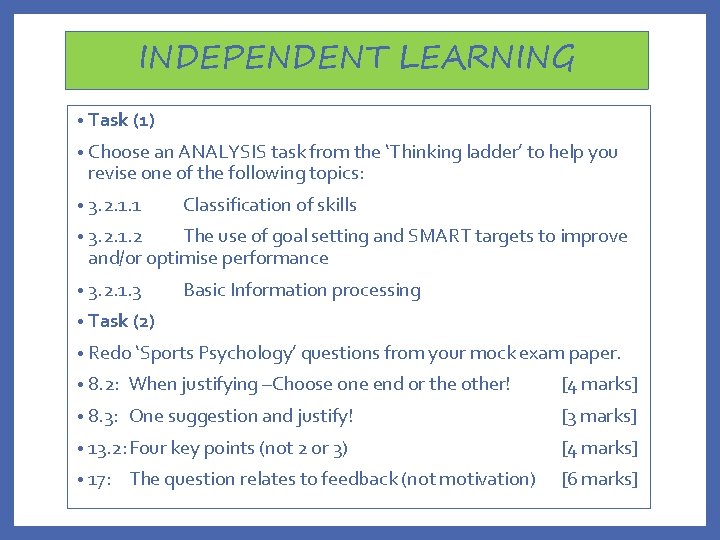
INDEPENDENT LEARNING • Task (1) • Choose an ANALYSIS task from the ‘Thinking ladder’ to help you revise one of the following topics: • 3. 2. 1. 1 Classification of skills • 3. 2. 1. 2 The use of goal setting and SMART targets to improve and/or optimise performance • 3. 2. 1. 3 Basic Information processing • Task (2) • Redo ‘Sports Psychology’ questions from your mock exam paper. • 8. 2: When justifying –Choose one end or the other! [4 marks] • 8. 3: One suggestion and justify! [3 marks] • 13. 2: Four key points (not 2 or 3) [4 marks] • 17: [6 marks] The question relates to feedback (not motivation)
Memory TASK 4 Thinking ladder! Analysing AO 3
DNA … REVIEW! • Refer to your marks sheme. • Tip: • Concentric = against gravity/upwards • Eccentric – with gravity/downwards