
GCSE Science Marking and improving student outcomes in

- Slides: 26
GCSE Science: Marking and improving student outcomes in AO 2 -focussed questions Jane Bryant Spring 2019
Welcome 2 Copyright © AQA and its licensors. All rights reserved.
This meeting will be recorded Exam boards have an Ofqual requirement to record event audio. Recordings are kept for the lifetime of the specification and not shared as an accompaniment to session resources. The recording will begin now. 3 Copyright © AQA and its licensors. All rights reserved.
Outline for the session • • • 4 Mark schemes and how we apply them AO 2 -focused questions in GCSE sciences Exercise using student work Using exam questions to improve student performance Assessing AO 2 at different levels of demand Copyright © AQA and its licensors. All rights reserved.
Mark schemes and how we apply them • • 5 What is the mark scheme for? Our GCSE Science mark schemes Points-based mark schemes Levels of response mark schemes Copyright © AQA and its licensors. All rights reserved.
What is the mark scheme for? • To evaluate the evidence from each student fairly • To reward positive achievement • To differentiate purely on evidence of subject knowledge, understanding and skills • To fully and consistently reflect the agreed interpretation of command words • To fully reflect the purpose of each assessment • To credit appropriate responses that reflect the different ways in which learners may demonstrate what they know, understand can do 6 Copyright © AQA and its licensors. All rights reserved.
Our GCSE Science mark schemes • The ‘Information to examiners’ section: • general guidance on the parts of the mark scheme • explicit guidance on what parts of the mark scheme mean and how they should be applied • marking levels of response questions • exactly the same for all GCSE Sciences. • Detailed mark scheme for each question: • specific guidance on what is/is not acceptable • points or levels of response marked. 7 Copyright © AQA and its licensors. All rights reserved.
Points-based mark schemes • Marks given for each correct point a student gives • Explicitly define correct (and incorrect) answers • Emphasis is on the correctness of the response, not the quality • Usually used for lower-tariff questions (<10 marks) • If well-written are very reliable 8 Copyright © AQA and its licensors. All rights reserved.
Levels of response mark schemes • Used for open questions where there a variety of ways for students to arrive at a mark • Reward the overall quality of the answer • Divide performance into chunks of marks (levels) on a continuum • Describe the performance at each level • Generic level descriptors linked to specific command words • Same descriptors apply to all GCSE sciences • Section of indicative content specific to each question 9 Copyright © AQA and its licensors. All rights reserved.
AO 2 -focused questions in GCSE sciences • • 10 What is AO 2? Regulatory requirements How do we assess AO 2? Common issues with AO 2 questions in Summer 2018 Copyright © AQA and its licensors. All rights reserved.
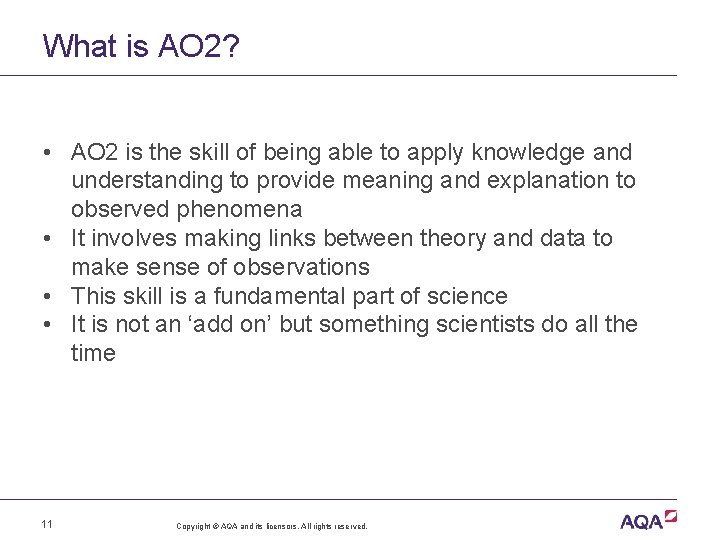
What is AO 2? • AO 2 is the skill of being able to apply knowledge and understanding to provide meaning and explanation to observed phenomena • It involves making links between theory and data to make sense of observations • This skill is a fundamental part of science • It is not an ‘add on’ but something scientists do all the time 11 Copyright © AQA and its licensors. All rights reserved.
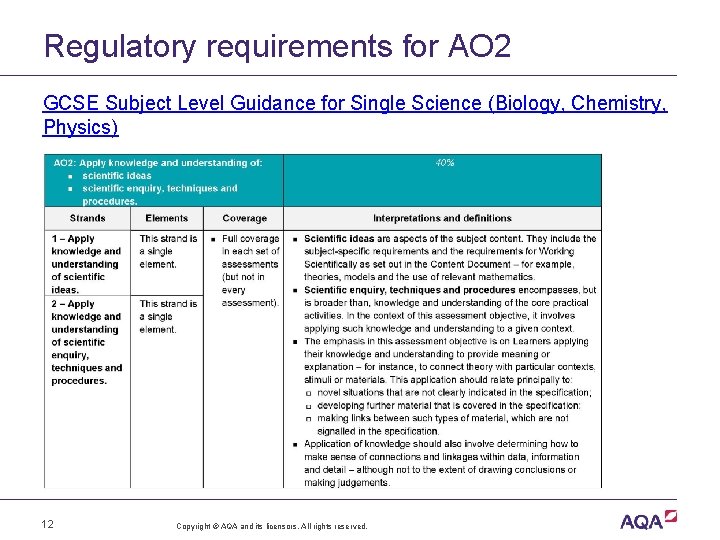
Regulatory requirements for AO 2 GCSE Subject Level Guidance for Single Science (Biology, Chemistry, Physics) 12 Copyright © AQA and its licensors. All rights reserved.
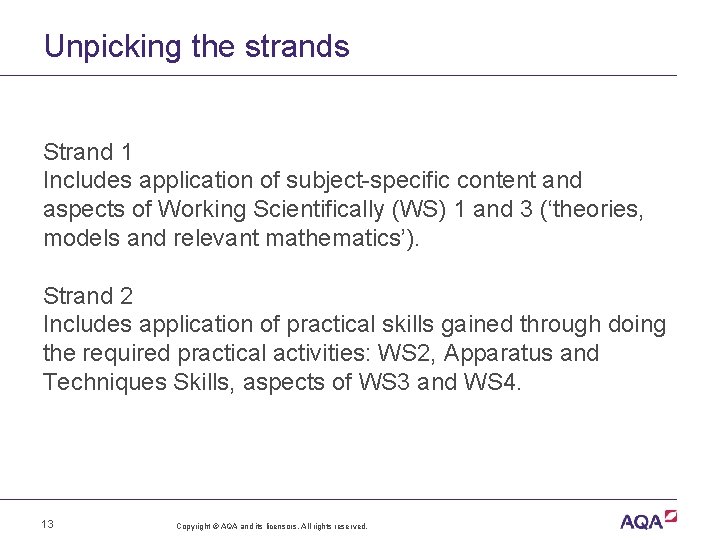
Unpicking the strands Strand 1 Includes application of subject-specific content and aspects of Working Scientifically (WS) 1 and 3 (‘theories, models and relevant mathematics’). Strand 2 Includes application of practical skills gained through doing the required practical activities: WS 2, Apparatus and Techniques Skills, aspects of WS 3 and WS 4. 13 Copyright © AQA and its licensors. All rights reserved.
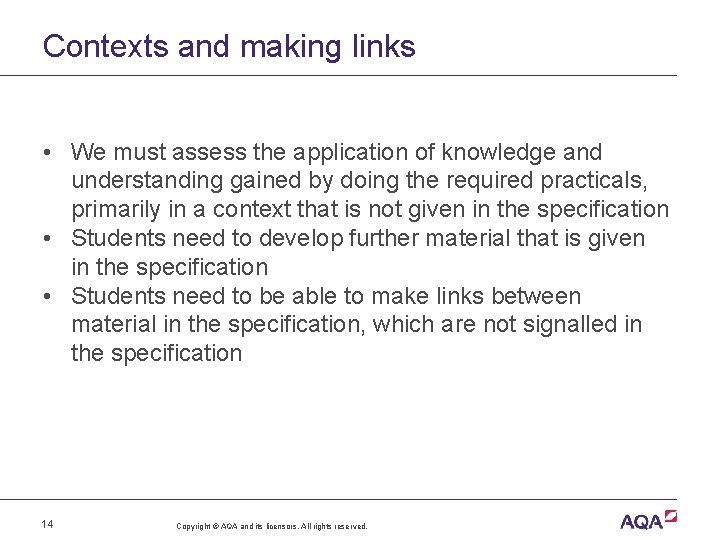
Contexts and making links • We must assess the application of knowledge and understanding gained by doing the required practicals, primarily in a context that is not given in the specification • Students need to develop further material that is given in the specification • Students need to be able to make links between material in the specification, which are not signalled in the specification 14 Copyright © AQA and its licensors. All rights reserved.
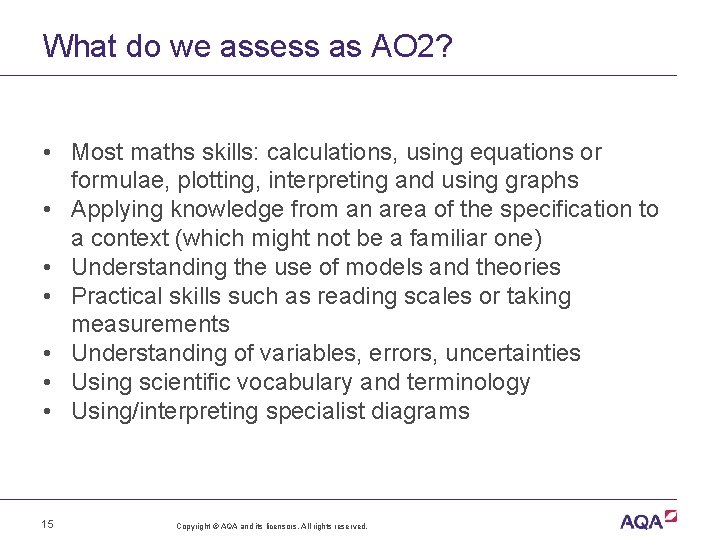
What do we assess as AO 2? • Most maths skills: calculations, using equations or formulae, plotting, interpreting and using graphs • Applying knowledge from an area of the specification to a context (which might not be a familiar one) • Understanding the use of models and theories • Practical skills such as reading scales or taking measurements • Understanding of variables, errors, uncertainties • Using scientific vocabulary and terminology • Using/interpreting specialist diagrams 15 Copyright © AQA and its licensors. All rights reserved.
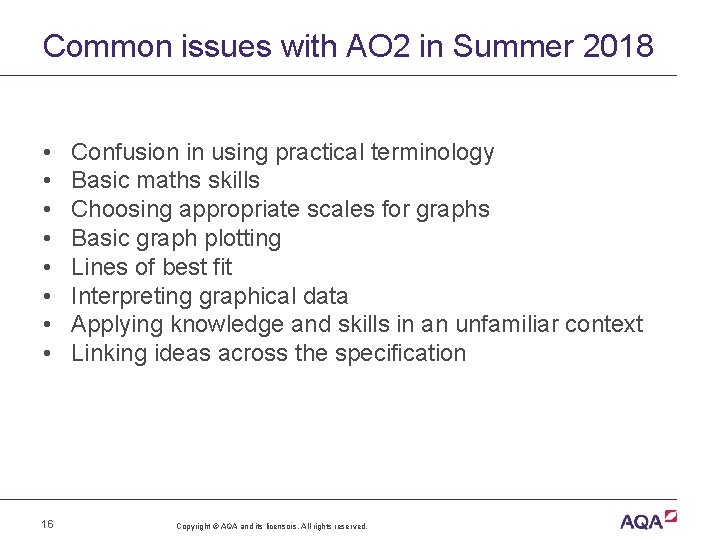
Common issues with AO 2 in Summer 2018 • • 16 Confusion in using practical terminology Basic maths skills Choosing appropriate scales for graphs Basic graph plotting Lines of best fit Interpreting graphical data Applying knowledge and skills in an unfamiliar context Linking ideas across the specification Copyright © AQA and its licensors. All rights reserved.
Using AO 2 questions to improve performance • Marking student responses • Using exam questions to improve student performance • Adapting AO 2 questions for different levels of demand 17 Copyright © AQA and its licensors. All rights reserved.
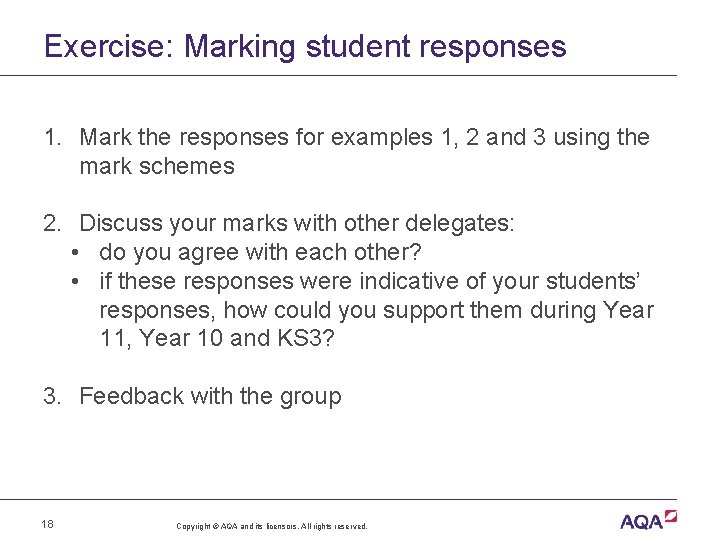
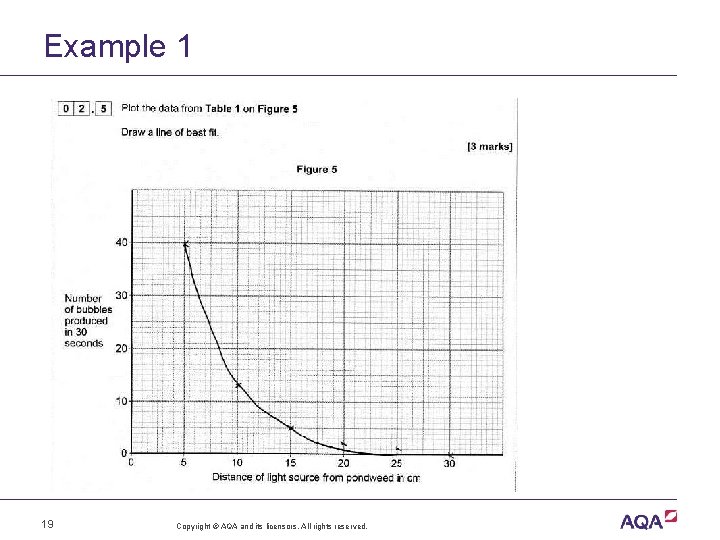
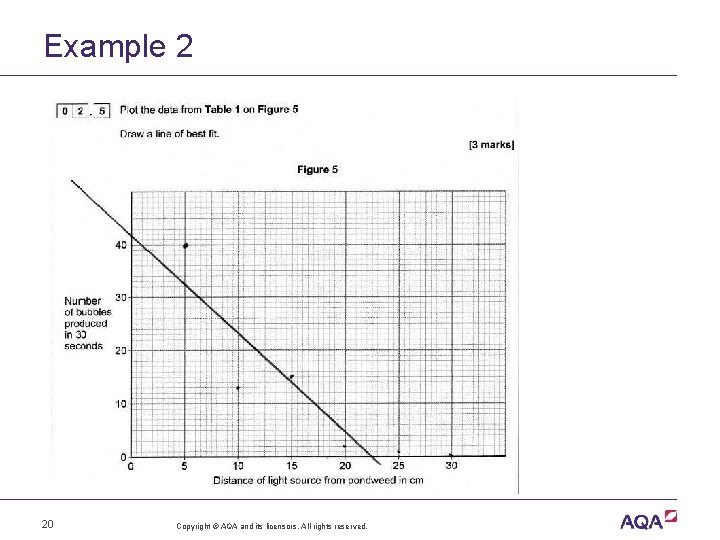
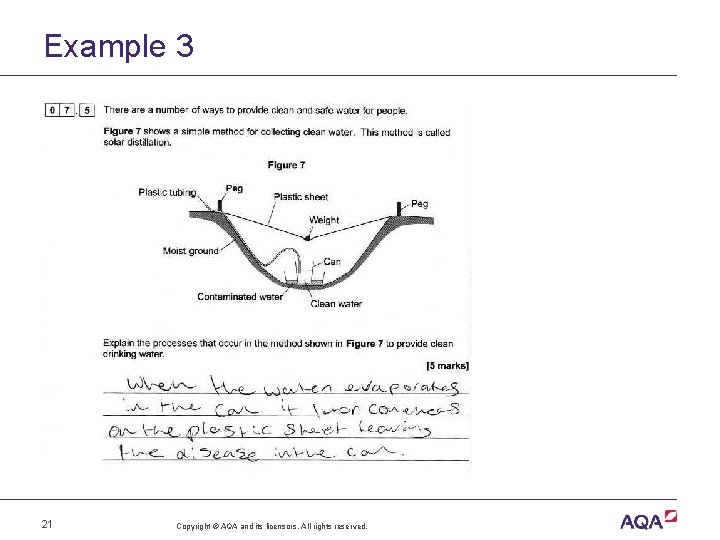
Exercise: Marking student responses 1. Mark the responses for examples 1, 2 and 3 using the mark schemes 2. Discuss your marks with other delegates: • do you agree with each other? • if these responses were indicative of your students’ responses, how could you support them during Year 11, Year 10 and KS 3? 3. Feedback with the group 18 Copyright © AQA and its licensors. All rights reserved.
Example 1 19 Copyright © AQA and its licensors. All rights reserved.
Example 2 20 Copyright © AQA and its licensors. All rights reserved.
Example 3 21 Copyright © AQA and its licensors. All rights reserved.
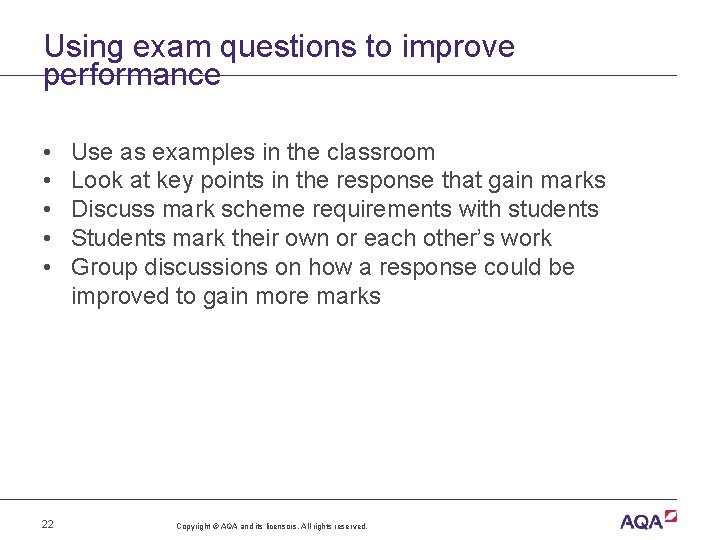
Using exam questions to improve performance • • • 22 Use as examples in the classroom Look at key points in the response that gain marks Discuss mark scheme requirements with students Students mark their own or each other’s work Group discussions on how a response could be improved to gain more marks Copyright © AQA and its licensors. All rights reserved.
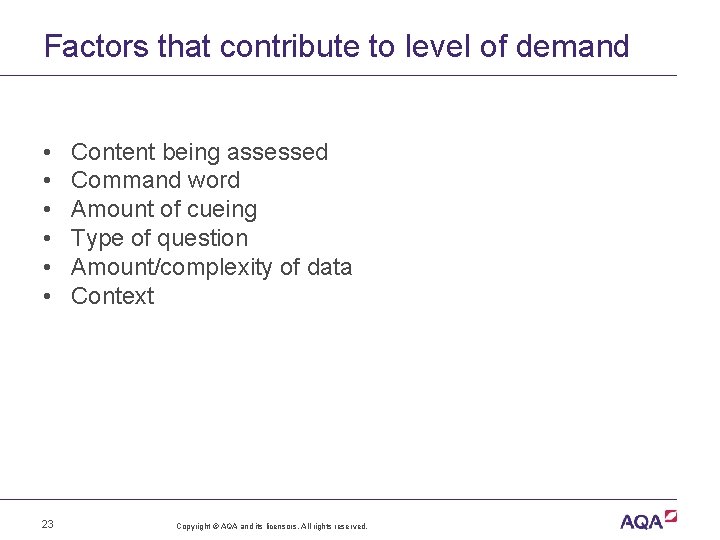
Factors that contribute to level of demand • • • 23 Content being assessed Command word Amount of cueing Type of question Amount/complexity of data Context Copyright © AQA and its licensors. All rights reserved.
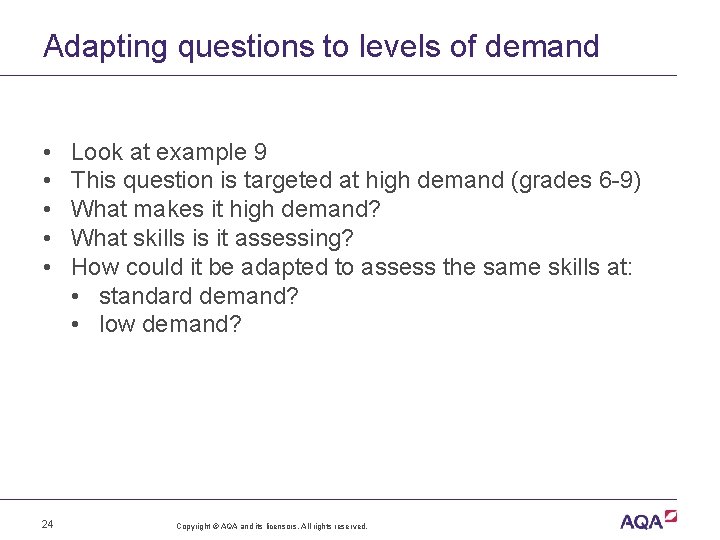
Adapting questions to levels of demand • • • 24 Look at example 9 This question is targeted at high demand (grades 6 -9) What makes it high demand? What skills is it assessing? How could it be adapted to assess the same skills at: • standard demand? • low demand? Copyright © AQA and its licensors. All rights reserved.
How did we do? • Please rate this session on the Sched Conference app. • Using the postcards provided, please write: • one thing you enjoyed about our session or will take away for your teaching • one thing you feel could be improved. • Please hand your postcard in as you leave. 25 Copyright © AQA and its licensors. All rights reserved.
Thank you 26 Copyright © AQA and its licensors. All rights reserved. Follow us on Twitter @AQACPD