
GCSE Science Awarding and outcomes explored Julian Clarke




- Slides: 69
GCSE Science: Awarding and outcomes explored Julian Clarke Spring 2019
Welcome 2 Copyright © AQA and its licensors. All rights reserved.
Outline for the session • This session will provide an update on the process by which GCSE and A-level grades are awarded by AQA and will include consideration of the arrangements for awarding for the first cohort examined against the new GCSE Science specifications. • Key messages from the A-level and GCSE Science exams in 2018 will also be considered. 3 Copyright © AQA and its licensors. All rights reserved.
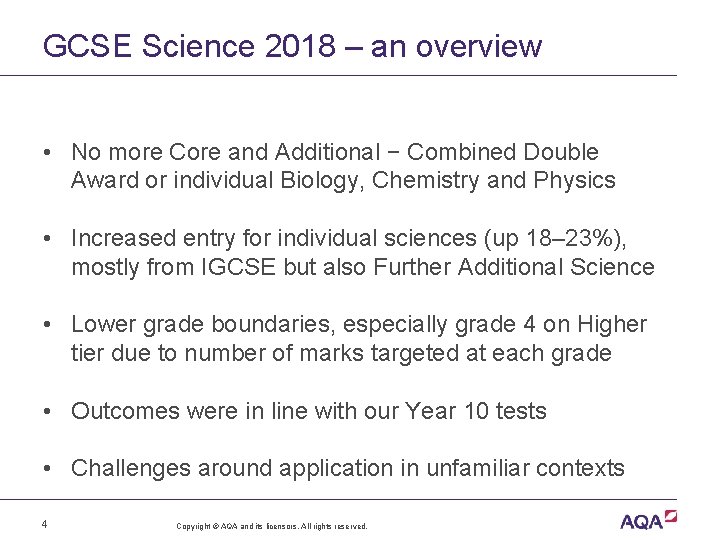
GCSE Science 2018 – an overview • No more Core and Additional − Combined Double Award or individual Biology, Chemistry and Physics • Increased entry for individual sciences (up 18– 23%), mostly from IGCSE but also Further Additional Science • Lower grade boundaries, especially grade 4 on Higher tier due to number of marks targeted at each grade • Outcomes were in line with our Year 10 tests • Challenges around application in unfamiliar contexts 4 Copyright © AQA and its licensors. All rights reserved.
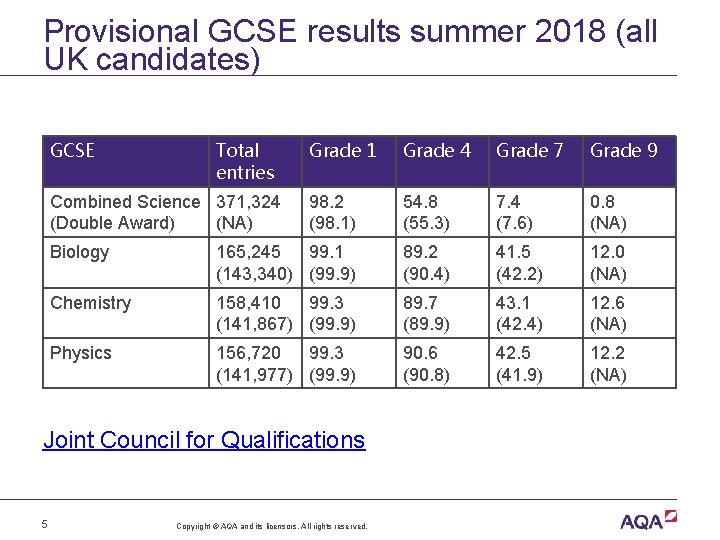
Provisional GCSE results summer 2018 (all UK candidates) GCSE Total entries Grade 1 Grade 4 Grade 7 Grade 9 98. 2 (98. 1) 54. 8 (55. 3) 7. 4 (7. 6) 0. 8 (NA) Biology 165, 245 99. 1 (143, 340) (99. 9) 89. 2 (90. 4) 41. 5 (42. 2) 12. 0 (NA) Chemistry 158, 410 99. 3 (141, 867) (99. 9) 89. 7 (89. 9) 43. 1 (42. 4) 12. 6 (NA) Physics 156, 720 99. 3 (141, 977) (99. 9) 90. 6 (90. 8) 42. 5 (41. 9) 12. 2 (NA) Combined Science 371, 324 (Double Award) (NA) Joint Council for Qualifications 5 Copyright © AQA and its licensors. All rights reserved.
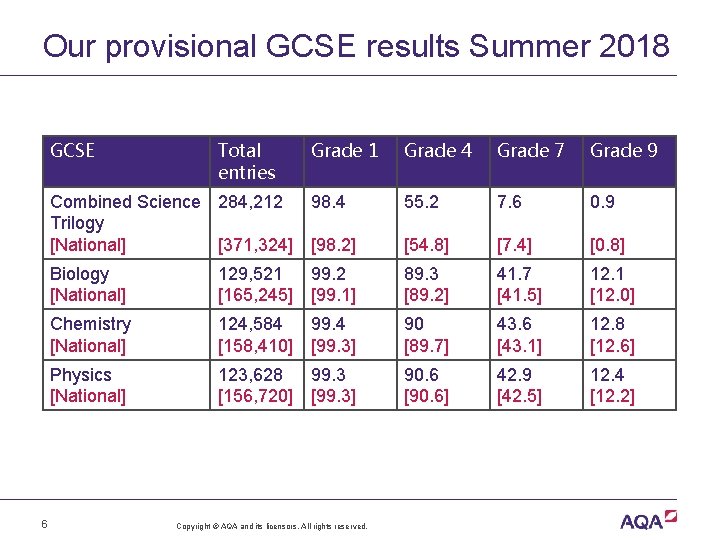
Our provisional GCSE results Summer 2018 GCSE 6 Total entries Grade 1 Grade 4 Grade 7 Grade 9 Combined Science 284, 212 Trilogy [National] [371, 324] 98. 4 55. 2 7. 6 0. 9 [98. 2] [54. 8] [7. 4] [0. 8] Biology [National] 129, 521 [165, 245] 99. 2 [99. 1] 89. 3 [89. 2] 41. 7 [41. 5] 12. 1 [12. 0] Chemistry [National] 124, 584 [158, 410] 99. 4 [99. 3] 90 [89. 7] 43. 6 [43. 1] 12. 8 [12. 6] Physics [National] 123, 628 [156, 720] 99. 3 [99. 3] 90. 6 [90. 6] 42. 9 [42. 5] 12. 4 [12. 2] Copyright © AQA and its licensors. All rights reserved.
Grade by gender Cumulative percentages GCSE Grade 1 Grade 4 Grade 7 Grade 9 Combined Science Male Female 97. 8 98. 7 52. 1 57. 5 6. 4 8. 4 0. 7 1. 0 Biology Male Female 99. 0 99. 2 88. 7 89. 7 39. 3 43. 6 10. 8 13. 1 Chemistry Male Female 99. 1 99. 5 89. 1 90. 4 42. 3 43. 9 12. 3 12. 8 Physics Male Female 99. 3 91. 0 90. 2 45. 3 39. 6 13. 9 10. 5 Joint Council for Qualifications 7 Copyright © AQA and its licensors. All rights reserved.
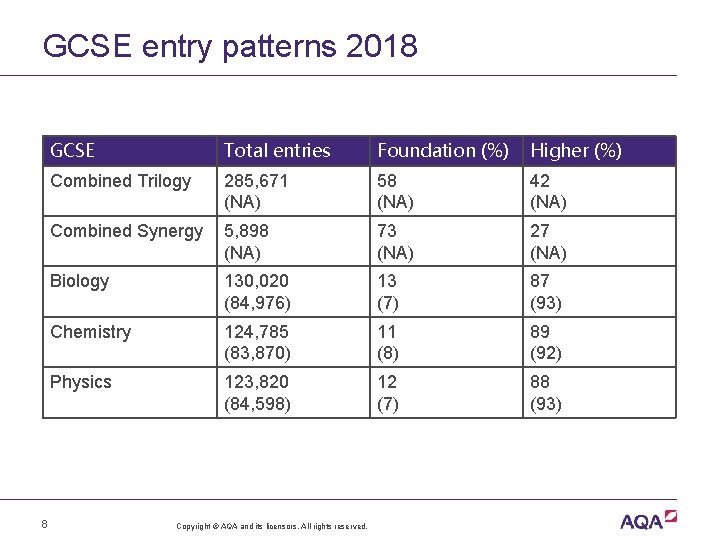
GCSE entry patterns 2018 8 GCSE Total entries Foundation (%) Higher (%) Combined Trilogy 285, 671 (NA) 58 (NA) 42 (NA) Combined Synergy 5, 898 (NA) 73 (NA) 27 (NA) Biology 130, 020 (84, 976) 13 (7) 87 (93) Chemistry 124, 785 (83, 870) 11 (8) 89 (92) Physics 123, 820 (84, 598) 12 (7) 88 (93) Copyright © AQA and its licensors. All rights reserved.
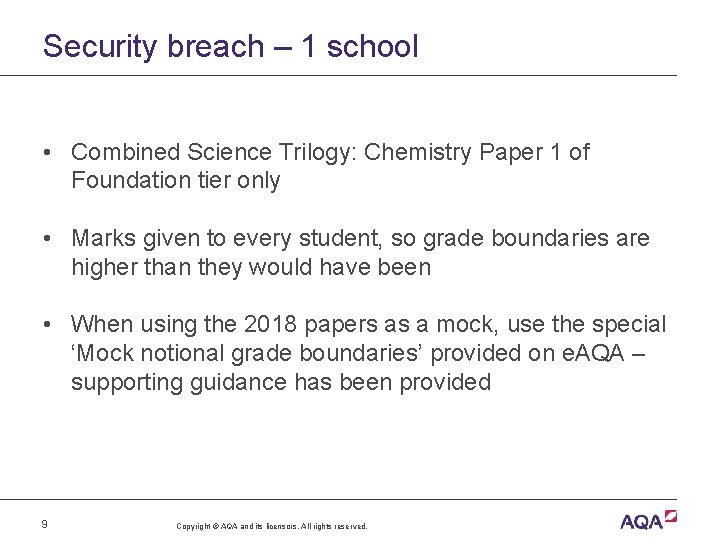
Security breach – 1 school • Combined Science Trilogy: Chemistry Paper 1 of Foundation tier only • Marks given to every student, so grade boundaries are higher than they would have been • When using the 2018 papers as a mock, use the special ‘Mock notional grade boundaries’ provided on e. AQA – supporting guidance has been provided 9 Copyright © AQA and its licensors. All rights reserved.
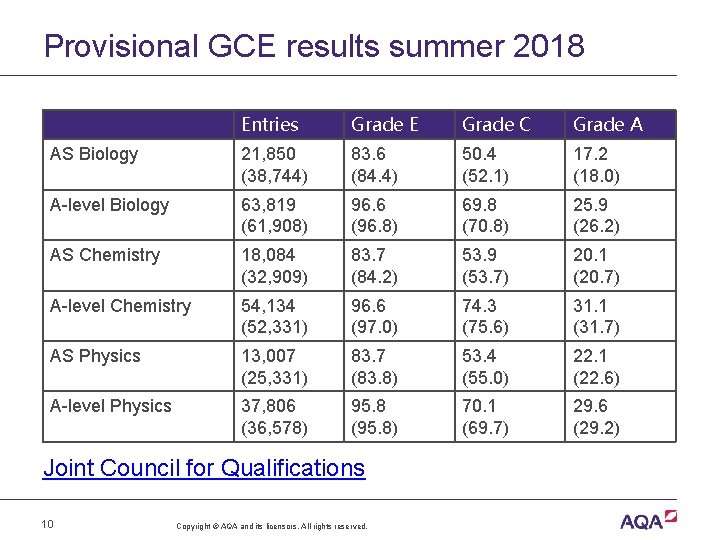
Provisional GCE results summer 2018 Entries Grade E Grade C Grade A AS Biology 21, 850 (38, 744) 83. 6 (84. 4) 50. 4 (52. 1) 17. 2 (18. 0) A-level Biology 63, 819 (61, 908) 96. 6 (96. 8) 69. 8 (70. 8) 25. 9 (26. 2) AS Chemistry 18, 084 (32, 909) 83. 7 (84. 2) 53. 9 (53. 7) 20. 1 (20. 7) A-level Chemistry 54, 134 (52, 331) 96. 6 (97. 0) 74. 3 (75. 6) 31. 1 (31. 7) AS Physics 13, 007 (25, 331) 83. 7 (83. 8) 53. 4 (55. 0) 22. 1 (22. 6) A-level Physics 37, 806 (36, 578) 95. 8 (95. 8) 70. 1 (69. 7) 29. 6 (29. 2) Joint Council for Qualifications 10 Copyright © AQA and its licensors. All rights reserved.
How we award grades Making the grades − a guide to awarding 11 Copyright © AQA and its licensors. All rights reserved.
How do students get an examination grade? • A qualification is a way of demonstrating that someone has achieved a certain level of learning. • It is based on a specification which sets out the skills, understanding and knowledge that students are expected to have gained by the end of their course. • Ofqual ensure the specification and assessment materials meet the National criteria; during the development of the specification, we collaborate with teachers and subject associations. 12 Copyright © AQA and its licensors. All rights reserved.
How do students get an examination grade? Question papers must test how well a students can demonstrate that they have acquired the knowledge, understanding and skills set out in the specification. 13 Copyright © AQA and its licensors. All rights reserved.
Assessment focusing on skills • Greater amount of content • But assessment generally doesn’t focus on knowledge • Some exceptions, eg formula recall • Limit on knowledge in isolation • Use the knowledge: • knowledge plus understanding • applying in context • supporting evaluation and analysis. 14 Copyright © AQA and its licensors. All rights reserved.
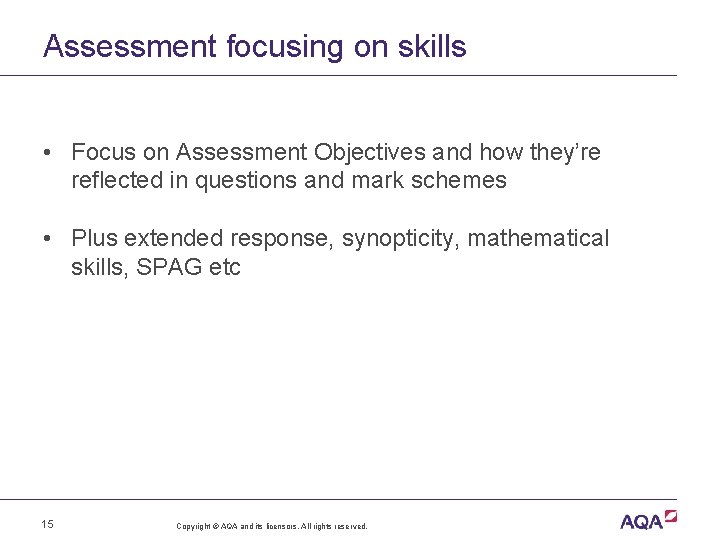
Assessment focusing on skills • Focus on Assessment Objectives and how they’re reflected in questions and mark schemes • Plus extended response, synopticity, mathematical skills, SPAG etc 15 Copyright © AQA and its licensors. All rights reserved.
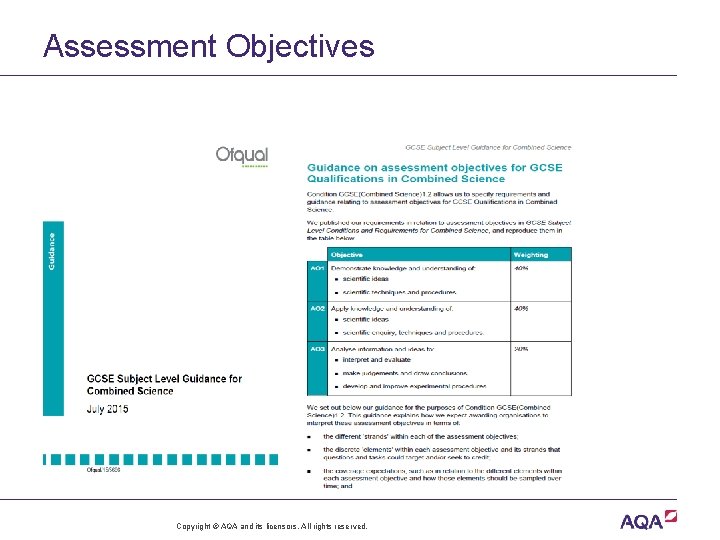
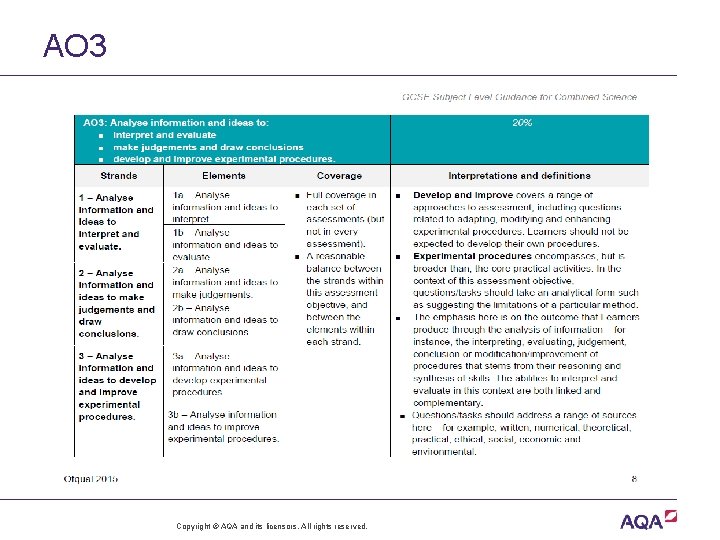
Assessment Objectives Copyright © AQA and its licensors. All rights reserved.
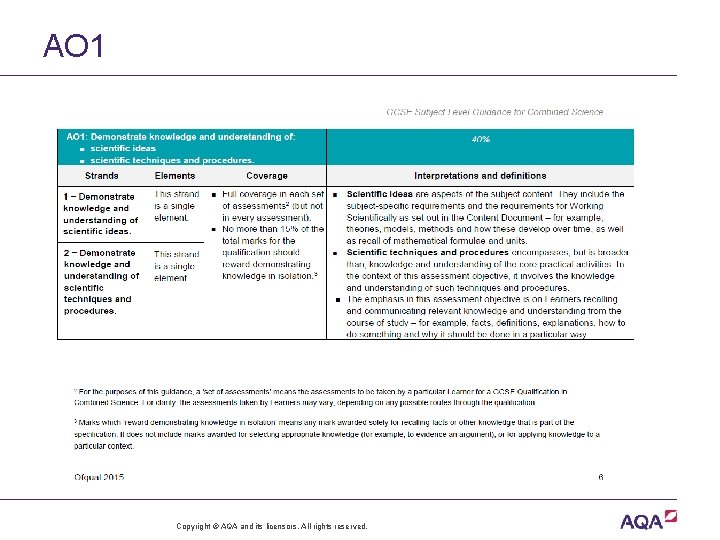
AO 1 Copyright © AQA and its licensors. All rights reserved.
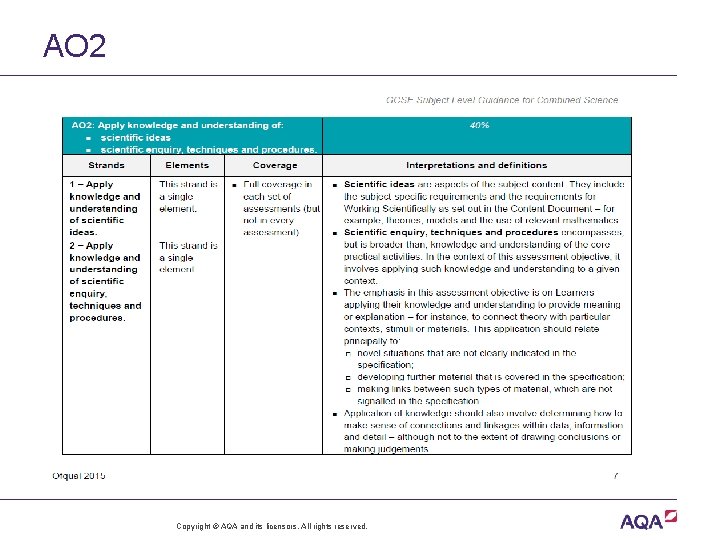
AO 2 Copyright © AQA and its licensors. All rights reserved.
AO 3 Copyright © AQA and its licensors. All rights reserved.
How do students get an examination grade? • It is impossible to test the entire specification in one set of exams so we select which areas to focus on in a particular paper, making sure that all areas of the specification are covered over a five year period. • The question paper, mark scheme and marking guidance are all written at the same time by an exam committee led by a chair of examiners for a subject, under whom chief examiners lead the development of the papers for a specification often with a lead assessment writer – almost all of whom are teachers. 20 Copyright © AQA and its licensors. All rights reserved.
How do students get an examination grade? • There is also an assessment developer, whose role is to check that every aspect of Ofqual’s requirements are met. • All papers are checked, scrutinised and revised many times to remove errors and ensure the right level of challenge and completion in the provided time. They are then proof read before being re-scrutinised before being signed off after 18 months of work 21 Copyright © AQA and its licensors. All rights reserved.
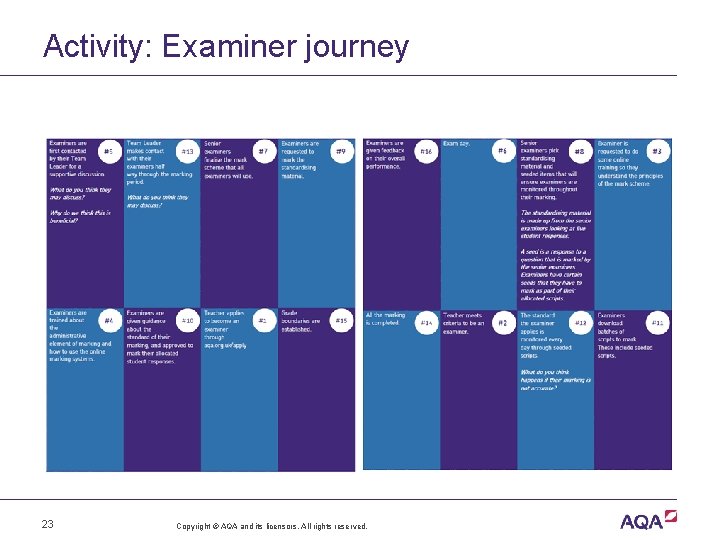
Our examining process • Look at the 16 cards describing the stages in the examining process. • Some of the cards have been numbered to show their place in the sequence of steps that take place to provide reliable marks are achieved by students. • Number those cards which do not have a number to create the sequence in which you think the steps take place. 22 Copyright © AQA and its licensors. All rights reserved.
Activity: Examiner journey 23 Copyright © AQA and its licensors. All rights reserved.
How do students get an examination grade? Marking • After the student has sat the paper, it is first marked and then graded. • We mark more than 7 million scripts each year and provide GCSE and A-level grades to more than 2 million students each year. • Examiners practice using the mark scheme at standardisation meetings (online or less frequently face to face). 24 Copyright © AQA and its licensors. All rights reserved.
How do students get an examination grade? Marking • The scripts are marked by the examiner team, with rigorous checking procedures to ensure examiners are consistent, fair and meet the required standard; if the examiner is not marking correctly, the scripts are removed from them and marked by another examiner. • The rigorous processes involved ensure that all scripts are marked fairly. 25 Copyright © AQA and its licensors. All rights reserved.
How do students get an examination grade? Awarding • Whilst boards try to set papers with consistent levels of difficulty, in practice there is variation. To avoid penalising students who sit a more difficult paper in one year compared to another, grade boundaries are set for each paper. 26 Copyright © AQA and its licensors. All rights reserved.
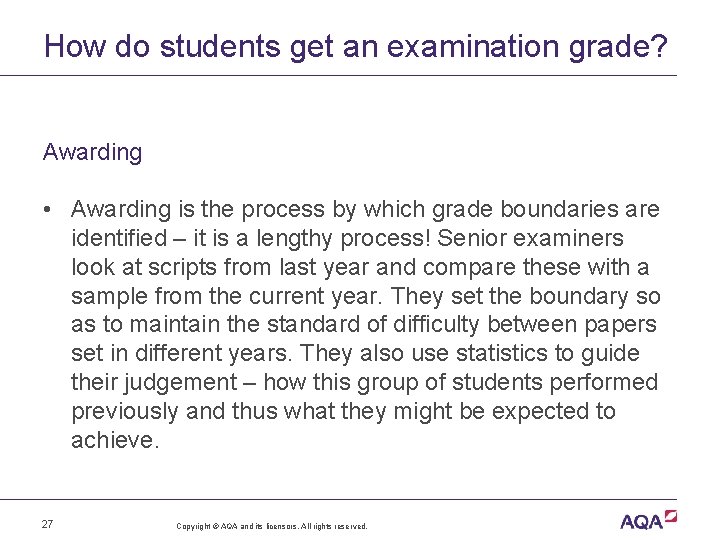
How do students get an examination grade? Awarding • Awarding is the process by which grade boundaries are identified – it is a lengthy process! Senior examiners look at scripts from last year and compare these with a sample from the current year. They set the boundary so as to maintain the standard of difficulty between papers set in different years. They also use statistics to guide their judgement – how this group of students performed previously and thus what they might be expected to achieve. 27 Copyright © AQA and its licensors. All rights reserved.
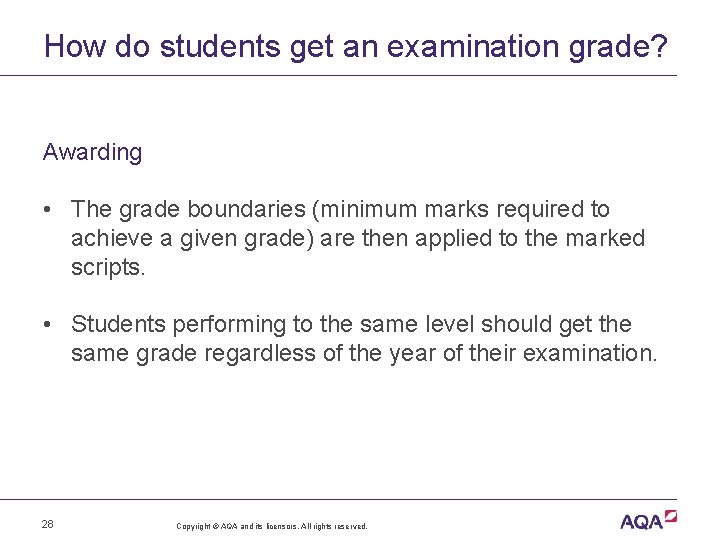
How do students get an examination grade? Awarding • The grade boundaries (minimum marks required to achieve a given grade) are then applied to the marked scripts. • Students performing to the same level should get the same grade regardless of the year of their examination. 28 Copyright © AQA and its licensors. All rights reserved.
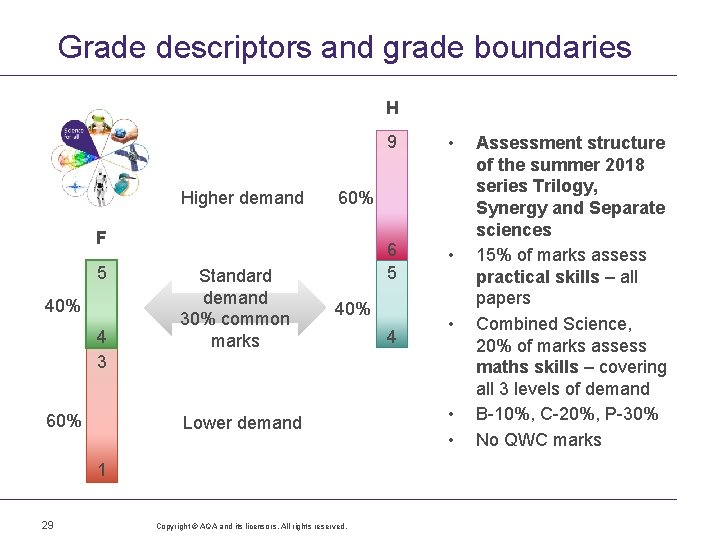
Grade descriptors and grade boundaries H Higher demand 40% 4 3 60% Standard demand 30% common marks 6 5 • 40% Lower demand 1 29 • 60% F 5 9 Copyright © AQA and its licensors. All rights reserved. 4 • • • Assessment structure of the summer 2018 series Trilogy, Synergy and Separate sciences 15% of marks assess practical skills – all papers Combined Science, 20% of marks assess maths skills – covering all 3 levels of demand B-10%, C-20%, P-30% No QWC marks
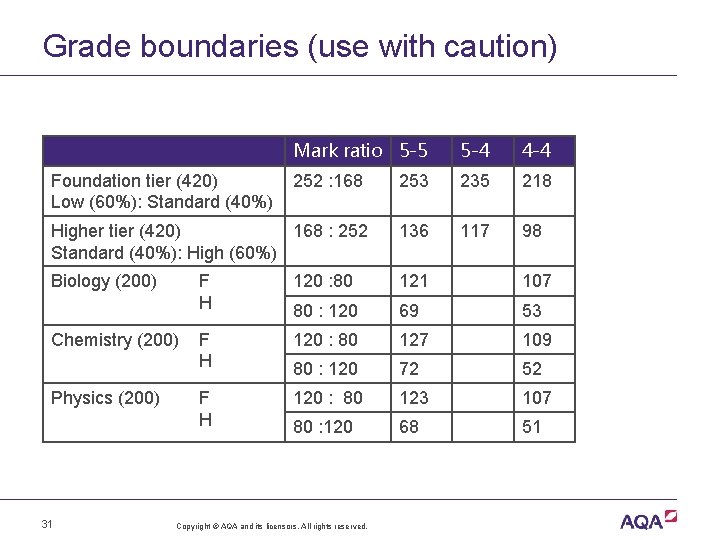
Grade boundaries (use with caution!) • Level of demand (low, standard and high) is a useful indicator of the target grade range of questions but a student’s attainment is based on performance across the papers and the whole mark allocation. • Individual performance can vary hugely depending on the topic and skill area. 30 Copyright © AQA and its licensors. All rights reserved.
Grade boundaries (use with caution) Mark ratio 5 -5 5 -4 4 -4 252 : 168 253 235 218 Higher tier (420) 168 : 252 Standard (40%): High (60%) 136 117 98 Biology (200) Foundation tier (420) Low (60%): Standard (40%) Chemistry (200) Physics (200) 31 F H 120 : 80 121 107 80 : 120 69 53 F H 120 : 80 127 109 80 : 120 72 52 F H 120 : 80 123 107 80 : 120 68 51 Copyright © AQA and its licensors. All rights reserved.
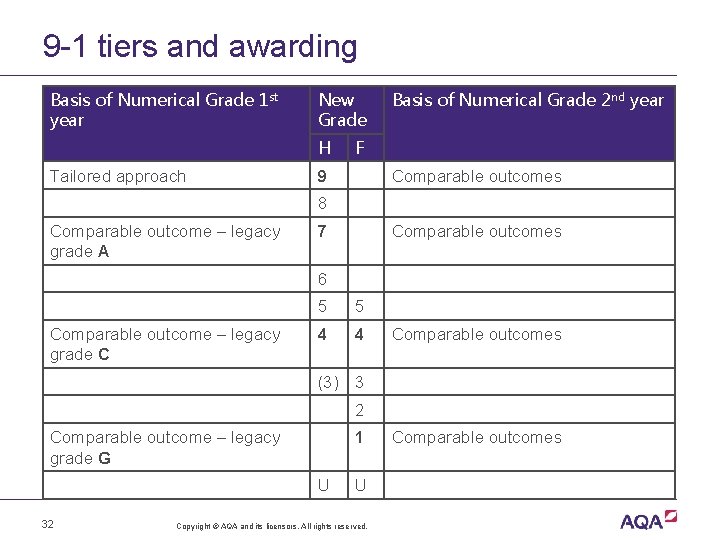
9 -1 tiers and awarding Basis of Numerical Grade 1 st year New Grade H Tailored approach Basis of Numerical Grade 2 nd year F 9 Comparable outcomes 8 Comparable outcome – legacy grade A 7 Comparable outcomes 6 Comparable outcome – legacy grade C 5 5 4 4 Comparable outcomes (3) 3 2 Comparable outcome – legacy grade G 1 U 32 U Copyright © AQA and its licensors. All rights reserved. Comparable outcomes
How is a grade boundary decided? The ‘statistical’ element Our Centre for Education Research and Compliance (CERP) use a range of statistics to make predictions which suggest the most appropriate statistically recommended grade boundaries. These are based on how comparable students have performed in previous series, KS 2 data and matched data. 33 Copyright © AQA and its licensors. All rights reserved.
How is a grade boundary decided? The ‘judgemental’ element The awarding meeting use a balance of judgemental and statistical evidence to make recommendations. The committee will look at a range of scripts for each ‘judgemental grade boundary’ (7, 4 and 1 for GCSE). Making the grades − a guide to awarding 34 Copyright © AQA and its licensors. All rights reserved.
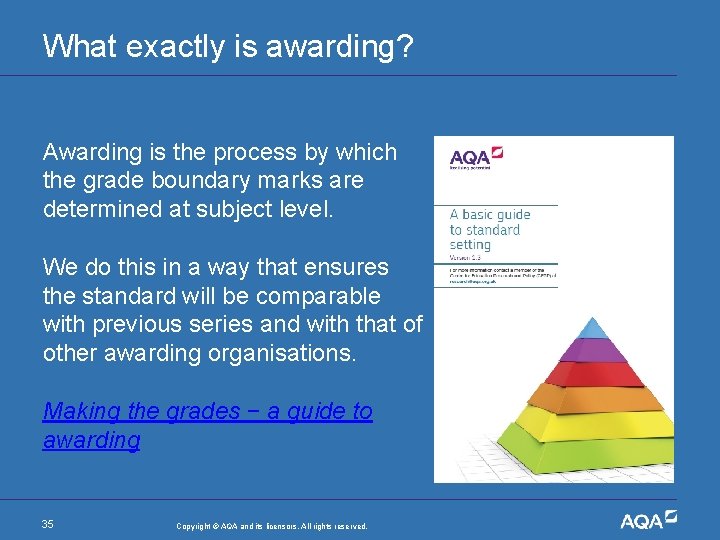
What exactly is awarding? Awarding is the process by which the grade boundary marks are determined at subject level. We do this in a way that ensures the standard will be comparable with previous series and with that of other awarding organisations. Making the grades − a guide to awarding 35 Copyright © AQA and its licensors. All rights reserved.
Awarding and the allocation of grade boundaries • The first award of all new GCSEs is based primarily on statistical predictions with examiner judgement playing a secondary role. • The grade standard established in the first award will be carried forward in the second and subsequent years; where the cohort has the same level of prior attainment, broadly the same proportion of students will achieve a grade 4 and above as currently achieve a C and above; grade 7 and above as currently achieve an A and above; grade 1 and above as currently achieve a grade G and above. 36 Copyright © AQA and its licensors. All rights reserved.
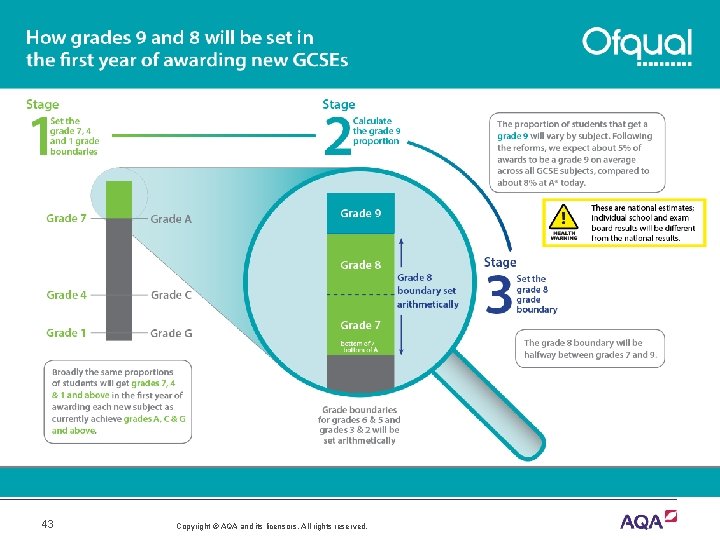
Awarding and the allocation of grade boundaries • All other grade boundaries will be set arithmetically, as previously. For example, the boundaries at grades 5 and 6 will be set based on the difference in marks between grades 4 and 7; grade 5 will be set at one third of the difference in marks, and grade 6 at two thirds the difference in marks. • The process of comparable outcomes works on the basis that if the cohort hasn’t changed much, we wouldn’t expect the proportion of each grade to change much either; this ensures that outcomes are fair, even if the specification or assessment tools are changed. 37 Copyright © AQA and its licensors. All rights reserved.
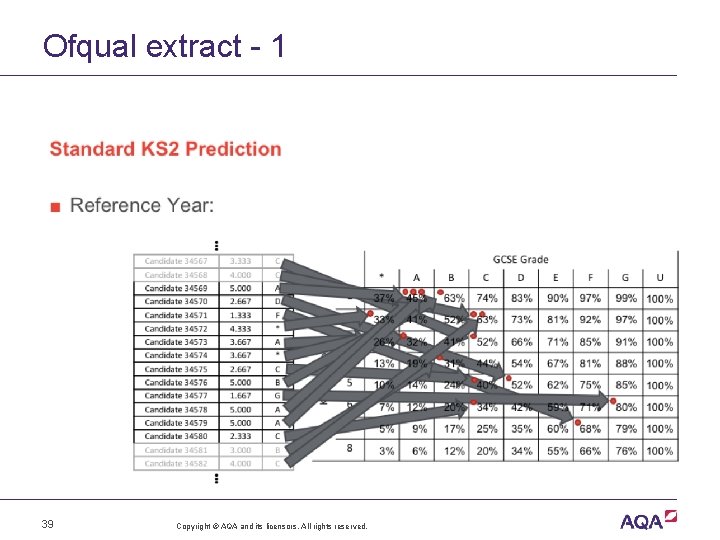
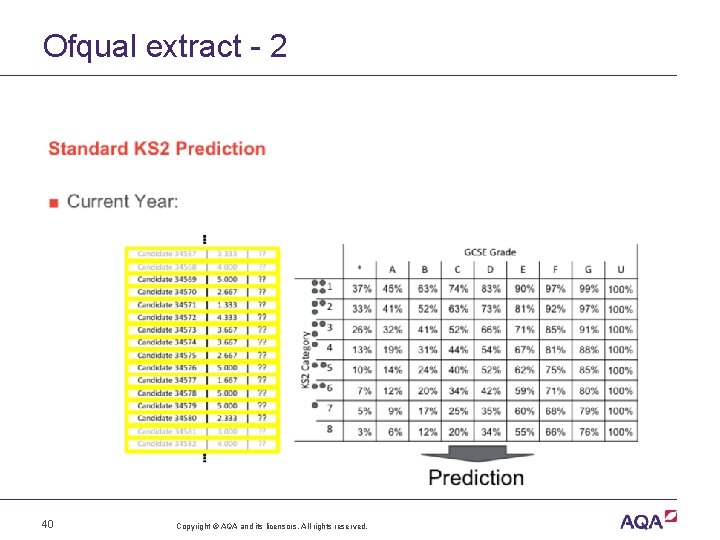
Comparable outcomes Awarding and comparable outcomes • In brief: • a statistical approach to predict the likely percentage of students achieving each grade • predicted outcome is contextualised by the prior attainment profile of the cohort (either KS 2 for GCSE for A-level) • based on the relationship between the prior attainment of students and their subsequent outcomes in a reference year, against which the performance of the current cohort is compares. 38 Copyright © AQA and its licensors. All rights reserved.
Ofqual extract - 1 39 Copyright © AQA and its licensors. All rights reserved.
Ofqual extract - 2 40 Copyright © AQA and its licensors. All rights reserved.
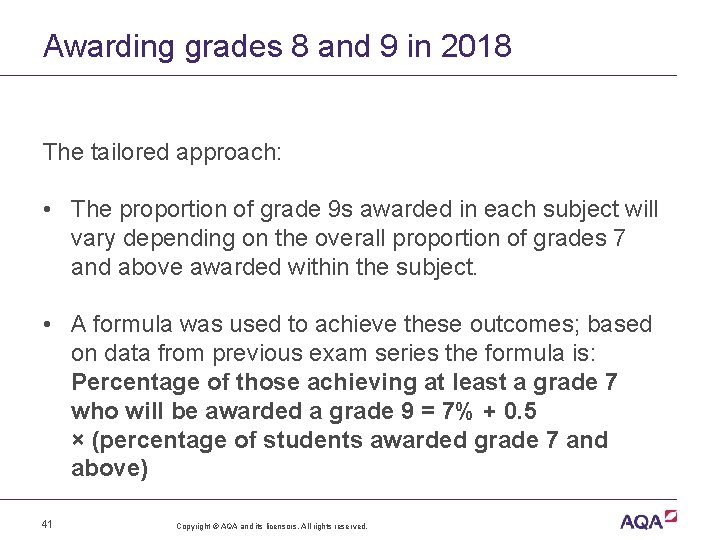
Awarding grades 8 and 9 in 2018 The tailored approach: • The proportion of grade 9 s awarded in each subject will vary depending on the overall proportion of grades 7 and above awarded within the subject. • A formula was used to achieve these outcomes; based on data from previous exam series the formula is: Percentage of those achieving at least a grade 7 who will be awarded a grade 9 = 7% + 0. 5 × (percentage of students awarded grade 7 and above) 41 Copyright © AQA and its licensors. All rights reserved.
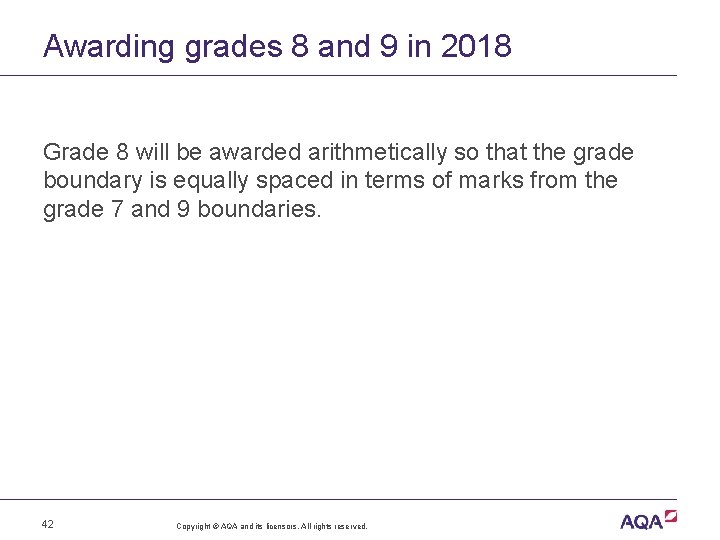
Awarding grades 8 and 9 in 2018 Grade 8 will be awarded arithmetically so that the grade boundary is equally spaced in terms of marks from the grade 7 and 9 boundaries. 42 Copyright © AQA and its licensors. All rights reserved.
43 Copyright © AQA and its licensors. All rights reserved.
Findings from 2018 – GCSE Please look at the relevant examiner reports on the our website 44 Copyright © AQA and its licensors. All rights reserved.
Our Insight reports GCSE Insight reports: 2018 results at a glance • • 45 Replace the Executive Summaries Highlight key points for each paper Headlines only Detailed information in Reports on the Exam Copyright © AQA and its licensors. All rights reserved.
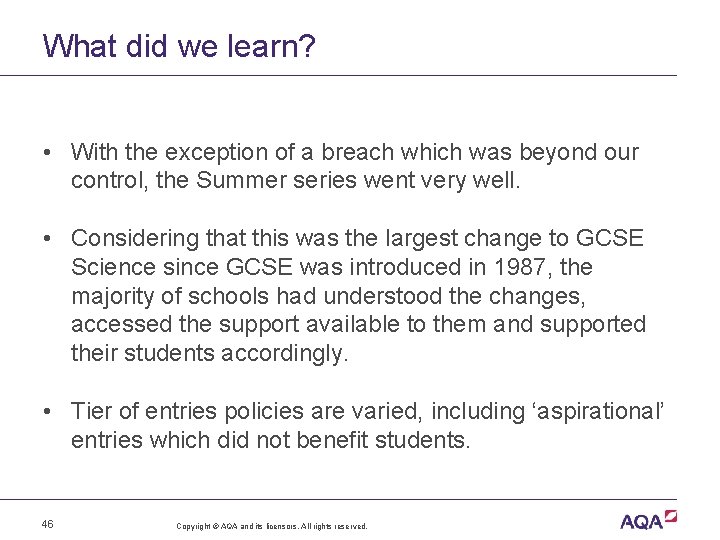
What did we learn? • With the exception of a breach which was beyond our control, the Summer series went very well. • Considering that this was the largest change to GCSE Science since GCSE was introduced in 1987, the majority of schools had understood the changes, accessed the support available to them and supported their students accordingly. • Tier of entries policies are varied, including ‘aspirational’ entries which did not benefit students. 46 Copyright © AQA and its licensors. All rights reserved.
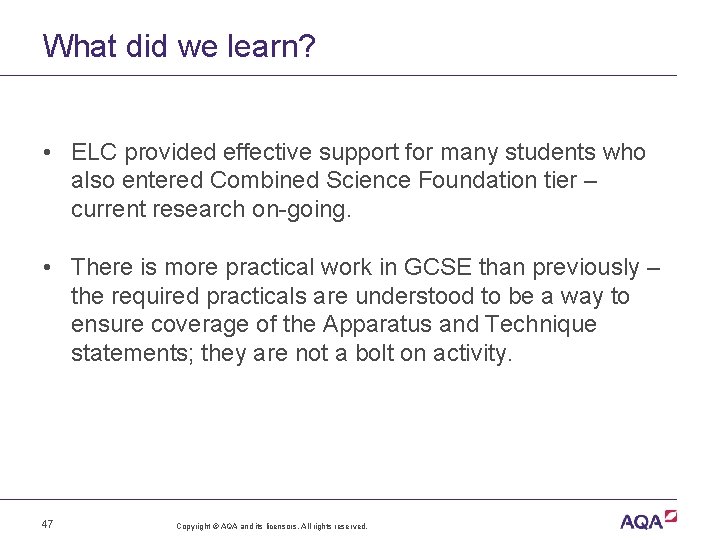
What did we learn? • ELC provided effective support for many students who also entered Combined Science Foundation tier – current research on-going. • There is more practical work in GCSE than previously – the required practicals are understood to be a way to ensure coverage of the Apparatus and Technique statements; they are not a bolt on activity. 47 Copyright © AQA and its licensors. All rights reserved.
But • The relative changes to grades and the tiering structure were not universally understood and parents and students had little understanding. • Some examination officers/invigilators were confused by the range of examinations available and may need additional support regarding tier of entry and specification. • More than 30, 000 candidates changed from Higher to Foundation tier during the last 6 weeks prior to the April 21 st deadline. 48 Copyright © AQA and its licensors. All rights reserved.
But GCSE provision is very mixed, with a lack of Science teachers in some schools and wide variations in teaching hours (120 GLH per GCSE expectation) – some have more than this but most have less. 49 Copyright © AQA and its licensors. All rights reserved.
Successes • • 50 In general, appropriate tier entered Writing to the end of the paper Full range of marks covered Discrimination Performance at different levels of demand Performance on common questions Basic maths skills were good Recall of equations Copyright © AQA and its licensors. All rights reserved.
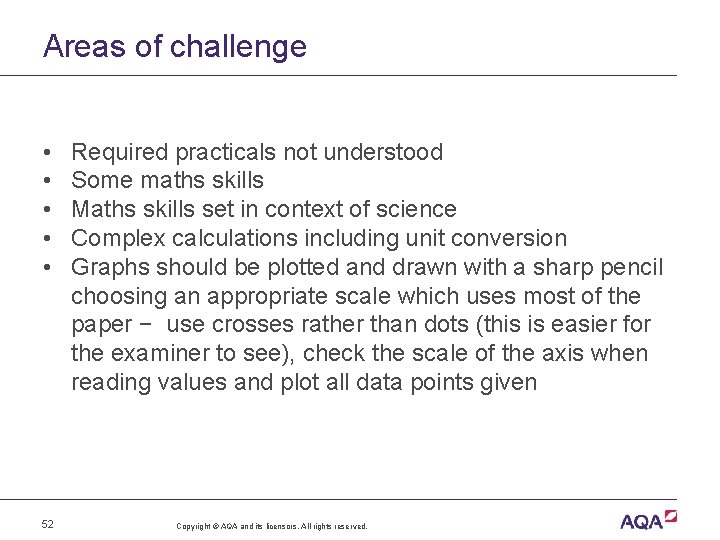
Areas of challenge • Reading and understanding the question • Understanding command words − describe, explain compare, evaluate • Writing coherent responses • Precise use of subject specific language • Synoptic linking of ideas particularly on Higher tier • Application of knowledge particular if set in unfamiliar context • Low demand − some gaps in basic knowledge 51 Copyright © AQA and its licensors. All rights reserved.
Areas of challenge • • • 52 Required practicals not understood Some maths skills Maths skills set in context of science Complex calculations including unit conversion Graphs should be plotted and drawn with a sharp pencil choosing an appropriate scale which uses most of the paper − use crosses rather than dots (this is easier for the examiner to see), check the scale of the axis when reading values and plot all data points given Copyright © AQA and its licensors. All rights reserved.
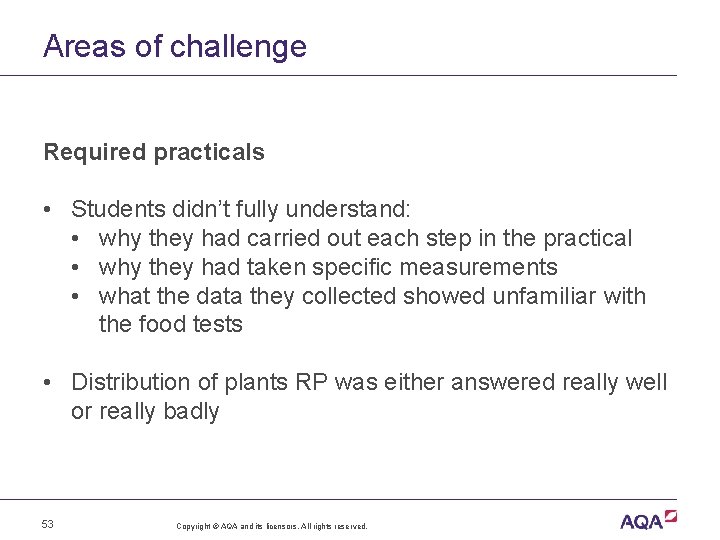
Areas of challenge Required practicals • Students didn’t fully understand: • why they had carried out each step in the practical • why they had taken specific measurements • what the data they collected showed unfamiliar with the food tests • Distribution of plants RP was either answered really well or really badly 53 Copyright © AQA and its licensors. All rights reserved.
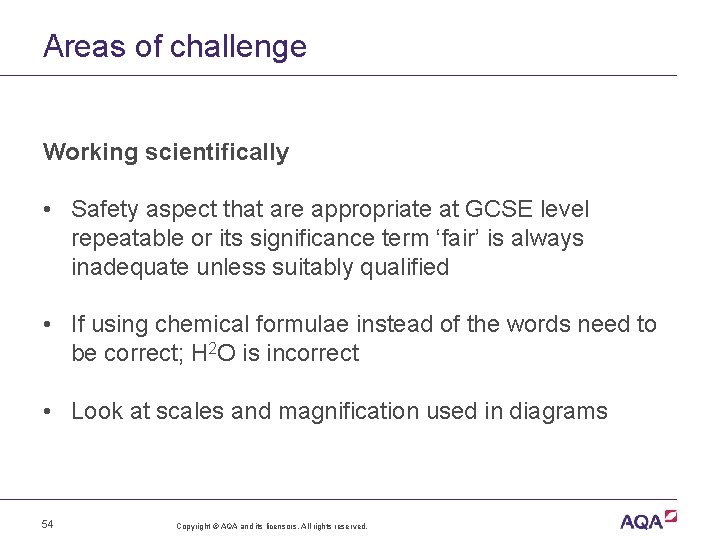
Areas of challenge Working scientifically • Safety aspect that are appropriate at GCSE level repeatable or its significance term ‘fair’ is always inadequate unless suitably qualified • If using chemical formulae instead of the words need to be correct; H 2 O is incorrect • Look at scales and magnification used in diagrams 54 Copyright © AQA and its licensors. All rights reserved.
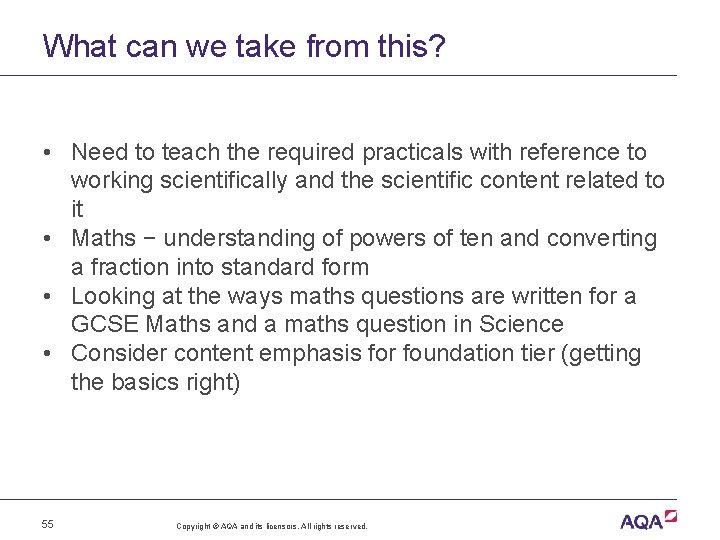
What can we take from this? • Need to teach the required practicals with reference to working scientifically and the scientific content related to it • Maths − understanding of powers of ten and converting a fraction into standard form • Looking at the ways maths questions are written for a GCSE Maths and a maths question in Science • Consider content emphasis for foundation tier (getting the basics right) 55 Copyright © AQA and its licensors. All rights reserved.
What can we take from this? • More practice with rearranging correctly • Looking at values and thinking which equations link these values • Breaking steps down and clearly showing intermediary values • Having to do unit conversions in examples in class • Thinking about what science knowledge they need to know 56 Copyright © AQA and its licensors. All rights reserved.
Some reminders for GCSE in 2019 57 Copyright © AQA and its licensors. All rights reserved.
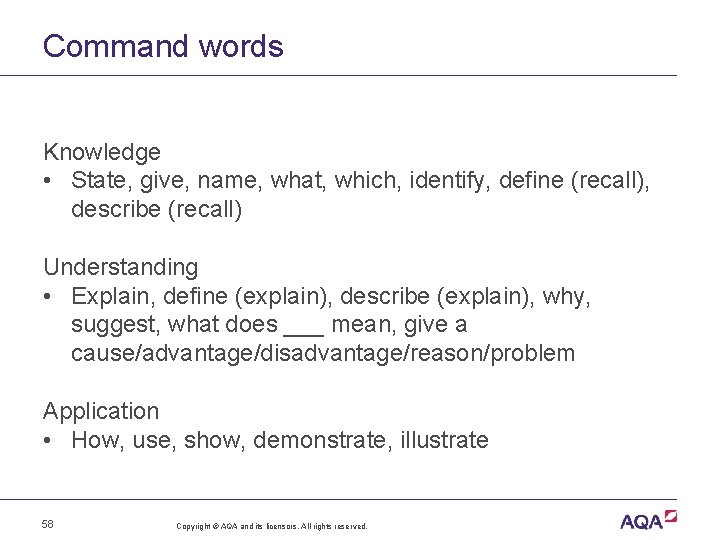
Command words Knowledge • State, give, name, what, which, identify, define (recall), describe (recall) Understanding • Explain, define (explain), describe (explain), why, suggest, what does ___ mean, give a cause/advantage/disadvantage/reason/problem Application • How, use, show, demonstrate, illustrate 58 Copyright © AQA and its licensors. All rights reserved.
Command words Analysis • Analyse, determine, explain, why, distinguish, appraise, examine Evaluation • Evaluate, assess, justify, compare, discuss, do you agree, contrast, judge 59 Copyright © AQA and its licensors. All rights reserved.
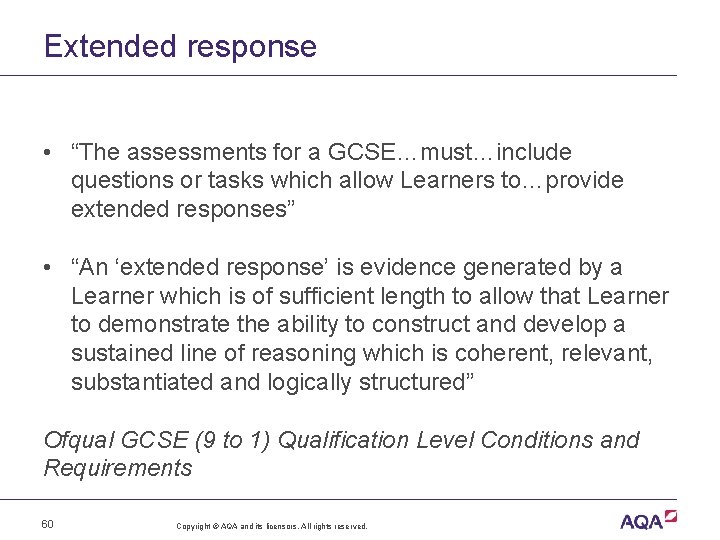
Extended response • “The assessments for a GCSE…must…include questions or tasks which allow Learners to…provide extended responses” • “An ‘extended response’ is evidence generated by a Learner which is of sufficient length to allow that Learner to demonstrate the ability to construct and develop a sustained line of reasoning which is coherent, relevant, substantiated and logically structured” Ofqual GCSE (9 to 1) Qualification Level Conditions and Requirements 60 Copyright © AQA and its licensors. All rights reserved.
Extended response • • Focus on technique Sustained line of reasoning is key Tactics – PEE, brainstorming/essay planning Answer the question – don’t lose focus on AO/command word • It should be clear which questions require extended responses 61 Copyright © AQA and its licensors. All rights reserved.
Tiering in Science for 2019 • You know your students best • Remember new Foundation tier goes up to grade 5 (previous grade B) and Higher tier starts at grade 4 (previous grade C) • Look at performance on common questions on sample papers • Previous B/C boundary a better guide than C/D • Grade 4/5 candidates may have challenging experience of Higher tier • Change tier of entry for free up to 21 st April (date tbc) • Supporting you in making tiering decisions foryour students 62 Copyright © AQA and its licensors. All rights reserved.
Using exam questions to improve performance • Use as examples in the classroom • Look at key points in the response that gain marks • Discuss mark scheme requirements with students • Students mark their own or each other’s work • Group discussions on how a response could be improved to gain more marks 63 Copyright © AQA and its licensors. All rights reserved.
Factors that contribute to level of demand • Content being assessed • Command word • Amount of cueing • Type of question • Amount/complexity of data • Context 64 Copyright © AQA and its licensors. All rights reserved.
Support • Regular updates via the website including ‘Insight reports’ in ‘Assess’ section of specification web pages • Secure key materials via e-AQA website including Enhanced Result Analysis (to pupil level); secure papers and resources • Telephone and email helplines • Termly local hub groups • Various CPD events (costed) 65 Copyright © AQA and its licensors. All rights reserved.
Unit award scheme • Remember ‘Record of achievement’ folders? • Certification against any criteria is available through our UAS – students meeting criteria, set by teachers, or from a pool, get a certificate • Works well alongside Entry Level Certificate and is being explored in a wider context – such as the STEM award materials 66 Copyright © AQA and its licensors. All rights reserved.
Research – work with us • How much teaching time do you get for GCSE in each year? • How many teachers are there in the department who are not Science graduates? (out of how many FTE? ) • How many GCSE students were taught by supply teachers for more than one week? • How much time do students spend on practical work on average in a week? • Who makes the decision about tier of entry? What is your entry policy based on? To help us with this, please provide your email address, school/college name and the data you have to hand. 67 Copyright © AQA and its licensors. All rights reserved.
How did we do? • Please rate this session on the Sched Conference app. • Using the postcards provided, please write: • one thing you enjoyed about our session or will take away for your teaching • one thing you feel could be improved. • Please hand your postcard in as you leave. 68 Copyright © AQA and its licensors. All rights reserved.
Thank you 69 Copyright © AQA and its licensors. All rights reserved. Follow us on Twitter @AQACPD