
GCSE Required Practicals Biology How to write a

GCSE Required Practicals Biology

How to write a method. . . just think of CIDER! Control variables Independent variable Dependent variable Equipment Repeats

GCSE Required Practicals Biology

How to write a method. . . just think of CIDER! Control variables Independent variable Dependent variable Equipment Repeats
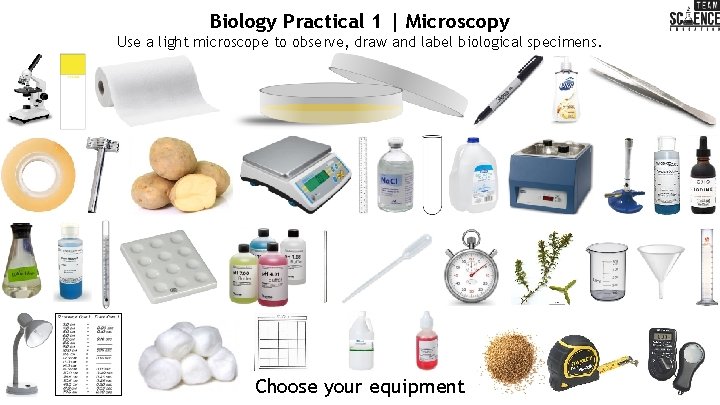
Biology Practical 1 | Microscopy Use a light microscope to observe, draw and label biological specimens. Choose your equipment
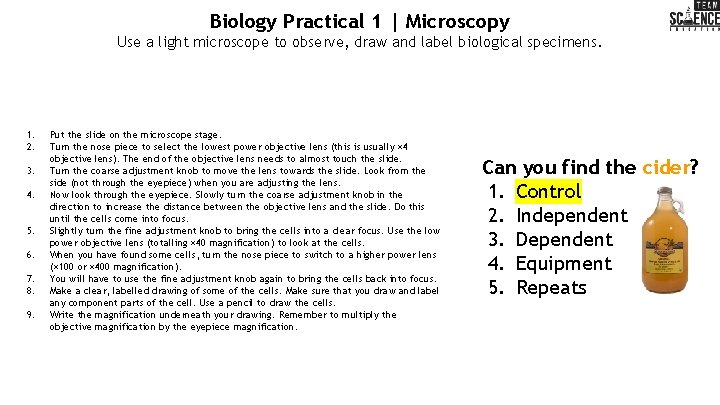
Biology Practical 1 | Microscopy Use a light microscope to observe, draw and label biological specimens. 1. 2. 3. 4. 5. 6. 7. 8. 9. Put the slide on the microscope stage. Turn the nose piece to select the lowest power objective lens (this is usually × 4 objective lens). The end of the objective lens needs to almost touch the slide. Turn the coarse adjustment knob to move the lens towards the slide. Look from the side (not through the eyepiece) when you are adjusting the lens. Now look through the eyepiece. Slowly turn the coarse adjustment knob in the direction to increase the distance between the objective lens and the slide. Do this until the cells come into focus. Slightly turn the fine adjustment knob to bring the cells into a clear focus. Use the low power objective lens (totalling × 40 magnification) to look at the cells. When you have found some cells, turn the nose piece to switch to a higher power lens (× 100 or × 400 magnification). You will have to use the fine adjustment knob again to bring the cells back into focus. Make a clear, labelled drawing of some of the cells. Make sure that you draw and label any component parts of the cell. Use a pencil to draw the cells. Write the magnification underneath your drawing. Remember to multiply the objective magnification by the eyepiece magnification. Can you find the cider? 1. Control 2. Independent 3. Dependent 4. Equipment 5. Repeats
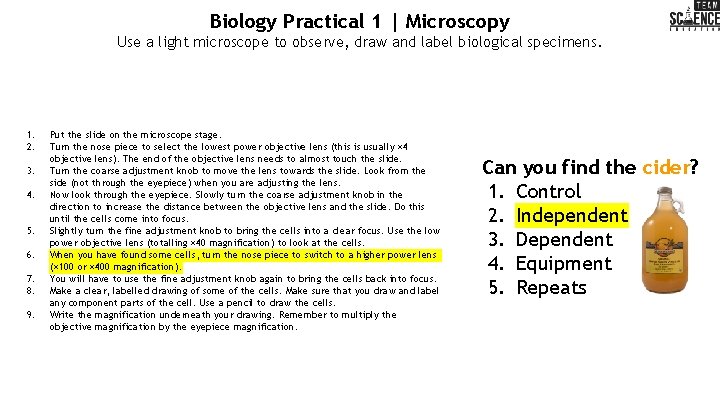
Biology Practical 1 | Microscopy Use a light microscope to observe, draw and label biological specimens. 1. 2. 3. 4. 5. 6. 7. 8. 9. Put the slide on the microscope stage. Turn the nose piece to select the lowest power objective lens (this is usually × 4 objective lens). The end of the objective lens needs to almost touch the slide. Turn the coarse adjustment knob to move the lens towards the slide. Look from the side (not through the eyepiece) when you are adjusting the lens. Now look through the eyepiece. Slowly turn the coarse adjustment knob in the direction to increase the distance between the objective lens and the slide. Do this until the cells come into focus. Slightly turn the fine adjustment knob to bring the cells into a clear focus. Use the low power objective lens (totalling × 40 magnification) to look at the cells. When you have found some cells, turn the nose piece to switch to a higher power lens (× 100 or × 400 magnification). You will have to use the fine adjustment knob again to bring the cells back into focus. Make a clear, labelled drawing of some of the cells. Make sure that you draw and label any component parts of the cell. Use a pencil to draw the cells. Write the magnification underneath your drawing. Remember to multiply the objective magnification by the eyepiece magnification. Can you find the cider? 1. Control 2. Independent 3. Dependent 4. Equipment 5. Repeats
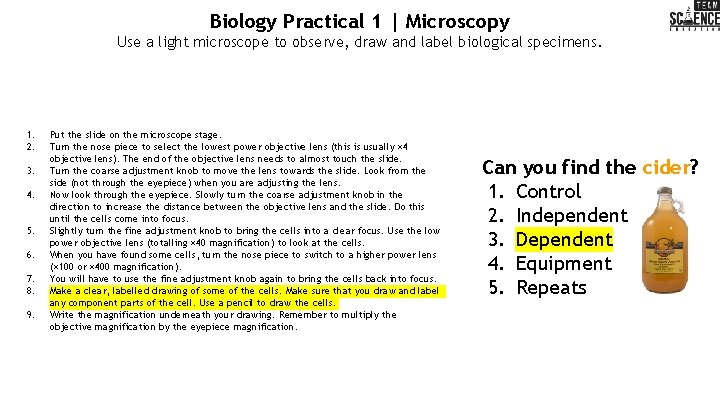
Biology Practical 1 | Microscopy Use a light microscope to observe, draw and label biological specimens. 1. 2. 3. 4. 5. 6. 7. 8. 9. Put the slide on the microscope stage. Turn the nose piece to select the lowest power objective lens (this is usually × 4 objective lens). The end of the objective lens needs to almost touch the slide. Turn the coarse adjustment knob to move the lens towards the slide. Look from the side (not through the eyepiece) when you are adjusting the lens. Now look through the eyepiece. Slowly turn the coarse adjustment knob in the direction to increase the distance between the objective lens and the slide. Do this until the cells come into focus. Slightly turn the fine adjustment knob to bring the cells into a clear focus. Use the low power objective lens (totalling × 40 magnification) to look at the cells. When you have found some cells, turn the nose piece to switch to a higher power lens (× 100 or × 400 magnification). You will have to use the fine adjustment knob again to bring the cells back into focus. Make a clear, labelled drawing of some of the cells. Make sure that you draw and label any component parts of the cell. Use a pencil to draw the cells. Write the magnification underneath your drawing. Remember to multiply the objective magnification by the eyepiece magnification. Can you find the cider? 1. Control 2. Independent 3. Dependent 4. Equipment 5. Repeats

Biology Practical 1 | Microscopy Use a light microscope to observe, draw and label biological specimens. 1. 2. 3. 4. 5. 6. 7. 8. 9. Put the slide on the microscope stage. Turn the nose piece to select the lowest power objective lens (this is usually × 4 objective lens). The end of the objective lens needs to almost touch the slide. Turn the coarse adjustment knob to move the lens towards the slide. Look from the side (not through the eyepiece) when you are adjusting the lens. Now look through the eyepiece. Slowly turn the coarse adjustment knob in the direction to increase the distance between the objective lens and the slide. Do this until the cells come into focus. Slightly turn the fine adjustment knob to bring the cells into a clear focus. Use the low power objective lens (totalling × 40 magnification) to look at the cells. When you have found some cells, turn the nose piece to switch to a higher power lens (× 100 or × 400 magnification). You will have to use the fine adjustment knob again to bring the cells back into focus. Make a clear, labelled drawing of some of the cells. Make sure that you draw and label any component parts of the cell. Use a pencil to draw the cells. Write the magnification underneath your drawing. Remember to multiply the objective magnification by the eyepiece magnification. Can you find the cider? 1. Control 2. Independent 3. Dependent 4. Equipment 5. Repeats
Biology Practical 1 | Microscopy Use a light microscope to observe, draw and label biological specimens. 1. 2. 3. 4. 5. 6. 7. 8. 9. Put the slide on the microscope stage. Turn the nose piece to select the lowest power objective lens (this is usually × 4 objective lens). The end of the objective lens needs to almost touch the slide. Turn the coarse adjustment knob to move the lens towards the slide. Look from the side (not through the eyepiece) when you are adjusting the lens. Now look through the eyepiece. Slowly turn the coarse adjustment knob in the direction to increase the distance between the objective lens and the slide. Do this until the cells come into focus. Slightly turn the fine adjustment knob to bring the cells into a clear focus. Use the low power objective lens (totalling × 40 magnification) to look at the cells. When you have found some cells, turn the nose piece to switch to a higher power lens (× 100 or × 400 magnification). You will have to use the fine adjustment knob again to bring the cells back into focus. Make a clear, labelled drawing of some of the cells. Make sure that you draw and label any component parts of the cell. Use a pencil to draw the cells. Write the magnification underneath your drawing. Remember to multiply the objective magnification by the eyepiece magnification. Can you find the cider? 1. Control 2. Independent 3. Dependent 4. Equipment 5. Repeats
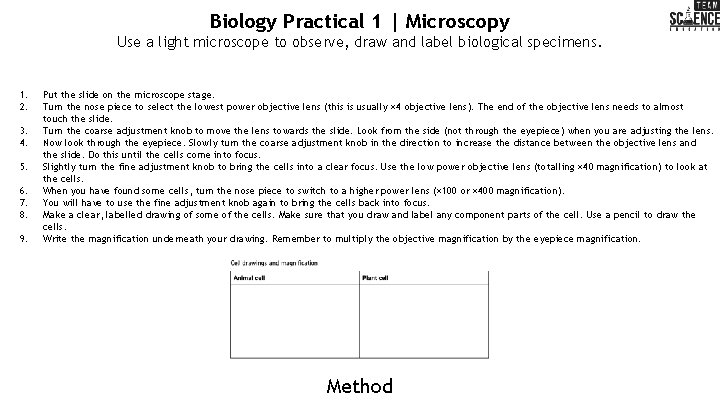
Biology Practical 1 | Microscopy Use a light microscope to observe, draw and label biological specimens. 1. 2. 3. 4. 5. 6. 7. 8. 9. Put the slide on the microscope stage. Turn the nose piece to select the lowest power objective lens (this is usually × 4 objective lens). The end of the objective lens needs to almost touch the slide. Turn the coarse adjustment knob to move the lens towards the slide. Look from the side (not through the eyepiece) when you are adjusting the lens. Now look through the eyepiece. Slowly turn the coarse adjustment knob in the direction to increase the distance between the objective lens and the slide. Do this until the cells come into focus. Slightly turn the fine adjustment knob to bring the cells into a clear focus. Use the low power objective lens (totalling × 40 magnification) to look at the cells. When you have found some cells, turn the nose piece to switch to a higher power lens (× 100 or × 400 magnification). You will have to use the fine adjustment knob again to bring the cells back into focus. Make a clear, labelled drawing of some of the cells. Make sure that you draw and label any component parts of the cell. Use a pencil to draw the cells. Write the magnification underneath your drawing. Remember to multiply the objective magnification by the eyepiece magnification. Method
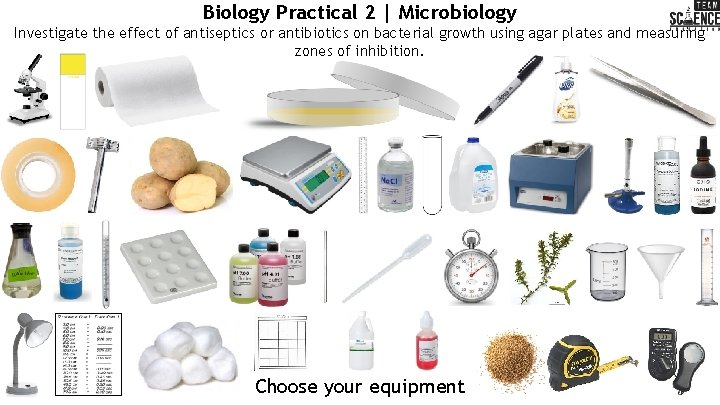
Biology Practical 2 | Microbiology Investigate the effect of antiseptics or antibiotics on bacterial growth using agar plates and measuring zones of inhibition. Choose your equipment
Biology Practical 2 | Microbiology Investigate the effect of antiseptics or antibiotics on bacterial growth using agar plates and measuring zones of inhibition. 1. Make sure your hands and work space are thoroughly clean before and after the experiment. 2. Spray the bench where you are working with disinfectant spray. Then wipe with paper towels. 3. Use the wax pencil or permanent marker to mark the bottom of the nutrient agar plate (not the lid) as shown in the diagram below. Make sure that the lid stays in place to avoid contamination. a. divide the plate into three equal sections and number them 1, 2 and 3 around the edge b. put a dot into the middle of each section c. add your initials, the date and the name of the bacteria. 4. Wash your hands with the antibacterial hand wash. 5. Put a different antiseptic onto each of the three filter paper discs, being careful to shake off excess liquid to avoid splashing. 6. Carefully lift the lid of the agar plate at an angle away from your face. Do not open it fully. 7. Use the forceps to carefully put each disc onto one of the dots you drew on with the wax pencil. 8. Make a note of which antiseptic is in each section. 9. Secure the lid of the agar plate in place using two small pieces of clear tape. Do not seal the lid all the way around as this creates anaerobic conditions. Anaerobic conditions will prevent the bacteria from growing and can encourage some other very nasty bacteria to grow. 10. Incubate the plate at 25 °C for 48 hours. 11. Measure the diameter of the clear zone around each disc. Measure again at 90° to your first measurement, then calculate the mean diameter. Can you find the cider? 1. Control 2. Independent 3. Dependent 4. Equipment 5. Repeats
Biology Practical 2 | Microbiology Investigate the effect of antiseptics or antibiotics on bacterial growth using agar plates and measuring zones of inhibition. 1. Make sure your hands and work space are thoroughly clean before and after the experiment. 2. Spray the bench where you are working with disinfectant spray. Then wipe with paper towels. 3. Use the wax pencil or permanent marker to mark the bottom of the nutrient agar plate (not the lid) as shown in the diagram below. Make sure that the lid stays in place to avoid contamination. a. divide the plate into three equal sections and number them 1, 2 and 3 around the edge b. put a dot into the middle of each section c. add your initials, the date and the name of the bacteria. 4. Wash your hands with the antibacterial hand wash. 5. Put a different antiseptic onto each of the three filter paper discs , being careful to shake off excess liquid to avoid splashing. 6. Carefully lift the lid of the agar plate at an angle away from your face. Do not open it fully. 7. Use the forceps to carefully put each disc onto one of the dots you drew on with the wax pencil. 8. Make a note of which antiseptic is in each section. 9. Secure the lid of the agar plate in place using two small pieces of clear tape. Do not seal the lid all the way around as this creates anaerobic conditions. Anaerobic conditions will prevent the bacteria from growing and can encourage some other very nasty bacteria to grow. 10. Incubate the plate at 25 °C for 48 hours. 11. Measure the diameter of the clear zone around each disc. Measure again at 90° to your first measurement, then calculate the mean diameter. Can you find the cider? 1. Control 2. Independent 3. Dependent 4. Equipment 5. Repeats
Biology Practical 2 | Microbiology Investigate the effect of antiseptics or antibiotics on bacterial growth using agar plates and measuring zones of inhibition. 1. Make sure your hands and work space are thoroughly clean before and after the experiment. 2. Spray the bench where you are working with disinfectant spray. Then wipe with paper towels. 3. Use the wax pencil or permanent marker to mark the bottom of the nutrient agar plate (not the lid) as shown in the diagram below. Make sure that the lid stays in place to avoid contamination. a. divide the plate into three equal sections and number them 1, 2 and 3 around the edge b. put a dot into the middle of each section c. add your initials, the date and the name of the bacteria. 4. Wash your hands with the antibacterial hand wash. 5. Put a different antiseptic onto each of the three filter paper discs, being careful to shake off excess liquid to avoid splashing. 6. Carefully lift the lid of the agar plate at an angle away from your face. Do not open it fully. 7. Use the forceps to carefully put each disc onto one of the dots you drew on with the wax pencil. 8. Make a note of which antiseptic is in each section. 9. Secure the lid of the agar plate in place using two small pieces of clear tape. Do not seal the lid all the way around as this creates anaerobic conditions. Anaerobic conditions will prevent the bacteria from growing and can encourage some other very nasty bacteria to grow. 10. Incubate the plate at 25 °C for 48 hours. 11. Measure the diameter of the clear zone around each disc. Measure again at 90° to your first measurement, then calculate the mean diameter. Can you find the cider? 1. Control 2. Independent 3. Dependent 4. Equipment 5. Repeats
Biology Practical 2 | Microbiology Investigate the effect of antiseptics or antibiotics on bacterial growth using agar plates and measuring zones of inhibition. 1. Make sure your hands and work space are thoroughly clean before and after the experiment. 2. Spray the bench where you are working with disinfectant spray. Then wipe with paper towels. 3. Use the wax pencil or permanent marker to mark the bottom of the nutrient agar plate (not the lid) as shown in the diagram below. Make sure that the lid stays in place to avoid contamination. a. divide the plate into three equal sections and number them 1, 2 and 3 around the edge b. put a dot into the middle of each section c. add your initials, the date and the name of the bacteria. 4. Wash your hands with the antibacterial hand wash. 5. Put a different antiseptic onto each of the three filter paper discs, being careful to shake off excess liquid to avoid splashing. 6. Carefully lift the lid of the agar plate at an angle away from your face. Do not open it fully. 7. Use the forceps to carefully put each disc onto one of the dots you drew on with the wax pencil. 8. Make a note of which antiseptic is in each section. 9. Secure the lid of the agar plate in place using two small pieces of clear tape. Do not seal the lid all the way around as this creates anaerobic conditions. Anaerobic conditions will prevent the bacteria from growing and can encourage some other very nasty bacteria to grow. 10. Incubate the plate at 25 °C for 48 hours. 11. Measure the diameter of the clear zone around each disc. Measure again at 90° to your first measurement, then calculate the mean diameter. Can you find the cider? 1. Control 2. Independent 3. Dependent 4. Equipment 5. Repeats
Biology Practical 2 | Microbiology Investigate the effect of antiseptics or antibiotics on bacterial growth using agar plates and measuring zones of inhibition. 1. Make sure your hands and work space are thoroughly clean before and after the experiment. 2. Spray the bench where you are working with disinfectant spray. Then wipe with paper towels. 3. Use the wax pencil or permanent marker to mark the bottom of the nutrient agar plate (not the lid) as shown in the diagram below. Make sure that the lid stays in place to avoid contamination. a. divide the plate into three equal sections and number them 1, 2 and 3 around the edge b. put a dot into the middle of each section c. add your initials, the date and the name of the bacteria. 4. Wash your hands with the antibacterial hand wash. 5. Put a different antiseptic onto each of the three filter paper discs, being careful to shake off excess liquid to avoid splashing. 6. Carefully lift the lid of the agar plate at an angle away from your face. Do not open it fully. 7. Use the forceps to carefully put each disc onto one of the dots you drew on with the wax pencil. 8. Make a note of which antiseptic is in each section. 9. Secure the lid of the agar plate in place using two small pieces of clear tape. Do not seal the lid all the way around as this creates anaerobic conditions. Anaerobic conditions will prevent the bacteria from growing and can encourage some other very nasty bacteria to grow. 10. Incubate the plate at 25 °C for 48 hours. 11. Measure the diameter of the clear zone around each disc. Measure again at 90° to your first measurement, then calculate the mean diameter. Can you find the cider? 1. Control 2. Independent 3. Dependent 4. Equipment 5. Repeats
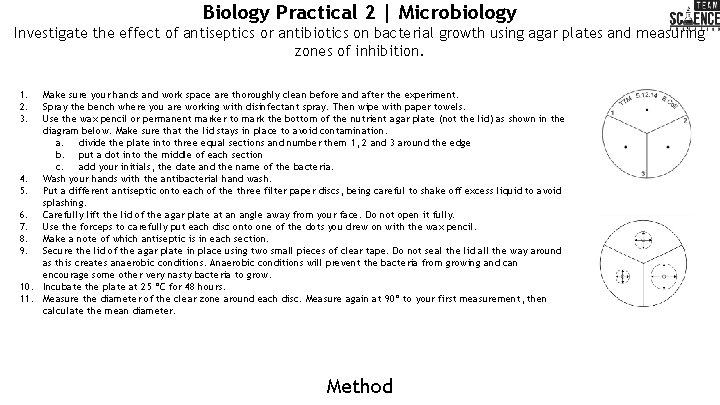
Biology Practical 2 | Microbiology Investigate the effect of antiseptics or antibiotics on bacterial growth using agar plates and measuring zones of inhibition. 1. 2. 3. Make sure your hands and work space are thoroughly clean before and after the experiment. Spray the bench where you are working with disinfectant spray. Then wipe with paper towels. Use the wax pencil or permanent marker to mark the bottom of the nutrient agar plate (not the lid) as shown in the diagram below. Make sure that the lid stays in place to avoid contamination. a. divide the plate into three equal sections and number them 1, 2 and 3 around the edge b. put a dot into the middle of each section c. add your initials, the date and the name of the bacteria. 4. Wash your hands with the antibacterial hand wash. 5. Put a different antiseptic onto each of the three filter paper discs, being careful to shake off excess liquid to avoid splashing. 6. Carefully lift the lid of the agar plate at an angle away from your face. Do not open it fully. 7. Use the forceps to carefully put each disc onto one of the dots you drew on with the wax pencil. 8. Make a note of which antiseptic is in each section. 9. Secure the lid of the agar plate in place using two small pieces of clear tape. Do not seal the lid all the way around as this creates anaerobic conditions. Anaerobic conditions will prevent the bacteria from growing and can encourage some other very nasty bacteria to grow. 10. Incubate the plate at 25 °C for 48 hours. 11. Measure the diameter of the clear zone around each disc. Measure again at 90° to your first measurement, then calculate the mean diameter. Method
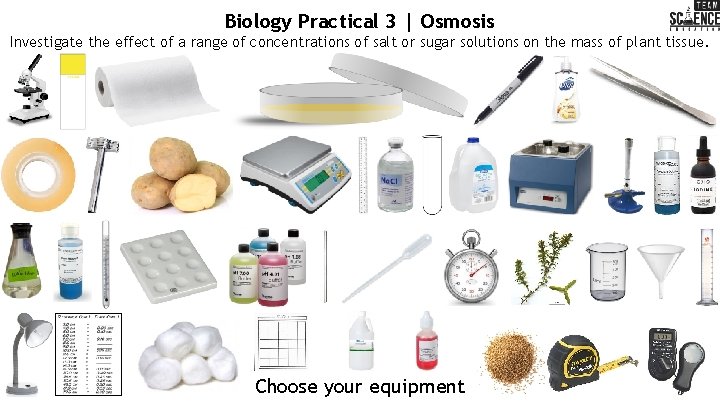
Biology Practical 3 | Osmosis Investigate the effect of a range of concentrations of salt or sugar solutions on the mass of plant tissue. Choose your equipment

Biology Practical 3 | Osmosis Investigate the effect of a range of concentrations of salt or sugar solutions on the mass of plant tissue. 1. 2. Use a cork borer to cut five potato cylinders of the same diameter. Use the knife to trim off any potato skin on each potato cylinder. Then trim each potato cylinder so that they are all the same length. 3. Accurately measure the mass of each potato cylinder. 4. Accurately measure the length of each cylinder. 5. Record your measurements in a table like the one shown over the page. 6. Measure 10 cm 3 of each concentration of sugar or salt solution and put into boiling tubes. 7. Label each boiling tube clearly. 8. Measure 10 cm 3 of the distilled water and put into the fifth boiling tube. Label the boiling tube clearly. 9. Add one potato cylinder to each boiling tube 10. Leave the potato cylinders in the boiling tubes for a chosen amount of time. 11. Remove the potato cylinders from the boiling tubes and carefully blot them dry with the paper towels. 12. Measure the new mass and length of each potato cylinder again. Record your measurements for each concentration in your table. Can you find the cider? 1. Control 2. Independent 3. Dependent 4. Equipment 5. Repeats
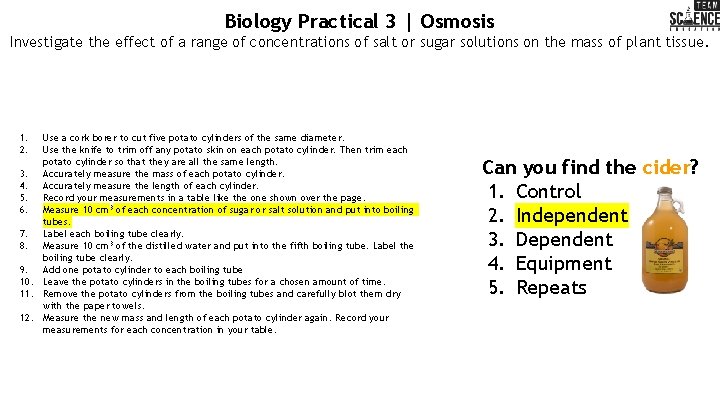
Biology Practical 3 | Osmosis Investigate the effect of a range of concentrations of salt or sugar solutions on the mass of plant tissue. 1. 2. Use a cork borer to cut five potato cylinders of the same diameter. Use the knife to trim off any potato skin on each potato cylinder. Then trim each potato cylinder so that they are all the same length. 3. Accurately measure the mass of each potato cylinder. 4. Accurately measure the length of each cylinder. 5. Record your measurements in a table like the one shown over the page. 6. Measure 10 cm 3 of each concentration of sugar or salt solution and put into boiling tubes. 7. Label each boiling tube clearly. 8. Measure 10 cm 3 of the distilled water and put into the fifth boiling tube. Label the boiling tube clearly. 9. Add one potato cylinder to each boiling tube 10. Leave the potato cylinders in the boiling tubes for a chosen amount of time. 11. Remove the potato cylinders from the boiling tubes and carefully blot them dry with the paper towels. 12. Measure the new mass and length of each potato cylinder again. Record your measurements for each concentration in your table. Can you find the cider? 1. Control 2. Independent 3. Dependent 4. Equipment 5. Repeats
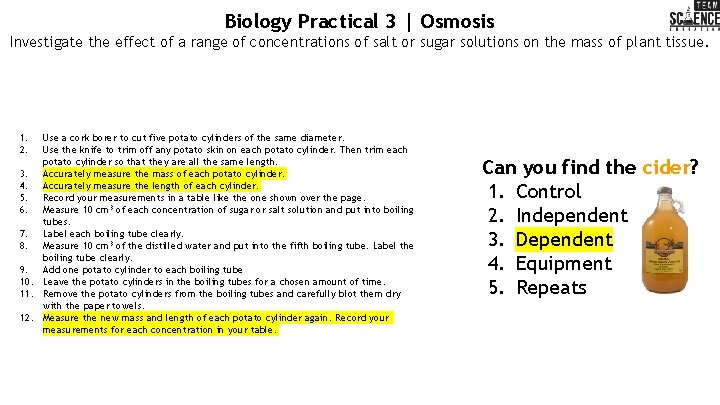
Biology Practical 3 | Osmosis Investigate the effect of a range of concentrations of salt or sugar solutions on the mass of plant tissue. 1. 2. Use a cork borer to cut five potato cylinders of the same diameter. Use the knife to trim off any potato skin on each potato cylinder. Then trim each potato cylinder so that they are all the same length. 3. Accurately measure the mass of each potato cylinder. 4. Accurately measure the length of each cylinder. 5. Record your measurements in a table like the one shown over the page. 6. Measure 10 cm 3 of each concentration of sugar or salt solution and put into boiling tubes. 7. Label each boiling tube clearly. 8. Measure 10 cm 3 of the distilled water and put into the fifth boiling tube. Label the boiling tube clearly. 9. Add one potato cylinder to each boiling tube 10. Leave the potato cylinders in the boiling tubes for a chosen amount of time. 11. Remove the potato cylinders from the boiling tubes and carefully blot them dry with the paper towels. 12. Measure the new mass and length of each potato cylinder again. Record your measurements for each concentration in your table. Can you find the cider? 1. Control 2. Independent 3. Dependent 4. Equipment 5. Repeats
Biology Practical 3 | Osmosis Investigate the effect of a range of concentrations of salt or sugar solutions on the mass of plant tissue. 1. 2. Use a cork borer to cut five potato cylinders of the same diameter. Use the knife to trim off any potato skin on each potato cylinder. Then trim each potato cylinder so that they are all the same length. 3. Accurately measure the mass of each potato cylinder. 4. Accurately measure the length of each cylinder. 5. Record your measurements in a table like the one shown over the page. 6. Measure 10 cm 3 of each concentration of sugar or salt solution and put into boiling tubes. 7. Label each boiling tube clearly. 8. Measure 10 cm 3 of the distilled water and put into the fifth boiling tube. Label the boiling tube clearly. 9. Add one potato cylinder to each boiling tube 10. Leave the potato cylinders in the boiling tubes for a chosen amount of time. 11. Remove the potato cylinders from the boiling tubes and carefully blot them dry with the paper towels. 12. Measure the new mass and length of each potato cylinder again. Record your measurements for each concentration in your table. Can you find the cider? 1. Control 2. Independent 3. Dependent 4. Equipment 5. Repeats
Biology Practical 3 | Osmosis Investigate the effect of a range of concentrations of salt or sugar solutions on the mass of plant tissue. 1. 2. Use a cork borer to cut five potato cylinders of the same diameter. Use the knife to trim off any potato skin on each potato cylinder. Then trim each potato cylinder so that they are all the same length. 3. Accurately measure the mass of each potato cylinder. 4. Accurately measure the length of each cylinder. 5. Record your measurements in a table like the one shown over the page. 6. Measure 10 cm 3 of each concentration of sugar or salt solution and put into boiling tubes. 7. Label each boiling tube clearly. 8. Measure 10 cm 3 of the distilled water and put into the fifth boiling tube. Label the boiling tube clearly. 9. Add one potato cylinder to each boiling tube 10. Leave the potato cylinders in the boiling tubes for a chosen amount of time. 11. Remove the potato cylinders from the boiling tubes and carefully blot them dry with the paper towels. 12. Measure the new mass and length of each potato cylinder again. Record your measurements for each concentration in your table. Can you find the cider? 1. Control 2. Independent 3. Dependent 4. Equipment 5. Repeats
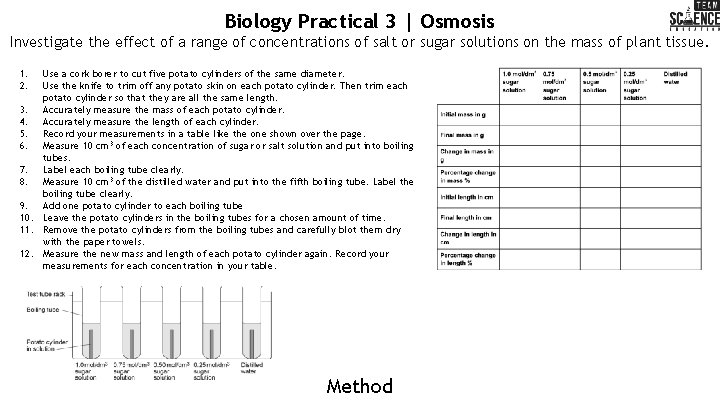
Biology Practical 3 | Osmosis Investigate the effect of a range of concentrations of salt or sugar solutions on the mass of plant tissue. 1. 2. Use a cork borer to cut five potato cylinders of the same diameter. Use the knife to trim off any potato skin on each potato cylinder. Then trim each potato cylinder so that they are all the same length. 3. Accurately measure the mass of each potato cylinder. 4. Accurately measure the length of each cylinder. 5. Record your measurements in a table like the one shown over the page. 6. Measure 10 cm 3 of each concentration of sugar or salt solution and put into boiling tubes. 7. Label each boiling tube clearly. 8. Measure 10 cm 3 of the distilled water and put into the fifth boiling tube. Label the boiling tube clearly. 9. Add one potato cylinder to each boiling tube 10. Leave the potato cylinders in the boiling tubes for a chosen amount of time. 11. Remove the potato cylinders from the boiling tubes and carefully blot them dry with the paper towels. 12. Measure the new mass and length of each potato cylinder again. Record your measurements for each concentration in your table. Method
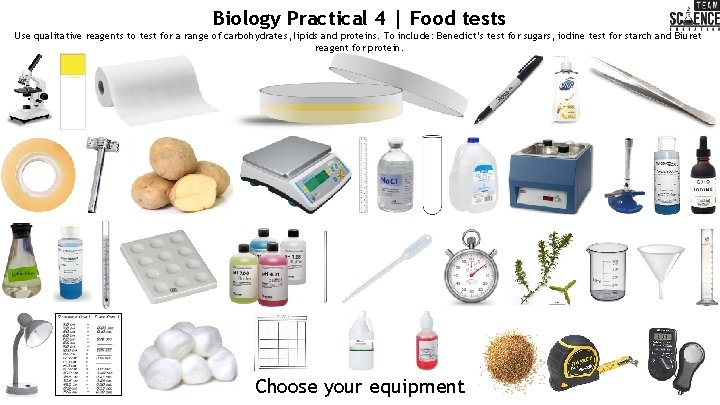
Biology Practical 4 | Food tests Use qualitative reagents to test for a range of carbohydrates, lipids and proteins. To include: Benedict’s test for sugars, iodine test for starch and Biuret reagent for protein. Choose your equipment

Biology Practical 4 | Food tests Use qualitative reagents to test for a range of carbohydrates, lipids and proteins. To include: Benedict’s test for sugars, iodine test for starch and Biuret reagent for protein. 1. 2. 3. 4. Benedicts a. Set up your traditional water bath set up using a Bunsen burner. b. Put some of the food sample into a test tube c. Add a few drops of Benedict’s solution to the sample in the test tube. d. Put the test tube in the water bath at a minimum of 80 °C for about 5 minutes. e. Note down any colour change in your table of results. Iodine a. Put some of the food sample into a test tube. b. Add a few drops of Iodine solution. c. Note down any colour change in your table of result Lipids a. Put some of the food sample into a test tube. b. Add a few drops of distilled water. c. Add a few drops of ethanol. d. Care: Ethanol is highly flammable. Keep the solution away from any flames. e. Shake the solution gently. f. Note what you see in your table of results. Protein a. Put some of the food sample into a test tube. b. Add 1 cm 3 of Biuret solution A and 1 cm 3 of Biuret solution B to the test tube. c. Care: Biuret solution contains copper sulphate, which is poisonous, and sodium hydroxide, which is corrosive. Handle the solution with care. Wash immediately if you spill it on your skin, and wipe up any spills. d. Shake the tube gently to mix. e. Note any colour change in your table of results Can you find the cider? 1. Control 2. Independent 3. Dependent 4. Equipment 5. Repeats
Biology Practical 4 | Food tests Use qualitative reagents to test for a range of carbohydrates, lipids and proteins. To include: Benedict’s test for sugars, iodine test for starch and Biuret reagent for protein. 1. 2. 3. 4. Benedicts a. Set up your traditional water bath set up using a Bunsen burner. b. Put some of the food sample into a test tube c. Add a few drops of Benedict’s solution to the sample in the test tube. d. Put the test tube in the water bath at a minimum of 80 °C for about 5 minutes. e. Note down any colour change in your table of results. Iodine a. Put some of the food sample into a test tube. b. Add a few drops of Iodine solution. c. Note down any colour change in your table of result Lipids a. Put some of the food sample into a test tube. b. Add a few drops of distilled water. c. Add a few drops of ethanol. d. Care: Ethanol is highly flammable. Keep the solution away from any flames. e. Shake the solution gently. f. Note what you see in your table of results. Protein a. Put some of the food sample into a test tube. b. Add 1 cm 3 of Biuret solution A and 1 cm 3 of Biuret solution B to the test tube. c. Care: Biuret solution contains copper sulphate, which is poisonous, and sodium hydroxide, which is corrosive. Handle the solution with care. Wash immediately if you spill it on your skin, and wipe up any spills. d. Shake the tube gently to mix. e. Note any colour change in your table of results Can you find the cider? 1. Control 2. Independent 3. Dependent 4. Equipment 5. Repeats
Biology Practical 4 | Food tests Use qualitative reagents to test for a range of carbohydrates, lipids and proteins. To include: Benedict’s test for sugars, iodine test for starch and Biuret reagent for protein. 1. 2. 3. 4. Benedicts a. Set up your traditional water bath set up using a Bunsen burner. b. Put some of the food sample into a test tube c. Add a few drops of Benedict’s solution to the sample in the test tube. d. Put the test tube in the water bath at a minimum of 80 °C for about 5 minutes. e. Note down any colour change in your table of results. Iodine a. Put some of the food sample into a test tube. b. Add a few drops of Iodine solution. c. Note down any colour change in your table of result Lipids a. Put some of the food sample into a test tube. b. Add a few drops of distilled water. c. Add a few drops of ethanol. d. Care: Ethanol is highly flammable. Keep the solution away from any flames. e. Shake the solution gently. f. Note what you see in your table of results. Protein a. Put some of the food sample into a test tube. b. Add 1 cm 3 of Biuret solution A and 1 cm 3 of Biuret solution B to the test tube. c. Care: Biuret solution contains copper sulphate, which is poisonous, and sodium hydroxide, which is corrosive. Handle the solution with care. Wash immediately if you spill it on your skin, and wipe up any spills. d. Shake the tube gently to mix. e. Note any colour change in your table of results Can you find the cider? 1. Control 2. Independent 3. Dependent 4. Equipment 5. Repeats
Biology Practical 4 | Food tests Use qualitative reagents to test for a range of carbohydrates, lipids and proteins. To include: Benedict’s test for sugars, iodine test for starch and Biuret reagent for protein. 1. 2. 3. 4. Benedicts a. Set up your traditional water bath set up using a Bunsen burner. b. Put some of the food sample into a test tube c. Add a few drops of Benedict’s solution to the sample in the test tube. d. Put the test tube in the water bath at a minimum of 80 °C for about 5 minutes. e. Note down any colour change in your table of results. Iodine a. Put some of the food sample into a test tube. b. Add a few drops of Iodine solution. c. Note down any colour change in your table of result Lipids a. Put some of the food sample into a test tube. b. Add a few drops of distilled water. c. Add a few drops of ethanol. d. Care: Ethanol is highly flammable. Keep the solution away from any flames. e. Shake the solution gently. f. Note what you see in your table of results. Protein a. Put some of the food sample into a test tube. b. Add 1 cm 3 of Biuret solution A and 1 cm 3 of Biuret solution B to the test tube. c. Care: Biuret solution contains copper sulphate, which is poisonous, and sodium hydroxide, which is corrosive. Handle the solution with care. Wash immediately if you spill it on your skin, and wipe up any spills. d. Shake the tube gently to mix. e. Note any colour change in your table of results Can you find the cider? 1. Control 2. Independent 3. Dependent 4. Equipment 5. Repeats
Biology Practical 4 | Food tests Use qualitative reagents to test for a range of carbohydrates, lipids and proteins. To include: Benedict’s test for sugars, iodine test for starch and Biuret reagent for protein. 1. 2. 3. 4. Benedicts a. Set up your traditional water bath set up using a Bunsen burner. b. Put some of the food sample into a test tube c. Add a few drops of Benedict’s solution to the sample in the test tube. d. Put the test tube in the water bath at a minimum of 80 °C for about 5 minutes. e. Note down any colour change in your table of results. Iodine a. Put some of the food sample into a test tube. b. Add a few drops of Iodine solution. c. Note down any colour change in your table of result Lipids a. Put some of the food sample into a test tube. b. Add a few drops of distilled water. c. Add a few drops of ethanol. d. Care: Ethanol is highly flammable. Keep the solution away from any flames. e. Shake the solution gently. f. Note what you see in your table of results. Protein a. Put some of the food sample into a test tube. b. Add 1 cm 3 of Biuret solution A and 1 cm 3 of Biuret solution B to the test tube. c. Care: Biuret solution contains copper sulphate, which is poisonous, and sodium hydroxide, which is corrosive. Handle the solution with care. Wash immediately if you spill it on your skin, and wipe up any spills. d. Shake the tube gently to mix. e. Note any colour change in your table of results Can you find the cider? 1. Control 2. Independent 3. Dependent 4. Equipment 5. Repeats
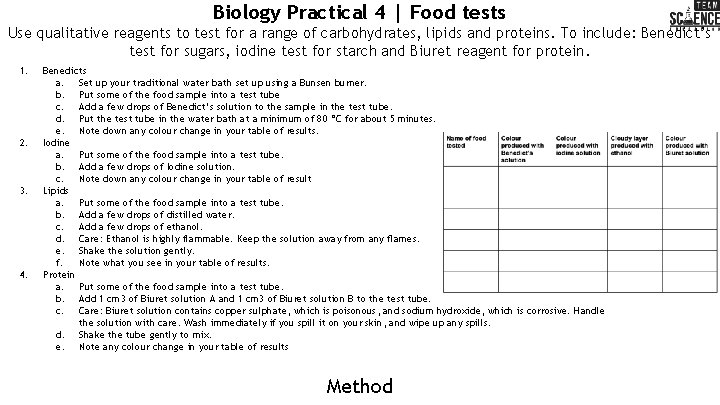
Biology Practical 4 | Food tests Use qualitative reagents to test for a range of carbohydrates, lipids and proteins. To include: Benedict’s test for sugars, iodine test for starch and Biuret reagent for protein. 1. 2. 3. 4. Benedicts a. Set up your traditional water bath set up using a Bunsen burner. b. Put some of the food sample into a test tube c. Add a few drops of Benedict’s solution to the sample in the test tube. d. Put the test tube in the water bath at a minimum of 80 °C for about 5 minutes. e. Note down any colour change in your table of results. Iodine a. Put some of the food sample into a test tube. b. Add a few drops of Iodine solution. c. Note down any colour change in your table of result Lipids a. Put some of the food sample into a test tube. b. Add a few drops of distilled water. c. Add a few drops of ethanol. d. Care: Ethanol is highly flammable. Keep the solution away from any flames. e. Shake the solution gently. f. Note what you see in your table of results. Protein a. Put some of the food sample into a test tube. b. Add 1 cm 3 of Biuret solution A and 1 cm 3 of Biuret solution B to the test tube. c. Care: Biuret solution contains copper sulphate, which is poisonous, and sodium hydroxide, which is corrosive. Handle the solution with care. Wash immediately if you spill it on your skin, and wipe up any spills. d. Shake the tube gently to mix. e. Note any colour change in your table of results Method
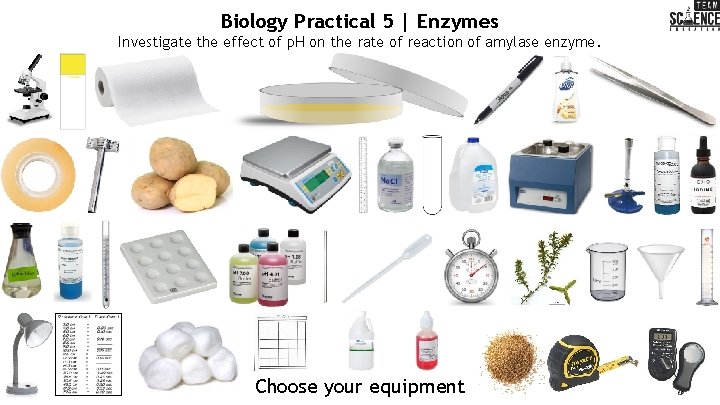
Biology Practical 5 | Enzymes Investigate the effect of p. H on the rate of reaction of amylase enzyme. Choose your equipment
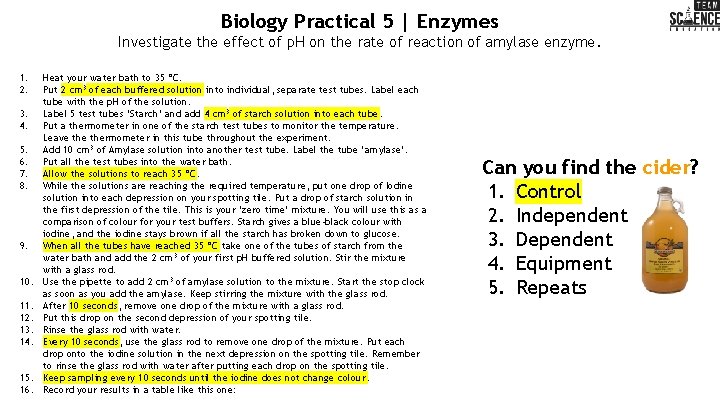
Biology Practical 5 | Enzymes Investigate the effect of p. H on the rate of reaction of amylase enzyme. 1. 2. 3. 4. 5. 6. 7. 8. 9. 10. 11. 12. 13. 14. 15. 16. Heat your water bath to 35 °C. Put 2 cm 3 of each buffered solution into individual, separate test tubes. Label each tube with the p. H of the solution. Label 5 test tubes ‘Starch’ and add 4 cm 3 of starch solution into each tube. Put a thermometer in one of the starch test tubes to monitor the temperature. Leave thermometer in this tube throughout the experiment. Add 10 cm 3 of Amylase solution into another test tube. Label the tube ‘amylase’. Put all the test tubes into the water bath. Allow the solutions to reach 35 °C. While the solutions are reaching the required temperature, put one drop of Iodine solution into each depression on your spotting tile. Put a drop of starch solution in the first depression of the tile. This is your ‘zero time’ mixture. You will use this as a comparison of colour for your test buffers. Starch gives a blue-black colour with iodine, and the iodine stays brown if all the starch has broken down to glucose. When all the tubes have reached 35 °C take one of the tubes of starch from the water bath and add the 2 cm 3 of your first p. H buffered solution. Stir the mixture with a glass rod. Use the pipette to add 2 cm 3 of amylase solution to the mixture. Start the stop clock as soon as you add the amylase. Keep stirring the mixture with the glass rod. After 10 seconds, remove one drop of the mixture with a glass rod. Put this drop on the second depression of your spotting tile. Rinse the glass rod with water. Every 10 seconds, use the glass rod to remove one drop of the mixture. Put each drop onto the iodine solution in the next depression on the spotting tile. Remember to rinse the glass rod with water after putting each drop on the spotting tile. Keep sampling every 10 seconds until the iodine does not change colour. Record your results in a table like this one: Can you find the cider? 1. Control 2. Independent 3. Dependent 4. Equipment 5. Repeats
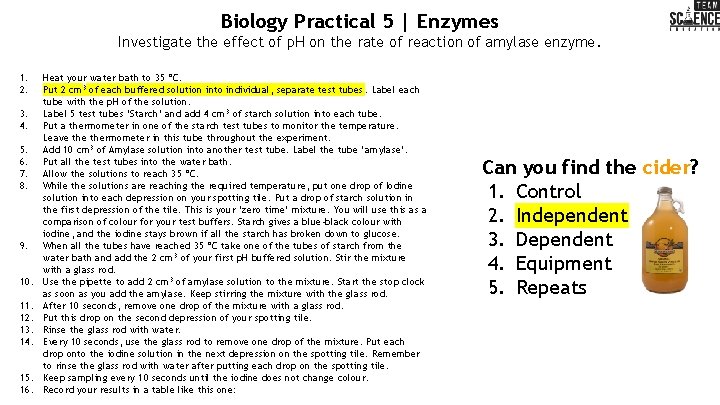
Biology Practical 5 | Enzymes Investigate the effect of p. H on the rate of reaction of amylase enzyme. 1. 2. 3. 4. 5. 6. 7. 8. 9. 10. 11. 12. 13. 14. 15. 16. Heat your water bath to 35 °C. Put 2 cm 3 of each buffered solution into individual, separate test tubes. Label each tube with the p. H of the solution. Label 5 test tubes ‘Starch’ and add 4 cm 3 of starch solution into each tube. Put a thermometer in one of the starch test tubes to monitor the temperature. Leave thermometer in this tube throughout the experiment. Add 10 cm 3 of Amylase solution into another test tube. Label the tube ‘amylase’. Put all the test tubes into the water bath. Allow the solutions to reach 35 °C. While the solutions are reaching the required temperature, put one drop of Iodine solution into each depression on your spotting tile. Put a drop of starch solution in the first depression of the tile. This is your ‘zero time’ mixture. You will use this as a comparison of colour for your test buffers. Starch gives a blue-black colour with iodine, and the iodine stays brown if all the starch has broken down to glucose. When all the tubes have reached 35 °C take one of the tubes of starch from the water bath and add the 2 cm 3 of your first p. H buffered solution. Stir the mixture with a glass rod. Use the pipette to add 2 cm 3 of amylase solution to the mixture. Start the stop clock as soon as you add the amylase. Keep stirring the mixture with the glass rod. After 10 seconds, remove one drop of the mixture with a glass rod. Put this drop on the second depression of your spotting tile. Rinse the glass rod with water. Every 10 seconds, use the glass rod to remove one drop of the mixture. Put each drop onto the iodine solution in the next depression on the spotting tile. Remember to rinse the glass rod with water after putting each drop on the spotting tile. Keep sampling every 10 seconds until the iodine does not change colour. Record your results in a table like this one: Can you find the cider? 1. Control 2. Independent 3. Dependent 4. Equipment 5. Repeats
Biology Practical 5 | Enzymes Investigate the effect of p. H on the rate of reaction of amylase enzyme. 1. 2. 3. 4. 5. 6. 7. 8. 9. 10. 11. 12. 13. 14. 15. 16. Heat your water bath to 35 °C. Put 2 cm 3 of each buffered solution into individual, separate test tubes. Label each tube with the p. H of the solution. Label 5 test tubes ‘Starch’ and add 4 cm 3 of starch solution into each tube. Put a thermometer in one of the starch test tubes to monitor the temperature. Leave thermometer in this tube throughout the experiment. Add 10 cm 3 of Amylase solution into another test tube. Label the tube ‘amylase’. Put all the test tubes into the water bath. Allow the solutions to reach 35 °C. While the solutions are reaching the required temperature, put one drop of Iodine solution into each depression on your spotting tile. Put a drop of starch solution in the first depression of the tile. This is your ‘zero time’ mixture. You will use this as a comparison of colour for your test buffers. Starch gives a blue-black colour with iodine, and the iodine stays brown if all the starch has broken down to glucose. When all the tubes have reached 35 °C take one of the tubes of starch from the water bath and add the 2 cm 3 of your first p. H buffered solution. Stir the mixture with a glass rod. Use the pipette to add 2 cm 3 of amylase solution to the mixture. Start the stop clock as soon as you add the amylase. Keep stirring the mixture with the glass rod. After 10 seconds, remove one drop of the mixture with a glass rod. Put this drop on the second depression of your spotting tile. Rinse the glass rod with water. Every 10 seconds, use the glass rod to remove one drop of the mixture. Put each drop onto the iodine solution in the next depression on the spotting tile. Remember to rinse the glass rod with water after putting each drop on the spotting tile. Keep sampling every 10 seconds until the iodine does not change colour. Record your results in a table like this one: Can you find the cider? 1. Control 2. Independent 3. Dependent 4. Equipment 5. Repeats
Biology Practical 5 | Enzymes Investigate the effect of p. H on the rate of reaction of amylase enzyme. 1. 2. 3. 4. 5. 6. 7. 8. 9. 10. 11. 12. 13. 14. 15. 16. Heat your water bath to 35 °C. Put 2 cm 3 of each buffered solution into individual, separate test tubes. Label each tube with the p. H of the solution. Label 5 test tubes ‘Starch’ and add 4 cm 3 of starch solution into each tube. Put a thermometer in one of the starch test tubes to monitor the temperature. Leave thermometer in this tube throughout the experiment. Add 10 cm 3 of Amylase solution into another test tube. Label the tube ‘amylase’. Put all the test tubes into the water bath. Allow the solutions to reach 35 °C. While the solutions are reaching the required temperature, put one drop of Iodine solution into each depression on your spotting tile. Put a drop of starch solution in the first depression of the tile. This is your ‘zero time’ mixture. You will use this as a comparison of colour for your test buffers. Starch gives a blue-black colour with iodine, and the iodine stays brown if all the starch has broken down to glucose. When all the tubes have reached 35 °C take one of the tubes of starch from the water bath and add the 2 cm 3 of your first p. H buffered solution. Stir the mixture with a glass rod. Use the pipette to add 2 cm 3 of amylase solution to the mixture. Start the stop clock as soon as you add the amylase. Keep stirring the mixture with the glass rod. After 10 seconds, remove one drop of the mixture with a glass rod. Put this drop on the second depression of your spotting tile. Rinse the glass rod with water. Every 10 seconds, use the glass rod to remove one drop of the mixture. Put each drop onto the iodine solution in the next depression on the spotting tile. Remember to rinse the glass rod with water after putting each drop on the spotting tile. Keep sampling every 10 seconds until the iodine does not change colour. Record your results in a table like this one: Can you find the cider? 1. Control 2. Independent 3. Dependent 4. Equipment 5. Repeats
Biology Practical 5 | Enzymes Investigate the effect of p. H on the rate of reaction of amylase enzyme. 1. 2. 3. 4. 5. 6. 7. 8. 9. 10. 11. 12. 13. 14. 15. 16. Heat your water bath to 35 °C. Put 2 cm 3 of each buffered solution into individual, separate test tubes. Label each tube with the p. H of the solution. Label 5 test tubes ‘Starch’ and add 4 cm 3 of starch solution into each tube. Put a thermometer in one of the starch test tubes to monitor the temperature. Leave thermometer in this tube throughout the experiment. Add 10 cm 3 of Amylase solution into another test tube. Label the tube ‘amylase’. Put all the test tubes into the water bath. Allow the solutions to reach 35 °C. While the solutions are reaching the required temperature, put one drop of Iodine solution into each depression on your spotting tile. Put a drop of starch solution in the first depression of the tile. This is your ‘zero time’ mixture. You will use this as a comparison of colour for your test buffers. Starch gives a blue-black colour with iodine, and the iodine stays brown if all the starch has broken down to glucose. When all the tubes have reached 35 °C take one of the tubes of starch from the water bath and add the 2 cm 3 of your first p. H buffered solution. Stir the mixture with a glass rod. Use the pipette to add 2 cm 3 of amylase solution to the mixture. Start the stop clock as soon as you add the amylase. Keep stirring the mixture with the glass rod. After 10 seconds, remove one drop of the mixture with a glass rod. Put this drop on the second depression of your spotting tile. Rinse the glass rod with water. Every 10 seconds, use the glass rod to remove one drop of the mixture. Put each drop onto the iodine solution in the next depression on the spotting tile. Remember to rinse the glass rod with water after putting each drop on the spotting tile. Keep sampling every 10 seconds until the iodine does not change colour. Record your results in a table like this one: Can you find the cider? 1. Control 2. Independent 3. Dependent 4. Equipment 5. Repeats
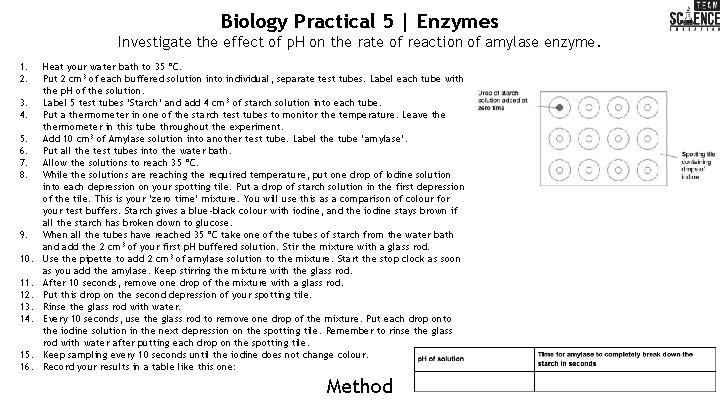
Biology Practical 5 | Enzymes Investigate the effect of p. H on the rate of reaction of amylase enzyme. 1. 2. 3. 4. 5. 6. 7. 8. 9. 10. 11. 12. 13. 14. 15. 16. Heat your water bath to 35 °C. Put 2 cm 3 of each buffered solution into individual, separate test tubes. Label each tube with the p. H of the solution. Label 5 test tubes ‘Starch’ and add 4 cm 3 of starch solution into each tube. Put a thermometer in one of the starch test tubes to monitor the temperature. Leave thermometer in this tube throughout the experiment. Add 10 cm 3 of Amylase solution into another test tube. Label the tube ‘amylase’. Put all the test tubes into the water bath. Allow the solutions to reach 35 °C. While the solutions are reaching the required temperature, put one drop of Iodine solution into each depression on your spotting tile. Put a drop of starch solution in the first depression of the tile. This is your ‘zero time’ mixture. You will use this as a comparison of colour for your test buffers. Starch gives a blue-black colour with iodine, and the iodine stays brown if all the starch has broken down to glucose. When all the tubes have reached 35 °C take one of the tubes of starch from the water bath and add the 2 cm 3 of your first p. H buffered solution. Stir the mixture with a glass rod. Use the pipette to add 2 cm 3 of amylase solution to the mixture. Start the stop clock as soon as you add the amylase. Keep stirring the mixture with the glass rod. After 10 seconds, remove one drop of the mixture with a glass rod. Put this drop on the second depression of your spotting tile. Rinse the glass rod with water. Every 10 seconds, use the glass rod to remove one drop of the mixture. Put each drop onto the iodine solution in the next depression on the spotting tile. Remember to rinse the glass rod with water after putting each drop on the spotting tile. Keep sampling every 10 seconds until the iodine does not change colour. Record your results in a table like this one: Method
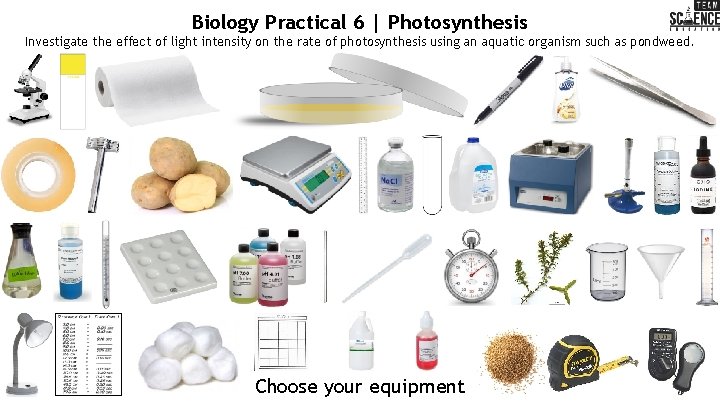
Biology Practical 6 | Photosynthesis Investigate the effect of light intensity on the rate of photosynthesis using an aquatic organism such as pondweed. Choose your equipment
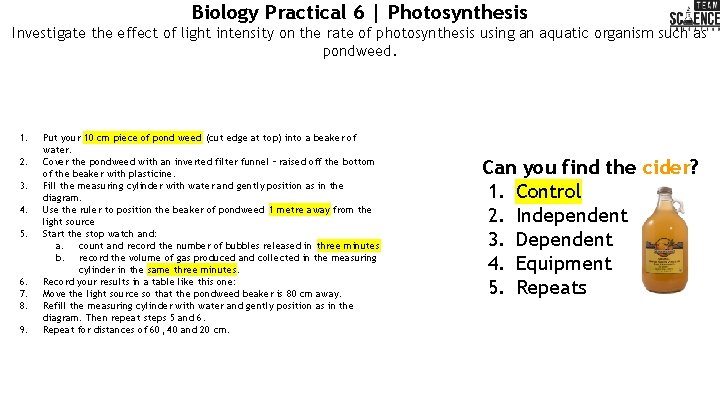
Biology Practical 6 | Photosynthesis Investigate the effect of light intensity on the rate of photosynthesis using an aquatic organism such as pondweed. 1. 2. 3. 4. 5. 6. 7. 8. 9. Put your 10 cm piece of pond weed (cut edge at top) into a beaker of water. Cover the pondweed with an inverted filter funnel – raised off the bottom of the beaker with plasticine. Fill the measuring cylinder with water and gently position as in the diagram. Use the ruler to position the beaker of pondweed 1 metre away from the light source Start the stop watch and: a. count and record the number of bubbles released in three minutes b. record the volume of gas produced and collected in the measuring cylinder in the same three minutes. Record your results in a table like this one: Move the light source so that the pondweed beaker is 80 cm away. Refill the measuring cylinder with water and gently position as in the diagram. Then repeat steps 5 and 6. Repeat for distances of 60, 40 and 20 cm. Can you find the cider? 1. Control 2. Independent 3. Dependent 4. Equipment 5. Repeats
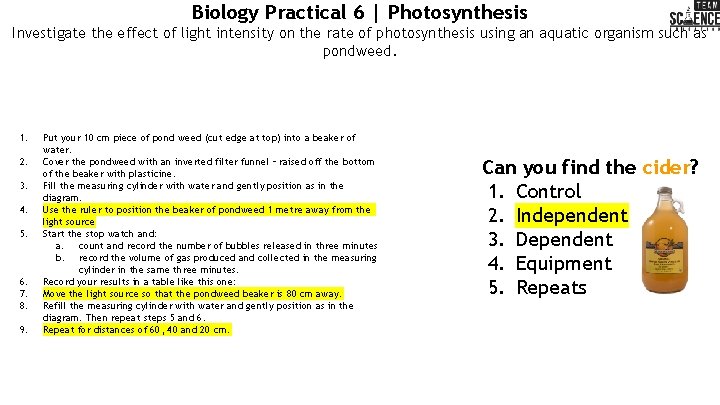
Biology Practical 6 | Photosynthesis Investigate the effect of light intensity on the rate of photosynthesis using an aquatic organism such as pondweed. 1. 2. 3. 4. 5. 6. 7. 8. 9. Put your 10 cm piece of pond weed (cut edge at top) into a beaker of water. Cover the pondweed with an inverted filter funnel – raised off the bottom of the beaker with plasticine. Fill the measuring cylinder with water and gently position as in the diagram. Use the ruler to position the beaker of pondweed 1 metre away from the light source Start the stop watch and: a. count and record the number of bubbles released in three minutes b. record the volume of gas produced and collected in the measuring cylinder in the same three minutes. Record your results in a table like this one: Move the light source so that the pondweed beaker is 80 cm away. Refill the measuring cylinder with water and gently position as in the diagram. Then repeat steps 5 and 6. Repeat for distances of 60, 40 and 20 cm. Can you find the cider? 1. Control 2. Independent 3. Dependent 4. Equipment 5. Repeats
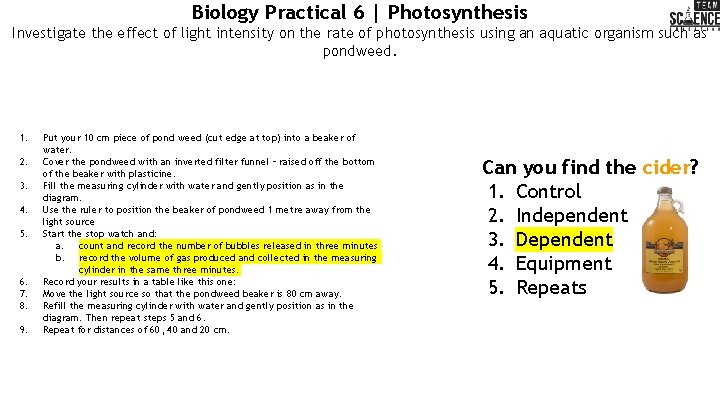
Biology Practical 6 | Photosynthesis Investigate the effect of light intensity on the rate of photosynthesis using an aquatic organism such as pondweed. 1. 2. 3. 4. 5. 6. 7. 8. 9. Put your 10 cm piece of pond weed (cut edge at top) into a beaker of water. Cover the pondweed with an inverted filter funnel – raised off the bottom of the beaker with plasticine. Fill the measuring cylinder with water and gently position as in the diagram. Use the ruler to position the beaker of pondweed 1 metre away from the light source Start the stop watch and: a. count and record the number of bubbles released in three minutes b. record the volume of gas produced and collected in the measuring cylinder in the same three minutes. Record your results in a table like this one: Move the light source so that the pondweed beaker is 80 cm away. Refill the measuring cylinder with water and gently position as in the diagram. Then repeat steps 5 and 6. Repeat for distances of 60, 40 and 20 cm. Can you find the cider? 1. Control 2. Independent 3. Dependent 4. Equipment 5. Repeats
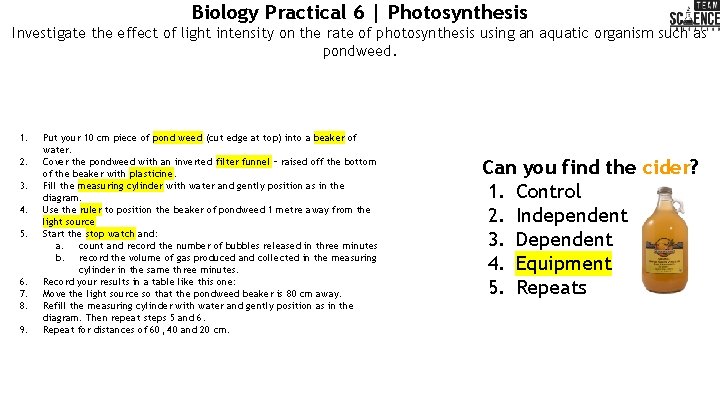
Biology Practical 6 | Photosynthesis Investigate the effect of light intensity on the rate of photosynthesis using an aquatic organism such as pondweed. 1. 2. 3. 4. 5. 6. 7. 8. 9. Put your 10 cm piece of pond weed (cut edge at top) into a beaker of water. Cover the pondweed with an inverted filter funnel – raised off the bottom of the beaker with plasticine. Fill the measuring cylinder with water and gently position as in the diagram. Use the ruler to position the beaker of pondweed 1 metre away from the light source Start the stop watch and: a. count and record the number of bubbles released in three minutes b. record the volume of gas produced and collected in the measuring cylinder in the same three minutes. Record your results in a table like this one: Move the light source so that the pondweed beaker is 80 cm away. Refill the measuring cylinder with water and gently position as in the diagram. Then repeat steps 5 and 6. Repeat for distances of 60, 40 and 20 cm. Can you find the cider? 1. Control 2. Independent 3. Dependent 4. Equipment 5. Repeats
Biology Practical 6 | Photosynthesis Investigate the effect of light intensity on the rate of photosynthesis using an aquatic organism such as pondweed. 1. 2. 3. 4. 5. 6. 7. 8. 9. Put your 10 cm piece of pond weed (cut edge at top) into a beaker of water. Cover the pondweed with an inverted filter funnel – raised off the bottom of the beaker with plasticine. Fill the measuring cylinder with water and gently position as in the diagram. Use the ruler to position the beaker of pondweed 1 metre away from the light source Start the stop watch and: a. count and record the number of bubbles released in three minutes b. record the volume of gas produced and collected in the measuring cylinder in the same three minutes. Record your results in a table like this one: Move the light source so that the pondweed beaker is 80 cm away. Refill the measuring cylinder with water and gently position as in the diagram. Then repeat steps 5 and 6. Repeat for distances of 60, 40 and 20 cm. Can you find the cider? 1. Control 2. Independent 3. Dependent 4. Equipment 5. Repeats
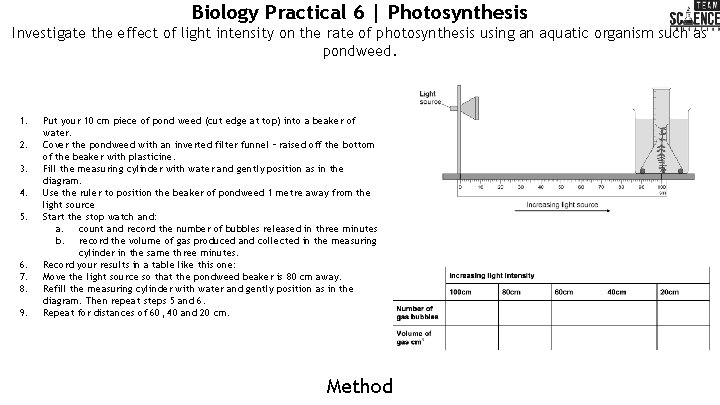
Biology Practical 6 | Photosynthesis Investigate the effect of light intensity on the rate of photosynthesis using an aquatic organism such as pondweed. 1. 2. 3. 4. 5. 6. 7. 8. 9. Put your 10 cm piece of pond weed (cut edge at top) into a beaker of water. Cover the pondweed with an inverted filter funnel – raised off the bottom of the beaker with plasticine. Fill the measuring cylinder with water and gently position as in the diagram. Use the ruler to position the beaker of pondweed 1 metre away from the light source Start the stop watch and: a. count and record the number of bubbles released in three minutes b. record the volume of gas produced and collected in the measuring cylinder in the same three minutes. Record your results in a table like this one: Move the light source so that the pondweed beaker is 80 cm away. Refill the measuring cylinder with water and gently position as in the diagram. Then repeat steps 5 and 6. Repeat for distances of 60, 40 and 20 cm. Method
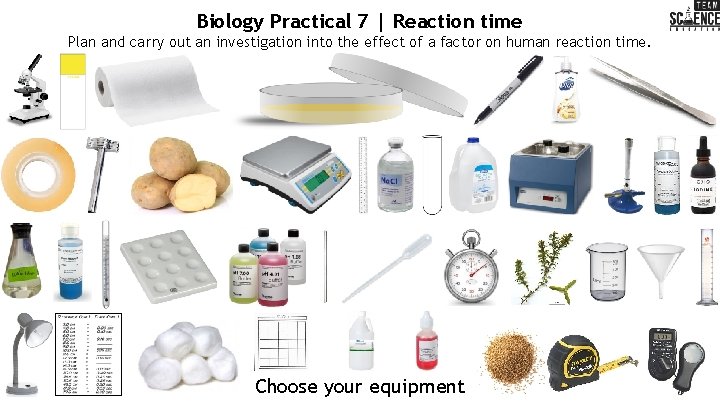
Biology Practical 7 | Reaction time Plan and carry out an investigation into the effect of a factor on human reaction time. Choose your equipment
Biology Practical 7 | Reaction time Plan and carry out an investigation into the effect of a factor on human reaction time. 1. 2. 3. 4. 5. 6. 7. 8. 9. 10. 11. 12. 13. 14. Work with a partner to do this test. Choose who will be person 1 and who will be person 2. Each of you should use your dominant hand to do this experiment. If you are right handed then your dominant hand is your right hand. Person 1 sits down on the chair, with good upright posture and eyes looking across the room. Person 1 puts the forearm of their dominant arm across the table with their hand overhanging the edge. Person 2 holds a ruler vertically with the bottom end (the end with the 0 cm mark) in between person 1’s thumb and first finger. They will tell person 1 to prepare to catch the ruler. Person 1 catches the ruler with their thumb and first finger as quickly as possible when it drops. Record the number on the ruler that is level with the top of person 1’s thumb. Have a short rest, then repeat the test several times. Record your results on a table. Repeat the test with Person 2 catching the ruler and Person 1 dropping it. Record Person 2’s results on the table. Use a conversion table to convert your ruler measurements into reaction times. Make the change that you are investigating to change human reaction time. Repeat steps 1 -9 for each person and record the results in your data table. Can you find the cider? 1. Control 2. Independent 3. Dependent 4. Equipment 5. Repeats
Biology Practical 7 | Reaction time Plan and carry out an investigation into the effect of a factor on human reaction time. 1. 2. 3. 4. 5. 6. 7. 8. 9. 10. 11. 12. 13. 14. Work with a partner to do this test. Choose who will be person 1 and who will be person 2. Each of you should use your dominant hand to do this experiment. If you are right handed then your dominant hand is your right hand. Person 1 sits down on the chair, with good upright posture and eyes looking across the room. Person 1 puts the forearm of their dominant arm across the table with their hand overhanging the edge. Person 2 holds a ruler vertically with the bottom end (the end with the 0 cm mark) in between person 1’s thumb and first finger. They will tell person 1 to prepare to catch the ruler. Person 1 catches the ruler with their thumb and first finger as quickly as possible when it drops. Record the number on the ruler that is level with the top of person 1’s thumb. Have a short rest, then repeat the test several times. Record your results on a table. Repeat the test with Person 2 catching the ruler and Person 1 dropping it. Record Person 2’s results on the table. Use a conversion table to convert your ruler measurements into reaction times. Make the change that you are investigating to change human reaction time. Repeat steps 1 -9 for each person and record the results in your data table. Can you find the cider? 1. Control 2. Independent 3. Dependent 4. Equipment 5. Repeats
Biology Practical 7 | Reaction time Plan and carry out an investigation into the effect of a factor on human reaction time. 1. 2. 3. 4. 5. 6. 7. 8. 9. 10. 11. 12. 13. 14. 15. Work with a partner to do this test. Choose who will be person 1 and who will be person 2. Each of you should use your dominant hand to do this experiment. If you are right handed then your dominant hand is your right hand. Person 1 sits down on the chair, with good upright posture and eyes looking across the room. Person 1 puts the forearm of their dominant arm across the table with their hand overhanging the edge. Person 2 holds a ruler vertically with the bottom end (the end with the 0 cm mark) in between person 1’s thumb and first finger. They will tell person 1 to prepare to catch the ruler. Person 1 catches the ruler with their thumb and first finger as quickly as possible when it drops. Record the number on the ruler that is level with the top of person 1’s thumb. Have a short rest, then repeat the test several times. Record your results on a table. Repeat the test with Person 2 catching the ruler and Person 1 dropping it. Record Person 2’s results on the table. Use a conversion table to convert your ruler measurements into reaction times. Make the change that you are investigating to change human reaction time. Repeat steps 1 -9 for each person and record the results in your data table. Can you find the cider? 1. Control 2. Independent 3. Dependent 4. Equipment 5. Repeats
Biology Practical 7 | Reaction time Plan and carry out an investigation into the effect of a factor on human reaction time. 1. 2. 3. 4. 5. 6. 7. 8. 9. 10. 11. 12. 13. 14. Work with a partner to do this test. Choose who will be person 1 and who will be person 2. Each of you should use your dominant hand to do this experiment. If you are right handed then your dominant hand is your right hand. Person 1 sits down on the chair, with good upright posture and eyes looking across the room. Person 1 puts the forearm of their dominant arm across the table with their hand overhanging the edge. Person 2 holds a ruler vertically with the bottom end (the end with the 0 cm mark) in between person 1’s thumb and first finger. They will tell person 1 to prepare to catch the ruler. Person 1 catches the ruler with their thumb and first finger as quickly as possible when it drops. Record the number on the ruler that is level with the top of person 1’s thumb. Have a short rest, then repeat the test several times. Record your results on a table. Repeat the test with Person 2 catching the ruler and Person 1 dropping it. Record Person 2’s results on the table. Use a conversion table to convert your ruler measurements into reaction times. Make the change that you are investigating to change human reaction time. Repeat steps 1 -9 for each person and record the results in your data table. Can you find the cider? 1. Control 2. Independent 3. Dependent 4. Equipment 5. Repeats
Biology Practical 7 | Reaction time Plan and carry out an investigation into the effect of a factor on human reaction time. 1. 2. 3. 4. 5. 6. 7. 8. 9. 10. 11. 12. 13. 14. 15. Work with a partner to do this test. Choose who will be person 1 and who will be person 2. Each of you should use your dominant hand to do this experiment. If you are right handed then your dominant hand is your right hand. Person 1 sits down on the chair, with good upright posture and eyes looking across the room. Person 1 puts the forearm of their dominant arm across the table with their hand overhanging the edge. Person 2 holds a ruler vertically with the bottom end (the end with the 0 cm mark) in between person 1’s thumb and first finger. They will tell person 1 to prepare to catch the ruler. Person 1 catches the ruler with their thumb and first finger as quickly as possible when it drops. Record the number on the ruler that is level with the top of person 1’s thumb. Have a short rest, then repeat the test several times. Record your results on a table. Repeat the test with Person 2 catching the ruler and Person 1 dropping it. Record Person 2’s results on the table. Use a conversion table to convert your ruler measurements into reaction times. Make the change that you are investigating to change human reaction time. Repeat steps 1 -9 for each person and record the results in your data table. Can you find the cider? 1. Control 2. Independent 3. Dependent 4. Equipment 5. Repeats
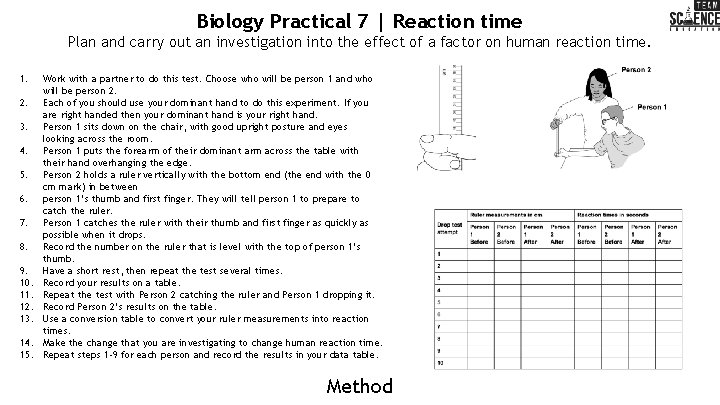
Biology Practical 7 | Reaction time Plan and carry out an investigation into the effect of a factor on human reaction time. 1. 2. 3. 4. 5. 6. 7. 8. 9. 10. 11. 12. 13. 14. 15. Work with a partner to do this test. Choose who will be person 1 and who will be person 2. Each of you should use your dominant hand to do this experiment. If you are right handed then your dominant hand is your right hand. Person 1 sits down on the chair, with good upright posture and eyes looking across the room. Person 1 puts the forearm of their dominant arm across the table with their hand overhanging the edge. Person 2 holds a ruler vertically with the bottom end (the end with the 0 cm mark) in between person 1’s thumb and first finger. They will tell person 1 to prepare to catch the ruler. Person 1 catches the ruler with their thumb and first finger as quickly as possible when it drops. Record the number on the ruler that is level with the top of person 1’s thumb. Have a short rest, then repeat the test several times. Record your results on a table. Repeat the test with Person 2 catching the ruler and Person 1 dropping it. Record Person 2’s results on the table. Use a conversion table to convert your ruler measurements into reaction times. Make the change that you are investigating to change human reaction time. Repeat steps 1 -9 for each person and record the results in your data table. Method
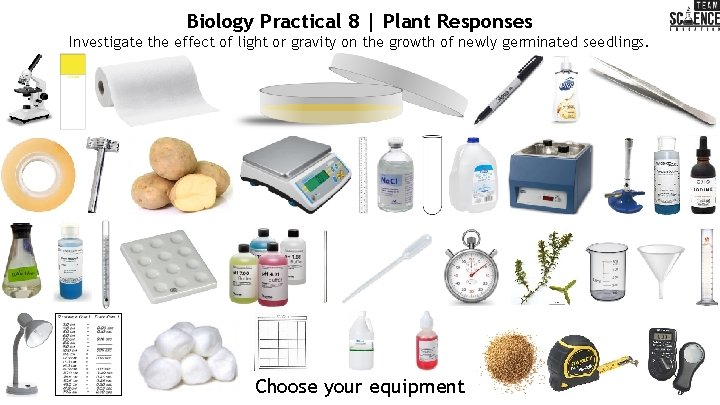
Biology Practical 8 | Plant Responses Investigate the effect of light or gravity on the growth of newly germinated seedlings. Choose your equipment
Biology Practical 8 | Plant Responses Investigate the effect of light or gravity on the growth of newly germinated seedlings. 1. Set up three petri dishes containing cotton wool soaked in equal amounts of water. 2. Put ten mustard seeds in each dish. 3. Put the dishes in a warm place. They must not be disturbed or moved. 4. Allow the mustard seeds to germinate. 5. Water daily with equal amounts of water to each dish. 6. Each dish should have the same number of seedlings after the seeds have germinated. 7. Remove excess seedlings from any dish that has too many. 8. Measure the height of each seedling in mm. 9. Move the petri dishes into position. a. Put one on a windowsill in full sunlight. b. Put the second one in partial light. c. Put the third one in darkness. 10. Measure the height of each seedling every day, for at least five consecutive days. 11. Record the heights in a table. Can you find the cider? 1. Control 2. Independent 3. Dependent 4. Equipment 5. Repeats
Biology Practical 8 | Plant Responses Investigate the effect of light or gravity on the growth of newly germinated seedlings. 1. Set up three petri dishes containing cotton wool soaked in equal amounts of water. 2. Put ten mustard seeds in each dish. 3. Put the dishes in a warm place. They must not be disturbed or moved. 4. Allow the mustard seeds to germinate. 5. Water daily with equal amounts of water to each dish. 6. Each dish should have the same number of seedlings after the seeds have germinated. 7. Remove excess seedlings from any dish that has too many. 8. Measure the height of each seedling in mm. 9. Move the petri dishes into position. a. Put one on a windowsill in full sunlight. b. Put the second one in partial light. c. Put the third one in darkness. 10. Measure the height of each seedling every day, for at least five consecutive days. 11. Record the heights in a table. Can you find the cider? 1. Control 2. Independent 3. Dependent 4. Equipment 5. Repeats
Biology Practical 8 | Plant Responses Investigate the effect of light or gravity on the growth of newly germinated seedlings. 1. Set up three petri dishes containing cotton wool soaked in equal amounts of water. 2. Put ten mustard seeds in each dish. 3. Put the dishes in a warm place. They must not be disturbed or moved. 4. Allow the mustard seeds to germinate. 5. Water daily with equal amounts of water to each dish. 6. Each dish should have the same number of seedlings after the seeds have germinated. 7. Remove excess seedlings from any dish that has too many. 8. Measure the height of each seedling in mm. 9. Move the petri dishes into position. a. Put one on a windowsill in full sunlight. b. Put the second one in partial light. c. Put the third one in darkness. 10. Measure the height of each seedling every day, for at least five consecutive days. 11. Record the heights in a table. Can you find the cider? 1. Control 2. Independent 3. Dependent 4. Equipment 5. Repeats
Biology Practical 8 | Plant Responses Investigate the effect of light or gravity on the growth of newly germinated seedlings. 1. Set up three petri dishes containing cotton wool soaked in equal amounts of water. 2. Put ten mustard seeds in each dish. 3. Put the dishes in a warm place. They must not be disturbed or moved. 4. Allow the mustard seeds to germinate. 5. Water daily with equal amounts of water to each dish. 6. Each dish should have the same number of seedlings after the seeds have germinated. 7. Remove excess seedlings from any dish that has too many. 8. Measure the height of each seedling in mm. 9. Move the petri dishes into position. a. Put one on a windowsill in full sunlight. b. Put the second one in partial light. c. Put the third one in darkness. 10. Measure the height of each seedling every day, for at least five consecutive days. 11. Record the heights in a table. Can you find the cider? 1. Control 2. Independent 3. Dependent 4. Equipment 5. Repeats
Biology Practical 8 | Plant Responses Investigate the effect of light or gravity on the growth of newly germinated seedlings. 1. Set up three petri dishes containing cotton wool soaked in equal amounts of water. 2. Put ten mustard seeds in each dish. 3. Put the dishes in a warm place. They must not be disturbed or moved. 4. Allow the mustard seeds to germinate. 5. Water daily with equal amounts of water to each dish. 6. Each dish should have the same number of seedlings after the seeds have germinated. 7. Remove excess seedlings from any dish that has too many. 8. Measure the height of each seedling in mm. 9. Move the petri dishes into position. a. Put one on a windowsill in full sunlight. b. Put the second one in partial light. c. Put the third one in darkness. 10. Measure the height of each seedling every day, for at least five consecutive days. 11. Record the heights in a table. Can you find the cider? 1. Control 2. Independent 3. Dependent 4. Equipment 5. Repeats
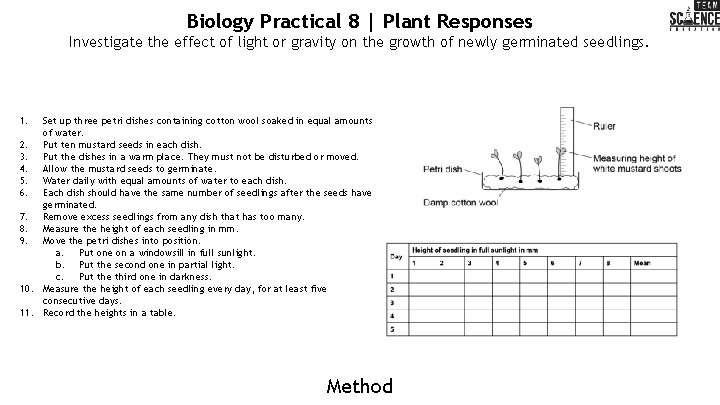
Biology Practical 8 | Plant Responses Investigate the effect of light or gravity on the growth of newly germinated seedlings. 1. Set up three petri dishes containing cotton wool soaked in equal amounts of water. 2. Put ten mustard seeds in each dish. 3. Put the dishes in a warm place. They must not be disturbed or moved. 4. Allow the mustard seeds to germinate. 5. Water daily with equal amounts of water to each dish. 6. Each dish should have the same number of seedlings after the seeds have germinated. 7. Remove excess seedlings from any dish that has too many. 8. Measure the height of each seedling in mm. 9. Move the petri dishes into position. a. Put one on a windowsill in full sunlight. b. Put the second one in partial light. c. Put the third one in darkness. 10. Measure the height of each seedling every day, for at least five consecutive days. 11. Record the heights in a table. Method
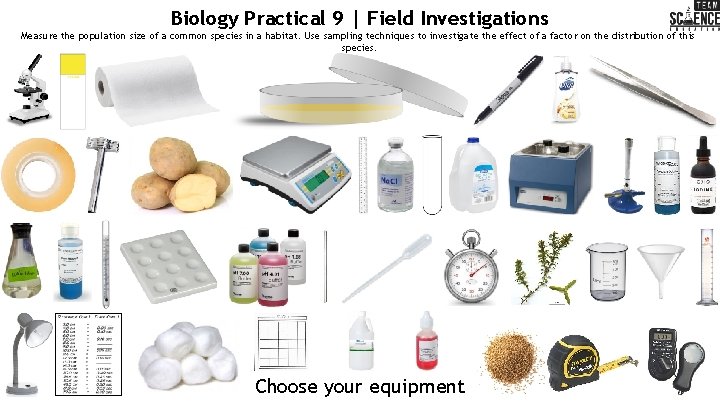
Biology Practical 9 | Field Investigations Measure the population size of a common species in a habitat. Use sampling techniques to investigate the effect of a factor on the distribution of this species. Choose your equipment
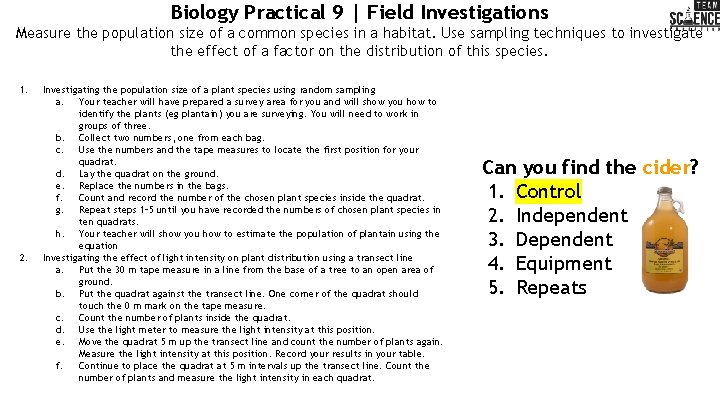
Biology Practical 9 | Field Investigations Measure the population size of a common species in a habitat. Use sampling techniques to investigate the effect of a factor on the distribution of this species. 1. 2. Investigating the population size of a plant species using random sampling a. Your teacher will have prepared a survey area for you and will show you how to identify the plants (eg plantain) you are surveying. You will need to work in groups of three. b. Collect two numbers, one from each bag. c. Use the numbers and the tape measures to locate the first position for your quadrat. d. Lay the quadrat on the ground. e. Replace the numbers in the bags. f. Count and record the number of the chosen plant species inside the quadrat. g. Repeat steps 1– 5 until you have recorded the numbers of chosen plant species in ten quadrats. h. Your teacher will show you how to estimate the population of plantain using the equation Investigating the effect of light intensity on plant distribution using a transect line a. Put the 30 m tape measure in a line from the base of a tree to an open area of ground. b. Put the quadrat against the transect line. One corner of the quadrat should touch the 0 m mark on the tape measure. c. Count the number of plants inside the quadrat. d. Use the light meter to measure the light intensity at this position. e. Move the quadrat 5 m up the transect line and count the number of plants again. Measure the light intensity at this position. Record your results in your table. f. Continue to place the quadrat at 5 m intervals up the transect line. Count the number of plants and measure the light intensity in each quadrat. Can you find the cider? 1. Control 2. Independent 3. Dependent 4. Equipment 5. Repeats
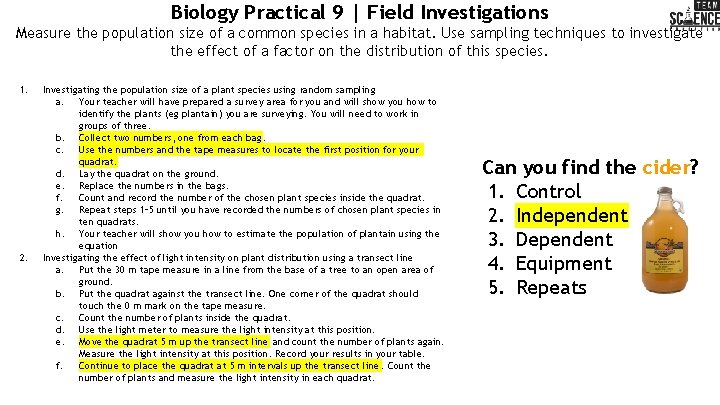
Biology Practical 9 | Field Investigations Measure the population size of a common species in a habitat. Use sampling techniques to investigate the effect of a factor on the distribution of this species. 1. 2. Investigating the population size of a plant species using random sampling a. Your teacher will have prepared a survey area for you and will show you how to identify the plants (eg plantain) you are surveying. You will need to work in groups of three. b. Collect two numbers, one from each bag. c. Use the numbers and the tape measures to locate the first position for your quadrat. d. Lay the quadrat on the ground. e. Replace the numbers in the bags. f. Count and record the number of the chosen plant species inside the quadrat. g. Repeat steps 1– 5 until you have recorded the numbers of chosen plant species in ten quadrats. h. Your teacher will show you how to estimate the population of plantain using the equation Investigating the effect of light intensity on plant distribution using a transect line a. Put the 30 m tape measure in a line from the base of a tree to an open area of ground. b. Put the quadrat against the transect line. One corner of the quadrat should touch the 0 m mark on the tape measure. c. Count the number of plants inside the quadrat. d. Use the light meter to measure the light intensity at this position. e. Move the quadrat 5 m up the transect line and count the number of plants again. Measure the light intensity at this position. Record your results in your table. f. Continue to place the quadrat at 5 m intervals up the transect line. Count the number of plants and measure the light intensity in each quadrat. Can you find the cider? 1. Control 2. Independent 3. Dependent 4. Equipment 5. Repeats
Biology Practical 9 | Field Investigations Measure the population size of a common species in a habitat. Use sampling techniques to investigate the effect of a factor on the distribution of this species. 1. 2. Investigating the population size of a plant species using random sampling a. Your teacher will have prepared a survey area for you and will show you how to identify the plants (eg plantain) you are surveying. You will need to work in groups of three. b. Collect two numbers, one from each bag. c. Use the numbers and the tape measures to locate the first position for your quadrat. d. Lay the quadrat on the ground. e. Replace the numbers in the bags. f. Count and record the number of the chosen plant species inside the quadrat. g. Repeat steps 1– 5 until you have recorded the numbers of chosen plant species in ten quadrats. h. Your teacher will show you how to estimate the population of plantain using the equation Investigating the effect of light intensity on plant distribution using a transect line a. Put the 30 m tape measure in a line from the base of a tree to an open area of ground. b. Put the quadrat against the transect line. One corner of the quadrat should touch the 0 m mark on the tape measure. c. Count the number of plants inside the quadrat. d. Use the light meter to measure the light intensity at this position. e. Move the quadrat 5 m up the transect line and count the number of plants again. Measure the light intensity at this position. Record your results in your table. f. Continue to place the quadrat at 5 m intervals up the transect line. Count the number of plants and measure the light intensity in each quadrat. Can you find the cider? 1. Control 2. Independent 3. Dependent 4. Equipment 5. Repeats
Biology Practical 9 | Field Investigations Measure the population size of a common species in a habitat. Use sampling techniques to investigate the effect of a factor on the distribution of this species. 1. 2. Investigating the population size of a plant species using random sampling a. Your teacher will have prepared a survey area for you and will show you how to identify the plants (eg plantain) you are surveying. You will need to work in groups of three. b. Collect two numbers, one from each bag. c. Use the numbers and the tape measures to locate the first position for your quadrat. d. Lay the quadrat on the ground. e. Replace the numbers in the bags. f. Count and record the number of the chosen plant species inside the quadrat. g. Repeat steps 1– 5 until you have recorded the numbers of chosen plant species in ten quadrats. h. Your teacher will show you how to estimate the population of plantain using the equation Investigating the effect of light intensity on plant distribution using a transect line a. Put the 30 m tape measure in a line from the base of a tree to an open area of ground. b. Put the quadrat against the transect line. One corner of the quadrat should touch the 0 m mark on the tape measure. c. Count the number of plants inside the quadrat. d. Use the light meter to measure the light intensity at this position. e. Move the quadrat 5 m up the transect line and count the number of plants again. Measure the light intensity at this position. Record your results in your table. f. Continue to place the quadrat at 5 m intervals up the transect line. Count the number of plants and measure the light intensity in each quadrat. Can you find the cider? 1. Control 2. Independent 3. Dependent 4. Equipment 5. Repeats
Biology Practical 9 | Field Investigations Measure the population size of a common species in a habitat. Use sampling techniques to investigate the effect of a factor on the distribution of this species. 1. 2. Investigating the population size of a plant species using random sampling a. Your teacher will have prepared a survey area for you and will show you how to identify the plants (eg plantain) you are surveying. You will need to work in groups of three. b. Collect two numbers, one from each bag. c. Use the numbers and the tape measures to locate the first position for your quadrat. d. Lay the quadrat on the ground. e. Replace the numbers in the bags. f. Count and record the number of the chosen plant species inside the quadrat. g. Repeat steps 1– 5 until you have recorded the numbers of chosen plant species in ten quadrats. h. Your teacher will show you how to estimate the population of plantain using the equation Investigating the effect of light intensity on plant distribution using a transect line a. Put the 30 m tape measure in a line from the base of a tree to an open area of ground. b. Put the quadrat against the transect line. One corner of the quadrat should touch the 0 m mark on the tape measure. c. Count the number of plants inside the quadrat. d. Use the light meter to measure the light intensity at this position. e. Move the quadrat 5 m up the transect line and count the number of plants again. Measure the light intensity at this position. Record your results in your table. f. Continue to place the quadrat at 5 m intervals up the transect line. Count the number of plants and measure the light intensity in each quadrat. Can you find the cider? 1. Control 2. Independent 3. Dependent 4. Equipment 5. Repeats
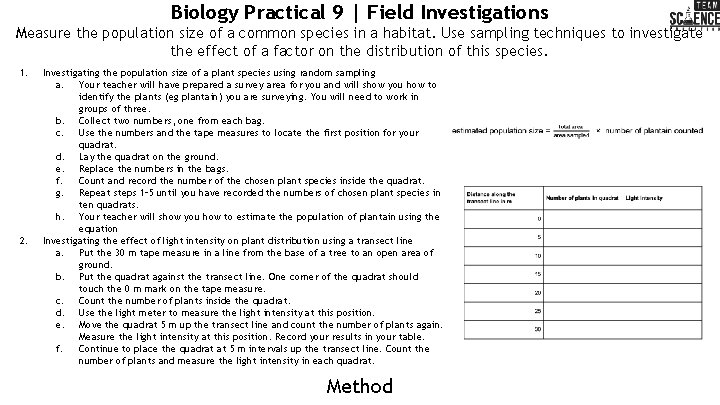
Biology Practical 9 | Field Investigations Measure the population size of a common species in a habitat. Use sampling techniques to investigate the effect of a factor on the distribution of this species. 1. 2. Investigating the population size of a plant species using random sampling a. Your teacher will have prepared a survey area for you and will show you how to identify the plants (eg plantain) you are surveying. You will need to work in groups of three. b. Collect two numbers, one from each bag. c. Use the numbers and the tape measures to locate the first position for your quadrat. d. Lay the quadrat on the ground. e. Replace the numbers in the bags. f. Count and record the number of the chosen plant species inside the quadrat. g. Repeat steps 1– 5 until you have recorded the numbers of chosen plant species in ten quadrats. h. Your teacher will show you how to estimate the population of plantain using the equation Investigating the effect of light intensity on plant distribution using a transect line a. Put the 30 m tape measure in a line from the base of a tree to an open area of ground. b. Put the quadrat against the transect line. One corner of the quadrat should touch the 0 m mark on the tape measure. c. Count the number of plants inside the quadrat. d. Use the light meter to measure the light intensity at this position. e. Move the quadrat 5 m up the transect line and count the number of plants again. Measure the light intensity at this position. Record your results in your table. f. Continue to place the quadrat at 5 m intervals up the transect line. Count the number of plants and measure the light intensity in each quadrat. Method
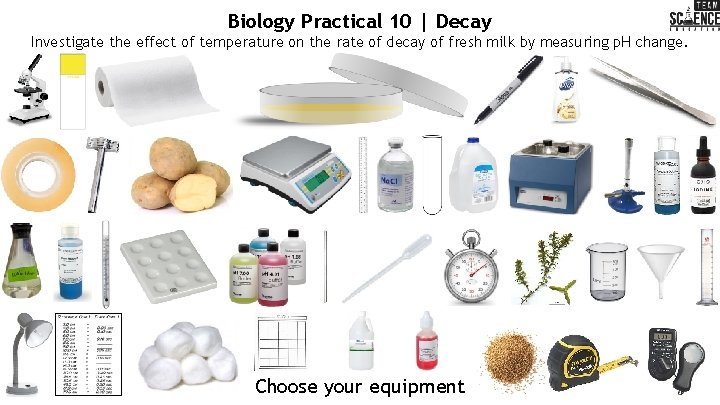
Biology Practical 10 | Decay Investigate the effect of temperature on the rate of decay of fresh milk by measuring p. H change. Choose your equipment

Biology Practical 10 | Decay Investigate the effect of temperature on the rate of decay of fresh milk by measuring p. H change. 1. 2. Label a boiling tube ‘lipase’ and add 5 cm 3 of the lipase solution. Label another boiling tube ‘milk’ and add five drops of the Cresol red solution. 3. Use a calibrated dropping pipette to add 5 cm 3 of milk to the ‘milk’ boiling tube. 4. Use another pipette to add 7 cm 3 of sodium carbonate solution to the ‘milk’ boiling tube. The solution should be purple. 5. Put a thermometer into the ‘milk’ boiling tube. 6. Set up a water bath to your first chosen temperature. 7. Put both boiling tubes into the water bath. Wait until the contents reach the same temperature as the water bath. 8. Use another dropping pipette to transfer 1 cm 3 of lipase from the ‘lipase’ tube to the ‘milk’ tube. Immediately start the stop clock. 9. Stir the contents of the ‘milk’ boiling tube until the solution turns yellow. 10. Record the time taken for the colour to change to yellow, in seconds. 11. Then repeat the investigation for different temperatures of water bath. 12. Record your results in a table like this one. Can you find the cider? 1. Control 2. Independent 3. Dependent 4. Equipment 5. Repeats

Biology Practical 10 | Decay Investigate the effect of temperature on the rate of decay of fresh milk by measuring p. H change. 1. 2. Label a boiling tube ‘lipase’ and add 5 cm 3 of the lipase solution. Label another boiling tube ‘milk’ and add five drops of the Cresol red solution. 3. Use a calibrated dropping pipette to add 5 cm 3 of milk to the ‘milk’ boiling tube. 4. Use another pipette to add 7 cm 3 of sodium carbonate solution to the ‘milk’ boiling tube. The solution should be purple. 5. Put a thermometer into the ‘milk’ boiling tube. 6. Set up a water bath to your first chosen temperature. 7. Put both boiling tubes into the water bath. Wait until the contents reach the same temperature as the water bath. 8. Use another dropping pipette to transfer 1 cm 3 of lipase from the ‘lipase’ tube to the ‘milk’ tube. Immediately start the stop clock. 9. Stir the contents of the ‘milk’ boiling tube until the solution turns yellow. 10. Record the time taken for the colour to change to yellow, in seconds. 11. Then repeat the investigation for different temperatures of water bath. 12. Record your results in a table like this one. Can you find the cider? 1. Control 2. Independent 3. Dependent 4. Equipment 5. Repeats

Biology Practical 10 | Decay Investigate the effect of temperature on the rate of decay of fresh milk by measuring p. H change. 1. 2. Label a boiling tube ‘lipase’ and add 5 cm 3 of the lipase solution. Label another boiling tube ‘milk’ and add five drops of the Cresol red solution. 3. Use a calibrated dropping pipette to add 5 cm 3 of milk to the ‘milk’ boiling tube. 4. Use another pipette to add 7 cm 3 of sodium carbonate solution to the ‘milk’ boiling tube. The solution should be purple. 5. Put a thermometer into the ‘milk’ boiling tube. 6. Set up a water bath to your first chosen temperature. 7. Put both boiling tubes into the water bath. Wait until the contents reach the same temperature as the water bath. 8. Use another dropping pipette to transfer 1 cm 3 of lipase from the ‘lipase’ tube to the ‘milk’ tube. Immediately start the stop clock. 9. Stir the contents of the ‘milk’ boiling tube until the solution turns yellow. 10. Record the time taken for the colour to change to yellow, in seconds. 11. Then repeat the investigation for different temperatures of water bath. 12. Record your results in a table like this one. Can you find the cider? 1. Control 2. Independent 3. Dependent 4. Equipment 5. Repeats

Biology Practical 10 | Decay Investigate the effect of temperature on the rate of decay of fresh milk by measuring p. H change. 1. 2. Label a boiling tube ‘lipase’ and add 5 cm 3 of the lipase solution. Label another boiling tube ‘milk’ and add five drops of the Cresol red solution. 3. Use a calibrated dropping pipette to add 5 cm 3 of milk to the ‘milk’ boiling tube. 4. Use another pipette to add 7 cm 3 of sodium carbonate solution to the ‘milk’ boiling tube. The solution should be purple. 5. Put a thermometer into the ‘milk’ boiling tube. 6. Set up a water bath to your first chosen temperature. 7. Put both boiling tubes into the water bath. Wait until the contents reach the same temperature as the water bath. 8. Use another dropping pipette to transfer 1 cm 3 of lipase from the ‘lipase’ tube to the ‘milk’ tube. Immediately start the stop clock. 9. Stir the contents of the ‘milk’ boiling tube until the solution turns yellow. 10. Record the time taken for the colour to change to yellow, in seconds. 11. Then repeat the investigation for different temperatures of water bath. 12. Record your results in a table like this one. Can you find the cider? 1. Control 2. Independent 3. Dependent 4. Equipment 5. Repeats

Biology Practical 10 | Decay Investigate the effect of temperature on the rate of decay of fresh milk by measuring p. H change. 1. 2. Label a boiling tube ‘lipase’ and add 5 cm 3 of the lipase solution. Label another boiling tube ‘milk’ and add five drops of the Cresol red solution. 3. Use a calibrated dropping pipette to add 5 cm 3 of milk to the ‘milk’ boiling tube. 4. Use another pipette to add 7 cm 3 of sodium carbonate solution to the ‘milk’ boiling tube. The solution should be purple. 5. Put a thermometer into the ‘milk’ boiling tube. 6. Set up a water bath to your first chosen temperature. 7. Put both boiling tubes into the water bath. Wait until the contents reach the same temperature as the water bath. 8. Use another dropping pipette to transfer 1 cm 3 of lipase from the ‘lipase’ tube to the ‘milk’ tube. Immediately start the stop clock. 9. Stir the contents of the ‘milk’ boiling tube until the solution turns yellow. 10. Record the time taken for the colour to change to yellow, in seconds. 11. Then repeat the investigation for different temperatures of water bath. 12. Record your results in a table like this one. Can you find the cider? 1. Control 2. Independent 3. Dependent 4. Equipment 5. Repeats

Biology Practical 10 | Decay Investigate the effect of temperature on the rate of decay of fresh milk by measuring p. H change. 1. 2. Label a boiling tube ‘lipase’ and add 5 cm 3 of the lipase solution. Label another boiling tube ‘milk’ and add five drops of the Cresol red solution. 3. Use a calibrated dropping pipette to add 5 cm 3 of milk to the ‘milk’ boiling tube. 4. Use another pipette to add 7 cm 3 of sodium carbonate solution to the ‘milk’ boiling tube. The solution should be purple. 5. Put a thermometer into the ‘milk’ boiling tube. 6. Set up a water bath to your first chosen temperature. 7. Put both boiling tubes into the water bath. Wait until the contents reach the same temperature as the water bath. 8. Use another dropping pipette to transfer 1 cm 3 of lipase from the ‘lipase’ tube to the ‘milk’ tube. Immediately start the stop clock. 9. Stir the contents of the ‘milk’ boiling tube until the solution turns yellow. 10. Record the time taken for the colour to change to yellow, in seconds. 11. Then repeat the investigation for different temperatures of water bath. 12. Record your results in a table like this one. Method
- Slides: 74