
GCSE Required Practical Chemistry 1 Making a salt
- Slides: 3
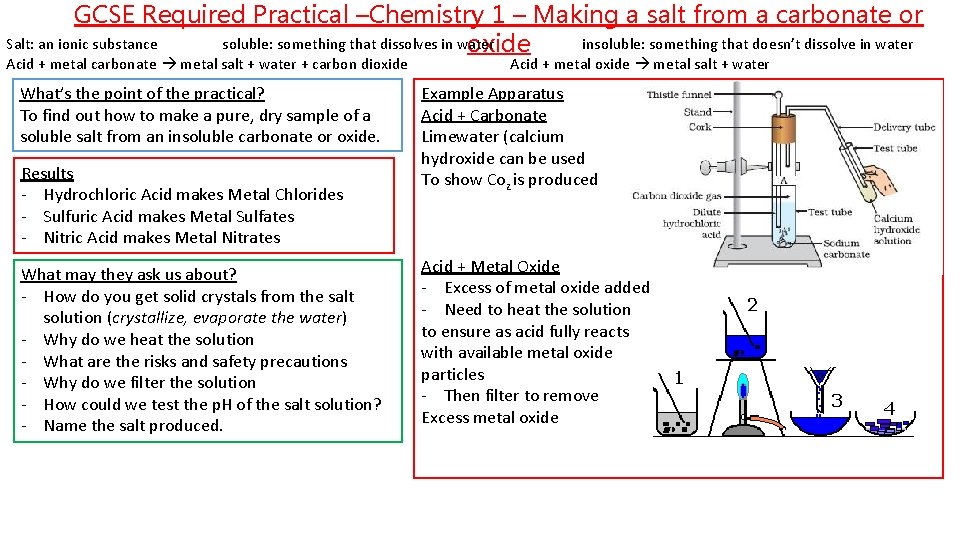
GCSE Required Practical –Chemistry 1 – Making a salt from a carbonate or Salt: an ionic substance soluble: something that dissolves in water insoluble: something that doesn’t dissolve in water oxide Acid + metal carbonate metal salt + water + carbon dioxide What’s the point of the practical? To find out how to make a pure, dry sample of a soluble salt from an insoluble carbonate or oxide. Results - Hydrochloric Acid makes Metal Chlorides - Sulfuric Acid makes Metal Sulfates - Nitric Acid makes Metal Nitrates What may they ask us about? - How do you get solid crystals from the salt solution (crystallize, evaporate the water) - Why do we heat the solution - What are the risks and safety precautions - Why do we filter the solution - How could we test the p. H of the salt solution? - Name the salt produced. Acid + metal oxide metal salt + water Example Apparatus Acid + Carbonate Limewater (calcium hydroxide can be used To show Coz is produced Acid + Metal Oxide - Excess of metal oxide added - Need to heat the solution to ensure as acid fully reacts with available metal oxide particles - Then filter to remove Excess metal oxide
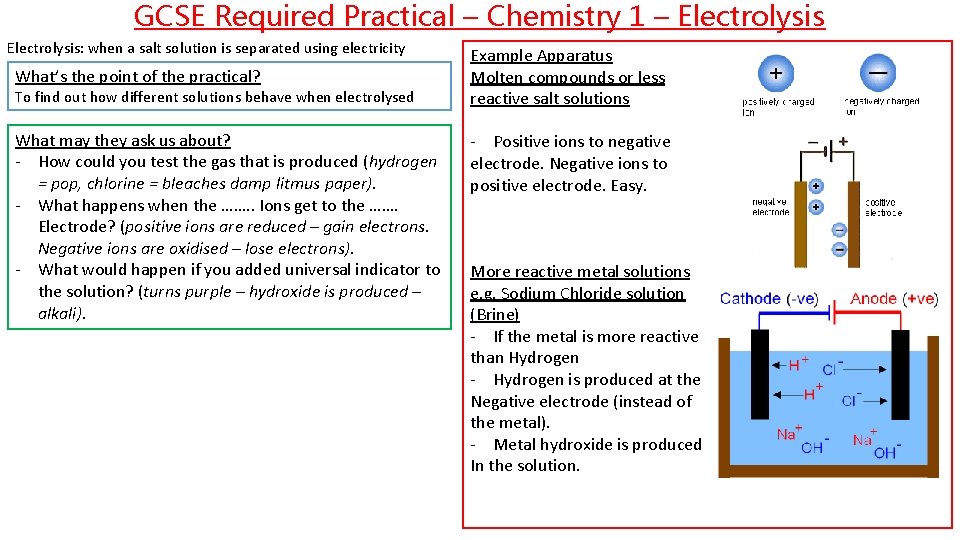
GCSE Required Practical – Chemistry 1 – Electrolysis: when a salt solution is separated using electricity What’s the point of the practical? To find out how different solutions behave when electrolysed What may they ask us about? - How could you test the gas that is produced (hydrogen = pop, chlorine = bleaches damp litmus paper). - What happens when the ……. . Ions get to the ……. Electrode? (positive ions are reduced – gain electrons. Negative ions are oxidised – lose electrons). - What would happen if you added universal indicator to the solution? (turns purple – hydroxide is produced – alkali). Example Apparatus Molten compounds or less reactive salt solutions - Positive ions to negative electrode. Negative ions to positive electrode. Easy. More reactive metal solutions e. g. Sodium Chloride solution (Brine) - If the metal is more reactive than Hydrogen - Hydrogen is produced at the Negative electrode (instead of the metal). - Metal hydroxide is produced In the solution.
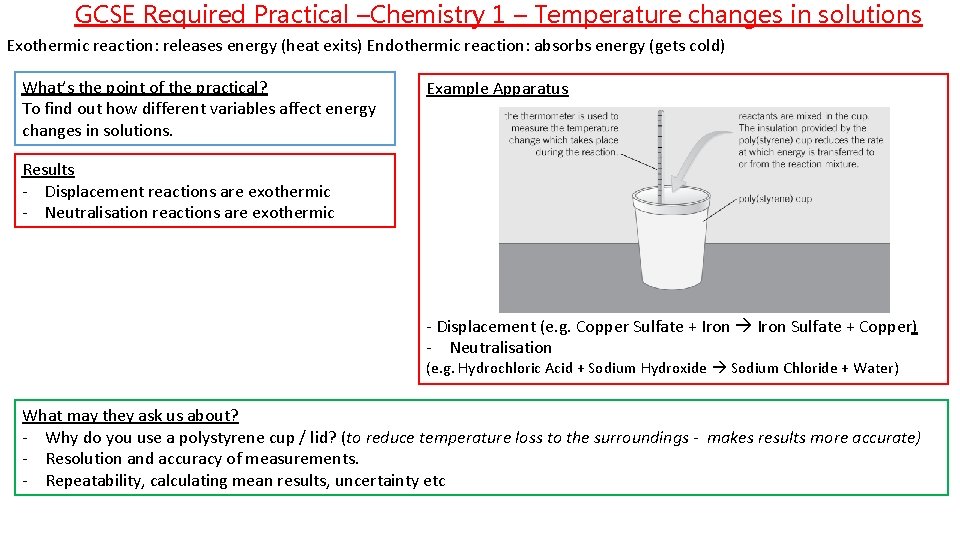
GCSE Required Practical –Chemistry 1 – Temperature changes in solutions Exothermic reaction: releases energy (heat exits) Endothermic reaction: absorbs energy (gets cold) What’s the point of the practical? To find out how different variables affect energy changes in solutions. Example Apparatus Results - Displacement reactions are exothermic - Neutralisation reactions are exothermic - Displacement (e. g. Copper Sulfate + Iron Sulfate + Copper) - Neutralisation (e. g. Hydrochloric Acid + Sodium Hydroxide Sodium Chloride + Water) What may they ask us about? - Why do you use a polystyrene cup / lid? (to reduce temperature loss to the surroundings - makes results more accurate) - Resolution and accuracy of measurements. - Repeatability, calculating mean results, uncertainty etc