
GCSE reform and new 9 1 grading scale
- Slides: 12
GCSE reform and new 9 -1 grading scale Scott Postlethwaite Qualifications Division
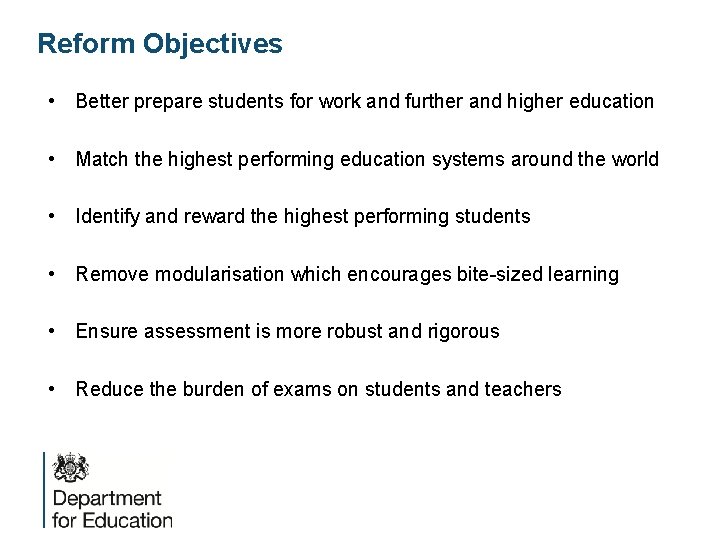
Reform Objectives • Better prepare students for work and further and higher education • Match the highest performing education systems around the world • Identify and reward the highest performing students • Remove modularisation which encourages bite-sized learning • Ensure assessment is more robust and rigorous • Reduce the burden of exams on students and teachers
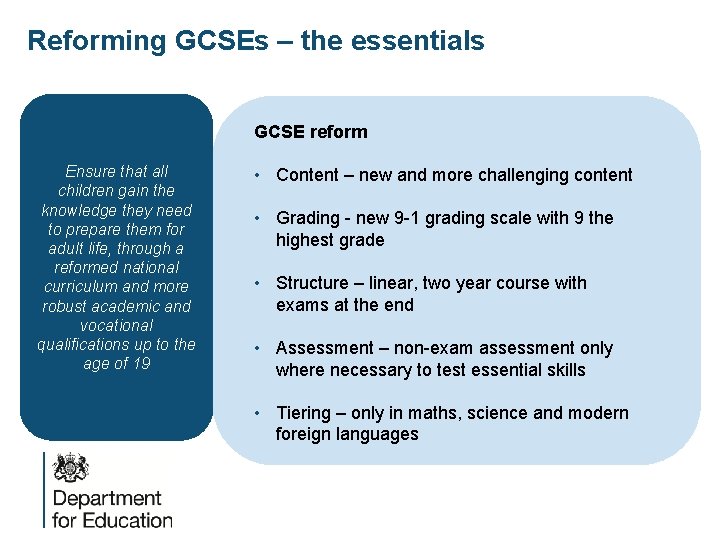
Reforming GCSEs – the essentials GCSE reform Ensure that all children gain the knowledge they need to prepare them for adult life, through a reformed national curriculum and more robust academic and vocational qualifications up to the age of 19 • Content – new and more challenging content • Grading - new 9 -1 grading scale with 9 the highest grade • Structure – linear, two year course with exams at the end • Assessment – non-exam assessment only where necessary to test essential skills • Tiering – only in maths, science and modern foreign languages
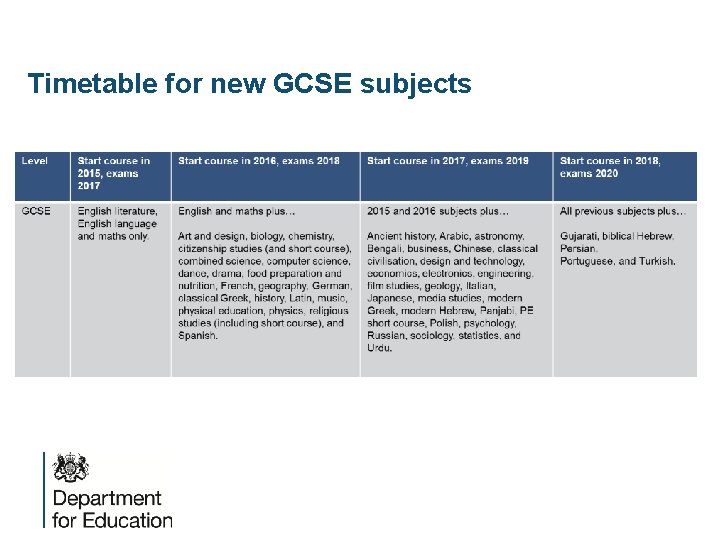
Timetable for new GCSE subjects
Why a new grading scale for GCSEs? § There are more grades at the higher end so that greater differentiation is possible for high achievers § The new grading scale makes it clear to employers, colleges and universities which pupils have sat the new, more challenging GCSEs.
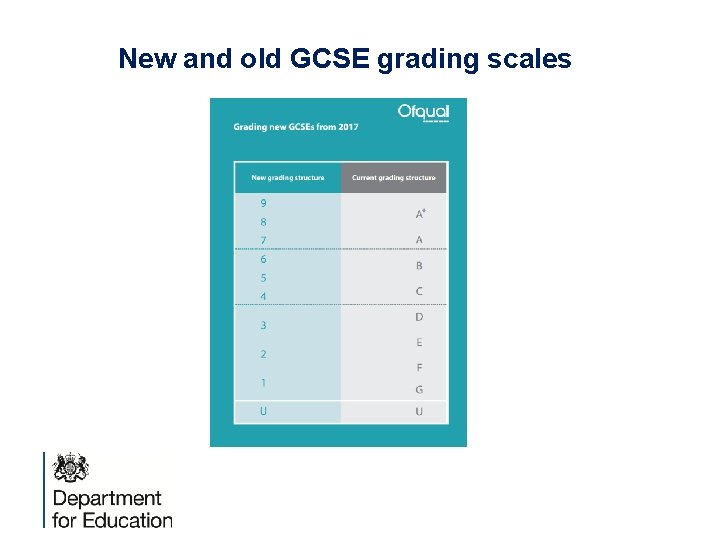
New and old GCSE grading scales
Comparing new and old grading scales § The new grading scale is not directly comparable to the old scale – the new scale has more grades. § However, there are three points of comparability: – The bottom of grade 7 is aligned to the bottom of grade A – The bottom of grade 4 is aligned to the bottom of grade C – The bottom of grade 1 is aligned to the bottom of grade G
New GCSE grades § A new GCSE grade 4 is equivalent to a low / medium C the threshold for a level 2 qualification § A new GCSE grade 5 is equivalent to a high C / low B § Fewer pupils will attain a grade 9 – but it will remain attainable for the highest achievers.
Ensuring pupils are not disadvantaged Ofqual use ‘comparable outcomes’ so that the same proportion of pupils will achieve comparable grades if the ability profile is the same. So in the first year of new grades being awarded: – Broadly the same proportion of pupils will achieve a grade 7 and above as currently achieve a grade A and above – Broadly the same proportion of pupils will achieve a grade 4 and above as currently achieve a grade C and above – The bottom of grade 1 is aligned to the bottom of grade G.
Communication of the reforms • Df. E, Ofqual and awarding organisations (exam boards) are working closely with key bodies such CBI and UCAS to communicate changes in GCSEs to audiences • Df. E / Ofqual joint slide pack and Ofqual postcards sent to all schools in England in July 2016 outlining the changes to GCSEs, AS and A levels Next steps Communications are increasing as we move towards the first award of new GCSEs: • Ofqual - social media, 9 -1 newsletter, blogs, speaking / stands at conferences and new video • Df. E producing new products e. g. GCSE Factsheet, GCSE Mythbuster • ‘Campaign page’ proposed for. GOV to link to resources and signpost other products • Stepping up communications via leading sector organisations e. g. Ao. C, ASCL, FSB.
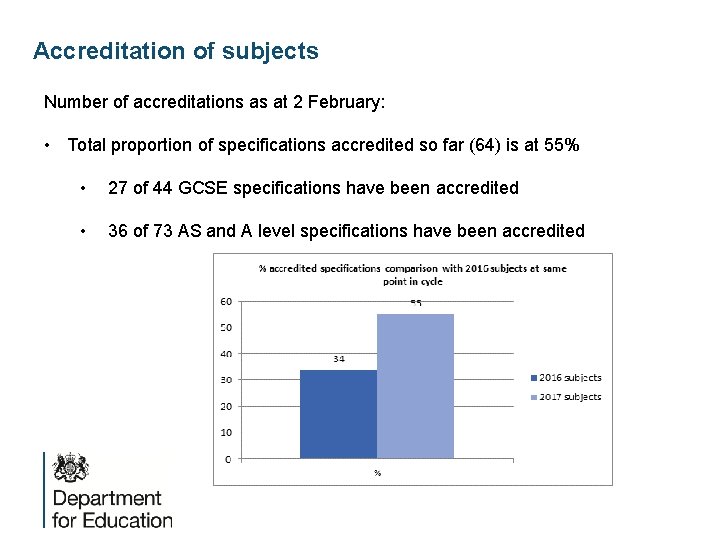
Accreditation of subjects Number of accreditations as at 2 February: • Total proportion of specifications accredited so far (64) is at 55% • 27 of 44 GCSE specifications have been accredited • 36 of 73 AS and A level specifications have been accredited
Questions?