
GCSE Physical Training Understanding Pulse raiser What am


- Slides: 16
GCSE Physical Training Understanding!
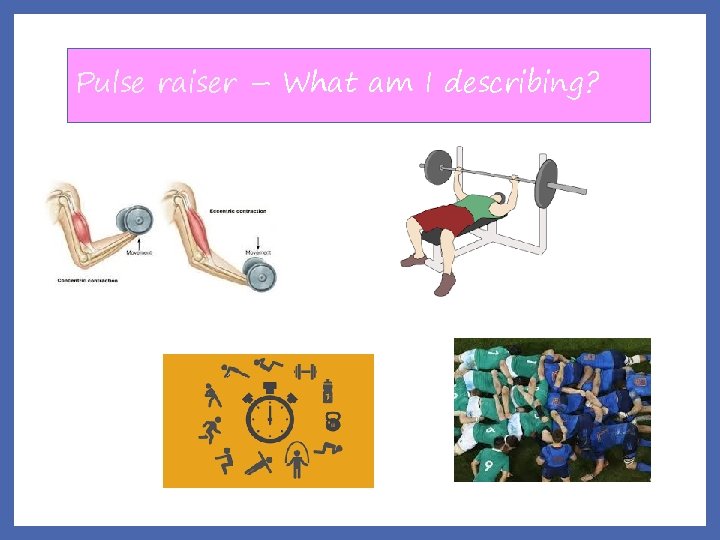
Pulse raiser – What am I describing?
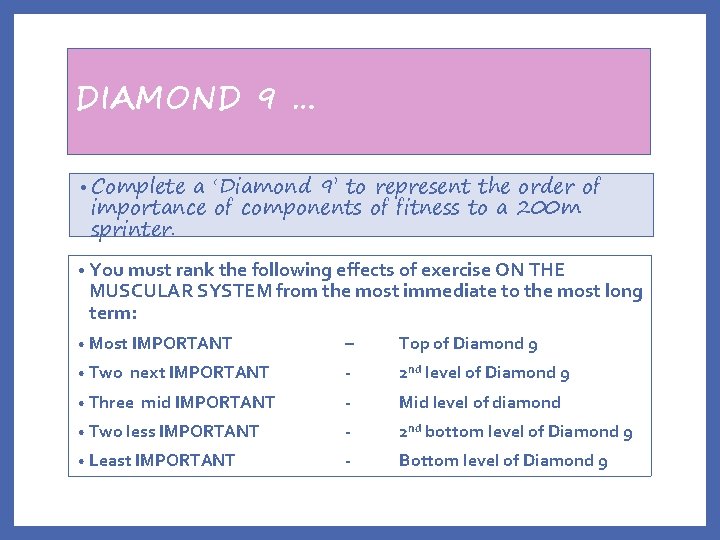
DIAMOND 9 … • Complete a ‘Diamond 9’ to represent the order of importance of components of fitness to a 200 m sprinter. • You must rank the following effects of exercise ON THE MUSCULAR SYSTEM from the most immediate to the most long term: • Most IMPORTANT – Top of Diamond 9 • Two - 2 nd level of Diamond 9 - Mid level of diamond • Two less IMPORTANT - 2 nd bottom level of Diamond 9 • Least IMPORTANT - Bottom level of Diamond 9 next IMPORTANT • Three mid IMPORTANT
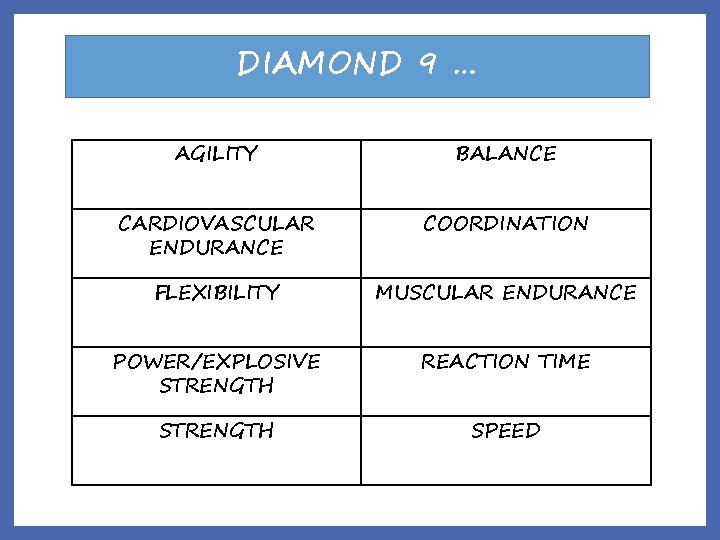
DIAMOND 9 … AGILITY BALANCE CARDIOVASCULAR ENDURANCE COORDINATION FLEXIBILITY MUSCULAR ENDURANCE POWER/EXPLOSIVE STRENGTH REACTION TIME STRENGTH SPEED
FILTERING– 30% of your time! • Session 2 • After the second or third time you have revised a topic you should not need to do any more filtering • Reduce the amount of information you have down to the essential parts of the knowledge: • Create mind maps • Create flash cards • Create crib sheets • Produce summary sheets • Write perfect exam answers from your notes COPYING OUT INFORMATION WORD FOR WORD IS NOT FILTERING
CREATING MIND MAPS • Create a ‘ SPEED’ mind map to link the following: • Definition of Speed • Speed Test – Testing procedures (protocol) • Reasons for and limitations of testing • Types of Training to improve SPEED! • Definition of ‘Interval Training’ • Advantages and disadvantages of ‘Interval Training’
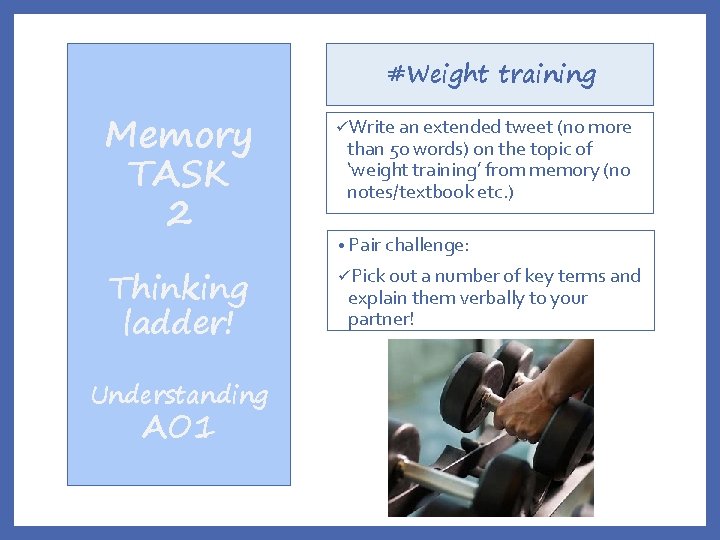
#Weight training Memory TASK 2 Thinking ladder! Understanding AO 1 üWrite an extended tweet (no more than 50 words) on the topic of ‘weight training’ from memory (no notes/textbook etc. ) • Pair challenge: üPick out a number of key terms and explain them verbally to your partner!
DNA …… SELF SOLVE! • Do you k. Now it • All …? Answer the two exam questions (10 minutes allowed) • Evaluate whether a 50 m front crawl competitive swimmer should use a combination of interval training and weight training to improve their performance. [9 marks]
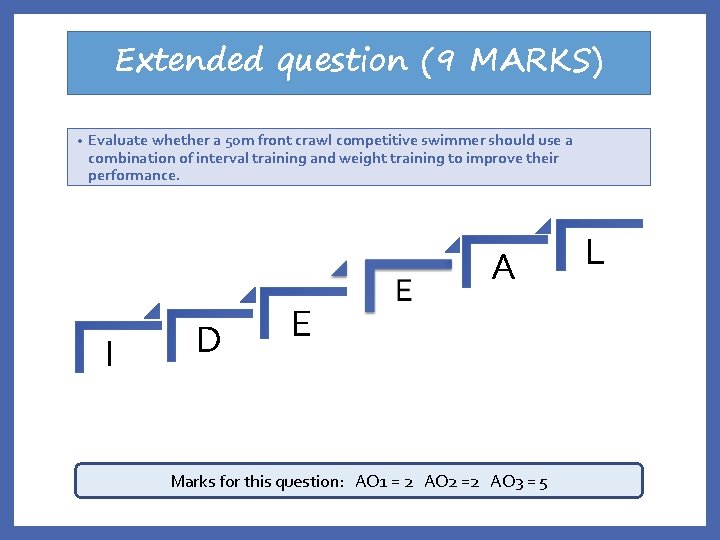
Extended question (9 MARKS) • Evaluate whether a 50 m front crawl competitive swimmer should use a combination of interval training and weight training to improve their performance. A I D E Marks for this question: AO 1 = 2 AO 2 =2 AO 3 = 5 L
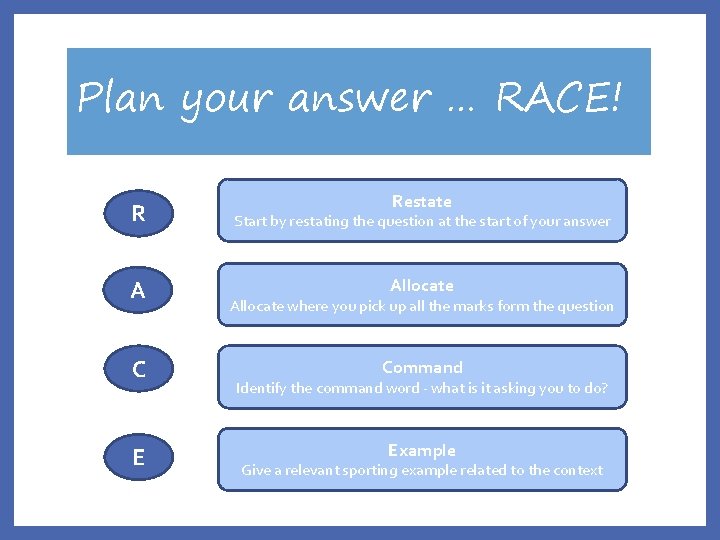
Plan your answer … RACE! Restate R Start by restating the question at the start of your answer A Allocate C E Allocate where you pick up all the marks form the question Command Identify the command word - what is it asking you to do? Example Give a relevant sporting example related to the context
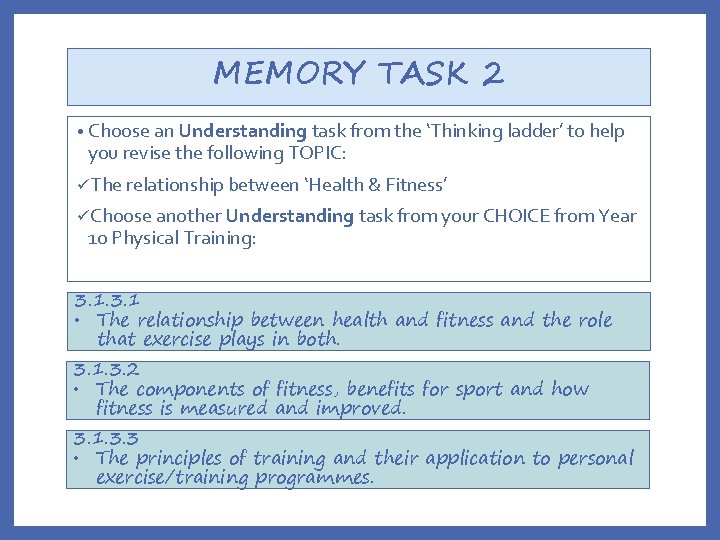
MEMORY TASK 2 • Choose an Understanding task from the ‘Thinking ladder’ to help you revise the following TOPIC: üThe relationship between ‘Health & Fitness’ üChoose another Understanding task from your CHOICE from Year 10 Physical Training: 3. 1 • The relationship between health and fitness and the role that exercise plays in both. 3. 1. 3. 2 • The components of fitness, benefits for sport and how fitness is measured and improved. 3. 1. 3. 3 • The principles of training and their application to personal exercise/training programmes.
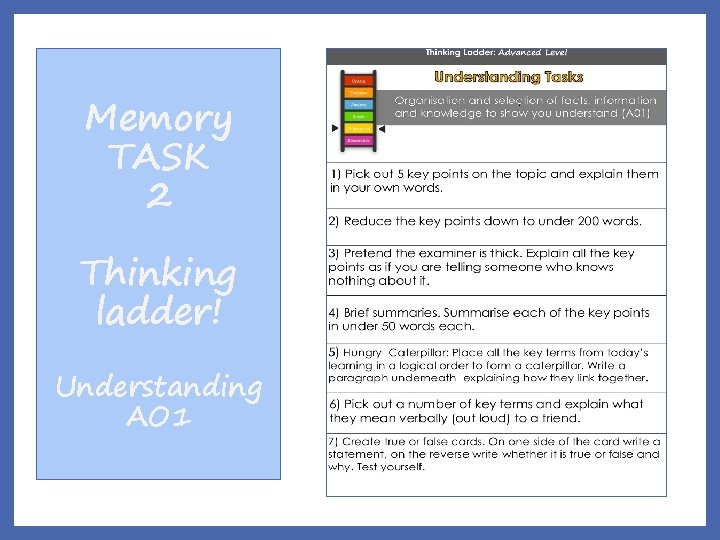
Memory TASK 2 Thinking ladder! Understanding AO 1
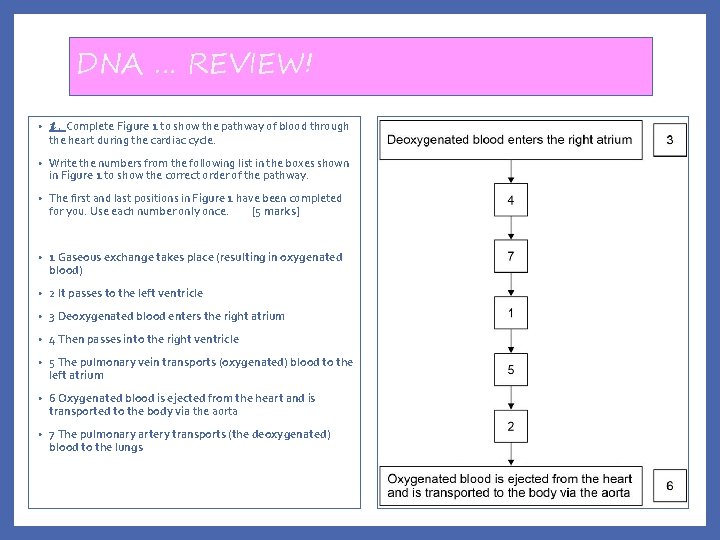
DNA … REVIEW! • 1. Complete Figure 1 to show the pathway of blood through the heart during the cardiac cycle. • Write the numbers from the following list in the boxes shown in Figure 1 to show the correct order of the pathway. • The first and last positions in Figure 1 have been completed for you. Use each number only once. [5 marks] • 1 Gaseous exchange takes place (resulting in oxygenated blood) • 2 It passes to the left ventricle • 3 Deoxygenated blood enters the right atrium • 4 Then passes into the right ventricle • 5 The pulmonary vein transports (oxygenated) blood to the left atrium • 6 Oxygenated blood is ejected from the heart and is transported to the body via the aorta • 7 The pulmonary artery transports (the deoxygenated) blood to the lungs
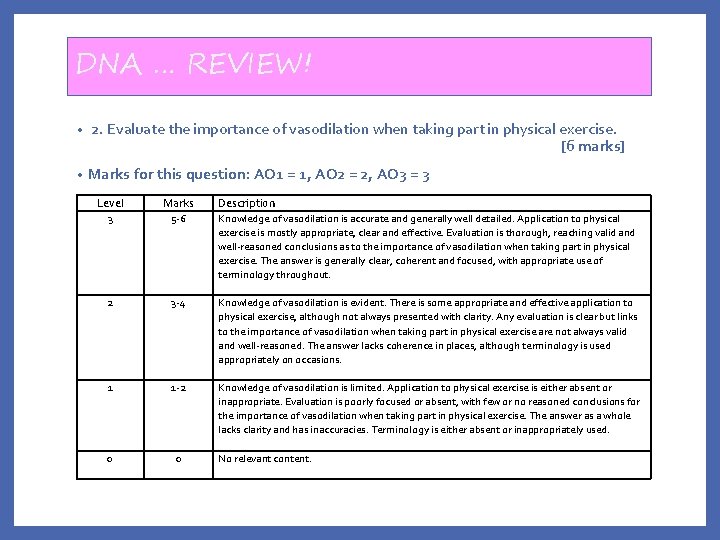
DNA … REVIEW! • 2. Evaluate the importance of vasodilation when taking part in physical exercise. [6 marks] • Marks for this question: AO 1 = 1, AO 2 = 2, AO 3 = 3 Level Marks Description 3 5 -6 Knowledge of vasodilation is accurate and generally well detailed. Application to physical exercise is mostly appropriate, clear and effective. Evaluation is thorough, reaching valid and well-reasoned conclusions as to the importance of vasodilation when taking part in physical exercise. The answer is generally clear, coherent and focused, with appropriate use of terminology throughout. 2 3 -4 Knowledge of vasodilation is evident. There is some appropriate and effective application to physical exercise, although not always presented with clarity. Any evaluation is clear but links to the importance of vasodilation when taking part in physical exercise are not always valid and well-reasoned. The answer lacks coherence in places, although terminology is used appropriately on occasions. 1 1 -2 Knowledge of vasodilation is limited. Application to physical exercise is either absent or inappropriate. Evaluation is poorly focused or absent, with few or no reasoned conclusions for the importance of vasodilation when taking part in physical exercise. The answer as a whole lacks clarity and has inaccuracies. Terminology is either absent or inappropriately used. 0 0 No relevant content.
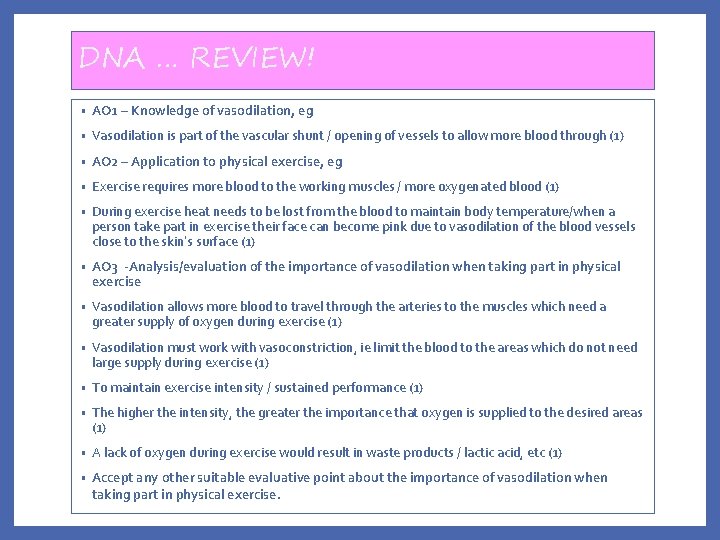
DNA … REVIEW! • AO 1 – Knowledge of vasodilation, eg • Vasodilation is part of the vascular shunt / opening of vessels to allow more blood through (1) • AO 2 – Application to physical exercise, eg • Exercise requires more blood to the working muscles / more oxygenated blood (1) • During exercise heat needs to be lost from the blood to maintain body temperature/when a person take part in exercise their face can become pink due to vasodilation of the blood vessels close to the skin’s surface (1) • AO 3 -Analysis/evaluation of the importance of vasodilation when taking part in physical exercise • Vasodilation allows more blood to travel through the arteries to the muscles which need a greater supply of oxygen during exercise (1) • Vasodilation must work with vasoconstriction, ie limit the blood to the areas which do not need large supply during exercise (1) • To maintain exercise intensity / sustained performance (1) • The higher the intensity, the greater the importance that oxygen is supplied to the desired areas (1) • A lack of oxygen during exercise would result in waste products / lactic acid, etc (1) • Accept any other suitable evaluative point about the importance of vasodilation when taking part in physical exercise.
Revision … TOP TIP! • Timetable – Create a revision timetable and stick to it! • Organise and order all your theory booklets (one file per unit) • Post it – Display notes where you will see them (Post it notes/Home screen on phone/tablet etc. ) • Topic summary - Summarise topic in 5 sentences - reduce to 5 words - reduce to one word! • Identify any weaknesses in knowledge and understanding • Practice exam questions (unit tests/home learning etc. )