
GCSE Physical Education Fitness Testing Muscular Strength Test
- Slides: 2
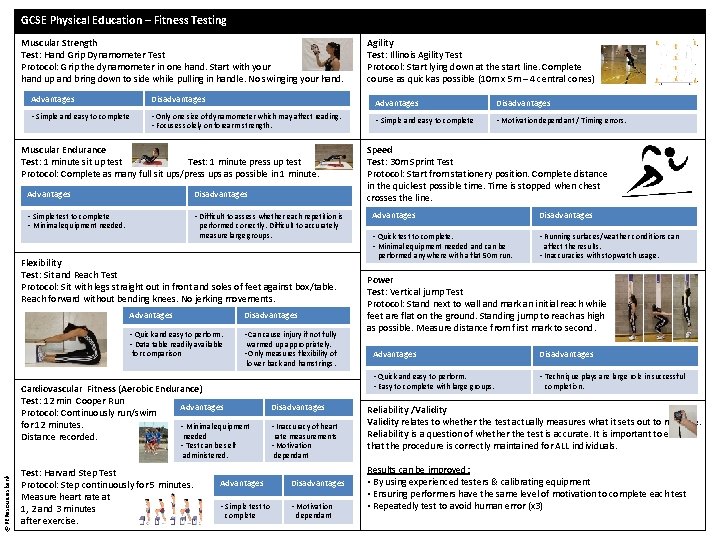
GCSE Physical Education – Fitness Testing Muscular Strength Test: Hand Grip Dynamometer Test Protocol: Grip the dynamometer in one hand. Start with your hand up and bring down to side while pulling in handle. No swinging your hand. Advantages Disadvantages • Simple and easy to complete • Only one size of dynamometer which may affect reading. • Focuses solely on forearm strength. Muscular Endurance Test: 1 minute sit up test Test: 1 minute press up test Protocol: Complete as many full sit ups/press ups as possible in 1 minute. Advantages Disadvantages • Simple test to complete • Minimal equipment needed. • Difficult to assess whether each repetition is performed correctly. Difficult to accurately measure large groups. Flexibility Test: Sit and Reach Test Protocol: Sit with legs straight out in front and soles of feet against box/table. Reach forward without bending knees. No jerking movements. Advantages Disadvantages • Quick and easy to perform. • Data table readily available • Can cause injury if not fully warmed up appropriately. • Only measures flexibility of for comparison lower back and hamstrings. Cardiovascular Fitness (Aerobic Endurance) Test: 12 min Cooper Run Advantages Protocol: Continuously run/swim for 12 minutes. • Minimal equipment needed Distance recorded. • Test can be self @PEResourcesbank administered. Test: Harvard Step Test Protocol: Step continuously for 5 minutes. Measure heart rate at 1, 2 and 3 minutes after exercise. Disadvantages • Inaccuracy of heart rate measurements • Motivation dependant Advantages Disadvantages • Simple test to • Motivation complete dependant Agility Test: Illinois Agility Test Protocol: Start lying down at the start line. Complete course as quick as possible (10 m x 5 m – 4 central cones) Advantages Disadvantages • Simple and easy to complete • Motivation dependant / Timing errors. Speed Test: 30 m Sprint Test Protocol: Start from stationery position. Complete distance in the quickest possible time. Time is stopped when chest crosses the line. Advantages Disadvantages • Quick test to complete. • Minimal equipment needed and can be • Running surfaces/weather conditions can performed anywhere with a flat 50 m run. affect the results. • Inaccuracies with stopwatch usage. Power Test: Vertical jump Test Protocol: Stand next to wall and mark an initial reach while feet are flat on the ground. Standing jump to reach as high as possible. Measure distance from first mark to second. Advantages Disadvantages • Quick and easy to perform. • Easy to complete with large groups. • Technique plays are large role in successful completion. Reliability /Validity relates to whether the test actually measures what it sets out to measure. Reliability is a question of whether the test is accurate. It is important to ensure that the procedure is correctly maintained for ALL individuals. Results can be improved: • By using experienced testers & calibrating equipment • Ensuring performers have the same level of motivation to complete each test • Repeatedly test to avoid human error (x 3)
GCSE Physical Education – Fitness Testing @PEResourcesbank Term Keywords: Definition/notes/concept