
GCSE PE Revision Guide AQA Paper 2 Bishop
GCSE PE Revision Guide AQA Paper 2 Bishop Stopford School PE Faculty Sept 2019 -20
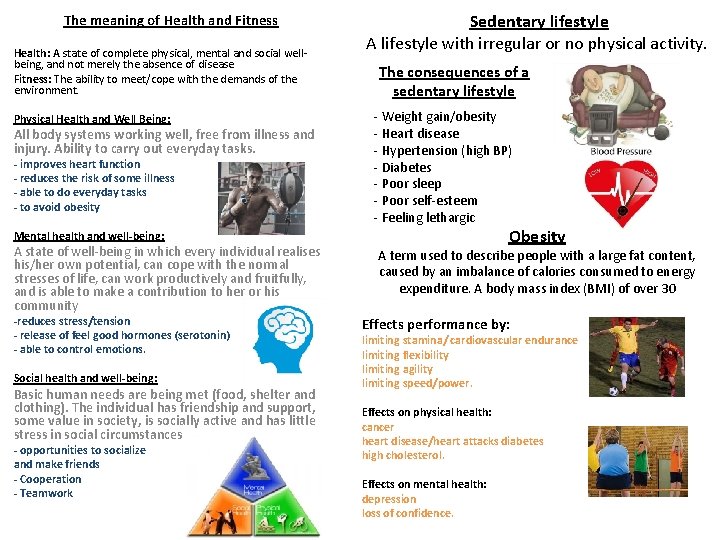
The meaning of Health and Fitness Health: A state of complete physical, mental and social wellbeing, and not merely the absence of disease Fitness: The ability to meet/cope with the demands of the environment. Physical Health and Well Being: All body systems working well, free from illness and injury. Ability to carry out everyday tasks. - improves heart function - reduces the risk of some illness - able to do everyday tasks - to avoid obesity Sedentary lifestyle A lifestyle with irregular or no physical activity. The consequences of a sedentary lifestyle - Weight gain/obesity - Heart disease - Hypertension (high BP) - Diabetes - Poor sleep - Poor self-esteem - Feeling lethargic Obesity Mental health and well-being: A state of well-being in which every individual realises his/her own potential, can cope with the normal stresses of life, can work productively and fruitfully, and is able to make a contribution to her or his community -reduces stress/tension - release of feel good hormones (serotonin) - able to control emotions. Social health and well-being: Basic human needs are being met (food, shelter and clothing). The individual has friendship and support, some value in society, is socially active and has little stress in social circumstances - opportunities to socialize and make friends - Cooperation - Teamwork A term used to describe people with a large fat content, caused by an imbalance of calories consumed to energy expenditure. A body mass index (BMI) of over 30 Effects performance by: limiting stamina/ cardiovascular endurance limiting flexibility limiting agility limiting speed/power. Effects on physical health: cancer heart disease/heart attacks diabetes high cholesterol. Effects on mental health: depression loss of confidence.
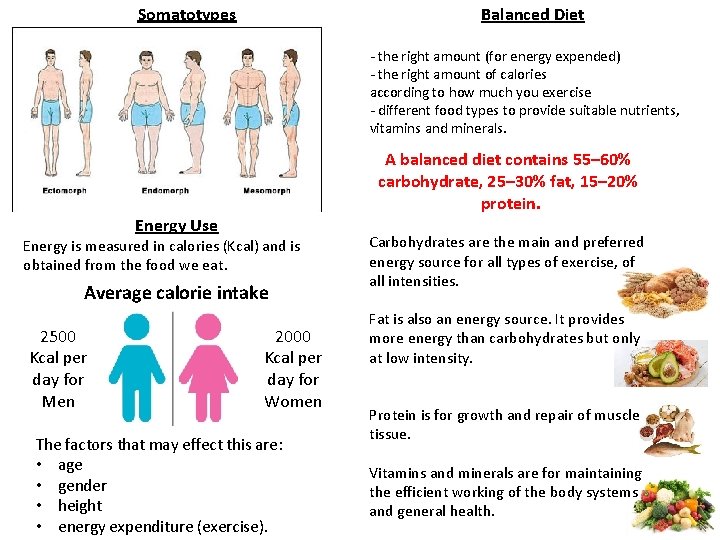
Somatotypes Balanced Diet - the right amount (for energy expended) - the right amount of calories according to how much you exercise - different food types to provide suitable nutrients, vitamins and minerals. A balanced diet contains 55– 60% carbohydrate, 25– 30% fat, 15– 20% protein. Energy Use Energy is measured in calories (Kcal) and is obtained from the food we eat. Average calorie intake 2500 Kcal per day for Men 2000 Kcal per day for Women The factors that may effect this are: • age • gender • height • energy expenditure (exercise). Carbohydrates are the main and preferred energy source for all types of exercise, of all intensities. Fat is also an energy source. It provides more energy than carbohydrates but only at low intensity. Protein is for growth and repair of muscle tissue. Vitamins and minerals are for maintaining the efficient working of the body systems and general health.
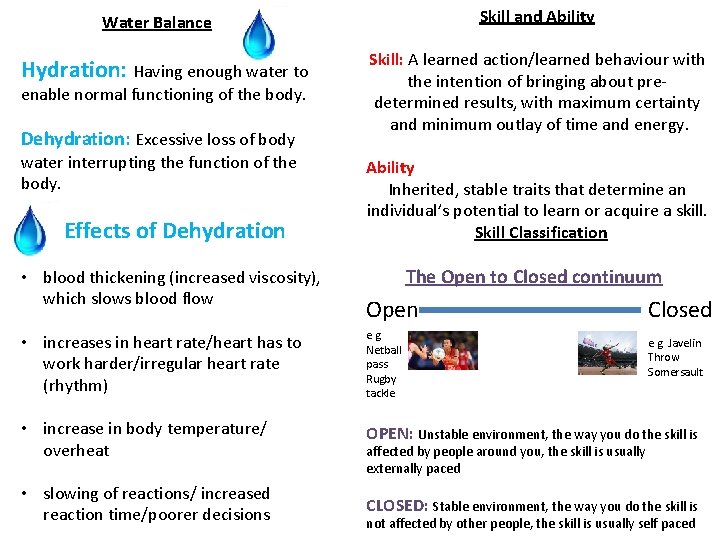
Skill and Ability Water Balance Hydration: Having enough water to enable normal functioning of the body. Dehydration: Excessive loss of body water interrupting the function of the body. Effects of Dehydration • blood thickening (increased viscosity), which slows blood flow Skill: A learned action/learned behaviour with the intention of bringing about predetermined results, with maximum certainty and minimum outlay of time and energy. Ability Inherited, stable traits that determine an individual’s potential to learn or acquire a skill. Skill Classification The Open to Closed continuum Open Closed • increases in heart rate/heart has to work harder/irregular heart rate (rhythm) e g. Netball pass Rugby tackle • increase in body temperature/ overheat OPEN: Unstable environment, the way you do the skill is • slowing of reactions/ increased reaction time/poorer decisions CLOSED: Stable environment, the way you do the skill is e g. Javelin Throw Somersault affected by people around you, the skill is usually externally paced not affected by other people, the skill is usually self paced
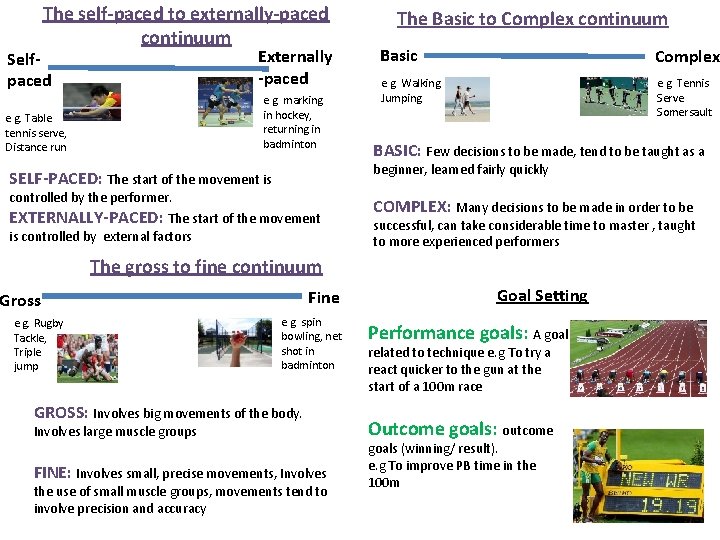
The self-paced to externally-paced continuum Externally -paced Selfpaced e g. marking in hockey, returning in badminton e g. Table tennis serve, Distance run The Basic to Complex continuum Basic Complex e g. Walking Jumping e g. Tennis Serve Somersault BASIC: Few decisions to be made, tend to be taught as a beginner, learned fairly quickly SELF-PACED: The start of the movement is controlled by the performer. EXTERNALLY-PACED: The start of the movement is controlled by external factors COMPLEX: Many decisions to be made in order to be successful, can take considerable time to master , taught to more experienced performers The gross to fine continuum Fine Gross e g. Rugby Tackle, Triple jump e g. spin bowling, net shot in badminton GROSS: Involves big movements of the body. Involves large muscle groups FINE: Involves small, precise movements, Involves the use of small muscle groups, movements tend to involve precision and accuracy Goal Setting Performance goals: A goal related to technique e. g To try a react quicker to the gun at the start of a 100 m race Outcome goals: outcome goals (winning/ result). e. g To improve PB time in the 100 m
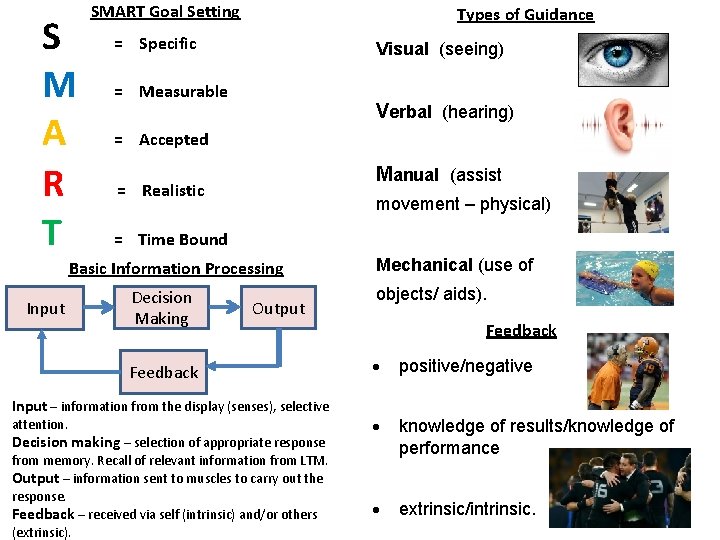
S M A R T SMART Goal Setting Types of Guidance = Specific Visual (seeing) = Measurable Verbal (hearing) = Accepted Manual (assist = Realistic movement – physical) = Time Bound Basic Information Processing Input Decision Making Output Feedback Input – information from the display (senses), selective attention. Decision making – selection of appropriate response from memory. Recall of relevant information from LTM. Output – information sent to muscles to carry out the response. Feedback – received via self (intrinsic) and/or others (extrinsic). Mechanical (use of objects/ aids). Feedback positive/negative knowledge of results/knowledge of performance extrinsic/intrinsic.
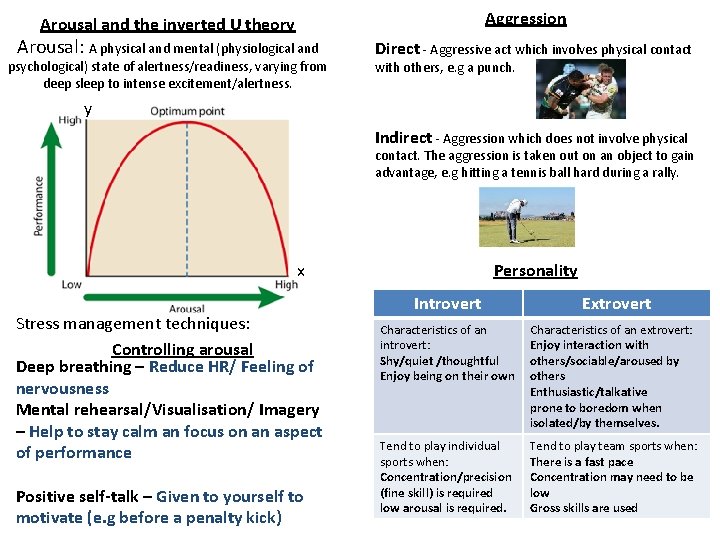
Aggression Arousal and the inverted U theory Arousal: A physical and mental (physiological and psychological) state of alertness/readiness, varying from deep sleep to intense excitement/alertness. Direct - Aggressive act which involves physical contact with others, e. g a punch. y Indirect - Aggression which does not involve physical contact. The aggression is taken out on an object to gain advantage, e. g hitting a tennis ball hard during a rally. x Stress management techniques: Controlling arousal Deep breathing – Reduce HR/ Feeling of nervousness Mental rehearsal/Visualisation/ Imagery – Help to stay calm an focus on an aspect of performance Positive self-talk – Given to yourself to motivate (e. g before a penalty kick) Personality Introvert Extrovert Characteristics of an introvert: Shy/quiet /thoughtful Enjoy being on their own Characteristics of an extrovert: Enjoy interaction with others/sociable/aroused by others Enthusiastic/talkative prone to boredom when isolated/by themselves. Tend to play individual sports when: Concentration/precision (fine skill) is required low arousal is required. Tend to play team sports when: There is a fast pace Concentration may need to be low Gross skills are used
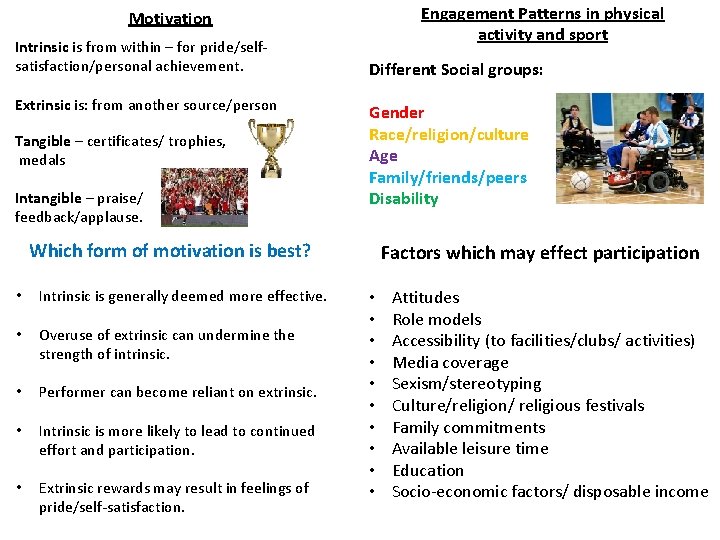
Engagement Patterns in physical activity and sport Motivation Intrinsic is from within – for pride/selfsatisfaction/personal achievement. Extrinsic is: from another source/person Tangible – certificates/ trophies, medals Intangible – praise/ feedback/applause. Different Social groups: Gender Race/religion/culture Age Family/friends/peers Disability Which form of motivation is best? • Intrinsic is generally deemed more effective. • Overuse of extrinsic can undermine the strength of intrinsic. • Performer can become reliant on extrinsic. • Intrinsic is more likely to lead to continued effort and participation. • Extrinsic rewards may result in feelings of pride/self-satisfaction. Factors which may effect participation • • • Attitudes Role models Accessibility (to facilities/clubs/ activities) Media coverage Sexism/stereotyping Culture/religion/ religious festivals Family commitments Available leisure time Education Socio-economic factors/ disposable income
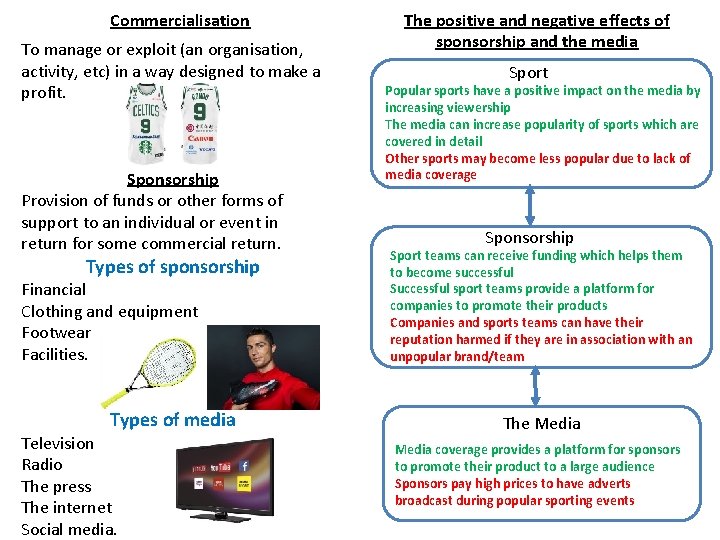
Commercialisation To manage or exploit (an organisation, activity, etc) in a way designed to make a profit. Sponsorship Provision of funds or other forms of support to an individual or event in return for some commercial return. Types of sponsorship Financial Clothing and equipment Footwear Facilities. Types of media Television Radio The press The internet Social media. The positive and negative effects of sponsorship and the media Sport Popular sports have a positive impact on the media by increasing viewership The media can increase popularity of sports which are covered in detail Other sports may become less popular due to lack of media coverage Sponsorship Sport teams can receive funding which helps them to become successful Successful sport teams provide a platform for companies to promote their products Companies and sports teams can have their reputation harmed if they are in association with an unpopular brand/team The Media coverage provides a platform for sponsors to promote their product to a large audience Sponsors pay high prices to have adverts broadcast during popular sporting events
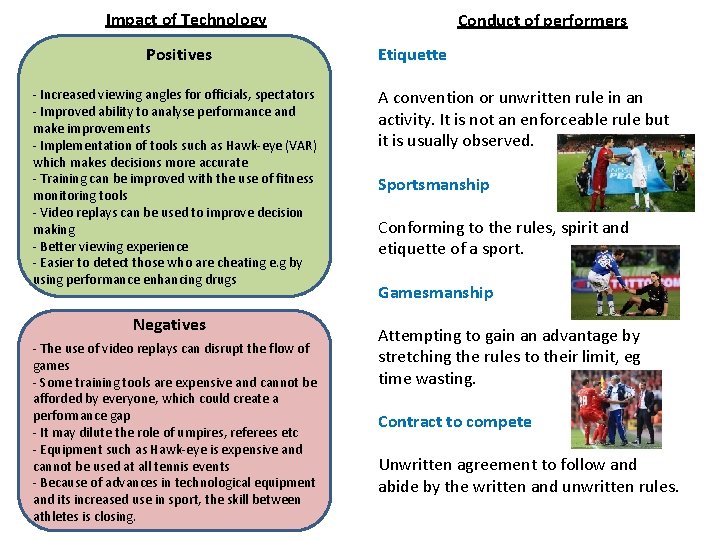
Impact of Technology Positives - Increased viewing angles for officials, spectators - Improved ability to analyse performance and make improvements - Implementation of tools such as Hawk-eye (VAR) which makes decisions more accurate - Training can be improved with the use of fitness monitoring tools - Video replays can be used to improve decision making - Better viewing experience - Easier to detect those who are cheating e. g by using performance enhancing drugs Negatives - The use of video replays can disrupt the flow of games - Some training tools are expensive and cannot be afforded by everyone, which could create a performance gap - It may dilute the role of umpires, referees etc - Equipment such as Hawk-eye is expensive and cannot be used at all tennis events - Because of advances in technological equipment and its increased use in sport, the skill between athletes is closing. Conduct of performers Etiquette A convention or unwritten rule in an activity. It is not an enforceable rule but it is usually observed. Sportsmanship Conforming to the rules, spirit and etiquette of a sport. Gamesmanship Attempting to gain an advantage by stretching the rules to their limit, eg time wasting. Contract to compete Unwritten agreement to follow and abide by the written and unwritten rules.
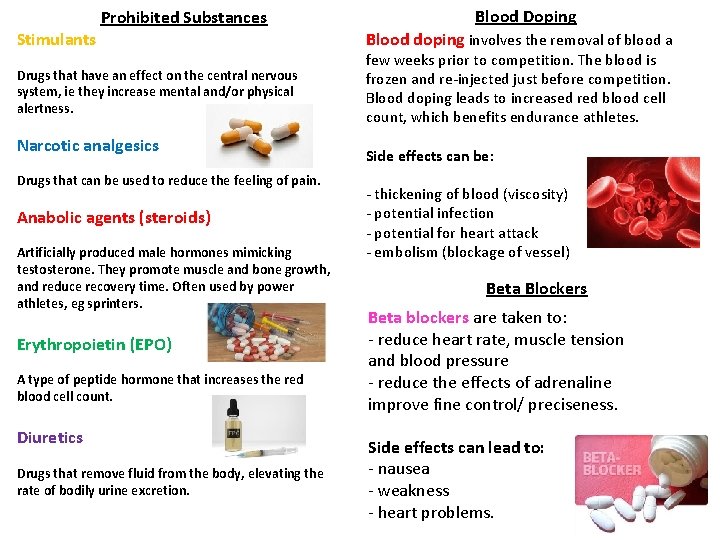
Stimulants Prohibited Substances Drugs that have an effect on the central nervous system, ie they increase mental and/or physical alertness. Narcotic analgesics Drugs that can be used to reduce the feeling of pain. Anabolic agents (steroids) Artificially produced male hormones mimicking testosterone. They promote muscle and bone growth, and reduce recovery time. Often used by power athletes, eg sprinters. Erythropoietin (EPO) A type of peptide hormone that increases the red blood cell count. Diuretics Drugs that remove fluid from the body, elevating the rate of bodily urine excretion. Blood Doping Blood doping involves the removal of blood a few weeks prior to competition. The blood is frozen and re-injected just before competition. Blood doping leads to increased red blood cell count, which benefits endurance athletes. Side effects can be: - thickening of blood (viscosity) - potential infection - potential for heart attack - embolism (blockage of vessel) Beta Blockers Beta blockers are taken to: - reduce heart rate, muscle tension and blood pressure - reduce the effects of adrenaline improve fine control/ preciseness. Side effects can lead to: - nausea - weakness - heart problems.
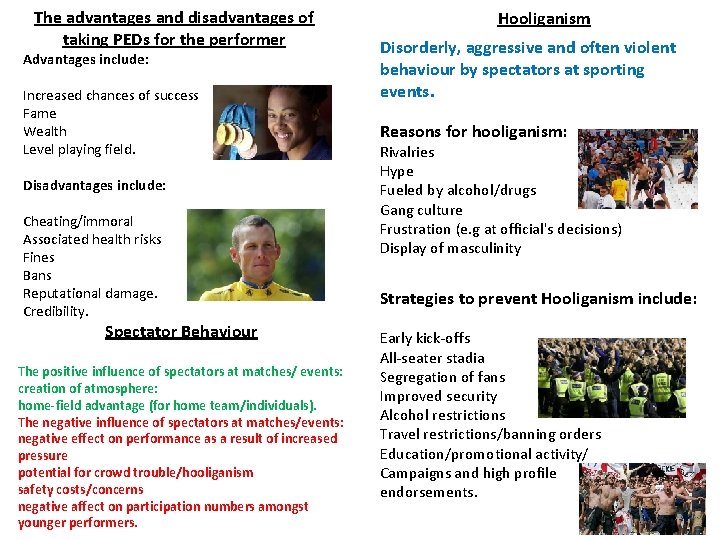
The advantages and disadvantages of taking PEDs for the performer Advantages include: Increased chances of success Fame Wealth Level playing field. Disadvantages include: Cheating/immoral Associated health risks Fines Bans Reputational damage. Credibility. Spectator Behaviour The positive influence of spectators at matches/ events: creation of atmosphere: home-field advantage (for home team/individuals). The negative influence of spectators at matches/events: negative effect on performance as a result of increased pressure potential for crowd trouble/hooliganism safety costs/concerns negative affect on participation numbers amongst younger performers. Hooliganism Disorderly, aggressive and often violent behaviour by spectators at sporting events. Reasons for hooliganism: Rivalries Hype Fueled by alcohol/drugs Gang culture Frustration (e. g at official's decisions) Display of masculinity Strategies to prevent Hooliganism include: Early kick-offs All-seater stadia Segregation of fans Improved security Alcohol restrictions Travel restrictions/banning orders Education/promotional activity/ Campaigns and high profile endorsements.
- Slides: 12