
GCSE Overview English LanguageLiterature ENGLISH LANGUAGE Controlled Assessments


- Slides: 19
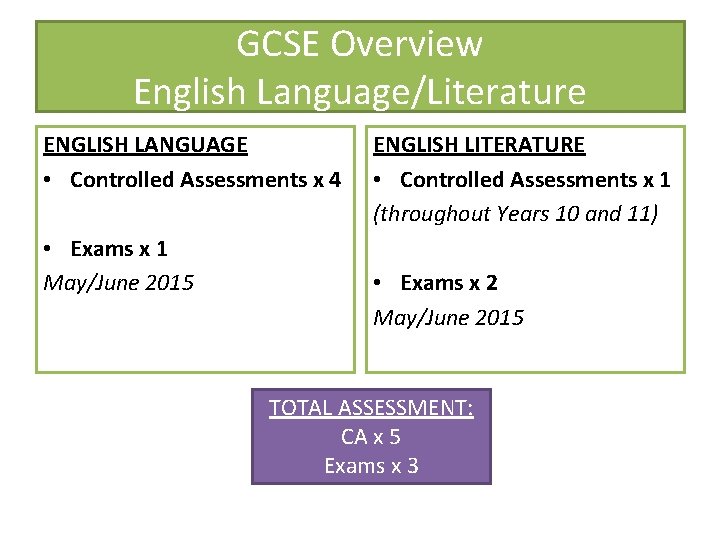
GCSE Overview English Language/Literature ENGLISH LANGUAGE • Controlled Assessments x 4 • Exams x 1 May/June 2015 ENGLISH LITERATURE • Controlled Assessments x 1 (throughout Years 10 and 11) • Exams x 2 May/June 2015 TOTAL ASSESSMENT: CA x 5 Exams x 3
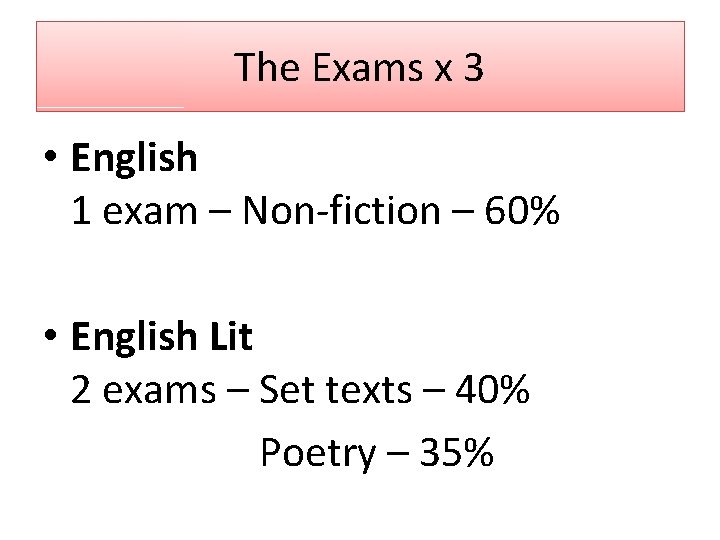
The Exams x 3 • English 1 exam – Non-fiction – 60% • English Lit 2 exams – Set texts – 40% Poetry – 35%
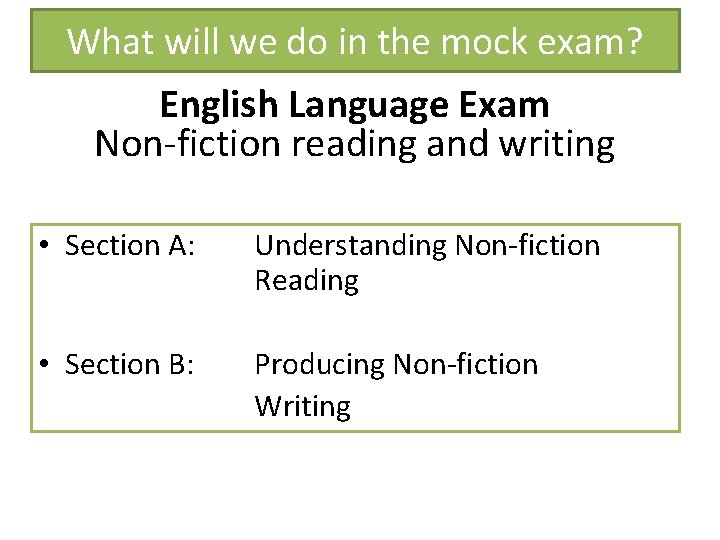
What will we do in the mock exam? English Language Exam Non-fiction reading and writing • Section A: Understanding Non-fiction Reading • Section B: Producing Non-fiction Writing
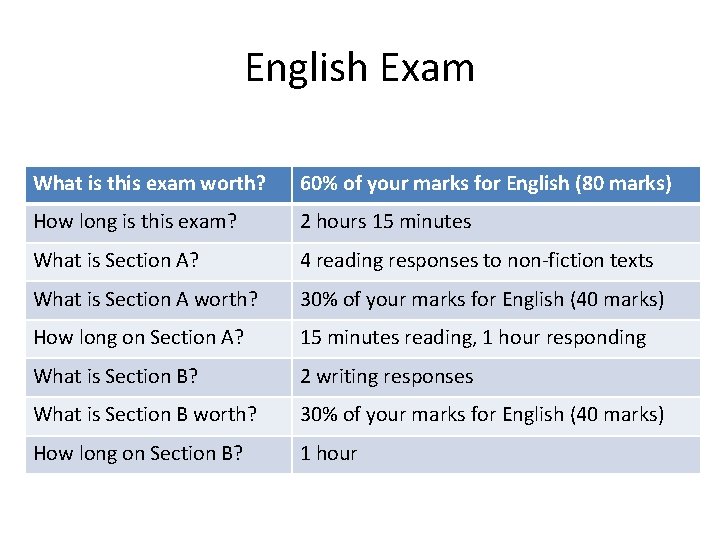
English Exam What is this exam worth? 60% of your marks for English (80 marks) How long is this exam? 2 hours 15 minutes What is Section A? 4 reading responses to non-fiction texts What is Section A worth? 30% of your marks for English (40 marks) How long on Section A? 15 minutes reading, 1 hour responding What is Section B? 2 writing responses What is Section B worth? 30% of your marks for English (40 marks) How long on Section B? 1 hour
Types of skill: • • • Select relevant detail Choose most relevant examples Analyse and explore effects Make a comparison Say why and give reasons Make links between parts of a text
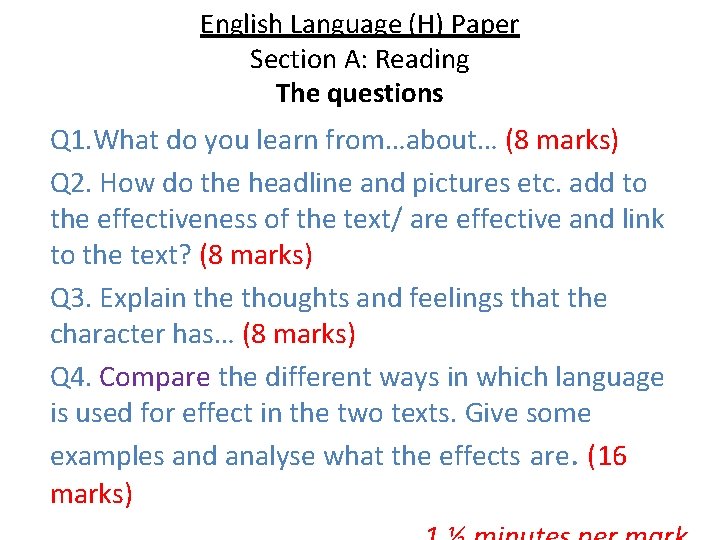
English Language (H) Paper Section A: Reading The questions Q 1. What do you learn from…about… (8 marks) Q 2. How do the headline and pictures etc. add to the effectiveness of the text/ are effective and link to the text? (8 marks) Q 3. Explain the thoughts and feelings that the character has… (8 marks) Q 4. Compare the different ways in which language is used for effect in the two texts. Give some examples and analyse what the effects are. (16 marks)
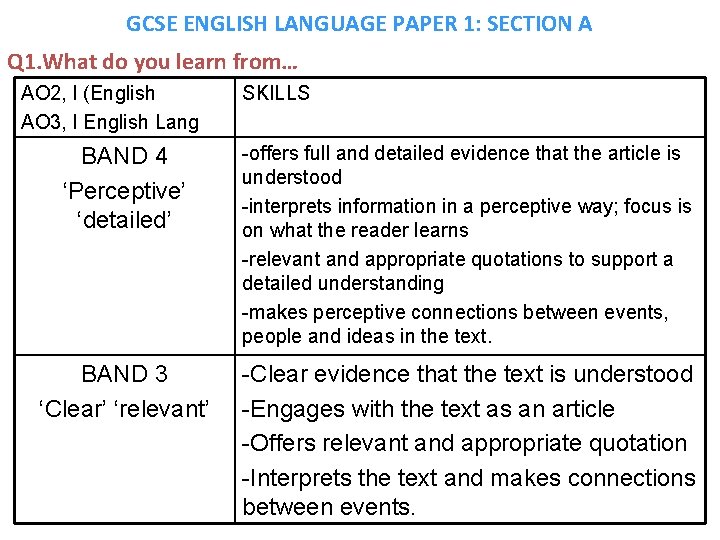
English Language Exam Section A: Reading Q 1. What do you learn about … from Source 1? (8 marks)
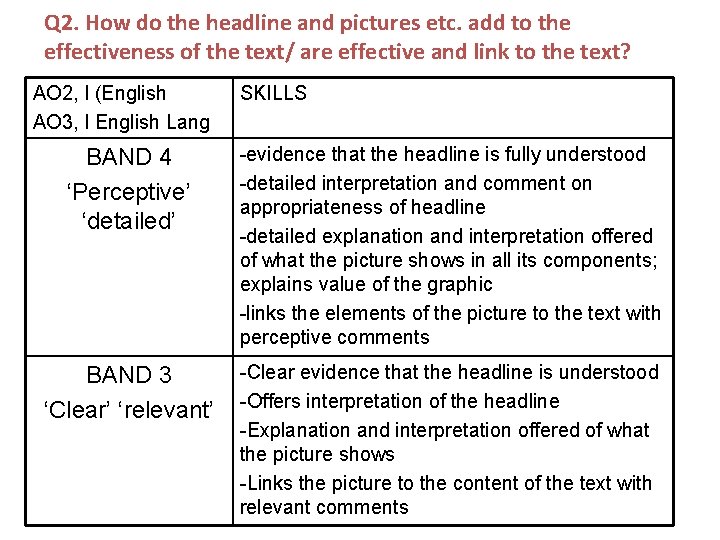
English Language Exam Section A: Reading Q 2. Explain how the presentational features in Source 2 are effective and how they link to the text? (8 marks)
English Language Exam Section A: Reading Q 3. Explain some of the thoughts and feelings experienced by … in Source 3. (8 marks)
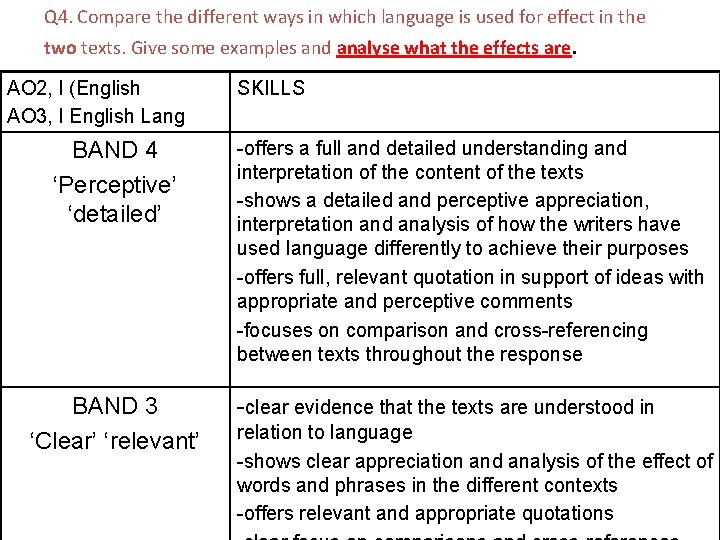
English Language Exam Section A: Reading Q 4. Compare the ways language is used for effect in Source 3 and one other text. Give examples and analyse the effects. (16 marks)
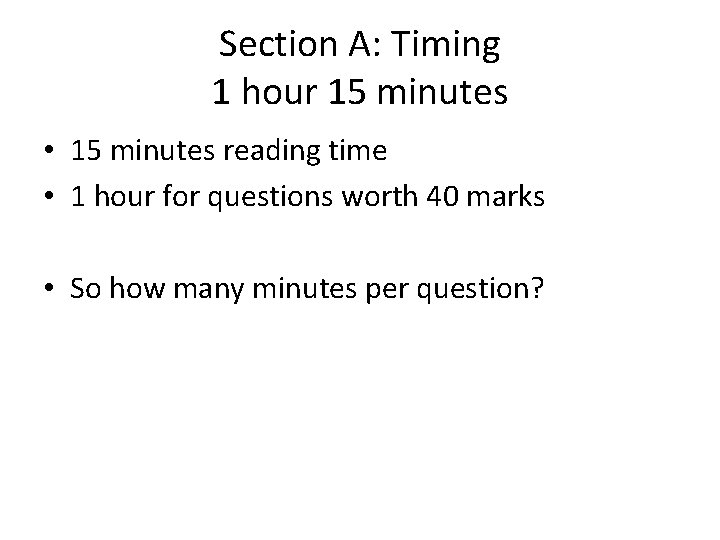
Section A: Timing 1 hour 15 minutes • 15 minutes reading time • 1 hour for questions worth 40 marks • So how many minutes per question?
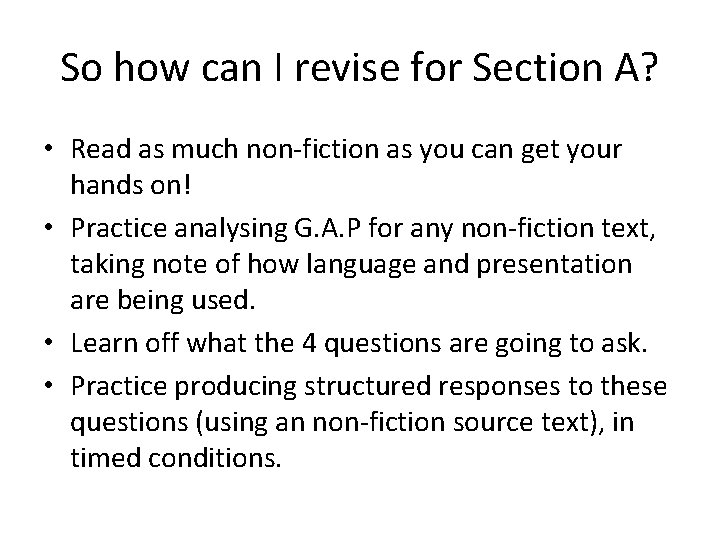
So how can I revise for Section A? • Read as much non-fiction as you can get your hands on! • Practice analysing G. A. P for any non-fiction text, taking note of how language and presentation are being used. • Learn off what the 4 questions are going to ask. • Practice producing structured responses to these questions (using an non-fiction source text), in timed conditions.
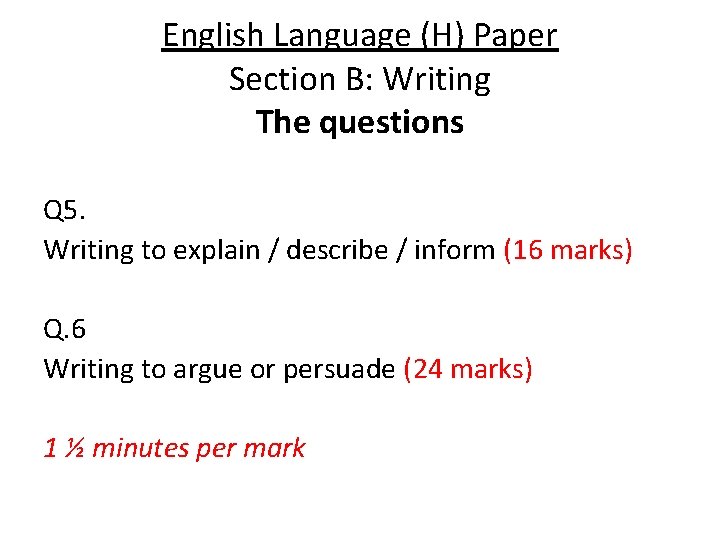
English Language (H) Paper Section B: Writing The questions Q 5. Writing to explain / describe / inform (16 marks) Q. 6 Writing to argue or persuade (24 marks) 1 ½ minutes per mark
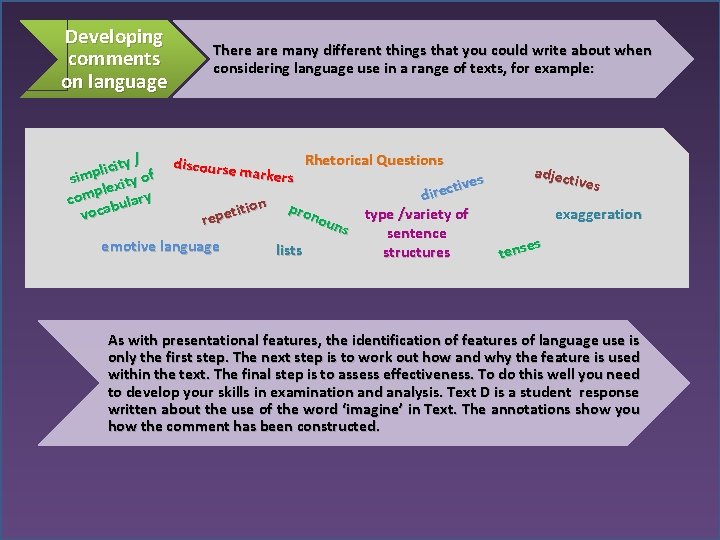
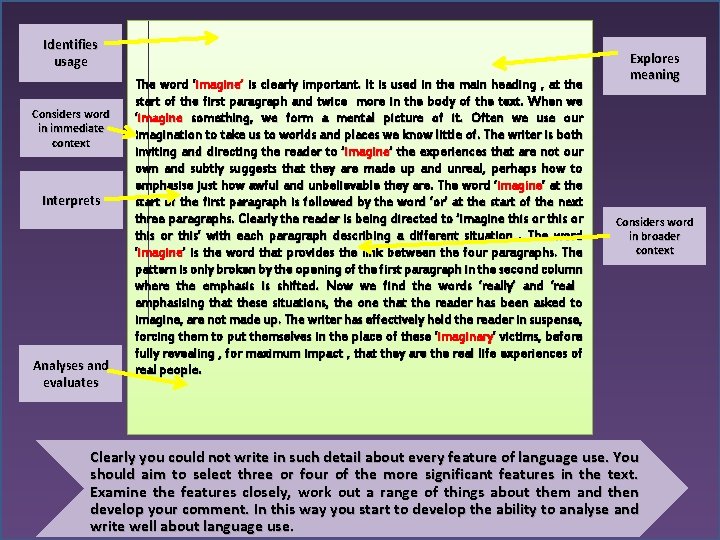
Developing comments on language There are many different things that you could write about when considering language use in a range of texts, for example: Rhetorical Questions discourse markers adject s ives e v i t c e r i d n o p i t r i t ono type /variety of exaggeration repe uns sentence es emotive language lists structures tens city / f i l p sim xity o ple com bulary voca As with presentational features, the identification of features of language use is only the first step. The next step is to work out how and why the feature is used within the text. The final step is to assess effectiveness. To do this well you need to develop your skills in examination and analysis. Text D is a student response written about the use of the word ‘imagine’ in Text. The annotations show you how the comment has been constructed.
Identifies usage Considers word in immediate context Interprets Analyses and evaluates The word ‘imagine’ is clearly important. It is used in the main heading , at the start of the first paragraph and twice more in the body of the text. When we ‘imagine something, we form a mental picture of it. Often we use our imagination to take us to worlds and places we know little of. The writer is both inviting and directing the reader to ‘imagine’ the experiences that are not our own and subtly suggests that they are made up and unreal, perhaps how to emphasise just how awful and unbelievable they are. The word ‘imagine’ at the start of the first paragraph is followed by the word ‘or’ at the start of the next three paragraphs. Clearly the reader is being directed to ‘imagine this or this’ with each paragraph describing a different situation. The word ‘imagine’ is the word that provides the link between the four paragraphs. The pattern is only broken by the opening of the first paragraph in the second column where the emphasis is shifted. Now we find the words ‘really’ and ‘real emphasising that these situations, the one that the reader has been asked to imagine, are not made up. The writer has effectively held the reader in suspense, forcing them to put themselves in the place of these ‘imaginary’ victims, before fully revealing , for maximum impact , that they are the real life experiences of real people. Explores meaning Considers word in broader context Clearly you could not write in such detail about every feature of language use. You should aim to select three or four of the more significant features in the text. Examine the features closely, work out a range of things about them and then develop your comment. In this way you start to develop the ability to analyse and write well about language use.
GCSE ENGLISH LANGUAGE PAPER 1: SECTION A Q 1. What do you learn from… AO 2, I (English AO 3, I English Lang SKILLS BAND 4 ‘Perceptive’ ‘detailed’ -offers full and detailed evidence that the article is understood -interprets information in a perceptive way; focus is on what the reader learns -relevant and appropriate quotations to support a detailed understanding -makes perceptive connections between events, people and ideas in the text. BAND 3 ‘Clear’ ‘relevant’ -Clear evidence that the text is understood -Engages with the text as an article -Offers relevant and appropriate quotation -Interprets the text and makes connections between events.
Q 2. How do the headline and pictures etc. add to the effectiveness of the text/ are effective and link to the text? AO 2, I (English AO 3, I English Lang SKILLS BAND 4 ‘Perceptive’ ‘detailed’ -evidence that the headline is fully understood -detailed interpretation and comment on appropriateness of headline -detailed explanation and interpretation offered of what the picture shows in all its components; explains value of the graphic -links the elements of the picture to the text with perceptive comments BAND 3 ‘Clear’ ‘relevant’ -Clear evidence that the headline is understood -Offers interpretation of the headline -Explanation and interpretation offered of what the picture shows -Links the picture to the content of the text with relevant comments
Q 4. Compare the different ways in which language is used for effect in the two texts. Give some examples and analyse what the effects are. AO 2, I (English AO 3, I English Lang BAND 4 ‘Perceptive’ ‘detailed’ BAND 3 ‘Clear’ ‘relevant’ SKILLS -offers a full and detailed understanding and interpretation of the content of the texts -shows a detailed and perceptive appreciation, interpretation and analysis of how the writers have used language differently to achieve their purposes -offers full, relevant quotation in support of ideas with appropriate and perceptive comments -focuses on comparison and cross-referencing between texts throughout the response -clear evidence that the texts are understood in relation to language -shows clear appreciation and analysis of the effect of words and phrases in the different contexts -offers relevant and appropriate quotations
Examiner’s report June 2012 Concluding remarks: The most successful students were evidently those who read and understood the specific requirements of each question and then addressed them accordingly. The fifteen minutes reading time is designed for students to facilitate this by reading the entire question paper and all the sources prior to attempting any response.