
GCSE MOVEMENT ANALYSIS APPLICATION Pulse raiser What am





- Slides: 20
GCSE MOVEMENT ANALYSIS APPLICATION
Pulse raiser – What am I describing?
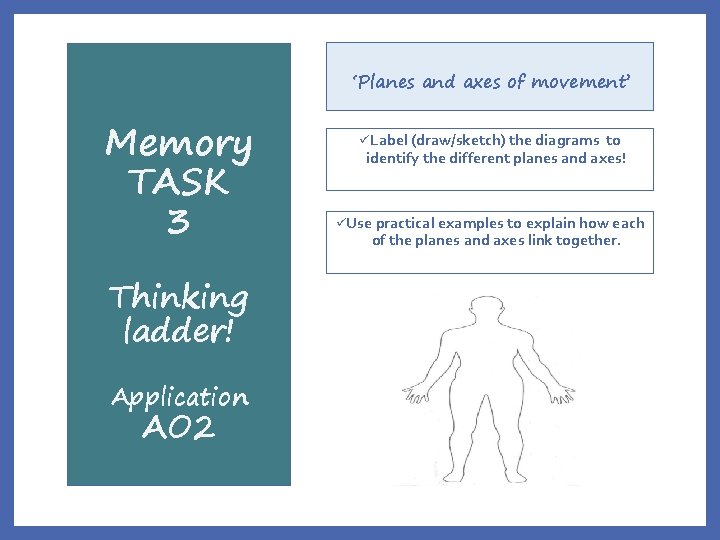
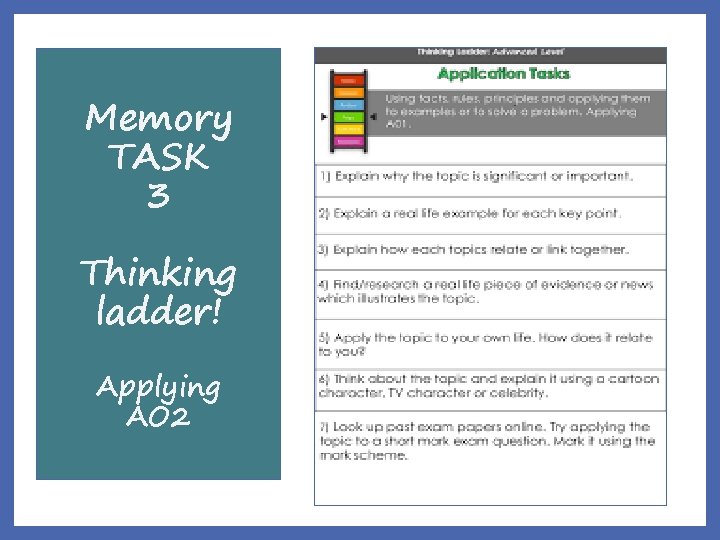
‘Planes and axes of movement’ Memory TASK 3 Thinking ladder! Application AO 2 üLabel (draw/sketch) the diagrams to identify the different planes and axes! üUse practical examples to explain how each of the planes and axes link together.
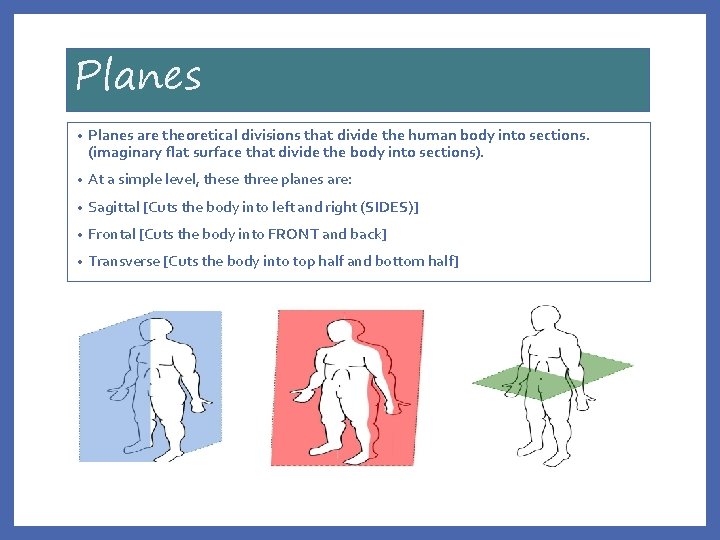
Planes • Planes are theoretical divisions that divide the human body into sections. (imaginary flat surface that divide the body into sections). • At a simple level, these three planes are: • Sagittal [Cuts the body into left and right (SIDES)] • Frontal [Cuts the body into FRONT and back] • Transverse [Cuts the body into top half and bottom half]
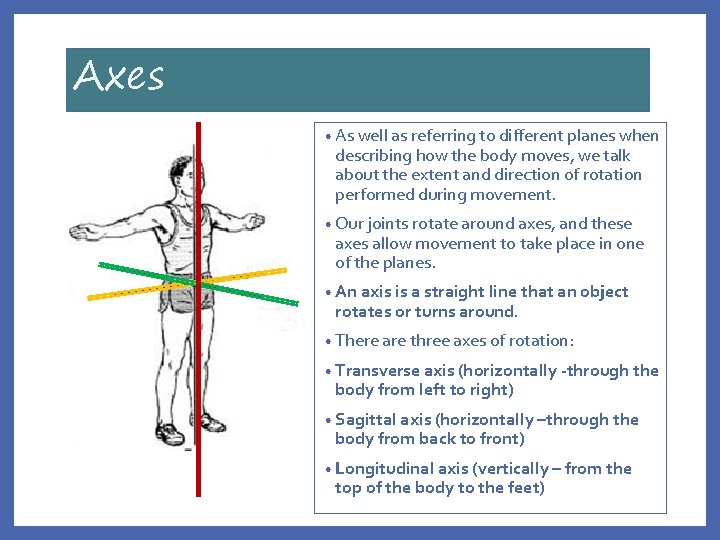
Axes • As well as referring to different planes when describing how the body moves, we talk about the extent and direction of rotation performed during movement. • Our joints rotate around axes, and these axes allow movement to take place in one of the planes. • An axis is a straight line that an object rotates or turns around. • There are three axes of rotation: • Transverse axis (horizontally -through the body from left to right) • Sagittal axis (horizontally –through the body from back to front) • Longitudinal axis (vertically – from the top of the body to the feet)
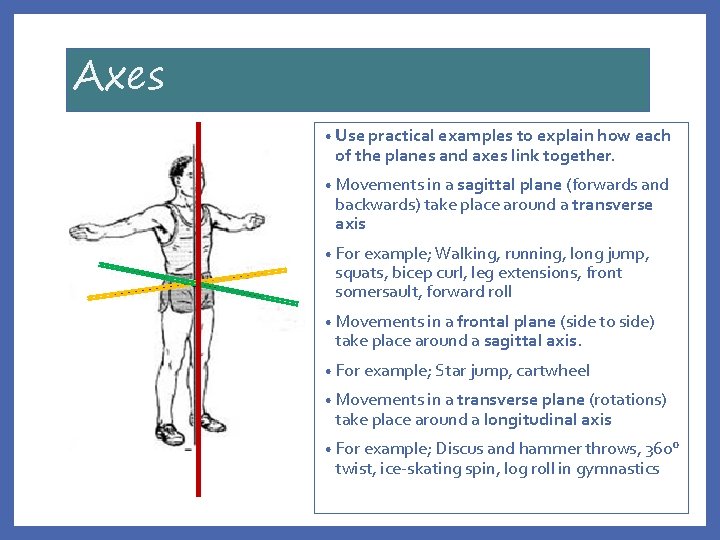
Axes • Use practical examples to explain how each of the planes and axes link together. • Movements in a sagittal plane (forwards and backwards) take place around a transverse axis • For example; Walking, running, long jump, squats, bicep curl, leg extensions, front somersault, forward roll • Movements in a frontal plane (side to side) take place around a sagittal axis. • For example; Star jump, cartwheel • Movements in a transverse plane (rotations) take place around a longitudinal axis • For example; Discus and hammer throws, 360° twist, ice-skating spin, log roll in gymnastics
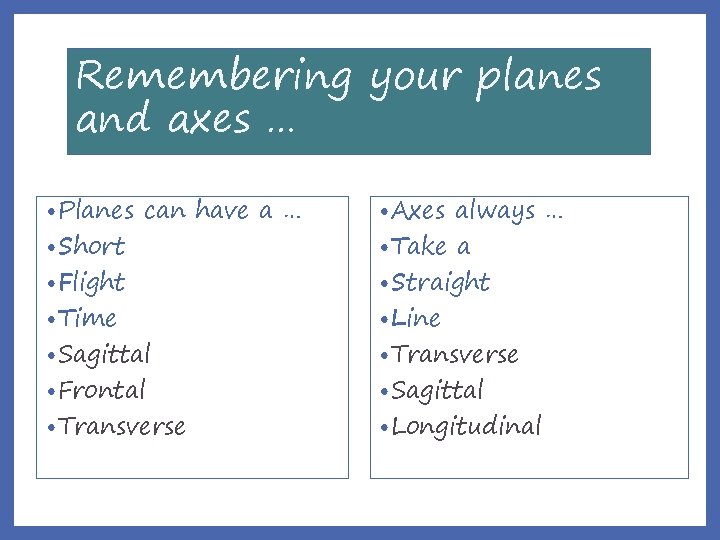
Remembering your planes and axes … • Planes • Short can have a … • Flight • Time • Sagittal • Frontal • Transverse • Axes always … • Take a • Straight • Line • Transverse • Sagittal • Longitudinal
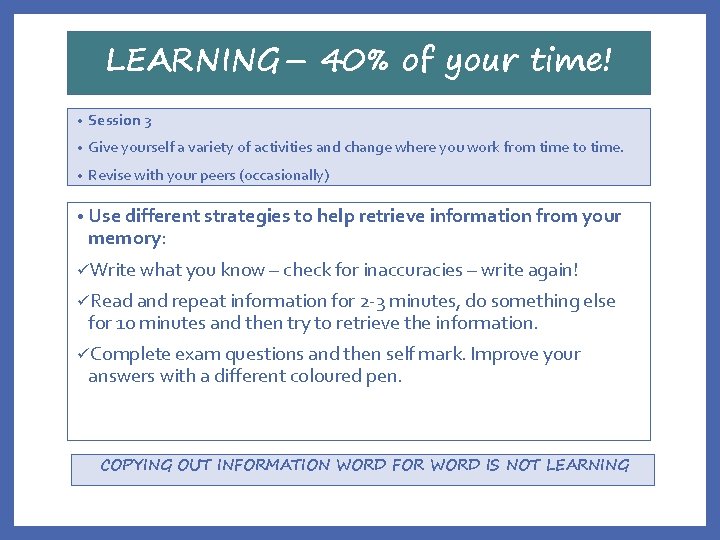
LEARNING– 40% of your time! • Session 3 • Give yourself a variety of activities and change where you work from time to time. • Revise with your peers (occasionally) • Use different strategies to help retrieve information from your memory: üWrite what you know – check for inaccuracies – write again! üRead and repeat information for 2 -3 minutes, do something else for 10 minutes and then try to retrieve the information. üComplete exam questions and then self mark. Improve your answers with a different coloured pen. COPYING OUT INFORMATION WORD FOR WORD IS NOT LEARNING
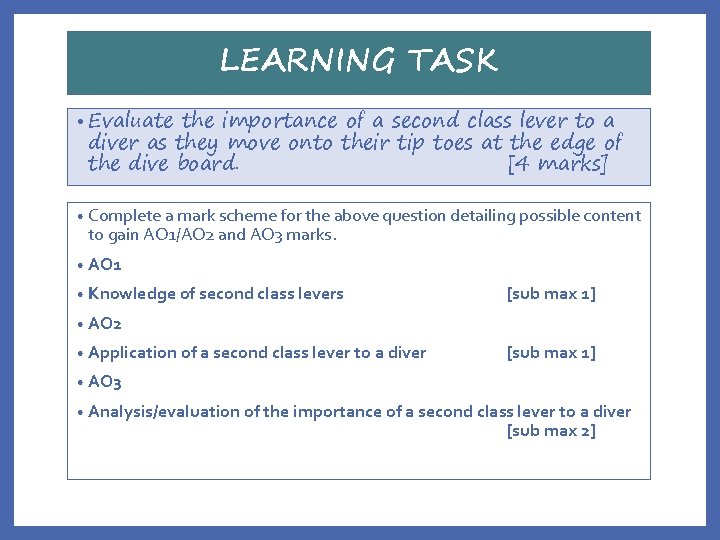
LEARNING TASK • Evaluate the importance of a second class lever to a diver as they move onto their tip toes at the edge of the dive board. [4 marks] • Complete a mark scheme for the above question detailing possible content to gain AO 1/AO 2 and AO 3 marks. • AO 1 • Knowledge of second class levers [sub max 1] • AO 2 • Application of a second class lever to a diver [sub max 1] • AO 3 • Analysis/evaluation of the importance of a second class lever to a diver [sub max 2]
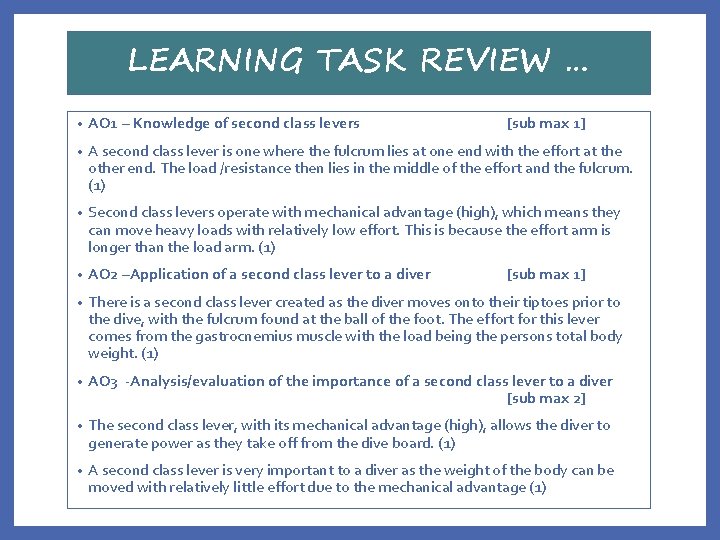
LEARNING TASK REVIEW … • AO 1 – Knowledge of second class levers [sub max 1] • A second class lever is one where the fulcrum lies at one end with the effort at the other end. The load /resistance then lies in the middle of the effort and the fulcrum. (1) • Second class levers operate with mechanical advantage (high), which means they can move heavy loads with relatively low effort. This is because the effort arm is longer than the load arm. (1) • AO 2 –Application of a second class lever to a diver • There is a second class lever created as the diver moves onto their tiptoes prior to the dive, with the fulcrum found at the ball of the foot. The effort for this lever comes from the gastrocnemius muscle with the load being the persons total body weight. (1) • AO 3 -Analysis/evaluation of the importance of a second class lever to a diver [sub max 2] • The second class lever, with its mechanical advantage (high), allows the diver to generate power as they take off from the dive board. (1) • A second class lever is very important to a diver as the weight of the body can be moved with relatively little effort due to the mechanical advantage (1) [sub max 1]
DNA …… SELF SOLVE! • Do you k. Now it • All …? Answer the EXAM questions (10 minutes allowed)
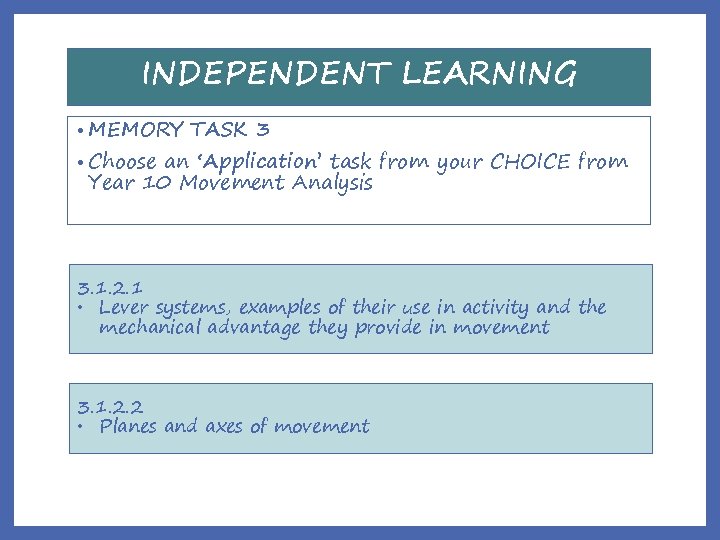
INDEPENDENT LEARNING • MEMORY • Choose TASK 3 an ‘Application’ task from your CHOICE from Year 10 Movement Analysis 3. 1. 2. 1 • Lever systems, examples of their use in activity and the mechanical advantage they provide in movement 3. 1. 2. 2 • Planes and axes of movement
Memory TASK 3 Thinking ladder! Applying AO 2
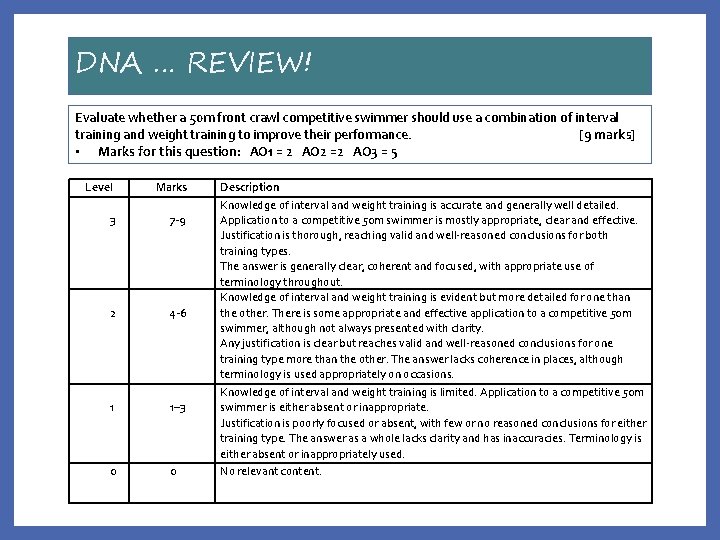
DNA … REVIEW! Evaluate whether a 50 m front crawl competitive swimmer should use a combination of interval training and weight training to improve their performance. [9 marks] • Marks for this question: AO 1 = 2 AO 2 =2 AO 3 = 5 Level Marks 3 7 -9 2 4 -6 1 1– 3 0 0 Description Knowledge of interval and weight training is accurate and generally well detailed. Application to a competitive 50 m swimmer is mostly appropriate, clear and effective. Justification is thorough, reaching valid and well-reasoned conclusions for both training types. The answer is generally clear, coherent and focused, with appropriate use of terminology throughout. Knowledge of interval and weight training is evident but more detailed for one than the other. There is some appropriate and effective application to a competitive 50 m swimmer, although not always presented with clarity. Any justification is clear but reaches valid and well-reasoned conclusions for one training type more than the other. The answer lacks coherence in places, although terminology is used appropriately on occasions. Knowledge of interval and weight training is limited. Application to a competitive 50 m swimmer is either absent or inappropriate. Justification is poorly focused or absent, with few or no reasoned conclusions for either training type. The answer as a whole lacks clarity and has inaccuracies. Terminology is either absent or inappropriately used. No relevant content.
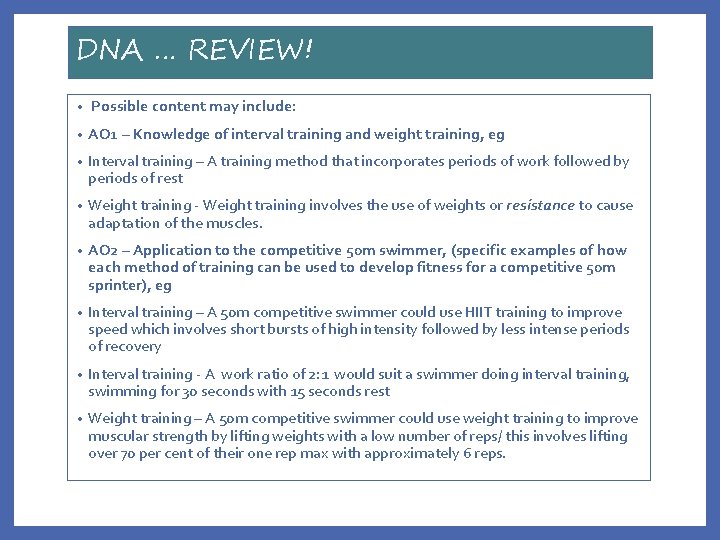
DNA … REVIEW! • Possible content may include: • AO 1 – Knowledge of interval training and weight training, eg • Interval training – A training method that incorporates periods of work followed by periods of rest • Weight training - Weight training involves the use of weights or resistance to cause adaptation of the muscles. • AO 2 – Application to the competitive 50 m swimmer, (specific examples of how each method of training can be used to develop fitness for a competitive 50 m sprinter), eg • Interval training – A 50 m competitive swimmer could use HIIT training to improve speed which involves short bursts of high intensity followed by less intense periods of recovery • Interval training - A work ratio of 2: 1 would suit a swimmer doing interval training, swimming for 30 seconds with 15 seconds rest • Weight training – A 50 m competitive swimmer could use weight training to improve muscular strength by lifting weights with a low number of reps/ this involves lifting over 70 per cent of their one rep max with approximately 6 reps.
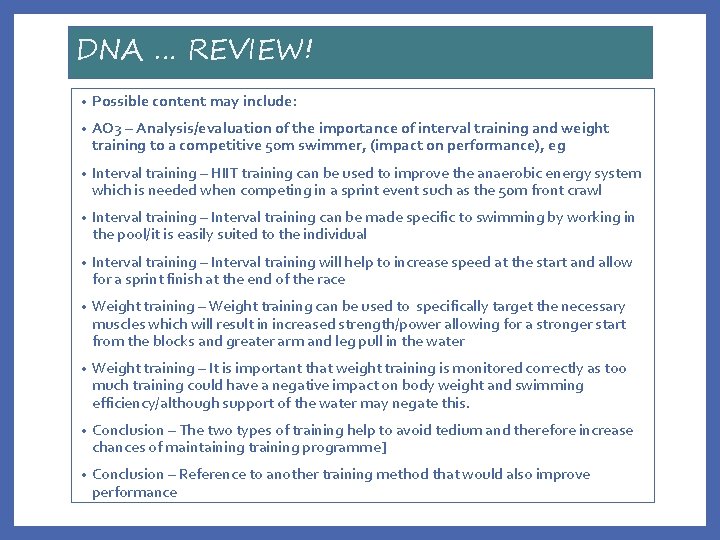
DNA … REVIEW! • Possible content may include: • AO 3 – Analysis/evaluation of the importance of interval training and weight training to a competitive 50 m swimmer, (impact on performance), eg • Interval training – HIIT training can be used to improve the anaerobic energy system which is needed when competing in a sprint event such as the 50 m front crawl • Interval training – Interval training can be made specific to swimming by working in the pool/it is easily suited to the individual • Interval training – Interval training will help to increase speed at the start and allow for a sprint finish at the end of the race • Weight training – Weight training can be used to specifically target the necessary muscles which will result in increased strength/power allowing for a stronger start from the blocks and greater arm and leg pull in the water • Weight training – It is important that weight training is monitored correctly as too much training could have a negative impact on body weight and swimming efficiency/although support of the water may negate this. • Conclusion – The two types of training help to avoid tedium and therefore increase chances of maintaining training programme] • Conclusion – Reference to another training method that would also improve performance
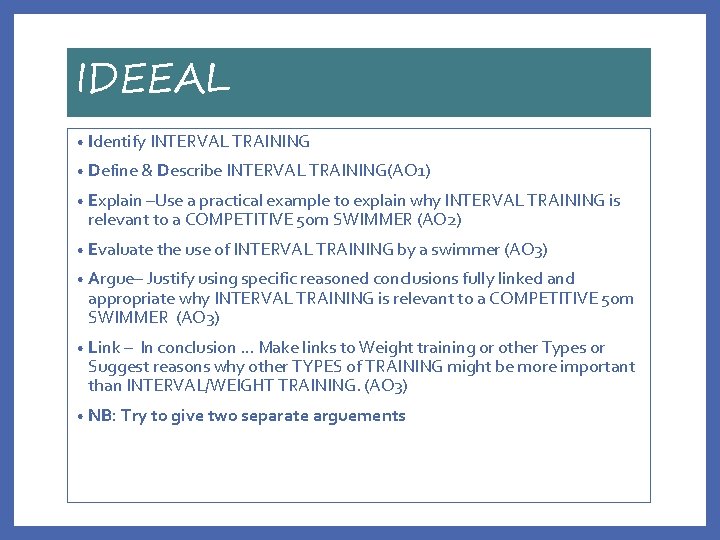
IDEEAL • Identify INTERVAL TRAINING • Define & Describe INTERVAL TRAINING(AO 1) • Explain –Use a practical example to explain why INTERVAL TRAINING is relevant to a COMPETITIVE 50 m SWIMMER (AO 2) • Evaluate the use of INTERVAL TRAINING by a swimmer (AO 3) • Argue– Justify using specific reasoned conclusions fully linked and appropriate why INTERVAL TRAINING is relevant to a COMPETITIVE 50 m SWIMMER (AO 3) • Link – In conclusion … Make links to Weight training or other Types or Suggest reasons why other TYPES of TRAINING might be more important than INTERVAL/WEIGHT TRAINING. (AO 3) • NB: Try to give two separate arguements
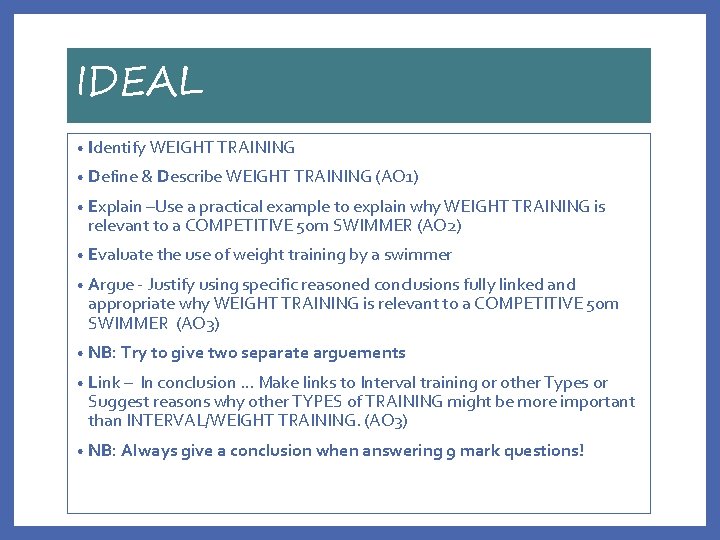
IDEAL • Identify WEIGHT TRAINING • Define & Describe WEIGHT TRAINING (AO 1) • Explain –Use a practical example to explain why WEIGHT TRAINING is relevant to a COMPETITIVE 50 m SWIMMER (AO 2) • Evaluate the use of weight training by a swimmer • Argue - Justify using specific reasoned conclusions fully linked and appropriate why WEIGHT TRAINING is relevant to a COMPETITIVE 50 m SWIMMER (AO 3) • NB: Try to give two separate arguements • Link – In conclusion … Make links to Interval training or other Types or Suggest reasons why other TYPES of TRAINING might be more important than INTERVAL/WEIGHT TRAINING. (AO 3) • NB: Always give a conclusion when answering 9 mark questions!
Revision … TOP TIP! • Timetable – Create a revision timetable and stick to it! • Organise and order all your theory booklets (one file per unit) • Post it – Display notes where you will see them (Post it notes/Home screen on phone/tablet etc. ) • Topic summary - Summarise topic in 5 sentences - reduce to 5 words - reduce to one word! • Identify any weaknesses in knowledge and understanding • Practice exam questions (unit tests/home learning etc. )