
GCSE MATHS NEED TO KNOW 2019 2020 HIGHER
- Slides: 4
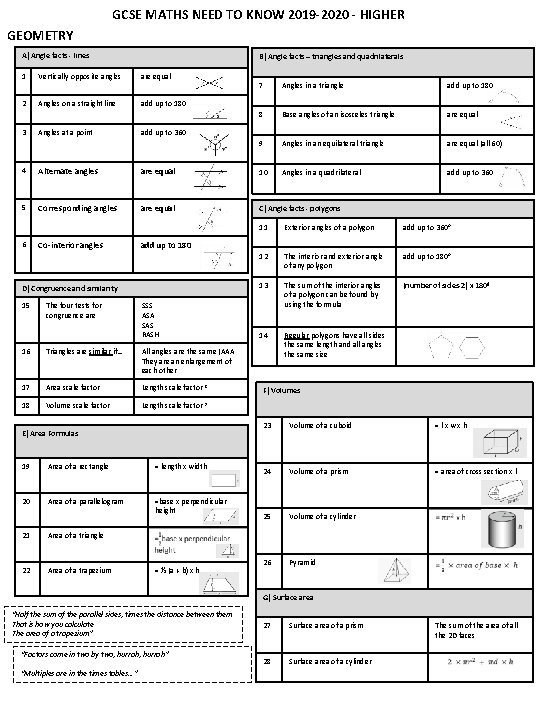
GCSE MATHS NEED TO KNOW 2019 -2020 - HIGHER GEOMETRY A) Angle facts - lines B) Angle facts – triangles and quadrilaterals 1 Vertically opposite angles are equal 2 Angles on a straight line add up to 180 3 Angles at a point 7 Angles in a triangle add up to 180 8 Base angles of an isosceles triangle are equal 9 Angles in an equilateral triangle are equal (all 60) Angles in a quadrilateral add up to 360 4 Alternate angles are equal 10 5 Corresponding angles are equal C) Angle facts - polygons 6 Co-interior angles The four tests for congruence are SSS ASA SAS RASH 16 Triangles are similar if… All angles are the same (AAA They are an enlargement of each other 17 Area scale factor Length scale factor 2 18 Volume scale factor Length scale 19 Area of a rectangle = length x width 20 Area of a parallelogram =base x perpendicular height Area of a triangle 22 Area of a trapezium add up to 360° 12 The interior and exterior angle of any polygon add up to 180° 13 The sum of the interior angles of a polygon can be found by using the formula (number of sides-2) x 180º 14 Regular polygons have all sides the same length and all angles the same size F) Volumes factor 3 E) Area Formulas 21 Exterior angles of a polygon add up to 180 D) Congruence and similarity 15 11 = ½ (a + b) x h 23 Volume of a cuboid =lxwxh 24 Volume of a prism = area of cross section x l 25 Volume of a cylinder 26 Pyramid G) Surface area “Half the sum of the parallel sides, times the distance between them That is how you calculate The area of a trapezium” “Factors come in two by two, hurrah” “Multiples are in the times tables…” 27 Surface area of a prism 28 Surface area of a cylinder The sum of the area of all the 2 D faces
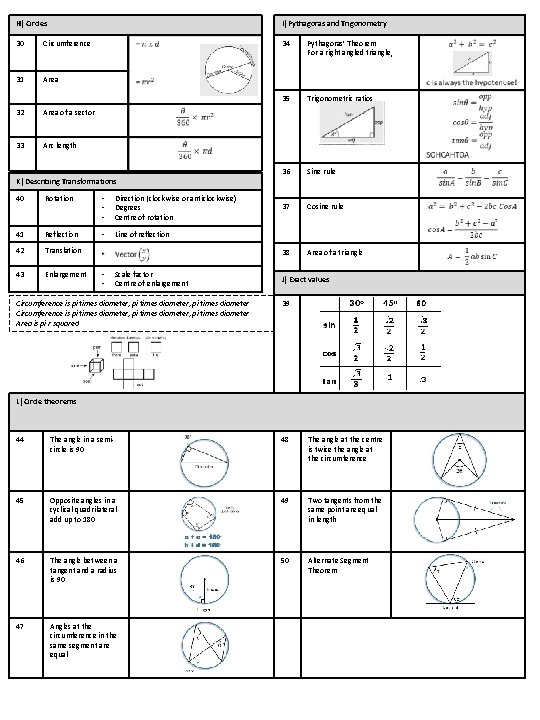
H) Circles I) Pythagoras and Trigonometry 30 Circumference 34 Pythagoras’ Theorem For a right angled triangle, 31 Area 35 Trigonometric ratios 32 Area of a sector 33 Arc length 36 Sine rule 37 Cosine rule 38 Area of a triangle K) Describing Transformations 40 Rotation • • • Direction (clockwise or anticlockwise) Degrees Centre of rotation 41 Reflection • Line of reflection 42 Translation 43 Enlargement • • Scale factor Centre of enlargement Circumference is pi times diameter, pi times diameter Area is pi r squared J) Exact values 39 L) Circle theorems 44 The angle in a semicircle is 90 48 The angle at the centre is twice the angle at the circumference 45 Opposite angles in a cyclical quadrilateral add up to 180 49 Two tangents from the same point are equal in length 46 The angle between a tangent and a radius is 90 50 Alternate Segment Theorem 47 Angles at the circumference in the same segment are equal
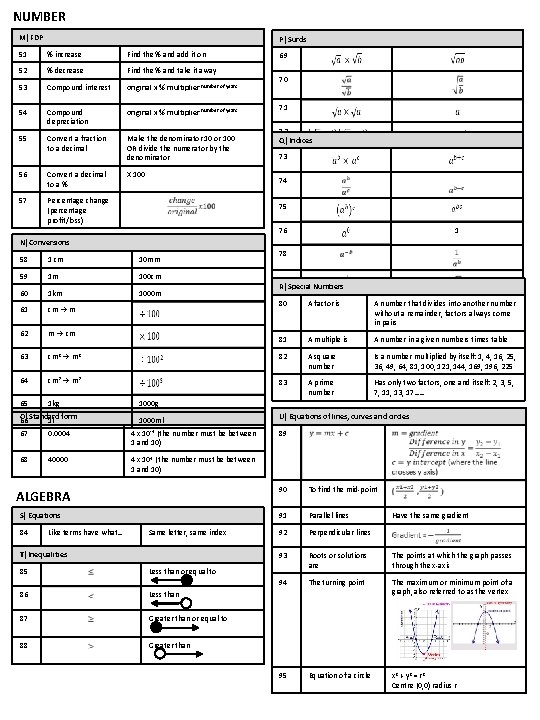
NUMBER M) FDP P) Surds 51 % increase Find the % and add it on 52 % decrease Find the % and take it away 53 Compound interest original x % multiplier number of years 54 Compound depreciation original x % multiplier number of years 55 Convert a fraction to a decimal Make the denominator 100 OR divide the numerator by the denominator 56 Convert a decimal to a % X 100 57 Percentage change (percentage profit/loss) 69 70 71 72 Q) Indices 73 74 75 76 1 N) Conversions 58 1 cm 10 mm 59 1 m 100 cm 60 1 km 1000 m 61 cm m 62 m cm 63 78 79 R) Special Numbers 80 A factor is A number that divides into another number without a remainder, factors always come in pairs 81 A multiple is A number in a given numbers times table cm 2 82 A square number Is a number multiplied by itself: 1, 4, 16, 25, 36, 49, 64, 81, 100, 121, 144, 169, 196, 225 64 cm 3 83 A prime number Has only two factors, one and itself: 2, 3, 5, 7, 11, 13, 17…… 65 1 kg O) Standard 66 1 l form 1000 g 1000 ml 67 0. 0004 4 x 10 -4 (the number must be between 1 and 10) 68 40000 4 x 10⁴ (the number must be between 1 and 10) ALGEBRA S) Equations 84 Like terms have what… Same letter, same index T) Inequalities 85 Less than or equal to 86 Less than 87 Greater than or equal to 88 Greater than U) Equations of lines, curves and circles 89 90 To find the mid-point 91 Parallel lines 92 Perpendicular lines 93 Roots or solutions are The points at which the graph passes through the x-axis 94 The turning point The maximum or minimum point of a graph, also referred to as the vertex 95 Equation of a circle x 2 + y 2 = r 2 Centre (0, 0) radius r Have the same gradient
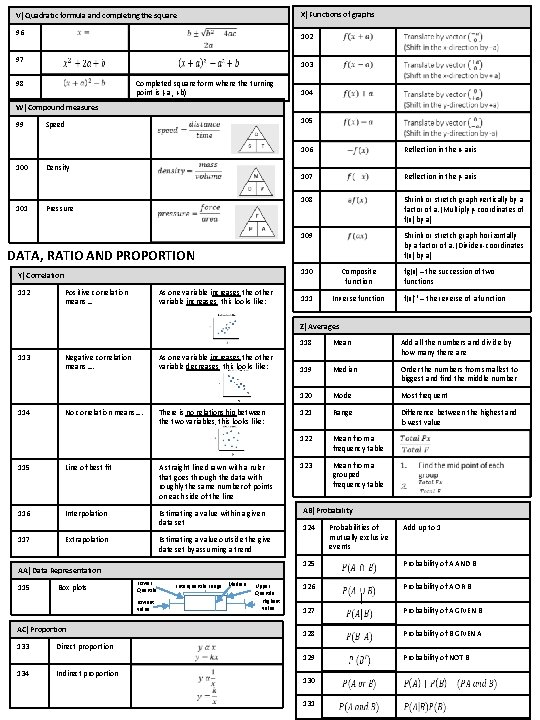
X) Functions of graphs V) Quadratic formula and completing the square 96 102 97 103 98 Completed square form where the turning point is (-a , +b) 104 W) Compound measures 99 105 Speed 100 Density 101 Pressure 106 Reflection in the x-axis 107 Reflection in the y-axis 108 Shrink or stretch graph vertically by a factor of a. (Multiply y-coordinates of f(x) by a) 109 Shrink or stretch graph horizontally by a factor of a. (Divide x-coordinates f(x) by a) DATA, RATIO AND PROPORTION Y) Correlation 112 Positive correlation means… As one variable increases the other variable increases, this looks like: 110 Composite function 111 Inverse function fg(x) – the succession of two functions f(x)-1 – the reverse of a function Z) Averages 113 114 Negative correlation means…. As one variable increases the other variable decreases, this looks like: No correlation means…. There is no relationship between the two variables, this looks like: 115 Line of best fit A straight line drawn with a ruler that goes through the data with roughly the same number of points on each side of the line 116 Interpolation Estimating a value within a given data set 117 Extrapolation Estimating a value outside the give date set by assuming a trend AA) Data Representation 115 Box plots Lower Quartile Lowest value AC) Proportion 133 134 Interquartile range Median Upper Quartile Highest value 118 Mean Add all the numbers and divide by how many there are 119 Median Order the numbers from smallest to biggest and find the middle number 120 Mode Most frequent 121 Range Difference between the highest and lowest value 122 Mean from a frequency table 123 Mean from a grouped frequency table AB) Probability 124 Probabilities of mutually exclusive events Add up to 1 125 Probability of A AND B 126 Probability of A OR B 127 Probability of A GIVEN B 128 Probability of B GIVEN A 129 Probability of NOT B Direct proportion Indirect proportion 130 131