
GCSE Mathematics Linear Route Map Foundation Tier Routemap
- Slides: 68
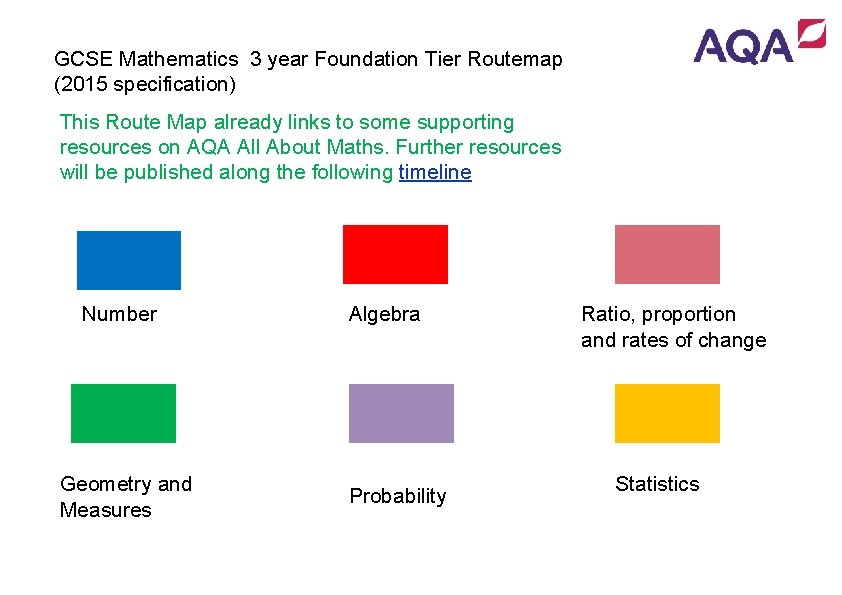
GCSE Mathematics Linear Route Map – Foundation Tier. Routemap GCSE Mathematics 3 year Foundation Tier (2015 specification) This Route Map already links to some supporting resources on AQA All About Maths. Further resources will be published along the following timeline Number Topic Number Geometry and Measures Algebra Topic Geometry & Measures Topic Algebra Probability Statistics Topic Ratio, proportion and rates of change Statistics
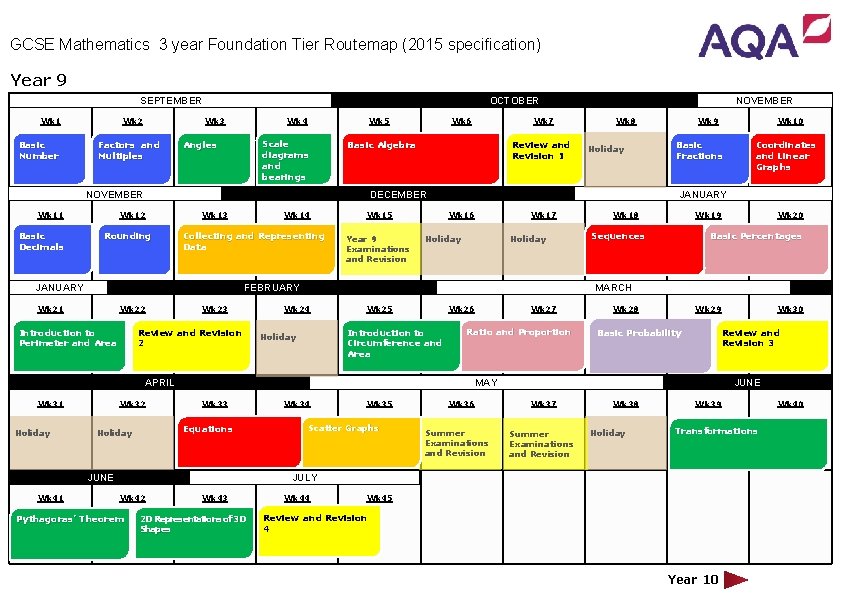
GCSE Mathematics 3 year Foundation Tier Routemap (2015 specification) Year 9 OCTOBER SEPTEMBER Wk 1 Basic Number Wk 2 Wk 3 Factors and Multiples Wk 4 Wk 5 Scale diagrams and bearings Angles Basic Decimals Review and Revision 1 Wk 12 Rounding Wk 22 Wk 13 Wk 14 Collecting and Representing Data Wk 23 Review and Revision 2 Introduction to Perimeter and Area Wk 15 Year 9 Examinations and Revision Wk 16 Wk 32 Wk 33 Equations Holiday Wk 18 Pythagoras’ Theorem Wk 43 2 D Representations of 3 D Shapes Coordinates and Linear Graphs Wk 19 Sequences Wk 20 Basic Percentages MARCH Wk 24 Wk 25 Wk 26 Introduction to Circumference and Area Holiday Wk 27 Ratio and Proportion Wk 28 Wk 29 Basic Probability Wk 34 Wk 35 Scatter Graphs Wk 36 Summer Examinations and Revision Wk 44 Wk 30 Review and Revision 3 JUNE Wk 37 Summer Examinations and Revision Wk 38 Holiday Wk 39 Transformations JULY Wk 42 Wk 10 Basic Fractions MAY JUNE Wk 41 Wk 17 Holiday APRIL Wk 31 Holiday Wk 9 JANUARY FEBRUARY Wk 21 Wk 8 DECEMBER JANUARY Holiday Wk 7 Basic Algebra NOVEMBER Wk 11 Wk 6 NOVEMBER Wk 45 Review and Revision 4 Year 10 Wk 40
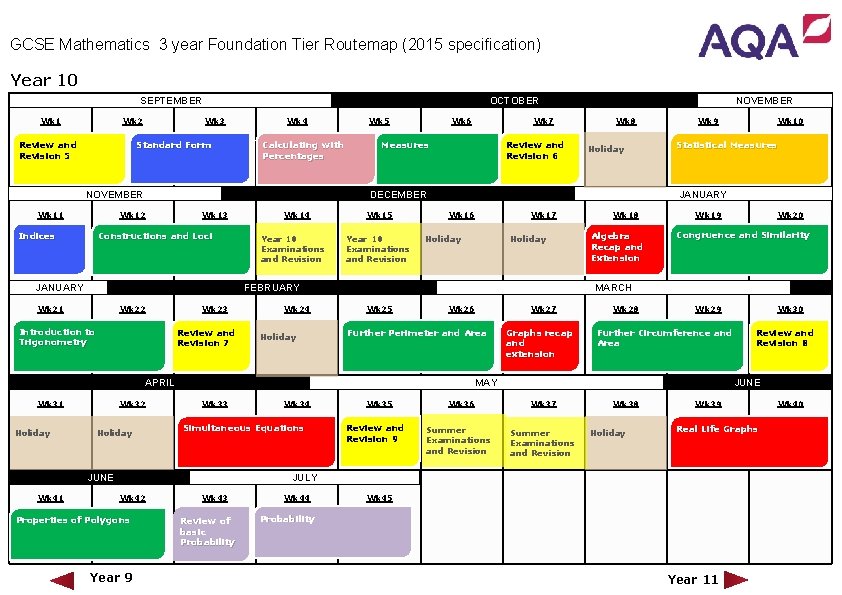
GCSE Mathematics 3 year Foundation Tier Routemap (2015 specification) Year 10 OCTOBER SEPTEMBER Wk 1 Wk 2 Wk 3 Standard Form Review and Revision 5 Wk 4 Calculating with Percentages NOVEMBER Wk 11 Wk 6 Wk 13 Constructions and Loci JANUARY Measures Review and Revision 6 Wk 22 Introduction to Trigonometry Wk 23 Review and Revision 7 Wk 14 Year 10 Examinations and Revision Wk 15 Year 10 Examinations and Revision Wk 16 Holiday Wk 24 Holiday Wk 32 Holiday Wk 9 Wk 33 Wk 34 Simultaneous Equations Holiday Wk 18 Algebra Recap and Extension Wk 19 Properties of Polygons Year 9 Wk 43 Review of basic Probability Wk 44 Wk 20 Congruence and Similarity MARCH Wk 25 Wk 26 Wk 27 Further Perimeter and Area Graphs recap and extension Wk 28 Wk 29 Further Circumference and Area Wk 35 Review and Revision 9 Wk 36 Summer Examinations and Revision Wk 30 Review and Revision 8 JUNE Wk 37 Summer Examinations and Revision Wk 38 Holiday Wk 39 Real Life Graphs JULY Wk 42 Wk 10 Statistical Measures MAY JUNE Wk 41 Wk 17 Holiday APRIL Wk 31 Wk 8 JANUARY FEBRUARY Wk 21 Holiday Wk 7 DECEMBER Wk 12 Indices Wk 5 NOVEMBER Wk 45 Probability Year 11 Wk 40
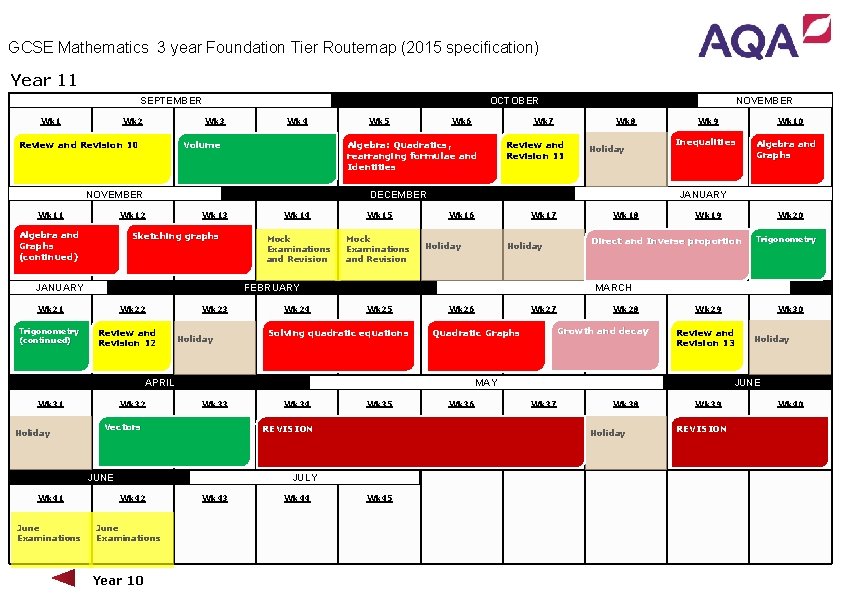
GCSE Mathematics 3 year Foundation Tier Routemap (2015 specification) Year 11 OCTOBER SEPTEMBER Wk 1 Wk 2 Wk 3 Review and Revision 10 Wk 4 Volume Wk 13 Sketching graphs JANUARY Wk 22 Review and Revision 12 Holiday Wk 23 Holiday Wk 14 Wk 15 Mock Examinations and Revision Wk 24 Wk 32 Wk 33 Vectors Wk 25 June Examinations Wk 35 REVISION Wk 16 Wk 17 Holiday June Examinations Year 10 Wk 18 Wk 19 Wk 43 Wk 44 Wk 20 Direct and Inverse proportion Wk 26 Wk 27 Wk 28 Growth and decay Quadratic Graphs Trigonometry Wk 29 Wk 36 Wk 45 Wk 30 Review and Revision 13 Holiday JUNE Wk 37 Wk 38 Holiday JULY Wk 42 Algebra and Graphs MARCH Solving quadratic equations Wk 34 Wk 10 Inequalities MAY JUNE Wk 41 Holiday Wk 9 JANUARY APRIL Wk 31 Wk 8 Review and Revision 11 FEBRUARY Wk 21 Trigonometry (continued) Wk 7 DECEMBER Wk 12 Algebra and Graphs (continued) Wk 6 Algebra: Quadratics, rearranging formulae and Identities NOVEMBER Wk 11 Wk 5 NOVEMBER Wk 39 REVISION Wk 40
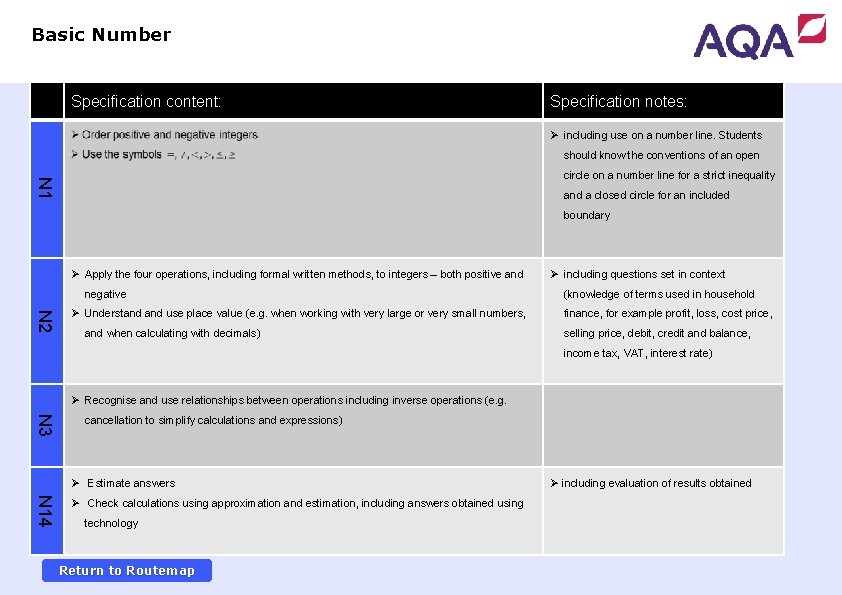
Basic Number Specification content: Specification notes: Ø including use on a number line. Students should know the conventions of an open N 1 circle on a number line for a strict inequality and a closed circle for an included boundary Ø Apply the four operations, including formal written methods, to integers – both positive and negative N 2 Ø Understand use place value (e. g. when working with very large or very small numbers, and when calculating with decimals) Ø including questions set in context (knowledge of terms used in household finance, for example profit, loss, cost price, selling price, debit, credit and balance, income tax, VAT, interest rate) Ø Recognise and use relationships between operations including inverse operations (e. g. N 3 cancellation to simplify calculations and expressions) Ø Estimate answers N 14 Ø Check calculations using approximation and estimation, including answers obtained using technology Return to Routemap Ø including evaluation of results obtained
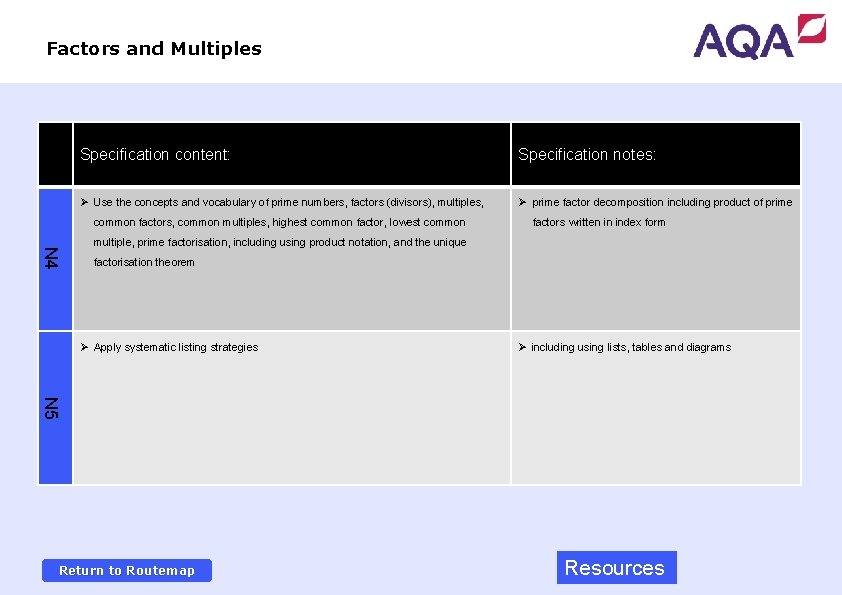
Factors and Multiples Specification content: Specification notes: Ø Use the concepts and vocabulary of prime numbers, factors (divisors), multiples, Ø prime factor decomposition including product of prime common factors, common multiples, highest common factor, lowest common factors written in index form N 4 multiple, prime factorisation, including using product notation, and the unique factorisation theorem Ø Apply systematic listing strategies Ø including using lists, tables and diagrams N 5 Return to Routemap Resources
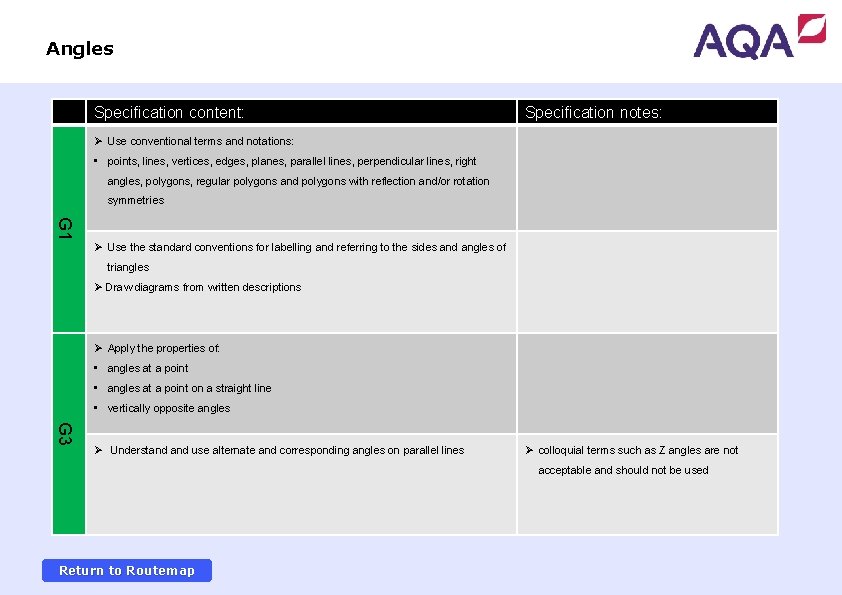
Angles Specification content: Specification notes: Ø Use conventional terms and notations: • points, lines, vertices, edges, planes, parallel lines, perpendicular lines, right angles, polygons, regular polygons and polygons with reflection and/or rotation symmetries G 1 Ø Use the standard conventions for labelling and referring to the sides and angles of triangles Ø Draw diagrams from written descriptions Ø Apply the properties of: • angles at a point on a straight line • vertically opposite angles G 3 Ø Understand use alternate and corresponding angles on parallel lines Ø colloquial terms such as Z angles are not acceptable and should not be used Return to Routemap
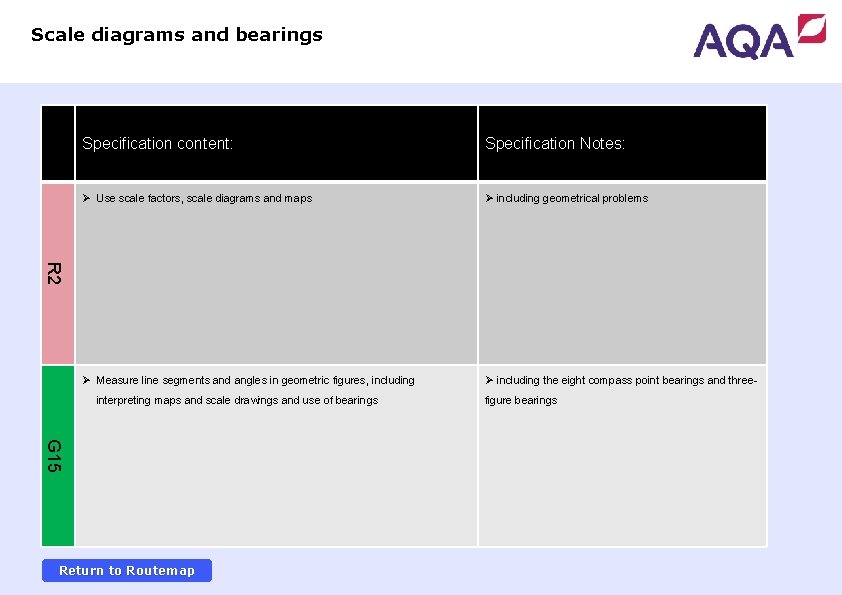
Scale diagrams and bearings Specification Notes: Ø Use scale factors, scale diagrams and maps Ø including geometrical problems Ø Measure line segments and angles in geometric figures, including Ø including the eight compass point bearings and three- R 2 Specification content: interpreting maps and scale drawings and use of bearings G 15 Return to Routemap figure bearings
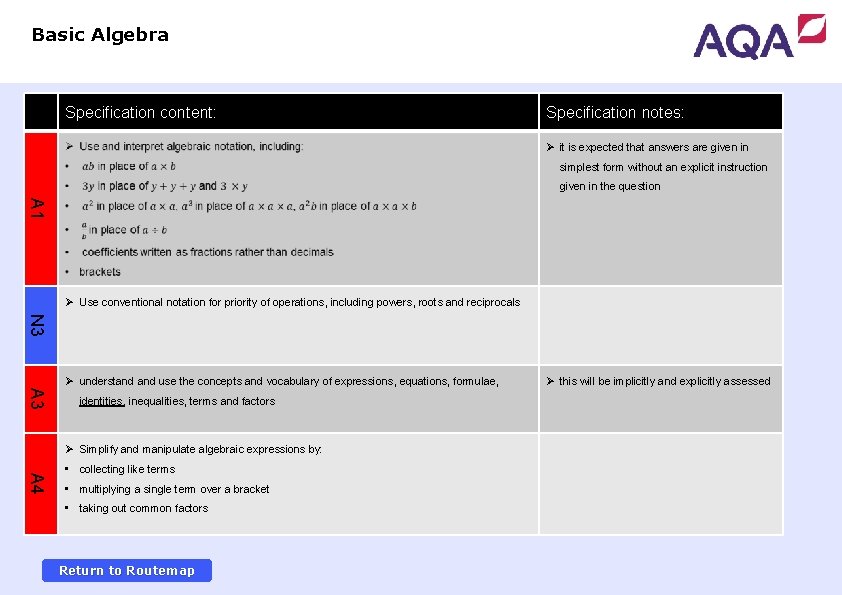
Basic Algebra Specification content: Specification notes: Ø it is expected that answers are given in simplest form without an explicit instruction given in the question A 1 Ø Use conventional notation for priority of operations, including powers, roots and reciprocals N 3 Ø understand use the concepts and vocabulary of expressions, equations, formulae, A 3 identities, inequalities, terms and factors Ø Simplify and manipulate algebraic expressions by: A 4 • collecting like terms • multiplying a single term over a bracket • taking out common factors Return to Routemap Ø this will be implicitly and explicitly assessed
Review and Revision 1 Specification content: Return to Routemap Specification notes:
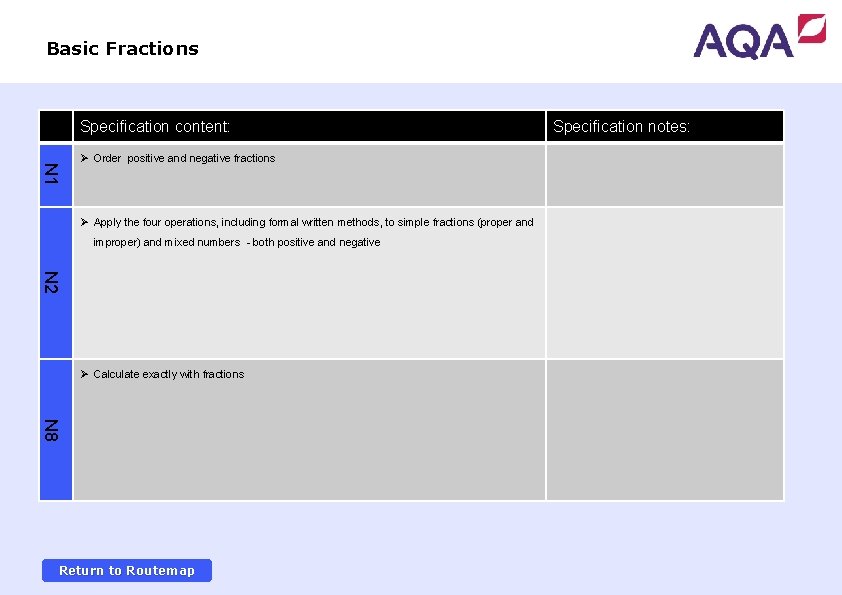
Basic Fractions Specification content: N 1 Ø Order positive and negative fractions Ø Apply the four operations, including formal written methods, to simple fractions (proper and improper) and mixed numbers - both positive and negative N 2 Ø Calculate exactly with fractions N 8 Return to Routemap Specification notes:
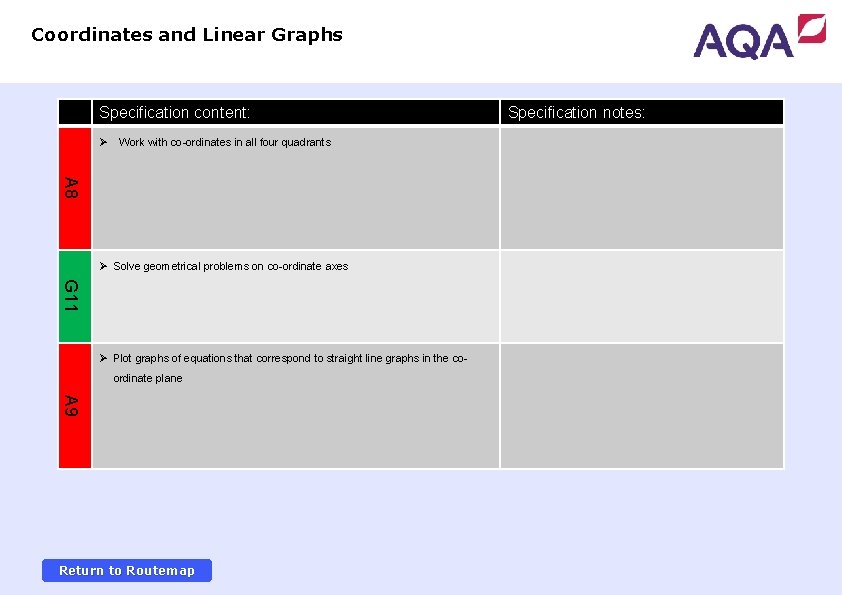
Coordinates and Linear Graphs Specification content: Ø Work with co-ordinates in all four quadrants A 8 Ø Solve geometrical problems on co-ordinate axes G 11 Ø Plot graphs of equations that correspond to straight line graphs in the coordinate plane A 9 Return to Routemap Specification notes:
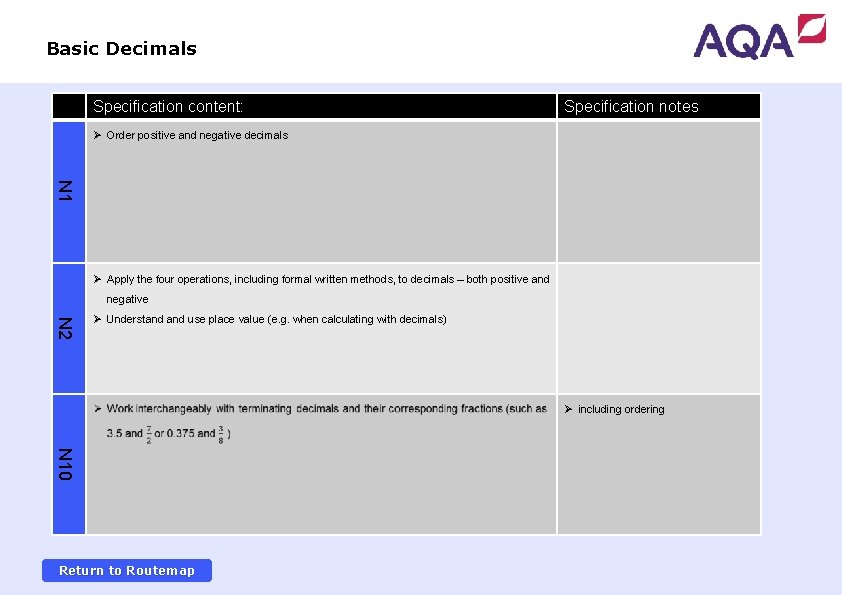
Basic Decimals Specification content: Specification notes Ø Order positive and negative decimals N 1 Ø Apply the four operations, including formal written methods, to decimals – both positive and negative N 2 Ø Understand use place value (e. g. when calculating with decimals) Ø including ordering N 10 Return to Routemap
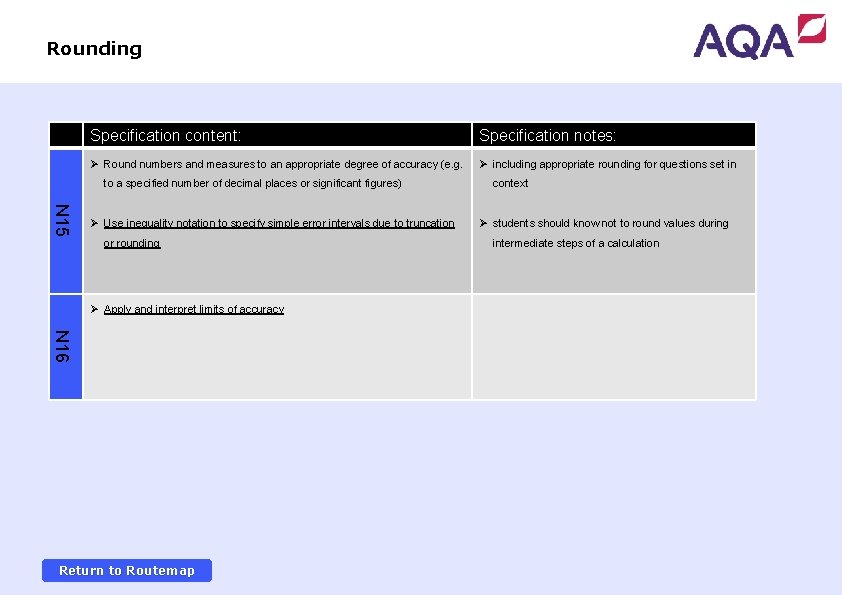
Rounding Specification content: Specification notes: Ø Round numbers and measures to an appropriate degree of accuracy (e. g. Ø including appropriate rounding for questions set in to a specified number of decimal places or significant figures) N 15 Ø Use inequality notation to specify simple error intervals due to truncation or rounding Ø Apply and interpret limits of accuracy N 16 Return to Routemap context Ø students should know not to round values during intermediate steps of a calculation
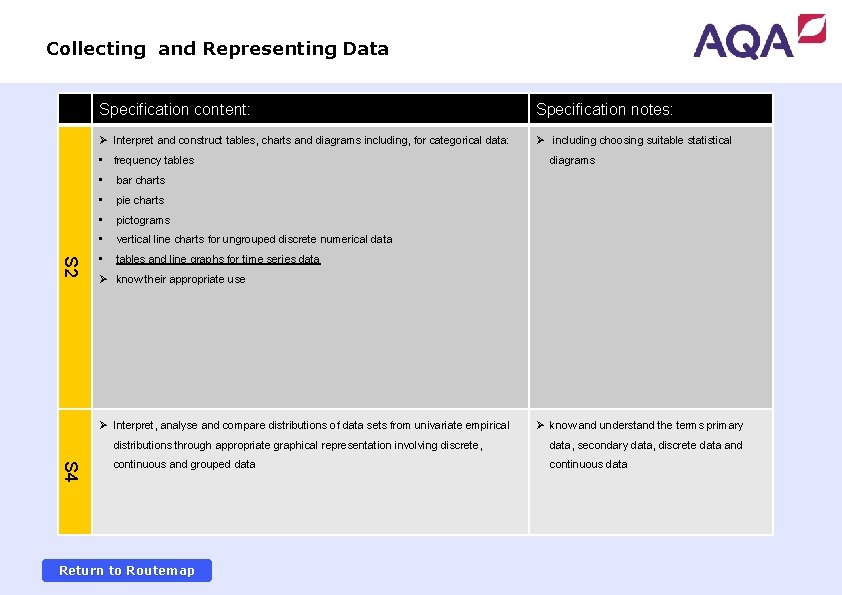
Collecting and Representing Data Specification content: Specification notes: Ø Interpret and construct tables, charts and diagrams including, for categorical data: Ø including choosing suitable statistical • frequency tables S 2 • bar charts • pie charts • pictograms • vertical line charts for ungrouped discrete numerical data • tables and line graphs for time series data diagrams Ø know their appropriate use Ø Interpret, analyse and compare distributions of data sets from univariate empirical Ø know and understand the terms primary S 4 distributions through appropriate graphical representation involving discrete, data, secondary data, discrete data and continuous and grouped data continuous data Return to Routemap
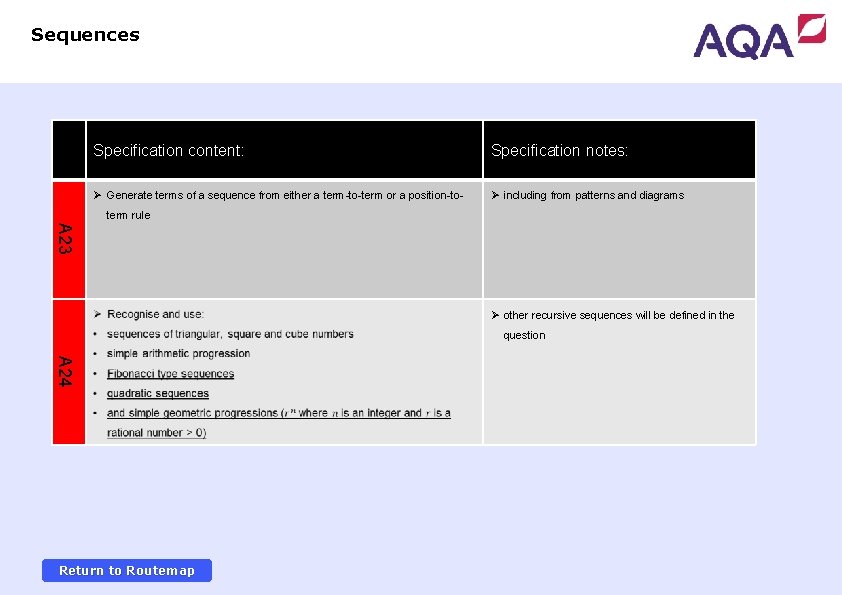
Sequences Specification content: Specification notes: Ø Generate terms of a sequence from either a term-to-term or a position-to- Ø including from patterns and diagrams term rule A 23 Ø other recursive sequences will be defined in the question A 24 Return to Routemap
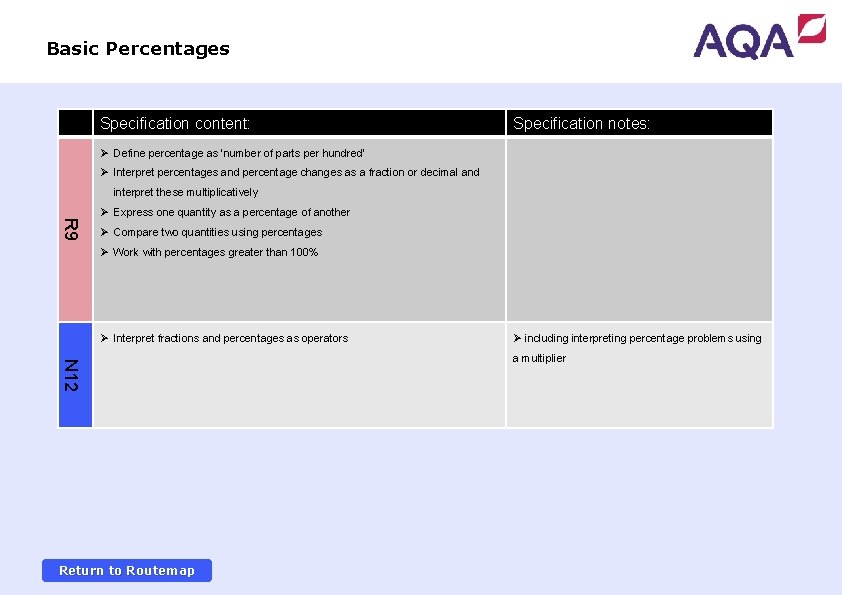
Basic Percentages Specification content: Specification notes: Ø Define percentage as ‘number of parts per hundred’ Ø Interpret percentages and percentage changes as a fraction or decimal and interpret these multiplicatively R 9 Ø Express one quantity as a percentage of another Ø Compare two quantities using percentages Ø Work with percentages greater than 100% Ø Interpret fractions and percentages as operators N 12 Return to Routemap Ø including interpreting percentage problems using a multiplier
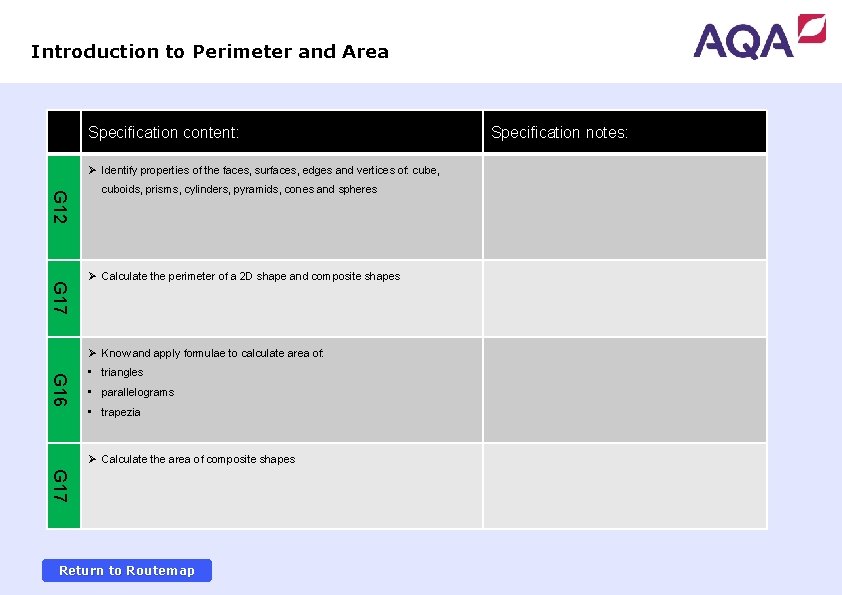
Introduction to Perimeter and Area Specification content: Ø Identify properties of the faces, surfaces, edges and vertices of: cube, G 12 cuboids, prisms, cylinders, pyramids, cones and spheres G 17 Ø Calculate the perimeter of a 2 D shape and composite shapes Ø Know and apply formulae to calculate area of: G 16 • triangles • parallelograms • trapezia Ø Calculate the area of composite shapes G 17 Return to Routemap Specification notes:
Review and Revision 2 Specification content: Return to Routemap Specification notes:
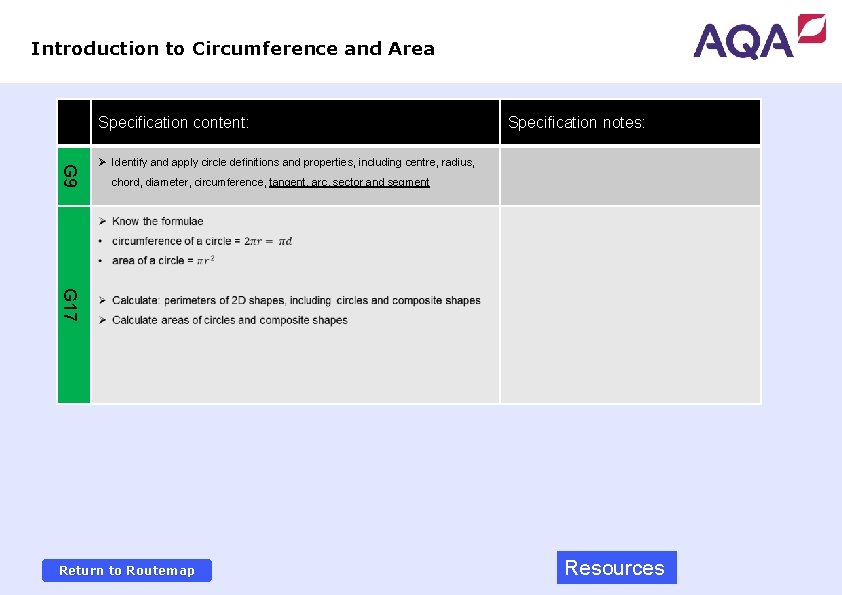
Introduction to Circumference and Area Specification content: Specification notes: G 9 Ø Identify and apply circle definitions and properties, including centre, radius, chord, diameter, circumference, tangent, arc, sector and segment G 17 Return to Routemap Resources
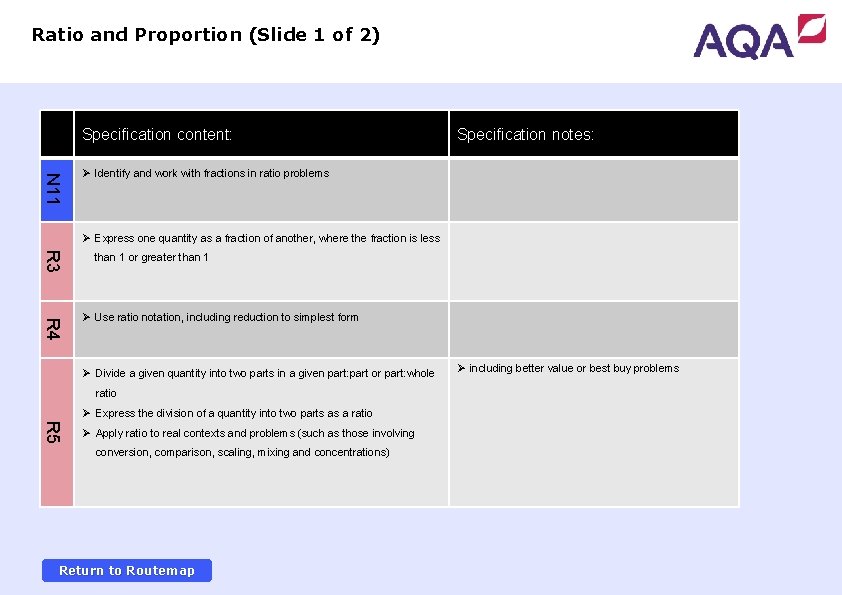
Ratio and Proportion (Slide 1 of 2) Specification content: Specification notes: N 11 Ø Identify and work with fractions in ratio problems Ø Express one quantity as a fraction of another, where the fraction is less R 3 than 1 or greater than 1 R 4 Ø Use ratio notation, including reduction to simplest form Ø Divide a given quantity into two parts in a given part: part or part: whole ratio Ø Express the division of a quantity into two parts as a ratio R 5 Ø Apply ratio to real contexts and problems (such as those involving conversion, comparison, scaling, mixing and concentrations) Return to Routemap Ø including better value or best buy problems
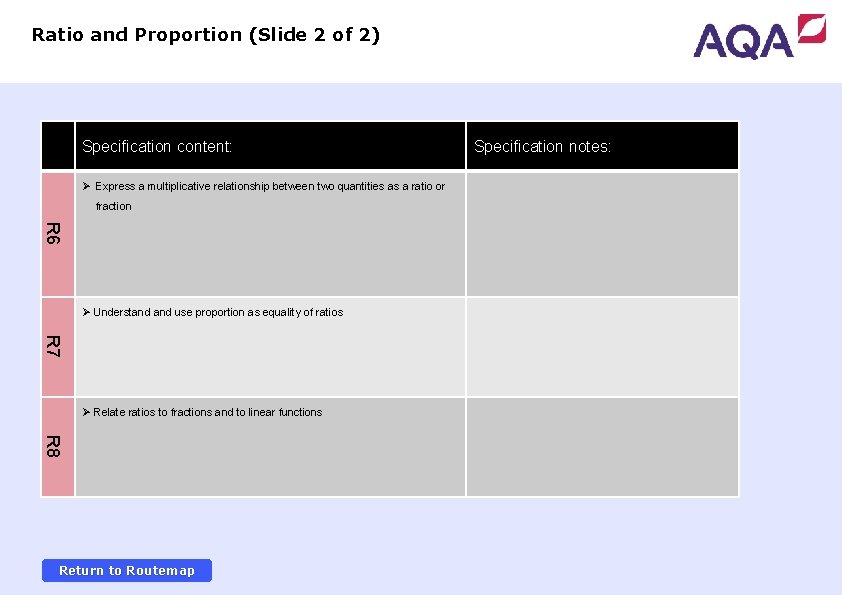
Ratio and Proportion (Slide 2 of 2) Specification content: Ø Express a multiplicative relationship between two quantities as a ratio or fraction R 6 Ø Understand use proportion as equality of ratios R 7 Ø Relate ratios to fractions and to linear functions R 8 Return to Routemap Specification notes:
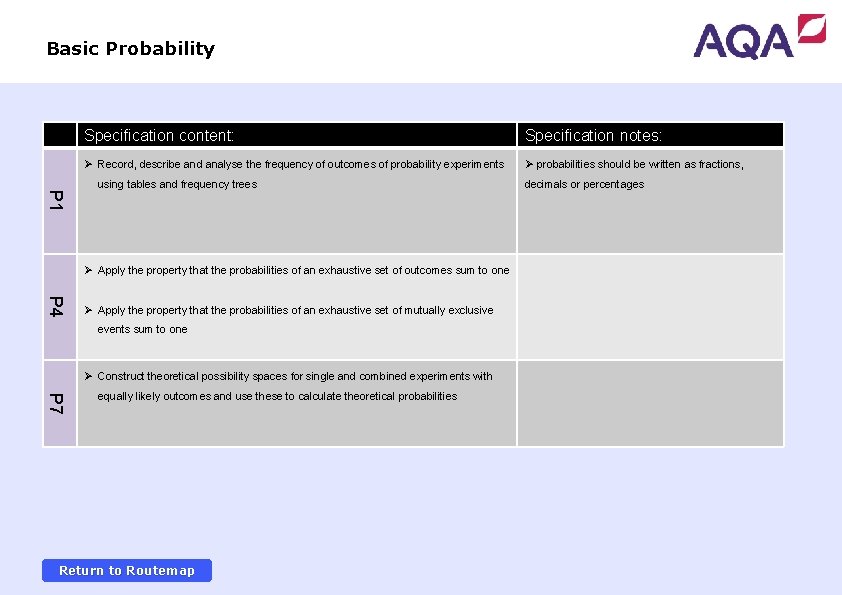
Basic Probability Specification content: Specification notes: Ø Record, describe and analyse the frequency of outcomes of probability experiments Ø probabilities should be written as fractions, using tables and frequency trees P 1 Ø Apply the property that the probabilities of an exhaustive set of outcomes sum to one P 4 Ø Apply the property that the probabilities of an exhaustive set of mutually exclusive events sum to one Ø Construct theoretical possibility spaces for single and combined experiments with P 7 equally likely outcomes and use these to calculate theoretical probabilities Return to Routemap decimals or percentages
Review and Revision 3 Specification content: Return to Routemap Specification notes:
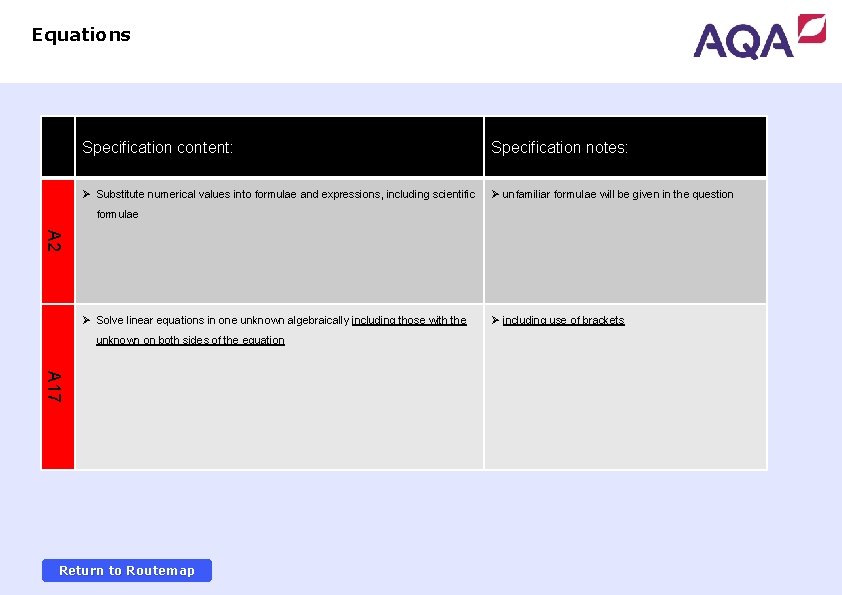
Equations Specification content: Specification notes: Ø Substitute numerical values into formulae and expressions, including scientific Ø unfamiliar formulae will be given in the question formulae A 2 Ø Solve linear equations in one unknown algebraically including those with the unknown on both sides of the equation A 17 Return to Routemap Ø including use of brackets
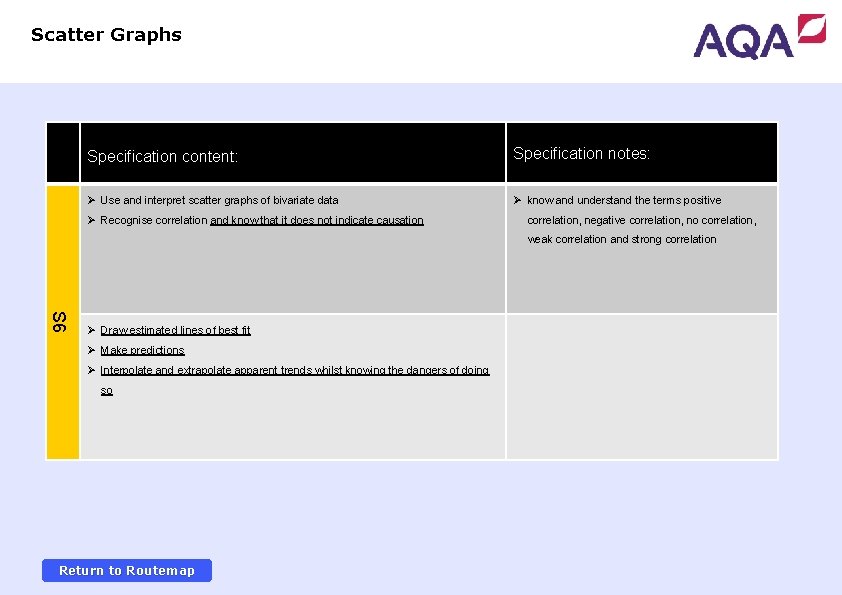
Scatter Graphs Specification content: Specification notes: Ø Use and interpret scatter graphs of bivariate data Ø know and understand the terms positive Ø Recognise correlation and know that it does not indicate causation correlation, negative correlation, no correlation, weak correlation and strong correlation S 6 Ø Draw estimated lines of best fit Ø Make predictions Ø Interpolate and extrapolate apparent trends whilst knowing the dangers of doing so Return to Routemap
Review and Revision 4 Specification content: Return to Routemap Specification notes:
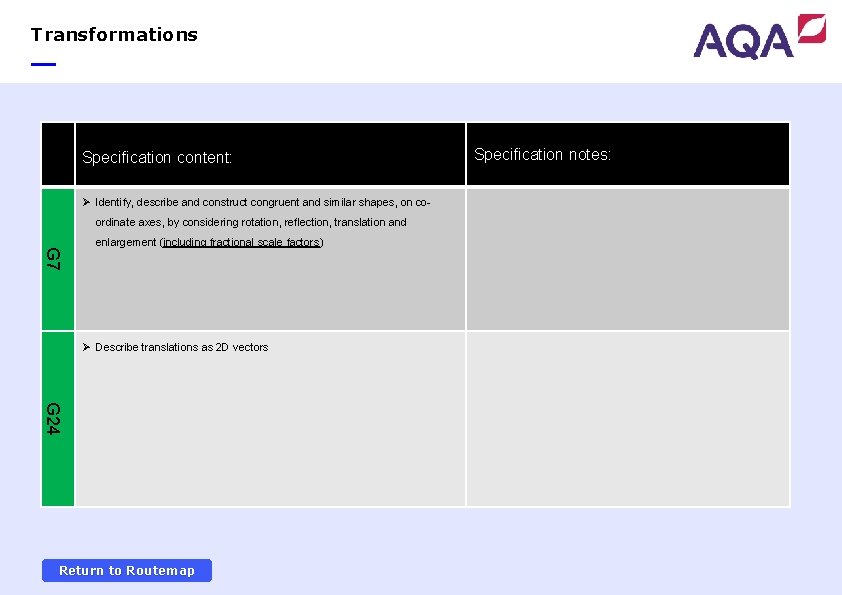
Transformations Specification content: Ø Identify, describe and construct congruent and similar shapes, on coordinate axes, by considering rotation, reflection, translation and G 7 enlargement (including fractional scale factors) Ø Describe translations as 2 D vectors G 24 Return to Routemap Specification notes:
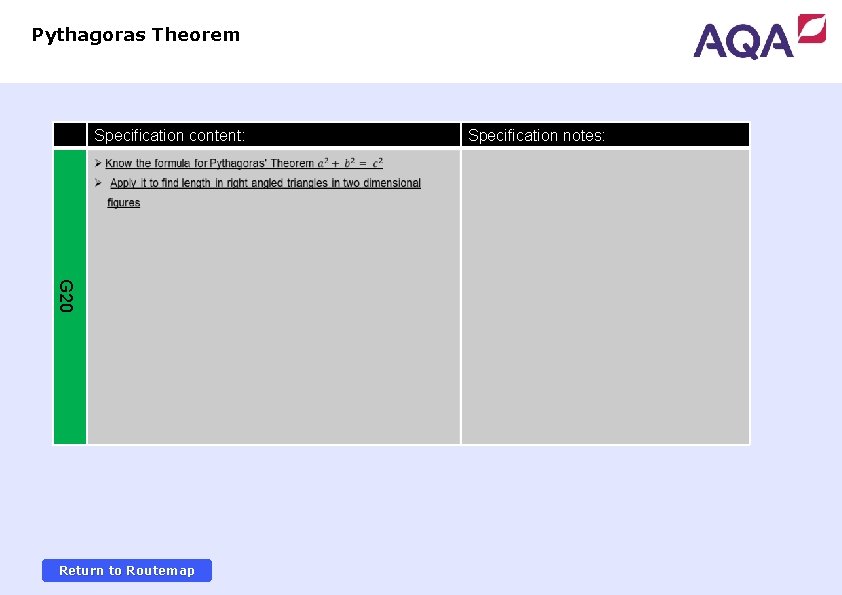
Pythagoras Theorem Specification content: G 20 Return to Routemap Specification notes:
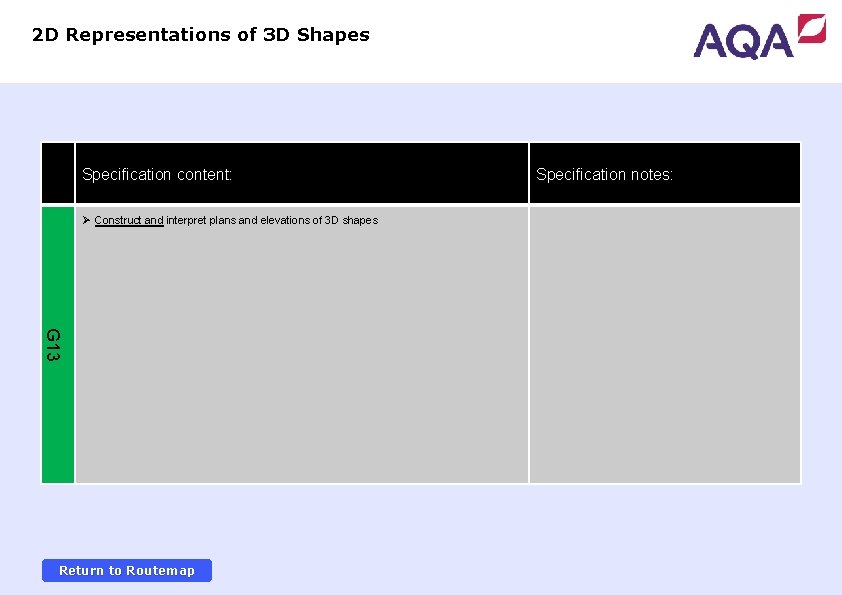
2 D Representations of 3 D Shapes Specification content: Ø Construct and interpret plans and elevations of 3 D shapes G 13 Return to Routemap Specification notes:
Review and Revision 5 Specification content: Return to Routemap Specification notes:
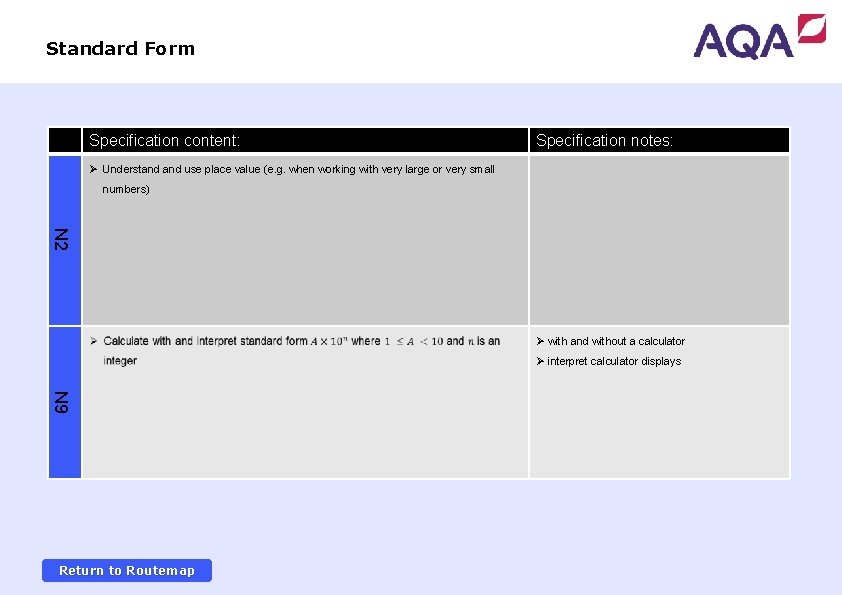
Standard Form Specification content: Specification notes: Ø Understand use place value (e. g. when working with very large or very small numbers) N 2 Ø with and without a calculator Ø interpret calculator displays N 9 Return to Routemap
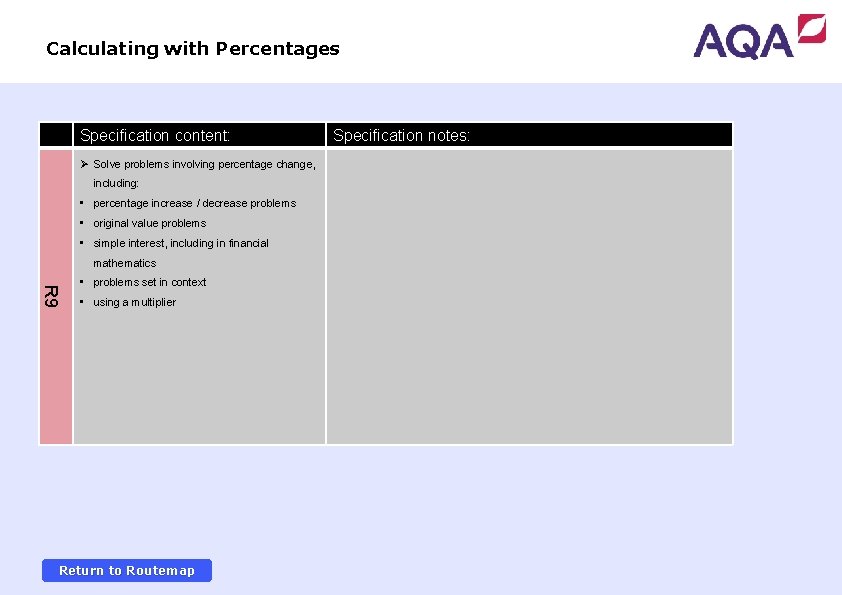
Calculating with Percentages Specification content: Ø Solve problems involving percentage change, including: • percentage increase / decrease problems • original value problems • simple interest, including in financial mathematics R 9 • problems set in context • using a multiplier Return to Routemap Specification notes:
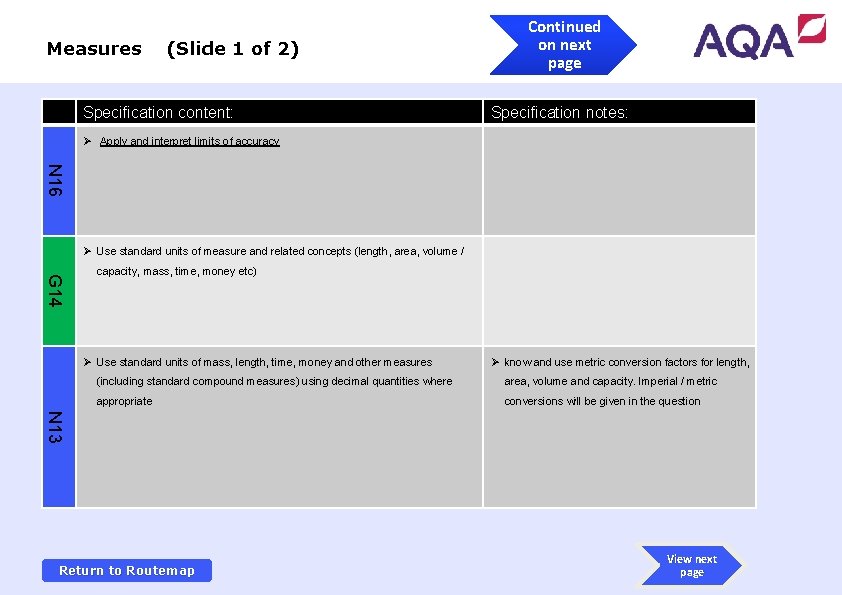
Measures (Slide 1 of 2) Specification content: Continued on next page Specification notes: Ø Apply and interpret limits of accuracy N 16 Ø Use standard units of measure and related concepts (length, area, volume / G 14 capacity, mass, time, money etc) Ø Use standard units of mass, length, time, money and other measures Ø know and use metric conversion factors for length, (including standard compound measures) using decimal quantities where area, volume and capacity. Imperial / metric appropriate conversions will be given in the question N 13 Return to Routemap View next page
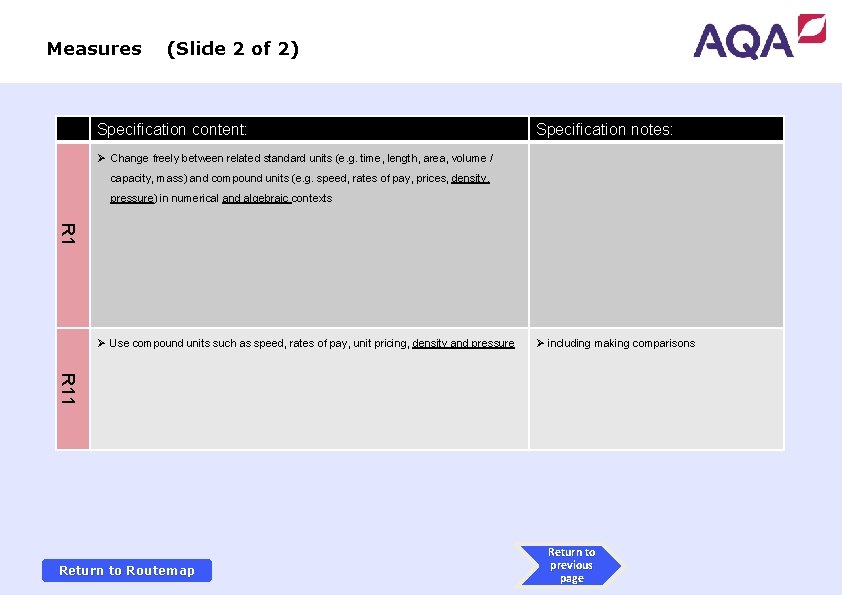
Measures (Slide 2 of 2) Specification content: Specification notes: Ø Change freely between related standard units (e. g. time, length, area, volume / capacity, mass) and compound units (e. g. speed, rates of pay, prices, density, pressure) in numerical and algebraic contexts R 1 Ø Use compound units such as speed, rates of pay, unit pricing, density and pressure Ø including making comparisons R 11 Return to Routemap Return to previous page
Review and Revision 6 Specification content: Return to Routemap Specification notes:
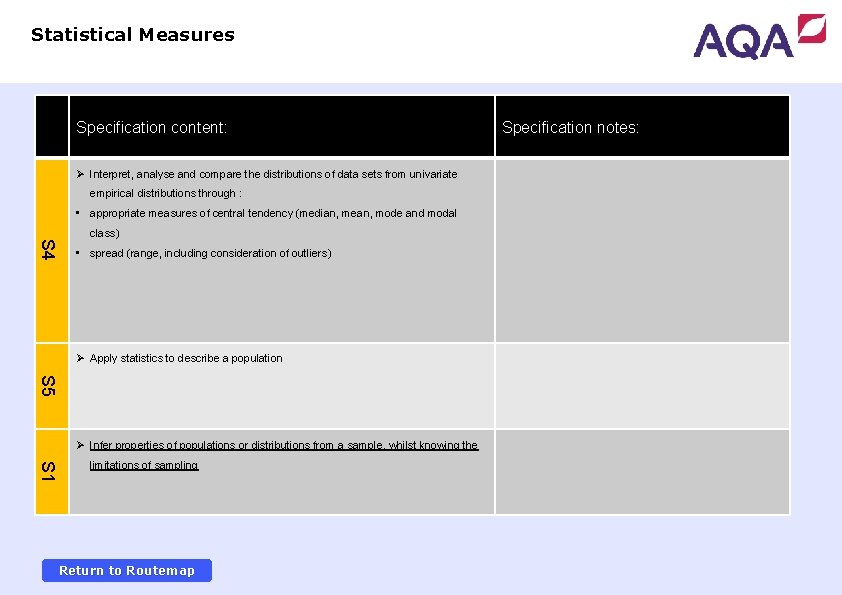
Statistical Measures Specification content: Ø Interpret, analyse and compare the distributions of data sets from univariate empirical distributions through : • appropriate measures of central tendency (median, mean, mode and modal class) S 4 • spread (range, including consideration of outliers) Ø Apply statistics to describe a population S 5 Ø Infer properties of populations or distributions from a sample, whilst knowing the S 1 limitations of sampling Return to Routemap Specification notes:
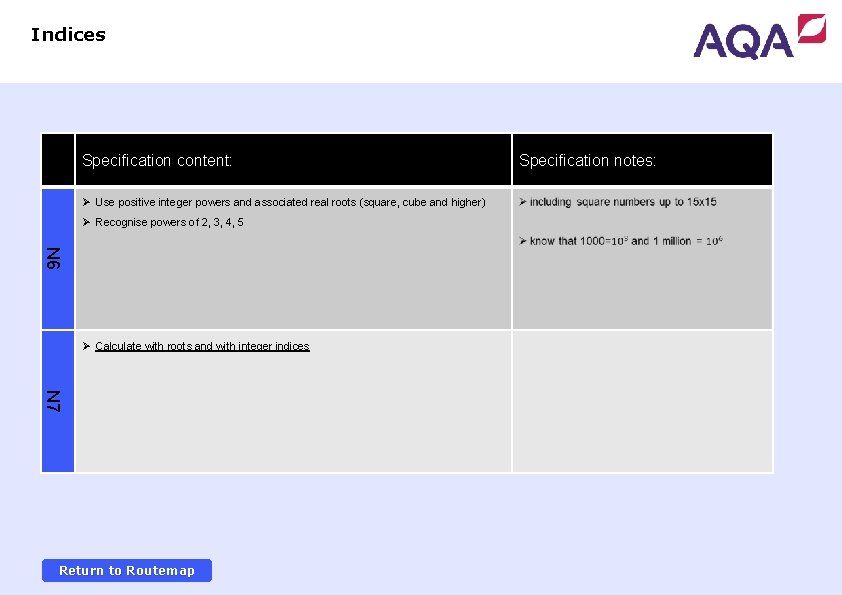
Indices Specification content: Ø Use positive integer powers and associated real roots (square, cube and higher) Ø Recognise powers of 2, 3, 4, 5 N 6 Ø Calculate with roots and with integer indices N 7 Return to Routemap Specification notes:
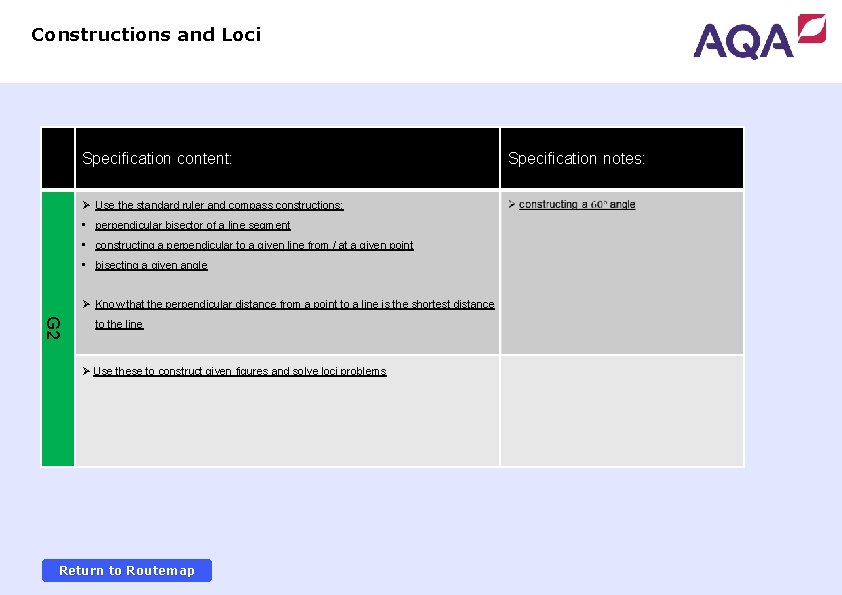
Constructions and Loci Specification content: Ø Use the standard ruler and compass constructions: • perpendicular bisector of a line segment • constructing a perpendicular to a given line from / at a given point • bisecting a given angle Ø Know that the perpendicular distance from a point to a line is the shortest distance G 2 to the line Ø Use these to construct given figures and solve loci problems Return to Routemap Specification notes:
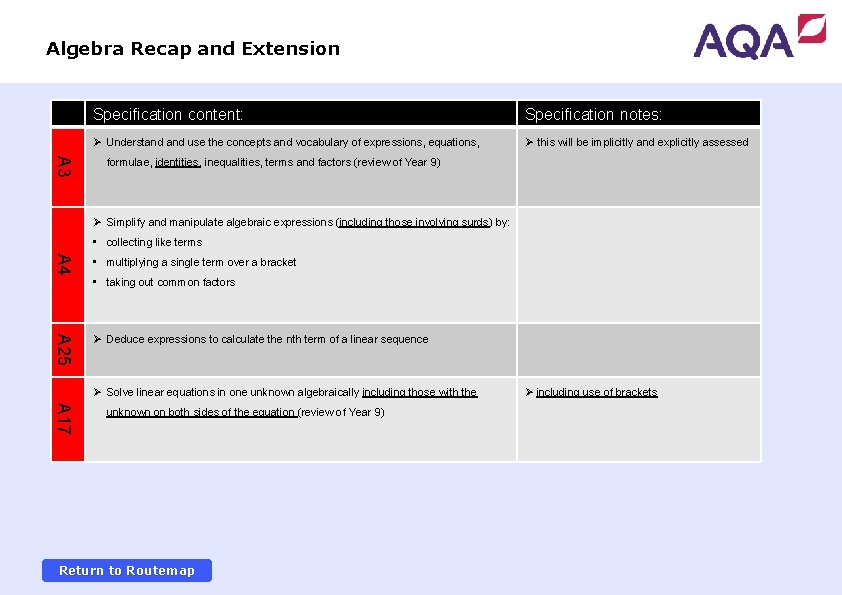
Algebra Recap and Extension Specification content: Specification notes: Ø Understand use the concepts and vocabulary of expressions, equations, Ø this will be implicitly and explicitly assessed A 3 formulae, identities, inequalities, terms and factors (review of Year 9) Ø Simplify and manipulate algebraic expressions (including those involving surds) by: • collecting like terms A 4 • multiplying a single term over a bracket A 25 Ø Deduce expressions to calculate the nth term of a linear sequence • taking out common factors Ø Solve linear equations in one unknown algebraically including those with the A 17 unknown on both sides of the equation (review of Year 9) Return to Routemap Ø including use of brackets
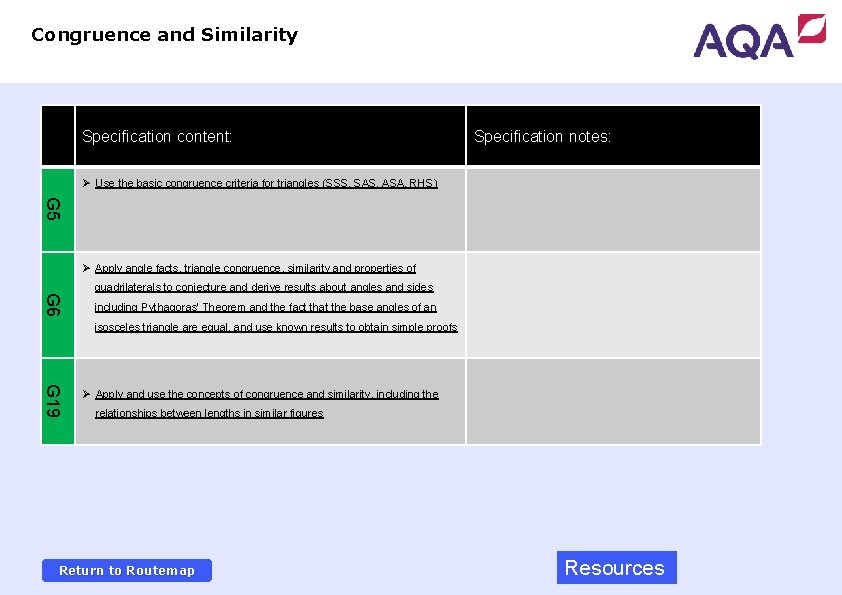
Congruence and Similarity Specification content: Specification notes: Ø Use the basic congruence criteria for triangles (SSS, SAS, ASA, RHS) G 5 Ø Apply angle facts, triangle congruence, similarity and properties of G 6 quadrilaterals to conjecture and derive results about angles and sides including Pythagoras’ Theorem and the fact that the base angles of an isosceles triangle are equal, and use known results to obtain simple proofs G 19 Ø Apply and use the concepts of congruence and similarity, including the relationships between lengths in similar figures Return to Routemap Resources
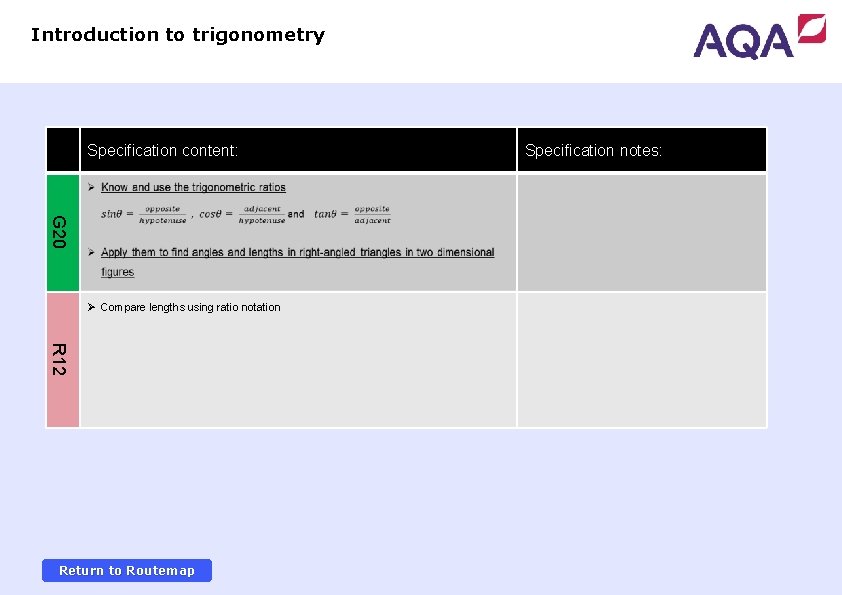
Introduction to trigonometry Specification content: G 20 Ø Compare lengths using ratio notation R 12 Return to Routemap Specification notes:
Review and Revision 7 Specification content: Return to Routemap Specification notes:
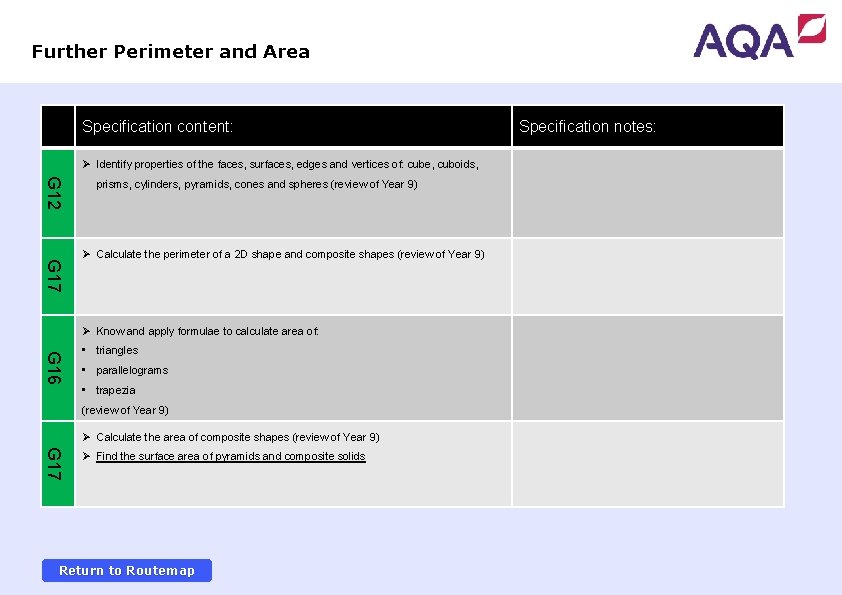
Further Perimeter and Area Specification content: Ø Identify properties of the faces, surfaces, edges and vertices of: cube, cuboids, G 12 prisms, cylinders, pyramids, cones and spheres (review of Year 9) G 17 Ø Calculate the perimeter of a 2 D shape and composite shapes (review of Year 9) Ø Know and apply formulae to calculate area of: G 16 • triangles • parallelograms • trapezia (review of Year 9) Ø Calculate the area of composite shapes (review of Year 9) G 17 Ø Find the surface area of pyramids and composite solids Return to Routemap Specification notes:
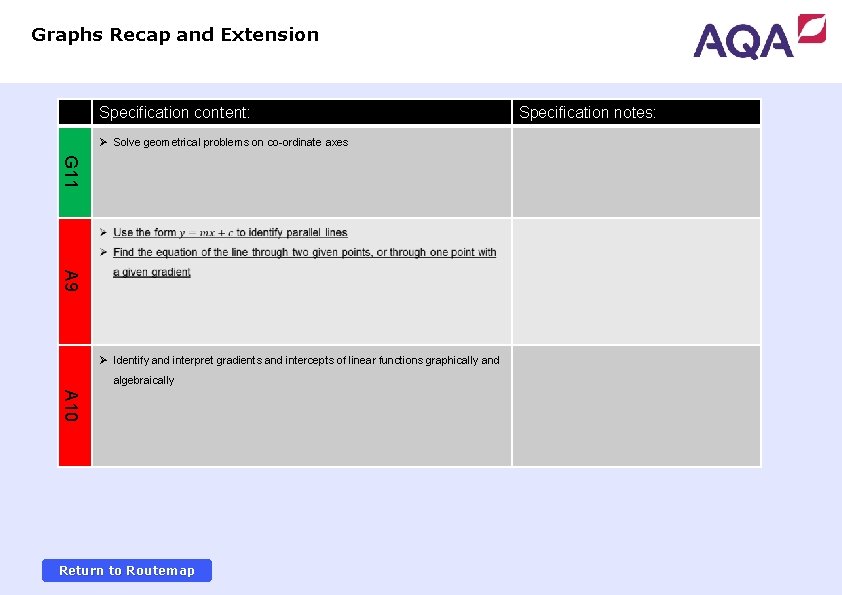
Graphs Recap and Extension Specification content: Ø Solve geometrical problems on co-ordinate axes G 11 A 9 Ø Identify and interpret gradients and intercepts of linear functions graphically and algebraically A 10 Return to Routemap Specification notes:
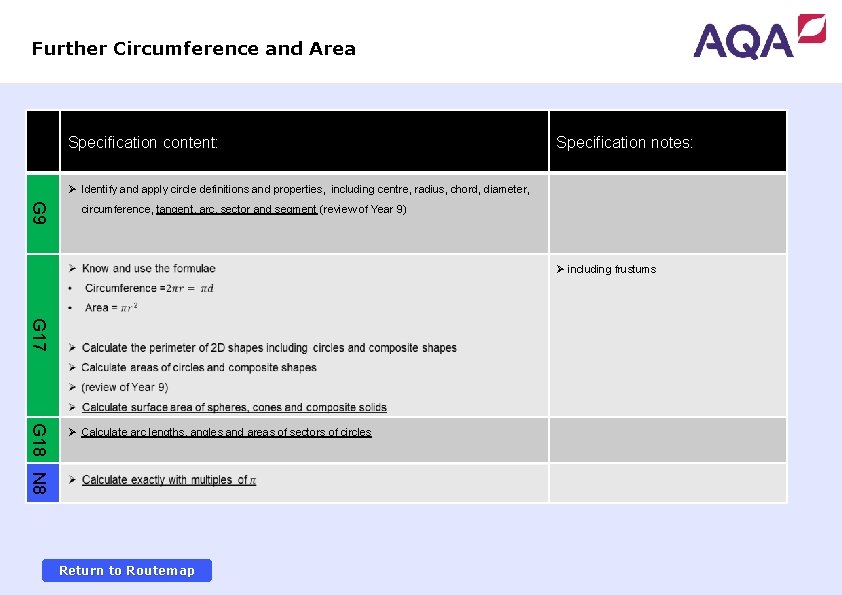
Further Circumference and Area Specification content: Specification notes: Ø Identify and apply circle definitions and properties, including centre, radius, chord, diameter, G 9 circumference, tangent, arc, sector and segment (review of Year 9) Ø including frustums G 17 G 18 N 8 Ø Calculate arc lengths, angles and areas of sectors of circles Return to Routemap
Review and Revision 8 Specification content: Return to Routemap Specification notes:
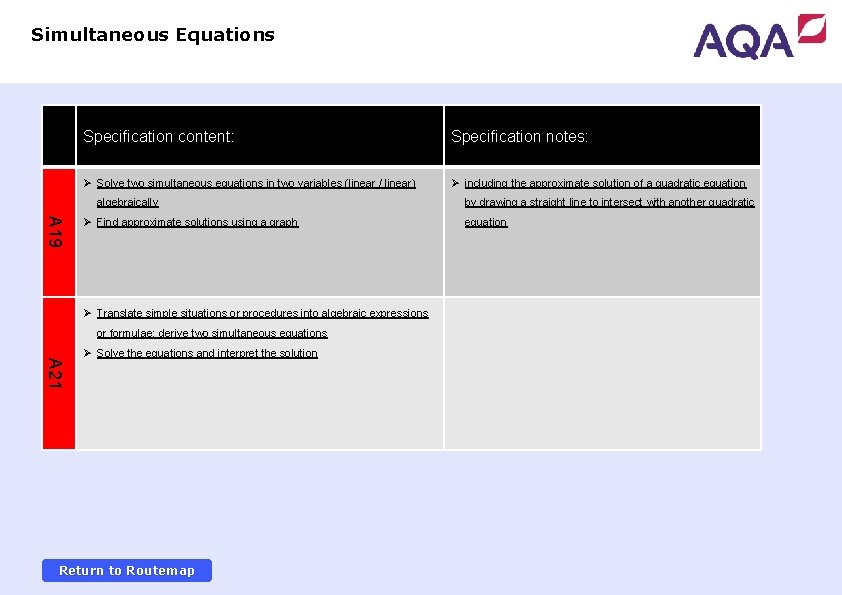
Simultaneous Equations Specification content: Specification notes: Ø Solve two simultaneous equations in two variables (linear / linear) Ø including the approximate solution of a quadratic equation algebraically A 19 Ø Find approximate solutions using a graph Ø Translate simple situations or procedures into algebraic expressions or formulae; derive two simultaneous equations A 21 Ø Solve the equations and interpret the solution Return to Routemap by drawing a straight line to intersect with another quadratic equation
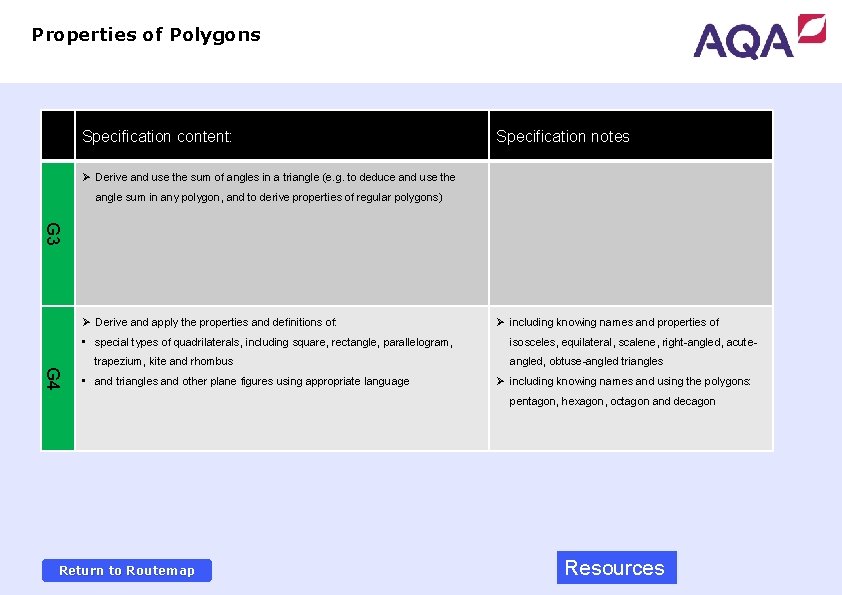
Properties of Polygons Specification content: Specification notes Ø Derive and use the sum of angles in a triangle (e. g. to deduce and use the angle sum in any polygon, and to derive properties of regular polygons) G 3 Ø Derive and apply the properties and definitions of: • special types of quadrilaterals, including square, rectangle, parallelogram, G 4 trapezium, kite and rhombus • and triangles and other plane figures using appropriate language Ø including knowing names and properties of isosceles, equilateral, scalene, right-angled, acuteangled, obtuse-angled triangles Ø including knowing names and using the polygons: pentagon, hexagon, octagon and decagon Return to Routemap Resources
Review and Revision 9 Specification content: Return to Routemap Specification notes:
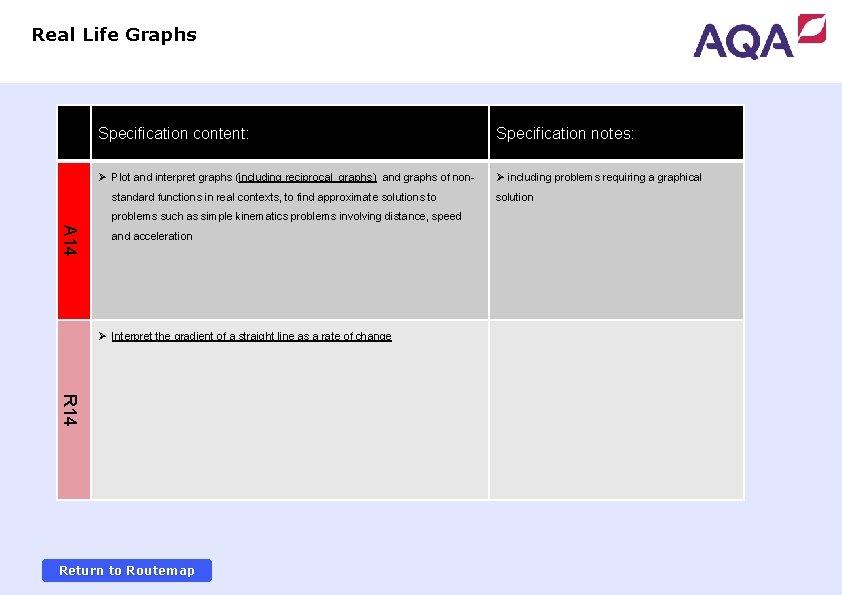
Real Life Graphs Specification content: Specification notes: Ø Plot and interpret graphs (including reciprocal graphs) and graphs of non- Ø including problems requiring a graphical standard functions in real contexts, to find approximate solutions to problems such as simple kinematics problems involving distance, speed A 14 and acceleration Ø Interpret the gradient of a straight line as a rate of change R 14 Return to Routemap solution
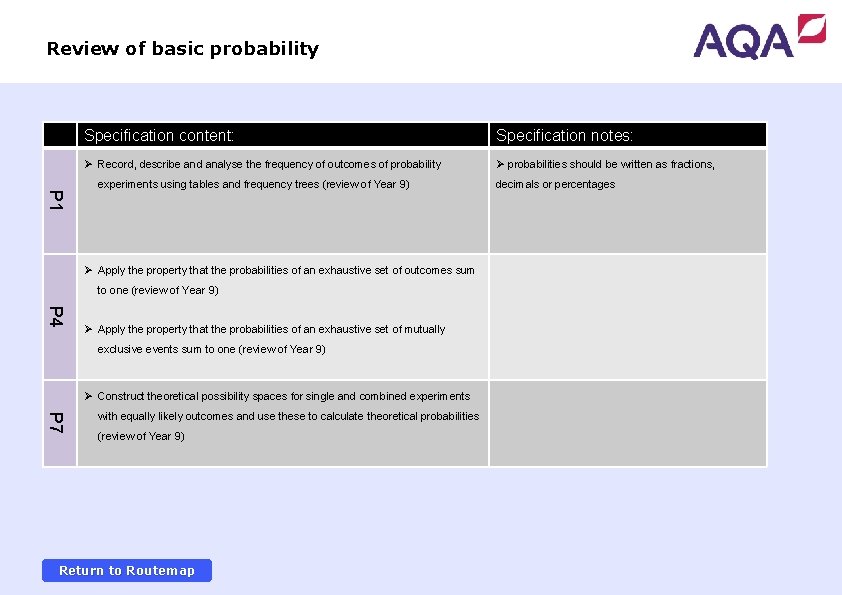
Review of basic probability Specification content: Specification notes: Ø Record, describe and analyse the frequency of outcomes of probability Ø probabilities should be written as fractions, experiments using tables and frequency trees (review of Year 9) P 1 Ø Apply the property that the probabilities of an exhaustive set of outcomes sum to one (review of Year 9) P 4 Ø Apply the property that the probabilities of an exhaustive set of mutually exclusive events sum to one (review of Year 9) Ø Construct theoretical possibility spaces for single and combined experiments P 7 with equally likely outcomes and use these to calculate theoretical probabilities (review of Year 9) Return to Routemap decimals or percentages
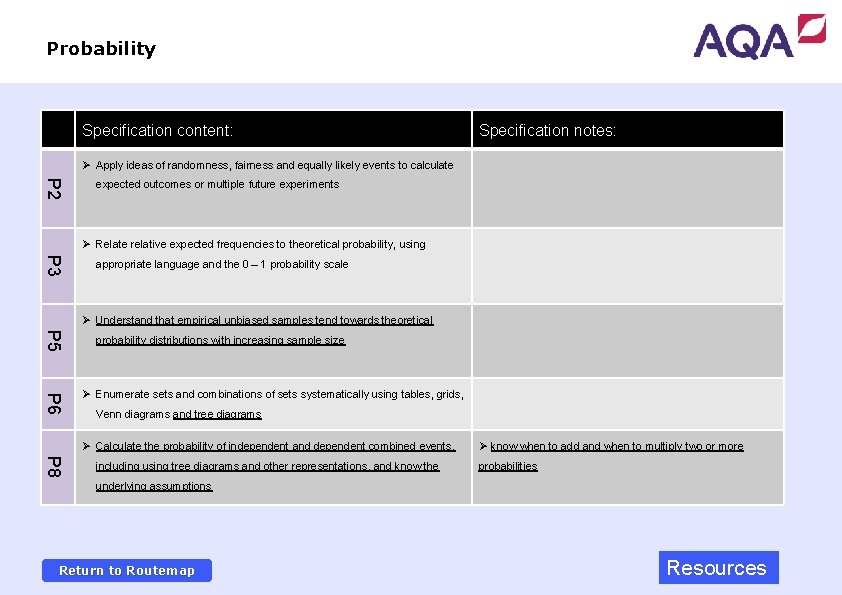
Probability Specification content: Specification notes: Ø Apply ideas of randomness, fairness and equally likely events to calculate P 2 expected outcomes or multiple future experiments Ø Relate relative expected frequencies to theoretical probability, using P 3 appropriate language and the 0 – 1 probability scale Ø Understand that empirical unbiased samples tend towards theoretical P 5 probability distributions with increasing sample size P 6 Ø Enumerate sets and combinations of sets systematically using tables, grids, Venn diagrams and tree diagrams Ø Calculate the probability of independent and dependent combined events, P 8 including using tree diagrams and other representations, and know the Ø know when to add and when to multiply two or more probabilities underlying assumptions Return to Routemap Resources
Review and Revision 10 Specification content: Return to Routemap Specification notes:
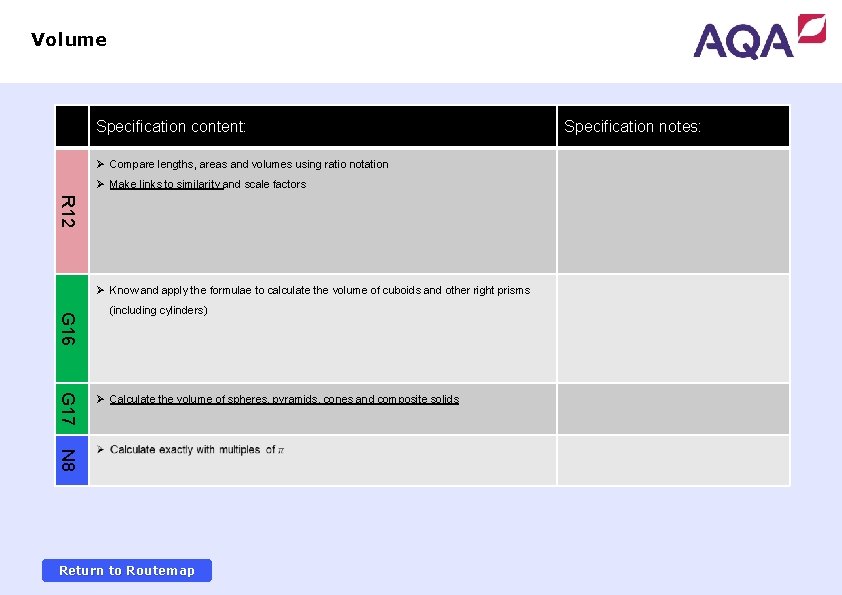
Volume Specification content: Ø Compare lengths, areas and volumes using ratio notation Ø Make links to similarity and scale factors R 12 Ø Know and apply the formulae to calculate the volume of cuboids and other right prisms G 16 (including cylinders) G 17 Ø Calculate the volume of spheres, pyramids, cones and composite solids N 8 Return to Routemap Specification notes:
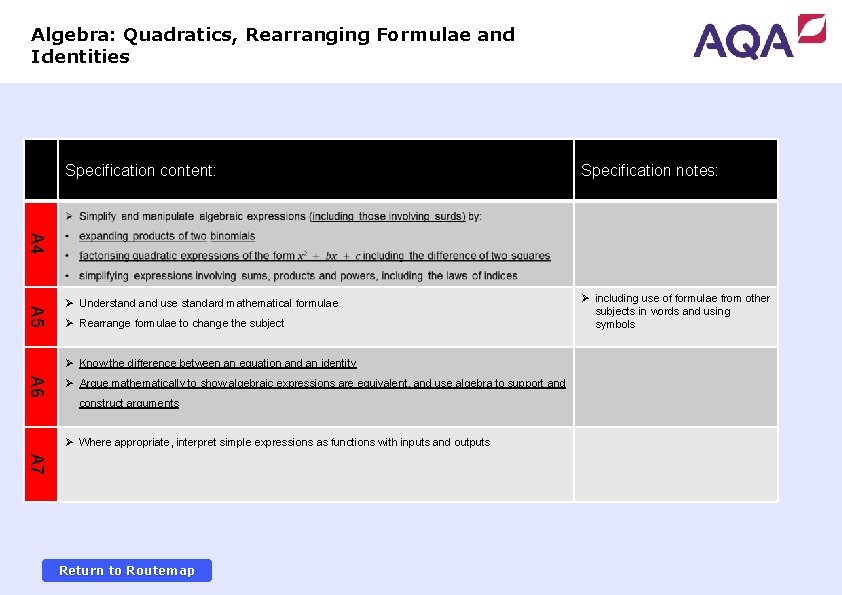
Algebra: Quadratics, Rearranging Formulae and Identities Specification notes: Ø Understand use standard mathematical formulae Ø including use of formulae from other subjects in words and using symbols A 4 Specification content: A 5 Ø Rearrange formulae to change the subject Ø Know the difference between an equation and an identity A 6 Ø Argue mathematically to show algebraic expressions are equivalent, and use algebra to support and construct arguments Ø Where appropriate, interpret simple expressions as functions with inputs and outputs A 7 Return to Routemap
Review and Revision 11 Specification content: Return to Routemap Specification notes:
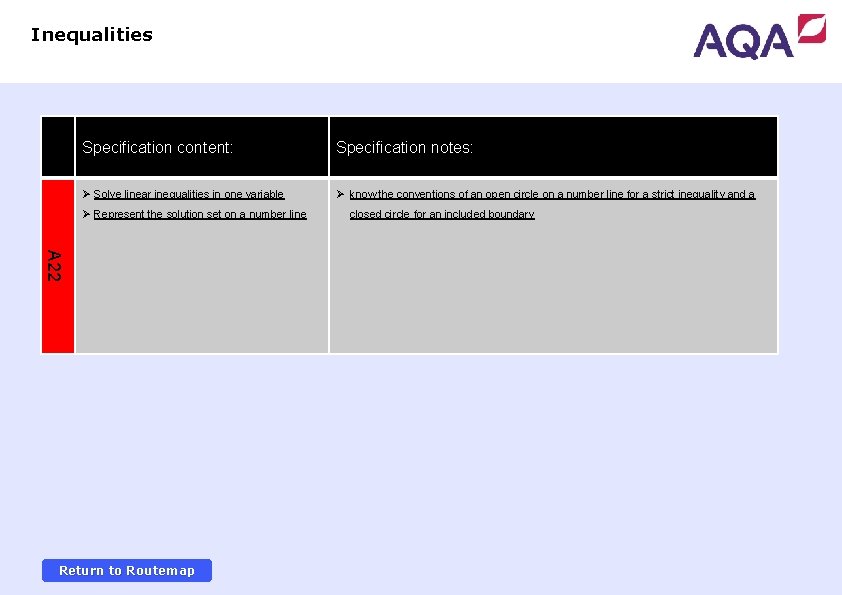
Inequalities Specification content: Specification notes: Ø Solve linear inequalities in one variable Ø know the conventions of an open circle on a number line for a strict inequality and a Ø Represent the solution set on a number line A 22 Return to Routemap closed circle for an included boundary
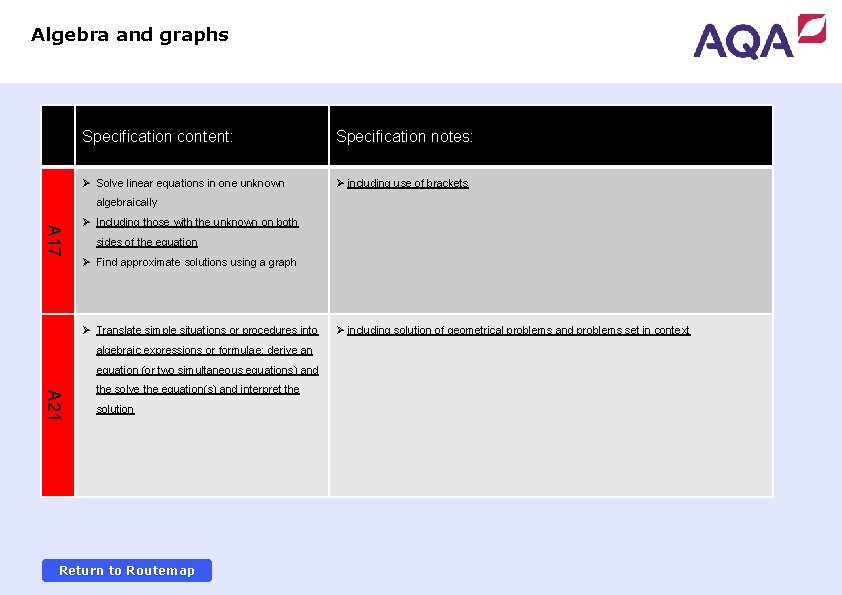
Algebra and graphs Specification content: Specification notes: Ø Solve linear equations in one unknown Ø including use of brackets algebraically A 17 Ø Including those with the unknown on both sides of the equation Ø Find approximate solutions using a graph Ø Translate simple situations or procedures into algebraic expressions or formulae; derive an equation (or two simultaneous equations) and A 21 the solve the equation(s) and interpret the solution Return to Routemap Ø including solution of geometrical problems and problems set in context
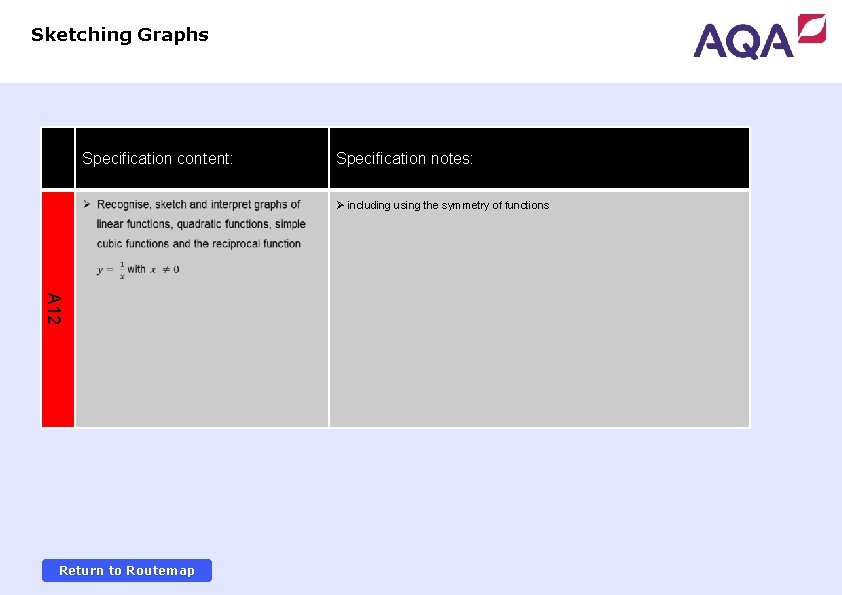
Sketching Graphs Specification content: Specification notes: Ø including using the symmetry of functions A 12 Return to Routemap
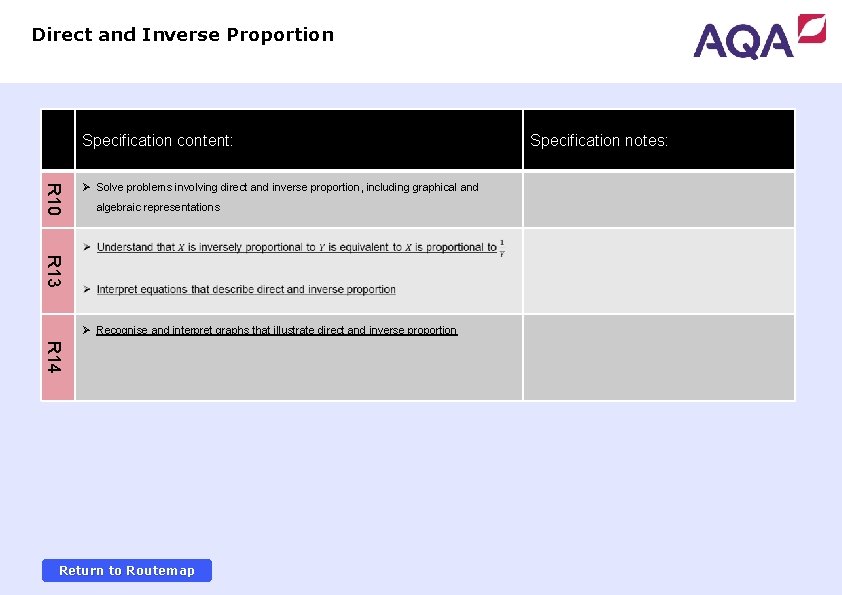
Direct and Inverse Proportion Specification content: R 10 Ø Solve problems involving direct and inverse proportion, including graphical and algebraic representations R 13 Ø Recognise and interpret graphs that illustrate direct and inverse proportion R 14 Return to Routemap Specification notes:
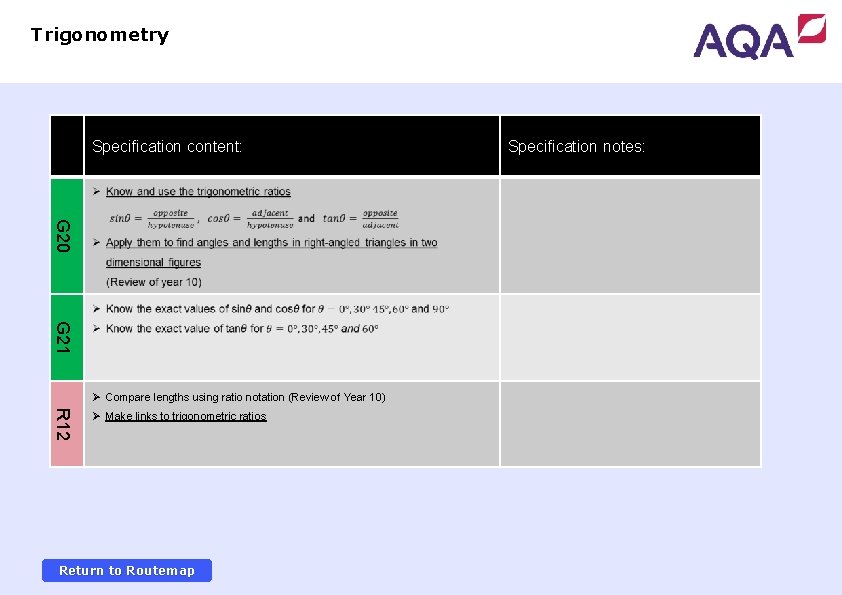
Trigonometry Specification content: G 20 G 21 Ø Compare lengths using ratio notation (Review of Year 10) R 12 Ø Make links to trigonometric ratios Return to Routemap Specification notes:
Review and Revision 12 Specification content: Return to Routemap Specification notes:
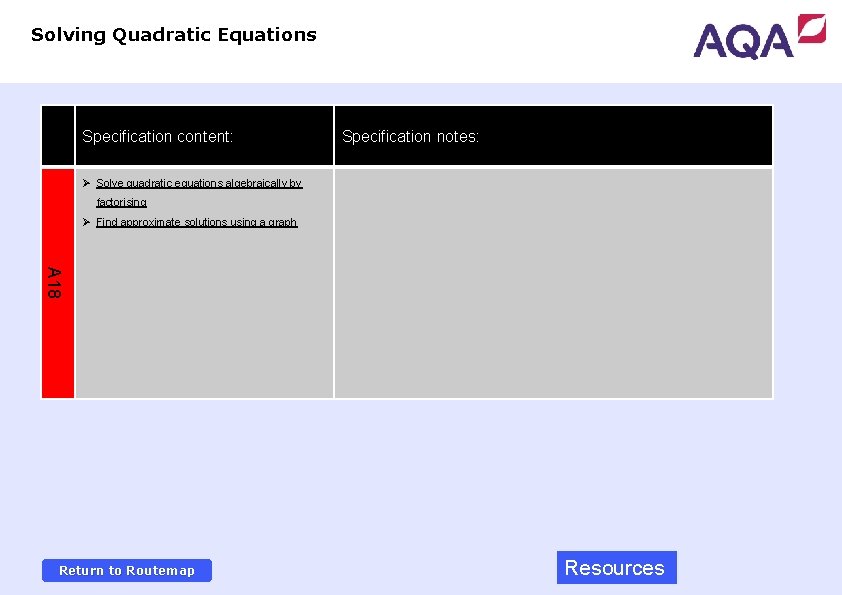
Solving Quadratic Equations Specification content: Specification notes: Ø Solve quadratic equations algebraically by factorising Ø Find approximate solutions using a graph A 18 Return to Routemap Resources
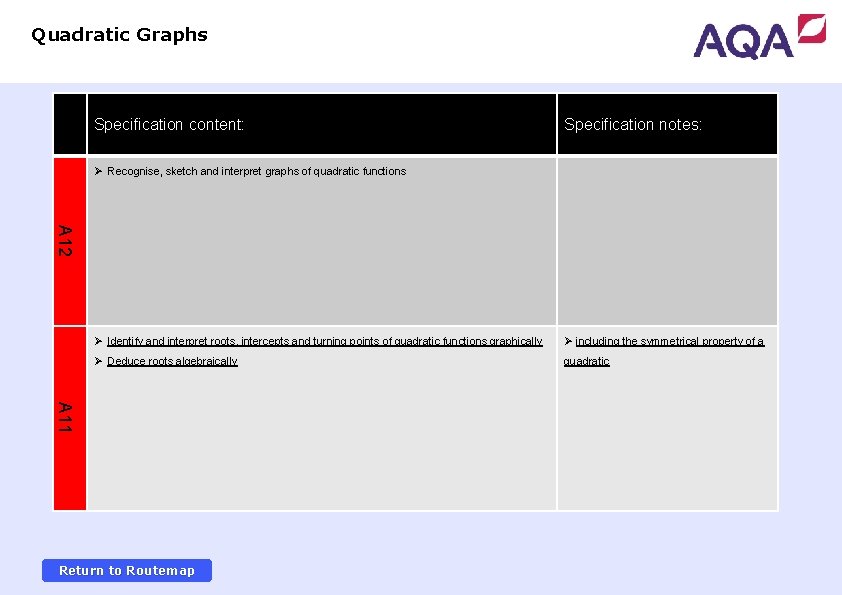
Quadratic Graphs Specification content: Specification notes: Ø Recognise, sketch and interpret graphs of quadratic functions A 12 Ø Identify and interpret roots, intercepts and turning points of quadratic functions graphically Ø including the symmetrical property of a Ø Deduce roots algebraically quadratic A 11 Return to Routemap
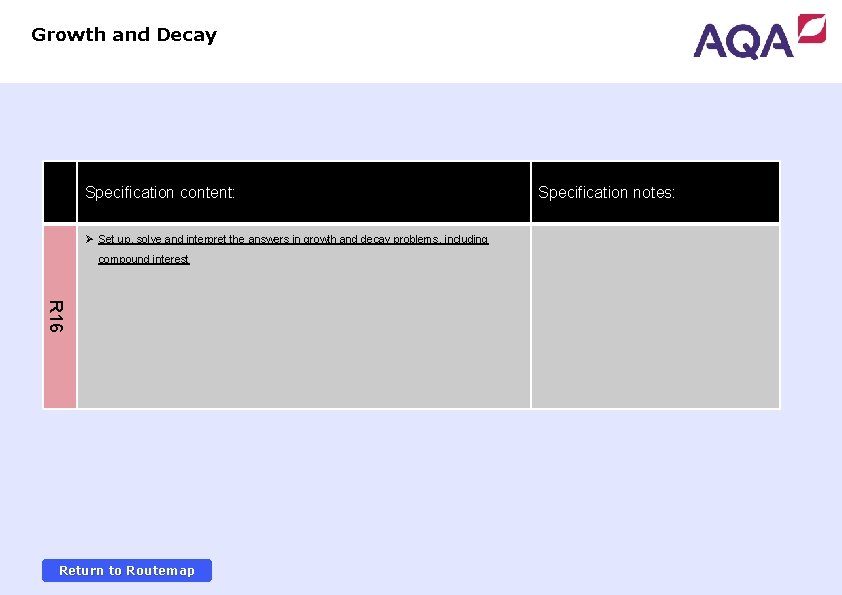
Growth and Decay Specification content: Ø Set up, solve and interpret the answers in growth and decay problems, including compound interest R 16 Return to Routemap Specification notes:
Review and Revision 13 Specification content: Return to Routemap Specification notes:
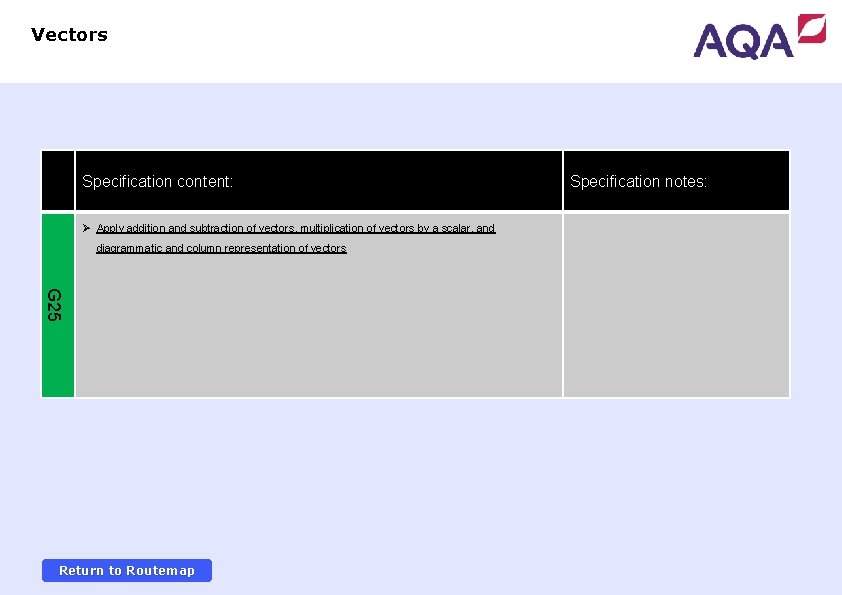
Vectors Specification content: Ø Apply addition and subtraction of vectors, multiplication of vectors by a scalar, and diagrammatic and column representation of vectors G 25 Return to Routemap Specification notes: