
GCSE Irish Revised First teaching from September 2017
GCSE Irish (Revised) (First teaching from September 2017) October - November 2018 GCSE Support Event
Support Event • Introduction • Key Resources • New GCSE Irish unit by unit • Support • Q&A
Introduction • • • A time of change New specification for GCSE Irish Unitised qualification First papers – summer 2018 First awards – summer 2019 40% of the assessments must be taken at the end of course
Key Resources CCEA Irish Microsite – Specification – Specimen Assessment Materials (SAMS) – GCSE Modern Languages Clarification document (June 2017) – Circular – GCSE Modern Languages Writing (April 2018) – Circular – 2018 GCSE Modern Languages (Sept 2018) – Speaking Examination at a glance (Sept 2018)
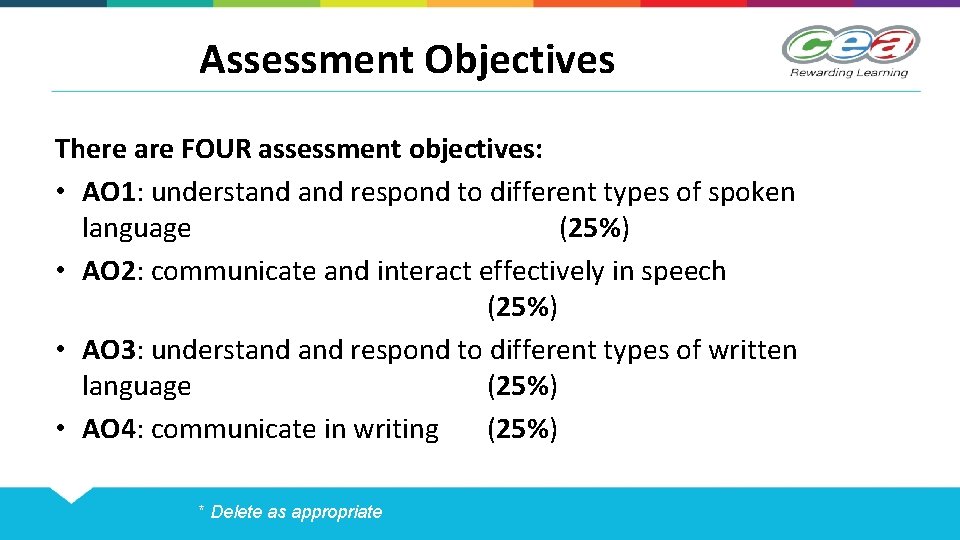
Assessment Objectives There are FOUR assessment objectives: • AO 1: understand respond to different types of spoken language (25%) • AO 2: communicate and interact effectively in speech (25%) • AO 3: understand respond to different types of written language (25%) • AO 4: communicate in writing (25%) * Delete as appropriate
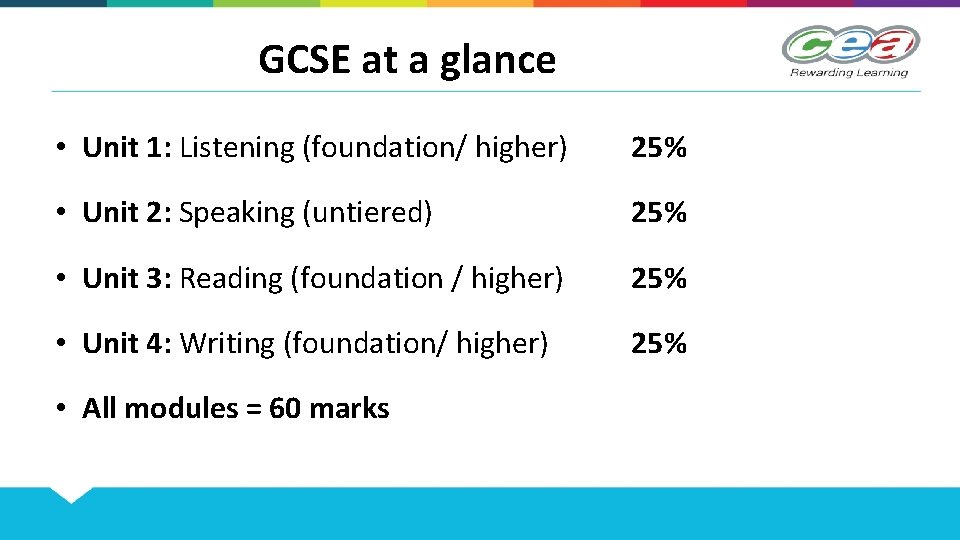
GCSE at a glance • Unit 1: Listening (foundation/ higher) 25% • Unit 2: Speaking (untiered) 25% • Unit 3: Reading (foundation / higher) 25% • Unit 4: Writing (foundation/ higher) 25% • All modules = 60 marks
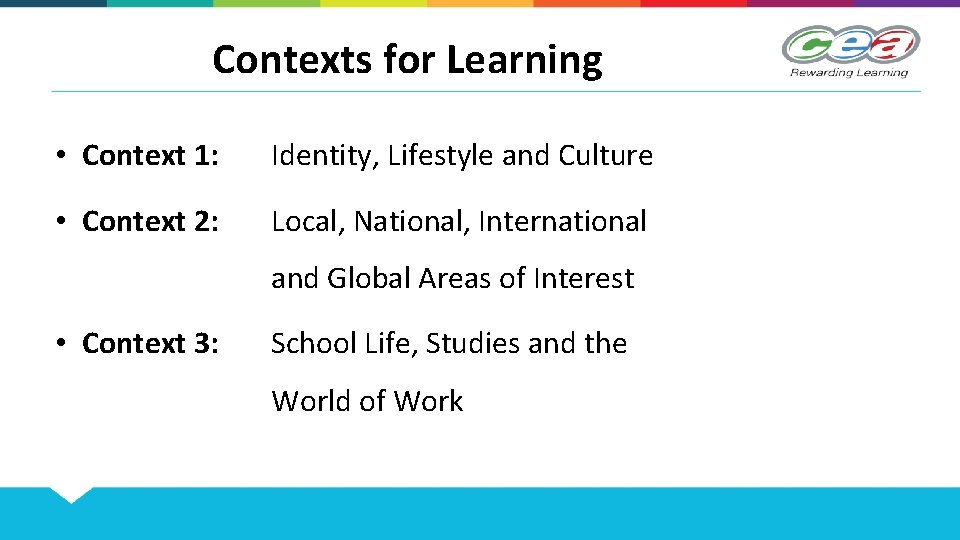
Contexts for Learning • Context 1: Identity, Lifestyle and Culture • Context 2: Local, National, International and Global Areas of Interest • Context 3: School Life, Studies and the World of Work
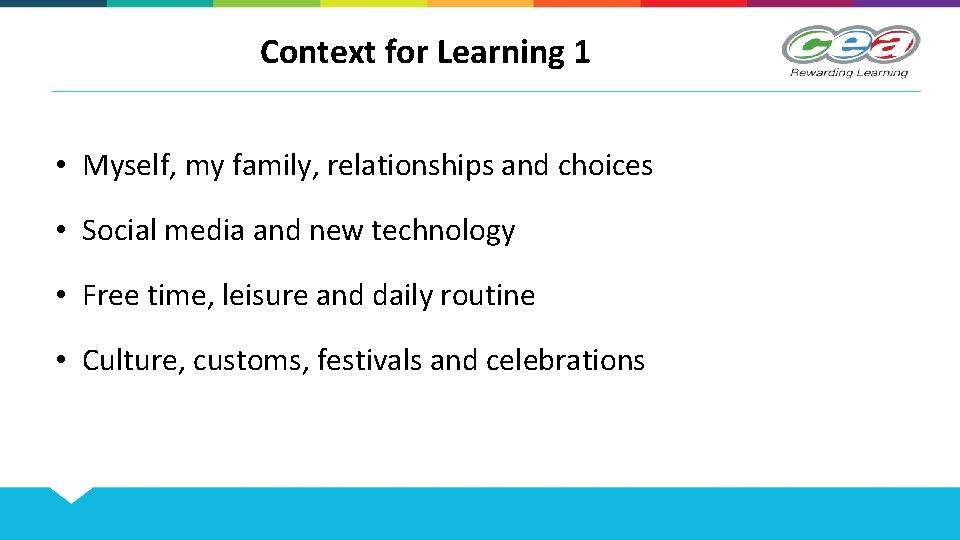
Context for Learning 1 • Myself, my family, relationships and choices • Social media and new technology • Free time, leisure and daily routine • Culture, customs, festivals and celebrations
Context for Learning 2 • My local area and the wider environment • Community involvement • Social and global issues • Travel and tourism
Context for Learning 3 • My studies and school life • Extra-curricular activities • Part-time jobs and money management • Future plans and career
Contexts for Learning • 3 Contexts for Learning • ALL 3 Contexts covered in every paper • 4 Topics in each context = framework for topics to assess • ALL TOPICS will be assessed over the lifetime of the specification

GCSE Unit 1: Listening This unit has TWO tiers: - Foundation 35 minutes (approx. ) - Higher 45 minutes (approx. )
GCSE Unit 1: Listening Changes from previous specification: - Foundation & Higher papers = 12 questions - 4 common questions - Questions and answers in English = Q. 1 - 8 - Questions and answers in Irish = Q. 9 - 12
GCSE Unit 1: Listening - Full sentences not required - Alternatives no marks awarded - Incorrect language no marks awarded - Candidate should answer clearly in the spaces provided
GCSE Unit 3: Reading This unit has TWO tiers: - Foundation 50 minutes - Higher 60 minutes
GCSE Unit 3: Reading Changes from previous specification: - Foundation & Higher papers = 12 questions - 4 questions are common to both tiers - Questions and answers in English and questions and answers in Irish - Answers in incorrect language no marks awarded - Full sentences not required in answers
GCSE Unit 3: Reading Changes from previous specification: - Foundation & Higher papers - translation - Translation of short sentences from Irish to English - Different questions for translation in foundation and higher papers
GCSE Unit 4: Writing This unit has TWO tiers: - Foundation 60 minutes - Higher 1 hour 15 minutes
GCSE Unit 4: Writing Foundation Tier = 4 questions - Listing and short phrases in Irish - Short phrase/ sentence responses in Irish - Translation of short sentences from English to Irish - Structured response – extended writing (one from choice of three) - CCEA Circular April 2018 – recommends 80 -100 words
GCSE Unit 4: Writing Higher Tier = 4 questions - Short phrase/ sentence responses in Irish - Short responses in Irish to one or more pieces of text - Translation of short sentences from English to Irish - Structured response – extended writing (one from choice of three) - CCEA Circular April 2018 – recommends 130 – 150 words
GCSE Unit 4: Writing Changes from previous specifications: - Replaces Controlled Assessment Writing - One common question - Translation English Irish - Structured responses in Irish – choice of 1 from 3 options
GCSE Unit 4: Writing In the Writing Papers - Phrases do not have to include a verb - Sentences do have to contain a verb - Word limits/ guidance = very important - Lengthy answers can be self-penalizing
GCSE Unit 4: Writing Extended writing - Three options - 1 option from each of the 3 Contexts for Learning - Set out answer clearly - Choose carefully – all 5 bullet points must be answered appropriately to access the higher bands - All bullet points have equal weighting
GCSE Unit 4: Writing Extended writing – Communication Band 5 • • 17 -20 marks Carries out the task effectively Very clear and concise language Excellent knowledge of the topic Ideas and opinions = expressed and justified
GCSE Unit 4: Writing Extended writing – Grammar and Structures Band 5 9 -10 marks • Well-organised and coherent • Attempts to use more complex language • Excellent range of appropriate vocabulary and structures • Few errors
GCSE Unit 2: Speaking This unit has ONE tier: - Role-plays 2 - 4 minutes - Conversation topic 1 4 minutes - Conversation topic 2 4 minutes - Suggested overall time 10 -12 minutes (teacher managed)
GCSE Unit 2: Speaking Teacher-conducted speaking test • MUST be recorded for uploading • Marked by CCEA • GCSE timetable is currently online – window for speaking tests
GCSE Unit 2: Speaking Timings - Upper time limits must be adhered to - Lengthy speaking tests are self-penalizing - Too short will not allow access to full range of marks
GCSE Unit 2: Speaking Role-plays - preparation - Two cards – presented to candidate face down - Each card has two role play situations - Candidate chooses without seeing the tasks - One card on each of the contexts not covered by pre-release topic
GCSE Unit 2: Speaking Role plays - preparation - CCEA will specify the order of the role play cards - A, B, C etc.
GCSE Unit 2: Speaking Role-plays - preparation - Preparation = 10 minutes - Candidates can write answers / notes on the Candidate Roleplay Response Sheet and use these in the examination
GCSE Unit 2: Speaking When Role-plays have been selected - Candidate sees the contents of the role-plays - 2 Situations based on different topics - Both from the same Context for Learning - Open and closed tasks - Ask questions
GCSE Unit 2: Speaking Role-plays - Teacher-examiner must adhere to the responses given in the Speaking Test Booklet - Candidates should not be prompted or corrected
GCSE Unit 2: Speaking Role-plays - Each element assessed 2/ 1/ 0 - Communication is key - Range of difficulty – untiered (A*-G) - Total marks for role plays = 2 x 10 = 20 marks
GCSE Unit 2: Speaking Conversation topic 1 - Pre-release topic - Topic released in September - 2019 Topic for GCSE Irish = School –My Local Area
GCSE Unit 2: Speaking Conversation topic 1 - Based on the topic ONLY - NOT based on the full Context - Up to 4 minutes - Candidate should answer and ask questions - Circular September 2018 – GCSE Modern Languages
GCSE Unit 2: Speaking Conversation topic 1 - Continues elements from Controlled Assessment in old specification - One hour preparation in class - Candidate Preparation Sheet - Not part of a “mock” examination
GCSE Unit 2: Speaking Conversation topic 1 - It should NOT be a series of mini-presentations - Natural flow to the conversation - CCEA questions (in Specification) – can be used / adapted
GCSE Unit 2: Speaking Conversation topic 2 - It must be on one topic NOT a full Context for Learning - It must be taken from the Context for Learning not covered so far in the speaking test - A natural conversation - Teacher chooses topic NOT the candidate - Candidates should answer and ask questions
GCSE Unit 2: Speaking Conversation topics 1 and 2 - Each conversation topic marked out of 20 - Each conversation topic assessed separately - Conversation topic 1 = 20 marks - Conversation topic 2 = 20 marks
GCSE Unit 2: Speaking Conversation – Communication (15 marks) Band 5 Candidate (13 -15 marks) • Asks and answers questions spontaneously and confidently • Communicates a lot of relevant information • Develops answers by giving unsolicited details with opinions and justification • Excellent pronunciation, intonation and fluency.
GCSE Unit 2: Speaking Conversation Grammar and Structures (5 marks) Band 5 Candidate (5 marks) • uses a wide range of grammar and structures giving the response some complexity • regularly incorporates vocabulary, idiomatic and creative expressions that give the response a natural feel • uses more complex language, with confident reference to past, present and future events, as appropriate • delivers a response with a high level of accuracy
GCSE Unit 2: Speaking THREE parts to the speaking test - One recording - Role-plays 20 marks - Conversation topic 1 20 marks - Conversation topic 2 20 marks - TOTAL = 60 marks
GCSE Unit 2: Speaking - Candidate Preparation sheet - Candidate Role-play Response Sheet - BOTH must be retained by centre until the Enquiry About Results (EAR) process is complete
![Contacts: GCSE Modern Languages Education Manager [with overall responsibility for GCSE French & German]:](http://slidetodoc.com/presentation_image_h2/7449616f954d45e0f87c12f39a18cc25/image-45.jpg "Contacts: GCSE Modern Languages Education Manager [with overall responsibility for GCSE French & German]:")
Contacts: GCSE Modern Languages Education Manager [with overall responsibility for GCSE French & German]: Jayne Fitz. Gerald Telephone: 028 90 261200 Ext 2255 Email: jfitzgerald@ccea. org. uk Education Manager [with overall responsibility for GCSE Irish and Spanish]: Seán Mc. Nally Telephone: 028 90 261200 Ext 2325 Email: smcnally@ccea. org. uk Subject Support Officer: Joan Jennings Telephone: 028 90 261200 Ext 2552 Email: jjennings@ccea. org. uk
Online support & resources Full range of materials for GCSE - available on the CCEA Irish microsite at www. ccea. org. uk - Specification, SAMS - Factfiles - Circulars - Chief Examiner’s Reports

http: //ccea. org. uk/signup
Subscriber Campaign CCEA are moving to more email based communications with all our centres and this will include providing teachers with • information on subject updates • information on subject events • information on new support materials • general news information It’s important that YOU subscribe using the link on the homepage of our website or http: //ccea. org. uk/signup
Working with CCEA The benefits of being an examiner with CCEA: – teacher cover provided [as appropriate] – first-hand experience of how the examining system works – creates links with CCEA personnel/subject officer – opportunity to network with other professionals – enhances the professional development of teachers
GCSE Irish
- Slides: 50