
GCSE History Paper 2 The Dark Side of
![Question Types – 4 Mark [inference] • This question asks you what a source](https://slidetodoc.com/presentation_image_h2/35d308f5a04c205dbba10ea214ccbaae/image-5.jpg "Question Types – 4 Mark [inference] • This question asks you what a source")
![How to answer [4] • Attitudes towards social changes for women varied amongst the](https://slidetodoc.com/presentation_image_h2/35d308f5a04c205dbba10ea214ccbaae/image-6.jpg "How to answer [4] • Attitudes towards social changes for women varied amongst the")
![Question Types – 6 Mark [Explain] • This question asks you to explain something.](https://slidetodoc.com/presentation_image_h2/35d308f5a04c205dbba10ea214ccbaae/image-7.jpg "Question Types – 6 Mark [Explain] • This question asks you to explain something.")
![How to answer [6] • The attitude of racial prejudice against immigrants from Southern](https://slidetodoc.com/presentation_image_h2/35d308f5a04c205dbba10ea214ccbaae/image-8.jpg "How to answer [6] • The attitude of racial prejudice against immigrants from Southern")
![Question Types – 10 Mark [Usefulness] • This question asks you how useful a](https://slidetodoc.com/presentation_image_h2/35d308f5a04c205dbba10ea214ccbaae/image-9.jpg "Question Types – 10 Mark [Usefulness] • This question asks you how useful a")
![How to answer [10] Useful • • The source is useful because it is](https://slidetodoc.com/presentation_image_h2/35d308f5a04c205dbba10ea214ccbaae/image-11.jpg "How to answer [10] Useful • • The source is useful because it is")
![How to answer [10] • How useful is Source F for studying the economic](https://slidetodoc.com/presentation_image_h2/35d308f5a04c205dbba10ea214ccbaae/image-12.jpg "How to answer [10] • How useful is Source F for studying the economic")
![Question Types – 8 Mark [Explain] • This is similar to the six mark](https://slidetodoc.com/presentation_image_h2/35d308f5a04c205dbba10ea214ccbaae/image-13.jpg "Question Types – 8 Mark [Explain] • This is similar to the six mark")
![How to answer [8] • Laissez faire and rugged individualism did not seem to](https://slidetodoc.com/presentation_image_h2/35d308f5a04c205dbba10ea214ccbaae/image-14.jpg "How to answer [8] • Laissez faire and rugged individualism did not seem to")
![How to answer [12] Agree Disagree • • Vietcong surprise attack – successful in](https://slidetodoc.com/presentation_image_h2/35d308f5a04c205dbba10ea214ccbaae/image-16.jpg "How to answer [12] Agree Disagree • • Vietcong surprise attack – successful in")
- Slides: 17
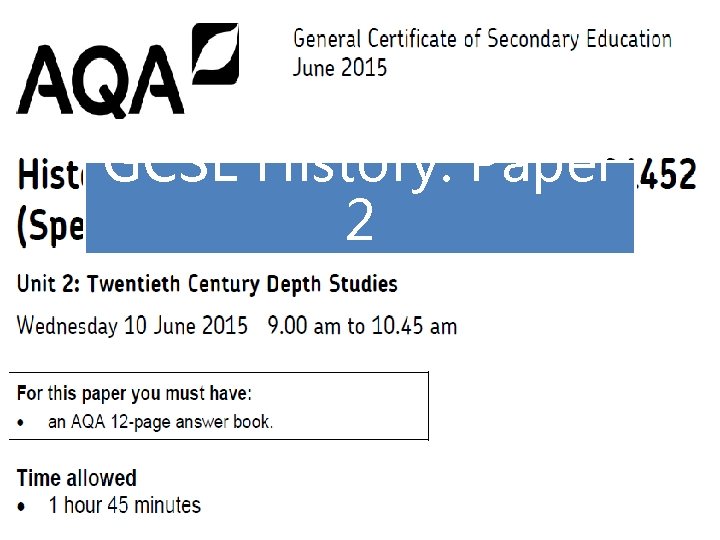
GCSE History: Paper 2
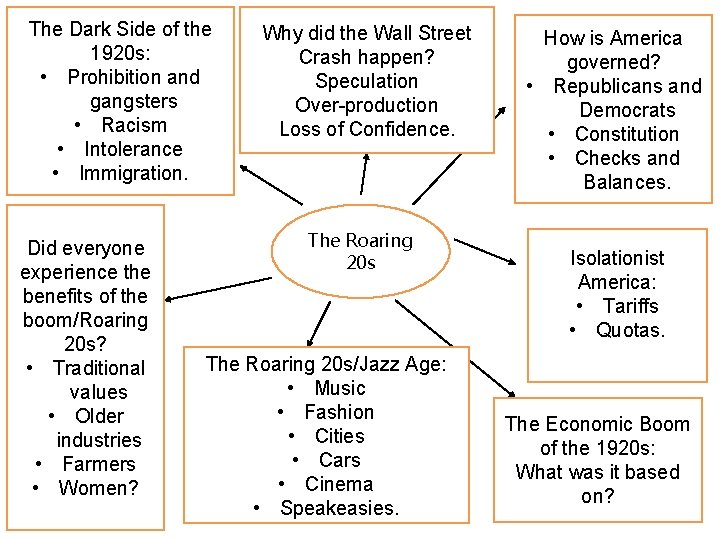
The Dark Side of the 1920 s: • Prohibition and gangsters • Racism • Intolerance • Immigration. Did everyone experience the benefits of the boom/Roaring 20 s? • Traditional values • Older industries • Farmers • Women? Why did the Wall Street Crash happen? Speculation Over-production Loss of Confidence. The Roaring 20 s/Jazz Age: • Music • Fashion • Cities • Cars • Cinema • Speakeasies. How is America governed? • Republicans and Democrats • Constitution • Checks and Balances. Isolationist America: • Tariffs • Quotas. The Economic Boom of the 1920 s: What was it based on?
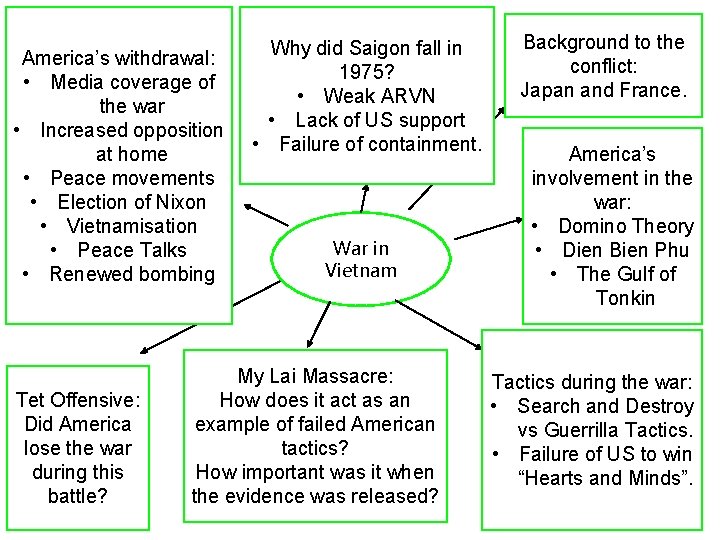
America’s withdrawal: • Media coverage of the war • Increased opposition at home • Peace movements • Election of Nixon • Vietnamisation • Peace Talks • Renewed bombing Tet Offensive: Did America lose the war during this battle? Why did Saigon fall in 1975? • Weak ARVN • Lack of US support • Failure of containment. War in Vietnam My Lai Massacre: How does it act as an example of failed American tactics? How important was it when the evidence was released? Background to the conflict: Japan and France. America’s involvement in the war: • Domino Theory • Dien Bien Phu • The Gulf of Tonkin Tactics during the war: • Search and Destroy vs Guerrilla Tactics. • Failure of US to win “Hearts and Minds”.
Question Types – 4 Mark [inference] • This question asks you what a source suggests. • This means that you need to infer meaning from the source: “read between the lines”.
How to answer [4] • Attitudes towards social changes for women varied amongst the American population. • Women ignored the older generation’s disapproval and followed the latest fashions. • They had more freedom to choose for themselves how they wanted to look and what they wanted to do. • Attitudes towards women were changing in some ways but not in others (such as getting the vote but not equal pay).
Question Types – 6 Mark [Explain] • This question asks you to explain something. • You should aim to fully develop 2 or 3 points on the topic it asks you about. • E. g. “Explain American attitudes and policies towards immigration in the 1920 s. ” • “Explain” means to say why something happened using words like “because” and “therefore”.
How to answer [6] • The attitude of racial prejudice against immigrants from Southern and Eastern Europe, including attitudes and policies of the KKK. Sense of superiority among WASPS. Therefore highlighting that white Americans of English decent saw the immigrants as… • 1921 Emergency Quotas Act which favoured immigrants from Northern and Western Europe and 1924 National Origins Act show that the government in the 1920 s were against large-scale migration to the US. • The Red Scare or the case of Sacco and Vanzetti showed a distrust of immigrants because they were persecuted and accused of being Communist.
Question Types – 10 Mark [Usefulness] • This question asks you how useful a source is. • You need to plan it like a normal essay – useful, not useful, conclusion. • You also need to consider the provenance of the source (where it came from) in your argument about its usefulness. • Remember – a source which is unreliable can still be useful! • There also marks for SPa. G in this question.
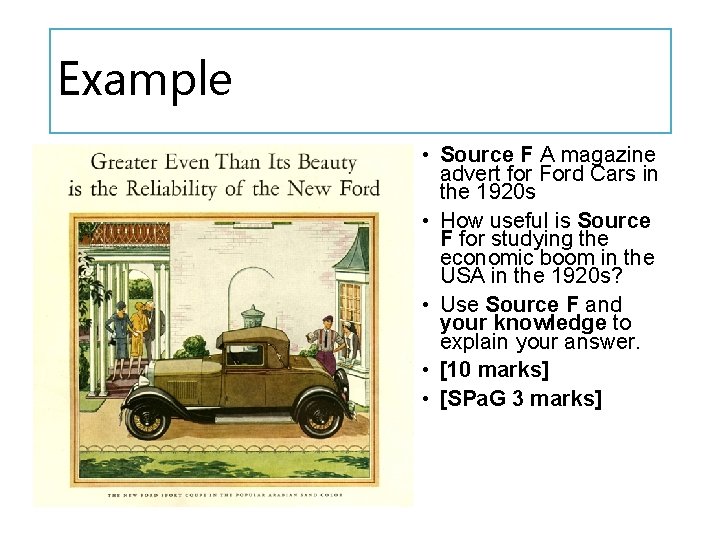
Example • Source F A magazine advert for Ford Cars in the 1920 s • How useful is Source F for studying the economic boom in the USA in the 1920 s? • Use Source F and your knowledge to explain your answer. • [10 marks] • [SPa. G 3 marks]
How to answer [10] Useful • • The source is useful because it is an example of the type of advertising that contributed to the boom. The purpose of the source was to increase sales by encouraging consumer demand. The fashionable women, attractive house and servants shown in the picture were intended to encourage aspirations among consumers and make them want to buy the products associated with the glamour of the advert. Not useful/Limited • • The source is limited as it does not show all the other factors that enabled the USA to become prosperous in the 1920 s. Mass production in consumer industries; advertising; hire purchase; share speculation and the Republican policy of laissez faire all contributed to the prosperity enjoyed in 1920 s America. The source is limited because the prosperity represented in the source only applied to less than half the American population in the 1920 s. The boom was not enjoyed by most black Americans and many recent immigrants lived in ghettos in cities in the eastern USA.
How to answer [10] • How useful is Source F for studying the economic boom in the USA in the 1920 s? • “Source F is useful to some extent because…” • “However, it also has its limitations because…” • “Overall, in spite of the limitations of the source, namely the bias of an advertisement, it still has its uses”.
Question Types – 8 Mark [Explain] • This is similar to the six mark explain question, but requires further development of each point and/or more reasons given. • Continue to use words and phrases like “therefore”, “this led to”, “because”, and “this can be highlighted by…”. • E. g. “Explain why Hoover lost the 1932 Presidential election. ”
How to answer [8] • Laissez faire and rugged individualism did not seem to help the American people. • Hoover had problems appreciating the extent of the crisis. E. g. Hoover’s policies mostly failed, e. g. Hawley-Smoot tariff. • Under Hoover, cities were close to bankruptcy, with problems added to through consequences of relief programmes. • Impact of poor publicity after dispersing the Bonus Army. • Roosevelt had enthusiasm and charisma, and promised to end the Depression. • Roosevelt travelled all around America and listened to the people. • Roosevelt used the radio to convey his promises to the people. • Roosevelt had been a successful State Governor in New York. • Remember – the key thing is to link back to the question! “This led to Hoover losing the 1932 election because…”
Question Types – 12 Mark • This is similar to the ten mark essay on paper 1, but instead of being given two factors to discuss you will only be given one. • It is up to you to develop the other side of the argument. • It also has similarities to the 6 mark question on paper 1 as well – it’s asking if you agree. • There are 3 marks for SPa. G. • E. g. ‘The Tet Offensive was the main reason the USA lost the Vietnam War. ’ How far do you agree with this interpretation? Explain your answer.
How to answer [12] Agree Disagree • • Vietcong surprise attack – successful in capturing Saigon briefly. E. g. Vietcong captured a lot of territory e. g. Hue for 25 days. US media showed US suffering setbacks – Belief spread that the war was unwinnable. President Johnson decided not to stand for re-election – Nixon elected on platform of bringing war to an end. • • • Effects of Vietcong guerrilla warfare and help from China. US troops suffering from terrain and climate; young and inexperienced. US tactic of search and destroy – lost support in Vietnam and when activities publicised encouraged anti-war sentiments at home. North Vietnamese use of Ho Chi Minh trail – Cambodia (US unwilling to invade). Level 3: Answers that explain more than one interpretation in depth. Answers will provide some evaluation of the history on which the interpretations are based and may assess the validity of the interpretations and/or explain how the interpretation came about. [7 -10] An analytical answer which clearly links interpretations and/or reaches a supported judgement about the validity of the interpretations through the use of historical evidence and/or context. [11 -12]
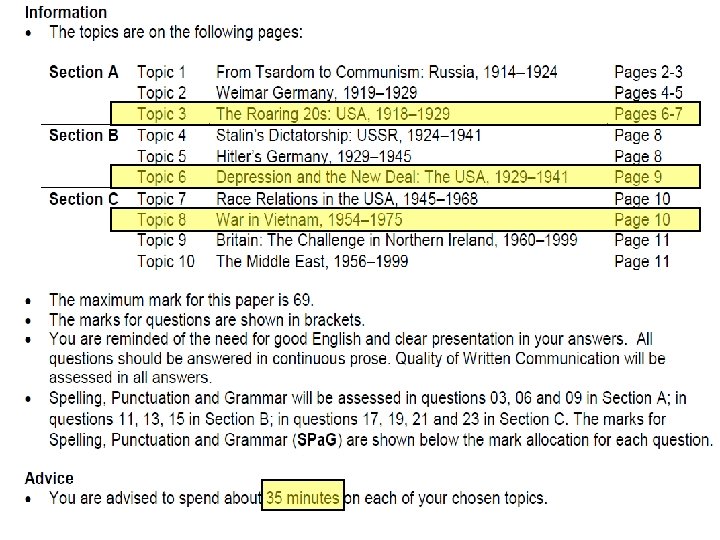
Timings • As before, spend about 35 minutes on each topic. • For Section A: • Spend 5 minutes (maximum!) on the 4 mark questions. • Spend 10 minutes on the 6 mark question. • Spend 20 minutes on the 10 mark question – 5 minutes to plan, 15 to write. • For Sections B and C: • Spend between 10 and 15 minutes on the 8 mark question. • Spend between 20 and 25 minutes on the 12 mark question. • Again, if you are struggling with a question, move on!