
GCSE Food Preparation and Nutrition Topic Nutrition The
- Slides: 3
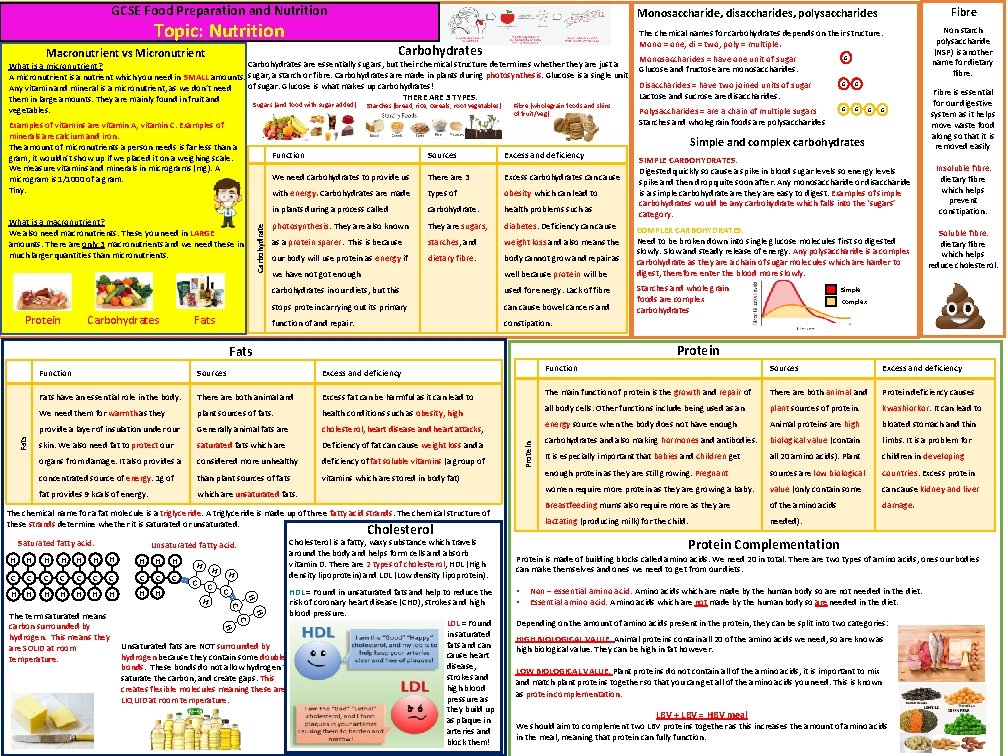
GCSE Food Preparation and Nutrition Topic: Nutrition The chemical names for carbohydrates depends on their structure. Mono = one, di = two, poly = multiple. Carbohydrates Macronutrient vs Micronutrient Carbohydrates are essentially sugars, but their chemical structure determines whether they are just a What is a micronutrient? A micronutrient is a nutrient which you need in SMALL amounts. sugar, a starch or fibre. Carbohydrates are made in plants during photosynthesis. Glucose is a single unit of sugar. Glucose is what makes up carbohydrates! Any vitamin and mineral is a micronutrient, as we don’t need THERE ARE 3 TYPES: them in large amounts. They are mainly found in fruit and Sugars (and food with sugar added) Starches (bread, rice, cereals, root vegetables) Fibre (wholegrain foods and skins vegetables. of fruit/veg) Examples of vitamins are vitamin A, vitamin C. Examples of minerals are calcium and iron. The amount of micronutrients a person needs is far less than a gram, it wouldn’t show up if we placed it on a weighing scale. We measure vitamins and minerals in micrograms (mg). A microgram is 1/1000 of a gram. Tiny. Carbohydrate What is a macronutrient? We also need macronutrients. These you need in LARGE amounts. There are only 3 macronutrients and we need these in much larger quantities than micronutrients. C Carbohydrates Protein Fats Function Sources Excess and deficiency We need carbohydrates to provide us There are 3 Excess carbohydrates can cause with energy. Carbohydrates are made types of obesity which can lead to in plants during a process called carbohydrate. health problems such as photosynthesis. They are also known They are sugars, diabetes. Deficiency can cause as a protein sparer. This is because starches, and weight loss and also means the our body will use protein as energy if dietary fibre. body cannot grow and repair as we have not got enough well because protein will be carbohydrates in our diets, but this used for energy. Lack of fibre stops protein carrying out its primary can cause bowel cancers and function of and repair. constipation. Sources Excess and deficiency Fats have an essential role in the body. There are both animal and Excess fat can be harmful as it can lead to We need them for warmth as they plant sources of fats. health conditions such as obesity, high provide a layer of insulation under our Generally animal fats are cholesterol, heart disease and heart attacks, skin. We also need fat to protect our saturated fats which are Deficiency of fat can cause weight loss and a organs from damage. It also provides a considered more unhealthy deficiency of fat soluble vitamins (a group of concentrated source of energy. 1 g of than plant sources of fats vitamins which are stored in body fat) fat provides 9 kcals of energy. which are unsaturated fats. Protein Fats Function The chemical name for a fat molecule is a triglyceride. A triglyceride is made up of three fatty acid strands. The chemical structure of these strands determine whether it is saturated or unsaturated. Cholesterol is a fatty, waxy substance which travels around the body and helps form cells and absorb vitamin D. There are 2 types of cholesterol, HDL (High density lipoprotein) and LDL (Low density lipoprotein). Unsaturated fatty acid: H H H H H C C C C C H H H H C H C H HDL = Found in unsaturated fats and help to reduce the risk of coronary heart disease (CHD), strokes and high blood pressure. LDL = Found in saturated fats and can Unsaturated fats are NOT surrounded by cause heart hydrogen because they contain some double disease, bonds. These bonds do not allow hydrogen to strokes and saturate the carbon, and create gaps. This high blood creates flexible molecules meaning these are pressure as LIQUID at room temperature. they build up as plaque in arteries and block them! H C G Disaccharides = have two joined units of sugar Lactose and sucrose are disaccharides. G G Polysaccharides = are a chain of multiple sugars Starches and wholegrain foods are polysaccharides G G Simple and complex carbohydrates Fibre is essential for our digestive system as it helps move waste food along so that it is removed easily SIMPLE CARBOHYDRATES: Digested quickly so cause a spike in blood sugar levels so energy levels spike and then drop quite soon after. Any monosaccharide or disaccharide is a simple carbohydrate are they are easy to digest. Examples of simple carbohydrates would be any carbohydrate which falls into the ‘sugars’ category. Insoluble fibre: dietary fibre which helps prevent constipation. COMPLEX CARBOHYDRATES: Need to be broken down into single glucose molecules first so digested slowly. Slow and steady release of energy. Any polysaccharide is a complex carbohydrate as they are a chain of sugar molecules which are harder to digest, therefore enter the blood more slowly. Soluble fibre: dietary fibre which helps reduce cholesterol. Starches and whole grain foods are complex carbohydrates G G Simple Complex Function Sources Excess and deficiency The main function of protein is the growth and repair of There are both animal and Protein deficiency causes all body cells. Other functions include being used as an plant sources of protein. kwashiorkor. It can lead to energy source when the body does not have enough Animal proteins are high bloated stomach and thin carbohydrates and also making hormones and antibodies. biological value (contain limbs. It is a problem for It is especially important that babies and children get all 20 amino acids). Plant children in developing enough protein as they are still growing. Pregnant sources are low biological countries. Excess protein women require more protein as they are growing a baby. value (only contain some can cause kidney and liver Breastfeeding mums also require more as they are of the amino acids damage. lactating (producing milk) for the child. needed). Protein Complementation Protein is made of building blocks called amino acids. We need 20 in total. There are two types of amino acids, ones our bodies can make themselves and ones we need to get from our diets. • • Non – essential amino acid: Amino acids which are made by the human body so are not needed in the diet. Essential amino acid: Amino acids which are not made by the human body so are needed in the diet. H C H The term saturated means carbon surrounded by hydrogen. This means they are SOLID at room temperature. H Monosaccharides = have one unit of sugar Glucose and fructose are monosaccharides. Non starch polysaccharide (NSP) is another name for dietary fibre. Protein Fats Saturated fatty acid: Fibre Monosaccharide, disaccharides, polysaccharides Depending on the amount of amino acids present in the protein, they can be split into two categories: HIGH BIOLOGICAL VALUE: Animal proteins contain all 20 of the amino acids we need, so are know as high biological value. They can be high in fat however. LOW BIOLOGICAL VALUE: Plant proteins do not contain all of the amino acids, it is important to mix and match plant proteins together so that you can get all of the amino acids you need. This is known as protein complementation. LBV + LBV = HBV meal We should aim to complement two LBV proteins together as this increases the amount of amino acids in the meal, meaning that protein can fully function.
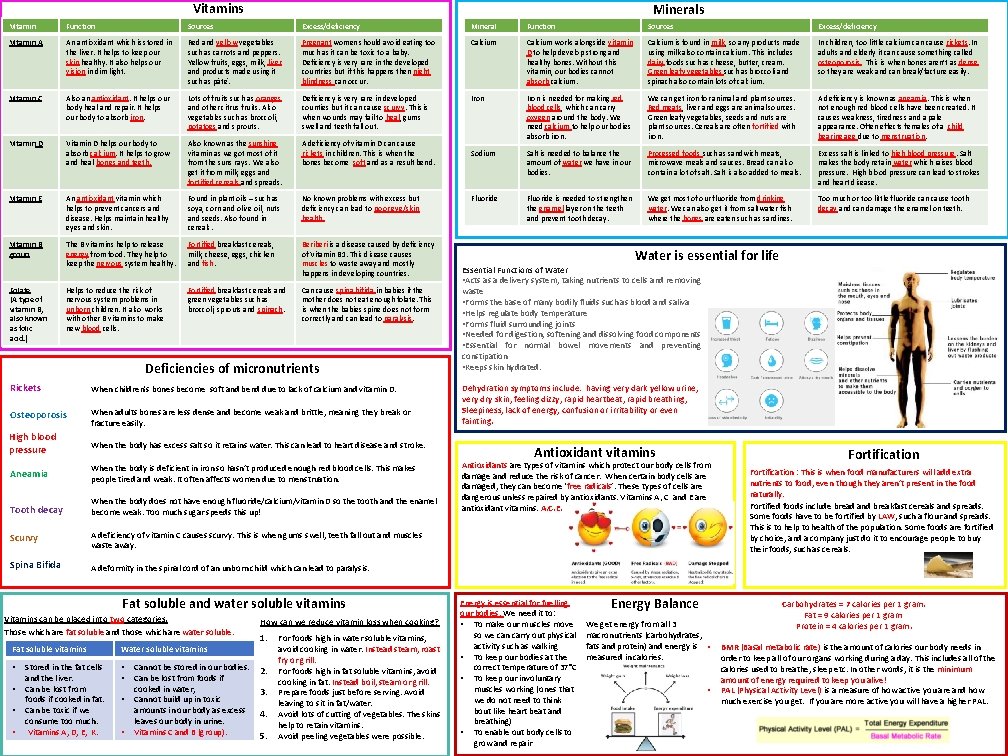
Vitamins Minerals Vitamin Function Sources Excess/deficiency Mineral Function Sources Excess/deficiency Vitamin A An antioxidant which is stored in the liver. It helps to keep our skin healthy. It also helps our vision in dim light. Red and yellow vegetables such as carrots and peppers. Yellow fruits, eggs, milk, liver and products made using it such as pâté. Pregnant women should avoid eating too much as it can be toxic to a baby. Deficiency is very rare in the developed countries but if this happens then night blindness can occur. Calcium works alongside vitamin D to help develop strong and healthy bones. Without this vitamin, our bodies cannot absorb calcium. Calcium is found in milk, so any products made using milk also contain calcium. This includes dairy foods such as cheese, butter, cream. Green leafy vegetables such as broccoli and spinach also contain lots of calcium. In children, too little calcium can cause rickets. In adults and elderly it can cause something called osteoporosis. This is when bones aren’t as dense so they are weak and can break/facture easily. Vitamin C Also an antioxidant. It helps our body heal and repair. It helps our body to absorb iron. Lots of fruits such as oranges and other citrus fruits. Also vegetables such as broccoli, potatoes and sprouts. Deficiency is very rare in developed counties but it can cause scurvy. This is when wounds may fail to heal, gums swell and teeth fall out. Iron Vitamin D helps our body to absorb calcium. It helps to grow and heal bones and teeth. Also known as the sunshine vitamin as we got most of it from the suns rays. We also get it from milk, eggs and fortified cereals and spreads. A deficiency of vitamin D can cause rickets in children. This is when the bones become soft and as a result bend. Iron is needed for making red blood cells, which can carry oxygen around the body. We need calcium to help our bodies absorb iron. We can get iron for animal and plant sources. Red meats, liver and eggs are animal sources. Green leafy vegetables, seeds and nuts are plant sources. Cereals are often fortified with iron. A deficiency is known as aneamia. This is when not enough red blood cells have been created. It causes weakness, tiredness and a pale appearance. Often effects females of a child bearing age due to menstruation. Sodium Salt is needed to balance the amount of water we have in our bodies. Processed foods such as sandwich meats, microwave meals and sauces. Bread can also contain a lot of salt. Salt is also added to meals. Excess salt is linked to high blood pressure. Salt makes the body retain water which raises blood pressure. High blood pressure can lead to strokes and heart disease. Vitamin E An antioxidant vitamin which helps to prevent cancers and disease. Helps maintain healthy eyes and skin. Found in plant oils – such as soya, corn and olive oil, nuts and seeds. Also found in cereals. No known problems with excess but deficiency can lead to poor eye/skin health. Fluoride is needed to strengthen the enamel layer on the teeth and prevent tooth decay. We get most of our fluoride from drinking water. We can also get it from saltwater fish where the bones are eaten such as sardines. Too much or too little fluoride can cause tooth decay and can damage the enamel on teeth. Vitamin B group The B vitamins help to release energy from food. They help to keep the nervous system healthy. Fortified breakfast cereals, milk, cheese, eggs, chicken and fish. Beriberi is a disease caused by deficiency of Vitamin B 1. This disease causes muscles to waste away and mostly happens in developing countries. Helps to reduce the risk of nervous system problems in unborn children. It also works with other B vitamins to make new blood cells. Fortified breakfast cereals and green vegetables such as broccoli, sprouts and spinach. Can cause spina bifida in babies if the mother does not eat enough folate. This is when the babies spine does not form correctly and can lead to paralysis. Folate (A type of vitamin B, also known as folic acid. ) Deficiencies of micronutrients Rickets When children's bones become soft and bend due to lack of calcium and vitamin D. Osteoporosis When adults bones are less dense and become weak and brittle, meaning they break or fracture easily. High blood pressure When the body has excess salt so it retains water. This can lead to heart disease and stroke. Aneamia When the body is deficient in iron so hasn’t produced enough red blood cells. This makes people tired and weak. It often affects women due to menstruation. Tooth decay When the body does not have enough fluoride/calcium/vitamin D so the tooth and the enamel become weak. Too much sugar speeds this up! Scurvy A deficiency of vitamin C causes scurvy. This is when gums swell, teeth fall out and muscles waste away. Spina Bifida A deformity in the spinal cord of an unborn child which can lead to paralysis. Fat soluble and water soluble vitamins Vitamins can be placed into two categories. Those which are fat soluble and those which are water soluble. Fat soluble vitamins Water soluble vitamins • • • Stored in the fat cells and the liver. Can be lost from foods if cooked in fat. Can be toxic if we consume too much. Vitamins A, D, E, K. • • Cannot be stored in our bodies. Can be lost from foods if cooked in water, Cannot build up in toxic amounts in our body as excess leaves our body in urine. Vitamins C and B (group). How can we reduce vitamin loss when cooking? 1. 2. 3. 4. 5. For foods high in water soluble vitamins, avoid cooking in water. Instead steam, roast fry or grill. For foods high in fat soluble vitamins, avoid cooking in fat. Instead boil, steam or grill. Prepare foods just before serving. Avoid leaving to sit in fat/water. Avoid lots of cutting of vegetables. The skins help to retain vitamins. Avoid peeling vegetables were possible. Water is essential for life Essential Functions of Water • Acts as a delivery system, taking nutrients to cells and removing waste • Forms the base of many bodily fluids such as blood and saliva • Helps regulate body temperature • Forms fluid surrounding joints • Needed for digestion, softening and dissolving food components • Essential for normal bowel movements and preventing constipation • Keeps skin hydrated. Dehydration symptoms include: having very dark yellow urine, very dry skin, feeling dizzy, rapid heartbeat, rapid breathing, Sleepiness, lack of energy, confusion or irritability or even fainting. Antioxidant vitamins Antioxidants are types of vitamins which protect our body cells from damage and reduce the risk of cancer. When certain body cells are damaged, they can become ‘free radicals’. These types of cells are dangerous unless repaired by antioxidants. Vitamins A, C and E are antioxidant vitamins. A. C. E. Energy is essential for fuelling our bodies. We need it to: • To make our muscles move so we can carry out physical activity such as walking • To keep our bodies at the correct temperature of 37°C • To keep our involuntary muscles working (ones that we do not need to think bout like heart beat and breathing) • To enable out body cells to grow and repair Energy Balance We get energy from all 3 macronutrients (carbohydrates, fats and protein) and energy is • measured in calories. • Fortification : This is when food manufacturers will add extra nutrients to food, even though they aren’t present in the food naturally. Fortified foods include bread and breakfast cereals and spreads. Some foods have to be fortified by LAW, such a flour and spreads. This is to help to health of the population. Some foods are fortified by choice, and a company just do it to encourage people to buy their foods, such as cereals. Carbohydrates = 7 calories per 1 gram. Fat = 9 calories per 1 gram Protein = 4 calories per 1 gram. BMR (Basal metabolic rate) is the amount of calories our body needs in order to keep all of our organs working during a day. This includes all of the calories used to breathe, sleep etc. In other words, it is the minimum amount of energy required to keep you alive! PAL (Physical Activity Level) is a measure of how active you are and how much exercise you get. If you are more active you will have a higher PAL.
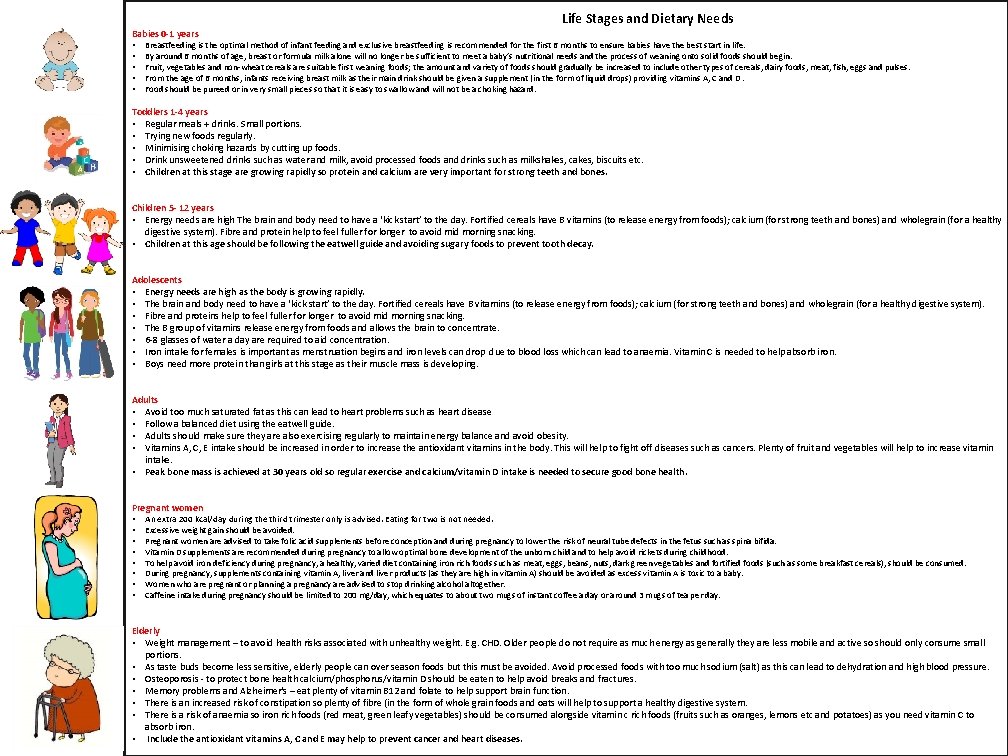
Life Stages and Dietary Needs Babies 0 -1 years • • • Breastfeeding is the optimal method of infant feeding and exclusive breastfeeding is recommended for the first 6 months to ensure babies have the best start in life. By around 6 months of age, breast or formula milk alone will no longer be sufficient to meet a baby’s nutritional needs and the process of weaning onto solid foods should begin. Fruit, vegetables and non-wheat cereals are suitable first weaning foods; the amount and variety of foods should gradually be increased to include other types of cereals, dairy foods, meat, fish, eggs and pulses. From the age of 6 months, infants receiving breast milk as their main drink should be given a supplement (in the form of liquid drops) providing vitamins A, C and D. Food should be pureed or in very small pieces so that it is easy to swallow and will not be a choking hazard. Toddlers 1 -4 years • Regular meals + drinks. Small portions. • Trying new foods regularly. • Minimising choking hazards by cutting up foods. • Drink unsweetened drinks such as water and milk, avoid processed foods and drinks such as milkshakes, cakes, biscuits etc. • Children at this stage are growing rapidly so protein and calcium are very important for strong teeth and bones. Children 5 - 12 years • Energy needs are high The brain and body need to have a ‘kick start’ to the day. Fortified cereals have B vitamins (to release energy from foods); calcium (for strong teeth and bones) and wholegrain (for a healthy digestive system). Fibre and protein help to feel fuller for longer to avoid morning snacking. • Children at this age should be following the eatwell guide and avoiding sugary foods to prevent tooth decay. Adolescents • Energy needs are high as the body is growing rapidly. • The brain and body need to have a ‘kick start’ to the day. Fortified cereals have B vitamins (to release energy from foods); calcium (for strong teeth and bones) and wholegrain (for a healthy digestive system). • Fibre and proteins help to feel fuller for longer to avoid morning snacking. • The B group of vitamins release energy from foods and allows the brain to concentrate. • 6 -8 glasses of water a day are required to aid concentration. • Iron intake for females is important as menstruation begins and iron levels can drop due to blood loss which can lead to anaemia. Vitamin C is needed to help absorb iron. • Boys need more protein than girls at this stage as their muscle mass is developing. Adults • Avoid too much saturated fat as this can lead to heart problems such as heart disease • Follow a balanced diet using the eatwell guide. • Adults should make sure they are also exercising regularly to maintain energy balance and avoid obesity. • Vitamins A, C, E intake should be increased in order to increase the antioxidant vitamins in the body. This will help to fight off diseases such as cancers. Plenty of fruit and vegetables will help to increase vitamin intake. • Peak bone mass is achieved at 30 years old so regular exercise and calcium/vitamin D intake is needed to secure good bone health. Pregnant women • • An extra 200 kcal/day during the third trimester only is advised. Eating for two is not needed. Excessive weight gain should be avoided. Pregnant women are advised to take folic acid supplements before conception and during pregnancy to lower the risk of neural tube defects in the fetus such as spina bifida. Vitamin D supplements are recommended during pregnancy to allow optimal bone development of the unborn child and to help avoid rickets during childhood. To help avoid iron deficiency during pregnancy, a healthy, varied diet containing iron rich foods such as meat, eggs, beans, nuts, dark green vegetables and fortified foods (such as some breakfast cereals), should be consumed. During pregnancy, supplements containing vitamin A, liver and liver products (as they are high in vitamin A) should be avoided as excess vitamin A is toxic to a baby. Women who are pregnant or planning a pregnancy are advised to stop drinking alcohol altogether. Caffeine intake during pregnancy should be limited to 200 mg/day, which equates to about two mugs of instant coffee a day or around 3 mugs of tea per day. Elderly • Weight management – to avoid health risks associated with unhealthy weight. E. g. CHD. Older people do not require as much energy as generally they are less mobile and active so should only consume small portions. • As taste buds become less sensitive, elderly people can over season foods but this must be avoided. Avoid processed foods with too much sodium (salt) as this can lead to dehydration and high blood pressure. • Osteoporosis - to protect bone health calcium/phosphorus/vitamin D should be eaten to help avoid breaks and fractures. • Memory problems and Alzheimer's – eat plenty of vitamin B 12 and folate to help support brain function. • There is an increased risk of constipation so plenty of fibre (in the form of whole grain foods and oats will help to support a healthy digestive system. • There is a risk of anaemia so iron rich foods (red meat, green leafy vegetables) should be consumed alongside vitamin c rich foods (fruits such as oranges, lemons etc and potatoes) as you need vitamin C to absorb iron. • Include the antioxidant vitamins A, C and E may help to prevent cancer and heart diseases.