
GCSE English Literature Unit 1 Analysing the Unseen

- Slides: 8
GCSE English Literature Unit 1 Analysing the Unseen Prose extract (GEL 11) www. ccea. org. uk
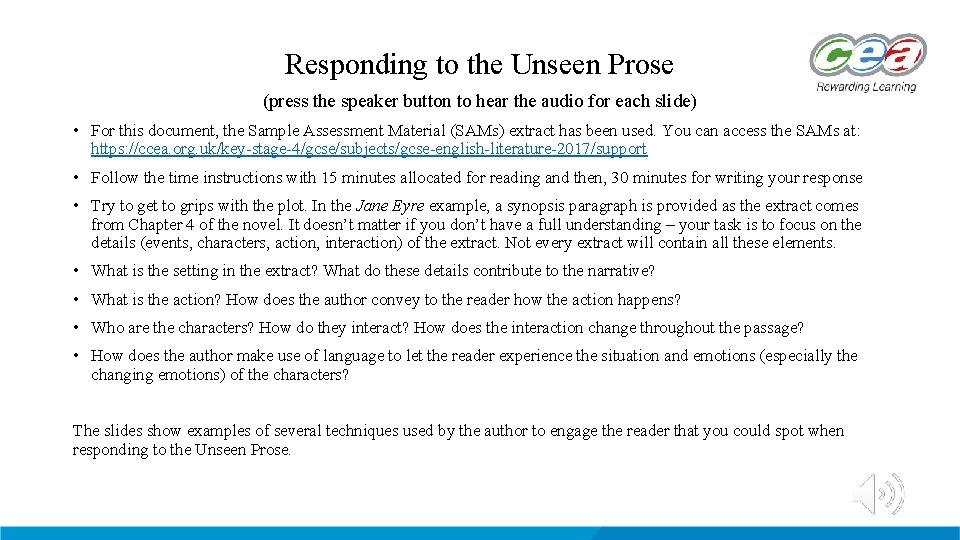
Responding to the Unseen Prose (press the speaker button to hear the audio for each slide) • For this document, the Sample Assessment Material (SAMs) extract has been used. You can access the SAMs at: https: //ccea. org. uk/key-stage-4/gcse/subjects/gcse-english-literature-2017/support • Follow the time instructions with 15 minutes allocated for reading and then, 30 minutes for writing your response • Try to get to grips with the plot. In the Jane Eyre example, a synopsis paragraph is provided as the extract comes from Chapter 4 of the novel. It doesn’t matter if you don’t have a full understanding – your task is to focus on the details (events, characters, action, interaction) of the extract. Not every extract will contain all these elements. • What is the setting in the extract? What do these details contribute to the narrative? • What is the action? How does the author convey to the reader how the action happens? • Who are the characters? How do they interact? How does the interaction change throughout the passage? • How does the author make use of language to let the reader experience the situation and emotions (especially the changing emotions) of the characters? The slides show examples of several techniques used by the author to engage the reader that you could spot when responding to the Unseen Prose.
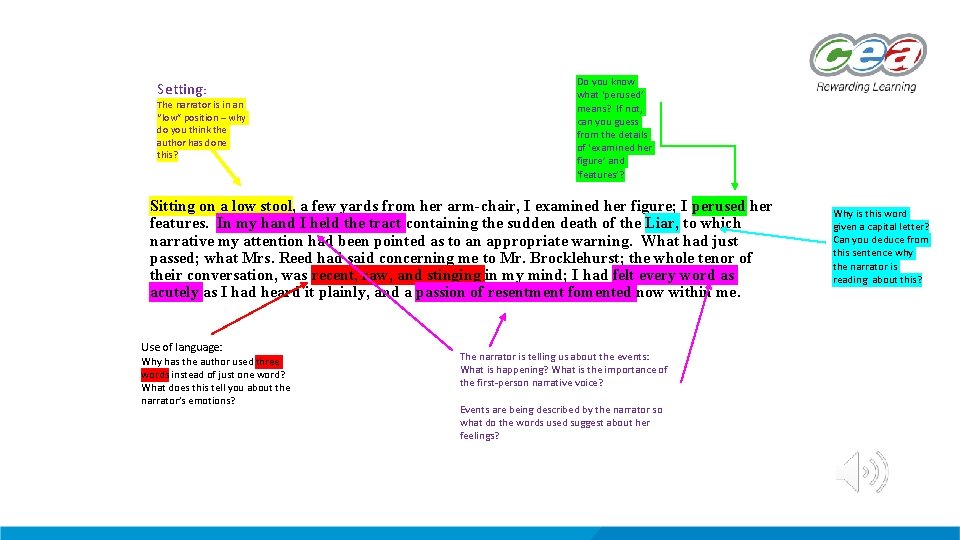
Setting: The narrator is in an “low” position – why do you think the author has done this? Do you know what ‘perused’ means? If not, can you guess from the details of ‘examined her figure’ and ‘features’? Sitting on a low stool, a few yards from her arm-chair, I examined her figure; I perused her features. In my hand I held the tract containing the sudden death of the Liar, to which narrative my attention had been pointed as to an appropriate warning. What had just passed; what Mrs. Reed had said concerning me to Mr. Brocklehurst; the whole tenor of their conversation, was recent, raw, and stinging in my mind; I had felt every word as acutely as I had heard it plainly, and a passion of resentment fomented now within me. Use of language: Why has the author used three words instead of just one word? What does this tell you about the narrator’s emotions? The narrator is telling us about the events: What is happening? What is the importance of the first-person narrative voice? Events are being described by the narrator so what do the words used suggest about her feelings? Why is this word given a capital letter? Can you deduce from this sentence why the narrator is reading about this?
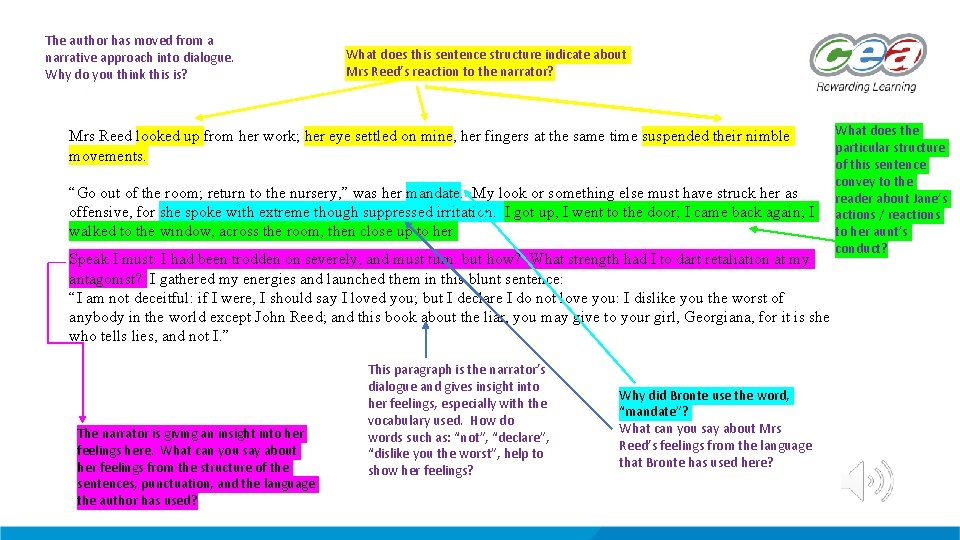
The author has moved from a narrative approach into dialogue. Why do you think this is? What does this sentence structure indicate about Mrs Reed’s reaction to the narrator? Mrs Reed looked up from her work; her eye settled on mine, her fingers at the same time suspended their nimble movements. “Go out of the room; return to the nursery, ” was her mandate. My look or something else must have struck her as offensive, for she spoke with extreme though suppressed irritation. I got up, I went to the door; I came back again; I walked to the window, across the room, then close up to her. Speak I must: I had been trodden on severely, and must turn: but how? What strength had I to dart retaliation at my antagonist? I gathered my energies and launched them in this blunt sentence: “I am not deceitful: if I were, I should say I loved you; but I declare I do not love you: I dislike you the worst of anybody in the world except John Reed; and this book about the liar, you may give to your girl, Georgiana, for it is she who tells lies, and not I. ” The narrator is giving an insight into her feelings here. What can you say about her feelings from the structure of the sentences, punctuation, and the language the author has used? This paragraph is the narrator’s dialogue and gives insight into her feelings, especially with the vocabulary used. How do words such as: “not”, “declare”, “dislike you the worst”, help to show her feelings? Why did Bronte use the word, “mandate”? What can you say about Mrs Reed’s feelings from the language that Bronte has used here? What does the particular structure of this sentence convey to the reader about Jane’s actions / reactions to her aunt’s conduct?
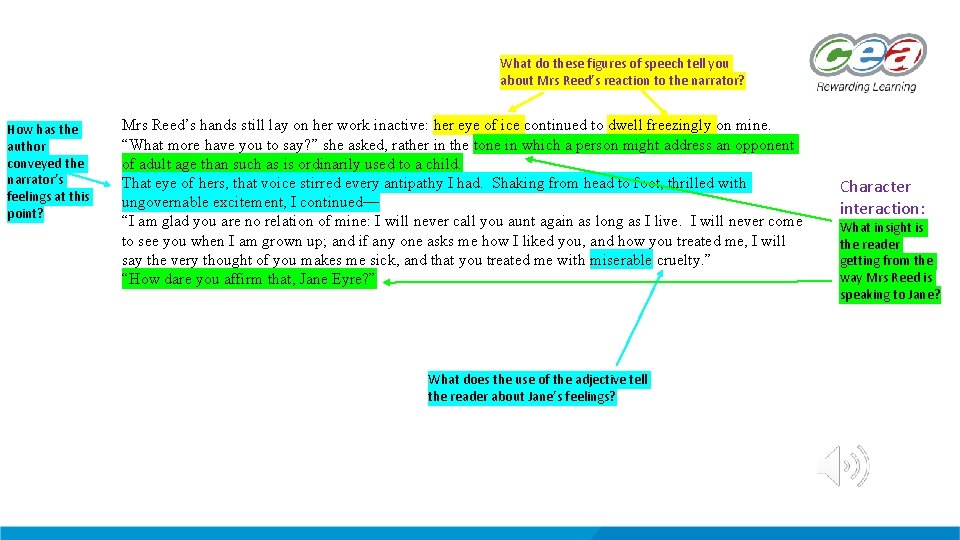
What do these figures of speech tell you about Mrs Reed’s reaction to the narrator? How has the author conveyed the narrator’s feelings at this point? Mrs Reed’s hands still lay on her work inactive: her eye of ice continued to dwell freezingly on mine. “What more have you to say? ” she asked, rather in the tone in which a person might address an opponent of adult age than such as is ordinarily used to a child. That eye of hers, that voice stirred every antipathy I had. Shaking from head to foot, thrilled with ungovernable excitement, I continued— “I am glad you are no relation of mine: I will never call you aunt again as long as I live. I will never come to see you when I am grown up; and if any one asks me how I liked you, and how you treated me, I will say the very thought of you makes me sick, and that you treated me with miserable cruelty. ” “How dare you affirm that, Jane Eyre? ” What does the use of the adjective tell the reader about Jane’s feelings? Character interaction: What insight is the reader getting from the way Mrs Reed is speaking to Jane?
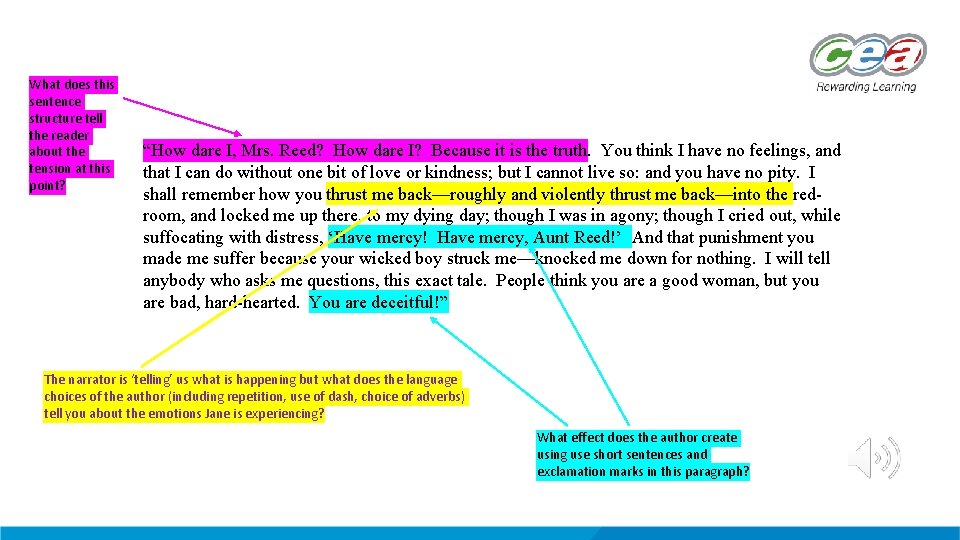
What does this sentence structure tell the reader about the tension at this point? “How dare I, Mrs. Reed? How dare I? Because it is the truth. You think I have no feelings, and that I can do without one bit of love or kindness; but I cannot live so: and you have no pity. I shall remember how you thrust me back—roughly and violently thrust me back—into the redroom, and locked me up there, to my dying day; though I was in agony; though I cried out, while suffocating with distress, ‘Have mercy! Have mercy, Aunt Reed!’ And that punishment you made me suffer because your wicked boy struck me—knocked me down for nothing. I will tell anybody who asks me questions, this exact tale. People think you are a good woman, but you are bad, hard-hearted. You are deceitful!” The narrator is ‘telling’ us what is happening but what does the language choices of the author (including repetition, use of dash, choice of adverbs) tell you about the emotions Jane is experiencing? What effect does the author create using use short sentences and exclamation marks in this paragraph?
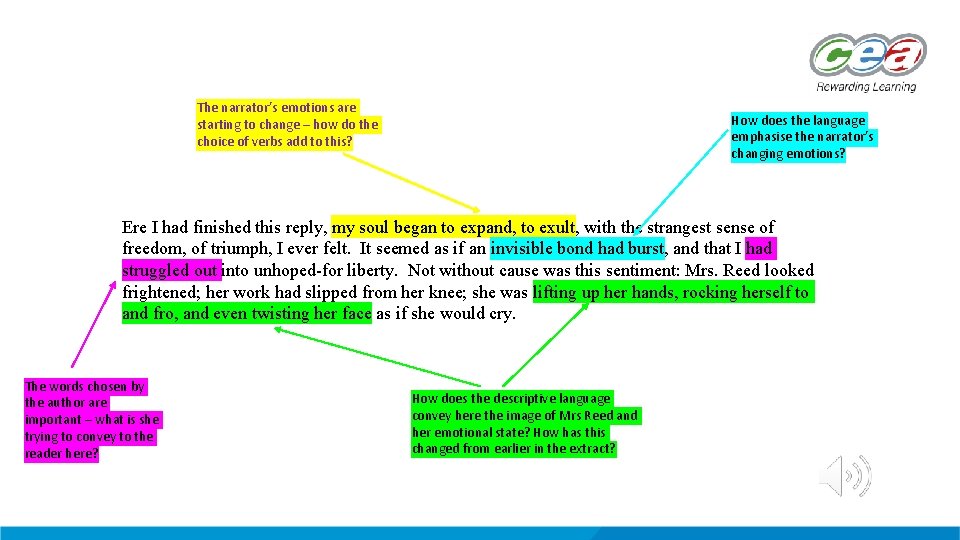
The narrator’s emotions are starting to change – how do the choice of verbs add to this? How does the language emphasise the narrator’s changing emotions? Ere I had finished this reply, my soul began to expand, to exult, with the strangest sense of freedom, of triumph, I ever felt. It seemed as if an invisible bond had burst, and that I had struggled out into unhoped-for liberty. Not without cause was this sentiment: Mrs. Reed looked frightened; her work had slipped from her knee; she was lifting up her hands, rocking herself to and fro, and even twisting her face as if she would cry. The words chosen by the author are important – what is she trying to convey to the reader here? How does the descriptive language convey here the image of Mrs Reed and her emotional state? How has this changed from earlier in the extract?