
GCSE ENGLISH LANGUAGE PAPER ONE REVISION REVISION LESSON

- Slides: 18
GCSE ENGLISH LANGUAGE – PAPER ONE REVISION
REVISION - LESSON THREE
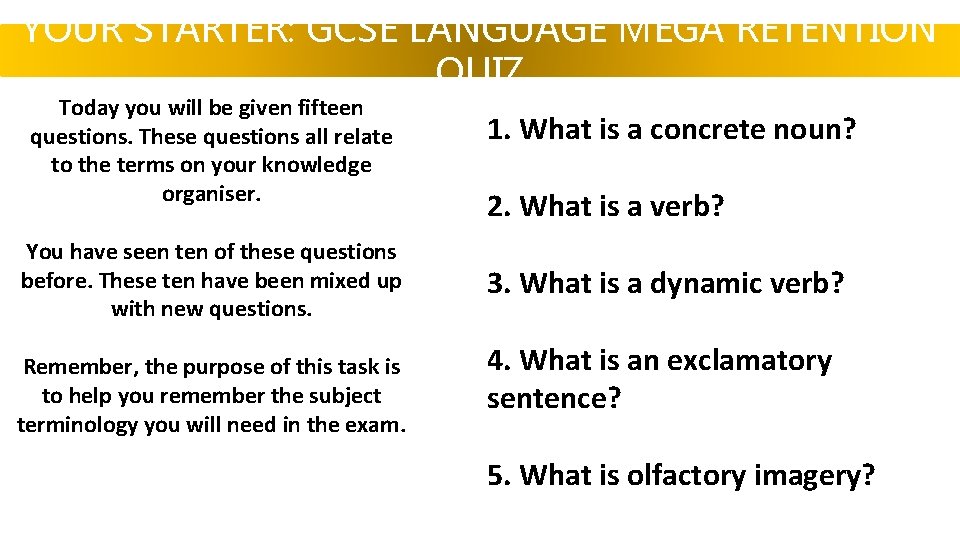
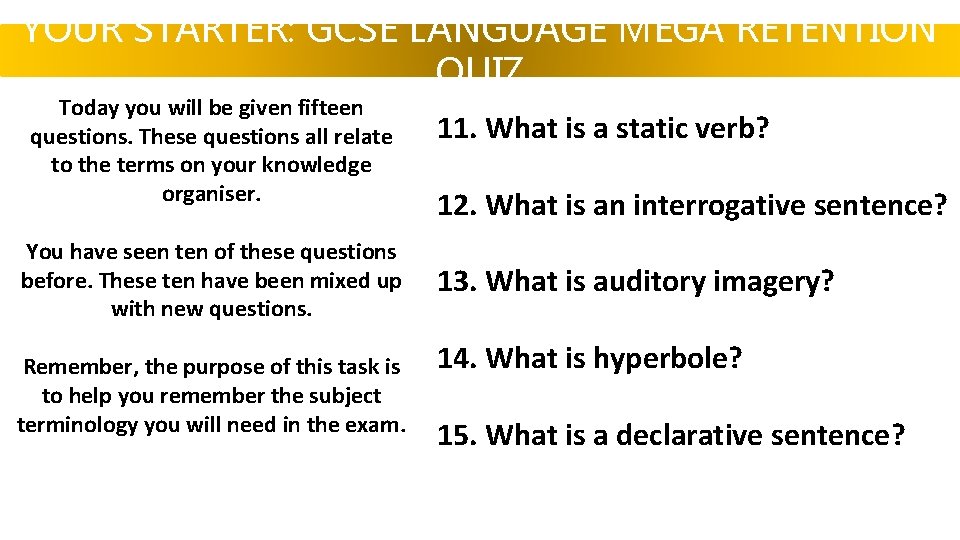
YOUR STARTER: GCSE LANGUAGE MEGA RETENTION QUIZ Today you will be given fifteen questions. These questions all relate to the terms on your knowledge organiser. You have seen ten of these questions before. These ten have been mixed up with new questions. Remember, the purpose of this task is to help you remember the subject terminology you will need in the exam. 1. What is a concrete noun? 2. What is a verb? 3. What is a dynamic verb? 4. What is an exclamatory sentence? 5. What is olfactory imagery?
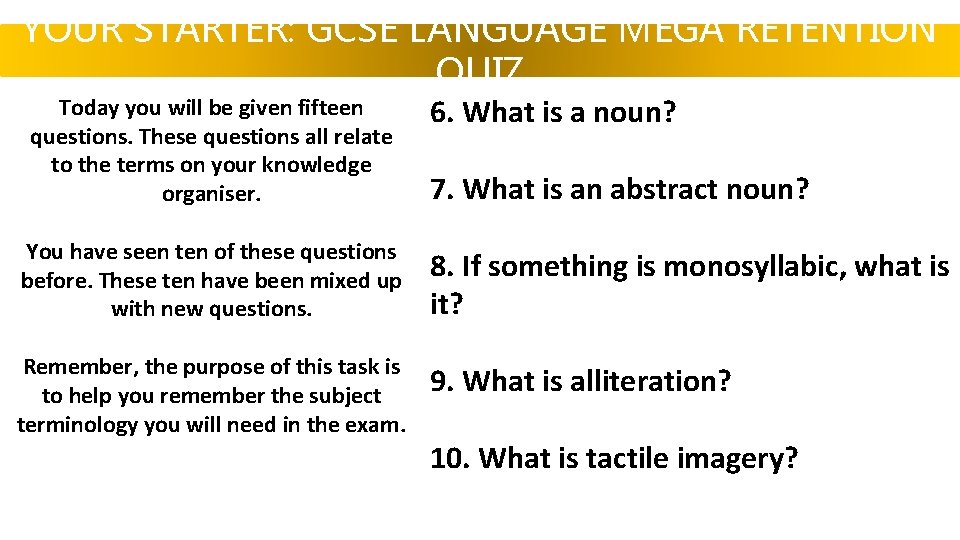
YOUR STARTER: GCSE LANGUAGE MEGA RETENTION QUIZ Today you will be given fifteen questions. These questions all relate to the terms on your knowledge organiser. 6. What is a noun? 7. What is an abstract noun? You have seen ten of these questions before. These ten have been mixed up with new questions. 8. If something is monosyllabic, what is it? Remember, the purpose of this task is to help you remember the subject terminology you will need in the exam. 9. What is alliteration? 10. What is tactile imagery?
YOUR STARTER: GCSE LANGUAGE MEGA RETENTION QUIZ Today you will be given fifteen questions. These questions all relate to the terms on your knowledge organiser. You have seen ten of these questions before. These ten have been mixed up with new questions. Remember, the purpose of this task is to help you remember the subject terminology you will need in the exam. 11. What is a static verb? 12. What is an interrogative sentence? 13. What is auditory imagery? 14. What is hyperbole? 15. What is a declarative sentence?
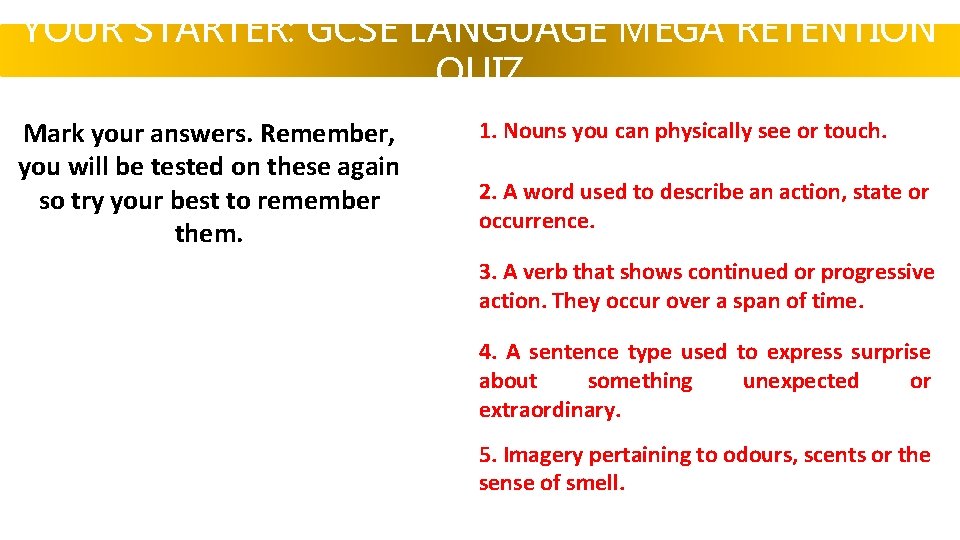
YOUR STARTER: GCSE LANGUAGE MEGA RETENTION QUIZ Mark your answers. Remember, you will be tested on these again so try your best to remember them. 1. 1. Nouns youiscan physically see or touch. What a concrete noun? 2. A word used to describe an action, state or 2. What is a verb? occurrence. 3. A verb that shows continued or progressive 3. What is a dynamic verb? action. They occur over a span of time. 4. 4. AWhat sentence typeexclamatory used to express surprise is an about something unexpected or sentence? extraordinary. 5. Imagery pertaining to odours, scents or the 5. What is olfactory imagery? sense of smell.
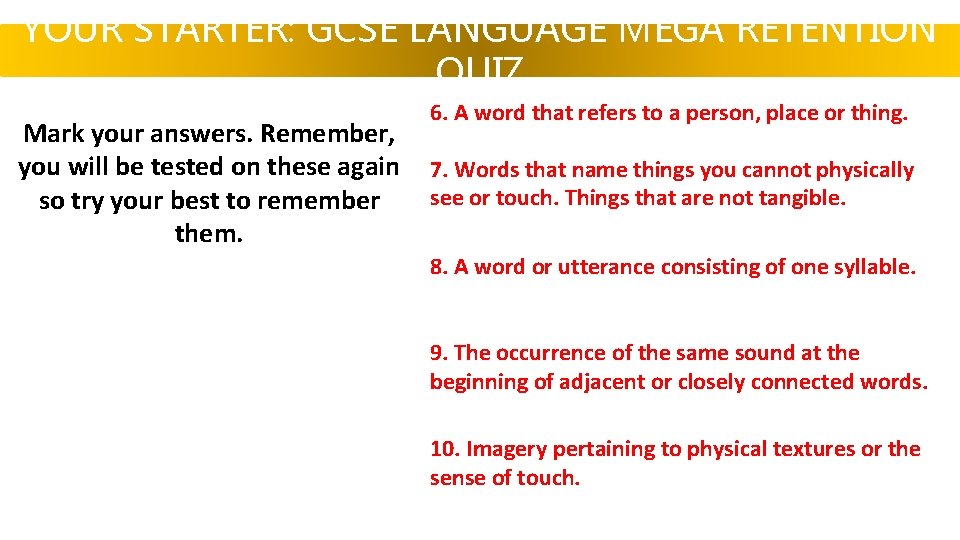
YOUR STARTER: GCSE LANGUAGE MEGA RETENTION QUIZ Mark your answers. Remember, you will be tested on these again so try your best to remember them. 6. word that to a person, place or thing. 6. AWhat is arefers noun? 7. Words that name things you cannot physically 7. is Things an abstract noun? see. What or touch. that are not tangible. 8. or utterance of one syllable. 8. AIfword something is consisting monosyllabic, what it? 9. The occurrence of the same sound at the beginning or closely connected words. 9. Whatofisadjacent alliteration? 10. physical textures or the 10. Imagery What pertaining is tactiletoimagery? sense of touch. is
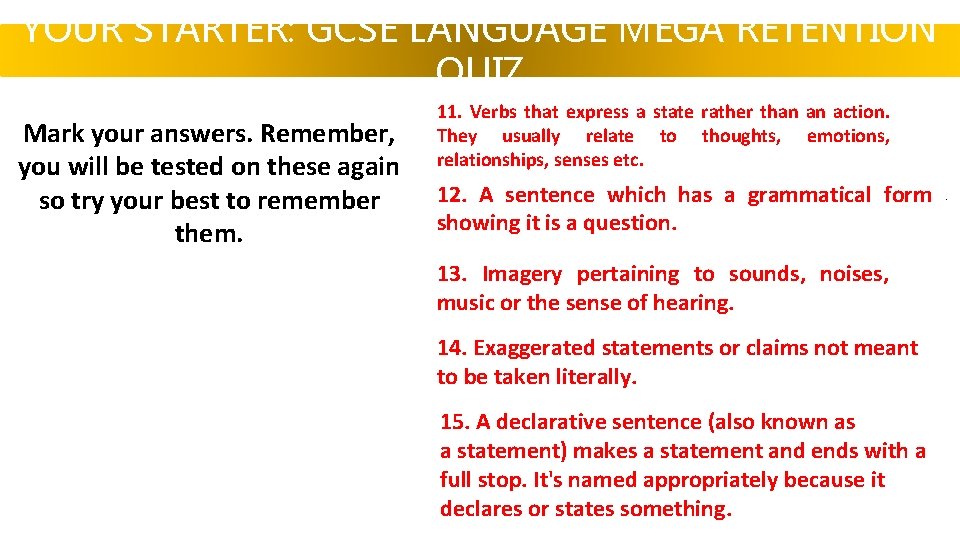
YOUR STARTER: GCSE LANGUAGE MEGA RETENTION QUIZ Mark your answers. Remember, you will be tested on these again so try your best to remember them. 11. Verbs that express a state rather than an action. They usually relate to thoughts, emotions, relationships, senses etc. 11. What is a static verb? 12. A sentence which has a grammatical form 12. What is an interrogative sentence? showing it is a question. 13. sounds, noises, 13. Imagery What ispertaining auditorytoimagery? music or the sense of hearing. 14. Exaggerated statements or claims not meant 14. What is hyperbole? to be taken literally. 15. A declarative sentence (also known as 15. What is a declarative sentence? a statement) makes a statement and ends with a full stop. It's named appropriately because it declares or states something.
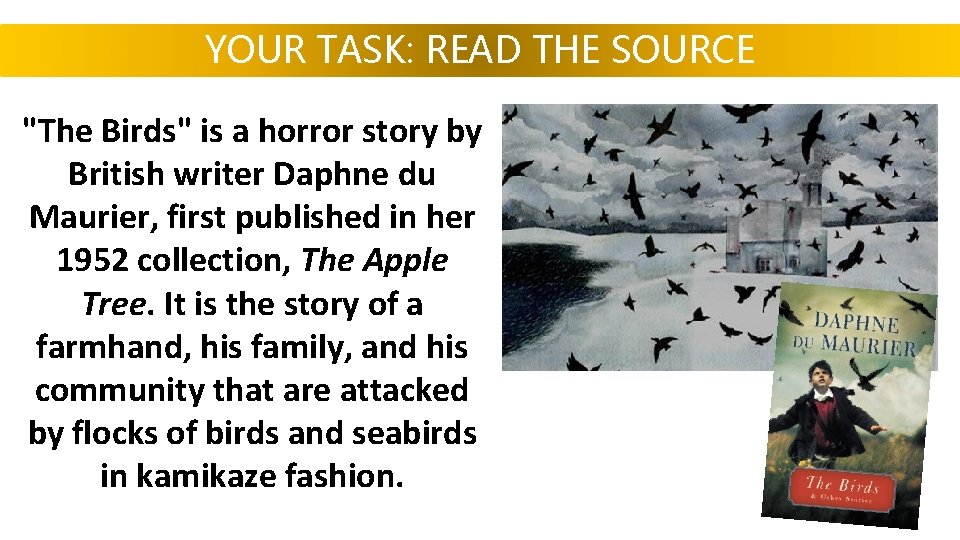
YOUR TASK: READ THE SOURCE "The Birds" is a horror story by British writer Daphne du Maurier, first published in her 1952 collection, The Apple Tree. It is the story of a farmhand, his family, and his community that are attacked by flocks of birds and seabirds in kamikaze fashion.
ORACY TASK: READING FOR MEANING CLASS DISCUSSION: 1. Read the extract from ‘The Birds’ together as a class. PAIRED DISCUSSION: 1. What do you think is happening in the extract? Which parts can you understand? 2. Is there any vocabulary you are unsure of? TABLE DISCUSSION: 1. Discuss on the table what you think is happening in the extract. 2. Is there anything you are still unsure of? Discuss anything you find confusing as a table/ 3. Thinking ahead to the requirements of each question, is there anything you have noticed in the extract that you could use in an answer? CLASS DISCUSSION: 1. What is happening in this extract? 2. Is there anything we still don’t understand? 3. Thinking ahead to the requirements of each question, is there anything you have noticed in the extract that you could use in an answer?
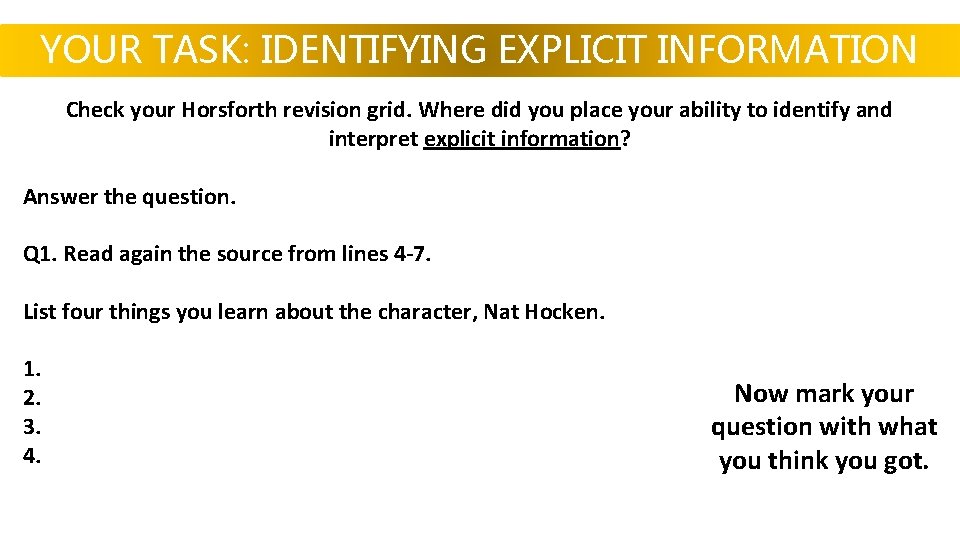
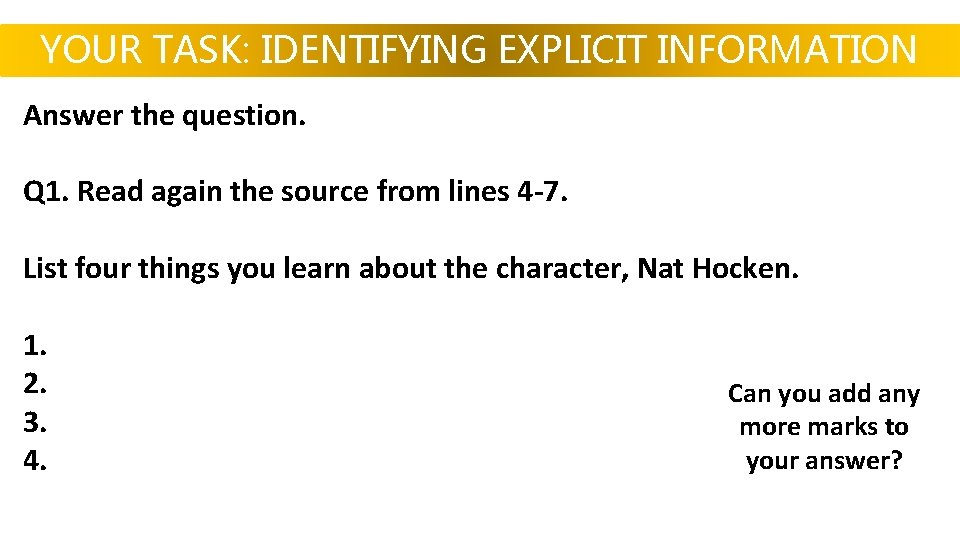
YOUR TASK: IDENTIFYING EXPLICIT INFORMATION Check your Horsforth revision grid. Where did you place your ability to identify and interpret explicit information? Answer the question. Q 1. Read again the source from lines 4 -7. List four things you learn about the character, Nat Hocken. 1. 2. 3. 4. Now mark your question with what you think you got.
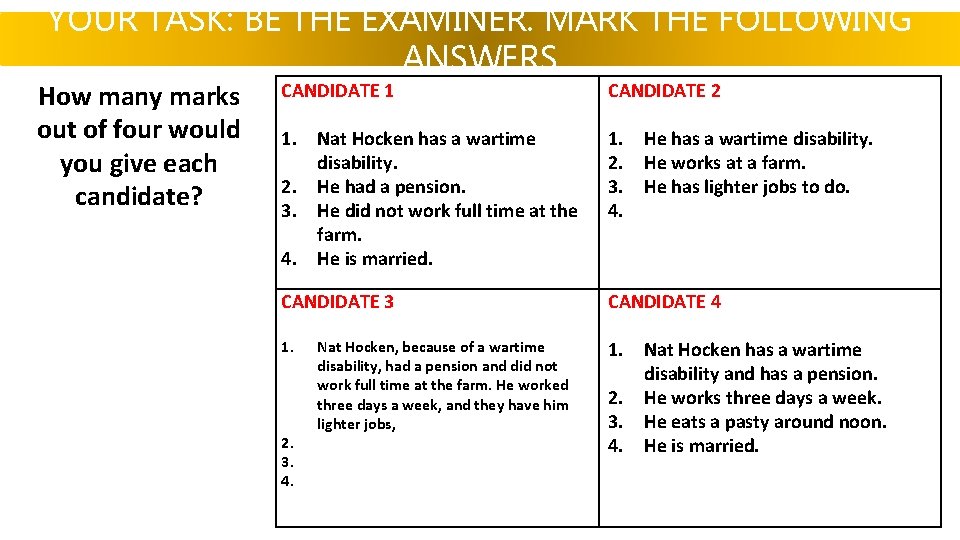
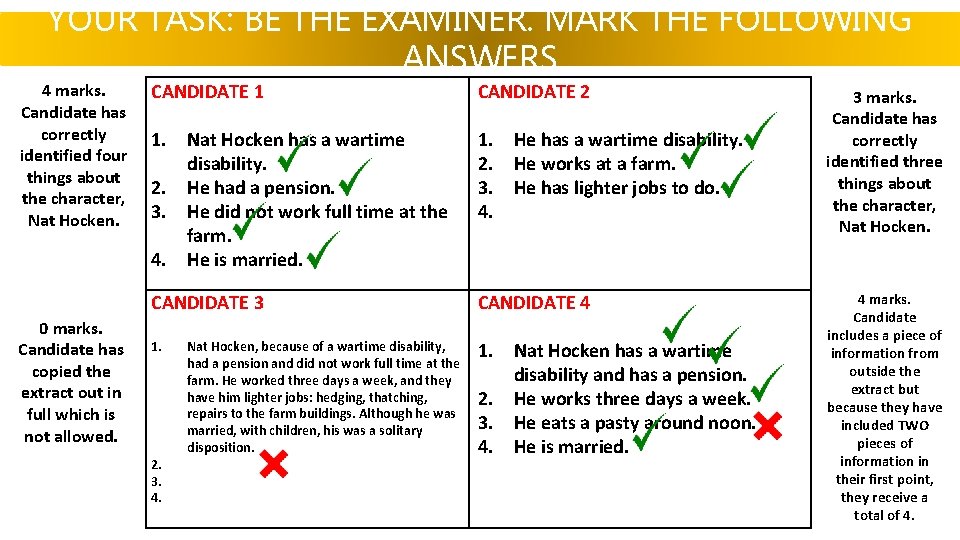
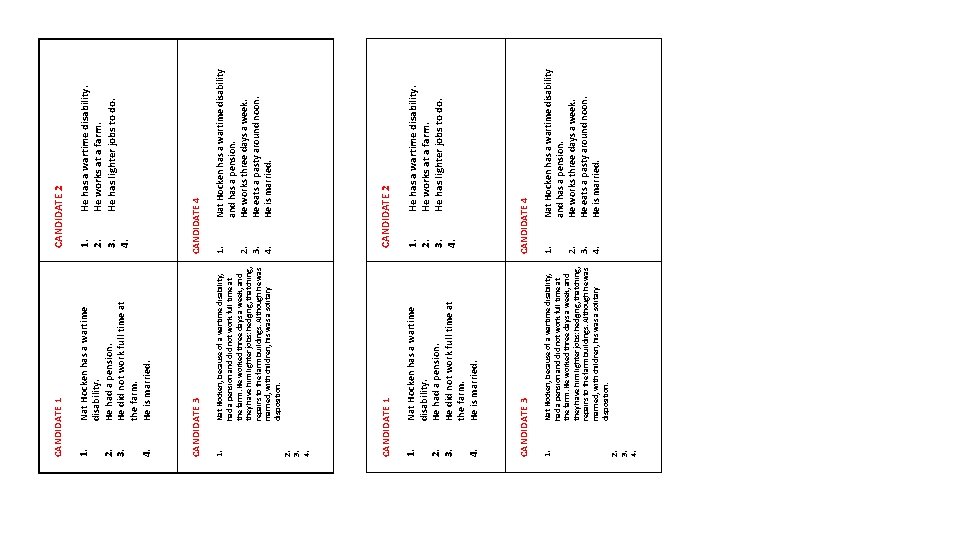
YOUR TASK: BE THE EXAMINER. MARK THE FOLLOWING ANSWERS How many marks out of four would you give each candidate? CANDIDATE 1 CANDIDATE 2 1. Nat Hocken has a wartime disability. 2. He had a pension. 3. He did not work full time at the farm. 4. He is married. 1. He has a wartime disability. 2. He works at a farm. 3. He has lighter jobs to do. 4. CANDIDATE 3 CANDIDATE 4 1. Nat Hocken has a wartime disability and has a pension. 2. He works three days a week. 3. He eats a pasty around noon. 4. He is married. 2. 3. 4. Nat Hocken, because of a wartime disability, had a pension and did not work full time at the farm. He worked three days a week, and they have him lighter jobs,
YOUR TASK: BE THE EXAMINER. MARK THE FOLLOWING ANSWERS 4 marks. Candidate has correctly identified four things about the character, Nat Hocken. 0 marks. Candidate has copied the extract out in full which is not allowed. CANDIDATE 1 CANDIDATE 2 1. Nat Hocken has a wartime disability. 2. He had a pension. 3. He did not work full time at the farm. 4. He is married. 1. He has a wartime disability. 2. He works at a farm. 3. He has lighter jobs to do. 4. CANDIDATE 3 CANDIDATE 4 1. Nat Hocken has a wartime disability and has a pension. 2. He works three days a week. 3. He eats a pasty around noon. 4. He is married. 2. 3. 4. Nat Hocken, because of a wartime disability, had a pension and did not work full time at the farm. He worked three days a week, and they have him lighter jobs: hedging, thatching, repairs to the farm buildings. Although he was married, with children, his was a solitary disposition. 3 marks. Candidate has correctly identified three things about the character, Nat Hocken. 4 marks. Candidate includes a piece of information from outside the extract but because they have included TWO pieces of information in their first point, they receive a total of 4.
YOUR TASK: IDENTIFYING EXPLICIT INFORMATION Answer the question. Q 1. Read again the source from lines 4 -7. List four things you learn about the character, Nat Hocken. 1. 2. 3. 4. Can you add any more marks to your answer?
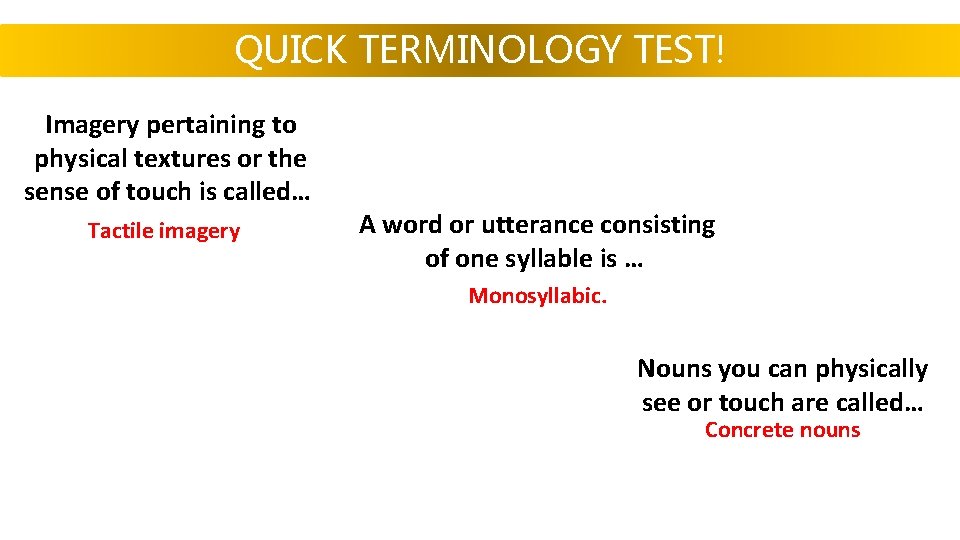
QUICK TERMINOLOGY TEST! Imagery pertaining to physical textures or the sense of touch is called… Tactile imagery A word or utterance consisting of one syllable is … Monosyllabic. Nouns you can physically see or touch are called… Concrete nouns
RESOURCES
2. 3. 4. Nat Hocken has a wartime disability and has a pension. He works three days a week. He eats a pasty around noon. He is married. 1. 1. Nat Hocken, because of a wartime disability, had a pension and did not work full time at the farm. He worked three days a week, and they have him lighter jobs: hedging, thatching, repairs to the farm buildings. Although he was married, with children, his was a solitary disposition. CANDIDATE 4 CANDIDATE 3 4. 2. 3. He has a wartime disability. He works at a farm. He has lighter jobs to do. 1. 2. 3. 4. 1. Nat Hocken has a wartime disability. He had a pension. He did not work full time at the farm. He is married. CANDIDATE 2 CANDIDATE 1 2. 3. 4. Nat Hocken has a wartime disability and has a pension. He works three days a week. He eats a pasty around noon. He is married. 1. Nat Hocken, because of a wartime disability, had a pension and did not work full time at the farm. He worked three days a week, and they have him lighter jobs: hedging, thatching, repairs to the farm buildings. Although he was married, with children, his was a solitary disposition. CANDIDATE 4 CANDIDATE 3 4. 2. 3. He has a wartime disability. He works at a farm. He has lighter jobs to do. 1. 2. 3. 4. 1. Nat Hocken has a wartime disability. He had a pension. He did not work full time at the farm. He is married. CANDIDATE 2 CANDIDATE 1