
GCSE English Language Paper 1 19 th Century
- Slides: 9
GCSE English Language Paper 1 – 19 th Century Fiction and Imaginative Writing
In this exam, you have to complete two sections: Section A: Reading. You will need to read a 19 th century fiction text and answer four questions in which you will have to find quotations, make inferences, analyse the language and structure and evaluate the text. Section B: Writing. You will need to choose one of two questions and construct an imaginative piece of writing.
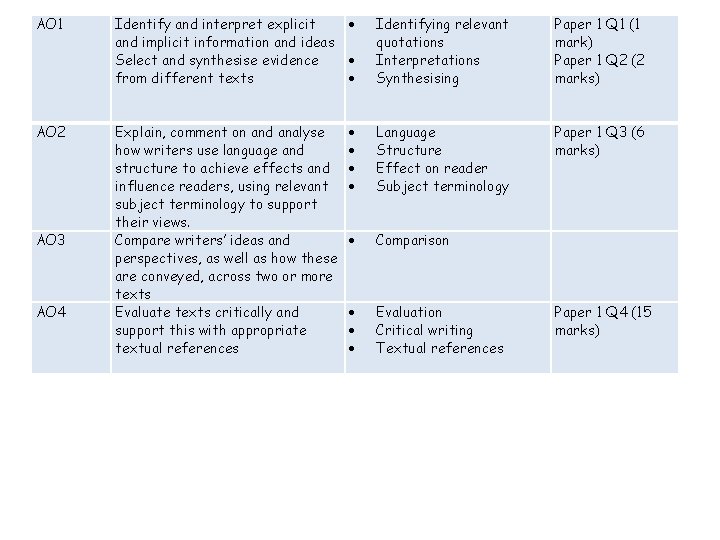
AO 1 AO 2 AO 3 AO 4 Identify and interpret explicit and implicit information and ideas Select and synthesise evidence from different texts Explain, comment on and analyse how writers use language and structure to achieve effects and influence readers, using relevant subject terminology to support their views. Compare writers’ ideas and perspectives, as well as how these are conveyed, across two or more texts Evaluate texts critically and support this with appropriate textual references Identifying relevant quotations Interpretations Synthesising Language Structure Effect on reader Subject terminology Comparison Evaluation Critical writing Textual references Paper 1 Q 1 (1 mark) Paper 1 Q 2 (2 marks) Paper 1 Q 3 (6 marks) Paper 1 Q 4 (15 marks)
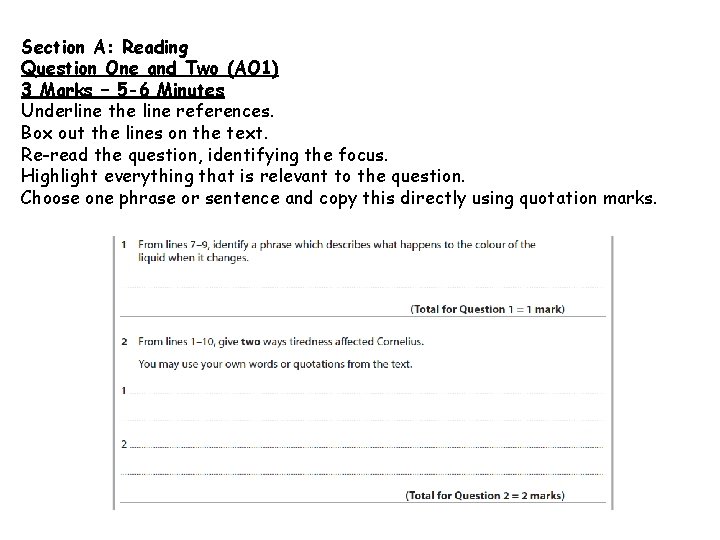
Section A: Reading Question One and Two (AO 1) 3 Marks – 5 -6 Minutes Underline the line references. Box out the lines on the text. Re-read the question, identifying the focus. Highlight everything that is relevant to the question. Choose one phrase or sentence and copy this directly using quotation marks.
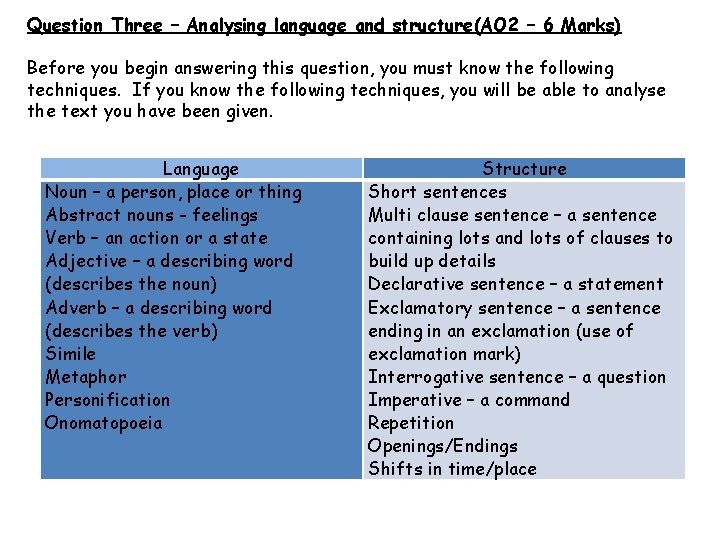
Question Three – Analysing language and structure(AO 2 – 6 Marks) Before you begin answering this question, you must know the following techniques. If you know the following techniques, you will be able to analyse the text you have been given. Language Noun – a person, place or thing Abstract nouns - feelings Verb – an action or a state Adjective – a describing word (describes the noun) Adverb – a describing word (describes the verb) Simile Metaphor Personification Onomatopoeia Structure Short sentences Multi clause sentence – a sentence containing lots and lots of clauses to build up details Declarative sentence – a statement Exclamatory sentence – a sentence ending in an exclamation (use of exclamation mark) Interrogative sentence – a question Imperative – a command Repetition Openings/Endings Shifts in time/place
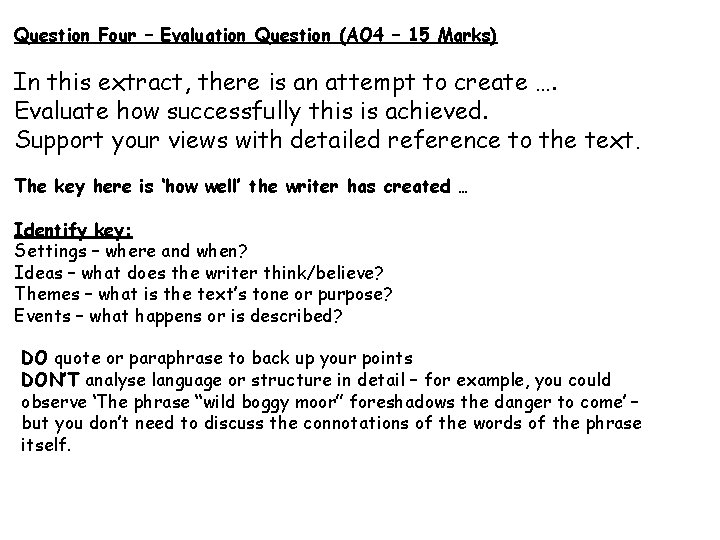
Question Four – Evaluation Question (AO 4 – 15 Marks) In this extract, there is an attempt to create …. Evaluate how successfully this is achieved. Support your views with detailed reference to the text. The key here is ‘how well’ the writer has created … Identify key: Settings – where and when? Ideas – what does the writer think/believe? Themes – what is the text’s tone or purpose? Events – what happens or is described? DO quote or paraphrase to back up your points DON’T analyse language or structure in detail – for example, you could observe ‘The phrase “wild boggy moor” foreshadows the danger to come’ – but you don’t need to discuss the connotations of the words of the phrase itself.
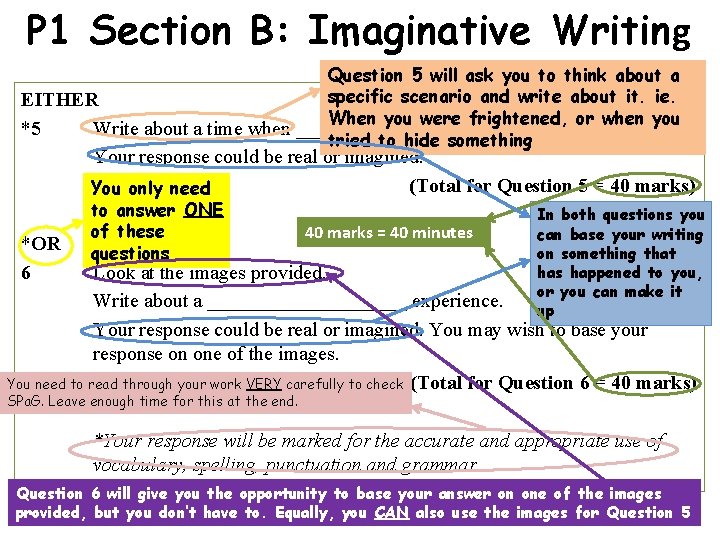
P 1 Section B: Imaginative Writing Question 5 will ask you to think about a specific scenario and write about it. ie. EITHER When you were frightened, or when you *5 Write about a time when ___________________ tried to hide something Your response could be real or imagined. (Total for Question 5 = 40 marks) You only need *OR 6 to answer ONE of these questions 40 marks = 40 minutes In both questions you can base your writing on something that has happened to you, or you can make it up Look at the images provided. Write about a __________ experience. Your response could be real or imagined. You may wish to base your response on one of the images. You need to read through your work VERY carefully to check (Total for Question 6 = 40 marks) SPa. G. Leave enough time for this at the end. *Your response will be marked for the accurate and appropriate use of vocabulary, spelling, punctuation and grammar. Question 6 will give you the opportunity to base your answer on one of the images provided, but you don’t have to. Equally, you CAN also use the images for Question 5
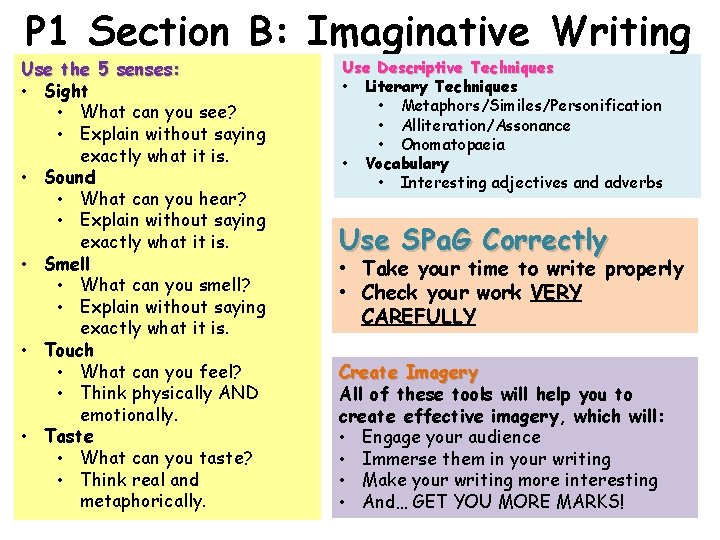
P 1 Section B: Imaginative Writing Use the 5 senses: • Sight • What can you see? • Explain without saying exactly what it is. • Sound • What can you hear? • Explain without saying exactly what it is. • Smell • What can you smell? • Explain without saying exactly what it is. • Touch • What can you feel? • Think physically AND emotionally. • Taste • What can you taste? • Think real and metaphorically. Use Descriptive Techniques • Literary Techniques • Metaphors/Similes/Personification • Alliteration/Assonance • Onomatopaeia • Vocabulary • Interesting adjectives and adverbs Use SPa. G Correctly • Take your time to write properly • Check your work VERY CAREFULLY Create Imagery All of these tools will help you to create effective imagery, which will: • Engage your audience • Immerse them in your writing • Make your writing more interesting • And… GET YOU MORE MARKS!
YOU CAN DO THIS!! Good Luck Year 11 üMs Reilly üMr Pillar üMiss Vaudry üMrs Bissett