
GCSE English Language For first teaching in 2015
- Slides: 44
GCSE English Language For first teaching in 2015 and for first assessment in 2017 Curriculum Adviser: Simon Miles smiles@aqa. org. uk / 07795 020693 Slide 1 Copyright © AQA and its licensors. All rights reserved. Follow us on Twitter @AQACPD.
Structure of the presentation Overview of the new specification • • • Underlying principles and key features Specification at a glance Summary of content and assessment objectives Paper 1 • Content and question types Paper 2 • Content and question types Support and resources Slide 2 Copyright © AQA and its licensors. All rights reserved. Follow us on Twitter @AQACPD.
Objectives • To understand the key elements of the specification structure, teaching content and assessment. • To start thinking about the implications for teaching and learning. • To review the resources and support available from AQA. • To enable any questions to be aired about the specification – and set out ways that these can be answered by the English subject and curriculum adviser team. Slide 3 Copyright © AQA and its licensors. All rights reserved. Follow us on Twitter @AQACPD.
Context • Developed by an experienced team of teachers and examiners. • Reviewed by a subject panel of stakeholders and subject experts. • Piloted in a range of schools to ensure effective, robust and engaging question strategies. • Fulfils all new National Curriculum requirements and complements all other qualifications in this suite: for example, GCSE English Literature. • The new specification is for teaching from September 2015 with first assessment in summer 2017. Slide 4 Copyright © AQA and its licensors. All rights reserved.
Underlying principles • An accessible and enabling qualification for all abilities of learner. • An assessment journey that supports students through each paper to make it a positive and engaging experience for all. • Two clear and distinct identities: Explorations in Creative Reading and Writing, and Writers’ Viewpoints and Perspectives. • NFER: “The AQA specification for English Language is innovative, combining reading and writing in each of the two papers. This is effective as the reading texts serve a double purpose: as the basis for comprehension questions and as supporting text for the writing tasks”. Slide 5 Copyright © AQA and its licensors. All rights reserved.
Overview of specification content • Paper 1: Explorations in creative reading and writing. • Paper 2: Writers’ viewpoints and perspectives. • Spoken Language as a separate endorsement. Slide 6 Copyright © AQA and its licensors. All rights reserved.
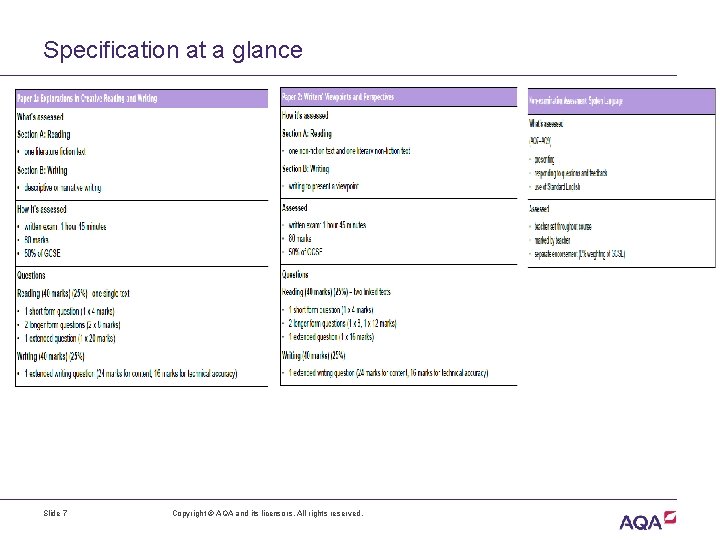
Specification at a glance Slide 7 Copyright © AQA and its licensors. All rights reserved.
Assessment Objective 1 Assessment Objective • Identify and interpret explicit and implicit information and ideas. • Select and synthesise evidence from different texts. Slide 8 Copyright © AQA and its licensors. All rights reserved.
Assessment Objective 2 Assessment Objective • Explain, comment on and analyse how writers use language and structure to achieve effects and influence readers, using relevant subject terminology to support their views. Slide 9 Copyright © AQA and its licensors. All rights reserved.
Assessment Objective 3 Assessment Objective • Compare writers’ ideas and perspectives, as well as how these are conveyed, across two or more texts. Slide 10 Copyright © AQA and its licensors. All rights reserved.
Assessment Objective 4 Assessment Objective • Evaluate texts critically and support this with appropriate textual references. Slide 11 Copyright © AQA and its licensors. All rights reserved.
Assessment Objective 5 and 6 Assessment Objectives AO 5 • Communicate clearly, effectively and imaginatively, selecting and adapting tone, style and register for different forms, purposes and audiences. • Organise information and ideas, using structural and grammatical features to support coherence and cohesion of texts. AO 6 • Use a range of vocabulary and sentence structures for clarity, purpose and effect, with accurate spelling and punctuation. Slide 12 Copyright © AQA and its licensors. All rights reserved.
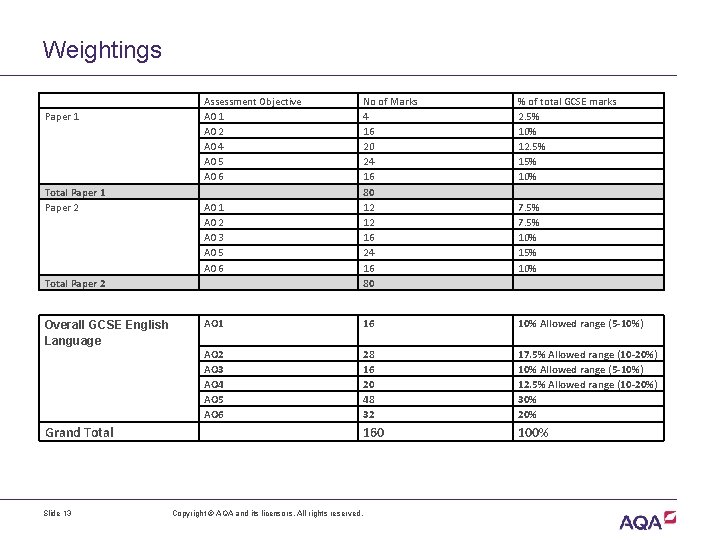
Weightings Assessment Objective AO 1 AO 2 AO 4 AO 5 AO 6 AO 1 AO 2 AO 3 AO 5 AO 6 No of Marks 4 16 20 24 16 80 12 12 16 24 16 80 % of total GCSE marks 2. 5% 10% 12. 5% 10% 7. 5% 10% 15% 10% Overall GCSE English Language AO 1 16 AO 2 AO 3 AO 4 AO 5 AO 6 28 16 20 48 32 10% Allowed range (5 -10%) 17. 5% Allowed range (10 -20%) 10% Allowed range (5 -10%) 12. 5% Allowed range (10 -20%) 30% 20% Grand Total 160 100% Paper 1 Total Paper 1 Paper 2 Total Paper 2 Slide 13 Copyright © AQA and its licensors. All rights reserved.
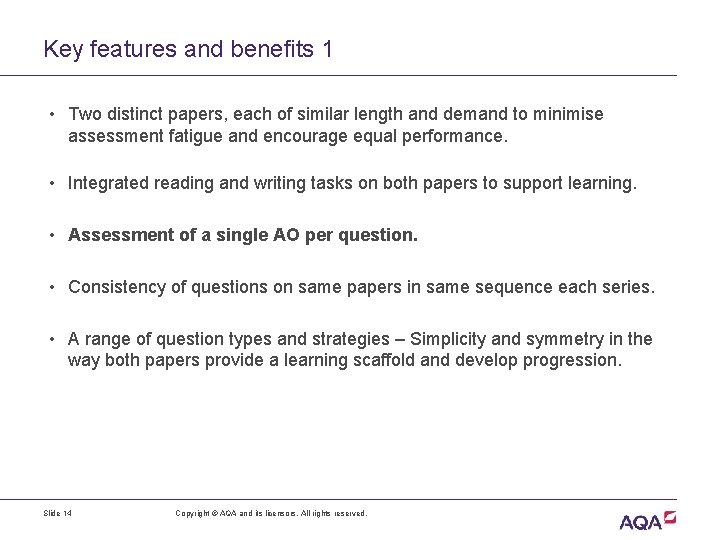
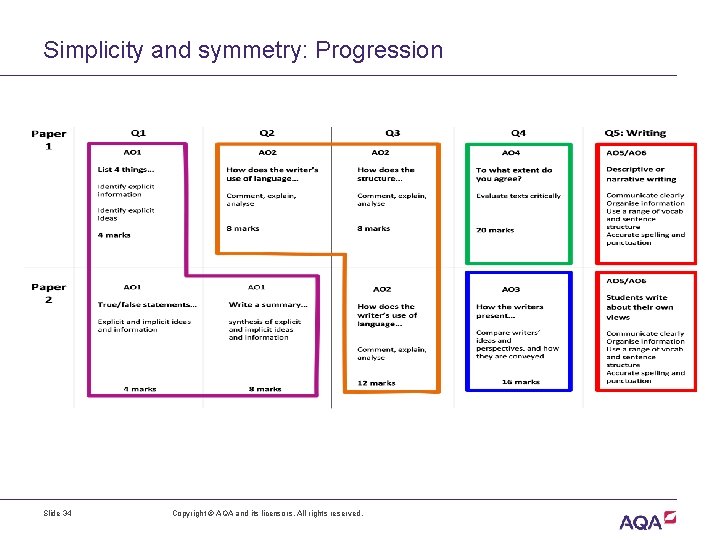
Key features and benefits 1 • Two distinct papers, each of similar length and demand to minimise assessment fatigue and encourage equal performance. • Integrated reading and writing tasks on both papers to support learning. • Assessment of a single AO per question. • Consistency of questions on same papers in same sequence each series. • A range of question types and strategies – Simplicity and symmetry in the way both papers provide a learning scaffold and develop progression. Slide 14 Copyright © AQA and its licensors. All rights reserved.
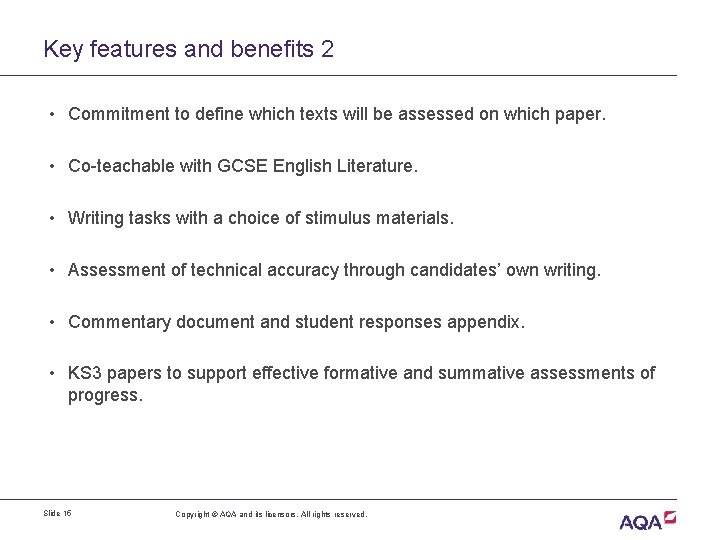
Key features and benefits 2 • Commitment to define which texts will be assessed on which paper. • Co-teachable with GCSE English Literature. • Writing tasks with a choice of stimulus materials. • Assessment of technical accuracy through candidates’ own writing. • Commentary document and student responses appendix. • KS 3 papers to support effective formative and summative assessments of progress. Slide 15 Copyright © AQA and its licensors. All rights reserved.
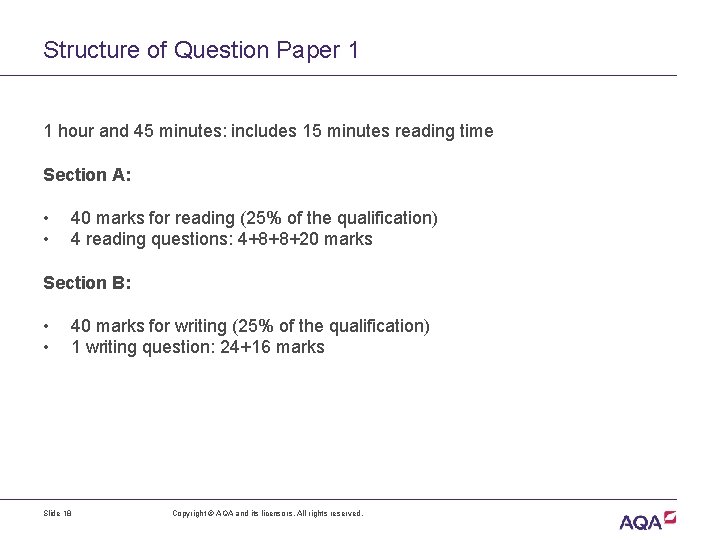
Structure of Question Paper 1 1 hour and 45 minutes: includes 15 minutes reading time Section A: • • 40 marks for reading (25% of the qualification) 4 reading questions: 4+8+8+20 marks Section B: • • 40 marks for writing (25% of the qualification) 1 writing question: 24+16 marks Slide 18 Copyright © AQA and its licensors. All rights reserved.
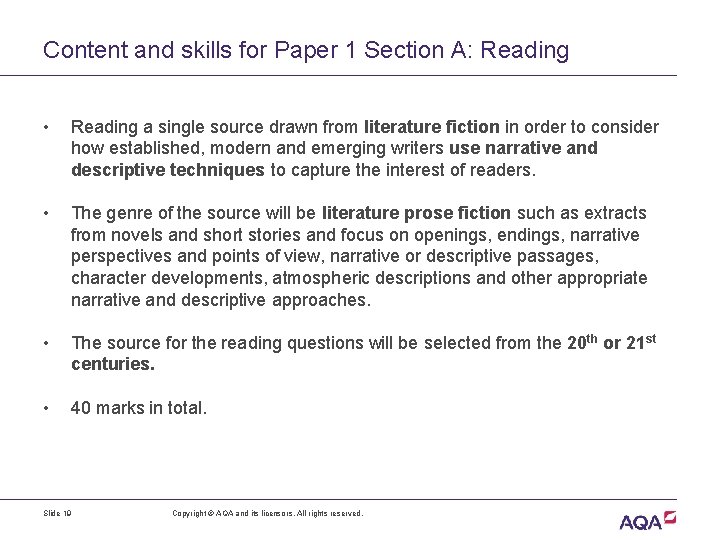
Content and skills for Paper 1 Section A: Reading • Reading a single source drawn from literature fiction in order to consider how established, modern and emerging writers use narrative and descriptive techniques to capture the interest of readers. • The genre of the source will be literature prose fiction such as extracts from novels and short stories and focus on openings, endings, narrative perspectives and points of view, narrative or descriptive passages, character developments, atmospheric descriptions and other appropriate narrative and descriptive approaches. • The source for the reading questions will be selected from the 20 th or 21 st centuries. • 40 marks in total. Slide 19 Copyright © AQA and its licensors. All rights reserved.
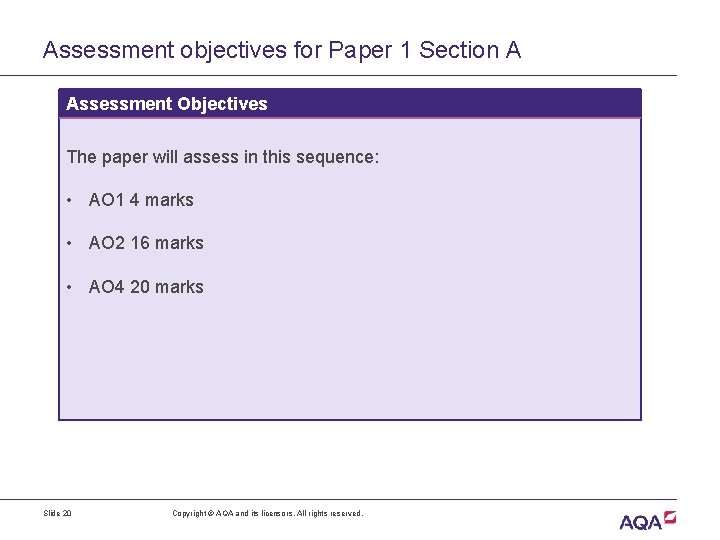
Assessment objectives for Paper 1 Section A Assessment Objectives The paper will assess in this sequence: • AO 1 4 marks • AO 2 16 marks • AO 4 20 marks Slide 20 Copyright © AQA and its licensors. All rights reserved.
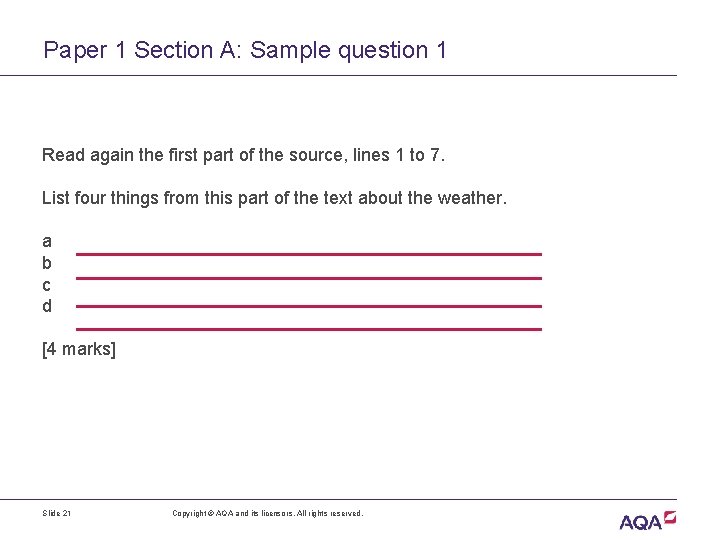
Paper 1 Section A: Sample question 1 Read again the first part of the source, lines 1 to 7. List four things from this part of the text about the weather. a b c d [4 marks] Slide 21 Copyright © AQA and its licensors. All rights reserved.
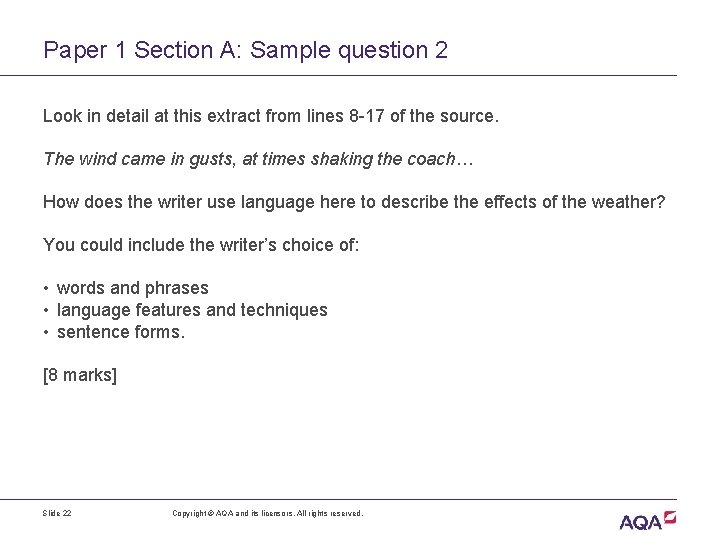
Paper 1 Section A: Sample question 2 Look in detail at this extract from lines 8 -17 of the source. The wind came in gusts, at times shaking the coach… How does the writer use language here to describe the effects of the weather? You could include the writer’s choice of: • words and phrases • language features and techniques • sentence forms. [8 marks] Slide 22 Copyright © AQA and its licensors. All rights reserved.
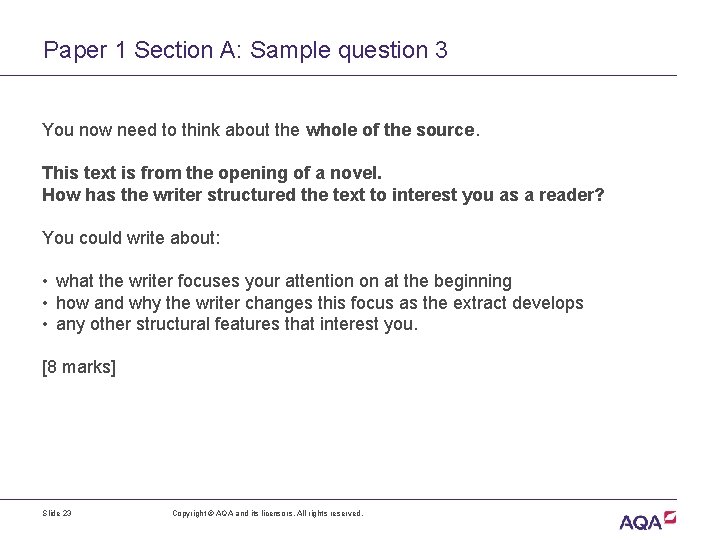
Paper 1 Section A: Sample question 3 You now need to think about the whole of the source. This text is from the opening of a novel. How has the writer structured the text to interest you as a reader? You could write about: • what the writer focuses your attention on at the beginning • how and why the writer changes this focus as the extract develops • any other structural features that interest you. [8 marks] Slide 23 Copyright © AQA and its licensors. All rights reserved.
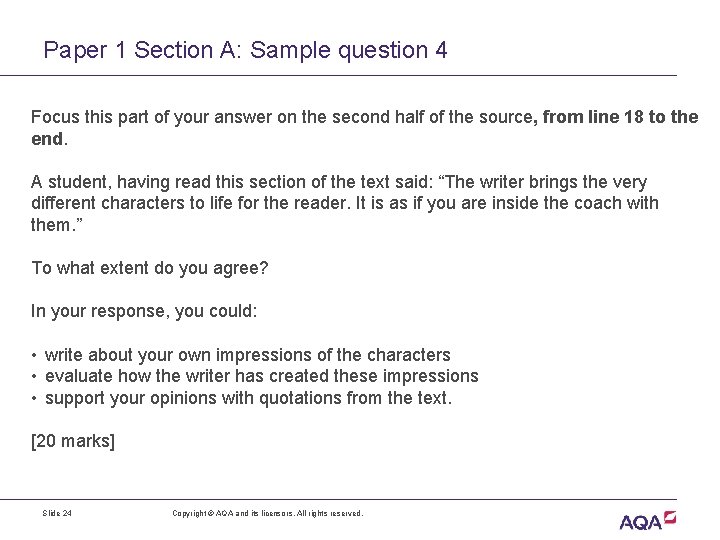
Paper 1 Section A: Sample question 4 Focus this part of your answer on the second half of the source, from line 18 to the end. A student, having read this section of the text said: “The writer brings the very different characters to life for the reader. It is as if you are inside the coach with them. ” To what extent do you agree? In your response, you could: • write about your own impressions of the characters • evaluate how the writer has created these impressions • support your opinions with quotations from the text. [20 marks] Slide 24 Copyright © AQA and its licensors. All rights reserved.
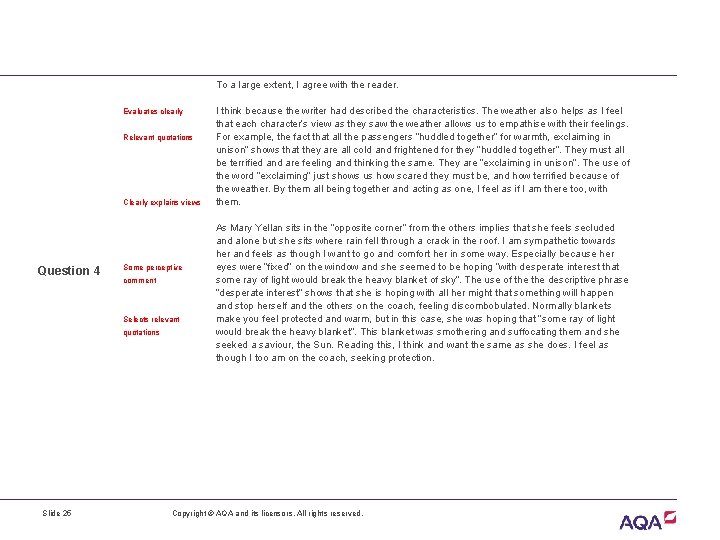
Evaluates clearly Relevant quotations Clearly explains views Question 4 Some perceptive comment Selects relevant quotations To a large extent, I agree with the reader. I think because the writer had described the characteristics. The weather also helps as I feel that each character’s view as they saw the weather allows us to empathise with their feelings. For example, the fact that all the passengers “huddled together” for warmth, exclaiming in unison” shows that they are all cold and frightened for they “huddled together”. They must all be terrified and are feeling and thinking the same. They are “exclaiming in unison”. The use of the word “exclaiming” just shows us how scared they must be, and how terrified because of the weather. By them all being together and acting as one, I feel as if I am there too, with them. As Mary Yellan sits in the “opposite corner” from the others implies that she feels secluded and alone but she sits where rain fell through a crack in the roof. I am sympathetic towards her and feels as though I want to go and comfort her in some way. Especially because her eyes were “fixed” on the window and she seemed to be hoping “with desperate interest that some ray of light would break the heavy blanket of sky”. The use of the descriptive phrase “desperate interest” shows that she is hoping with all her might that something will happen and stop herself and the others on the coach, feeling discombobulated. Normally blankets make you feel protected and warm, but in this case, she was hoping that “some ray of light would break the heavy blanket”. This blanket was smothering and suffocating them and she seeked a saviour, the Sun. Reading this, I think and want the same as she does. I feel as though I too am on the coach, seeking protection. Slide 25 Copyright © AQA and its licensors. All rights reserved.
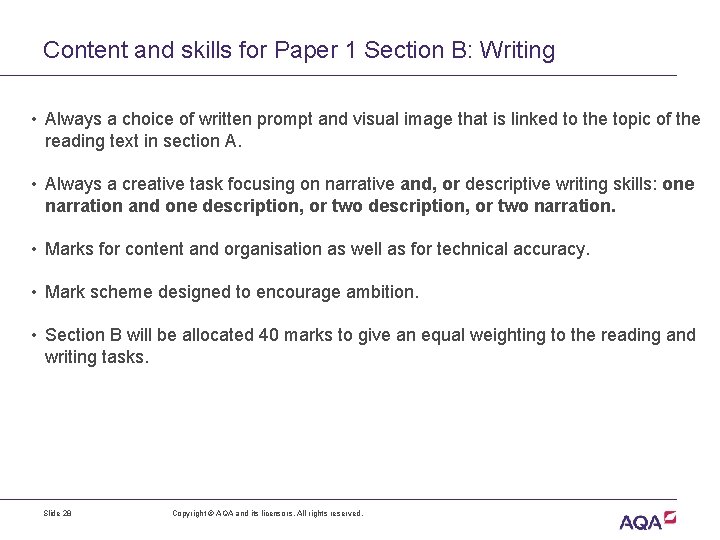
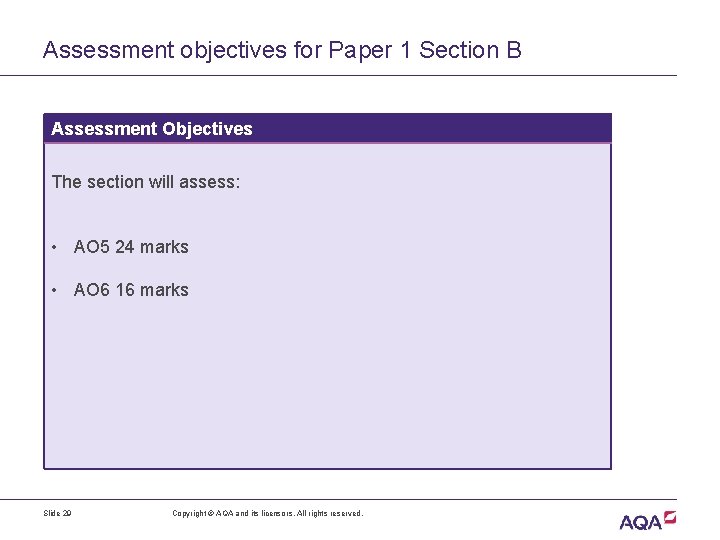
Content and skills for Paper 1 Section B: Writing • Always a choice of written prompt and visual image that is linked to the topic of the reading text in section A. • Always a creative task focusing on narrative and, or descriptive writing skills: one narration and one description, or two narration. • Marks for content and organisation as well as for technical accuracy. • Mark scheme designed to encourage ambition. • Section B will be allocated 40 marks to give an equal weighting to the reading and writing tasks. Slide 28 Copyright © AQA and its licensors. All rights reserved.
Assessment objectives for Paper 1 Section B Assessment Objectives The section will assess: • AO 5 24 marks • AO 6 16 marks Slide 29 Copyright © AQA and its licensors. All rights reserved.
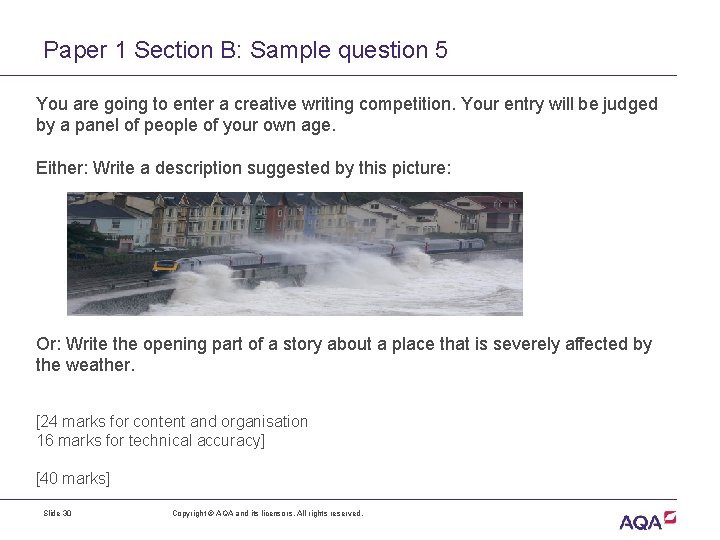
Paper 1 Section B: Sample question 5 You are going to enter a creative writing competition. Your entry will be judged by a panel of people of your own age. Either: Write a description suggested by this picture: Or: Write the opening part of a story about a place that is severely affected by the weather. [24 marks for content and organisation 16 marks for technical accuracy] [40 marks] Slide 30 Copyright © AQA and its licensors. All rights reserved.
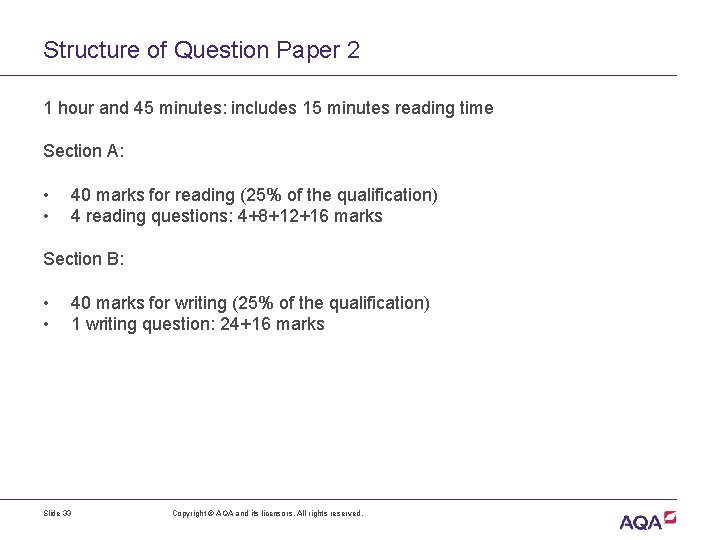
Structure of Question Paper 2 1 hour and 45 minutes: includes 15 minutes reading time Section A: • • 40 marks for reading (25% of the qualification) 4 reading questions: 4+8+12+16 marks Section B: • • 40 marks for writing (25% of the qualification) 1 writing question: 24+16 marks Slide 33 Copyright © AQA and its licensors. All rights reserved.
Simplicity and symmetry: Progression Slide 34 Copyright © AQA and its licensors. All rights reserved.
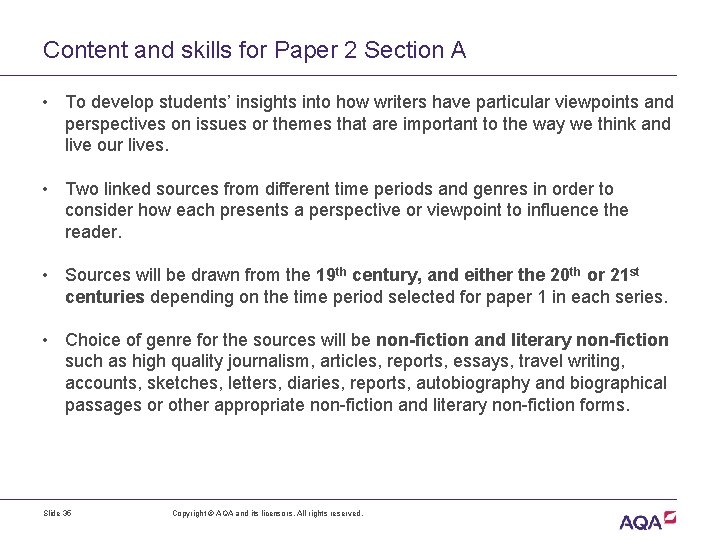
Content and skills for Paper 2 Section A • To develop students’ insights into how writers have particular viewpoints and perspectives on issues or themes that are important to the way we think and live our lives. • Two linked sources from different time periods and genres in order to consider how each presents a perspective or viewpoint to influence the reader. • Sources will be drawn from the 19 th century, and either the 20 th or 21 st centuries depending on the time period selected for paper 1 in each series. • Choice of genre for the sources will be non-fiction and literary non-fiction such as high quality journalism, articles, reports, essays, travel writing, accounts, sketches, letters, diaries, reports, autobiography and biographical passages or other appropriate non-fiction and literary non-fiction forms. Slide 35 Copyright © AQA and its licensors. All rights reserved.
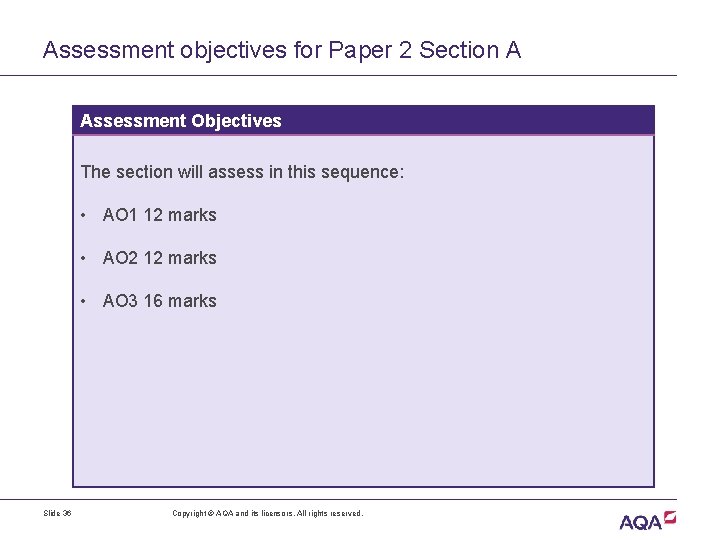
Assessment objectives for Paper 2 Section A Assessment Objectives The section will assess in this sequence: • AO 1 12 marks • AO 2 12 marks • AO 3 16 marks Slide 36 Copyright © AQA and its licensors. All rights reserved.
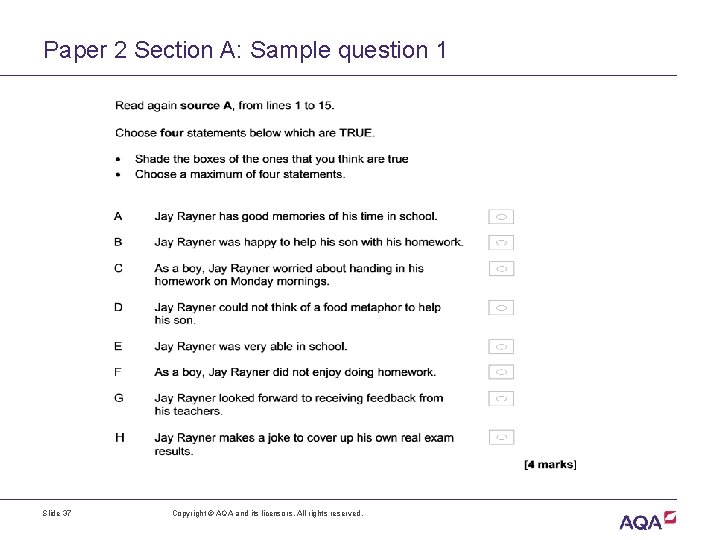
Paper 2 Section A: Sample question 1 Slide 37 Copyright © AQA and its licensors. All rights reserved.
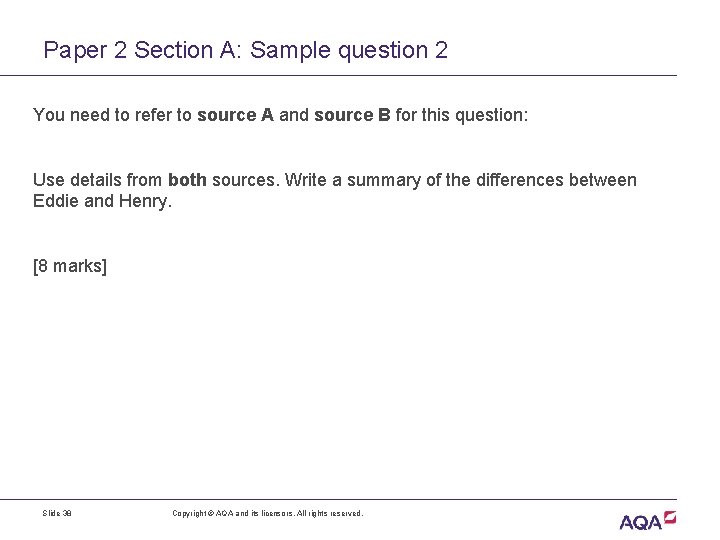
Paper 2 Section A: Sample question 2 You need to refer to source A and source B for this question: Use details from both sources. Write a summary of the differences between Eddie and Henry. [8 marks] Slide 38 Copyright © AQA and its licensors. All rights reserved.
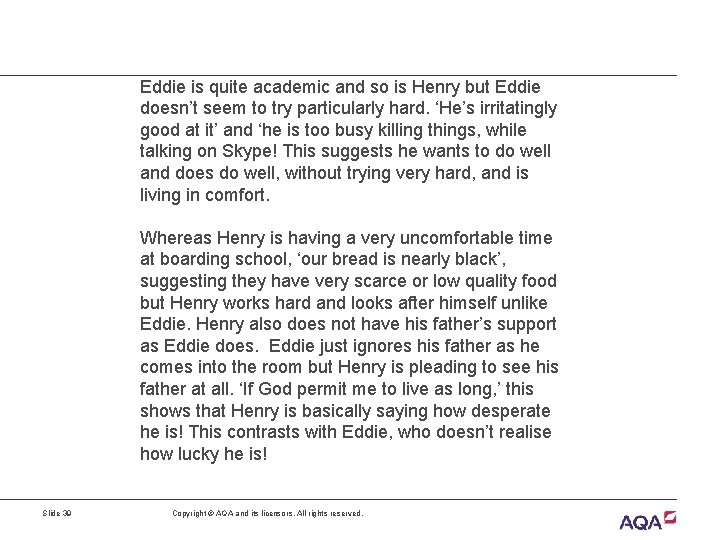
Eddie is quite academic and so is Henry but Eddie doesn’t seem to try particularly hard. ‘He’s irritatingly good at it’ and ‘he is too busy killing things, while talking on Skype! This suggests he wants to do well and does do well, without trying very hard, and is living in comfort. Whereas Henry is having a very uncomfortable time at boarding school, ‘our bread is nearly black’, suggesting they have very scarce or low quality food but Henry works hard and looks after himself unlike Eddie. Henry also does not have his father’s support as Eddie does. Eddie just ignores his father as he comes into the room but Henry is pleading to see his father at all. ‘If God permit me to live as long, ’ this shows that Henry is basically saying how desperate he is! This contrasts with Eddie, who doesn’t realise how lucky he is! Slide 39 Copyright © AQA and its licensors. All rights reserved.
Paper 2 Section A: Sample question 3 You now need to refer only to source B, the letter by Henry written to his father. How does Henry use language to try to influence his father? [12 marks] Slide 40 Copyright © AQA and its licensors. All rights reserved.
Paper 2 Section A: Sample question 4 For this question, you need to refer to the whole of source A together with source B, the father’s letter to a family friend. Compare how the two writers convey their different attitudes to parenting and education. In your answer, you should: • • • compare their different attitudes compare the methods they use to convey their attitudes support your ideas with quotations from both texts. [16 marks] Slide 41 Copyright © AQA and its licensors. All rights reserved.
Slide 42 Copyright © AQA and its licensors. All rights reserved.
Content and skills for Paper 2 Section B • The task will require students to produce a written text to a specified audience, purpose and form in which they give their own perspective on theme that has been introduced to them in section A. • There will be a single writing task which could use a range of opinions, statements and writing scenarios to provoke a response. Slide 44 Copyright © AQA and its licensors. All rights reserved.
Assessment objectives for Paper 2 Section B Assessment Objectives The section will assess: AO 5 24 marks AO 6 16 marks Section B will be allocated 40 marks to give an equal weighting to the reading and writing tasks. Slide 45 Copyright © AQA and its licensors. All rights reserved.
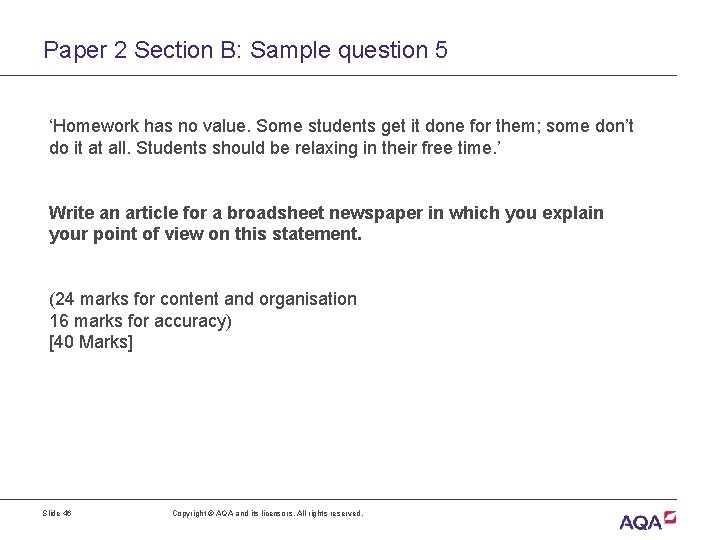
Paper 2 Section B: Sample question 5 ‘Homework has no value. Some students get it done for them; some don’t do it at all. Students should be relaxing in their free time. ’ Write an article for a broadsheet newspaper in which you explain your point of view on this statement. (24 marks for content and organisation 16 marks for accuracy) [40 Marks] Slide 46 Copyright © AQA and its licensors. All rights reserved.
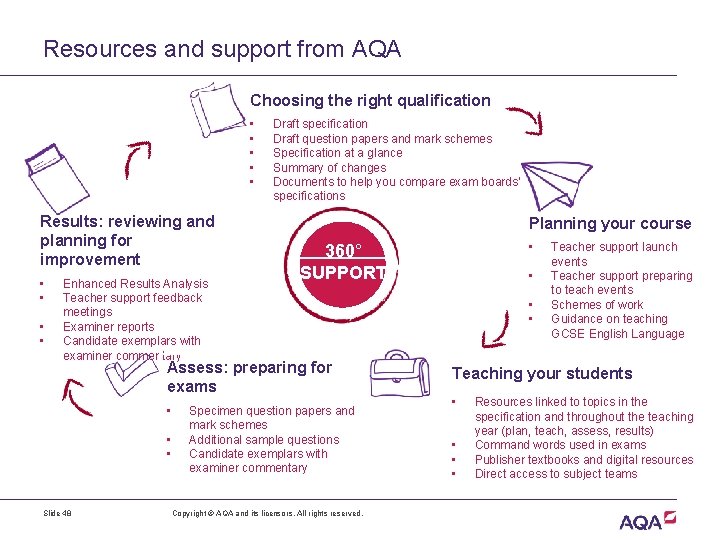
Resources and support from AQA Choosing the right qualification • • • Results: reviewing and planning for improvement • • Enhanced Results Analysis Teacher support feedback meetings Examiner reports Candidate exemplars with examiner commentary Draft specification Draft question papers and mark schemes Specification at a glance Summary of changes Documents to help you compare exam boards’ specifications Planning your course Assess: preparing for exams • • • Slide 48 • 360° SUPPORT Specimen question papers and mark schemes Additional sample questions Candidate exemplars with examiner commentary Copyright © AQA and its licensors. All rights reserved. • • • Teacher support launch events Teacher support preparing to teach events Schemes of work Guidance on teaching GCSE English Language Teaching your students • • Resources linked to topics in the specification and throughout the teaching year (plan, teach, assess, results) Command words used in exams Publisher textbooks and digital resources Direct access to subject teams
GCSE English Language resources • • • Commentary and student responses. KS 3 assessment tests. Free printed anthologies for short stories in Literature support preparation for Paper 1. Expanded and evolved Digital Anthology. Collection of sample texts. Additional sample questions and commentaries. Support with course planning. Network of subject advocates. Best practice schools. Slide 49 Copyright © AQA and its licensors. All rights reserved.
AQA resources Include: • AQA website • e-AQA • secure key materials • ERA (Enhanced Results Analysis) • training courses (2014 onwards) • preparing to teach events (2015) • publishers • AQA family of businesses. Slide 50 Copyright © AQA and its licensors. All rights reserved.
Contact points for more information and guidance • Customer Support Managers english-gcse@aqa. org. uk 0161 953 7504 • Teacher Support and CPD Managers teachercpd@aqa. org. uk 0161 957 3646 • AQA Website: www. aqa. org. uk Slide 52 Copyright © AQA and its licensors. All rights reserved.
Thank you Slide 54 Copyright © AQA and its licensors. All rights reserved. Follow us on Twitter @AQACPD.