
GCSE Engineering Controlled Assessment Checklist All the work
- Slides: 45
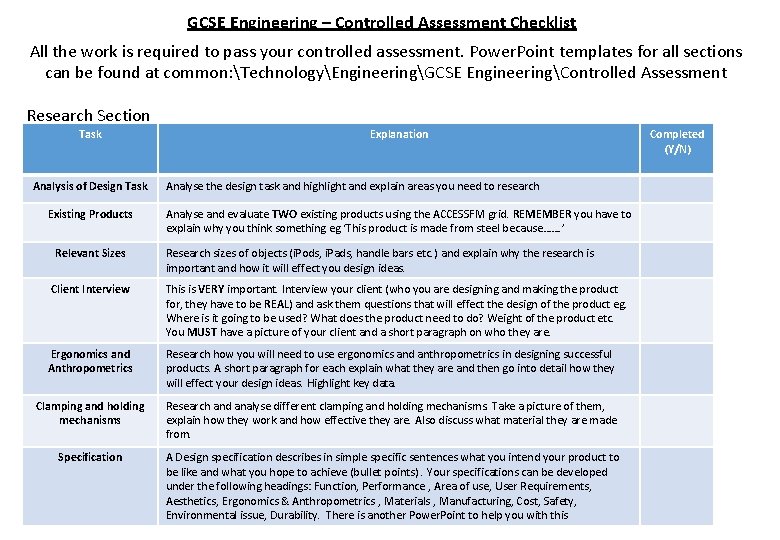
GCSE Engineering – Controlled Assessment Checklist All the work is required to pass your controlled assessment. Power. Point templates for all sections can be found at common: TechnologyEngineeringGCSE EngineeringControlled Assessment Research Section Task Analysis of Design Task Existing Products Relevant Sizes Explanation Analyse the design task and highlight and explain areas you need to research Analyse and evaluate TWO existing products using the ACCESSFM grid. REMEMBER you have to explain why you think something eg ‘This product is made from steel because……. ’ Research sizes of objects (i. Pods, i. Pads, handle bars etc. ) and explain why the research is important and how it will effect you design ideas. Client Interview This is VERY important. Interview your client (who you are designing and making the product for, they have to be REAL) and ask them questions that will effect the design of the product eg. Where is it going to be used? What does the product need to do? Weight of the product etc. You MUST have a picture of your client and a short paragraph on who they are. Ergonomics and Anthropometrics Research how you will need to use ergonomics and anthropometrics in designing successful products. A short paragraph for each explain what they are and then go into detail how they will effect your design ideas. Highlight key data. Clamping and holding mechanisms Research and analyse different clamping and holding mechanisms. Take a picture of them, explain how they work and how effective they are. Also discuss what material they are made from. Specification A Design specification describes in simple specific sentences what you intend your product to be like and what you hope to achieve (bullet points). Your specifications can be developed under the following headings: Function, Performance , Area of use, User Requirements, Aesthetics, Ergonomics & Anthropometrics , Materials , Manufacturing, Cost, Safety, Environmental issue, Durability. There is another Power. Point to help you with this Completed (Y/N)
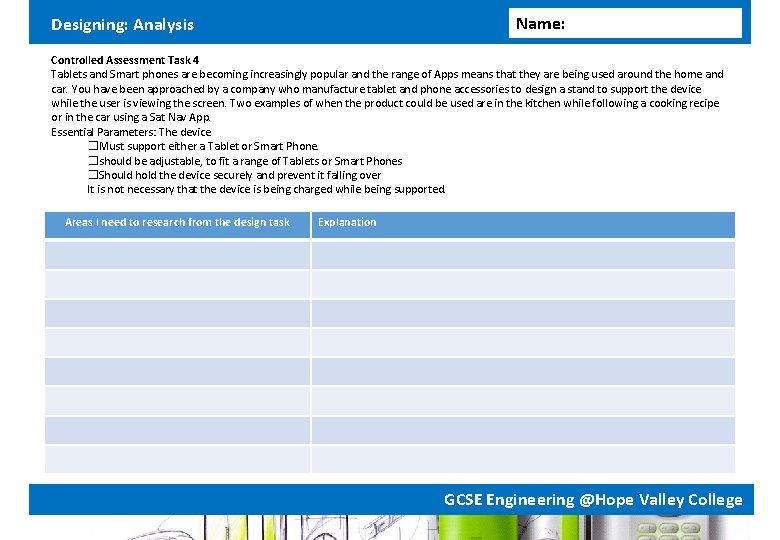
Name: Designing: Analysis Controlled Assessment Task 4 Tablets and Smart phones are becoming increasingly popular and the range of Apps means that they are being used around the home and car. You have been approached by a company who manufacture tablet and phone accessories to design a stand to support the device while the user is viewing the screen. Two examples of when the product could be used are in the kitchen while following a cooking recipe or in the car using a Sat Nav App. Essential Parameters: The device �Must support either a Tablet or Smart Phone. �should be adjustable, to fit a range of Tablets or Smart Phones �Should hold the device securely and prevent it falling over It is not necessary that the device is being charged while being supported. Areas I need to research from the design task Explanation GCSE Engineering @Hope Valley College
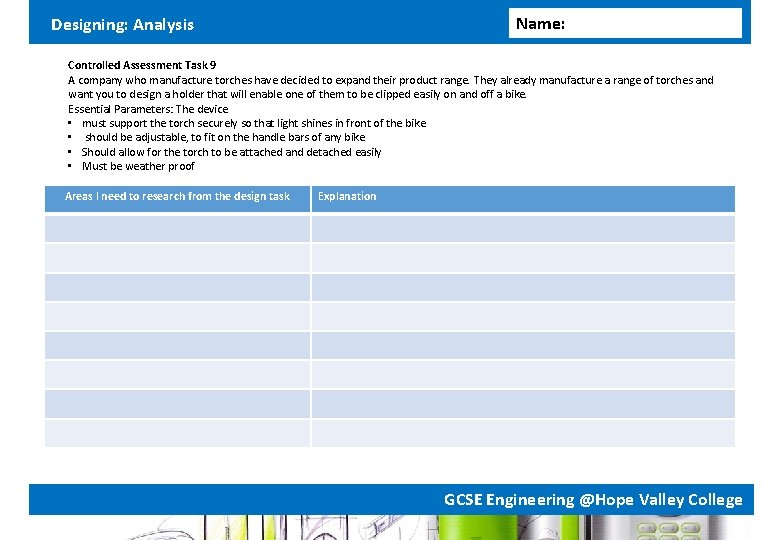
Name: Designing: Analysis Controlled Assessment Task 9 A company who manufacture torches have decided to expand their product range. They already manufacture a range of torches and want you to design a holder that will enable one of them to be clipped easily on and off a bike. Essential Parameters: The device • must support the torch securely so that light shines in front of the bike • should be adjustable, to fit on the handle bars of any bike • Should allow for the torch to be attached and detached easily • Must be weather proof Areas I need to research from the design task Explanation GCSE Engineering @Hope Valley College
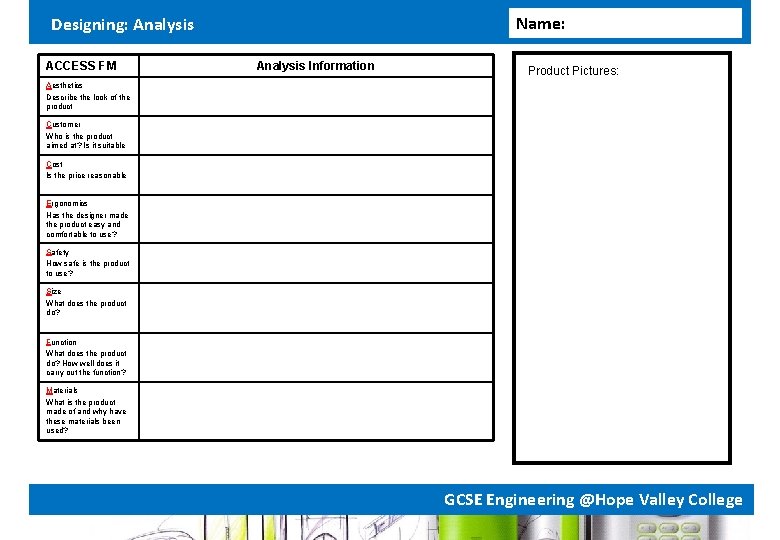
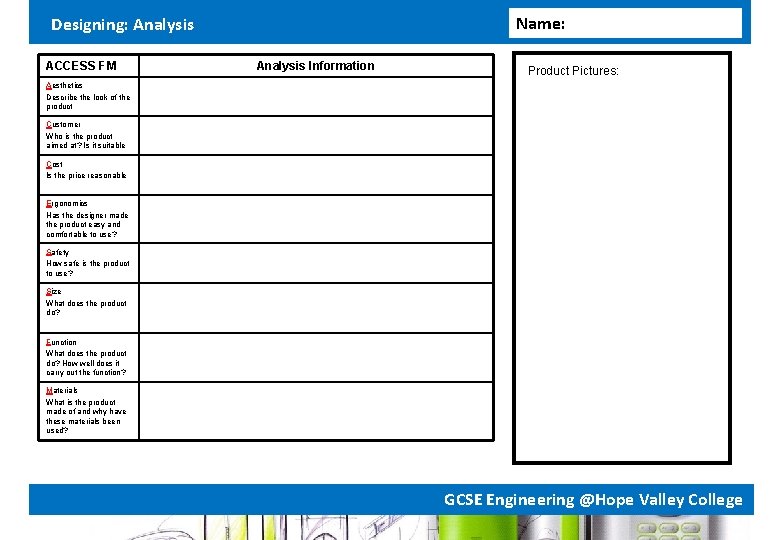
Name: Designing: Analysis ACCESS FM Analysis Information Product Pictures: Aesthetics Describe the look of the product Customer Who is the product aimed at? Is it suitable Cost Is the price reasonable Ergonomics Has the designer made the product easy and comfortable to use? Safety How safe is the product to use? Size What does the product do? Function What does the product do? How well does it carry out the function? Materials What is the product made of and why have these materials been used? GCSE Engineering @Hope Valley College
Name: Designing: Analysis ACCESS FM Analysis Information Product Pictures: Aesthetics Describe the look of the product Customer Who is the product aimed at? Is it suitable Cost Is the price reasonable Ergonomics Has the designer made the product easy and comfortable to use? Safety How safe is the product to use? Size What does the product do? Function What does the product do? How well does it carry out the function? Materials What is the product made of and why have these materials been used? GCSE Engineering @Hope Valley College
Designing: Initial Ideas Name: GCSE Engineering @Hope Valley College
Designing: Analysis Name: GCSE Engineering @Hope Valley College
Designing: Analysis Name: GCSE Engineering @Hope Valley College
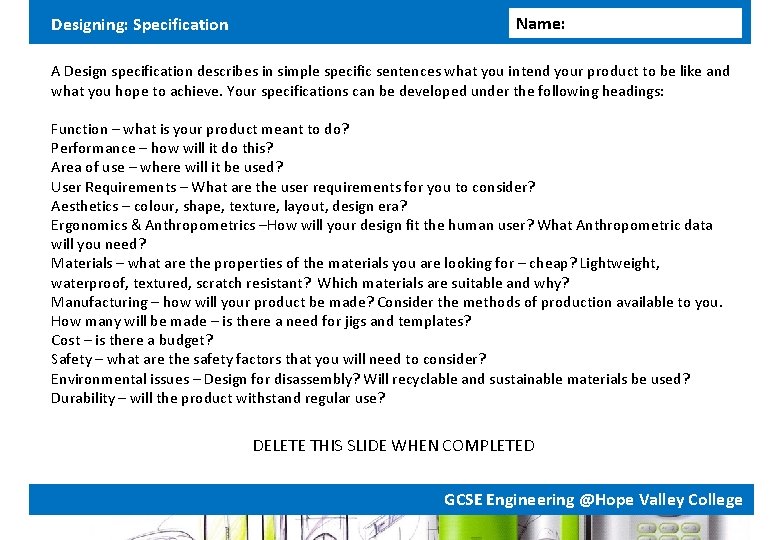
Designing: Specification Name: A Design specification describes in simple specific sentences what you intend your product to be like and what you hope to achieve. Your specifications can be developed under the following headings: Function – what is your product meant to do? Performance – how will it do this? Area of use – where will it be used? User Requirements – What are the user requirements for you to consider? Aesthetics – colour, shape, texture, layout, design era? Ergonomics & Anthropometrics –How will your design fit the human user? What Anthropometric data will you need? Materials – what are the properties of the materials you are looking for – cheap? Lightweight, waterproof, textured, scratch resistant? Which materials are suitable and why? Manufacturing – how will your product be made? Consider the methods of production available to you. How many will be made – is there a need for jigs and templates? Cost – is there a budget? Safety – what are the safety factors that you will need to consider? Environmental issues – Design for disassembly? Will recyclable and sustainable materials be used? Durability – will the product withstand regular use? DELETE THIS SLIDE WHEN COMPLETED GCSE Engineering @Hope Valley College
Designing: Specification Name: GCSE Engineering @Hope Valley College
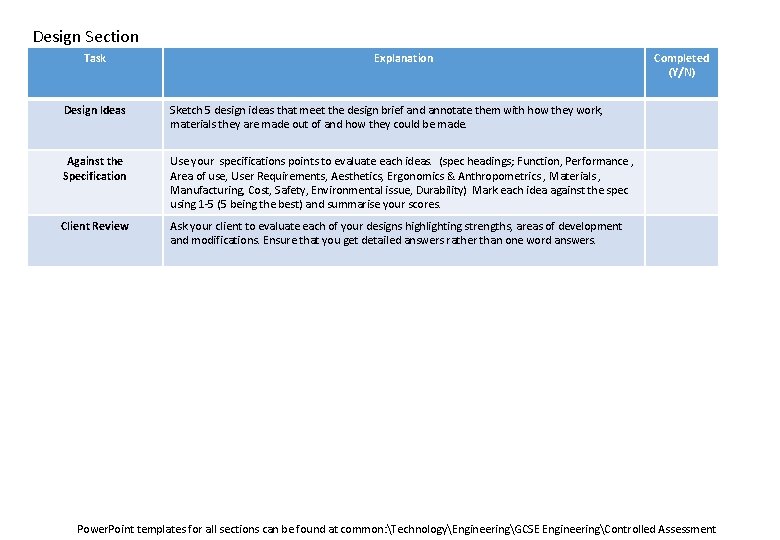
Design Section Task Explanation Design Ideas Sketch 5 design ideas that meet the design brief and annotate them with how they work, materials they are made out of and how they could be made. Against the Specification Use your specifications points to evaluate each ideas. (spec headings; Function, Performance , Area of use, User Requirements, Aesthetics, Ergonomics & Anthropometrics , Materials , Manufacturing, Cost, Safety, Environmental issue, Durability) Mark each idea against the spec using 1 -5 (5 being the best) and summarise your scores. Client Review Ask your client to evaluate each of your designs highlighting strengths, areas of development and modifications. Ensure that you get detailed answers rather than one word answers. Completed (Y/N) Power. Point templates for all sections can be found at common: TechnologyEngineeringGCSE EngineeringControlled Assessment
Designing: Initial Ideas GCSE Engineering @Hope Valley College
Designing: Initial ideas Name: GCSE Engineering @Hope Valley College
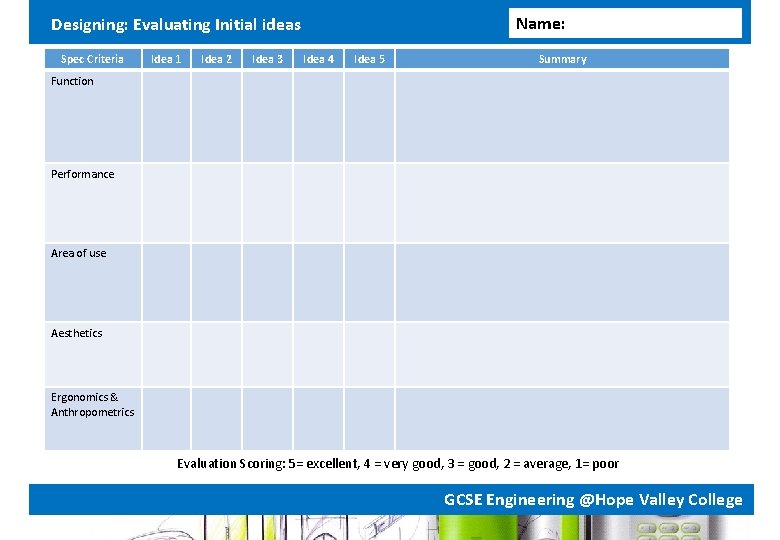
Name: Designing: Evaluating Initial ideas Spec Criteria Idea 1 Idea 2 Idea 3 Idea 4 Idea 5 Summary Function Performance Area of use Aesthetics Ergonomics & Anthropometrics Evaluation Scoring: 5= excellent, 4 = very good, 3 = good, 2 = average, 1= poor GCSE Engineering @Hope Valley College
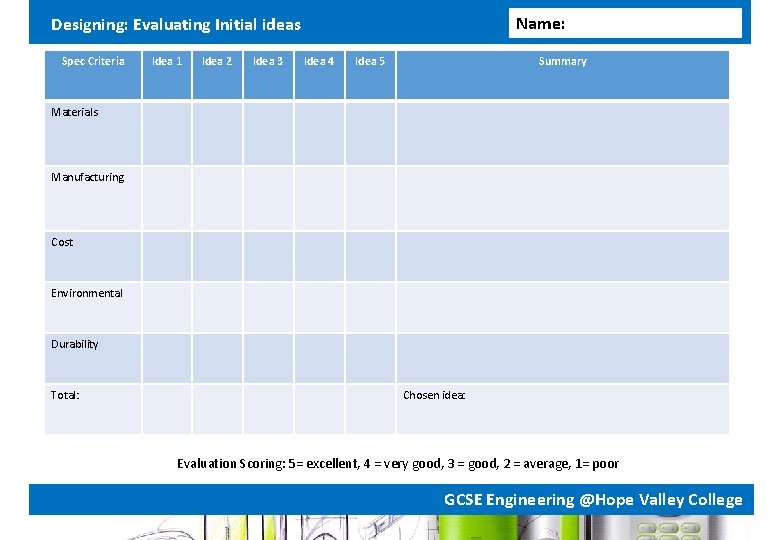
Name: Designing: Evaluating Initial ideas Spec Criteria Idea 1 Idea 2 Idea 3 Idea 4 Idea 5 Summary Materials Manufacturing Cost Environmental Durability Total: Chosen idea: Evaluation Scoring: 5= excellent, 4 = very good, 3 = good, 2 = average, 1= poor GCSE Engineering @Hope Valley College
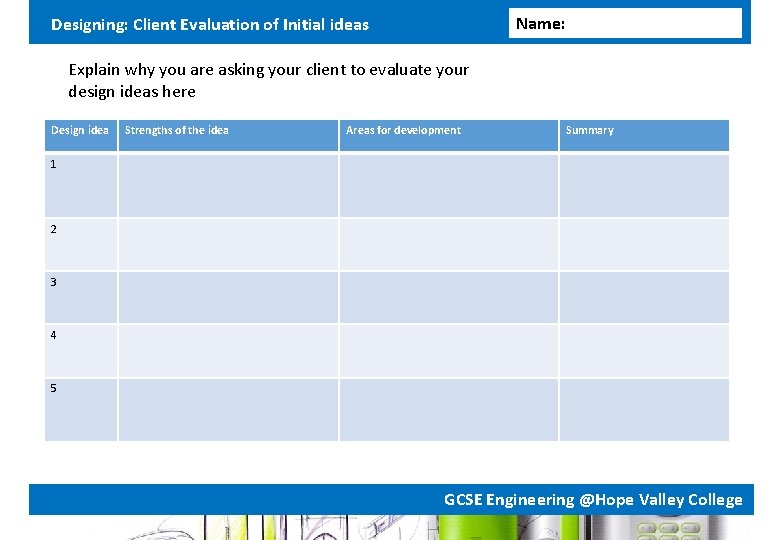
Name: Designing: Client Evaluation of Initial ideas Explain why you are asking your client to evaluate your design ideas here Design idea Strengths of the idea Areas for development Summary 1 2 3 4 5 GCSE Engineering @Hope Valley College
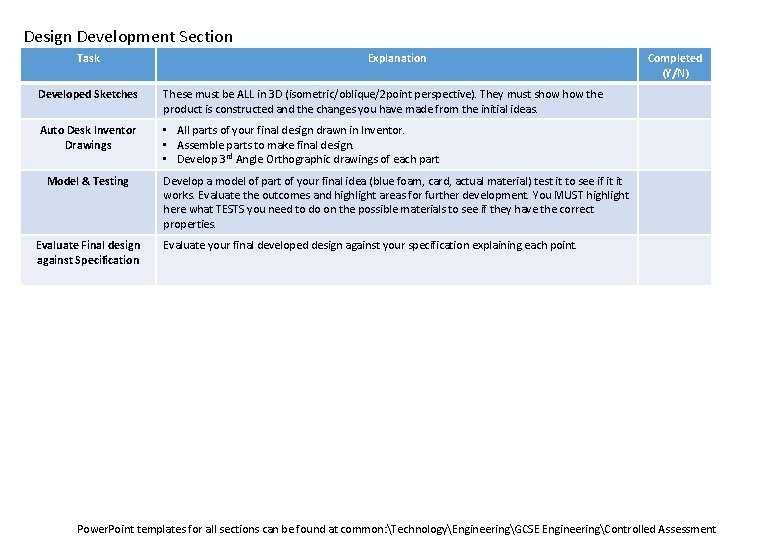
Design Development Section Task Explanation Developed Sketches These must be ALL in 3 D (isometric/oblique/2 point perspective). They must show the product is constructed and the changes you have made from the initial ideas. Auto Desk Inventor Drawings • All parts of your final design drawn in Inventor. • Assemble parts to make final design. • Develop 3 rd Angle Orthographic drawings of each part Model & Testing Evaluate Final design against Specification Completed (Y/N) Develop a model of part of your final idea (blue foam, card, actual material) test it to see if it it works. Evaluate the outcomes and highlight areas for further development. You MUST highlight here what TESTS you need to do on the possible materials to see if they have the correct properties. Evaluate your final developed design against your specification explaining each point. Power. Point templates for all sections can be found at common: TechnologyEngineeringGCSE EngineeringControlled Assessment
Development: Sketches Name: GCSE Engineering @Hope Valley College
Development: CAD Parts Name: GCSE Engineering @Hope Valley College
Development: CAD Assembly Name: GCSE Engineering @Hope Valley College
Development: 3 rd Angle Orthographic Projection Name: GCSE Engineering @Hope Valley College
Development: Model & Testing Name: GCSE Engineering @Hope Valley College
Development: Final Design Developments Name: GCSE Engineering @Hope Valley College
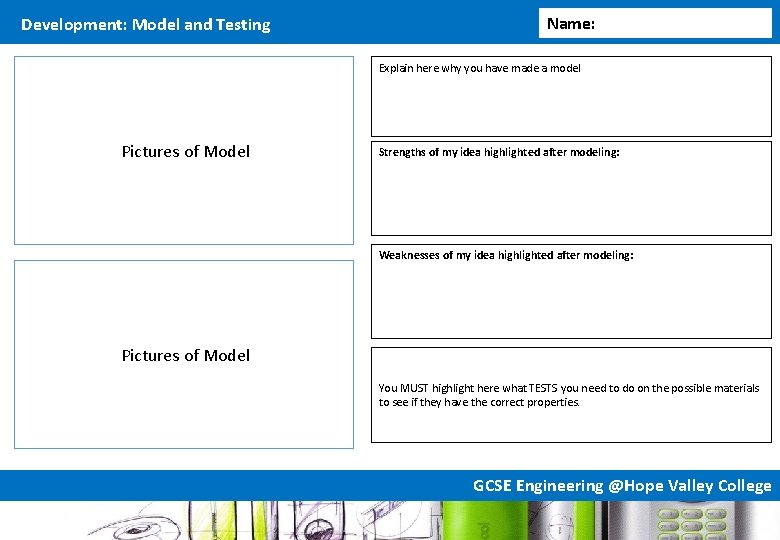
Development: Model and Testing Name: Explain here why you have made a model Pictures of Model Strengths of my idea highlighted after modeling: Weaknesses of my idea highlighted after modeling: Pictures of Model You MUST highlight here what TESTS you need to do on the possible materials to see if they have the correct properties. GCSE Engineering @Hope Valley College
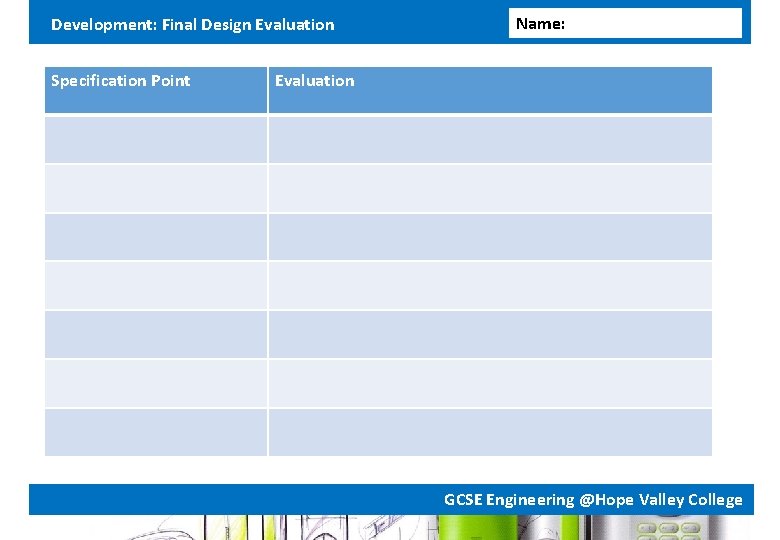
Development: Final Design Evaluation Specification Point Name: Evaluation GCSE Engineering @Hope Valley College
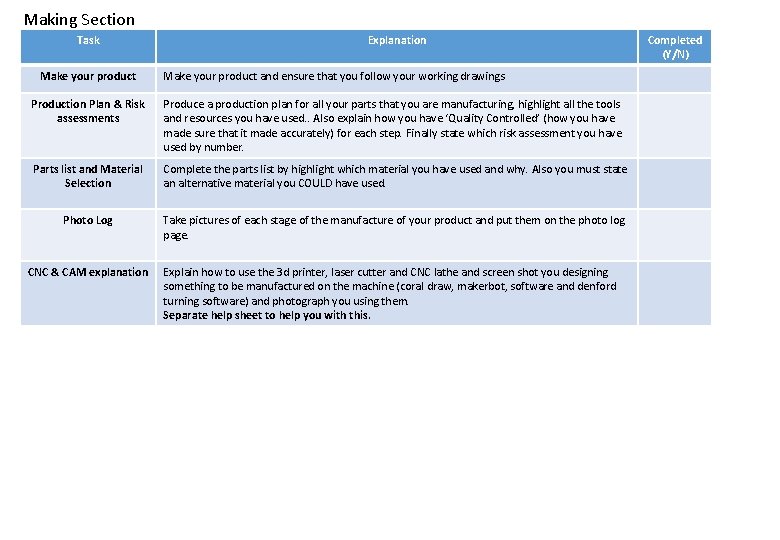
Making Section Task Make your product Explanation Make your product and ensure that you follow your working drawings Production Plan & Risk assessments Produce a production plan for all your parts that you are manufacturing, highlight all the tools and resources you have used. . Also explain how you have ‘Quality Controlled’ (how you have made sure that it made accurately) for each step. Finally state which risk assessment you have used by number. Parts list and Material Selection Complete the parts list by highlight which material you have used and why. Also you must state an alternative material you COULD have used. Photo Log Take pictures of each stage of the manufacture of your product and put them on the photo log page. CNC & CAM explanation Explain how to use the 3 d printer, laser cutter and CNC lathe and screen shot you designing something to be manufactured on the machine (coral draw, makerbot, software and denford turning software) and photograph you using them. Separate help sheet to help you with this. Completed (Y/N)
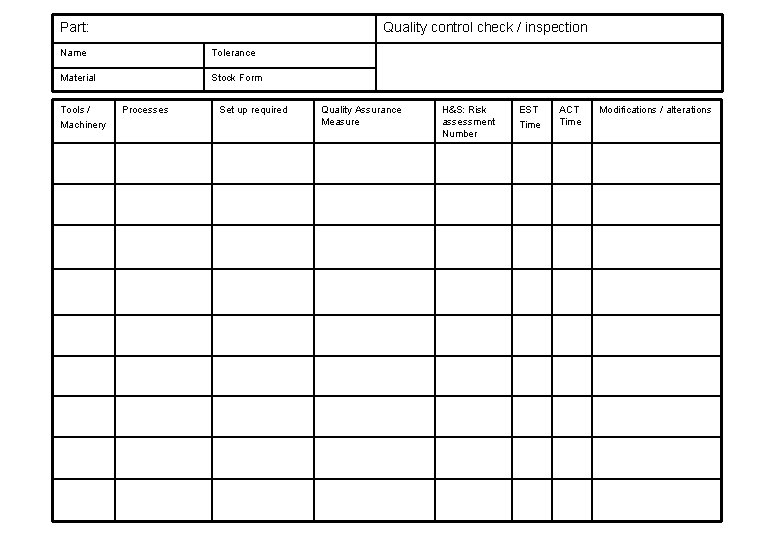
Part: Quality control check / inspection Name Tolerance Material Stock Form Tools / Machinery Processes Set up required Quality Assurance Measure H&S: Risk assessment Number EST Time ACT Time Modifications / alterations
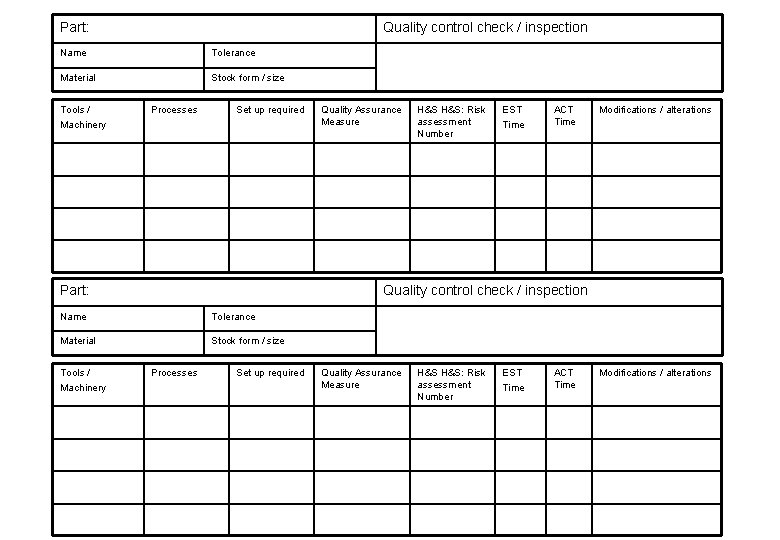
Part: Quality control check / inspection Name Tolerance Material Stock form / size Tools / Machinery Processes Set up required Part: H&S: Risk assessment Number EST Time ACT Time Modifications / alterations Quality control check / inspection Name Tolerance Material Stock form / size Tools / Machinery Quality Assurance Measure Processes Set up required Quality Assurance Measure H&S: Risk assessment Number EST Time ACT Time Modifications / alterations
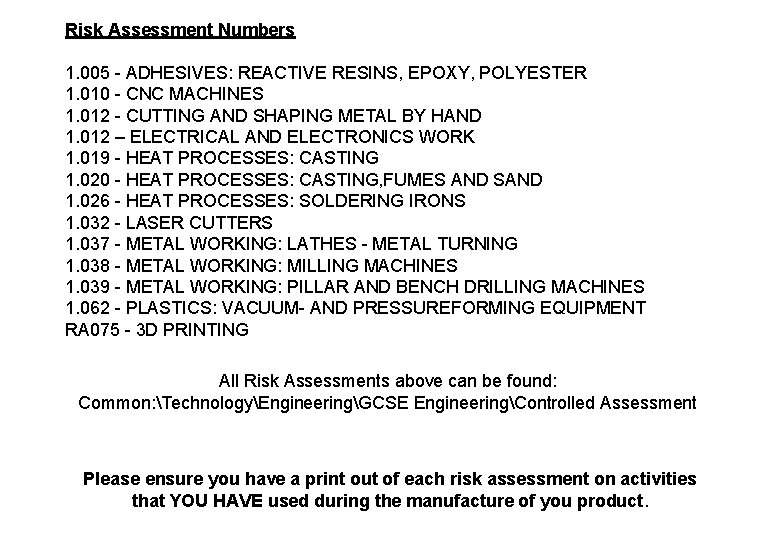
Risk Assessment Numbers 1. 005 - ADHESIVES: REACTIVE RESINS, EPOXY, POLYESTER 1. 010 - CNC MACHINES 1. 012 - CUTTING AND SHAPING METAL BY HAND 1. 012 – ELECTRICAL AND ELECTRONICS WORK 1. 019 - HEAT PROCESSES: CASTING 1. 020 - HEAT PROCESSES: CASTING, FUMES AND SAND 1. 026 - HEAT PROCESSES: SOLDERING IRONS 1. 032 - LASER CUTTERS 1. 037 - METAL WORKING: LATHES - METAL TURNING 1. 038 - METAL WORKING: MILLING MACHINES 1. 039 - METAL WORKING: PILLAR AND BENCH DRILLING MACHINES 1. 062 - PLASTICS: VACUUM- AND PRESSUREFORMING EQUIPMENT RA 075 - 3 D PRINTING All Risk Assessments above can be found: Common: TechnologyEngineeringGCSE EngineeringControlled Assessment Please ensure you have a print out of each risk assessment on activities that YOU HAVE used during the manufacture of you product.
Name: Manufacturing – Photo Log Photo Explanation: Photo Explanation: GCSE Engineering @Hope Valley College
Applying New Technologies – Operating CNC Machines Name: Using the Denford CNC Lathe Picture of you using the CNC Machine This is a picture of me setting up and using the CNC lathe Screen Shot of software Parts Manufactured: This is a screen shot of my designs ready for manufacture GCSE Engineering @Hope Valley College
Applying New Technologies – Operating CNC Machines Name: Using the Makerbot Mini – 3 D Printer Picture of you using the CNC Machine This is a picture of me setting up and using the Makerbot Screen Shot of software Parts Manufactured: This is a screen shot of my designs ready for manufacture GCSE Engineering @Hope Valley College
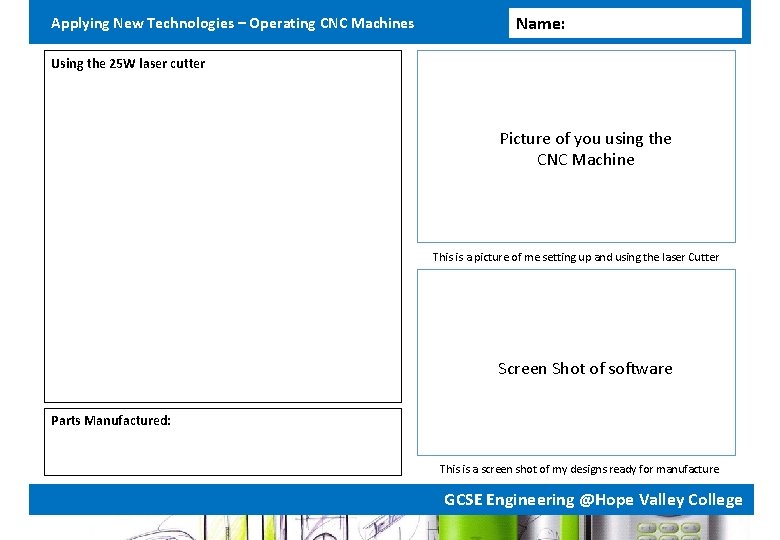
Applying New Technologies – Operating CNC Machines Name: Using the 25 W laser cutter Picture of you using the CNC Machine This is a picture of me setting up and using the laser Cutter Screen Shot of software Parts Manufactured: This is a screen shot of my designs ready for manufacture GCSE Engineering @Hope Valley College
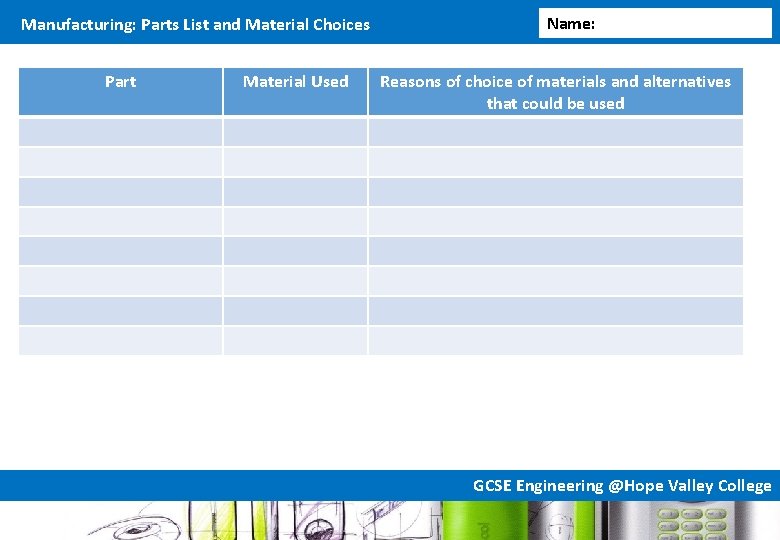
Manufacturing: Parts List and Material Choices Part Material Used Name: Reasons of choice of materials and alternatives that could be used GCSE Engineering @Hope Valley College
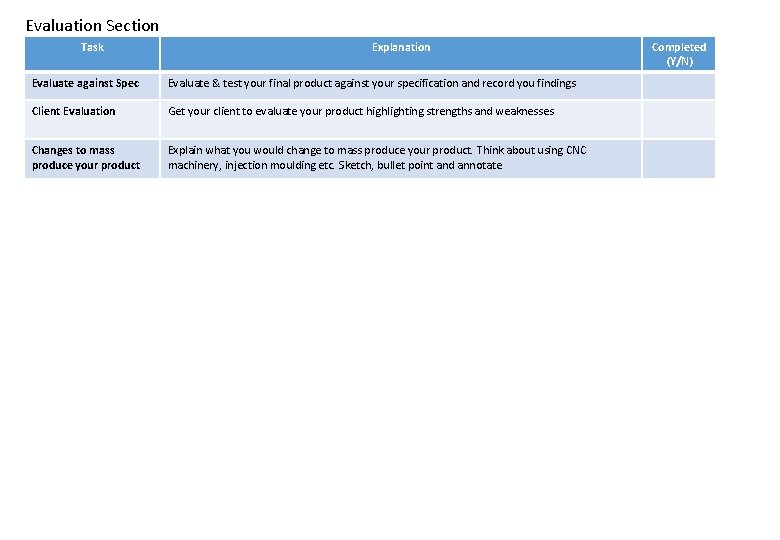
Evaluation Section Task Explanation Evaluate against Spec Evaluate & test your final product against your specification and record you findings Client Evaluation Get your client to evaluate your product highlighting strengths and weaknesses Changes to mass produce your product Explain what you would change to mass produce your product. Think about using CNC machinery, injection moulding etc. Sketch, bullet point and annotate Completed (Y/N)
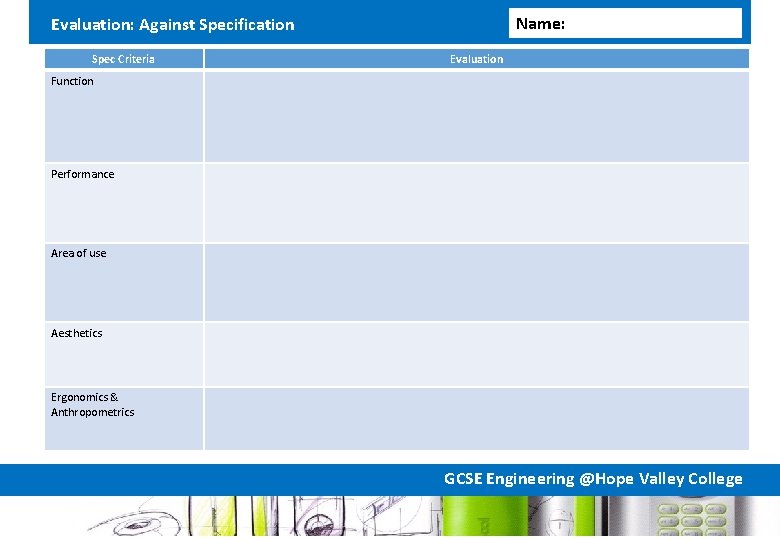
Name: Evaluation: Against Specification Spec Criteria Evaluation Function Performance Area of use Aesthetics Ergonomics & Anthropometrics GCSE Engineering @Hope Valley College
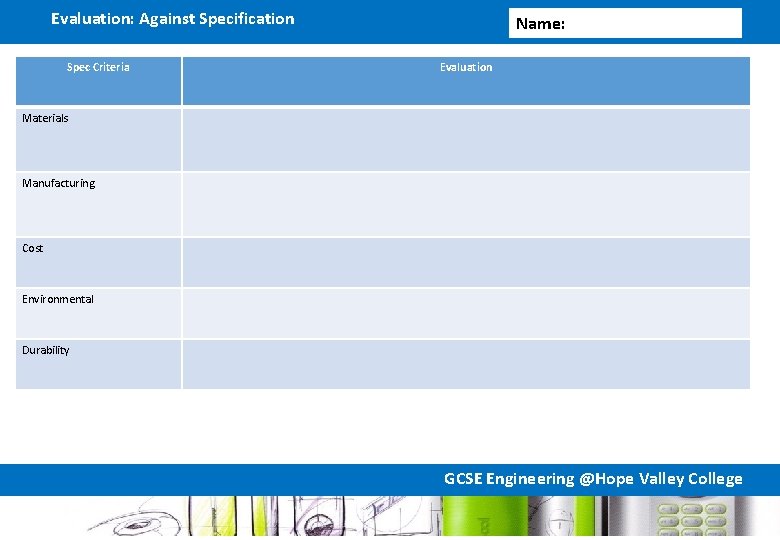
Evaluation: Against Specification Spec Criteria Name: Evaluation Materials Manufacturing Cost Environmental Durability GCSE Engineering @Hope Valley College
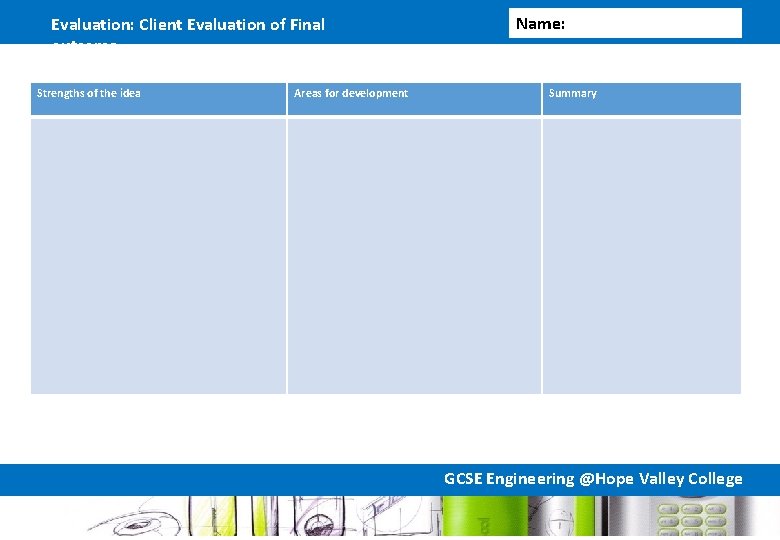
Evaluation: Client Evaluation of Final outcome Strengths of the idea Areas for development Name: Summary GCSE Engineering @Hope Valley College
Evaluation: Mass production Changes Name: GCSE Engineering @Hope Valley College
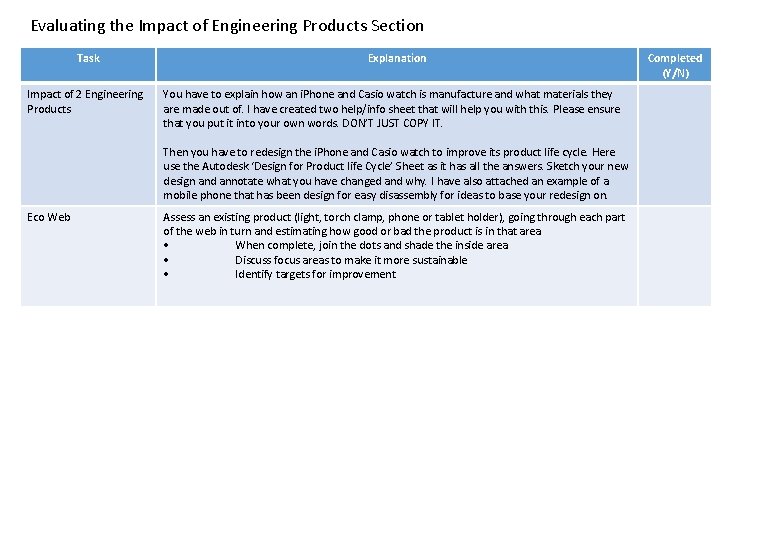
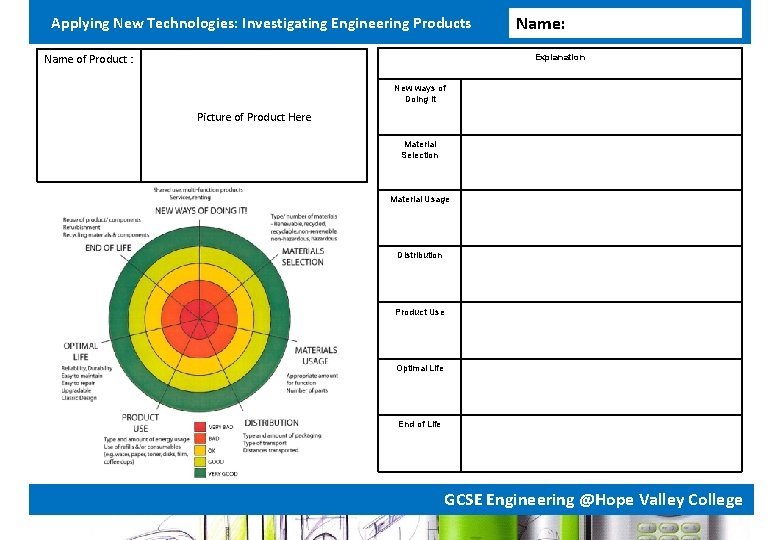
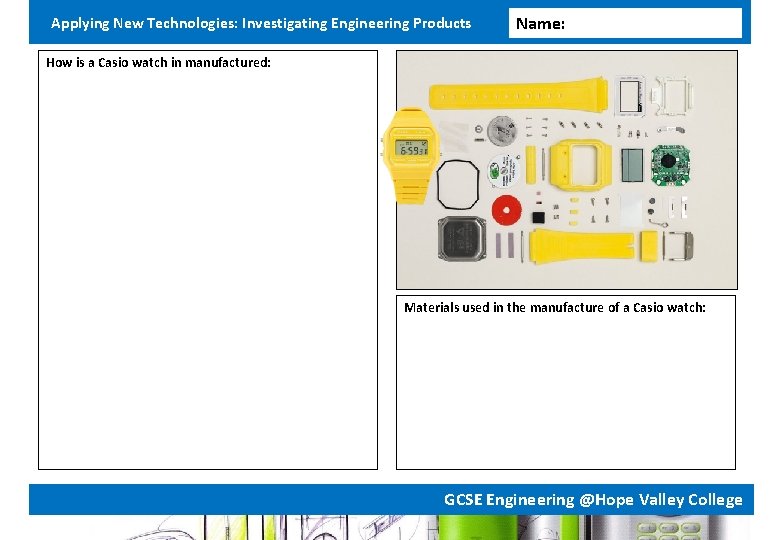
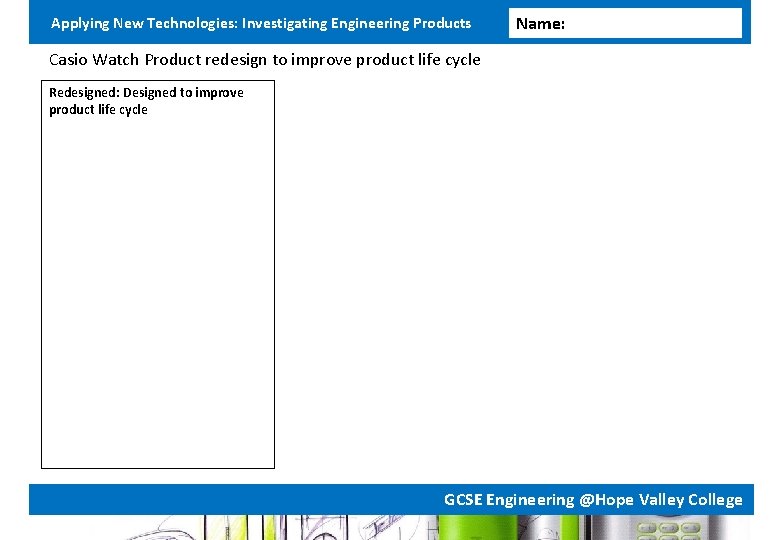
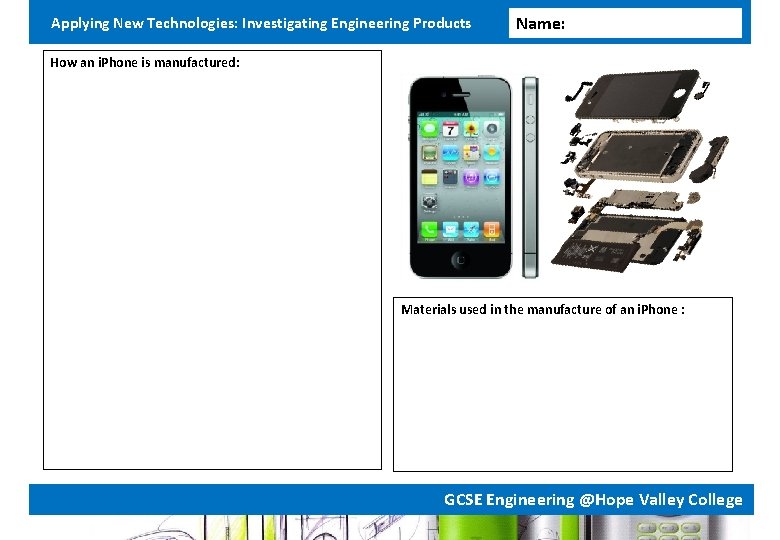
Evaluating the Impact of Engineering Products Section Task Impact of 2 Engineering Products Explanation You have to explain how an i. Phone and Casio watch is manufacture and what materials they are made out of. I have created two help/info sheet that will help you with this. Please ensure that you put it into your own words. DON’T JUST COPY IT. Then you have to redesign the i. Phone and Casio watch to improve its product life cycle. Here use the Autodesk ‘Design for Product life Cycle’ Sheet as it has all the answers. Sketch your new design and annotate what you have changed and why. I have also attached an example of a mobile phone that has been design for easy disassembly for ideas to base your redesign on. Eco Web Assess an existing product (light, torch clamp, phone or tablet holder), going through each part of the web in turn and estimating how good or bad the product is in that area • When complete, join the dots and shade the inside area • Discuss focus areas to make it more sustainable • Identify targets for improvement Completed (Y/N)
Applying New Technologies: Investigating Engineering Products Name: Explanation Name of Product : New ways of Doing it Picture of Product Here Material Selection Material Usage Distribution Product Use Optimal Life End of Life GCSE Engineering @Hope Valley College
Applying New Technologies: Investigating Engineering Products Name: How is a Casio watch in manufactured: Materials used in the manufacture of a Casio watch: GCSE Engineering @Hope Valley College
Applying New Technologies: Investigating Engineering Products Name: Casio Watch Product redesign to improve product life cycle Redesigned: Designed to improve product life cycle GCSE Engineering @Hope Valley College
Applying New Technologies: Investigating Engineering Products Name: How an i. Phone is manufactured: Materials used in the manufacture of an i. Phone : GCSE Engineering @Hope Valley College
Applying New Technologies: Investigating Engineering Products Name: i. Phone Product redesign to improve product life cycle Redesigned: Designed to improve product life cycle GCSE Engineering @Hope Valley College