
GCSE Economics 3 3 Managing Personal Finances Savings

- Slides: 37
GCSE Economics 3. 3 Managing Personal Finances
Savings Saving is important for the following reasons: • Provides financial security and covers emergency situations which need a financial solution, e. g. lost debit card, loss of car due to an accident. • Enables goods/services to be purchased at a later date, living expenses to be paid and meet basic survival needs, e. g. purchase of a new car. • To ensure a reasonable standard of living during retirement or provide for dependents. Images © thinkstockphotos. co. uk
Borrowing is important for the following reasons: • Provides immediate funding to an individual in an emergency situation, e. g. access to funds to pay for a new car in the event of an accident. • Provides an individual with the ability to acquire high-cost items for use in everyday life, i. e. property to live in, vehicles to commute to/from work and undertake family responsibilities. • Enables an individual to meet short term financial needs until a more appropriate financial solution can be implemented Images © thinkstockphotos. co. uk
Personal Life Cycle Definition: • A personal life cycle attempts to summarises the key phases which all individuals go through during their lifetime matched with their changing financial needs. Images © thinkstockphotos. co. uk
Managing Personal Finances – Personal Life Cycle Images © thinkstockphotos. co. uk
Phases of the Personal Life Cycle Birth/Early Age: • Children and young teenagers are more likely to be supported by their parents/guardians. Their financial needs will be met through the provision of basic items such as living expenses, food, clothing and accessories. • During this phase of the life cycle, financial needs are also likely to be addressed from pocket money and/or gifts and savings likely to be held in a savings/deposit account. Images © thinkstockphotos. co. uk
Phases of the Personal Life Cycle Young Adult: • A young adult may continue to be supported by parents/guardians with continued financial support provided in respect of living expenses, food, clothing and accessories – particularly if continuing with education/training/studies and/or early stages of employment. • Stable employment provides income therefore parental support is likely to diminish; or state benefits if unemployed. Financial products typically in use to support key life choices in this phase include bank account, insurance products, savings/deposit account, credit card and possibly a mortgage. Images © thinkstockphotos. co. uk
Phases of the Personal Life Cycle Middle Age: • Likely to be employed and have access to a regular source of income, ie. wages/salary; or state benefits if unemployed. • Financial needs may vary – typical adult has a mortgage, some savings, some credit card debt. Contributions towards a pension scheme in addition to normal living expenses; • A life insurance policy may ensure that the financial needs of spouses/partners/dependents are met in the event of death Images © thinkstockphotos. co. uk
Phases of the Personal Life Cycle Old Age/Death: • An adult typically near end of a period of full time employment and expected to enter retirement. • Private/State Pension is a smaller proportion of earned income. • Expected that any outstanding mortgage and credit card debt would be paid off. • An end-of-life insurance policy could meet any outstanding debts upon the death of an individual. Images © thinkstockphotos. co. uk
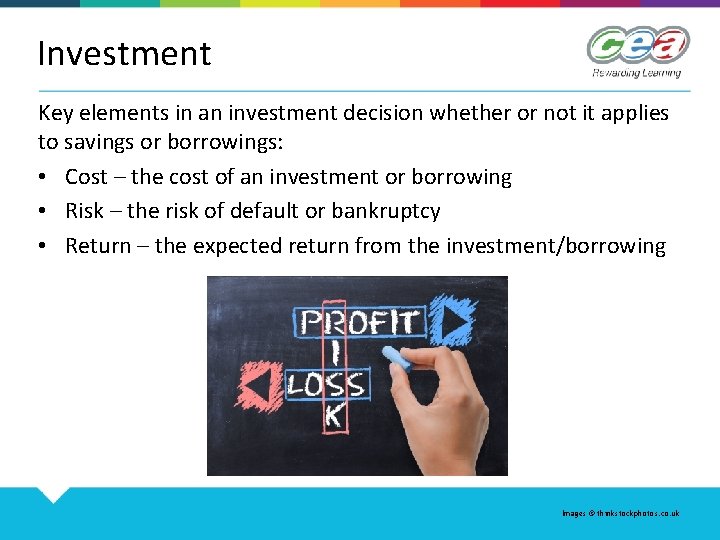
Investment Key elements in an investment decision whether or not it applies to savings or borrowings: • Cost – the cost of an investment or borrowing • Risk – the risk of default or bankruptcy • Return – the expected return from the investment/borrowing Images © thinkstockphotos. co. uk
Savings • Cost – bank deposit/savings account – a saver will lodge funds in an account – an opportunity cost might the a more profitable/alternative use of the funds • Risk – banks required to guarantee savings/deposits up to £ 85, 000 for individuals; • Return – low rates of return due to: (i) low levels of risk; (ii) low base rates in UK economy, to which bank interest rates are linked Images © thinkstockphotos. co. uk
Borrowings • Cost – an individual borrower will have to repay the principal and any interest charged • Risk – a lender will assess this based on the borrower’s credit status, amount borrowed, length of term in order to avoid default • Return - a lender will charge an interest rate (fixed or variable) on the funds advanced; unsecured debt tends to attract higher interest charges, secured debt tends to attract lower interest charges Images © thinkstockphotos. co. uk
Debt Definition: • Money borrowed by an individual which is repayable to a lender. Images © thinkstockphotos. co. uk
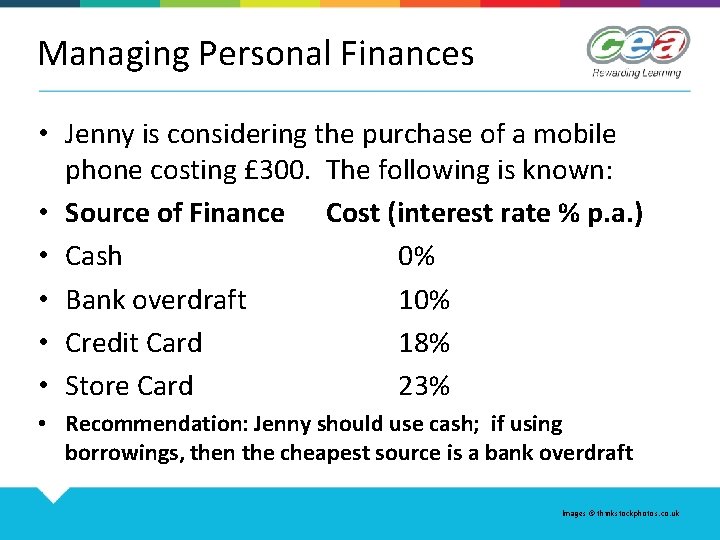
Managing Personal Finances • Jenny is considering the purchase of a mobile phone costing £ 300. The following is known: • Source of Finance Cost (interest rate % p. a. ) • Cash 0% • Bank overdraft 10% • Credit Card 18% • Store Card 23% • Recommendation: Jenny should use cash; if using borrowings, then the cheapest source is a bank overdraft Images © thinkstockphotos. co. uk
Debt The levels of consumer debt have increased in recent times, according to the UK government. Possible reasons for this include: • Static/Declining consumer incomes – consumers wish to maintain their existing levels of consumption, therefore will continue to use debt/borrowings to finance current lifestyles, despite static/declining levels of income Images © thinkstockphotos. co. uk
Credit • Affordability of Credit – in the context of low base rates of interest, many lenders have made it cheaper for consumers to borrow money, through the provision of credit facilities attracting low-cost interest charges, e. g. promotion of 0% interest deals on credit cards • Accessibility to credit – a relaxation of lending criteria coupled with low interest rates increases the accessibility to credit by consumers Images © thinkstockphotos. co. uk
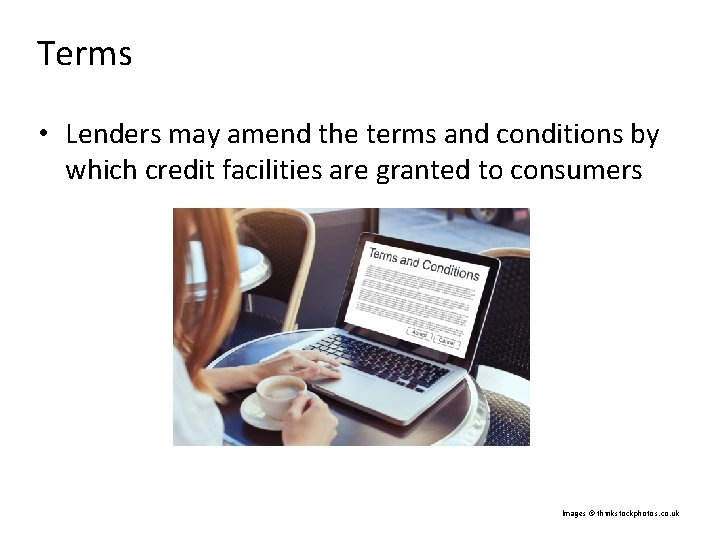
Terms • Lenders may amend the terms and conditions by which credit facilities are granted to consumers Images © thinkstockphotos. co. uk
Impact of Increasing Debt Levels • Consumers – a continual increase in the amount of debt could result in increased levels of insolvency/bankruptcy by individuals, since they will be unable to afford to repay existing debts, i. e. individual cash flows are likely to decrease since outgoings will eventually exceed income levels. • Increased levels of debt will also lead to consumers being refused access to additional credit in later life due to poor credit ratings. Images © thinkstockphotos. co. uk
Producers • Producers – increasing levels of debt will initially lead to a possible increase in demand (and potentially profits), since consumers will spend more to acquire goods/services. However, when credit options are exhausted, consumers will reduce spending and this will theoretically lead to a fall in sales/demand for goods/services, therefore profits are likely to decline Images © thinkstockphotos. co. uk
Economy • Economy – increasing levels of debt in the economy might initially lead to an increase in consumption and possible increases in the inflation rate as consumer confidence and spending rises. However, an increase in interest rates to reduce consumer spending might lead to an increase in debt repayments and possible bankruptcies as vulnerable consumers will face reduced incomes due to high levels of repayments on excessive levels of consumer debt Images © thinkstockphotos. co. uk
Sources of Reliable Financial Information • The Money Advice Service (https: //www. moneyadviceservice. org. uk/en) • Financial Services Providers regulated by the Prudential Regulation Authority (PRA) • Citizens Advice Bureau • Independent Financial Advisers • Debt Advice Northern Ireland (http: //www. debtadvicenorthernireland. co. uk/) Images © thinkstockphotos. co. uk
Avoiding Financial Difficulties • Ensure that income is greater than expenditure at all times • Maximise opportunities for earning income – part time/full time work; savings; tuition; income from hobbies • Reduce outgoings/spending/outgoings – keep spending to a minimum or essentials • If using credit – use cheapest source of credit i. e. 0% interest rates Images © thinkstockphotos. co. uk
Resolving Financial Difficulties Reduce spending on non-essential items Agree debt(s) outstanding and devise repayment plan Prioritise debts – pay state debts first – e. g. taxes Consolidate debts with one lender, or transfer debts to 0% interest facilities if possible • Use savings or sell personal assets – e. g. car, house • Discuss difficulties with lender and reschedule over longer time period • Contact debt advice charity or Citizens Advice Bureau • • Images © thinkstockphotos. co. uk
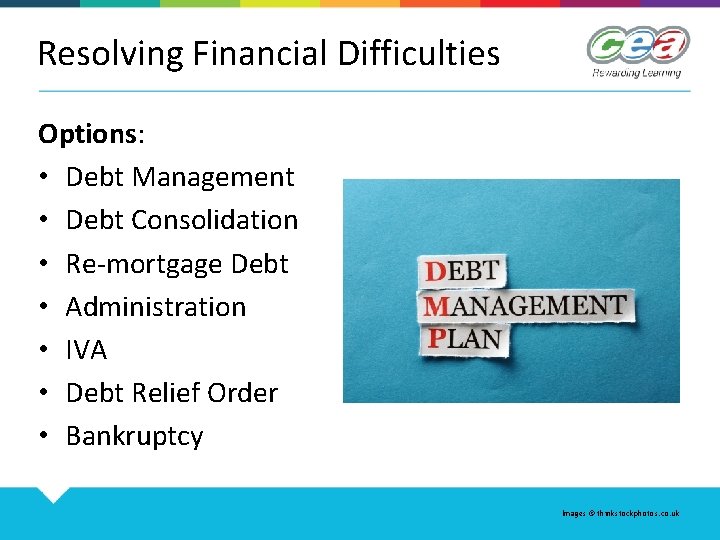
Resolving Financial Difficulties Options: • Debt Management • Debt Consolidation • Re-mortgage Debt • Administration • IVA • Debt Relief Order • Bankruptcy Images © thinkstockphotos. co. uk
Issues related to Debt • Moral: lenders are required to clearly disclose the facts related to credit agreements to consumers prior to completion of any loan agreements. Lenders are also required to provide a ‘cooling off’ period for consumers to allow them to change their minds after entering a loan agreement. Lenders therefore have a moral obligation to provide this information to consumers. Images © thinkstockphotos. co. uk
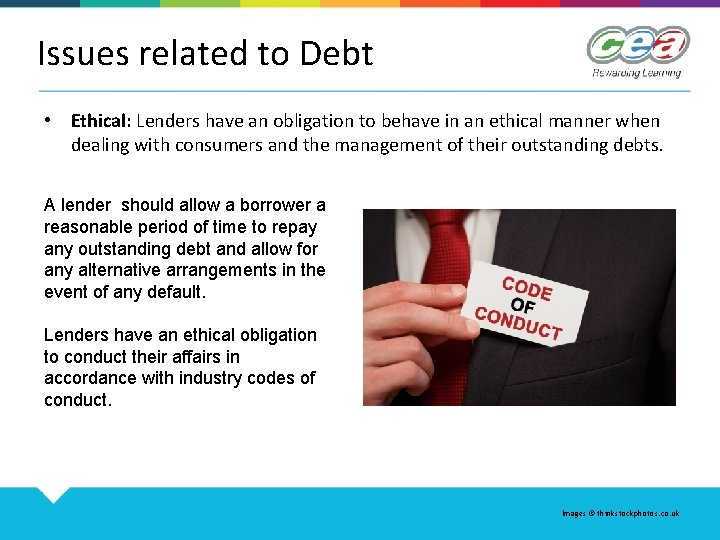
Issues related to Debt • Ethical: Lenders have an obligation to behave in an ethical manner when dealing with consumers and the management of their outstanding debts. A lender should allow a borrower a reasonable period of time to repay any outstanding debt and allow for any alternative arrangements in the event of any default. Lenders have an ethical obligation to conduct their affairs in accordance with industry codes of conduct. Images © thinkstockphotos. co. uk
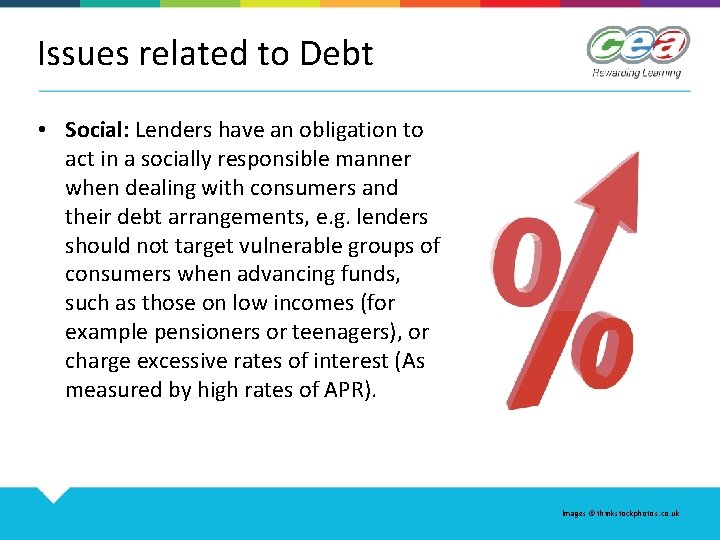
Issues related to Debt • Social: Lenders have an obligation to act in a socially responsible manner when dealing with consumers and their debt arrangements, e. g. lenders should not target vulnerable groups of consumers when advancing funds, such as those on low incomes (for example pensioners or teenagers), or charge excessive rates of interest (As measured by high rates of APR). Images © thinkstockphotos. co. uk
Issues related to Debt • Legislative: lenders must abide by the rules/regulations aimed at protecting the interests of consumers (e. g. consumer credit act) and comply with the requirements of the regulatory authorities (e. g. Financial Conduct Authority and Prudential Regulation Authority). This also applies to the procedures related to the recovery of bad debts or consumers who face the possibility of bankruptcy Images © thinkstockphotos. co. uk
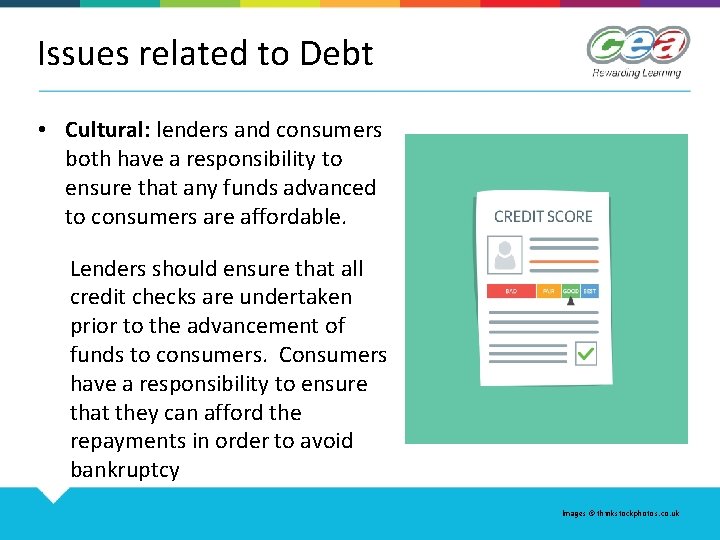
Issues related to Debt • Cultural: lenders and consumers both have a responsibility to ensure that any funds advanced to consumers are affordable. Lenders should ensure that all credit checks are undertaken prior to the advancement of funds to consumers. Consumers have a responsibility to ensure that they can afford the repayments in order to avoid bankruptcy Images © thinkstockphotos. co. uk
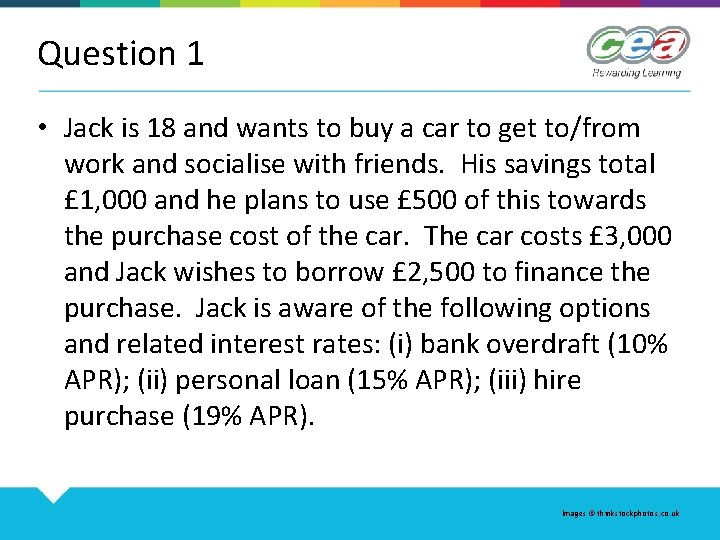
Question 1 • Jack is 18 and wants to buy a car to get to/from work and socialise with friends. His savings total £ 1, 000 and he plans to use £ 500 of this towards the purchase cost of the car. The car costs £ 3, 000 and Jack wishes to borrow £ 2, 500 to finance the purchase. Jack is aware of the following options and related interest rates: (i) bank overdraft (10% APR); (ii) personal loan (15% APR); (iii) hire purchase (19% APR). Images © thinkstockphotos. co. uk
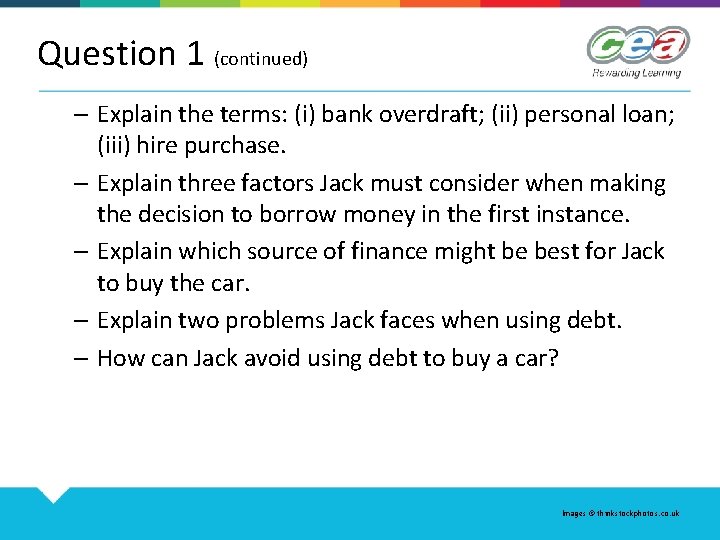
Question 1 (continued) – Explain the terms: (i) bank overdraft; (ii) personal loan; (iii) hire purchase. – Explain three factors Jack must consider when making the decision to borrow money in the first instance. – Explain which source of finance might be best for Jack to buy the car. – Explain two problems Jack faces when using debt. – How can Jack avoid using debt to buy a car? Images © thinkstockphotos. co. uk
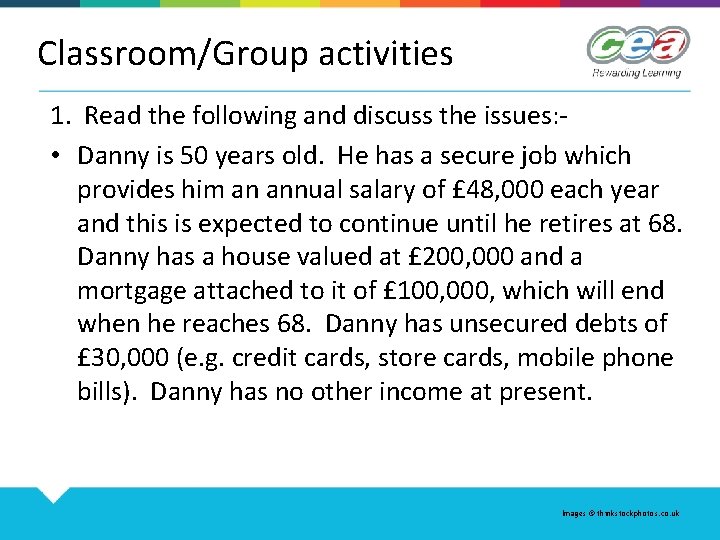
Classroom/Group activities 1. Read the following and discuss the issues: • Danny is 50 years old. He has a secure job which provides him an annual salary of £ 48, 000 each year and this is expected to continue until he retires at 68. Danny has a house valued at £ 200, 000 and a mortgage attached to it of £ 100, 000, which will end when he reaches 68. Danny has unsecured debts of £ 30, 000 (e. g. credit cards, store cards, mobile phone bills). Danny has no other income at present. Images © thinkstockphotos. co. uk
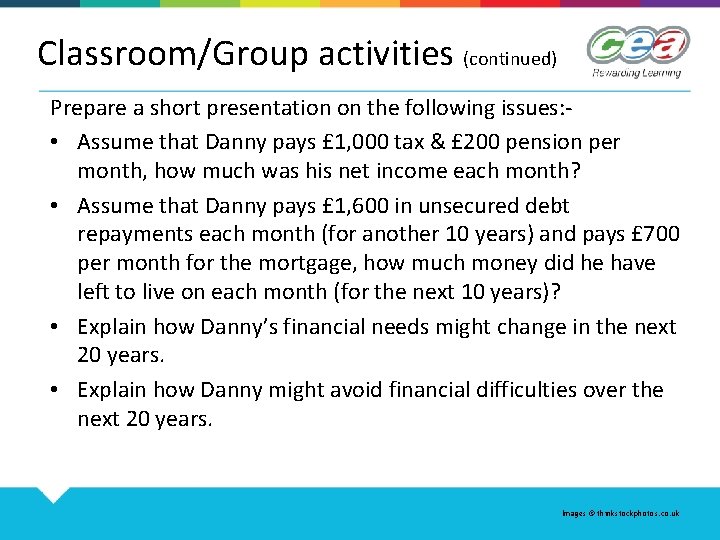
Classroom/Group activities (continued) Prepare a short presentation on the following issues: • Assume that Danny pays £ 1, 000 tax & £ 200 pension per month, how much was his net income each month? • Assume that Danny pays £ 1, 600 in unsecured debt repayments each month (for another 10 years) and pays £ 700 per month for the mortgage, how much money did he have left to live on each month (for the next 10 years)? • Explain how Danny’s financial needs might change in the next 20 years. • Explain how Danny might avoid financial difficulties over the next 20 years. Images © thinkstockphotos. co. uk
Classroom/Group activities (continued) 2. Using a personal friend or close relative as a worked example, for each of the following situations, compare/contrast examples of the following financial products/services as a way of meeting that person’s financial needs: • Premium bonds v high interest deposit account (£ 30, 000 available) • Bank overdraft v bank loan (for a £ 600 laptop pc) • Hire purchase v leasing (for a £ 12, 000 Ford Fiesta car payable over 4 years) • Car insurance v no insurance (to insure the car stated above) • Life insurance v ‘death only’ policy (£ 20, 000 cover needed) • Private pension v state pension (£ 800 per month needed) Images © thinkstockphotos. co. uk
Classroom/Group activities (continued) 3. As interest rates start to increase from their current base rate of 0. 25% (2016), the UK government is concerned about the high levels of personal debt. It plans to keep checking the rules/regulations that financial services providers use when lending to individual consumers. Images © thinkstockphotos. co. uk
Managing Personal Finances • As a student on work experience in a local debt charity, you are required to prepare notes for use by staff/volunteers in meeting customers using the services of the charity on the following: – Explain 2 types of credit services offered by the following: (a) banks; (b) credit union; (c) one other financial services provider. – Explain how these financial services providers must protect their consumers. – Discuss how increasing levels of personal debt affects: (a) individual consumers; and (b) economy. Images © thinkstockphotos. co. uk
Managing Personal Finances • Notes: Images © thinkstockphotos. co. uk