
GCSE Construction The Built Environment Domestic Stair Design

GCSE Construction & The Built Environment Domestic Stair Design

Function • The function of stairs is to provide easy walking access from one floor or level to another in safety. • Stairs must be strong enough to carry the weight of people using them and also the weight of any – equipment or furniture being moved from one level to another. • Stairs must be fire resistant for a sufficient length of time to provide a safe means of escape for the occupants of the building.
Stair Terminology Some of the main terms associated with stair construction and design are: Stairs: The number of steps and landings leading from one floor level to another. Stairwell: The space occupied by the stairs. Flight: Continuous set of steps from one floor to another floor or to a landing. Landing: Platform between two flights to serve as a rest. Also used to change the direction of stairs.
Component Parts Tread: The upper surface of a step (where the foot is placed). Riser: The vertical member connecting two treads. Nosing: The distance that treads project beyond the riser usually. Step: It consists of the tread and riser supported by the strings. The number of steps is governed by the floor height. Going: The horizontal distance between the face of one riser and the face of the next. Rise: The vertical distance between the top of a thread and the top of the thread above or below it. The rise of a flight is the overall height from the finished level of one floor or landing to the finished level of the adjoining floor or landing.
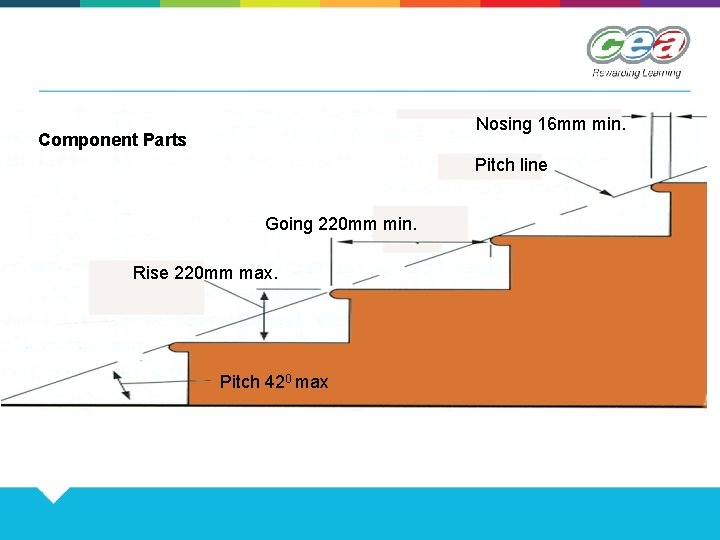
Nosing 16 mm min. Component Parts Pitch line Going 220 mm min. Rise 220 mm max. Pitch 420 max
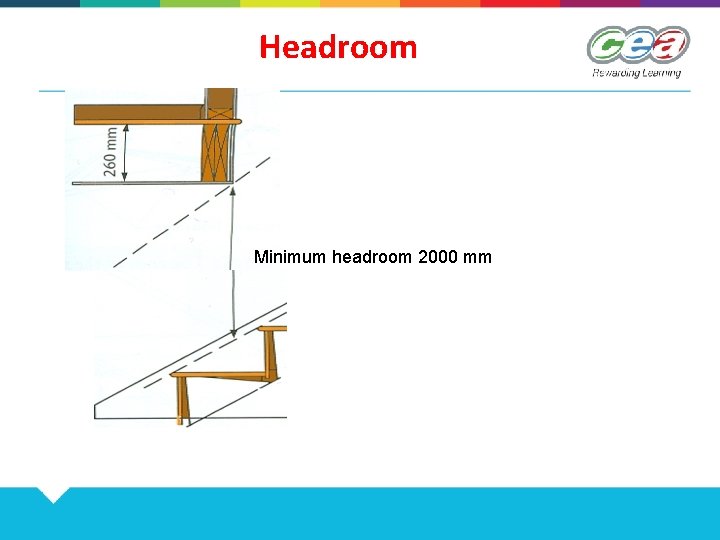
Headroom Minimum headroom 2000 mm
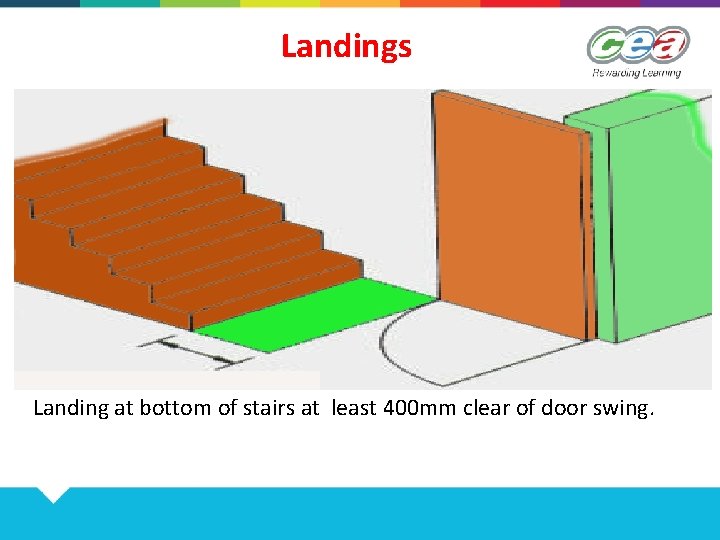
Landings Landing at bottom of stairs at least 400 mm clear of door swing.

Stair Design Of the many aspects to be considered when a stair is designed, the following should receive prime consideration: a) The fitting of the proposed stair – whethere is enough room. b) Construction and installation details must conform with current building regulations. c) Suitable material for the stair members. d) The finished appearance (aesthetics).
Stair Design There should not be more than sixteen risers in any one flight. This is the maximum number of steps that the average person can climb safely without requiring a rest. A flight containing one or two risers should be situated at the bottom of the stairs. • The rise for the step is calculated by dividing the overall rise by the chosen number of risers. • The going for the step is selected to suit the available floor area while ensuring that, together with the rise, the Building Regulations are complied with. • The number of steps in any one flight will be one less than the number of risers. This is because the last riser connects with the landing.
Stair Design Example Going (G): Rise (R): Pitch: 220 mm min. (250 mm optimum). 220 mm max. (175 mm optimum). 420 max (350 optimum). To comply with the Building Regulations the following formula is used: (2 R+G) Where R: Riser & G: Going Should be between 550 mm and 700 mm.
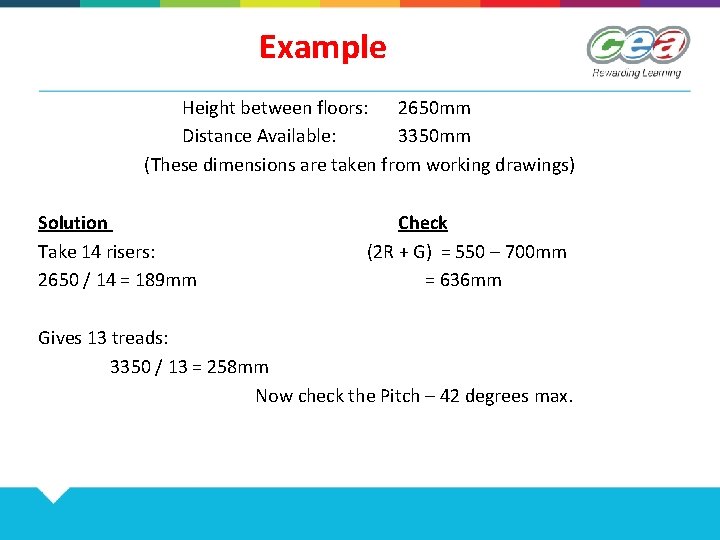
Example Height between floors: 2650 mm Distance Available: 3350 mm (These dimensions are taken from working drawings) Solution Take 14 risers: 2650 / 14 = 189 mm Check (2 R + G) = 550 – 700 mm = 636 mm Gives 13 treads: 3350 / 13 = 258 mm Now check the Pitch – 42 degrees max.
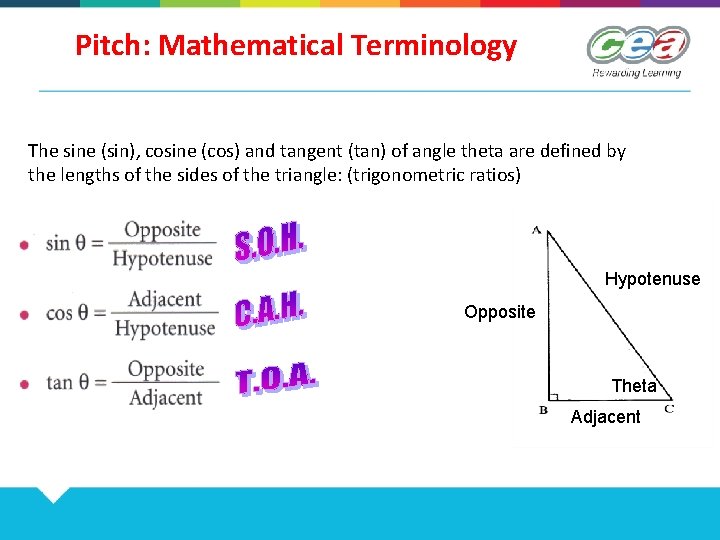
Pitch: Mathematical Terminology The sine (sin), cosine (cos) and tangent (tan) of angle theta are defined by the lengths of the sides of the triangle: (trigonometric ratios) Hypotenuse Opposite Theta Adjacent
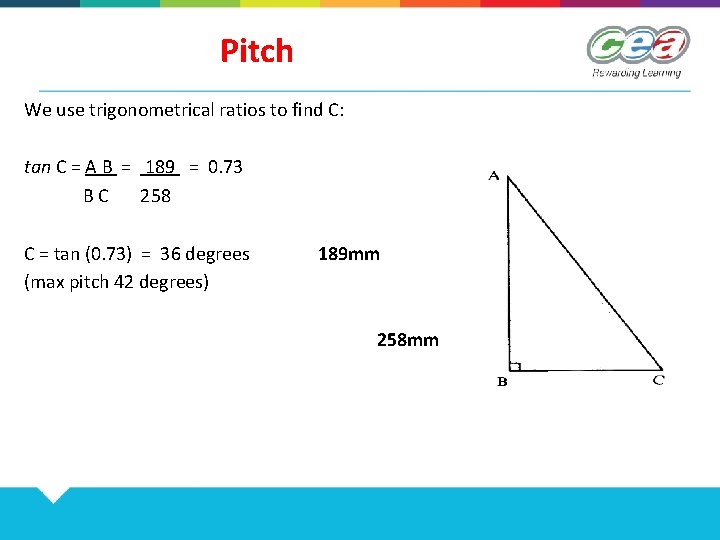
Pitch We use trigonometrical ratios to find C: tan C = A B = 189 = 0. 73 BC 258 C = tan (0. 73) = 36 degrees (max pitch 42 degrees) 189 mm 258 mm
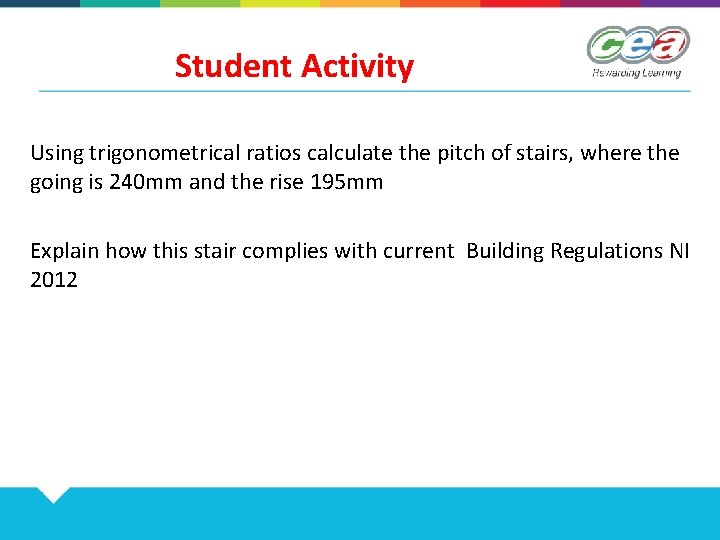
Student Activity Using trigonometrical ratios calculate the pitch of stairs, where the going is 240 mm and the rise 195 mm Explain how this stair complies with current Building Regulations NI 2012
- Slides: 15