
GCSE Compound Measures Rates of Flow Dr J


![Exercise 1 a 11 [Edexcel GCSE June 2014 -1 H Q 14] Emily is](https://slidetodoc.com/presentation_image/3a40383959cd61e08acd70a744768601/image-9.jpg "Exercise 1 a 11 [Edexcel GCSE June 2014 -1 H Q 14] Emily is")

![Exercise 1 b 1 [Edexcel GCSE June 2016 -2 H Q 14 Edited] The](https://slidetodoc.com/presentation_image/3a40383959cd61e08acd70a744768601/image-12.jpg "Exercise 1 b 1 [Edexcel GCSE June 2016 -2 H Q 14 Edited] The")
![Exercise 1 b 3 [Edexcel GCSE Nov 2011 -3 H Q 16] The diagram](https://slidetodoc.com/presentation_image/3a40383959cd61e08acd70a744768601/image-13.jpg "Exercise 1 b 3 [Edexcel GCSE Nov 2011 -3 H Q 16] The diagram")



![Exercise 3 3 4 [Frost] A cone of radius 2 cm and height](https://slidetodoc.com/presentation_image/3a40383959cd61e08acd70a744768601/image-27.jpg "Exercise 3 3 4 [Frost] A cone of radius 2 cm and height")
- Slides: 27
GCSE Compound Measures & Rates of Flow Dr J Frost (jfrost@tiffin. kingston. sch. uk) www. drfrostmaths. com @Dr. Frost. Maths Last modified: 21 st March 2018
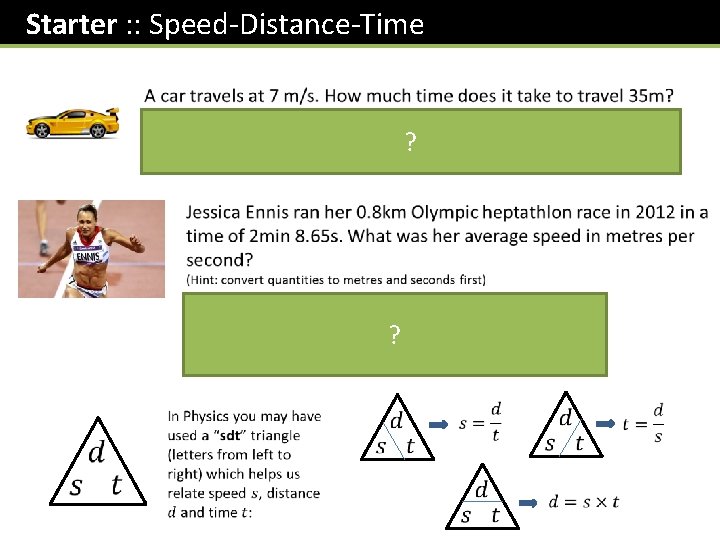
Starter : : Speed-Distance-Time ? ?
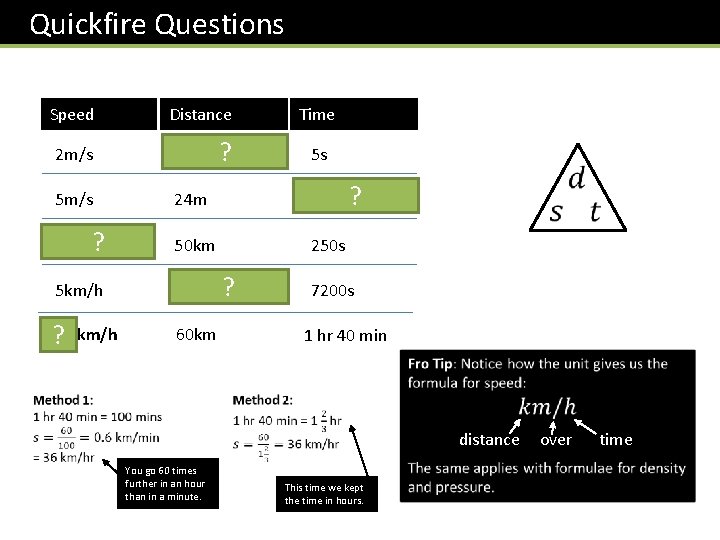
Quickfire Questions Speed Distance Time ? 2 m/s 10 m 5 s 5 m/s 24 m 4. 8 s 0. 2 km/s ? 50 km 250 s 5 km/h 10 km ? 36 km/h 60 km ? ? 7200 s 1 hr 40 min distance You go 60 times further in an hour than in a minute. This time we kept the time in hours. over time
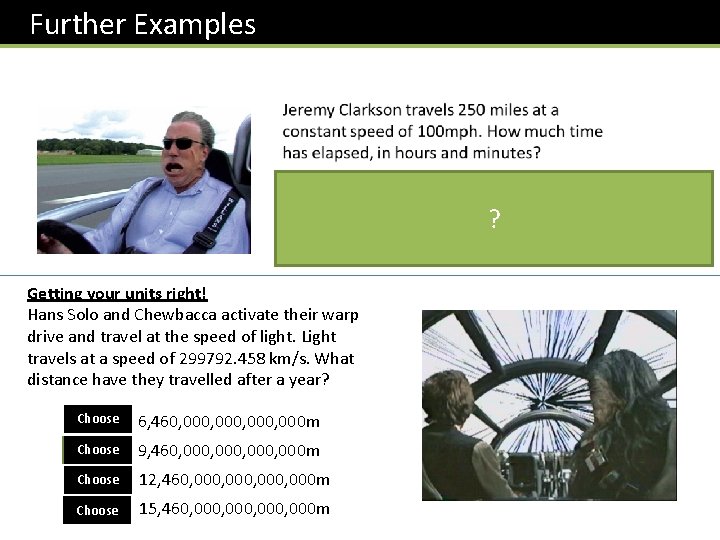
Further Examples Getting your units right! Hans Solo and Chewbacca activate their warp drive and travel at the speed of light. Light travels at a speed of 299792. 458 km/s. What distance have they travelled after a year? Choose 6, 460, 000, 000 m 9, 460, 000, 000 m 12, 460, 000, 000 m 15, 460, 000, 000 m ?
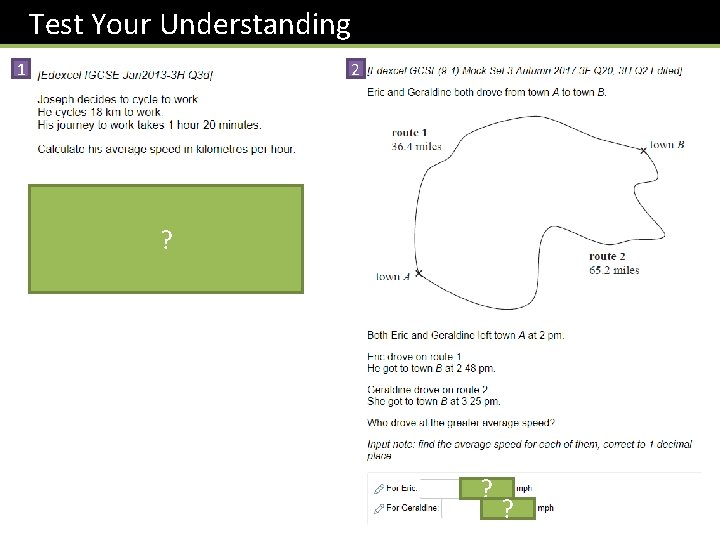
Test Your Understanding 1 2 ? ? 45. 5 ? 46. 0
Density gives us a measure of how tightly packed matter is within a space. This is a rock. The density of a rock is 2. 3 g/cm 3. Work out the mass of a piece of this rock with a volume of 20 cm 3. ? Test Your Understanding: ? 19. 3 Again, the unit of g/cm 3 allows you to work out the formula for density if you forget.
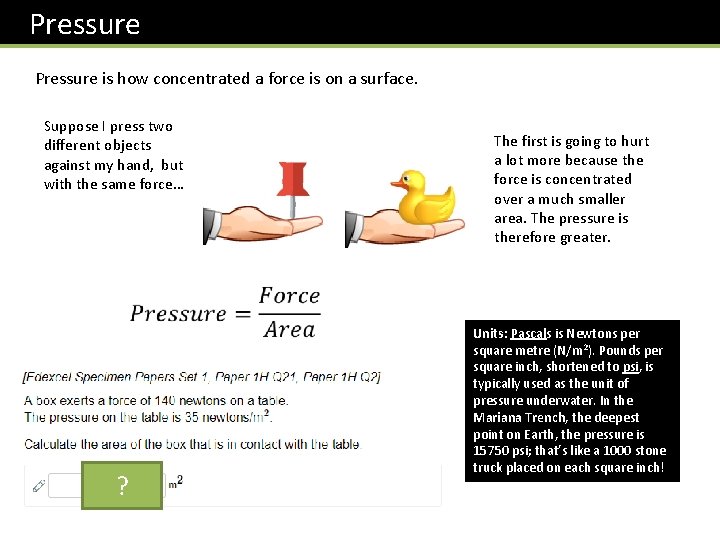
Pressure is how concentrated a force is on a surface. Suppose I press two different objects against my hand, but with the same force… The first is going to hurt a lot more because the force is concentrated over a much smaller area. The pressure is therefore greater. ? Units: Pascals is Newtons per square metre (N/m 2). Pounds per square inch, shortened to psi, is typically used as the unit of pressure underwater. In the Mariana Trench, the deepest point on Earth, the pressure is 15750 psi; that’s like a 1000 stone truck placed on each square inch!
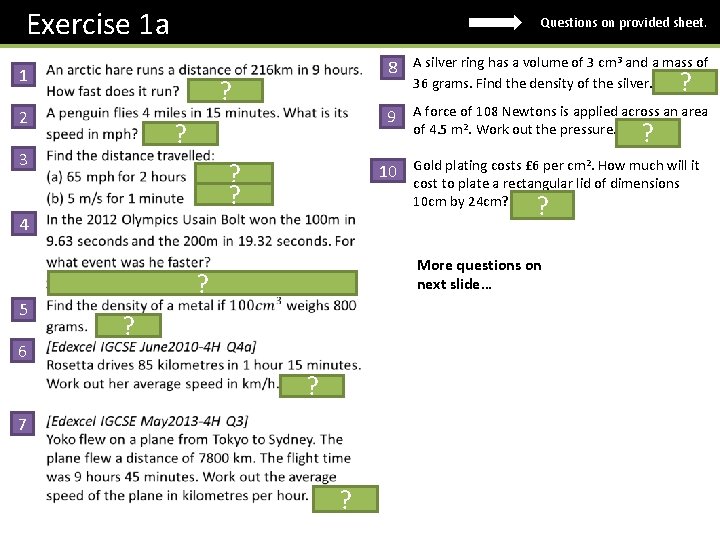
Exercise 1 a 1 Questions on provided sheet. 3 8 A silver ring has a volume of 3 cm and a mass of ? ? 2 36 grams. Find the density of the silver. 12 g/cm 3 9 A force of 108 Newtons is applied across an area 2 2 ? ? 3 of 4. 5 m. Work out the pressure. 24 N/m 2 10 Gold plating costs £ 6 per cm. How much will it ? ? cost to plate a rectangular lid of dimensions 10 cm by 24 cm? £ 1440 ? 4 5 6 More questions on next slide… ? ? ? 7 ?
Exercise 1 a 11 [Edexcel GCSE June 2014 -1 H Q 14] Emily is driving in France. She sees this sign. Emily is going to drive to Dijon. She plans to drive at an average speed of 50 miles per hour. Work out how long it should take Emily to drive to Dijon. N 1 [IMC 2003 Q 16] After a year’s training, Minnie Midriffe increased her average speed in the London Marathon by 25%. By what percentage did her time decrease? 20% ? N 2 [JMC 2011 Q 21] Gill leave Lille by train at 09: 00. The train travels the first 27 km at 96 km/h. It then stops at Lens for 3 minutes before travelling the final 29 km to Lillers at 96 km/h. At what time does Gill arrive at Lillers? 9: 58 ? ? 12 ?
Density involving Volumes Sometimes we have to work out the volume of the solid ourselves, before subsequently working out density or mass. ? ? Fro Tip: Ensure any units are consistent with the others. If the unit of density is g/cm 3, then your mass will be in grams.
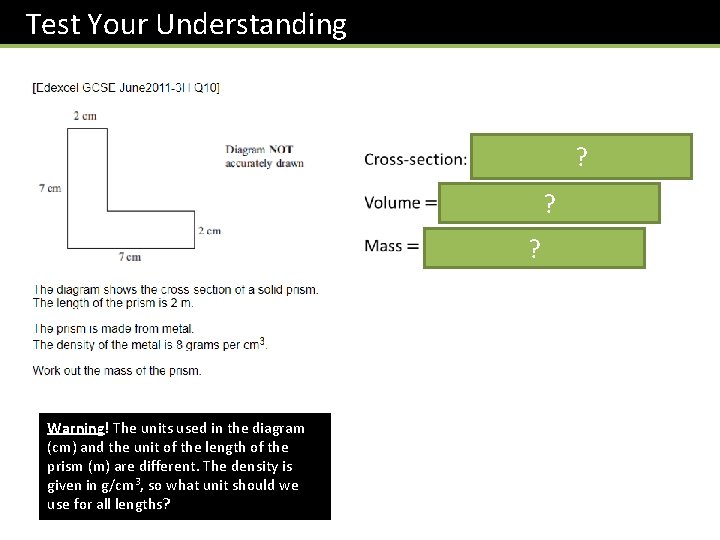
Test Your Understanding ? ? ? Warning! The units used in the diagram (cm) and the unit of the length of the prism (m) are different. The density is given in g/cm 3, so what unit should we use for all lengths?
Exercise 1 b 1 [Edexcel GCSE June 2016 -2 H Q 14 Edited] The diagram shows a metal bar in the shape of a prism. The length of the metal bar is 120 cm. The cross section of the metal bar is shown below. All corners are right angles. The metal bar is made from steel with density 8 g/cm 3. Sean has a trolley. The trolley can carry a maximum mass of 250 kg. How many metal bars can the trolley carry at the same time? 3 metal bars ? 2 [Edexcel GCSE(9 -1) Mock Set 1 Autumn 2016 3 H Q 12 Edited] The diagram shows a piece of wood in the shape of a cuboid. The piece of wood is 3 cm by 20 cm by 1. 2 m. The mass of the piece of wood is 8 kg. The piece of wood will float in sea water if the density of the wood is less than the density of the sea water. In a large pool, 1 litre of sea water has a mass of 1030 g. Will the piece of wood float in this pool? Justify your answer. [Note: 1 litre = 1000 cm 3] Wood: 1. 11 g/cm 3, Water: 1. 03 g/cm 3 1. 11 > 1. 03 so wood? will sink (i. e. not float)
Exercise 1 b 3 [Edexcel GCSE Nov 2011 -3 H Q 16] The diagram shows a solid prism made from metal. The cross-section of the prism is a trapezium. The parallel sides of the trapezium are 8 cm and 12 cm. The height of the trapezium is 6 cm. The length of the prism is 20 cm. The density of the metal is 5 g/cm 3. Calculate the mass of the prism. Give your answer in kilograms. 6 kg ? 4 [Edexcel GCSE June 2008 -4 H Q 13 b] A solid cylinder has a radius of 4 cm and a height of 10 cm. The cylinder is made from wood. The density of the wood is 0. 6 grams per cm 3. Work out the mass of the cylinder. Give your answer correct to 3 significant figures. 302 g ?
Combining parts of a journey Sometimes a journey may consist of multiple parts. Given the large amount of information to process, you may find it helpful to arrange it in a table. Use the rows for speed, distance and time, and the columns for each leg of the journey: Speed 40 mph 54 mph ? Distance 10 miles 18 miles Time 1/4 hr ? 1/3 hrs ?
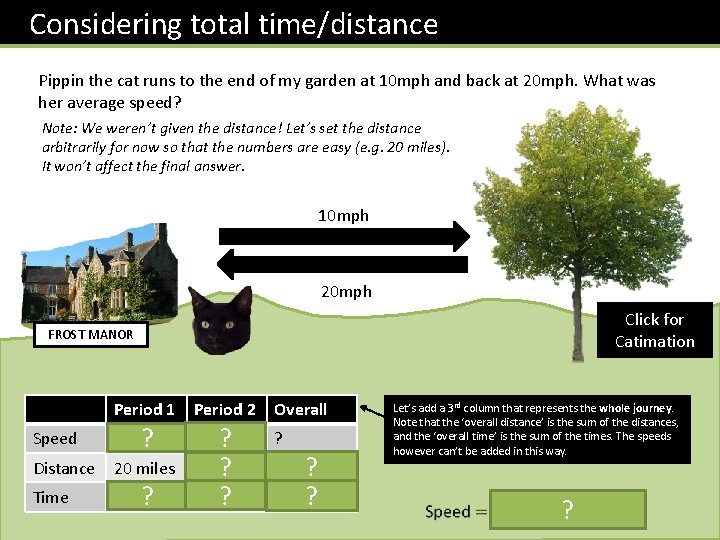
Considering total time/distance Pippin the cat runs to the end of my garden at 10 mph and back at 20 mph. What was her average speed? Note: We weren’t given the distance! Let’s set the distance arbitrarily for now so that the numbers are easy (e. g. 20 miles). It won’t affect the final answer. 10 mph 20 mph Click for Catimation FROST MANOR Period 1 Speed 10 mph ? Distance 20 miles Time 2 hours ? Period 2 20 mph ? 20 miles ? 1 hour ? Overall ? 40 miles ? 3 hours ? Let’s add a 3 rd column that represents the whole journey. Note that the ‘overall distance’ is the sum of the distances, and the ‘overall time’ is the sum of the times. The speeds however can’t be added in this way. ?
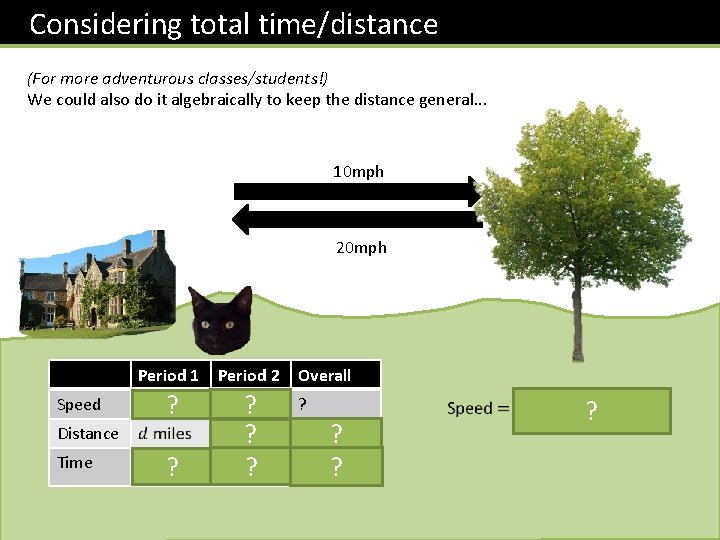
Considering total time/distance (For more adventurous classes/students!) We could also do it algebraically to keep the distance general. . . 10 mph 20 mph Speed Period 1 Period 2 Overall 10 mph ? 20 mph ? ? Distance Time ? ? ? ?
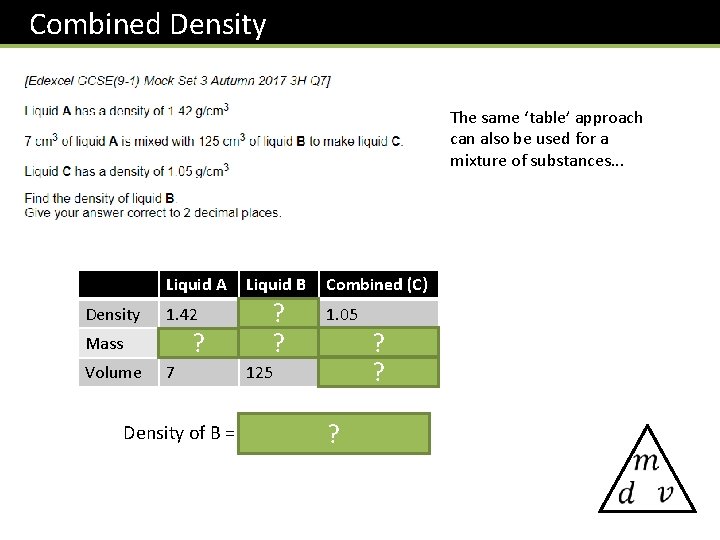
Combined Density The same ‘table’ approach can also be used for a mixture of substances. . . Liquid A Liquid B Combined (C) Density 1. 42 1. 05 Mass 9. 94? 1. 02928 ? 128. 66 ? 138. 6 ? Volume 7 125 132 ? Density of B = 1. 03 g/cm 3? (to 2 dp)
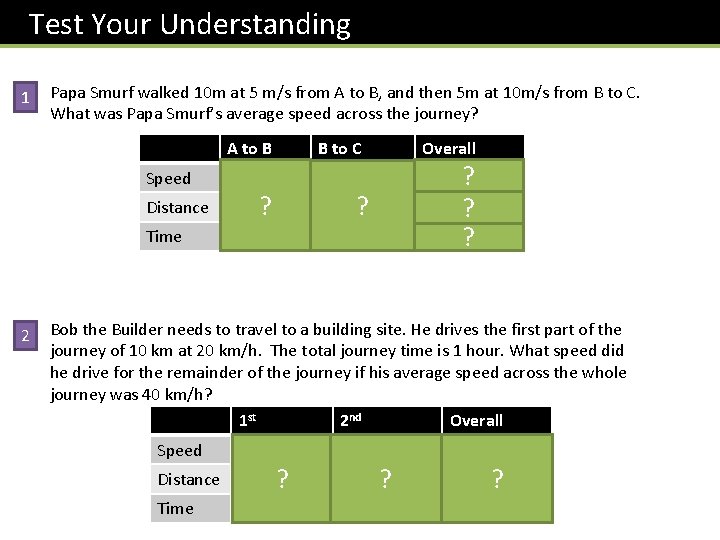
Test Your Understanding 1 Papa Smurf walked 10 m at 5 m/s from A to B, and then 5 m at 10 m/s from B to C. What was Papa Smurf’s average speed across the journey? Speed 2 A to B B to C 5 m/s 10 m/s 6 m/s? 5 m 15 m Distance 10 m? Time 2 seconds ? 0. 5 seconds Overall 2. 5 s ? ? Bob the Builder needs to travel to a building site. He drives the first part of the journey of 10 km at 20 km/h. The total journey time is 1 hour. What speed did he drive for the remainder of the journey if his average speed across the whole journey was 40 km/h? 1 st 2 nd Overall Speed 20 km/h 60 km/h 40 km/h Distance 10 km? 30 km? 40 km? Time 0. 5 hr 1 hr
Exercise 2 4 1 ? 2 5 ? 3 ? 6 ? ?
Exercise 2 N 1 N 2 ? ?
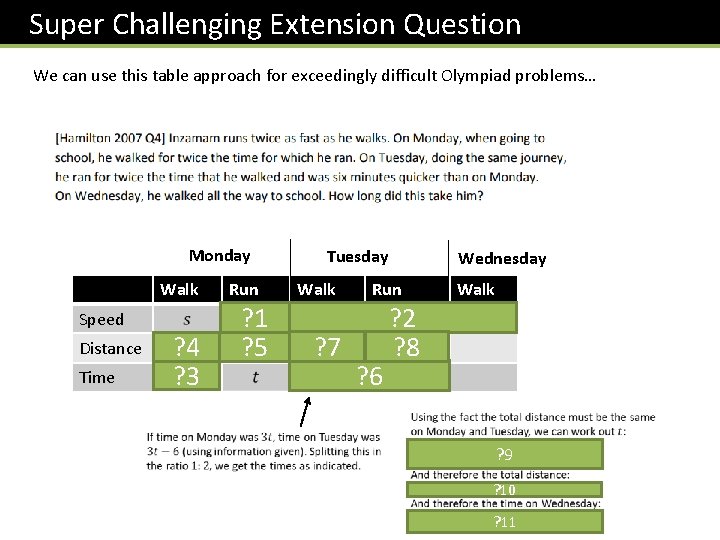
Super Challenging Extension Question We can use this table approach for exceedingly difficult Olympiad problems… Monday Walk Speed ? 4 ? 3 Distance Time Run ? 1 ? 5 Tuesday Walk ? 7 Wednesday Run ? 6 ? 2 ? 8 Walk ? 9 ? 10 ? 11
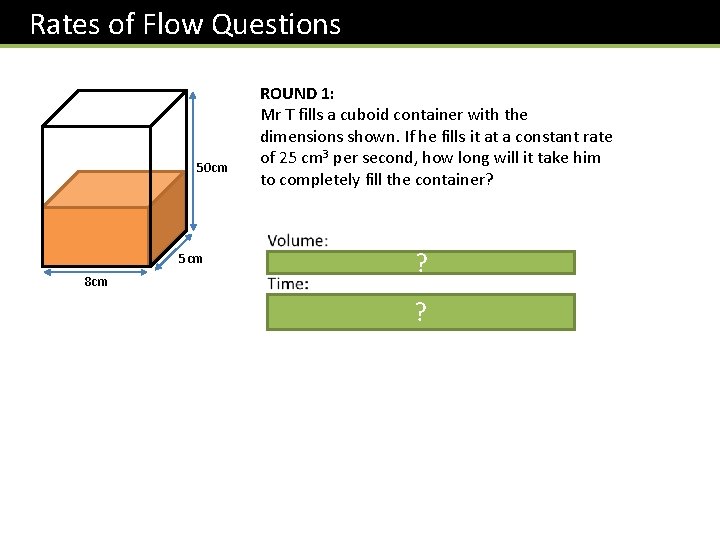
Rates of Flow Questions 50 cm 5 cm 8 cm ROUND 1: Mr T fills a cuboid container with the dimensions shown. If he fills it at a constant rate of 25 cm 3 per second, how long will it take him to completely fill the container? ? ?
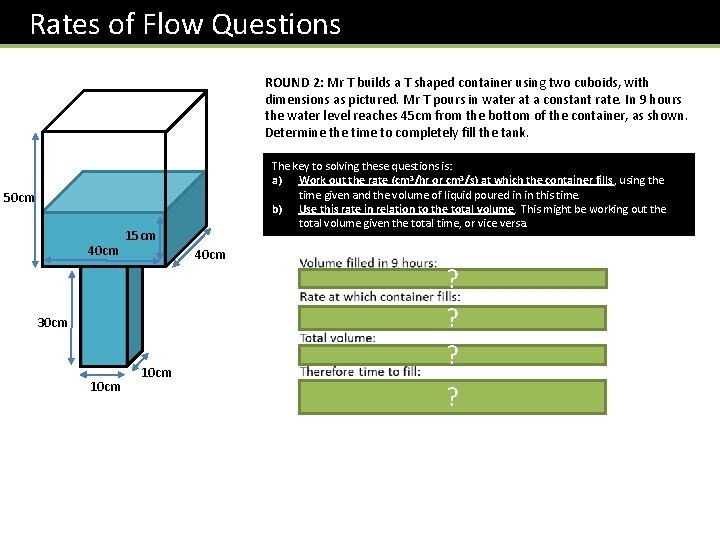
Rates of Flow Questions ROUND 2: Mr T builds a T shaped container using two cuboids, with dimensions as pictured. Mr T pours in water at a constant rate. In 9 hours the water level reaches 45 cm from the bottom of the container, as shown. Determine the time to completely fill the tank. The key to solving these questions is: a) Work out the rate (cm 3/hr or cm 3/s) at which the container fills, using the time given and the volume of liquid poured in in this time. b) Use this rate in relation to the total volume. This might be working out the total volume given the total time, or vice versa. 50 cm 40 cm 15 cm 40 cm 30 cm 10 cm ? ?
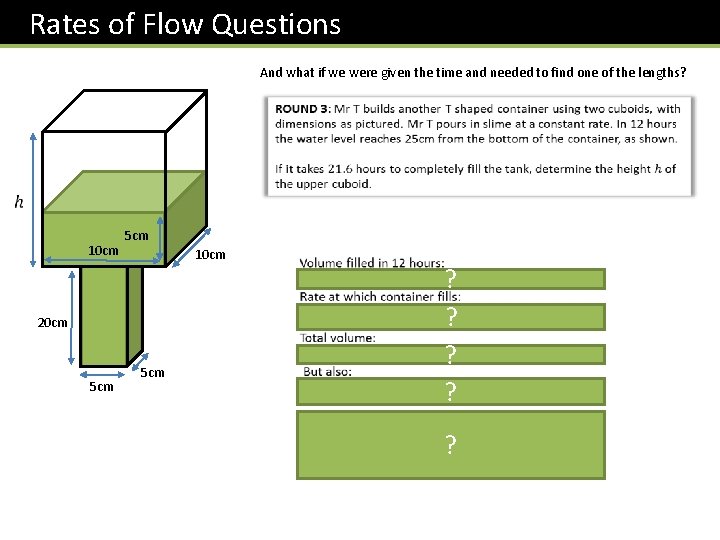
Rates of Flow Questions And what if we were given the time and needed to find one of the lengths? 10 cm 5 cm 10 cm 20 cm 5 cm ? ? ?
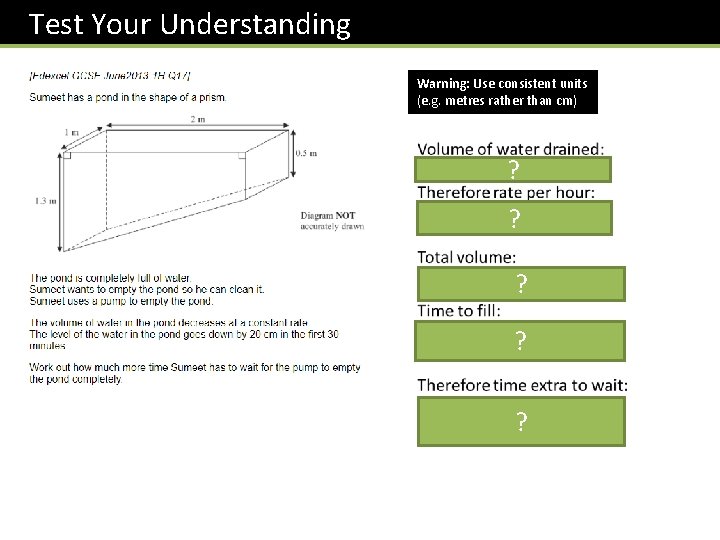
Test Your Understanding Warning: Use consistent units (e. g. metres rather than cm) ? ? ?
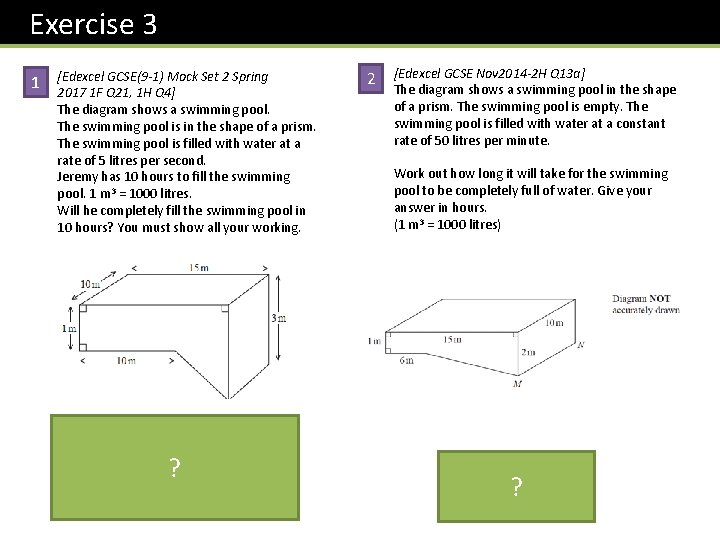
Exercise 3 1 [Edexcel GCSE(9 -1) Mock Set 2 Spring 2017 1 F Q 21, 1 H Q 4] The diagram shows a swimming pool. The swimming pool is in the shape of a prism. The swimming pool is filled with water at a rate of 5 litres per second. Jeremy has 10 hours to fill the swimming pool. 1 m 3 = 1000 litres. Will he completely fill the swimming pool in 10 hours? You must show all your working. 2 [Edexcel GCSE Nov 2014 -2 H Q 13 a] The diagram shows a swimming pool in the shape of a prism. The swimming pool is empty. The swimming pool is filled with water at a constant rate of 50 litres per minute. Work out how long it will take for the swimming pool to be completely full of water. Give your answer in hours. (1 m 3 = 1000 litres) ? 65 hours ?
Exercise 3 3 4 [Frost] A cone of radius 2 cm and height 4 cm is gradually filled with water at a constant rate. After 37 hours that water level has risen to 1 cm. How long will it take the cone to completely fill with water? 4 cm 2 cm ? ?