
GCSE Business Studies Unit 1 Introduction to a
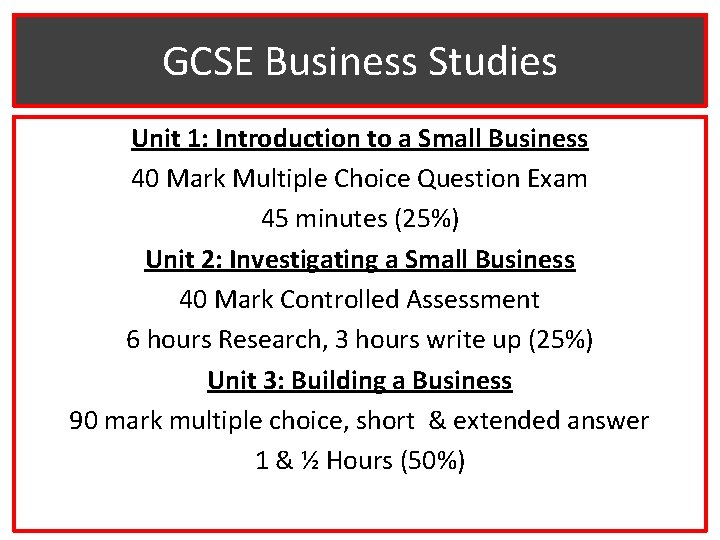
GCSE Business Studies Unit 1: Introduction to a Small Business 40 Mark Multiple Choice Question Exam 45 minutes (25%) Unit 2: Investigating a Small Business 40 Mark Controlled Assessment 6 hours Research, 3 hours write up (25%) Unit 3: Building a Business 90 mark multiple choice, short & extended answer 1 & ½ Hours (50%)
Unit 1: Introduction to a Small Business 1. 1: Spotting a Business Opportunity 1. 2: Showing Enterprise 1. 3: Putting a business idea into practice 1. 4: Making the start-up effective 1. 5: The Economic Context
1. 1: Spotting a Business Opportunity LO 1 About businesses LO 2 Understanding customer needs LO 3 Market mapping LO 4 Competition LO 5 Adding value LO 6 Franchising
LO 1 About businesses Most businesses are small, employing less than 50 staff
LO 1 About businesses Businesses exist to buy and sell goods and services
LO 1 About businesses Goods – physical items (baked beans) Services - non physical (taxi Journey)
LO 1 About businesses Most businesses close within one year of opening
LO 1 About businesses Supplies: businesses that sell products to other businesses Customers: A person or organisation that is supplied with a product or service
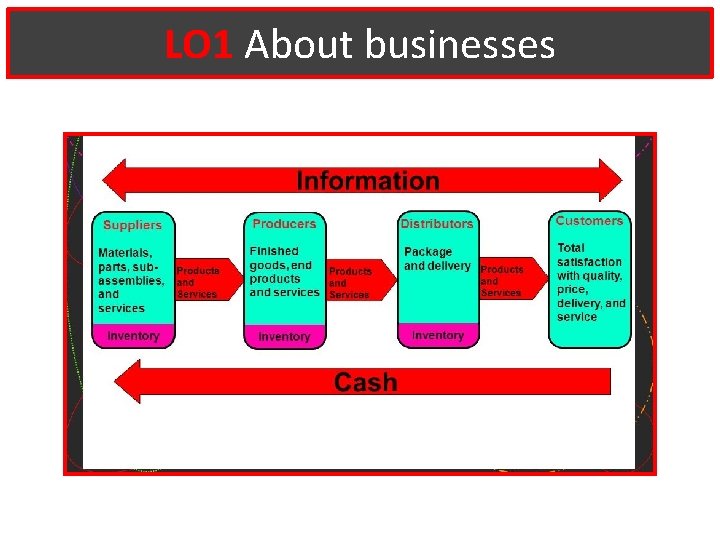
LO 1 About businesses
LO 2 Understanding customer needs Customer needs- wants and desires of buyers of the product/ service: • Location • Price • Product range • Product quality
LO 2 Understanding customer needs Market research: Gaining information about the product, service, competition or market
LO 2 Understanding customer needs Primary research (Field): First hand research, it has not been collected before - Questionnaire - Focus group - Observation - Taste Test
LO 2 Understanding customer needs Secondary Research (Desk): Has been collected before, created by another person/ group - Websites - Census (national survey) - Financial data - Industry research
LO 2 Understanding customer needs Quantitative data: - You can use to make graphs - It is numerical data - Eg; % of customers aged 12 -24 - Closed questions
LO 2 Understanding customer needs Qualitative data: - Is opinions and words - Judgements and attitudes - Open questions
LO 3 Market mapping Buying through habit: Habit means customers buy that product as a force of habit, rather than actually preferring it. Eg; Colgate toothpaste
LO 3 Market mapping Buying through preference: Preference means customers buy that product because they actually like it more than the alternatives Eg; Cadbury chocolate
LO 3 Market mapping Market segmentation: This is a part of the market that has groups of buyers with similar buying habits, such as age or income Eg; i. Phones target different segments Teens, middle aged business people
LO 3 Market mapping Market maps allow you to show the posibble positions in the market you may plce your product, based on two features, eg price and quality You map the competition and see where there are the least competitors, this is the ‘gap in the market’

LO 3 Market mapping
LO 4 Competition Analysing the market allows you to compare your product features against the competition: - Price - Location - Quality - Brand Image - Design
LO 4 Competition You should look at the strengths and weaknesses of the competition Then you can work out where there are opportunities and threats to your business plan
LO 5 Adding value: increasing the worth of your product Difference between the price you buy the original product for and what you sell it for
LO 5 Adding value There are many sources of added value: • convenience and speed • Branding • Quality • Design • unique selling point.
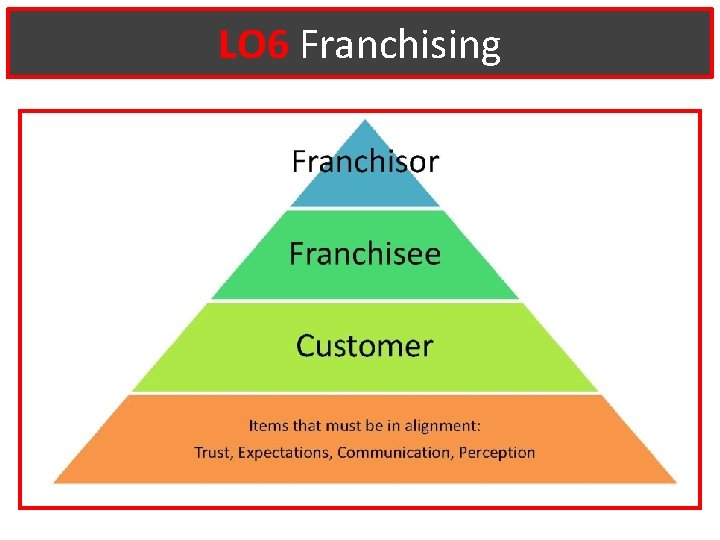
LO 6 Franchising
LO 6 Franchising Franchise advantages: • Support • Training • Equipment • Reputable business name and product • Well Established brand • Loyal customers
LO 6 Franchising Franchise disadvantages: • Costs • Lack of creativity allowed • Cost of start up • % of profits paid to franchisor (royalty)
1. 2: Showing Enterprise LO 1 What is enterprise LO 2 Thinking creatively LO 3 Entrepreneurs questions LO 4 Invention and innovation LO 5 Taking calculated risks LO 6 Other enterprise skills
LO 1 What is enterprise Enterprise: another word for business
LO 1 What is enterprise Entrepreneur: • Willing to take risks • Shows initiative • Willing to undertake new ventures
LO 2 Thinking creatively: coming up with new ideas
LO 2 Thinking creatively Deliberate creativity: intentional creation of new ideas through recognised and accepted techniques
LO 2 Thinking creatively Lateral thinking: thinking differently to find new and unexpected ideas
LO 2 Thinking creatively Blue skies thinking: participants are asked to think of as many ideas as possible about an issue or problem, they are then analysed
LO 2 Thinking creatively Six Hats thinking: 6 different techniques to organise and focus on ideas

LO 3 Entrepreneurs questions It is important for entrepreneurs to ask: • ‘why? ’, • ‘why not? ’ • ‘what if? ’
LO 3 Entrepreneurs questions It is important for entrepreneurs to ask: • ‘why? ’, • ‘why not? ’ • ‘what if? ’
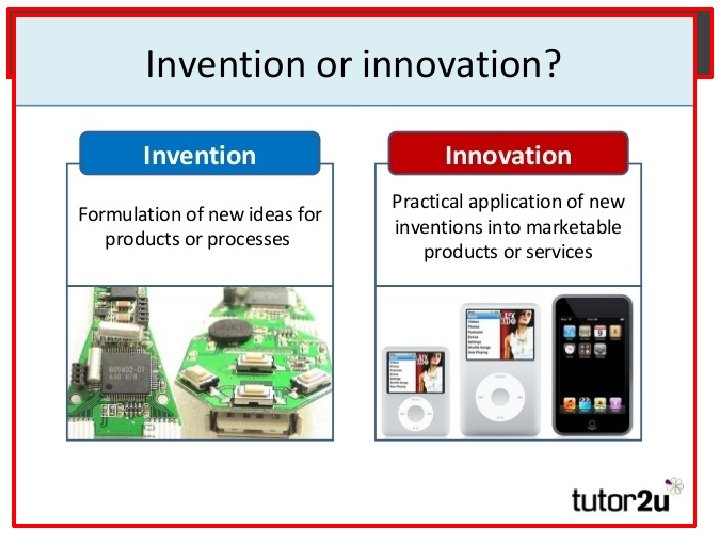
LO 4 Invention and innovation
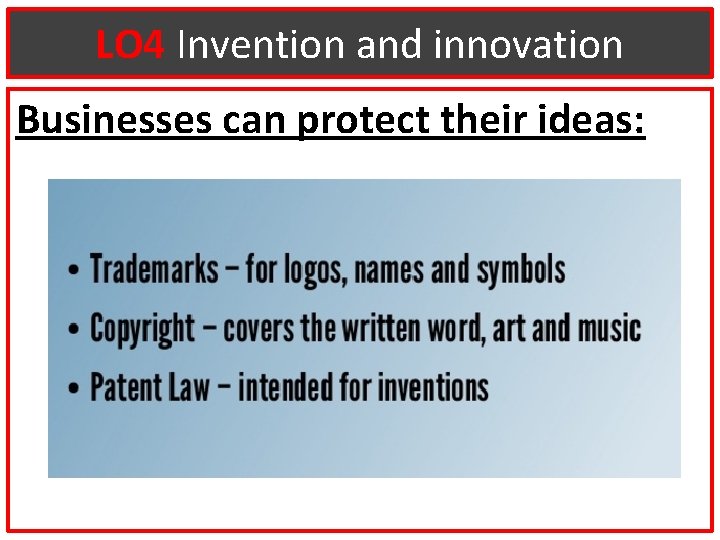
LO 4 Invention and innovation Businesses can protect their ideas:
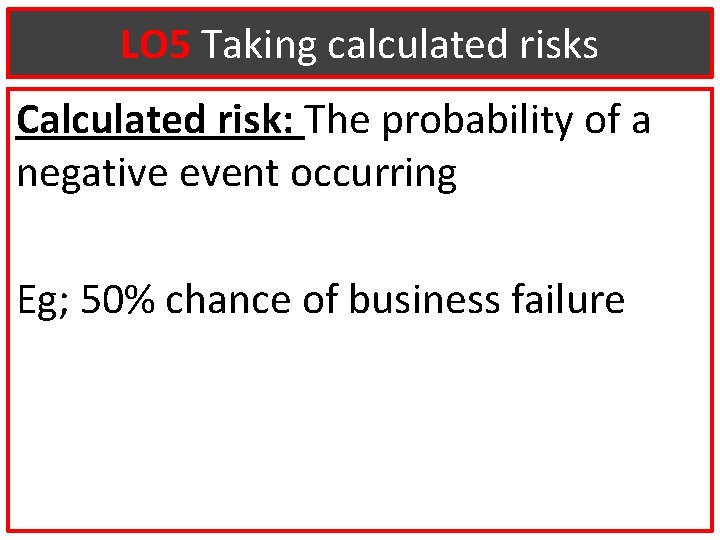
LO 5 Taking calculated risks Calculated risk: The probability of a negative event occurring Eg; 50% chance of business failure
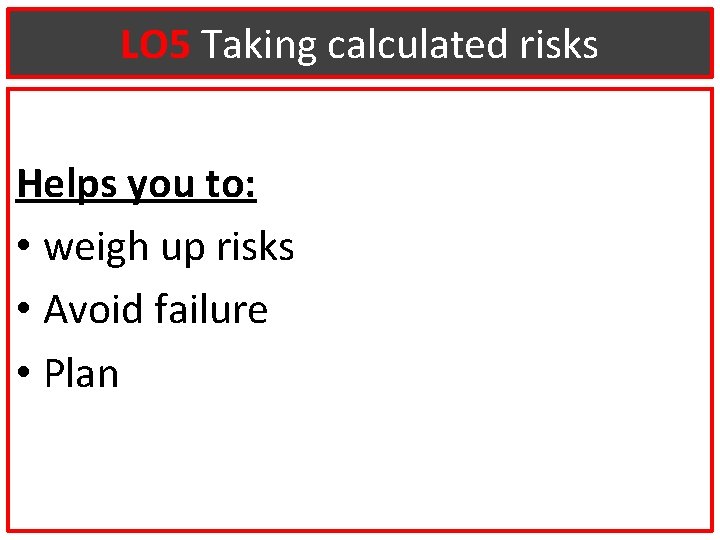
LO 5 Taking calculated risks Helps you to: • weigh up risks • Avoid failure • Plan
LO 6 Other enterprise skills Enterprise skills important for success: • Seeing opportunities • Effective planning • Thinking ahead • Drive and determination
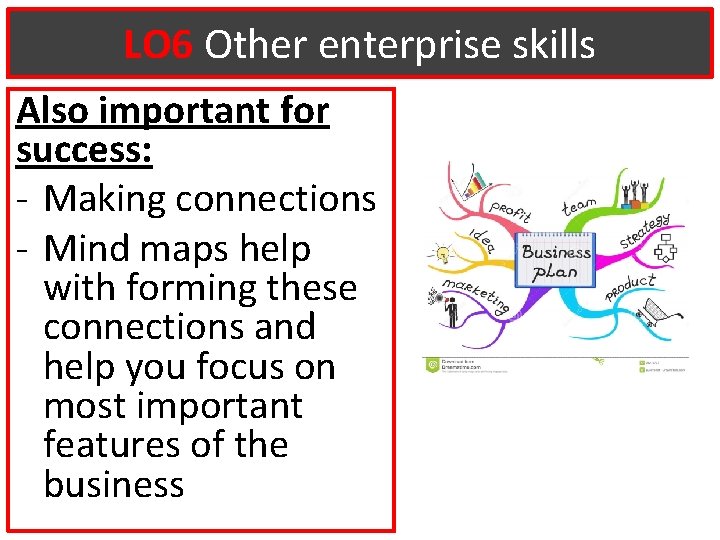
LO 6 Other enterprise skills Also important for success: - Making connections - Mind maps help with forming these connections and help you focus on most important features of the business
1. 3: Putting a business idea into practice LO 1 Objectives for start up LO 2 Qualities of Entrepreneurs LO 3 Estimating revenues costs and profit LO 4 Forecasting Cashflow LO 5 The Business Plan LO 6 Obtaining Finance
LO 1 Objectives for start up Start up businesses have FINANCIAL objectives: v. Profit v. Income vfinancial security v. Wealth And NON FINANCIAL objectives: • personal satisfaction • challenge
LO 1 Objectives for start up
LO 1 Objectives for start up Objectives for social enterprises will be different: - To support a group in the community - To make a difference
LO 2 Qualities of Entrepreneurs The qualities shown by entrepreneurs: v. Determination v. Initiative v Willingness to take risks v Decision Making v Ability to plan v Gift of persuasion v Showing leadership v Being lucky
LO 3 Estimating revenues costs and profit Revenue/ turnover/ sales income: The amount of money coming in from selling goods and services
LO 3 Estimating revenues costs and profit REVENUE: Selling price x Units sold
LO 3 Estimating revenues costs and profit Fixed Costs: Do not change with number of sales made Eg: rent
LO 3 Estimating revenues costs and profit Variable Costs: Do change with number of sales made Eg: Raw materials • Ice cream cones for ice cream man • Tyres for a car manufacturer
LO 3 Estimating revenues costs and profit Total Variable Costs: The variable cost in total for all products made Variable cost of one product X Number of products sold
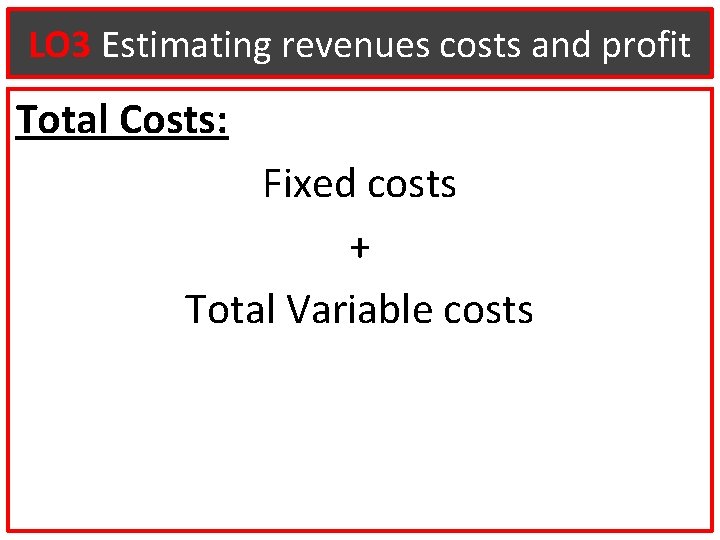
LO 3 Estimating revenues costs and profit Total Costs: Fixed costs + Total Variable costs
LO 3 Estimating revenues costs and profit Cost: how much the businesses spends on making the product Price: How much you are selling the product for * Always think in terms of the business
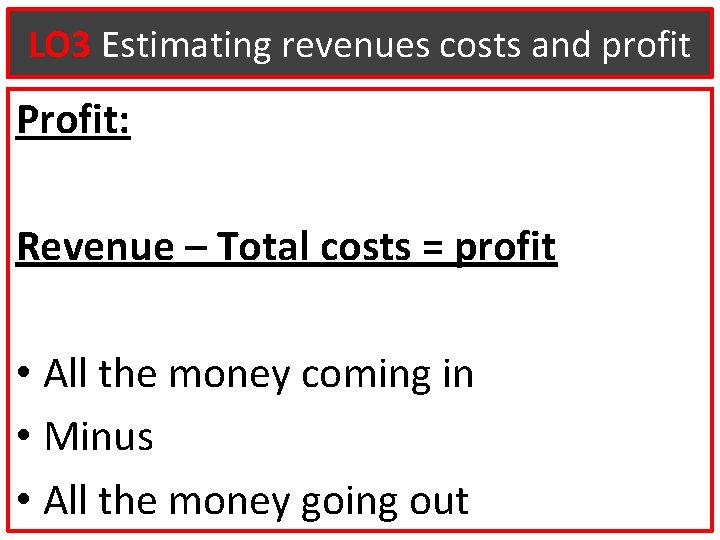
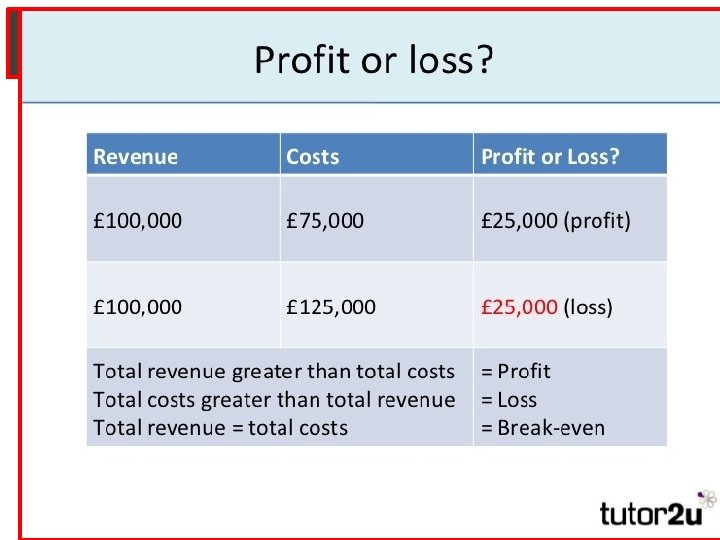
LO 3 Estimating revenues costs and profit Profit: Revenue – Total costs = profit • All the money coming in • Minus • All the money going out
LO 4 Forecasting cash flow Cash Flow: - The flow of money into and out of a business - Inflow: money coming in - Outflow: money going out
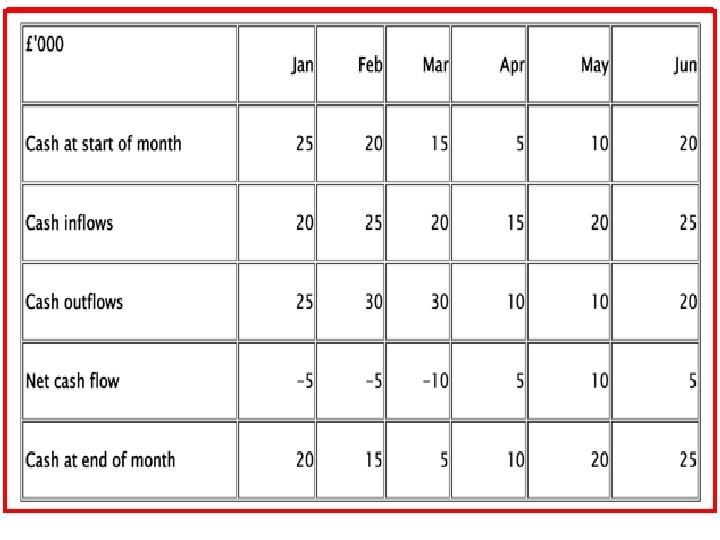
LO 4 Forecasting cash flow Cash Flow Forecast: Prediction Cash Flow Statement: Actual
LO 4 Forecasting cash flow
LO 4 Forecasting cash flow Negative cash flow: - May not pay suppliers on time - May not be able to purchase more materials - Unable to pay fixed costs - Business becomes insolvent (money not flowing to pay bills)
LO 4 Forecasting cash flow How do cash flow problems arise: - Change in sales - Costs change - Credit terms change (length of borrowing time) - Stock levels change
LO 4 Forecasting cash flow Plan ahead: - Cash flow forecasts help to foresee issues - Plan for additional finance where necessary - Change pricing or out goings where necessary - Change credit terms
LO 5 The Business Plan Business plan: Plan for the development of the business, information about the market research, the projected sales and costs • Reduces risks • Helps to access bank loan
LO 6 Obtaining Finance Sources of Finance: Internal - comes from within the business External- comes from outside the business
LO 6 Obtaining Finance Sources of Finance: Short term - borrowed for less than a year Long term- borrowed for more than a year
LO 6 Obtaining Finance • Long term: – Share capital – Loans – Retained profit – Leasing – Grants • Short term: - Bank overdraft - Factoring - Trade Credit
1. 4: Making the start-up effective LO 1 Customer focus and marketing Mix LO 2 Importance of limited liability LO 3 Start up legal and tax issues LO 4 Customer satisfaction LO 5 Recruiting, training and motivating
LO 1 Customer focus and marketing Mix Businesses need customers to survive, so we must meet their needs. We do this by: Identifying: Identify needs Anticipating: Anticipate trends Meeting: Meet those requirements to keep customers happy
LO 1 Customer focus and marketing Mix To meet customers needs we use the marketing tool ‘THE MARKETING MIX’ (the 4 P’s) - Product (what you are selling) - Price (how much for) - Place (where you are selling it) - Promotion (how you communicate with your target audience)
LO 1 Customer focus and marketing Mix The marketing mix must be coherent: • it must make sense • Eg; don’t sell high end, classic, expensive furniture in a poorer area
LO 2 Importance of limited liability Limited liability: When shareholders/ owners of a business are not personally liable for the debts of the company They can only lose money invested in the business, not personal finance and assets
LO 2 Importance of limited liability Unlimited liability: - Sole trader - partnership
LO 2 Importance of limited liability Limited liability: - Private Limited Company (Ltd) - Public Limited Company (Plc)
LO 3 Start up legal and tax issues Business name: • Cannot use the name of another business if it has been trademarked – legally protected • You also cannot register an Ltd name that has already been registered
LO 3 Start up legal and tax issues Business must keep records: - Businesses must keep financial records - HMRC tax department may require them
LO 3 Start up legal and tax issues Sole traders and Partnerships (unlimited): - Pay income tax - % Taxed on your earnings - As they are not legally separate from their business - The same tax paid if you are employed by a company
LO 3 Start up legal and tax issues PLC and Ltd (Limited) - Pay corporation tax - The business earnings are taxed - As they are legally separate from their business
LO 3 Start up legal and tax issues VAT ; • only paid if business earns over £ 67, 000 per year • Tax on Value of Sales • Paid by business to the government
LO 3 Start up legal and tax issues National Insurance: • Sole traders/ partnerships: pay contributions based on their earnings • Ltd and PLc: tax on the earnings of workers, paid by employers on their wages
LO 4 Customer satisfaction Customer Service: • The customers experience
LO 4 Customer satisfaction Customer Satisfaction: - A measure of how much the product/ service meets customers needs
LO 4 Customer satisfaction Repeat Custom: - Orders or sales by returning customers
LO 5 Recruiting, training and motivating Recruitment process: - Job analysis - Job description: describes job - Person specification: described person wanted for job - Job advert: - CV’s and application forms: - Short list: - Interview - Appoint
LO 5 Recruiting, training and motivating Training: Internal: Trained on the business property External: Trained elsewhere
LO 5 Recruiting, training and motivating Skill: Can be taught (ICT skills) Attitude: Cannot (being on time)
1. 5: The Economic Context LO 1 Demand supply LO 2 The impact of interest rates LO 3 The impact of exchange rates LO 4 The impact of the business cycle LO 5 Business decisions and stakeholders
What is a commodity? A raw material such as coal, barley or livestock
What is demand? The amount that an individual or individuals are willing to buy at any given price.
What is supply? The amount of goods that producers are willing to supply / sell at a given price
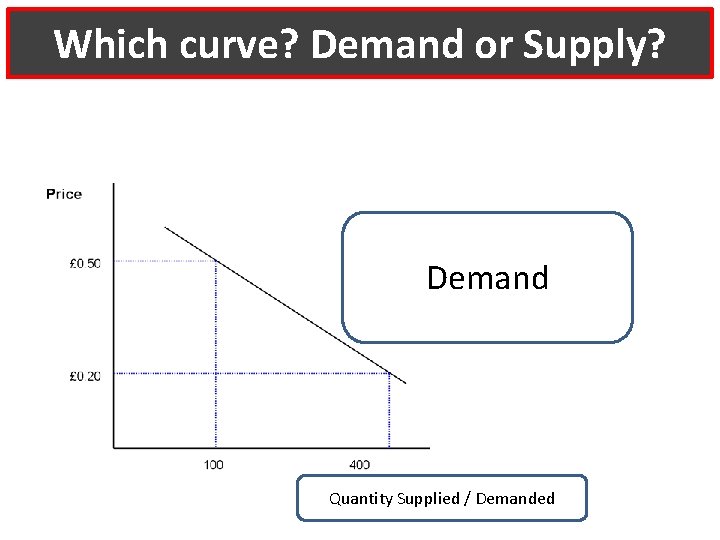
Which curve? Demand or Supply? Demand Quantity Supplied / Demanded
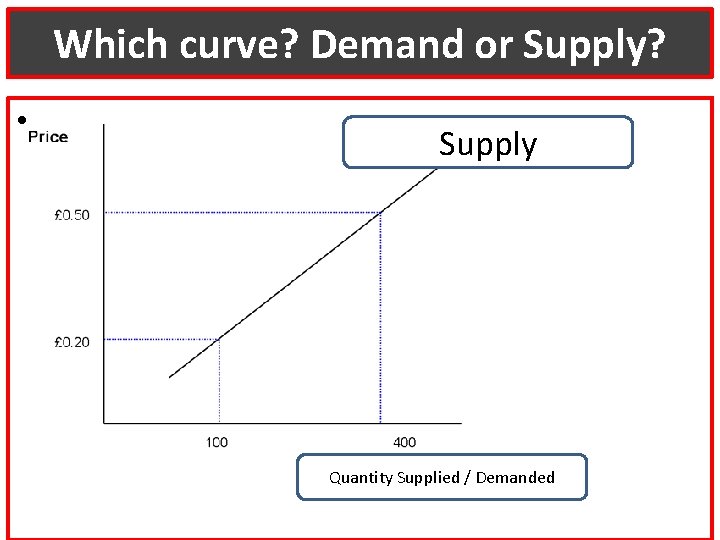
Which curve? Demand or Supply? • Supply Quantity Supplied / Demanded
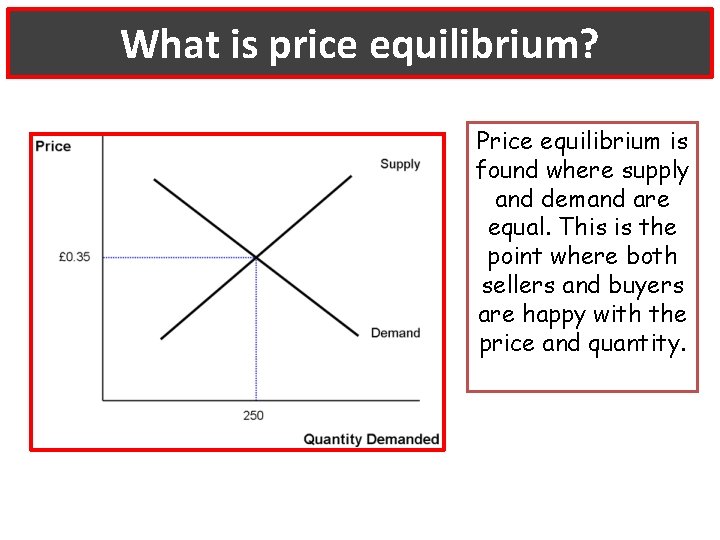
What is price equilibrium? Price equilibrium is found where supply and demand are equal. This is the point where both sellers and buyers are happy with the price and quantity.
How do supply and demand determine price? The equilibrium point helps to determine price Too high and customers will not buy Too low and suppliers are not will to manufacture/ sell
What is a commodity market? The farmers and purchasers of the raw materials on the planet
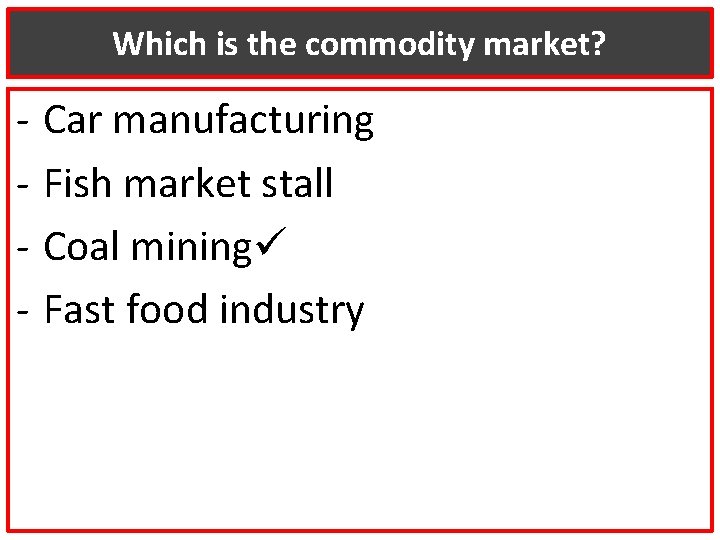
Which is the commodity market? - Car manufacturing Fish market stall Coal mining Fast food industry
What is a normal market? A market which buys and sells products which have been purchased from commodity markets, or other normal markets
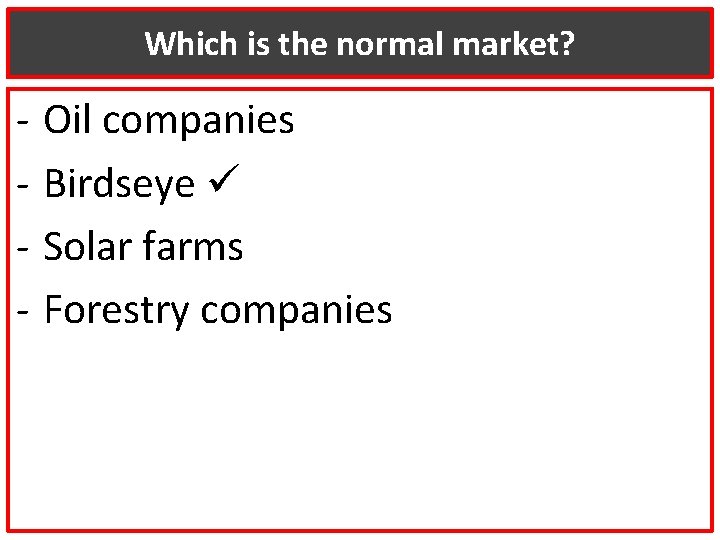
Which is the normal market? - Oil companies Birdseye Solar farms Forestry companies
How are small businesses impacted by price changes in raw materials and energy costs? They see an increase in their fixed and variable costs, therefore increasing total costs, therefore decreasing either their profits or their prices
What are interest rates? The % added on to the borrowing or savings of the country. Based on Bank of England base interest rates
How would an increase in interest rates effect a business with a loan? They would have an increase in the payments which they must pay back to the bank. Fixed rate loans: no change Variable rate loans: will go up
How would an increase in interest rates effect a business with retained profit in the bank? The business would get an increased amount of interest paid to them by the bank. Therefore the money in their bank would grow.
How does a rise in interest rates effect consumers and their spending? The consumers will have less leisure spend, due to having to pay more on their loans.
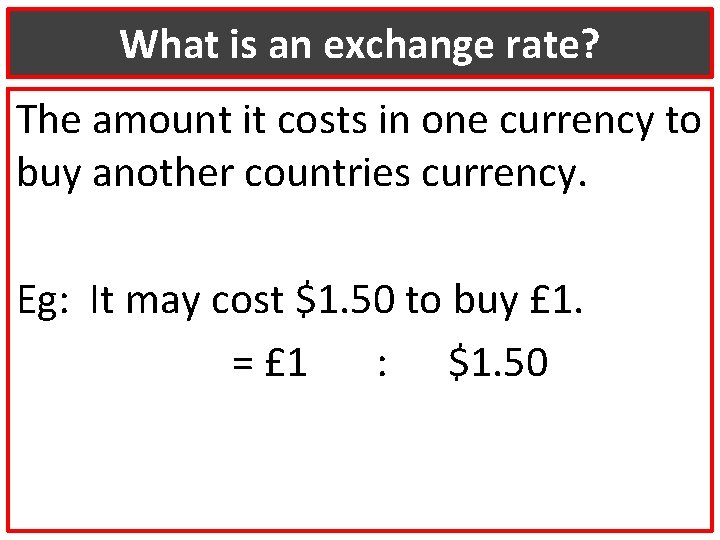
What is an exchange rate? The amount it costs in one currency to buy another countries currency. Eg: It may cost $1. 50 to buy £ 1. = £ 1 : $1. 50
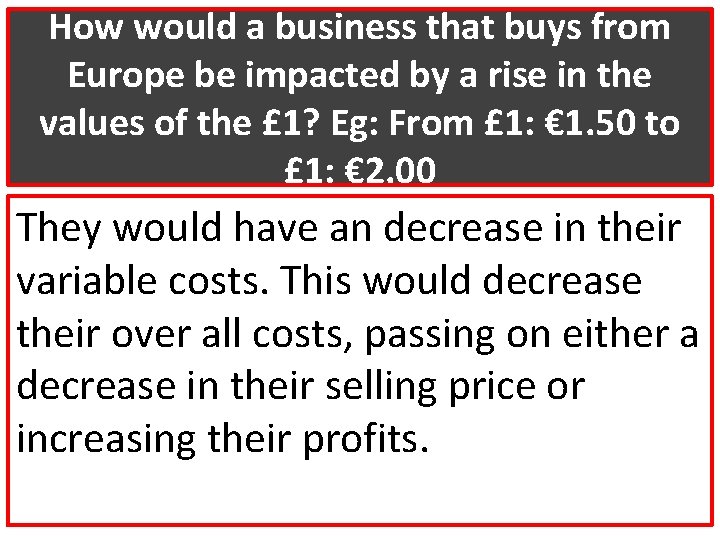
How would a business that buys from Europe be impacted by a rise in the values of the £ 1? Eg: From £ 1: € 1. 50 to £ 1: € 2. 00 They would have an decrease in their variable costs. This would decrease their over all costs, passing on either a decrease in their selling price or increasing their profits.
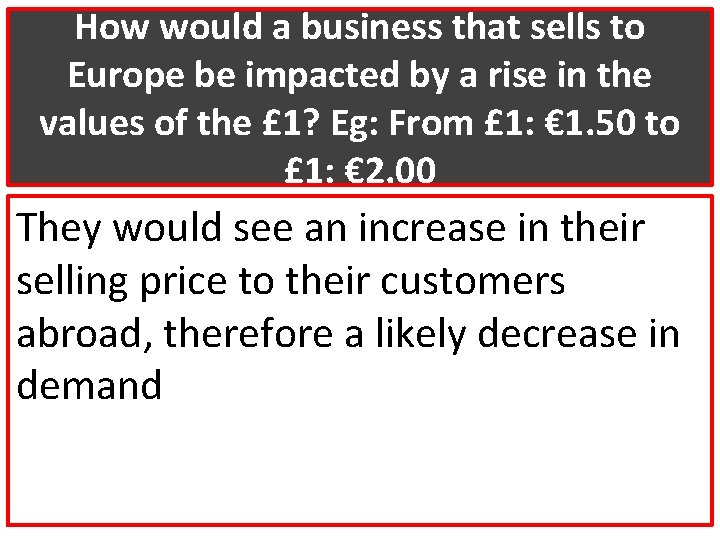
How would a business that sells to Europe be impacted by a rise in the values of the £ 1? Eg: From £ 1: € 1. 50 to £ 1: € 2. 00 They would see an increase in their selling price to their customers abroad, therefore a likely decrease in demand
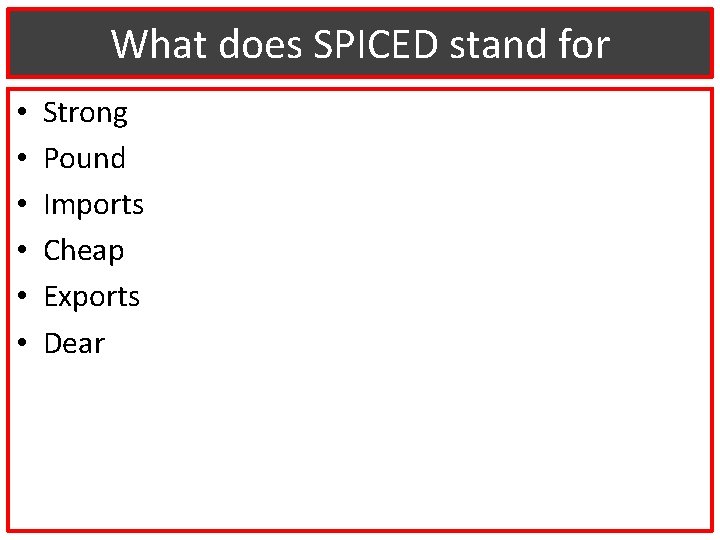
What does SPICED stand for • • • Strong Pound Imports Cheap Exports Dear
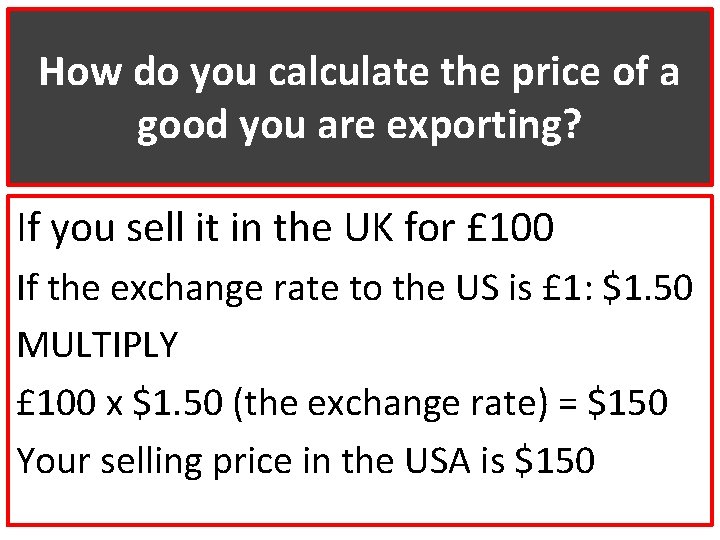
How do you calculate the price of a good you are exporting? If you sell it in the UK for £ 100 If the exchange rate to the US is £ 1: $1. 50 MULTIPLY £ 100 x $1. 50 (the exchange rate) = $150 Your selling price in the USA is $150
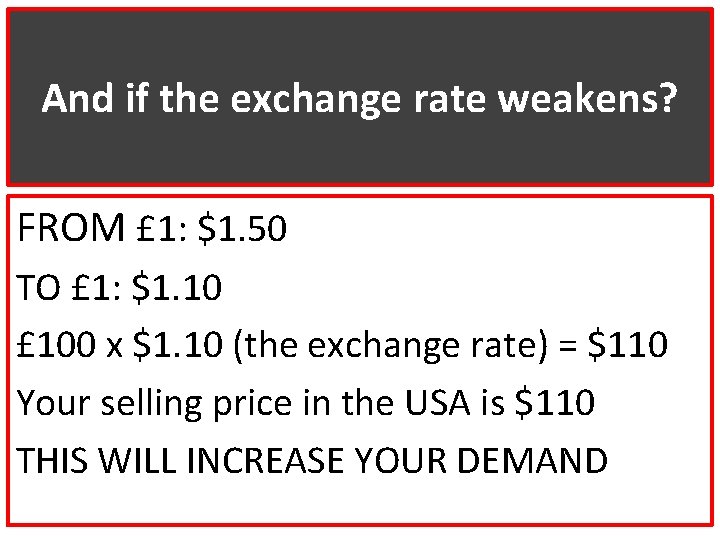
And if the exchange rate weakens? FROM £ 1: $1. 50 TO £ 1: $1. 10 £ 100 x $1. 10 (the exchange rate) = $110 Your selling price in the USA is $110 THIS WILL INCREASE YOUR DEMAND
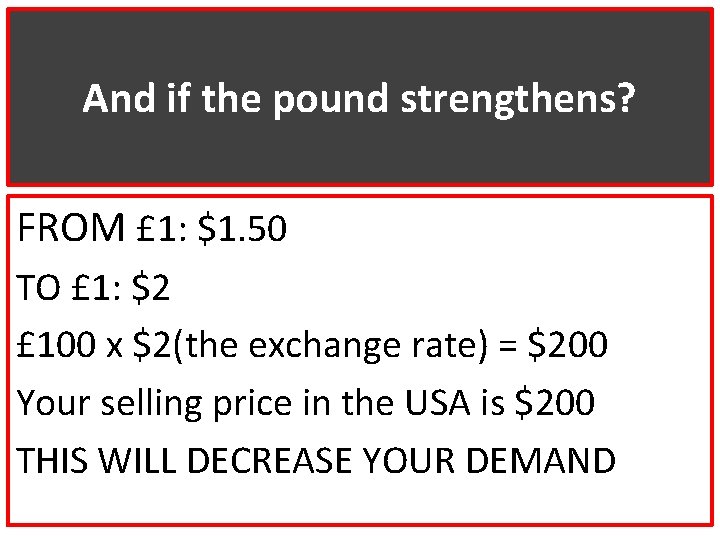
And if the pound strengthens? FROM £ 1: $1. 50 TO £ 1: $2 £ 100 x $2(the exchange rate) = $200 Your selling price in the USA is $200 THIS WILL DECREASE YOUR DEMAND
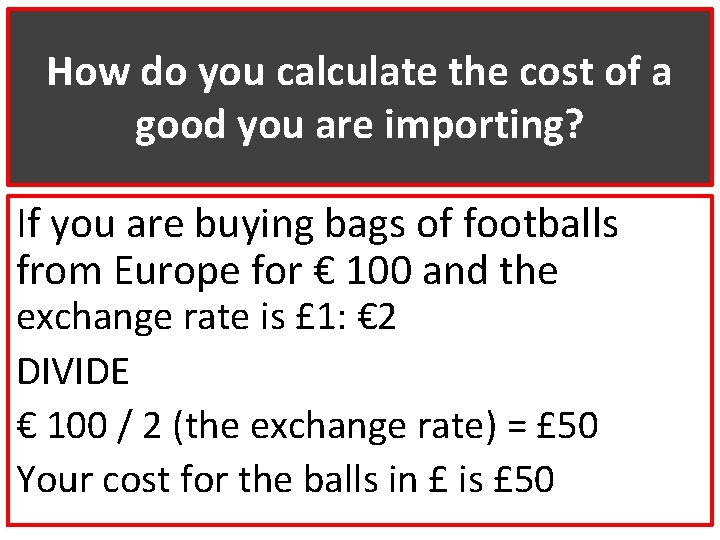
How do you calculate the cost of a good you are importing? If you are buying bags of footballs from Europe for € 100 and the exchange rate is £ 1: € 2 DIVIDE € 100 / 2 (the exchange rate) = £ 50 Your cost for the balls in £ is £ 50
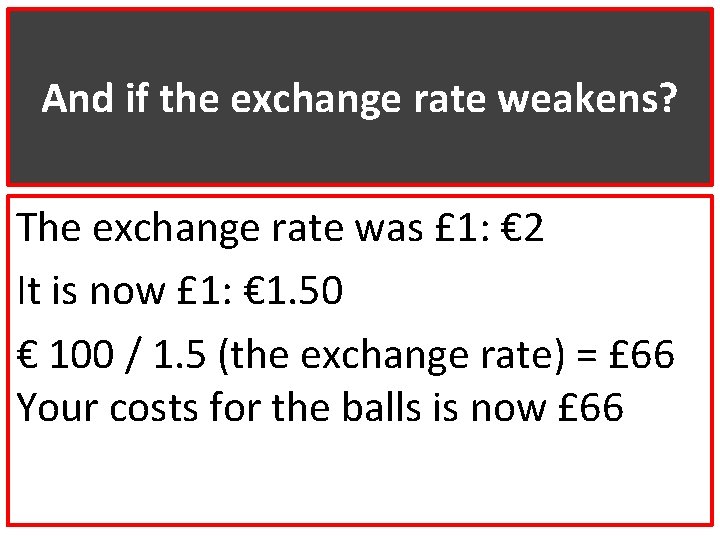
And if the exchange rate weakens? The exchange rate was £ 1: € 2 It is now £ 1: € 1. 50 € 100 / 1. 5 (the exchange rate) = £ 66 Your costs for the balls is now £ 66
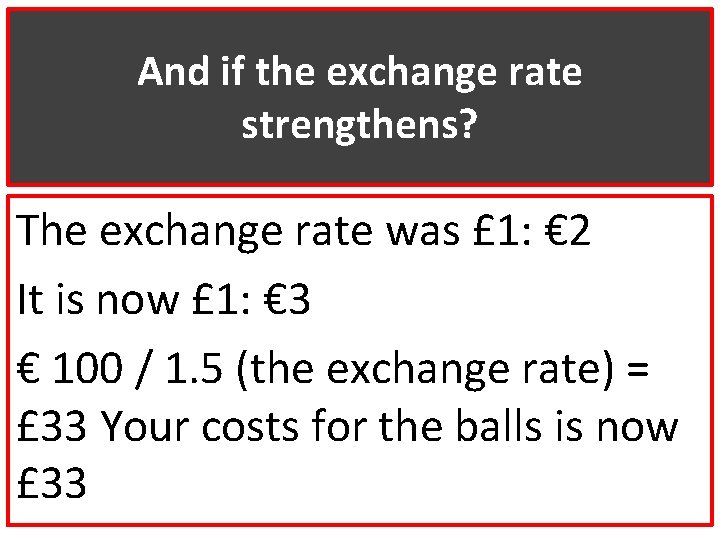
And if the exchange rate strengthens? The exchange rate was £ 1: € 2 It is now £ 1: € 3 € 100 / 1. 5 (the exchange rate) = £ 33 Your costs for the balls is now £ 33
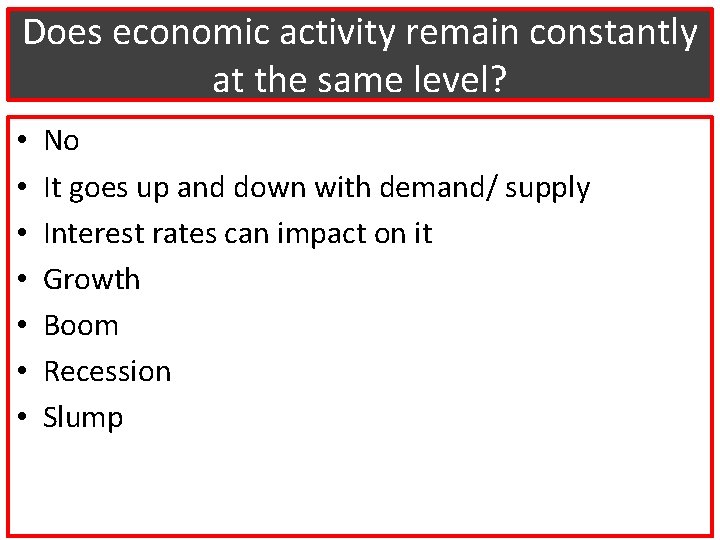
Does economic activity remain constantly at the same level? • • No It goes up and down with demand/ supply Interest rates can impact on it Growth Boom Recession Slump
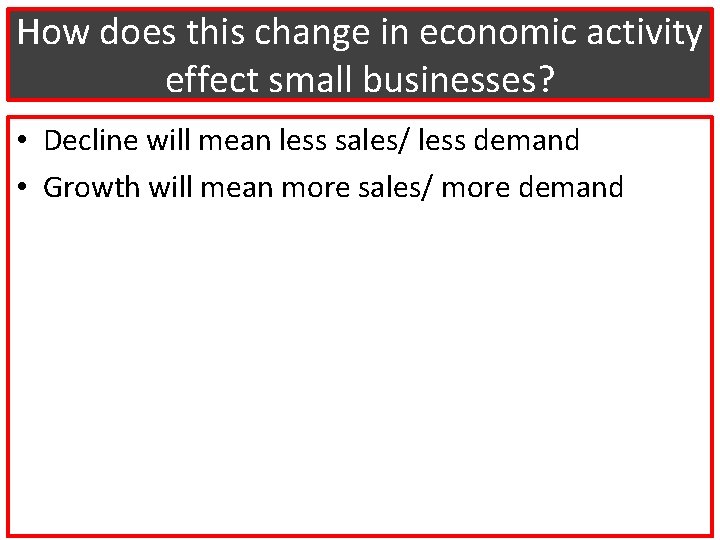
How does this change in economic activity effect small businesses? • Decline will mean less sales/ less demand • Growth will mean more sales/ more demand
What are stakeholders? • Anyone who has an interest in or is impacted by business activities
Who are the stakeholders of the The Kibworth Bookshop • • Owner Customers Local people Government Suppliers Competition Trade Unions
How would two different stakeholders react to a rise in prices of TKB? • Customers- unhappy • Owner- happy
Why might TKS find it difficult find it hard to keep ALL stakeholders happy when making decisions for their business? • Shorter summer holidays – Parents might be happy – Students and teachers unhappy
- Slides: 122