
GCSE Business Studies Profit Lesson Aim Explain the
GCSE Business Studies Profit Lesson Aim Explain the key terms relating to profit Calculate the different types of profit Explain why profit is important to businesses Compare business performance using profit figures
Starter • Write down the calculation used to work out sales revenue • Selling price x quantity sold
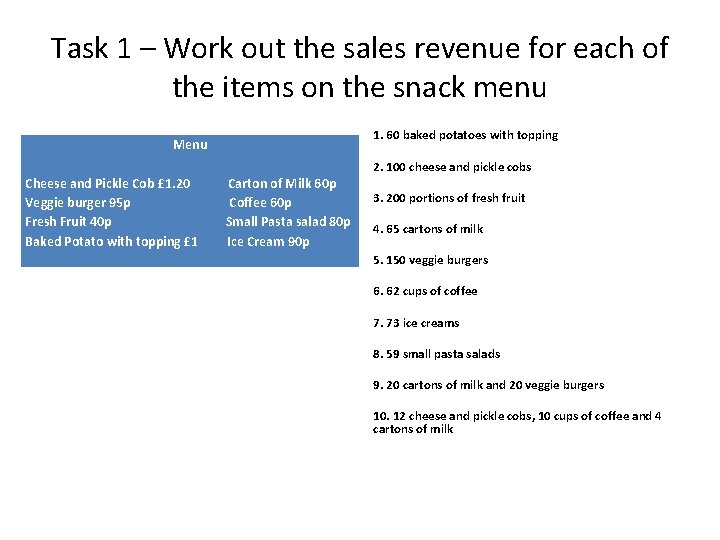
Task 1 – Work out the sales revenue for each of the items on the snack menu 1. 60 baked potatoes with topping Menu 2. 100 cheese and pickle cobs Cheese and Pickle Cob £ 1. 20 Veggie burger 95 p Fresh Fruit 40 p Baked Potato with topping £ 1 Carton of Milk 60 p Coffee 60 p Small Pasta salad 80 p Ice Cream 90 p 3. 200 portions of fresh fruit 4. 65 cartons of milk 5. 150 veggie burgers 6. 62 cups of coffee 7. 73 ice creams 8. 59 small pasta salads 9. 20 cartons of milk and 20 veggie burgers 10. 12 cheese and pickle cobs, 10 cups of coffee and 4 cartons of milk

Calculating profit – • Gross profit – The amount of profit made by a business as a result of buying and selling goods or services, but without paying for any of the day-to-day or other expenses of running the business. It is calculated by using the following formula: • • Selling price minus the buying price = gross profit 25 p – 15 p = 10 p • This can then be used to calculate the profit margin which is calculated as a percentage using the following formula • Profit margin = Gross profit x 100 Buying price • • 10 p x 100 = 66. 7% 15 p • Where a lot of items are sold, gross profit can be calculated using the figure for sales revenue. The following formula is used: • Gross profit = sales revenue less the cost of buying good that have been sold • Gross profit = £ 250 - £ 150 = £ 100
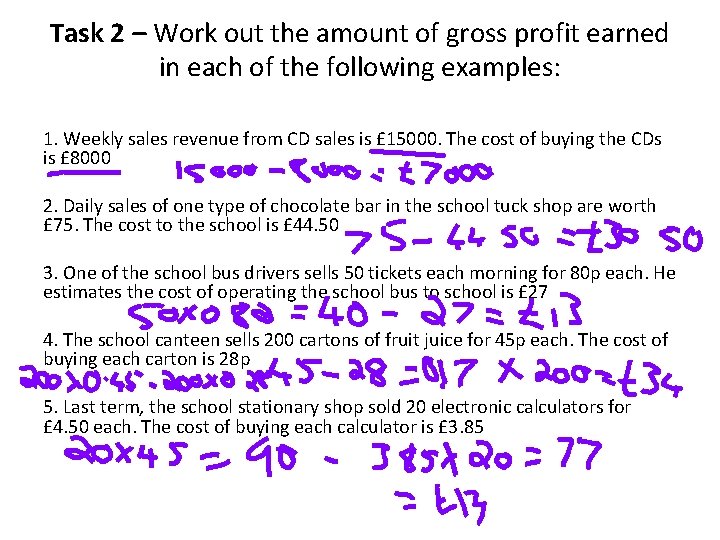
Task 2 – Work out the amount of gross profit earned in each of the following examples: 1. Weekly sales revenue from CD sales is £ 15000. The cost of buying the CDs is £ 8000 2. Daily sales of one type of chocolate bar in the school tuck shop are worth £ 75. The cost to the school is £ 44. 50 3. One of the school bus drivers sells 50 tickets each morning for 80 p each. He estimates the cost of operating the school bus to school is £ 27 4. The school canteen sells 200 cartons of fruit juice for 45 p each. The cost of buying each carton is 28 p 5. Last term, the school stationary shop sold 20 electronic calculators for £ 4. 50 each. The cost of buying each calculator is £ 3. 85
Net profit • This takes into account the profit made as a result of buying and selling goods or services but also makes an allowance for the costs involved in running the business. It is calculated using the following formula: • Net profit = Gross profit less the cost of running the business
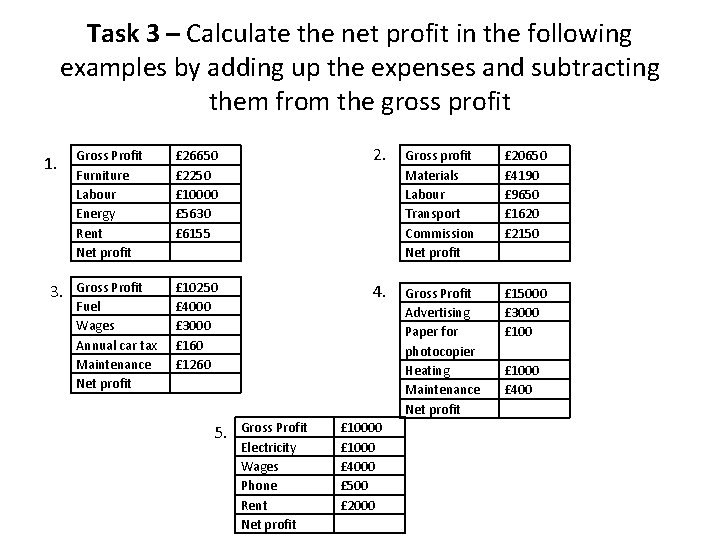
Task 3 – Calculate the net profit in the following examples by adding up the expenses and subtracting them from the gross profit 1. 3. Gross Profit Furniture Labour Energy Rent Net profit £ 26650 £ 2250 £ 10000 £ 5630 £ 6155 2. Gross profit Materials Labour Transport Commission Net profit £ 20650 £ 4190 £ 9650 £ 1620 £ 2150 Gross Profit Fuel Wages Annual car tax Maintenance Net profit £ 10250 £ 4000 £ 3000 £ 160 £ 1260 4. Gross Profit Advertising Paper for photocopier Heating Maintenance Net profit £ 15000 £ 3000 £ 100 5. Gross Profit Electricity Wages Phone Rent Net profit £ 10000 £ 1000 £ 4000 £ 500 £ 2000 £ 1000 £ 400
Task 4 – Comparing profit – businesses will compare the financial performance of a business over a period of time and with its competitors. You need to discuss in your groups about why they do this and who will use it Why they compare profit Who will use profit comparisons
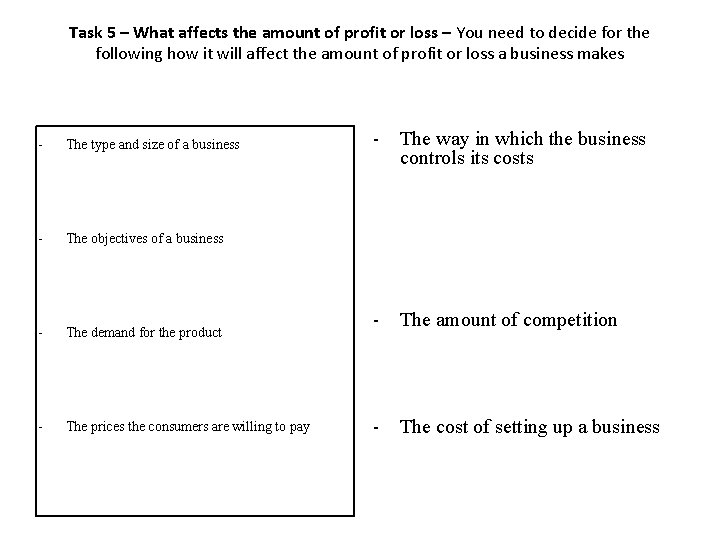
Task 5 – What affects the amount of profit or loss – You need to decide for the following how it will affect the amount of profit or loss a business makes - The type and size of a business - The objectives of a business - The demand for the product - The prices the consumers are willing to pay - The way in which the business controls its costs - The amount of competition - The cost of setting up a business
Why do some businesses not want to make a profit? • Charities are an example of a business who does not want to make a profit. They aim to raise as much money as possible for the cause they support. Social clubs and sports clubs will want to raise money to improve facilities for the benefit of their members. Any surplus money they have will be spent on equipment or improvements to premises.
Why is profit important to most businesses? • Profit can be seen as a return on the investment made into a business. This is where the owners of a business expect something back in return for investing their money. Profit is also a reward for risk-taking. Profit can be paid as: • Dividends to shareholders of private limited and public limited companies • Drawings to owners of sole proprietors and partnerships • Profit can also be used to help finance and develop business activity or buy new equipment and buildings. Any profit kept by a business is known as retained profit.
Keywords • Opportunity cost – this is the cost associated with not using profit for some other activity such as paying out dividends. Whenever a business has to decide between alternatives • Profit and financial records – these are important for a business. They use it to check that an activity they are doing is worthwhile and if they should continue doing it. This process is called ‘accounting’ and the document produced is called ‘trading, profit and loss account’. • Profit and Break-even analysis - The amount of profit made by a business at a given level of output is forecast using a break-even analysis.
- Slides: 12