
GCSE Business Studies Business Ownership Structures Public Private
GCSE Business Studies. Business Ownership Structures Public & Private
Learning Objectives: Identify different business structures l Explain unlimited liability & the implications of this on setting up a business l Explain the differences between Sole Traders & Partnerships l
UK Business Ownership. Most UK Businesses are privately owned. This means: l They are owned by private individuals l These individuals risk their own money l The owners’ reward is the profit the business makes
Private Ownership Options l l l Sole Trader – 1 owner Partnership – 2 or more people Private Limited Companies – often a family run business with protection of limited liability Public Limited Company – large organisations whose shares are traded on the stock exchange Franchise – small business trading with the agreement of a large firm Cooperatives – collectively owned by workers / customers
Public Ownership This term is used for enterprises owned or run by the state. l The aim is to provide services needed by everyone, regardless of income or wealth Eg; health & education. l This is mainly financed through tax. l
Examples of public ownership Central government departments, Eg; Department of Health l Local authorities and councils. l Public organisations, Eg; BBC, Bank of England, British Nuclear Fuels l
Liability l l Businesses can have either unlimited liability. limited or This depends on the type of business that is formed.
Unlimited Liability. l l This means that the owner of the business has a higher level of risk. The business and the owner are the same (unincorporated) The owner could lose not only the capital they had invested but also their personal assets to pay the business debts if the business failed. Personal assets: l l l House Car Computer
Limited Liability. This means that the owner/s of the business have their losses limited to the amount of capital they have invested within the business. l The business is separate to the owners (incorporated) l For Example: If you purchase £ 1000 of shares in M&S you only lose the maximum of £ 1000 if the company fails. l
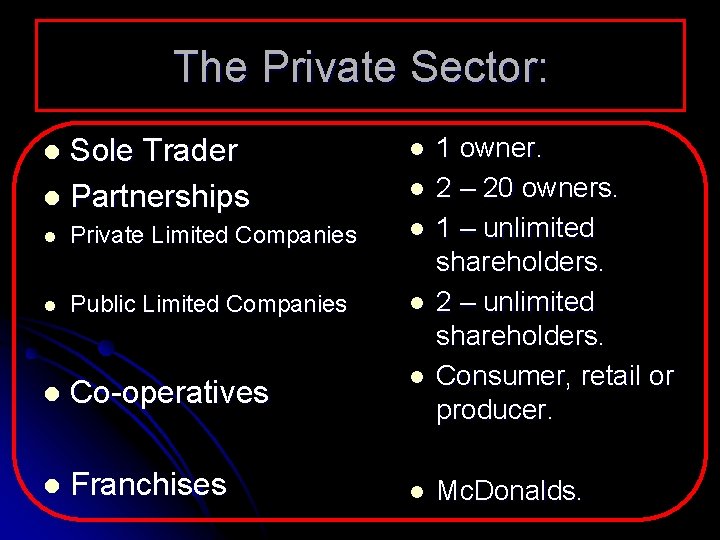
The Private Sector: Sole Trader l Partnerships l l Private Limited Companies l l Public Limited Companies l l Co-operatives l l Franchises l 1 owner. 2 – 20 owners. 1 – unlimited shareholders. 2 – unlimited shareholders. Consumer, retail or producer. Mc. Donalds.
Sole Trader. “A sole trader is a business owned and controlled by one person. Sole traders can operate under their own name and are responsible for the day to day running of the business. ”
The Key Points: l l l Sole Trader is referred to as a one person business. Sole Traders own & control their own business. The Sole Trader makes all the decisions and keeps all the profits. A Sole Trader is the easiest form of business to set up. The Sole Trader is the most common business in the UK. Sole Traders pay income tax on their profit
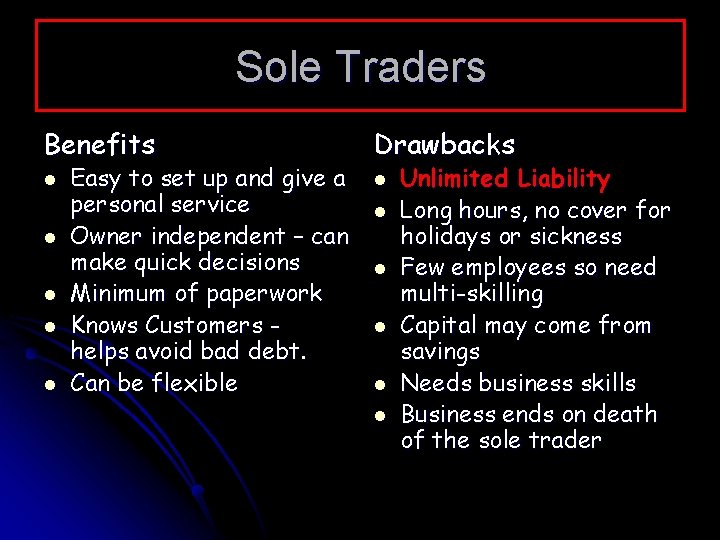
Sole Traders Benefits Drawbacks l l l Easy to set up and give a personal service Owner independent – can make quick decisions Minimum of paperwork Knows Customers helps avoid bad debt. Can be flexible l l l Unlimited Liability Long hours, no cover for holidays or sickness Few employees so need multi-skilling Capital may come from savings Needs business skills Business ends on death of the sole trader
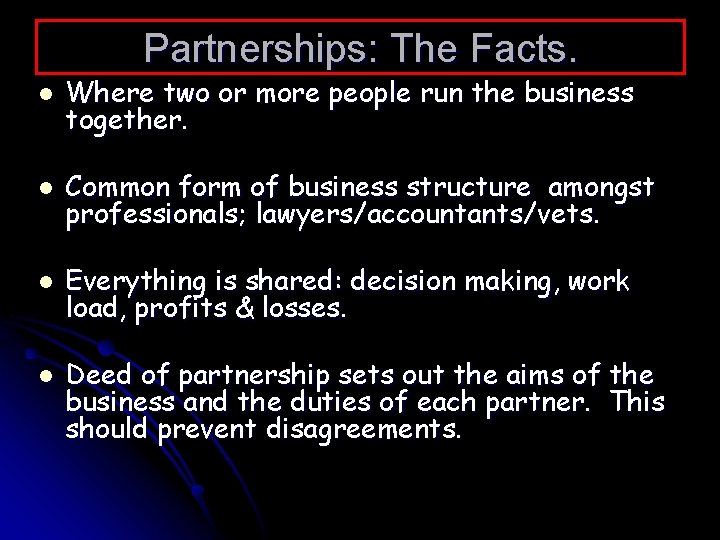
Partnerships: The Facts. l Where two or more people run the business together. l Common form of business structure amongst professionals; lawyers/accountants/vets. l Everything is shared: decision making, work load, profits & losses. l Deed of partnership sets out the aims of the business and the duties of each partner. This should prevent disagreements.
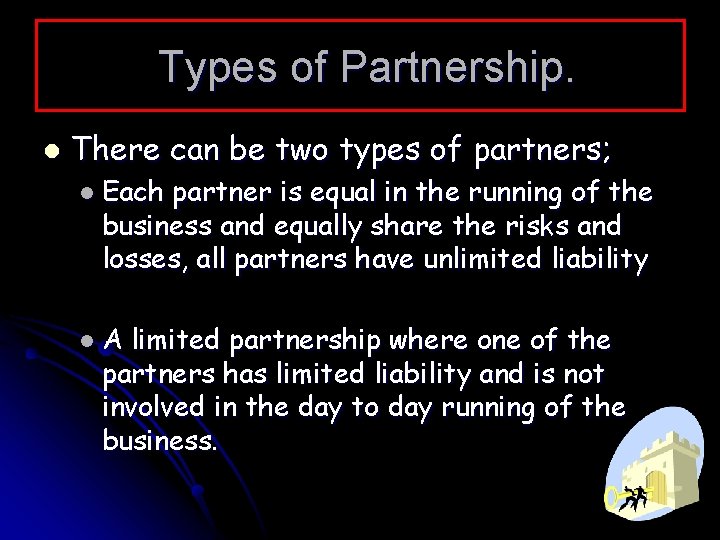
Types of Partnership. l There can be two types of partners; l Each partner is equal in the running of the business and equally share the risks and losses, all partners have unlimited liability l. A limited partnership where one of the partners has limited liability and is not involved in the day to day running of the business.
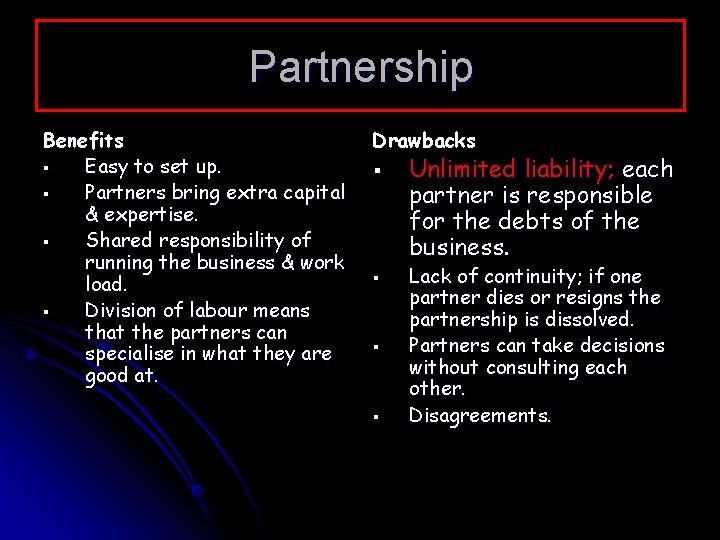
Partnership Benefits § Easy to set up. § Partners bring extra capital & expertise. § Shared responsibility of running the business & work load. § Division of labour means that the partners can specialise in what they are good at. Drawbacks § § Unlimited liability; each partner is responsible for the debts of the business. Lack of continuity; if one partner dies or resigns the partnership is dissolved. Partners can take decisions without consulting each other. Disagreements.
Deed of Partnership. l l l The Deed of Partnership is a legally binding contract between the partners. This document outlines each partners duties & responsibilities within the business. This can help prevent any future disagreements about the running of the business.
Lonely Hearts Ads HAPPY-GO-LUCKY, petite East MALE, 42, Asian looking but End woman, loves keeping fit and English, 5 ft 10 ins, medium build, music, seeks white male, 30 -35, thin on top with grey hair, looking who is 100% genuine, honest and for lady, 5 ft 8 ins, 35 -47, intelligent, caring, for friendship possibly more. funny, fairly attractive, to get my thoughts alive and back on course. CUDDLY male, young 47, likes food, wine, sports, comedies, evenings in/out, WLTM warm, considerate female, 30 -40, NS, GSOH
Lonely Hearts Ads l Write your own lonely heart ad to find your perfect business partner l ALA: all letters answered GSOH: good sense of humour ISO: in search of LTR: long-term relationship MBA: mutual business arrangement OHAC: own house and car WLTM: would like to meet nn. YO: nn years old; for example, 23 yo = 23 years old FS: Financially secure (or stable) l l l l
Task You are writing a newspaper article for a local business magazine. You have 1 page of A 4 to fill. Write an article about the 2 types of ownership Sole Traders and Partnerships You need to include all of the key points and explain which method of ownership you think is best for a small business
- Slides: 20