
GCSE Astronomy Topic 11 Exploring the Solar system

- Slides: 44
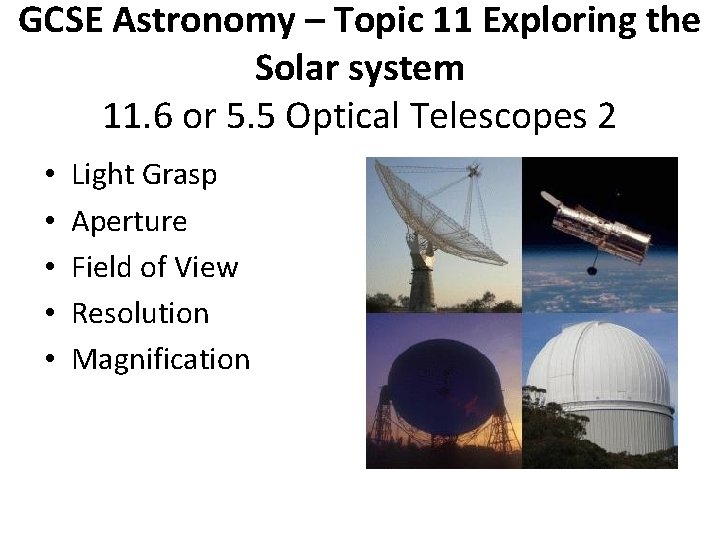
GCSE Astronomy – Topic 11 Exploring the Solar system 11. 6 or 5. 5 Optical Telescopes 2 • • • Light Grasp Aperture Field of View Resolution Magnification
Find out what the ‘light grasp’ of a telescope is and how it relates to the telescope’s aperture (diameter of the objective element). • Write two questions that could test your fellow pupils knowledge of this concept. • First question should be a simple statement answer the second should be an explain or describe type question. • Find someone to try out your questions on.
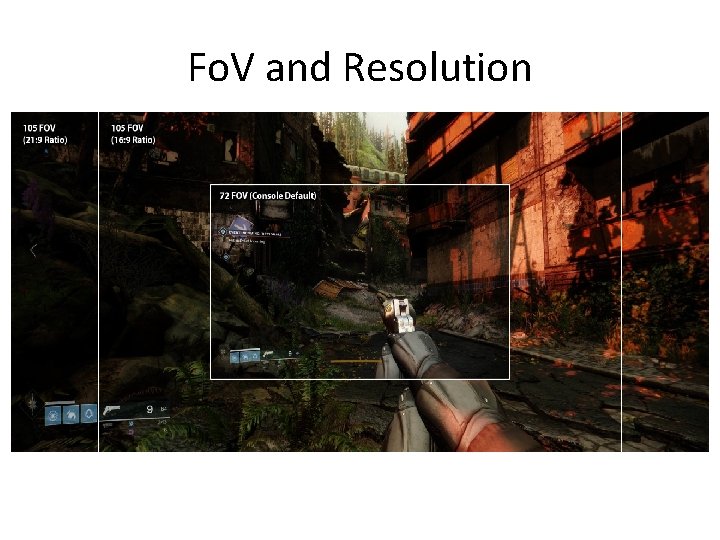
Fo. V and Resolution • What is the field of view of a telescope, why is it measured in degrees or arcmin? • Find out about the resolution of a telescope including why it is: • proportional to the diameter of the objective element • reduced by observing at a longer wavelength(IR and radio).
3. Telescopes • Three distinct types of telescopic power 1. Collecting Power (also called light gathering power or light grasp) 2. Magnifying Power 3. Resolving Power
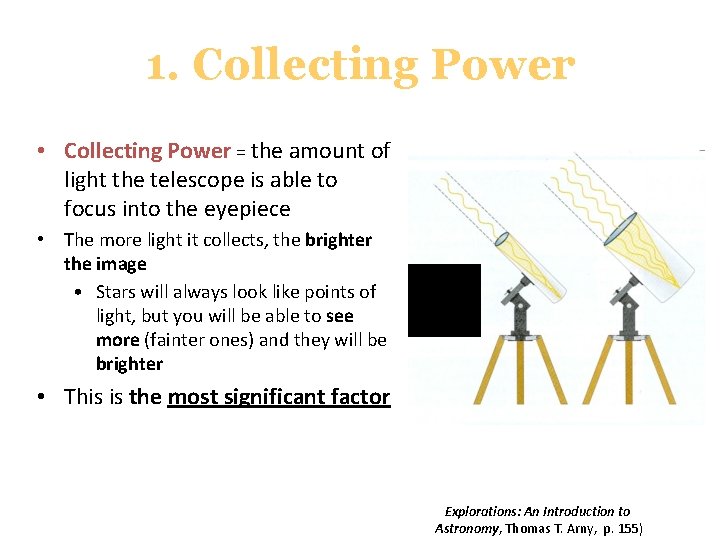
1. Collecting Power • Collecting Power = the amount of light the telescope is able to focus into the eyepiece • The more light it collects, the brighter the image • Stars will always look like points of light, but you will be able to see more (fainter ones) and they will be brighter • This is the most significant factor Explorations: An Introduction to Astronomy, Thomas T. Arny, p. 155)
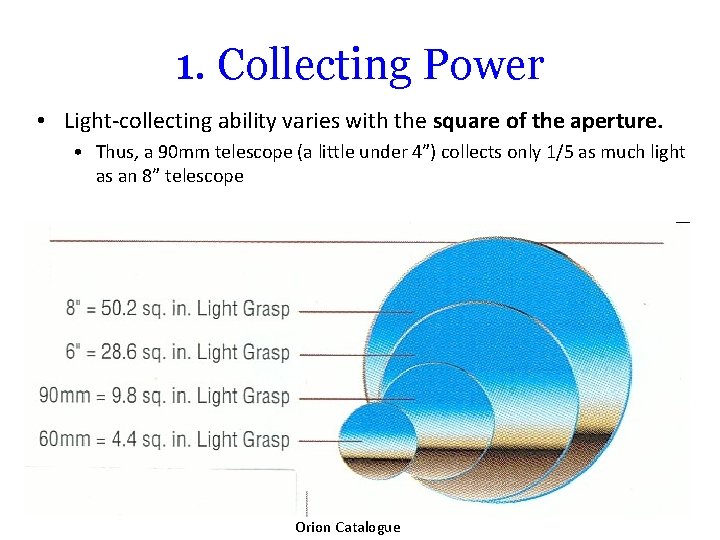
1. Collecting Power • Light-collecting ability varies with the square of the aperture. • Thus, a 90 mm telescope (a little under 4”) collects only 1/5 as much light as an 8” telescope Orion Catalogue
2. Magnifying Power • Magnifying Power = the number of times a telescope (or binocular) can increase the apparent size of an object. • 8 x, 100 x, etc. • We’ll discuss how to calculate magnifying power later.
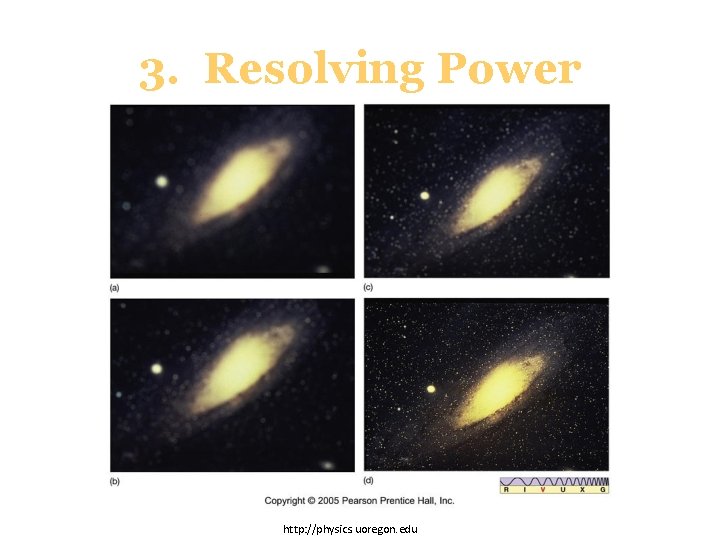
3. Resolving Power • Resolving Power = the ability of the instrument to discriminate fine detail. • How sharp or fuzzy the image is • The limitation on resolving power is imposed by the interaction of light and optics. • The quality of the optics is a major factor • Lens, mirrors, eyepieces, etc. • Usually, you get what you pay for • The turbulence in the air column you are looking through, moisture in the air, etc. also effect this.
3. Resolving Power http: //physics. uoregon. edu
Telescopes – Eyepieces Your eye • An eyepiece brings the light rays gathered by the telescope into sharp focus. • The eyepiece determines the magnification, as well as its brightness and contrast Orion Catalogue
Telescopes – Eyepieces • Eyepieces with shorter focal lengths (lower numbers) provide higher magnifications • Ex. 4 mm to 12 mm focal length • Images under high magnifications become more and more fuzzy, depending on the quality of the optics
Telescopes – Eyepieces • Eyepieces with longer focal lengths (larger numbers) provide lower magnification, but yield brighter, sharper images • Ex. 20 mm to 40 mm (wider angle)
Telescopes – Eyepieces • Medium Lengths • 13 mm to 19 mm • The author recommends having at least one low (20 -40 mm) and one medium (12 -19 mm) power eyepiece.
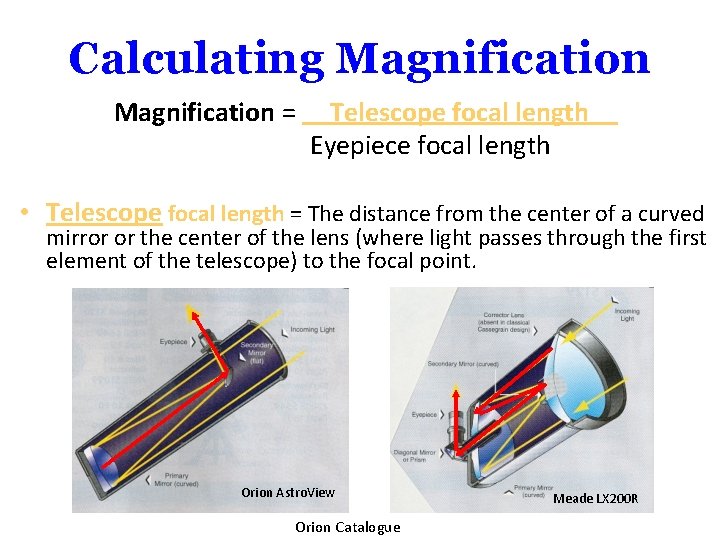
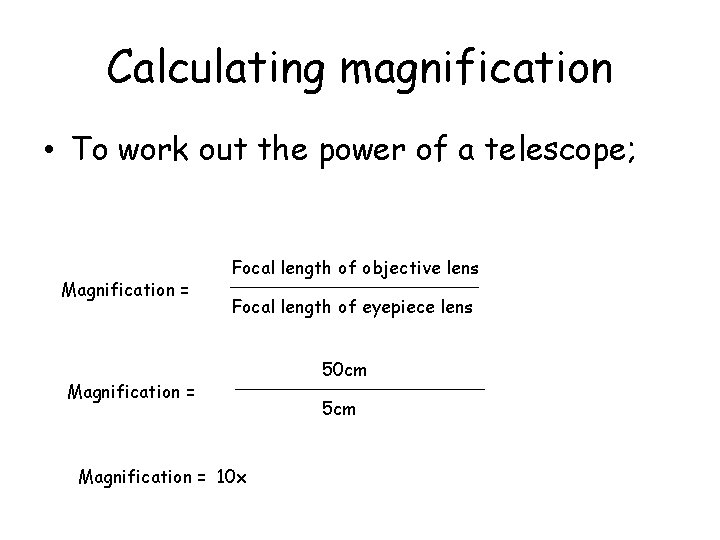
Calculating Magnification = Telescope focal length Eyepiece focal length • Telescope focal length = The distance from the center of a curved mirror or the center of the lens (where light passes through the first element of the telescope) to the focal point. Orion Astro. View Orion Catalogue Meade LX 200 R
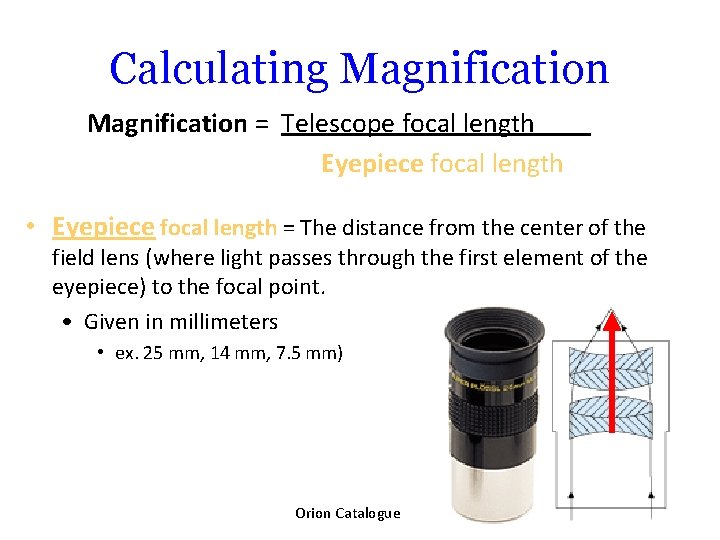
Calculating Magnification = Telescope focal length Eyepiece focal length • Eyepiece focal length = The distance from the center of the field lens (where light passes through the first element of the eyepiece) to the focal point. • Given in millimeters • ex. 25 mm, 14 mm, 7. 5 mm) Orion Catalogue
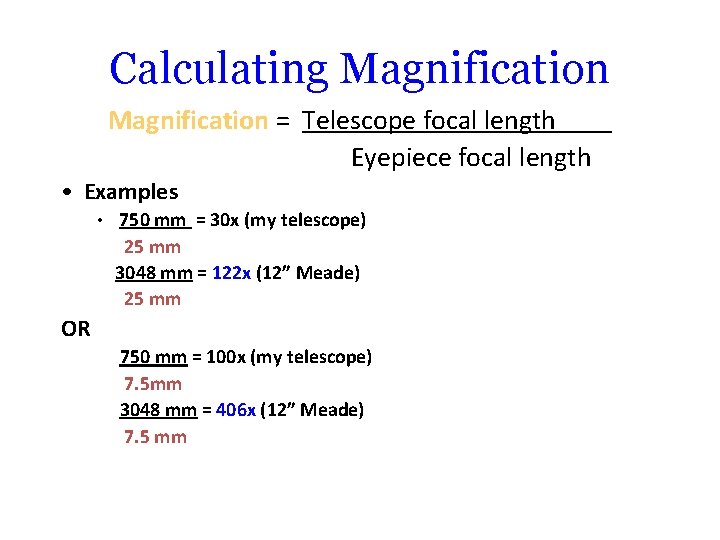
Calculating Magnification = Telescope focal length Eyepiece focal length • Examples • 750 mm = 30 x (my telescope) 25 mm 3048 mm = 122 x (12” Meade) 25 mm OR 750 mm = 100 x (my telescope) 7. 5 mm 3048 mm = 406 x (12” Meade) 7. 5 mm
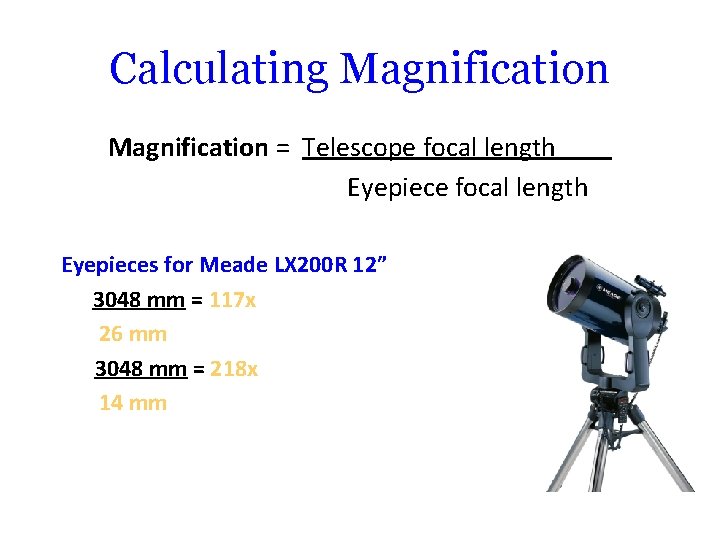
Calculating Magnification = Telescope focal length Eyepiece focal length Eyepieces for Meade LX 200 R 12” 3048 mm = 117 x 26 mm 3048 mm = 218 x 14 mm
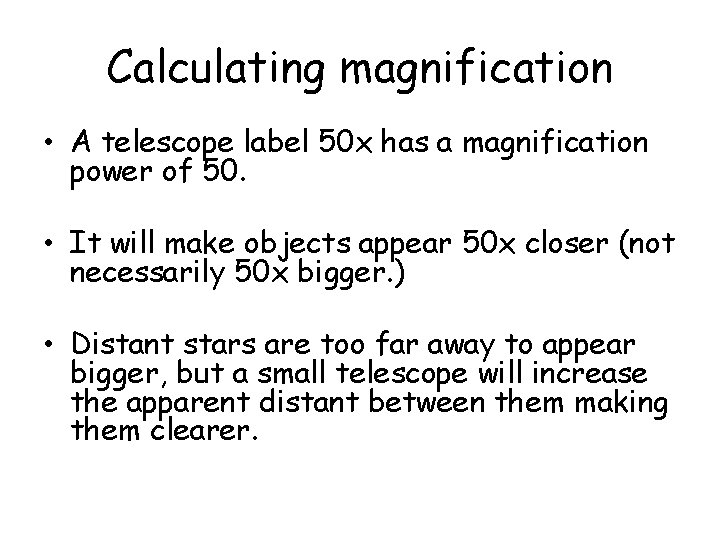
Calculating magnification • A telescope label 50 x has a magnification power of 50. • It will make objects appear 50 x closer (not necessarily 50 x bigger. ) • Distant stars are too far away to appear bigger, but a small telescope will increase the apparent distant between them making them clearer.
Calculating magnification • To work out the power of a telescope; Magnification = Focal length of objective lens Focal length of eyepiece lens Magnification = 10 x 50 cm 5 cm
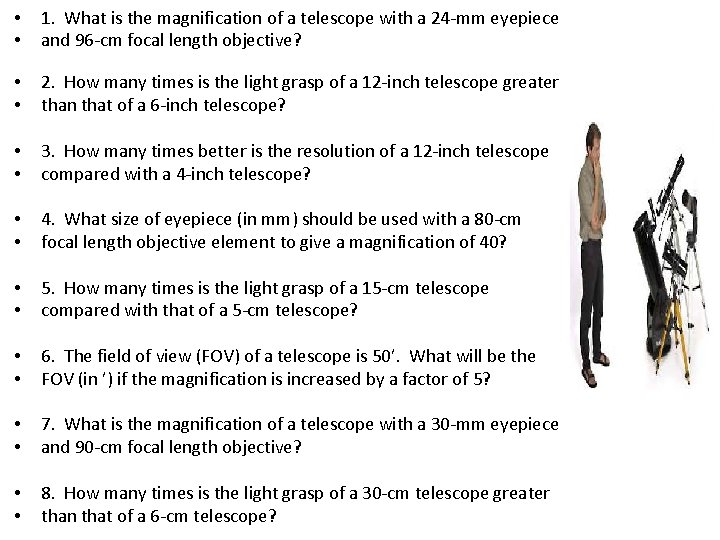
• • 1. What is the magnification of a telescope with a 24 -mm eyepiece and 96 -cm focal length objective? • • 2. How many times is the light grasp of a 12 -inch telescope greater than that of a 6 -inch telescope? • • 3. How many times better is the resolution of a 12 -inch telescope compared with a 4 -inch telescope? • • 4. What size of eyepiece (in mm) should be used with a 80 -cm focal length objective element to give a magnification of 40? • • 5. How many times is the light grasp of a 15 -cm telescope compared with that of a 5 -cm telescope? • • 6. The field of view (FOV) of a telescope is 50’. What will be the FOV (in ’) if the magnification is increased by a factor of 5? • • 7. What is the magnification of a telescope with a 30 -mm eyepiece and 90 -cm focal length objective? • • 8. How many times is the light grasp of a 30 -cm telescope greater than that of a 6 -cm telescope?
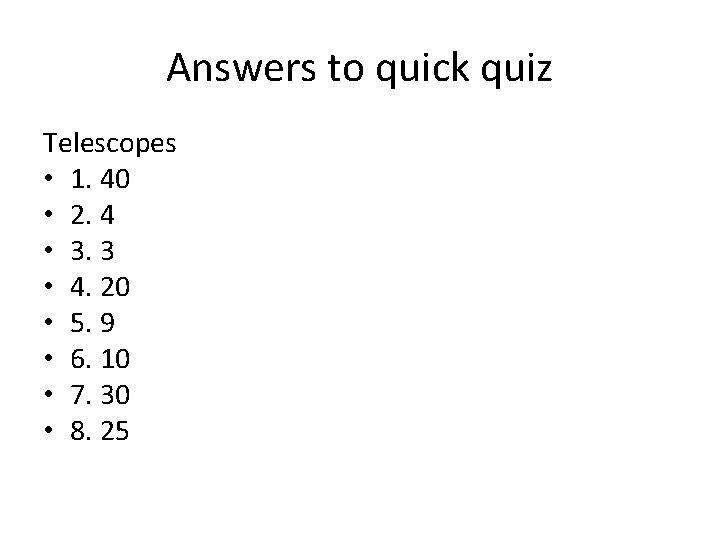
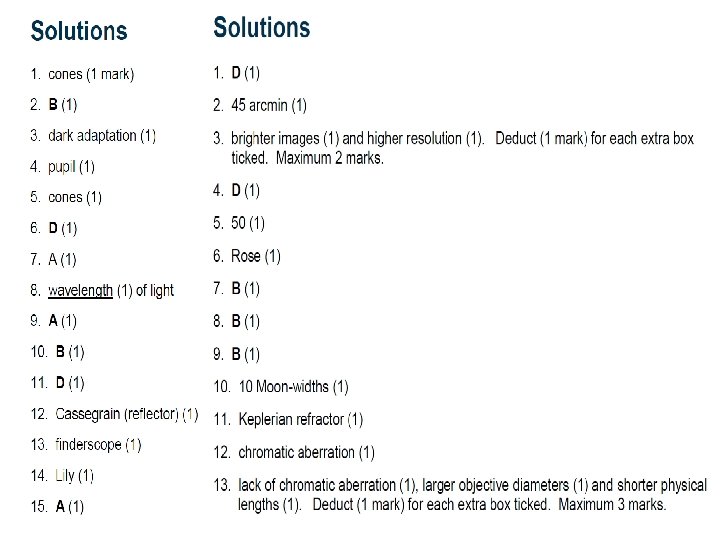
Answers to quick quiz Telescopes • 1. 40 • 2. 4 • 3. 3 • 4. 20 • 5. 9 • 6. 10 • 7. 30 • 8. 25
Worksheet Time • Have a go at the two worksheets • When you have finished try to determine what telescope you would recommend to someone if you had a £ 1000 budget to buy a telescope with. • Recommend the type of telescope and how much light grasp it has, what its aperture is and the Fo. V and resolution of your chosen telescope.
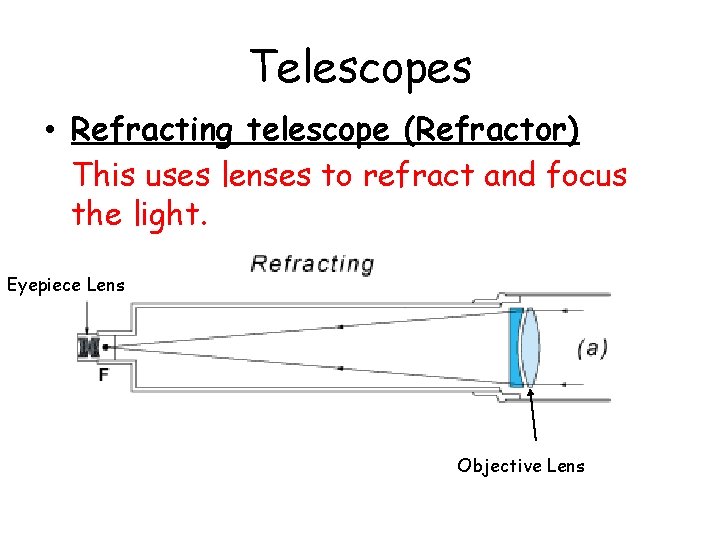
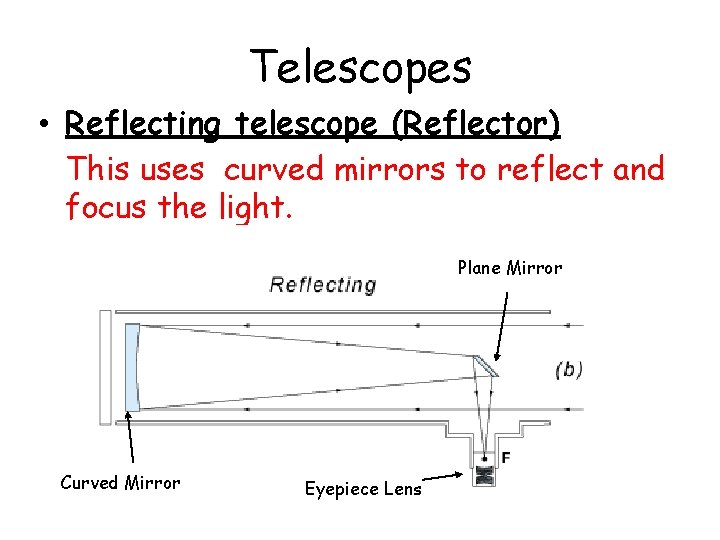
Telescopes • There are two main types of telescope; • Refracting telescope (Refractor) This uses lenses to refract and focus the light. • Reflecting telescope (Reflector) This uses curved mirrors to reflect and focus the light.
Refracting telescope • .
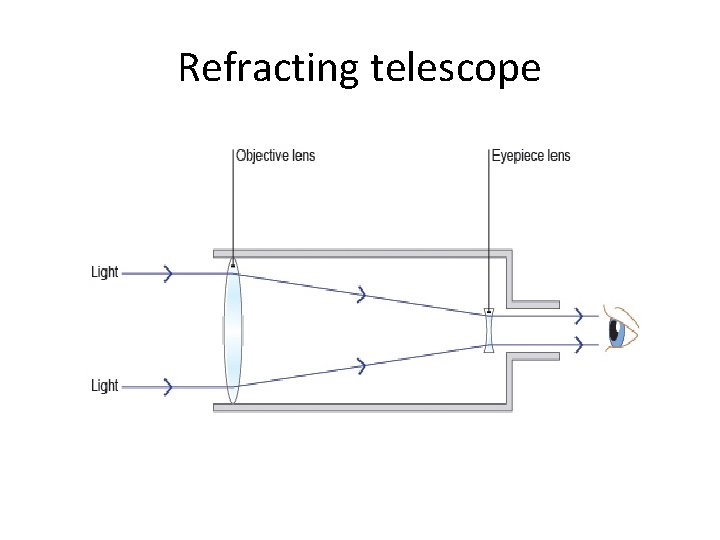
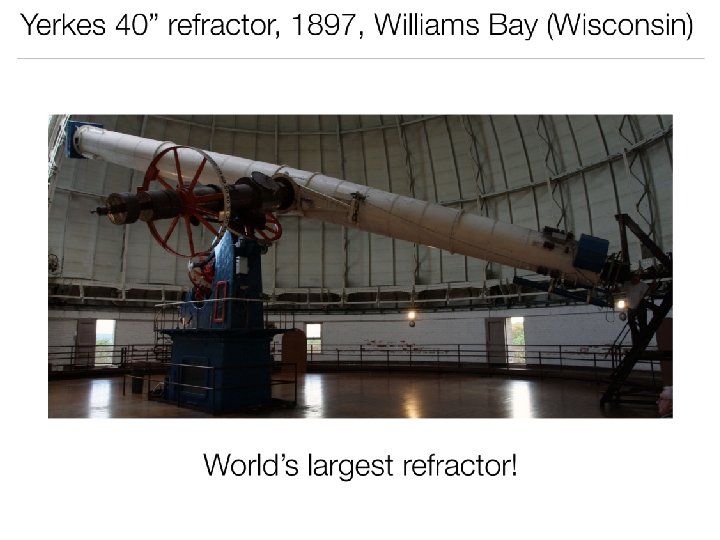
Telescopes • Refracting telescope (Refractor) This uses lenses to refract and focus the light. Eyepiece Lens Objective Lens
Refracting telescope • A refracting telescope works bending light through a lens so that it forms an image. There a few problems with refracting telescopes: • some of the light reflects off the lens so the image is very faint • large lenses are needed to improve the magnification – this can be difficult to do perfectly.
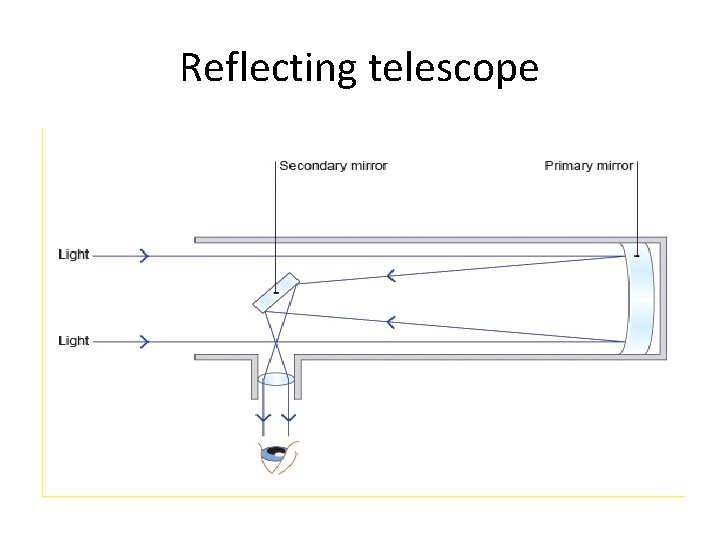
Reflecting telescope
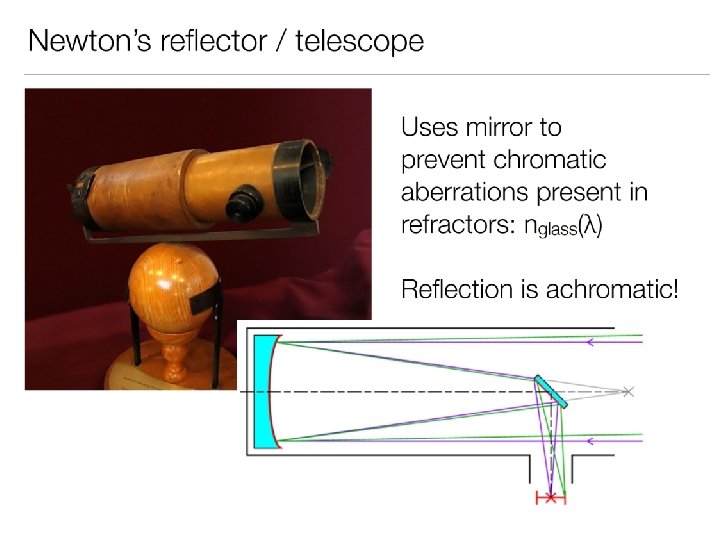
Telescopes • Reflecting telescope (Reflector) This uses curved mirrors to reflect and focus the light. Plane Mirror Curved Mirror Eyepiece Lens
A reflecting mirror. • How it works…… In a reflecting telescope the image is formed by reflection from a curved mirror. It is then magnified by a secondary mirror.
Types of telescope • Biscuit Task: Find out more about refracting and reflecting telescopes. Make a table to compare the advantages and disadvantages of both. • Draw or find a good picture of each type of telescope with the main components labelled and their functions described.
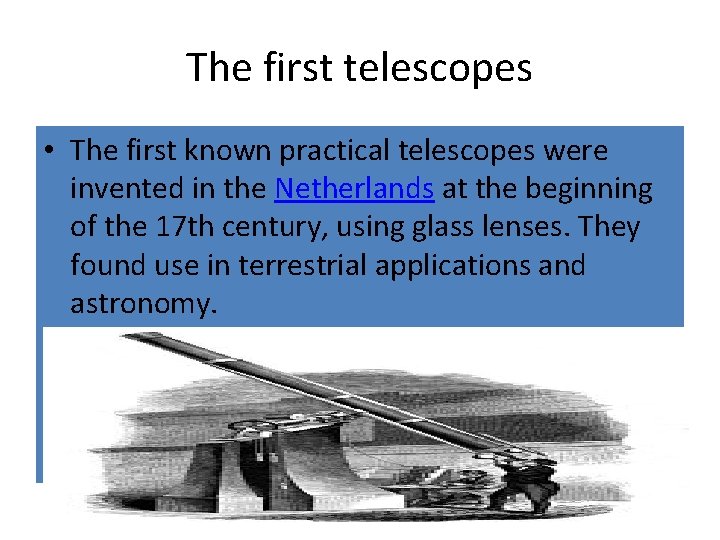
The first telescopes • The first known practical telescopes were invented in the Netherlands at the beginning of the 17 th century, using glass lenses. They found use in terrestrial applications and astronomy.
Limitations of the human eye • Find out the reasons for using telescopes and why it is connected to the limitations of human eye sight.
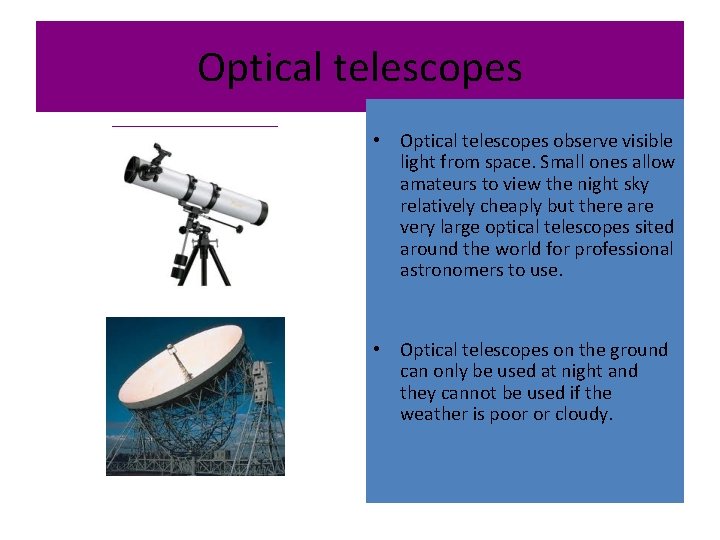
Optical telescopes • Optical telescopes observe visible light from space. Small ones allow amateurs to view the night sky relatively cheaply but there are very large optical telescopes sited around the world for professional astronomers to use. • Optical telescopes on the ground can only be used at night and they cannot be used if the weather is poor or cloudy.
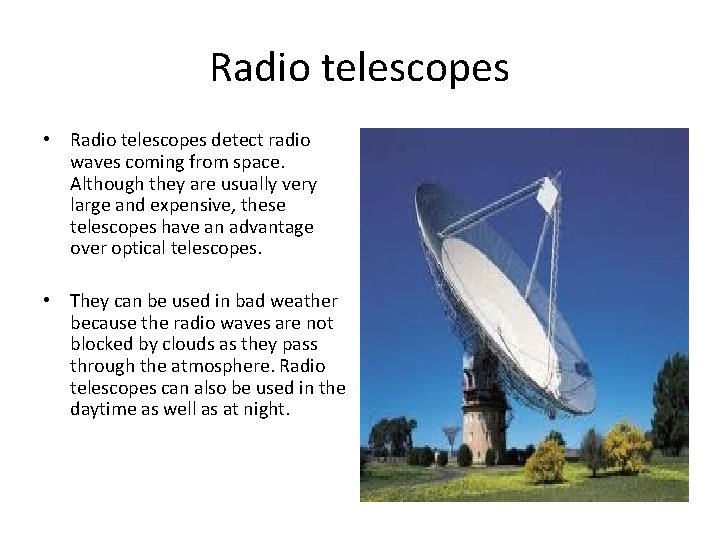
Radio telescopes • Radio telescopes detect radio waves coming from space. Although they are usually very large and expensive, these telescopes have an advantage over optical telescopes. • They can be used in bad weather because the radio waves are not blocked by clouds as they pass through the atmosphere. Radio telescopes can also be used in the daytime as well as at night.
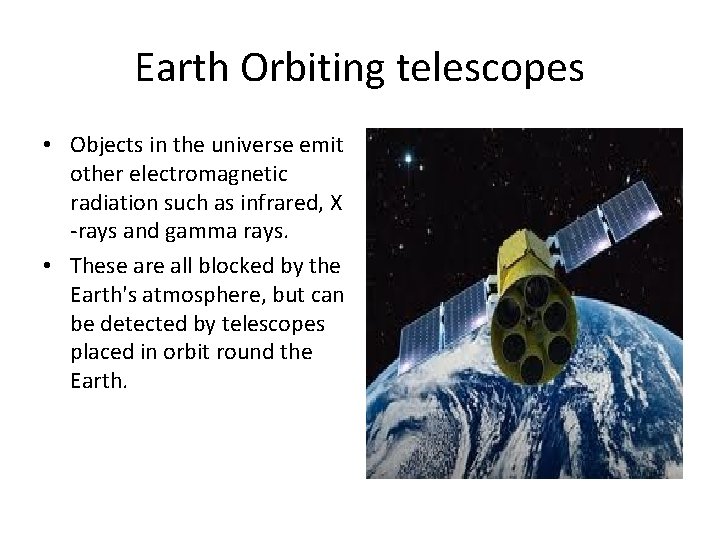
Earth Orbiting telescopes • Objects in the universe emit other electromagnetic radiation such as infrared, X -rays and gamma rays. • These are all blocked by the Earth's atmosphere, but can be detected by telescopes placed in orbit round the Earth.
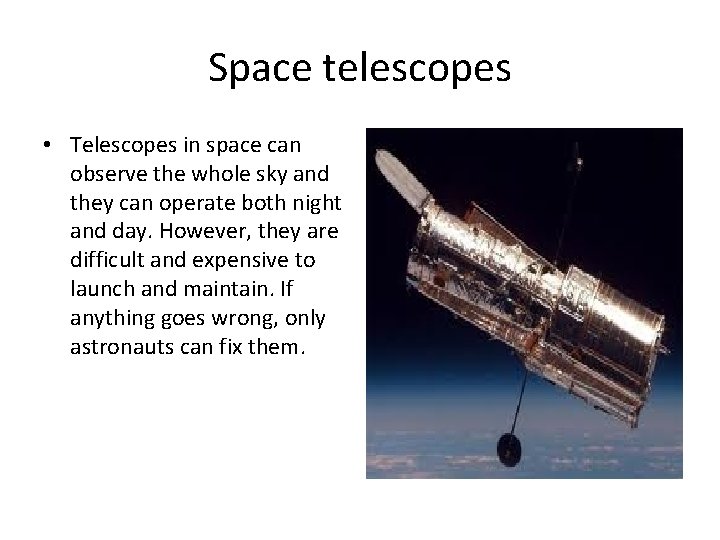
Space telescopes • Telescopes in space can observe the whole sky and they can operate both night and day. However, they are difficult and expensive to launch and maintain. If anything goes wrong, only astronauts can fix them.
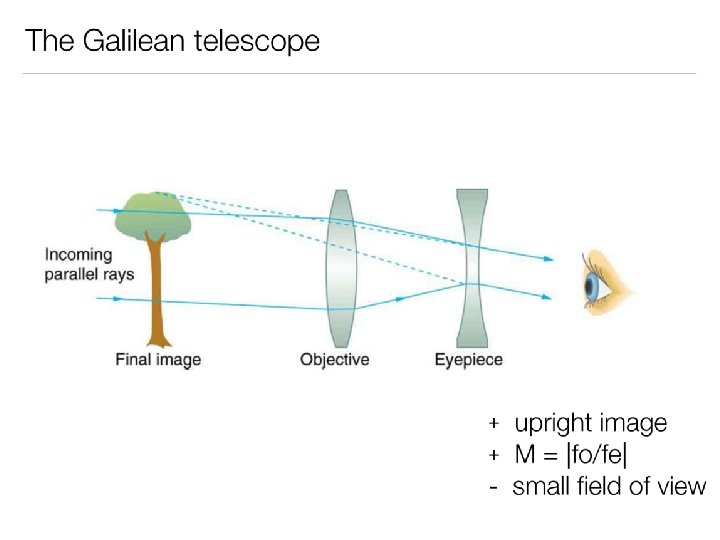
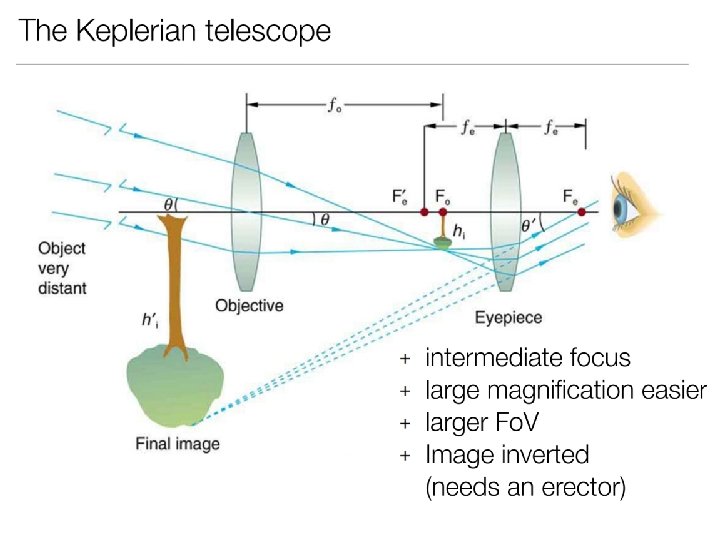
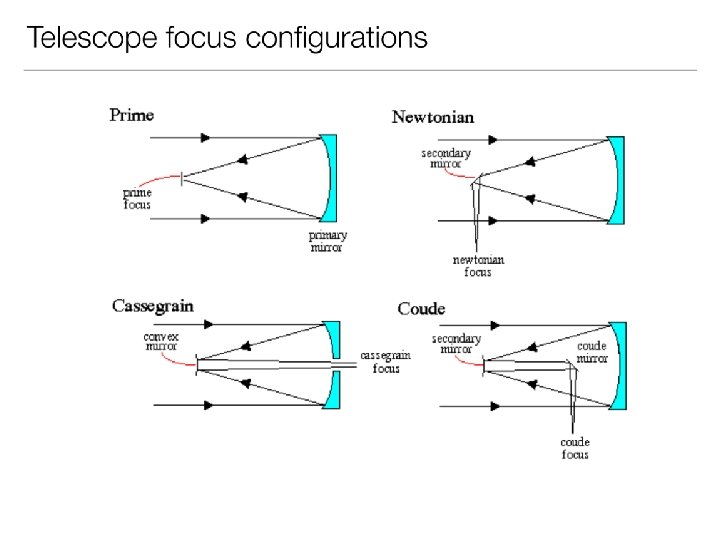
Research task: • Research the optical elements of refracting and reflecting telescopes in further detail, and study the basic designs of: • • Keplerian refracting telescope Galilean refracting telescope Newtonian reflecting telescope Cassegrain reflecting telescope.
Telescopes WALT: To understand advantages and disadvantages of using different types of telescope on Earth and in space. To know why scientists make observations and deductions about the universe. WILF: Name four different types of telescope and describe how they can be used. (Grade C) To compare the advantages and disadvantages of using each type of telescope. (B) To explain in detail how telescopes use electromagnetic radiation including X-rays, infrared, gamma waves, visible light etc. (A/A*)