
GCSE ART AND DESIGN UNIT 2 EXTERNALLY SET
- Slides: 17
GCSE ART AND DESIGN - UNIT 2 EXTERNALLY SET ASSIGNMENT Jan -May 2020
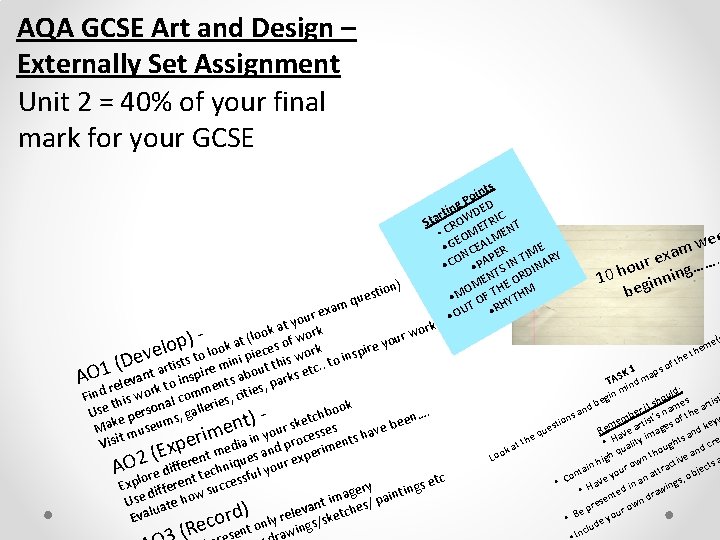
AQA GCSE Art and Design – Externally Set Assignment Unit 2 = 40% of your final mark for your GCSE ion) st que s int o P ing DED C t r Sta CROW ETRI NT E • M EO ALM G E E • NC APER TIM RY O • C • P TS IN INA D EN E OR M H O M • M OF T YTH UT • RH • O exam r u o at y rk ork k o w o o r l ( w u p) look at eces of ork e yo o r l i p e s i Devt artists toire mini pout this wetc. . to in ( 1 AO relevan k to insp ents ab es, parks Find his wor al comm ies, citi t r n ook. b Use perso s, galle h c t ) en… e e m t e k k u a b s n e s M e in your cesses s have m i t mu i r s i e V xp nt mediaes and proxperiment E ( AO 2 ore differtetechniqusful your e s etc y Expl ifferen succes g r n e i d nt ag w Use ate ho t im es/ pai n a u ) y relev sketch d r Eval o l / (Rec ent on awings wee m exa …. r u … o 10 h ginning be e( em e th h of t 1 s p a SK TA ind m d: nm t oul es egi h s b rtis t i a m a nd r e a n be th s ns w em rtist’ es of tio s m key a e e g d u R e a an av im eq • H uality oughts d cre t th a k n q h ea Loo nt igh v a i h w t o in cts ac r r a e u t j t t a yo ob on • C Have d in an wings, • e dra ent s e wn r o p r e • B de you lu Inc
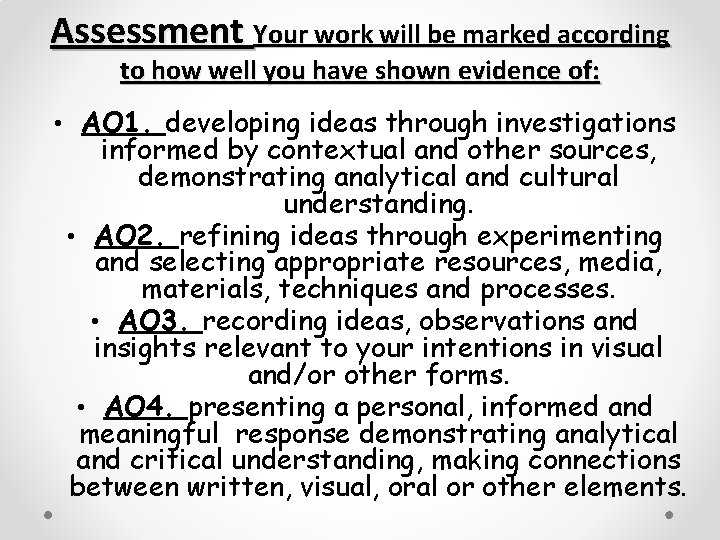
Assessment Your work will be marked according to how well you have shown evidence of: • AO 1. developing ideas through investigations informed by contextual and other sources, demonstrating analytical and cultural understanding. • AO 2. refining ideas through experimenting and selecting appropriate resources, media, materials, techniques and processes. • AO 3. recording ideas, observations and insights relevant to your intentions in visual and/or other forms. • AO 4. presenting a personal, informed and meaningful response demonstrating analytical and critical understanding, making connections between written, visual, oral or other elements.
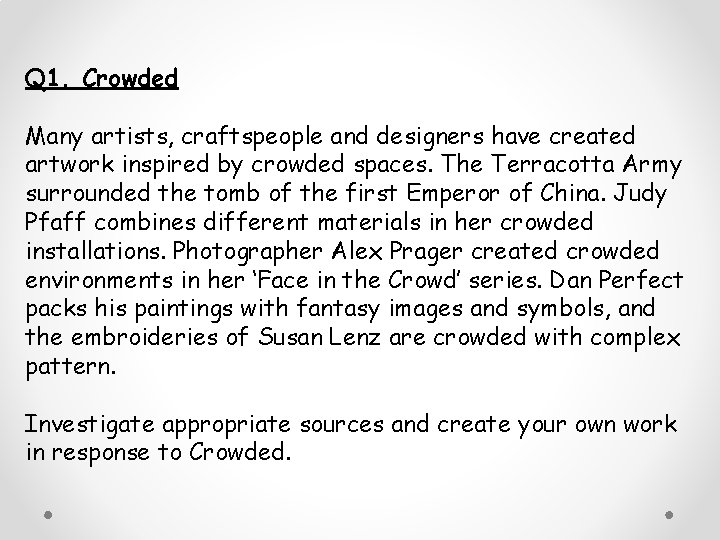
Q 1. Crowded Many artists, craftspeople and designers have created artwork inspired by crowded spaces. The Terracotta Army surrounded the tomb of the first Emperor of China. Judy Pfaff combines different materials in her crowded installations. Photographer Alex Prager created crowded environments in her ‘Face in the Crowd’ series. Dan Perfect packs his paintings with fantasy images and symbols, and the embroideries of Susan Lenz are crowded with complex pattern. Investigate appropriate sources and create your own work in response to Crowded.
You could also think about the following: • Different places where there are crowds eg. Theatres, train stations, shopping centres, music festivals, protest marches, battlefields, sporting events, exam halls etc…. . • Other types of crowds, for instance crowds of animals – penguins, seals, flocks of birds, fish, insects, cats etc…. . . • Compare and contrast the differing natures of crowds – happy crowds, aggressive crowds, lively crowds. Look at how crowds act together, mimic each other. Look at how wasps, bees and ants react and work as a collective. • Think about using items to represent individuals in a crowd, objects that are in plentiful supply such as paper clips, lego bricks, sugar cubes etc. Go to a building site or scrapyard, you could set up your own 3 D interpretation of a crowd. • Look at Antony Gormley’s “The crowd” for inspiration. Explore how the individual gets lost in a crowd and link to pixels on a TV screen or cogs in a machine.
Q 2. Geometric shapes and forms have been used by many artists, craftspeople and designers. In the ancient Greek Geometric period, ceramics were decorated with ordered patterns. Sonia Delaunay designed textile prints and garments using geometric patterns and Ben Nicholson created many abstract geometric paintings and reliefs. Jelle Martens incorporates images of landscape in digital geometric photo collages and Andy Gilmore designs geometric digital prints, projections and desktop wallpapers. J 1 Studio make modular geometric furnishings and Maria Dahlgren uses geometric shapes in her product designs. Research relevant examples and produce your own work in response to Geometric.
You could also think about the following: • Geometric forms in nature with aerial landscape views, honey combs, flower petals, leaf structures and also proportions of the human form and skeleton. Also look at microscopic images like the structure of cells in leaves, plants and food. • Look at architecture and fashion/textile design through the ages and how many architects and designers have been influenced by geometry. • Think about why humans are drawn to geometric patterns with order and organisation. You could build a project around our need for order in a chaotic world. You could also explore the use of geometry in video games where geometric frameworks are constructed before textures are placed over the top. • Don’t forget to use your phone to take pictures – you could manipulate them using the many apps that are available. There are some great kaleidoscope apps out there.
Q 3. Concealment Sometimes artists, craftspeople and designers use concealment to disguise identity or Simply hidden meaning in their work. Charlotte Caron paints on photographic portraits to conceal the identity of the person and suggest the animal within. Pablo Thecuadro makes photographic montages that explore the idea of dual identity. Graphic designer Viktor Koen uses steampunk items in digital illustrations to help disguise appearances. Danica Pistekova makes sculptural garments that hide the figure and Crystal Neubauer uses overlooked items to create collages with concealed layers. Explore relevant sources and develop a personal response to Concealment.
You could also think about the following: • • • Set up still life displays to work from which have objects partially revealed. For instance chocolate or sweets partially unwrapped or fruit partially unpeeled. You could then progress the work to have fruit being peeled to reveal something unexpected eg. Different fruit/veg inside. This could link well to the work of the Surrealists such as Dali or Magritte. Alternatively you could look at how different groups in society conceal their identity. This could be through the way they dress or the way they present themselves on the internet. Identity concealment could include the exploration of religious beliefs. It could also look at drag artists, military, police, uniforms, face masks, scarves, face paint, camouflage and mirrors etc…. . . Explore figures being obscured by weather conditions, mist, fog, snow, rain. Being lost in a crowd. This links well to question 1. You could start off by exploring both questions before deciding which to focus on.
Q 4. Paper Artists, craftspeople and designers use paper in many different ways. In ancient China, paper scrolls were used as a surface for painting and calligraphy. Eva Isaksen prints and draws on handmade papers and Kurt Schwitters made collages from found and discarded papers. Hugh Dunford Wood’s wallpapers are block printed by hand. Rich Mc. Cor, aka Paperboyo, remodels landscapes by combining photographs with paper cut-outs. Leslie Pearson creates paper sculptures inspired by the natural world and Mokalache Design use eco-friendly paper for their packaging products. Investigate appropriate sources and create your own work in response to Paper.
You could also think about the following: • • You could start by distressing paper in as many ways as you can and recording the outcome through drawing and photography. Rip, scrunch, shred, burn (at home), wet, freeze in water, shine light through. Explore different types of paper, different thicknesses and colours. Make 3 dimensional shapes out of paper and record the shadows cast by them. Your research could include looking at the history of paper manufacture and this could inform your idea development. Research paper mills. You could think about sustainability and environmentalism and how forests need to be re planted in order to maintain balance. Consider the demise of paper and the written work in favour of email and other digital forms of communication. You could explore communication in general and how in the past it was all done by letter.
Q 5. Moments in time Capturing moments in time has interested many artists, craftspeople and designers. Rembrandt van Rijn painted self-portraits using different lighting, costume and posture to record himself at different periods of his life. Ben Gest’s photographs capture people at a current moment in everyday life. Godfrey Reggio’s film Koyaanisqatsi’ dramatically captured momentary changes in the environment and Karen Henderson’s weavings illustrate fleeting moments seen in nature. Sand in Your Eye created stencilled figures on a beach in memory of ‘The Fallen 9000’, to record a moment in time. Research relevant examples and produce your own work based on Moments in time.
You could also think about the following: • • Think carefully about what moment you want to capture. It could be the moment before something happens, for instance the moment before a drop of water lands, the moment before a cup hits the ground and breaks, the moment before two people kiss, the moment before a punch lands on someone’s face. Or it could be the moment after something has happened. You might want to capture the stages of something, for instance someone kicking a ball or throwing, or dancing, food decomposing or different ages of people in a family. There apps that allow you to photograph stages of an action, so don’t forget to use your phone, it’s a powerful tool. There might be particular pivotal moments from your lifetime that you want to explore. You could consider the concept of time itself. What is it? How do we know it exists? Does it exist or is it simply a convenient way of explaining why things change. Your work could have some very deep questions running through it …. Don’t forget to annotate!
Q 6. Out of the ordinary Many artists, craftspeople and designers have created art work that is unusual and could be considered to be out of the ordinary. Marc Chagall painted dreamlike compositions and Niki de Saint Phalle made extraordinary monumental sculptures. Patricia Casey creates surreal portraits that combine photography and embroidery. Elisa Strozyk produces unconventional textile products with wood. Illustrator Mateo Dineen creates strange and unusual characters set in everyday situations. Investigate appropriate sources and create your own work in response to Out of the ordinary.
You could also think about the following: • Consider everyday scenes that could be manipulated to make them less ordinary. For instance people sitting around a dinner table ready to eat, but everyone is wearing fancy dress costumes! When you start thinking about it. You will be able to come up with loads of out of the ordinary ideas. It could be people sitting in a living room watching TV, but everyone is sitting upside down …. The TV is upside down too. Other ideas could include amalgamating different parts of animals to produce an imaginary animal form. • You could combine everyday objects to make new objects or images such as in the work of Redmer Hoekstra…. • Think about objects or people that are in unusual places, explore theme of “Guerrilla Art”…. .
Q 7. Rhythm The theme Rhythm can be interpreted in many ways. Refer to appropriate sources to develop your own interpretation of Rhythm, or respond to one of the following: (a) the rhythm and flow of everyday life at home, school or work (b) the rhythm of colour (c) ‘Rhythm’: a touring exhibition celebrating rhythm in art, music and dance requires promotional material and souvenir items in any media.
You could also think about the following: • Different types of rhythm – music, drum beats, heat beats, ticking clocks, the rhythm of the sea coming in and going out, the rhythm of life (ageing), the seasons. It is important that you pin point things to respond to through drawing. How do you show rhythm through drawing? You could set up a pendulum with a pen or pencil and allow it to swing across paper, making a mark as it goes. • You could explore dance and produce drawings based on the movements of a figure. Draw or paint in the style of Kandinsky whilst listening to music…. • You could research the anatomy of the heart as this is the organ that gives the human body a rhythm. It is thought that the origin of the drum beat is man’s fascination with the heart-beat, so this could be explored. In music, a fast drum beat encourages us to be lively, just as our heart rate increases when we are active. As the question paper suggests, you could also consider the marks made on a surface when you respond in a rhythmical way. Perhaps use your whole body to draw with – strong links to dance and music.