
GCSE ANATOMY PHYSIOLOGY Remembering Pulse raiser Identify the

GCSE ANATOMY & PHYSIOLOGY Remembering!
Pulse raiser – Identify the terms T H I N G E A R

GATHERING– 10% of your time! • Session 1 • After the first time you have revised a topic you should not need to do any further ‘gathering’ • You will need: • Before you start: • Class booklets • • Home learning booklets Rank the topics you need to cover from most to least confident. Begin with the topics lowest on the list. • Unit tests • • Your exam papers • Revision guides Read through and become familiar with the information you need to know in order to be successful. • Textbooks • • Websites Identify any bits of knowledge you have missing any see the appropriate teacher to help fill gaps. Gathering is NOT REVISION DO NOT SPEND MUCH TIME AT THIS STAGE
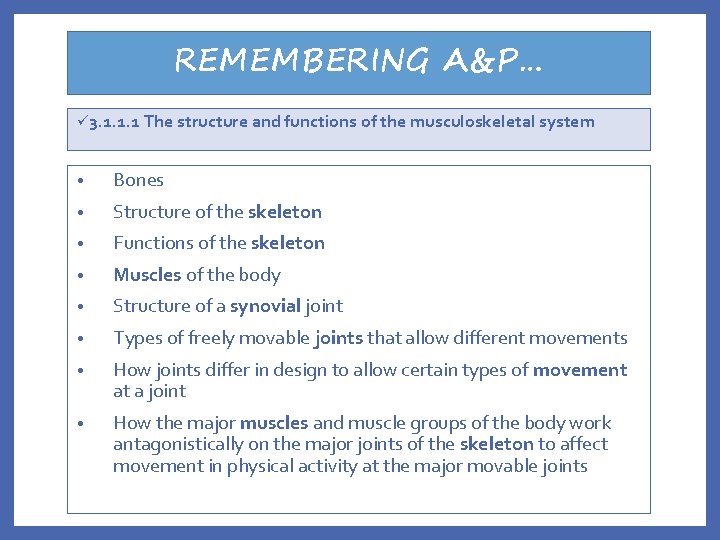
REMEMBERING A&P… ü 3. 1. 1. 1 The structure and functions of the musculoskeletal system • Bones • Structure of the skeleton • Functions of the skeleton • Muscles of the body • Structure of a synovial joint • Types of freely movable joints that allow different movements • How joints differ in design to allow certain types of movement at a joint • How the major muscles and muscle groups of the body work antagonistically on the major joints of the skeleton to affect movement in physical activity at the major movable joints
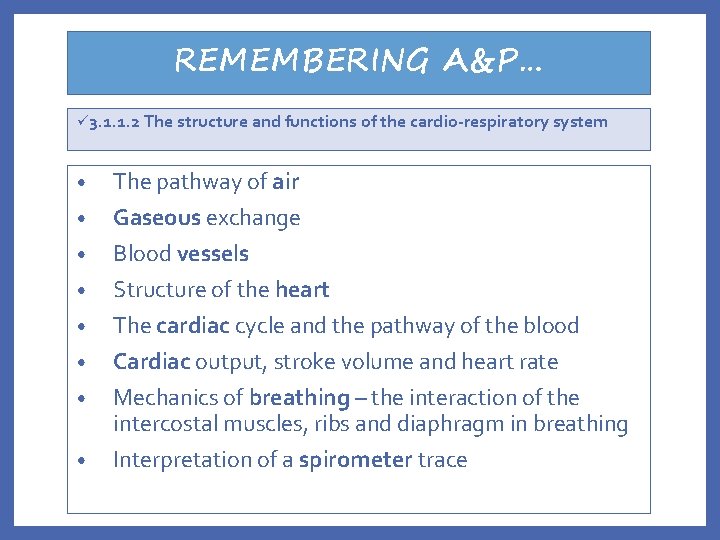
REMEMBERING A&P… ü 3. 1. 1. 2 The structure and functions of the cardio-respiratory system • • The pathway of air Gaseous exchange Blood vessels Structure of the heart The cardiac cycle and the pathway of the blood Cardiac output, stroke volume and heart rate Mechanics of breathing – the interaction of the intercostal muscles, ribs and diaphragm in breathing Interpretation of a spirometer trace
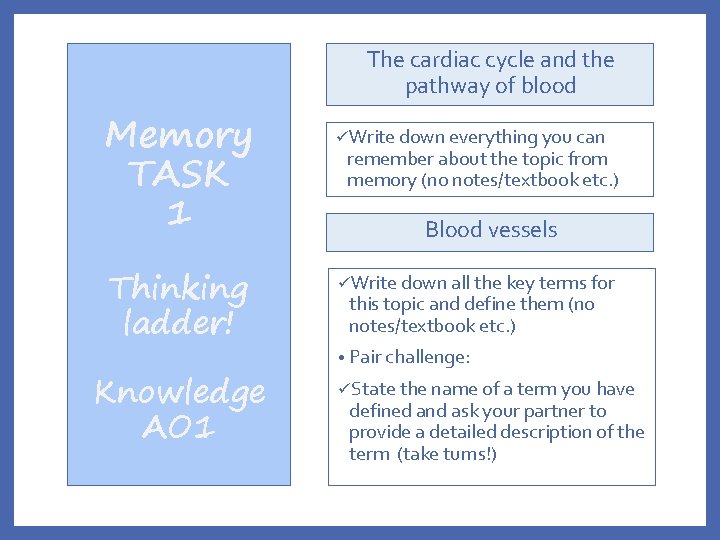
The cardiac cycle and the pathway of blood Memory TASK 1 Thinking ladder! Knowledge AO 1 üWrite down everything you can remember about the topic from memory (no notes/textbook etc. ) Blood vessels üWrite down all the key terms for this topic and define them (no notes/textbook etc. ) • Pair challenge: üState the name of a term you have defined and ask your partner to provide a detailed description of the term (take turns!)
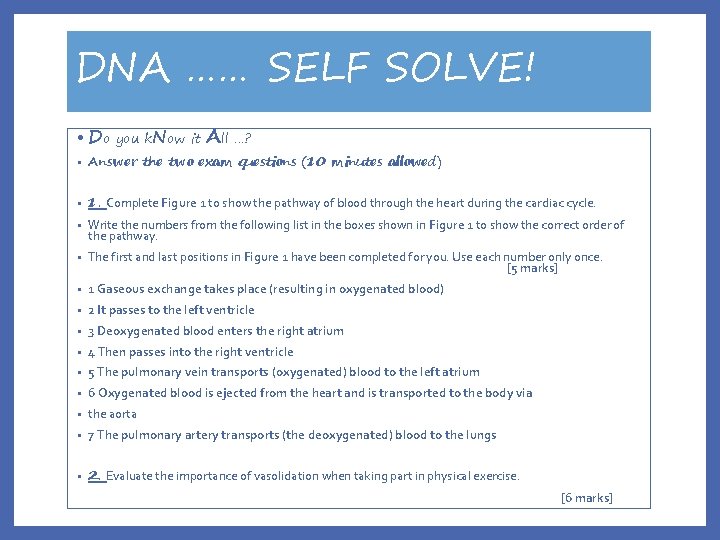
DNA …… SELF SOLVE! • Do you k. Now it All …? • Answer the two exam questions (10 minutes allowed) • 1. Complete Figure 1 to show the pathway of blood through the heart during the cardiac cycle. • Write the numbers from the following list in the boxes shown in Figure 1 to show the correct order of the pathway. • The first and last positions in Figure 1 have been completed for you. Use each number only once. [5 marks] • 1 Gaseous exchange takes place (resulting in oxygenated blood) • 2 It passes to the left ventricle • 3 Deoxygenated blood enters the right atrium • 4 Then passes into the right ventricle • 5 The pulmonary vein transports (oxygenated) blood to the left atrium • 6 Oxygenated blood is ejected from the heart and is transported to the body via • the aorta • 7 The pulmonary artery transports (the deoxygenated) blood to the lungs • 2. Evaluate the importance of vasolidation when taking part in physical exercise. [6 marks]
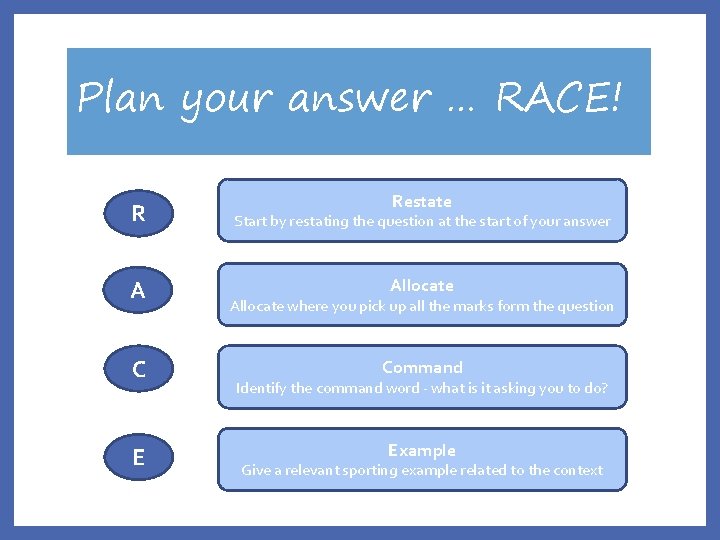
Plan your answer … RACE! Restate R Start by restating the question at the start of your answer A Allocate C E Allocate where you pick up all the marks form the question Command Identify the command word - what is it asking you to do? Example Give a relevant sporting example related to the context
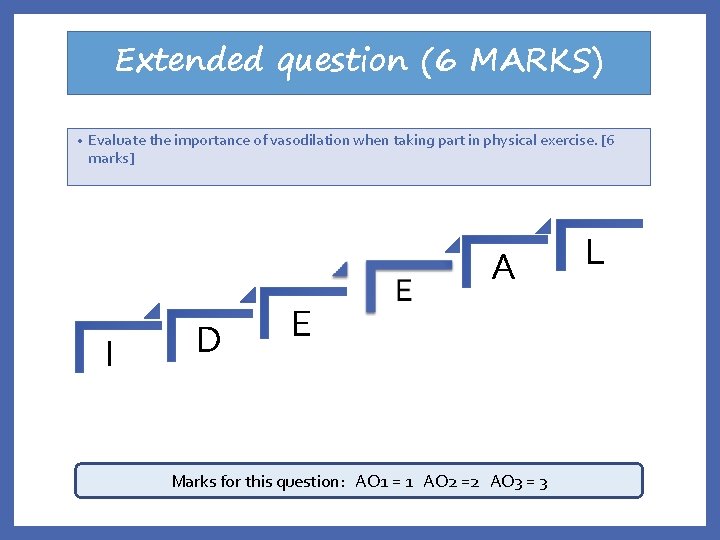
Extended question (6 MARKS) • Evaluate the importance of vasodilation when taking part in physical exercise. [6 marks] A I D E Marks for this question: AO 1 = 1 AO 2 =2 AO 3 = 3 L
• Memory TASK 1 Thinking ladder! Knowledge AO 1 1. Choose a remembering task from the ‘Thinking ladder’ to help you revise the following TOPIC: • Structure of the heart! • atria (left and right atria) • ventricles (left and right ventricles). • 2. Choose another remembering task from the ‘Thinking ladder’ to help you revise a TOPIC of your CHOICE from Year 10 Applied A&P!
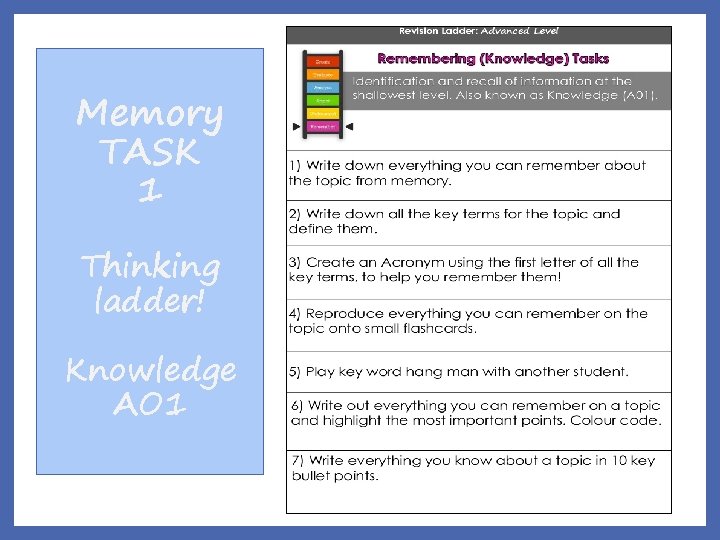
Memory TASK 1 Thinking ladder! Knowledge AO 1
- Slides: 11