
GCSE 9 1 History Weimar and Nazi Germany


- Slides: 38
GCSE (9 -1) History: Weimar and Nazi Germany 1919 -1939 Interpretations Learning Goals To understand the difference between sources and interpretations. To practice questions on the Interpretations section of Paper 3.
Questions for thought • Is Justin Bieber a good musician? • Are Man United a better football team than Man City? • Did people vote Brexit because of immigration or other factors? • Should Germany have got the blame for starting World War One? • Donald Trump: Friend or Foe?
Interpretations • The honest views on these questions will likely differ between different students. • Essentially, you will have differing interpretations depending on your point of view and the evidence you have available to you. • This is the same for historians. They often strongly disagree with each other despite studying the same events, and, sometimes having access to similar evidence.
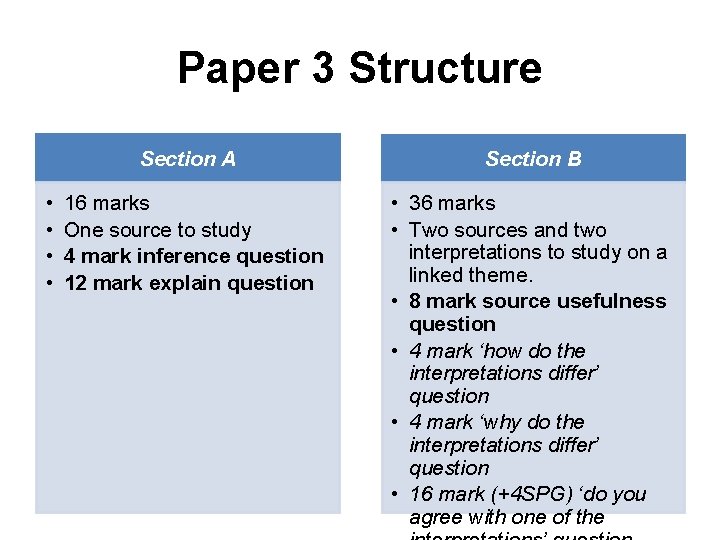
Paper 3 Structure • • Section A Section B 16 marks One source to study 4 mark inference question 12 mark explain question • 36 marks • Two sources and two interpretations to study on a linked theme. • 8 mark source usefulness question • 4 mark ‘how do the interpretations differ’ question • 4 mark ‘why do the interpretations differ’ question • 16 mark (+4 SPG) ‘do you agree with one of the
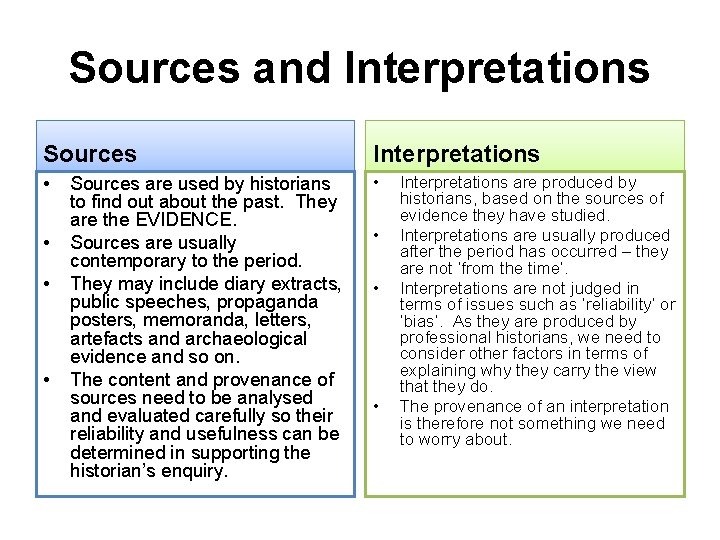
Sources and Interpretations Sources Interpretations • • • Sources are used by historians to find out about the past. They are the EVIDENCE. Sources are usually contemporary to the period. They may include diary extracts, public speeches, propaganda posters, memoranda, letters, artefacts and archaeological evidence and so on. The content and provenance of sources need to be analysed and evaluated carefully so their reliability and usefulness can be determined in supporting the historian’s enquiry. • • • Interpretations are produced by historians, based on the sources of evidence they have studied. Interpretations are usually produced after the period has occurred – they are not ‘from the time’. Interpretations are not judged in terms of issues such as ‘reliability’ or ‘bias’. As they are produced by professional historians, we need to consider other factors in terms of explaining why they carry the view that they do. The provenance of an interpretation is therefore not something we need to worry about.
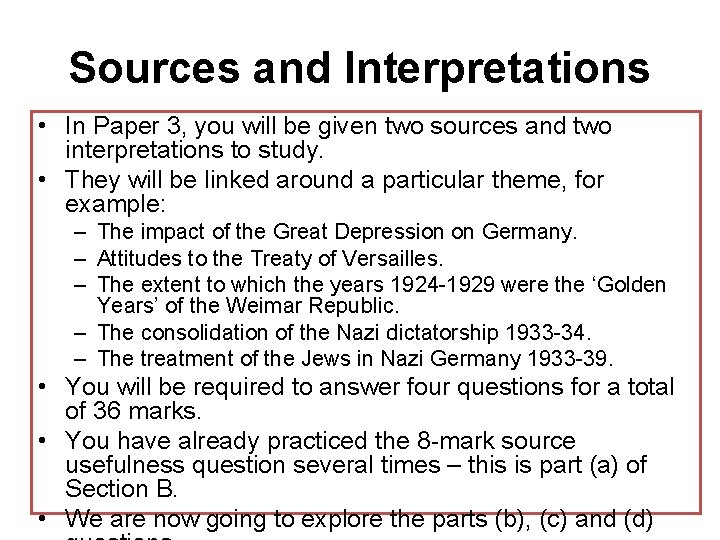
Sources and Interpretations • In Paper 3, you will be given two sources and two interpretations to study. • They will be linked around a particular theme, for example: – The impact of the Great Depression on Germany. – Attitudes to the Treaty of Versailles. – The extent to which the years 1924 -1929 were the ‘Golden Years’ of the Weimar Republic. – The consolidation of the Nazi dictatorship 1933 -34. – The treatment of the Jews in Nazi Germany 1933 -39. • You will be required to answer four questions for a total of 36 marks. • You have already practiced the 8 -mark source usefulness question several times – this is part (a) of Section B. • We are now going to explore the parts (b), (c) and (d)
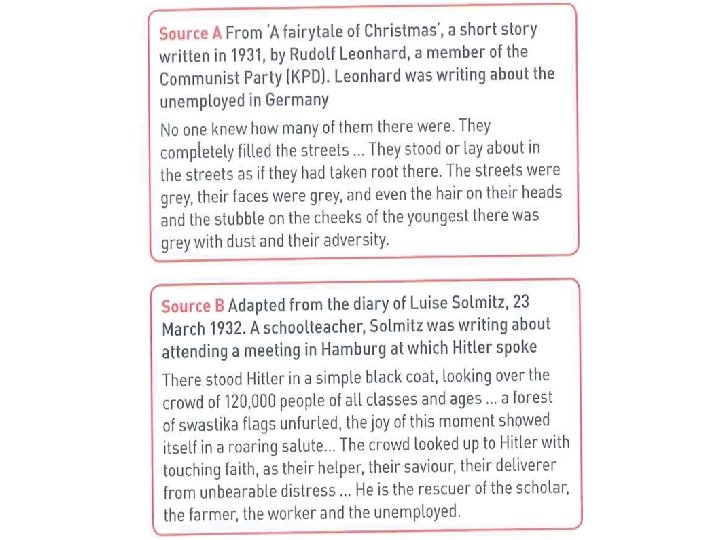
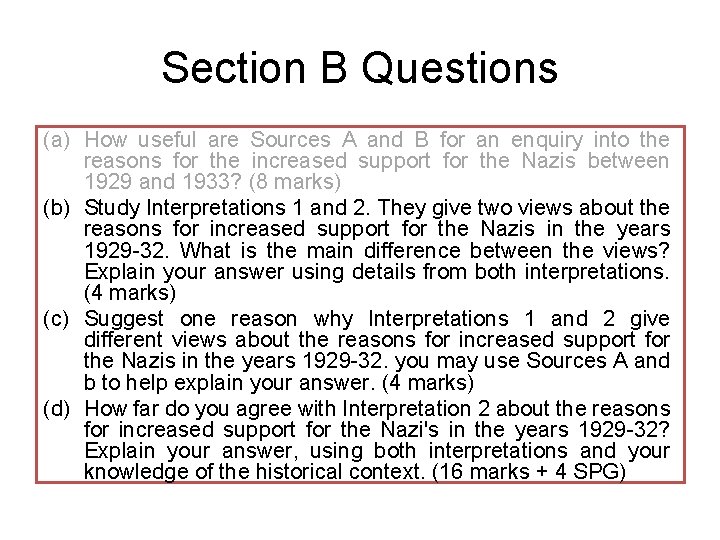
Section B Questions (a) How useful are Sources A and B for an enquiry into the reasons for the increased support for the Nazis between 1929 and 1933? (8 marks) (b) Study Interpretations 1 and 2. They give two views about the reasons for increased support for the Nazis in the years 1929 -32. What is the main difference between the views? Explain your answer using details from both interpretations. (4 marks) (c) Suggest one reason why Interpretations 1 and 2 give different views about the reasons for increased support for the Nazis in the years 1929 -32. you may use Sources A and b to help explain your answer. (4 marks) (d) How far do you agree with Interpretation 2 about the reasons for increased support for the Nazi's in the years 1929 -32? Explain your answer, using both interpretations and your knowledge of the historical context. (16 marks + 4 SPG)
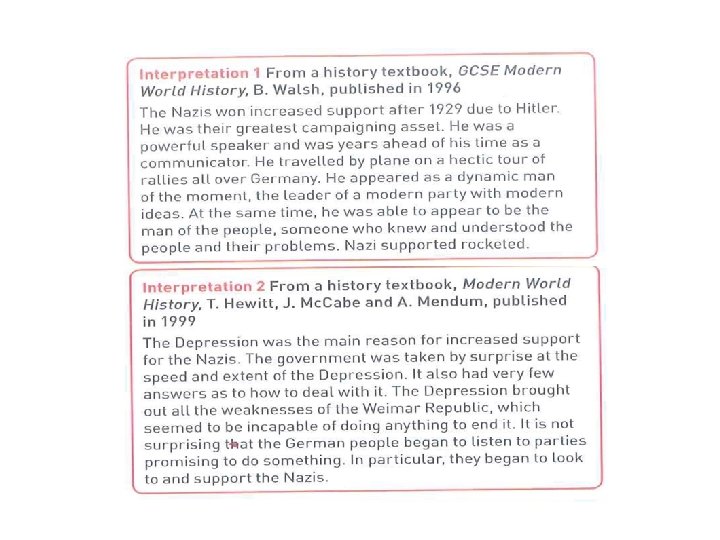
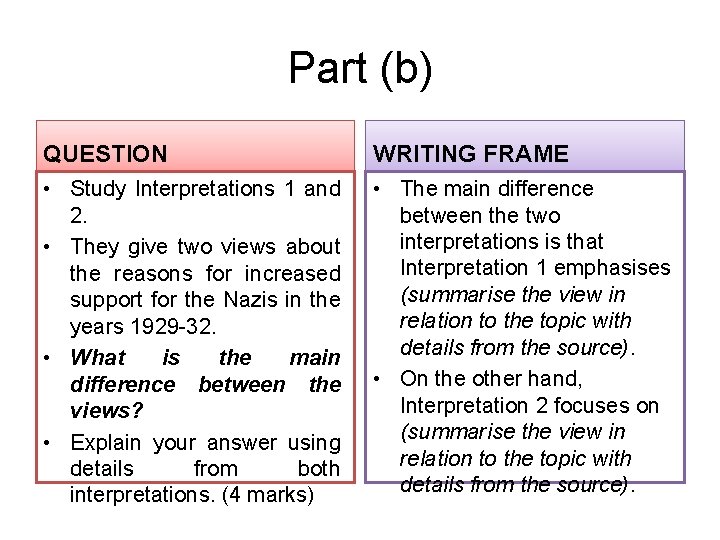
Part (b) QUESTION WRITING FRAME • Study Interpretations 1 and 2. • They give two views about the reasons for increased support for the Nazis in the years 1929 -32. • What is the main difference between the views? • Explain your answer using details from both interpretations. (4 marks) • The main difference between the two interpretations is that Interpretation 1 emphasises (summarise the view in relation to the topic with details from the source). • On the other hand, Interpretation 2 focuses on (summarise the view in relation to the topic with details from the source).
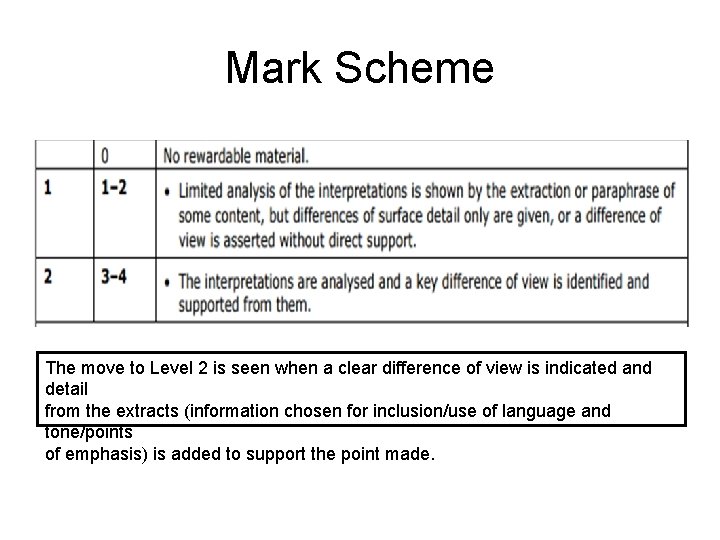
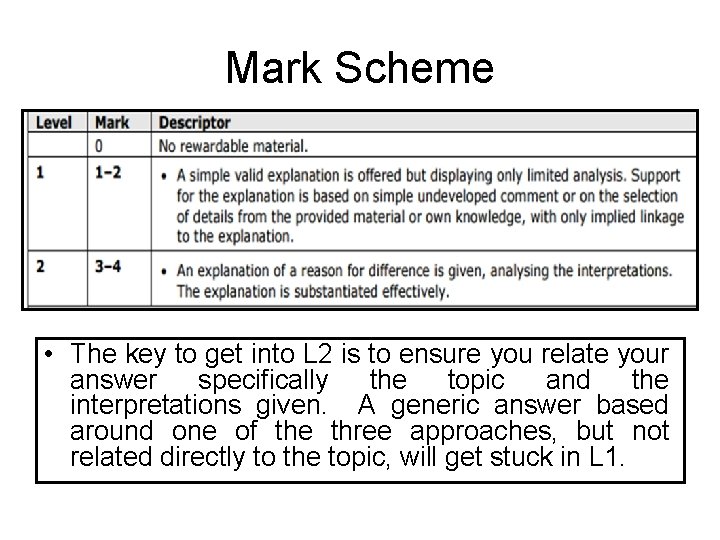
Mark Scheme The move to Level 2 is seen when a clear difference of view is indicated and detail from the extracts (information chosen for inclusion/use of language and tone/points of emphasis) is added to support the point made.
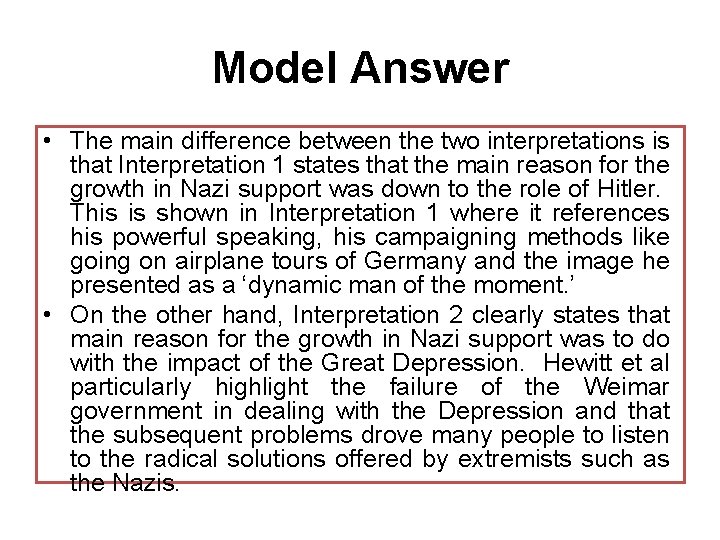
Model Answer • The main difference between the two interpretations is that Interpretation 1 states that the main reason for the growth in Nazi support was down to the role of Hitler. This is shown in Interpretation 1 where it references his powerful speaking, his campaigning methods like going on airplane tours of Germany and the image he presented as a ‘dynamic man of the moment. ’ • On the other hand, Interpretation 2 clearly states that main reason for the growth in Nazi support was to do with the impact of the Great Depression. Hewitt et al particularly highlight the failure of the Weimar government in dealing with the Depression and that the subsequent problems drove many people to listen to the radical solutions offered by extremists such as the Nazis.
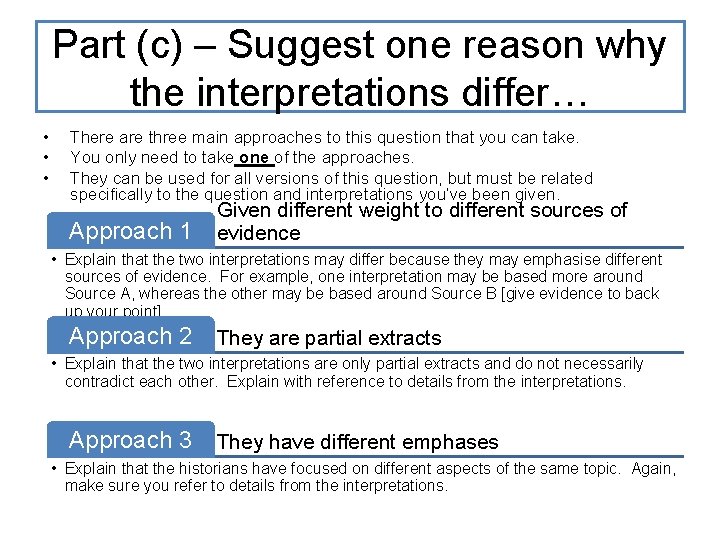
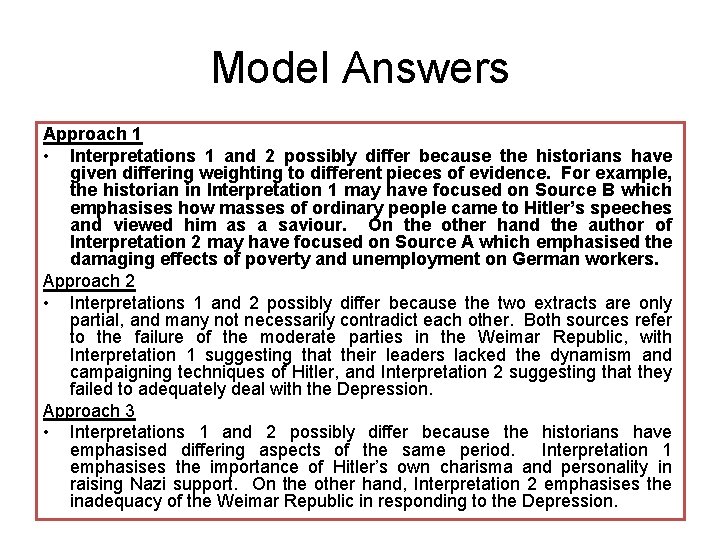
Part (c) – Suggest one reason why the interpretations differ… • • • There are three main approaches to this question that you can take. You only need to take one of the approaches. They can be used for all versions of this question, but must be related specifically to the question and interpretations you’ve been given. Approach 1 Given different weight to different sources of evidence • Explain that the two interpretations may differ because they may emphasise different sources of evidence. For example, one interpretation may be based more around Source A, whereas the other may be based around Source B [give evidence to back up your point]. Approach 2 They are partial extracts • Explain that the two interpretations are only partial extracts and do not necessarily contradict each other. Explain with reference to details from the interpretations. Approach 3 They have different emphases • Explain that the historians have focused on different aspects of the same topic. Again, make sure you refer to details from the interpretations.
Mark Scheme • The key to get into L 2 is to ensure you relate your answer specifically the topic and the interpretations given. A generic answer based around one of the three approaches, but not related directly to the topic, will get stuck in L 1.
Model Answers Approach 1 • Interpretations 1 and 2 possibly differ because the historians have given differing weighting to different pieces of evidence. For example, the historian in Interpretation 1 may have focused on Source B which emphasises how masses of ordinary people came to Hitler’s speeches and viewed him as a saviour. On the other hand the author of Interpretation 2 may have focused on Source A which emphasised the damaging effects of poverty and unemployment on German workers. Approach 2 • Interpretations 1 and 2 possibly differ because the two extracts are only partial, and many not necessarily contradict each other. Both sources refer to the failure of the moderate parties in the Weimar Republic, with Interpretation 1 suggesting that their leaders lacked the dynamism and campaigning techniques of Hitler, and Interpretation 2 suggesting that they failed to adequately deal with the Depression. Approach 3 • Interpretations 1 and 2 possibly differ because the historians have emphasised differing aspects of the same period. Interpretation 1 emphasises the importance of Hitler’s own charisma and personality in raising Nazi support. On the other hand, Interpretation 2 emphasises the inadequacy of the Weimar Republic in responding to the Depression.
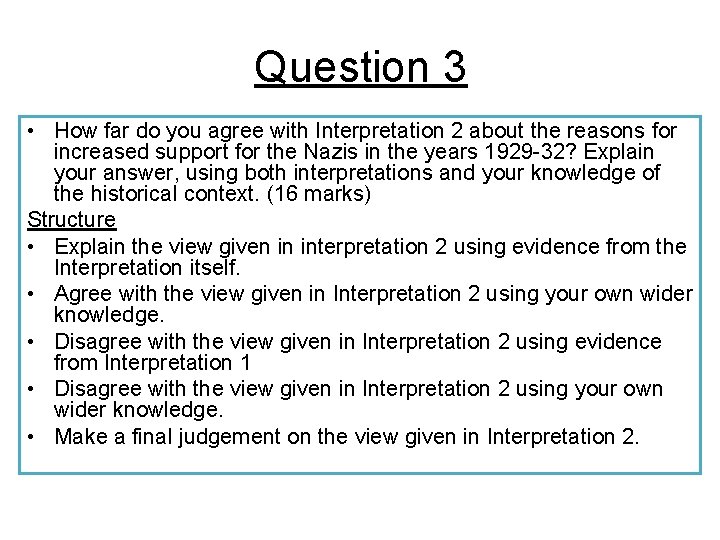
Question 3 • How far do you agree with Interpretation 2 about the reasons for increased support for the Nazis in the years 1929 -32? Explain your answer, using both interpretations and your knowledge of the historical context. (16 marks) Structure • Explain the view given in interpretation 2 using evidence from the Interpretation itself. • Agree with the view given in Interpretation 2 using your own wider knowledge. • Disagree with the view given in Interpretation 2 using evidence from Interpretation 1 • Disagree with the view given in Interpretation 2 using your own wider knowledge. • Make a final judgement on the view given in Interpretation 2.
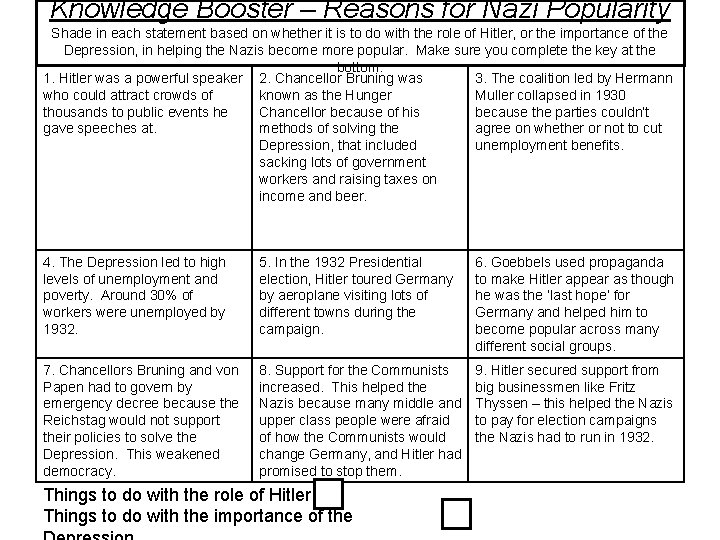
Knowledge Booster – Reasons for Nazi Popularity Shade in each statement based on whether it is to do with the role of Hitler, or the importance of the Depression, in helping the Nazis become more popular. Make sure you complete the key at the bottom. 1. Hitler was a powerful speaker 2. Chancellor Bruning was 3. The coalition led by Hermann who could attract crowds of known as the Hunger Muller collapsed in 1930 thousands to public events he Chancellor because of his because the parties couldn’t gave speeches at. methods of solving the agree on whether or not to cut Depression, that included unemployment benefits. sacking lots of government workers and raising taxes on income and beer. 4. The Depression led to high levels of unemployment and poverty. Around 30% of workers were unemployed by 1932. 5. In the 1932 Presidential election, Hitler toured Germany by aeroplane visiting lots of different towns during the campaign. 6. Goebbels used propaganda to make Hitler appear as though he was the ‘last hope’ for Germany and helped him to become popular across many different social groups. 7. Chancellors Bruning and von Papen had to govern by emergency decree because the Reichstag would not support their policies to solve the Depression. This weakened democracy. 8. Support for the Communists increased. This helped the Nazis because many middle and upper class people were afraid of how the Communists would change Germany, and Hitler had promised to stop them. 9. Hitler secured support from big businessmen like Fritz Thyssen – this helped the Nazis to pay for election campaigns the Nazis had to run in 1932. Things to do with the role of Hitler Things to do with the importance of the
Interpretation 2 suggests that the Great Depression was the main reason for the increased support for the Nazis. I would agree with this judgement to some extent, although it is clear that other factors, such as the role of Hitler as highlighted by Interpretation 1, were also important.
Mark Scheme
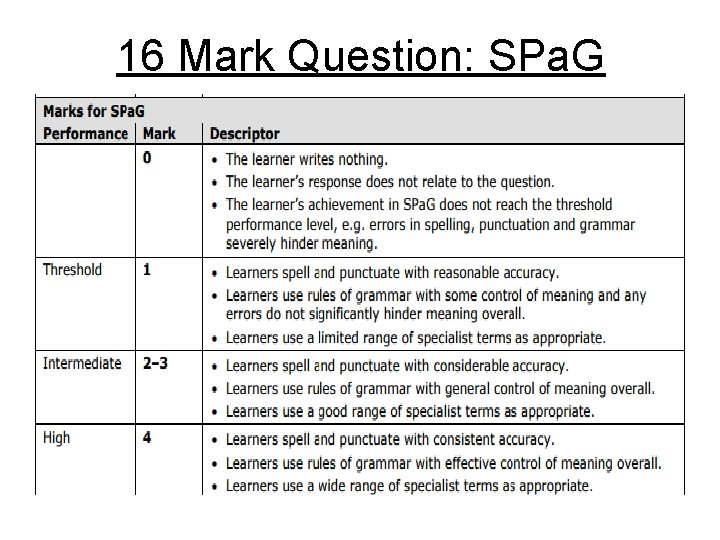
16 Mark Question: SPa. G
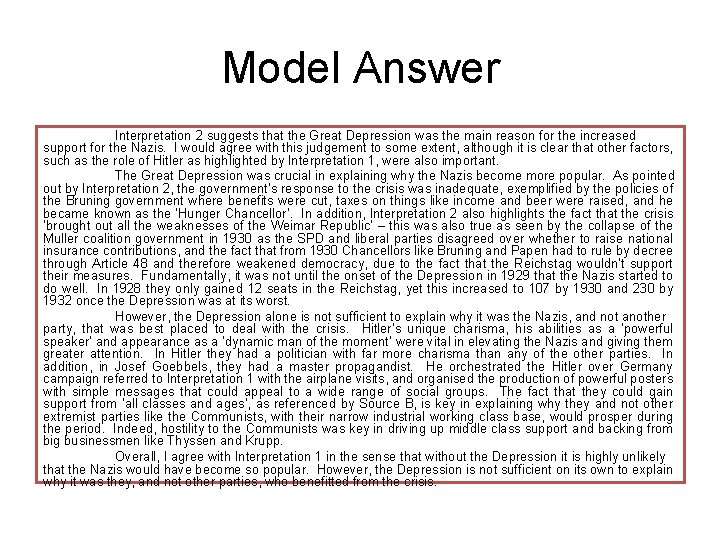
Model Answer Interpretation 2 suggests that the Great Depression was the main reason for the increased support for the Nazis. I would agree with this judgement to some extent, although it is clear that other factors, such as the role of Hitler as highlighted by Interpretation 1, were also important. The Great Depression was crucial in explaining why the Nazis become more popular. As pointed out by Interpretation 2, the government’s response to the crisis was inadequate, exemplified by the policies of the Bruning government where benefits were cut, taxes on things like income and beer were raised, and he became known as the ‘Hunger Chancellor’. In addition, Interpretation 2 also highlights the fact that the crisis ‘brought out all the weaknesses of the Weimar Republic’ – this was also true as seen by the collapse of the Muller coalition government in 1930 as the SPD and liberal parties disagreed over whether to raise national insurance contributions, and the fact that from 1930 Chancellors like Bruning and Papen had to rule by decree through Article 48 and therefore weakened democracy, due to the fact that the Reichstag wouldn’t support their measures. Fundamentally, it was not until the onset of the Depression in 1929 that the Nazis started to do well. In 1928 they only gained 12 seats in the Reichstag, yet this increased to 107 by 1930 and 230 by 1932 once the Depression was at its worst. However, the Depression alone is not sufficient to explain why it was the Nazis, and not another party, that was best placed to deal with the crisis. Hitler’s unique charisma, his abilities as a ‘powerful speaker’ and appearance as a ‘dynamic man of the moment’ were vital in elevating the Nazis and giving them greater attention. In Hitler they had a politician with far more charisma than any of the other parties. In addition, in Josef Goebbels, they had a master propagandist. He orchestrated the Hitler over Germany campaign referred to Interpretation 1 with the airplane visits, and organised the production of powerful posters with simple messages that could appeal to a wide range of social groups. The fact that they could gain support from ‘all classes and ages’, as referenced by Source B, is key in explaining why they and not other extremist parties like the Communists, with their narrow industrial working class base, would prosper during the period. Indeed, hostility to the Communists was key in driving up middle class support and backing from big businessmen like Thyssen and Krupp. Overall, I agree with Interpretation 1 in the sense that without the Depression it is highly unlikely that the Nazis would have become so popular. However, the Depression is not sufficient on its own to explain why it was they, and not other parties, who benefitted from the crisis.
Colour-coding task • Annotate the model answer and label/highlight the following. – Where Interpretation 2 has been used in the response. – Where wider knowledge has been used to develop comments from Interpretation 2. – Where Interpretation 1 has been used in the response. – Where wider knowledge has been used to develop comments from Interpretation 1.
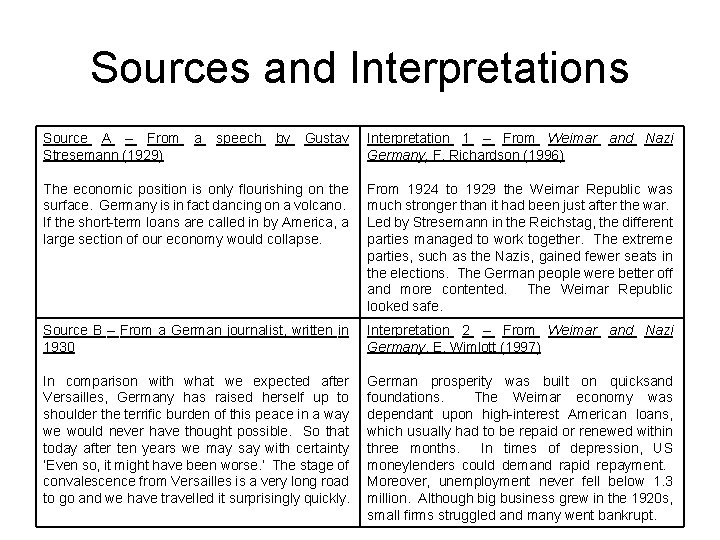
Sources and Interpretations Source A – From Stresemann (1929) a speech by Gustav Interpretation 1 – From Weimar and Nazi Germany, F. Richardson (1996) The economic position is only flourishing on the surface. Germany is in fact dancing on a volcano. If the short-term loans are called in by America, a large section of our economy would collapse. From 1924 to 1929 the Weimar Republic was much stronger than it had been just after the war. Led by Stresemann in the Reichstag, the different parties managed to work together. The extreme parties, such as the Nazis, gained fewer seats in the elections. The German people were better off and more contented. The Weimar Republic looked safe. Source B – From a German journalist, written in 1930 Interpretation 2 – From Weimar and Nazi Germany, E. Wimlott (1997) In comparison with what we expected after Versailles, Germany has raised herself up to shoulder the terrific burden of this peace in a way we would never have thought possible. So that today after ten years we may say with certainty ‘Even so, it might have been worse. ’ The stage of convalescence from Versailles is a very long road to go and we have travelled it surprisingly quickly. German prosperity was built on quicksand foundations. The Weimar economy was dependant upon high-interest American loans, which usually had to be repaid or renewed within three months. In times of depression, US moneylenders could demand rapid repayment. Moreover, unemployment never fell below 1. 3 million. Although big business grew in the 1920 s, small firms struggled and many went bankrupt.
Revision material Warning This is NOT necessarily what will come up in your exam. The topics might but the questions may differ. However use this to help you revise how to answer each question type.
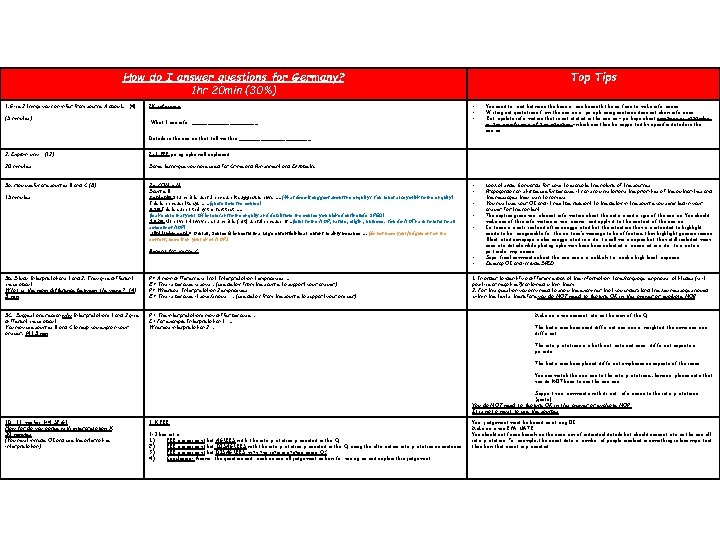
How do I answer questions for Germany? 1 hr 20 min (30%) 1. Give 2 things you can infer from source A about. . … (4) (5 minutes) 2 X inference What I can infer: ___________ Top Tips • • • You need to read between the lines or see beneath the surface to make inferences. Writing out quotations from the source or paraphrasing sections does not show inference. Extrapolate information that is not stated in the source – perhaps about emotions or attitudes, or the significance of the situation – which can then be supported by specific details in the source. • • Look at slide 6 onwards for ways to evaluate the nature of the sources Propaganda can still be useful because it can show historians the priorities of the authorities and the messages they wish to convey. You must use your OK and it must be relevant to the detail in the source you selected in your answer for the content The caption gives you relevant information about the nature and origin of the source. You should make use of this information in your answer and apply it to the content of the source. Cartoons are satirical and often exaggerated but the situation they are intended to highlight needs to be recognisable for the cartoon’s message to be effective; they highlight genuine issues. Illustrated newspapers also exaggerated in order to sell more copies but they still included many accurate details while photographs may have been selected or censored in order to create a particular impression. Superficial comments about the sources are unlikely to reach a high level response. Develop OK and include SPED Details in the source that tell me this: ____________ 2. Explain why … (12) 2 -3 PEE paragraphs well explained 20 minutes Same technique you have used for Crime and Punishment and Elizabeth. 3 a. How useful are sources B and C (8) 2 x CON + M Source B Content= Source B is useful because it suggests/shows…. . (What does it suggest about the enquiry? You must always link to the enquiry) This is because it says……(quote from the source) OK= This is supported by the fact that …. . (make sure that your OK is relevant to the enquiry and detail from the source you picked out include SPED) NOP= Moreover/ However, source B is (not) useful because of…(refer to the NOP, nature, origin , purpose. You do NOT have to refer to all aspects of NOP) Mini judgement = Overall, Source B is useful to a large extent/minimal extent mainly because…. (do not base your judgement on the content, base it on your ok or NOP. ) 15 minutes Repeat for source C 3 b. Study Interpretations 1 and 2. They give different views about …… What is the main difference between the views? (4) 5 min P= E= A main difference is that Interpretation 1 emphasises…. . This is because is says…. (use detail from the source to support your answer) Whereas, Interpretation 2 emphasises…… This is because it says/shows……. (use detail from the source to support your answer) 3 C. Suggest one reason why Interpretations 1 and 2 give different views about… You may use sources B and C to help you explain your answer. (4) 5 min P = The interpretations may differ because…. E= For example Interpretation 1 …. . Whereas interpretation 2…. • • • 1. In order to identify a difference look at the information, tone/language, emphasis, attitudes (is it positive or negative? )contained within them 2. For this question you only need to show the examiner that you understand the key message showed within the texts, therefore you do NOT need to feature OK in this answer or evaluate NOP. Make sure you concentrate on the view of the Q The historians have used different sources or weighted the same sources different The interpretations are both extracts and cover different aspects or periods The historians have placed different emphases on aspects of the issue. You can match the sources to the interpretations, , however please note that you do NOT have to use the sources. Support your comments with direct references to the interpretations (quote) You do NOT need to feature OK in this answer or evaluate NOP. It is not a must to use the sources 3 D. 16 marker (+4 SPa. G) How far do you agree with interpretation X 30 minutes (You must include OK and use the alternative interpretation) 3 X PEE 2 -3 line intro 1) PEE paragraph that AGREES with the interpretation presented in the Q 2) PEE paragraph that DISAGREES with the interpretation presented in the Q using the alternative interpretation as evidence 3) PEE paragraph that DISAGREES with the interpretation using OK 4) Conclusion- Answer the question and reach an overall judgement on how far you agree and explain this judgement. Your judgement must be based on strong OK. Make sure you EVALUATE You should not focus heavily on the accuracy of individual details but should concentrate on the overall interpretation. For example, the exact date or number of people involved in something is less important than how that event is presented.
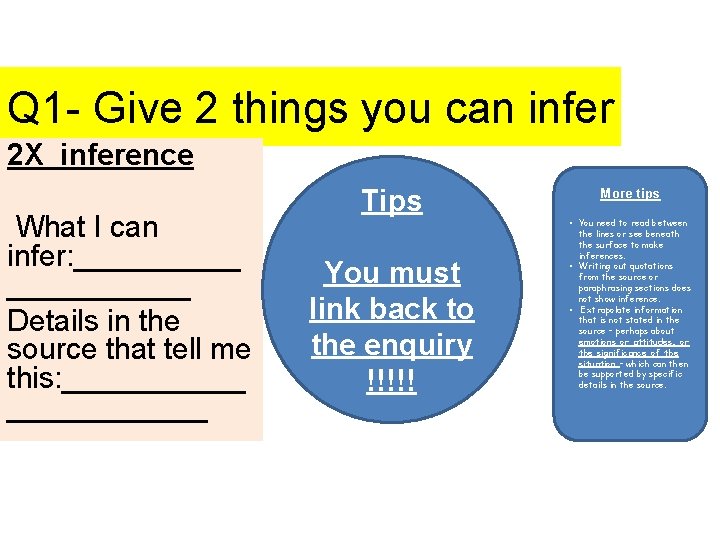
Q 1 - Give 2 things you can infer 2 X inference What I can infer: ___________ Details in the source that tell me this: ____________ Tips You must link back to the enquiry !!!!! More tips • You need to read between the lines or see beneath the surface to make inferences. • Writing out quotations from the source or paraphrasing sections does not show inference. • Extrapolate information that is not stated in the source – perhaps about emotions or attitudes, or the significance of the situation – which can then be supported by specific details in the source.
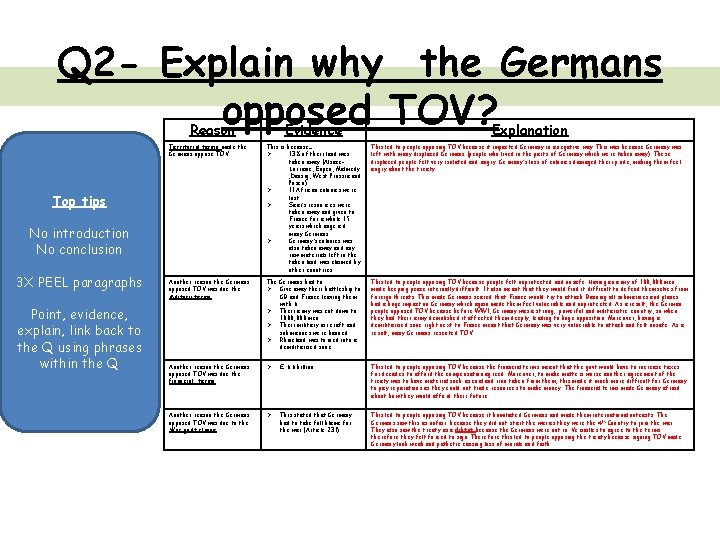
Q 2 - Explain why the Germans opposed TOV? Reason This is because…. Ø 13% of their land was taken away (Alsace. Lorraine, Eupen, Malmedy , Danzig, West Prussia and Posen) Ø 11 African colonies were lost Ø Saar’s resources were taken away and given to France for a whole 15 years which angered many Germans Ø Germany’s colonies was also taken away and any raw materials left in the taken land was claimed by other countries. This led to people opposing TOV because it impacted Germany in a negative way. This was because Germany was left with many displaced Germans (people who lived in the parts of Germany which were taken away). These displaced people felt very isolated angry. Germany’s loss of colonies damaged their pride, making them feel angry about the treaty. Another reason the Germans opposed TOV was due the Military terms. The Germans had to: Ø Give away their battleship to GB and France leaving them with 6 Ø Their army was cut down to 1000, 000 men Ø Their military air craft and submarines were banned Ø Rhineland was turned into a demilitarized zone This led to people opposing TOV because people felt unprotected and unsafe. Having an army of 100, 000 men made keeping peace internally difficult. It also meant that they would find it difficult to defend themselves from foreign threats. This made Germans scared that France would try to attack. Banning all submarines and planes had a huge impact on Germany which again made them feel vulnerable and unprotected. As a result, the German people opposed TOV because before WW 1, Germany was a strong, powerful and militaristic country, so when they had their army demolished it affected them deeply, leading to huge opposition. Moreover, having a demilitarised zone right next to France meant that Germany was very vulnerable to attack and felt unsafe. As a result, many Germans resented TOV. Another reason the Germans opposed TOV was due the financial terms. Ø £ 6. 6 billion This led to people opposing TOV because the financial terms meant that the govt would have to increase taxes for decades to afford the compensation agreed. Moreover, to make matters worse another agreement of the treaty was to have material such as coal and iron taken from them, this made it much more difficult for Germany to pay reparations as they could not trade resources to make money. The financial terms made Germany afraid about how they would afford their future. Another reason the Germans opposed TOV was due to the War guilt clause Ø This stated that Germany had to take full blame for the war (Article 231). This led to people opposing TOV because it humiliated Germans and made them international outcasts. The Germans saw this as unfair because they did not start the war as they were the 4 th Country to join the war. They also saw the treaty as a diktat because the Germans were not in Versailles to agree to the terms therefore they felt forced to sign. Therefore this led to people opposing the treaty because signing TOV made Germany look weak and pathetic causing loss of morale and faith. No introduction No conclusion Point, evidence, explain, link back to the Q using phrases within the Q Explanation Territorial terms made the Germans oppose TOV Top tips 3 X PEEL paragraphs Evidence
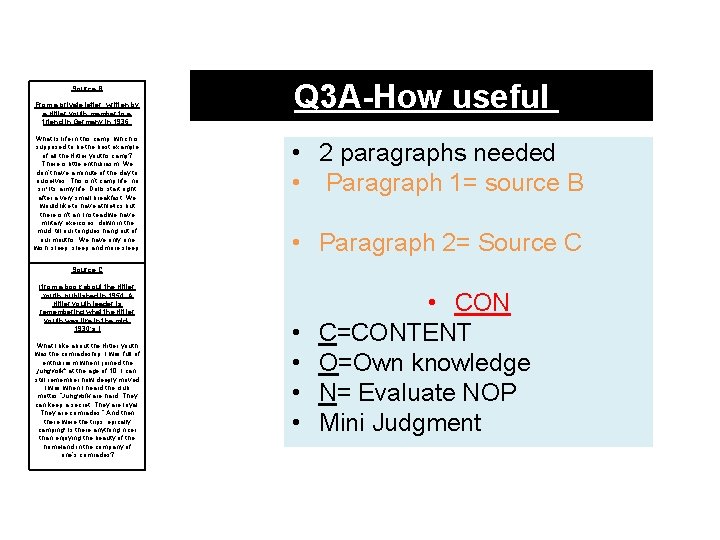
Source B From a private letter, written by a Hitler youth member to a friend in Germany in 1936. What Is life in this camp, which is supposed to be the best example of all the Hitler youths camp? There is little enthusiasm. We don’t have a minute of the day to ourselves. This isn’t camp life, no sir! Its army life. Drills start right after a very small breakfast. We would like to have athletics but there isn't an. Instead we have military exercises, down in the mud, till our tongues hang out of our mouths. We have only one wish: sleep, sleep and more sleep. Q 3 A-How useful • 2 paragraphs needed • Paragraph 1= source B • Paragraph 2= Source C (from a book about the Hitler Youth, published in 1954. A Hitler youth leader is remembering what the Hitler youth was like in the mid 1930’s. ) What I like about the Hitler youth was the comradeship. I was full of enthusiasm when I joined the jungvolk* at the age of 10. I can still remember how deeply moved I was when I heard the club mottos: ”Jungvolk are hard. They can keep a secret. They are loyal. They are comrades. ” And then there were the trips, epically camping! Is there anything nicer than enjoying the beauty of the homeland in the company of one’s comrades? • • • CON C=CONTENT O=Own knowledge N= Evaluate NOP Mini Judgment
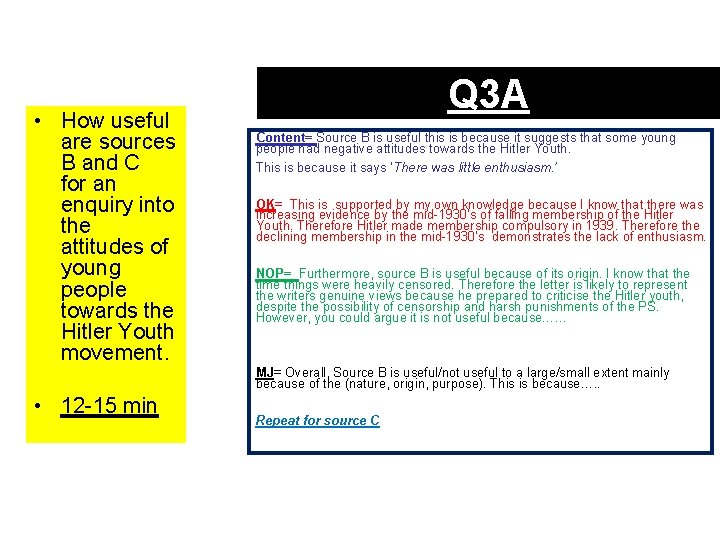
• How useful are sources B and C for an enquiry into the attitudes of young people towards the Hitler Youth movement. Q 3 A Content= Source B is useful this is because it suggests that some young people had negative attitudes towards the Hitler Youth. This is because it says ‘There was little enthusiasm. ’ OK= This is supported by my own knowledge because I know that there was increasing evidence by the mid-1930’s of falling membership of the Hitler Youth. Therefore Hitler made membership compulsory in 1939. Therefore the declining membership in the mid-1930’s demonstrates the lack of enthusiasm. NOP= Furthermore, source B is useful because of its origin. I know that the time things were heavily censored. Therefore the letter is likely to represent the writers genuine views because he prepared to criticise the Hitler youth, despite the possibility of censorship and harsh punishments of the PS. However, you could argue it is not useful because…… MJ= Overall, Source B is useful/not useful to a large/small extent mainly because of the (nature, origin, purpose). This is because…. . • 12 -15 min Repeat for source C
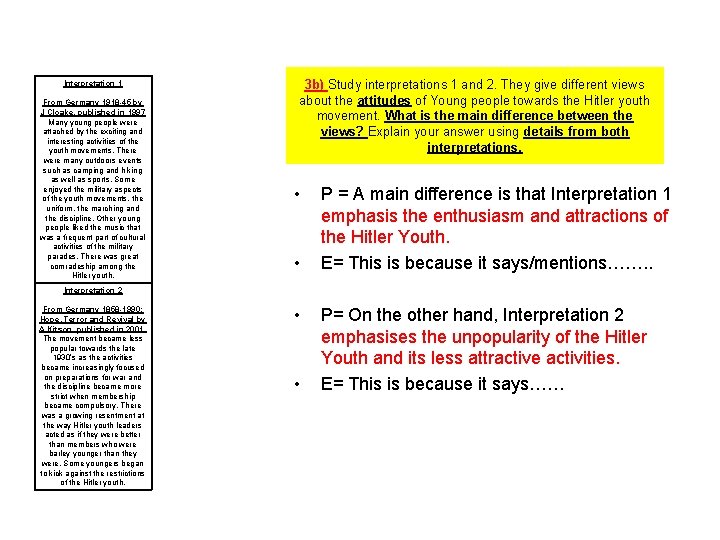
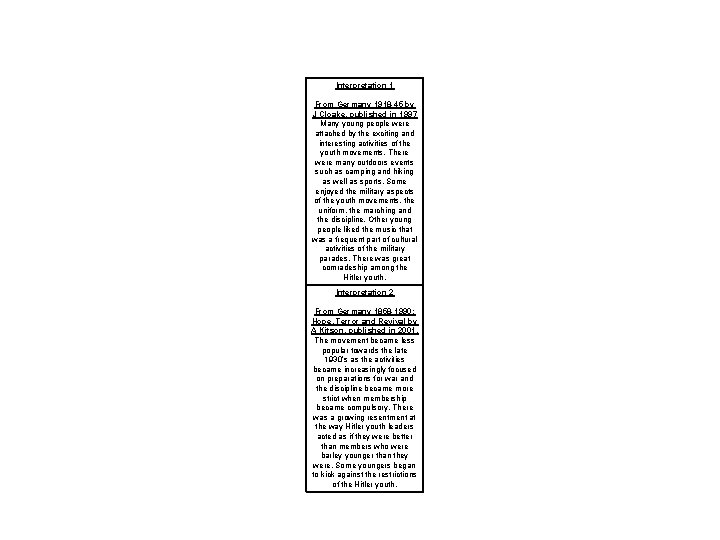
Interpretation 1 From Germany 1918 -45 by J Cloake, published in 1997 Many young people were attached by the exciting and interesting activities of the youth movements. There were many outdoors events such as camping and hiking as well as sports. Some enjoyed the military aspects of the youth movements, the uniform, the marching and the discipline. Other young people liked the music that was a frequent part of cultural activities of the military parades. There was great comradeship among the Hitler youth. 3 b) Study interpretations 1 and 2. They give different views about the attitudes of Young people towards the Hitler youth movement. What is the main difference between the views? Explain your answer using details from both interpretations. • • P = A main difference is that Interpretation 1 emphasis the enthusiasm and attractions of the Hitler Youth. E= This is because it says/mentions……. . Interpretation 2 From Germany 1858 -1990: Hope, Terror and Revival by A Kitson, published in 2001. The movement became less popular towards the late 1930’s as the activities became increasingly focused on preparations for war and the discipline became more strict when membership became compulsory. There was a growing resentment at the way Hitler youth leaders acted as if they were better than members who were barley younger than they were. Some youngers began to kick against the restrictions of the Hitler youth. • • P= On the other hand, Interpretation 2 emphasises the unpopularity of the Hitler Youth and its less attractive activities. E= This is because it says……
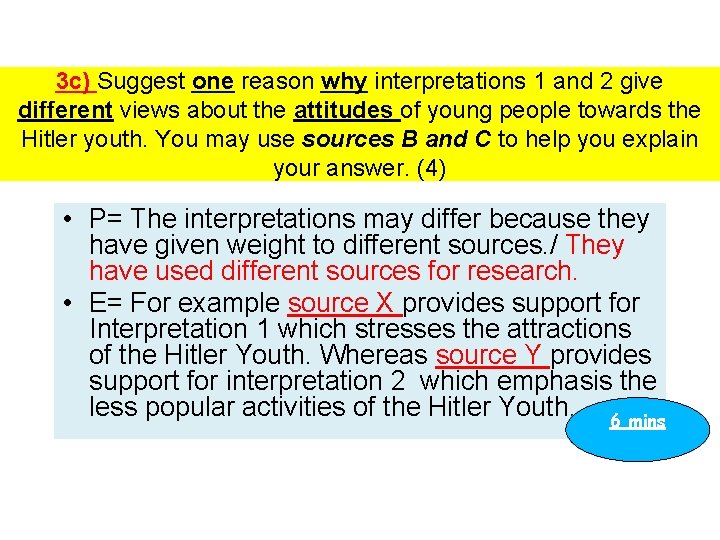
3 c) Suggest one reason why interpretations 1 and 2 give different views about the attitudes of young people towards the Hitler youth. You may use sources B and C to help you explain your answer. (4) • P= The interpretations may differ because they have given weight to different sources. / They have used different sources for research. • E= For example source X provides support for Interpretation 1 which stresses the attractions of the Hitler Youth. Whereas source Y provides support for interpretation 2 which emphasis the less popular activities of the Hitler Youth. 6 mins
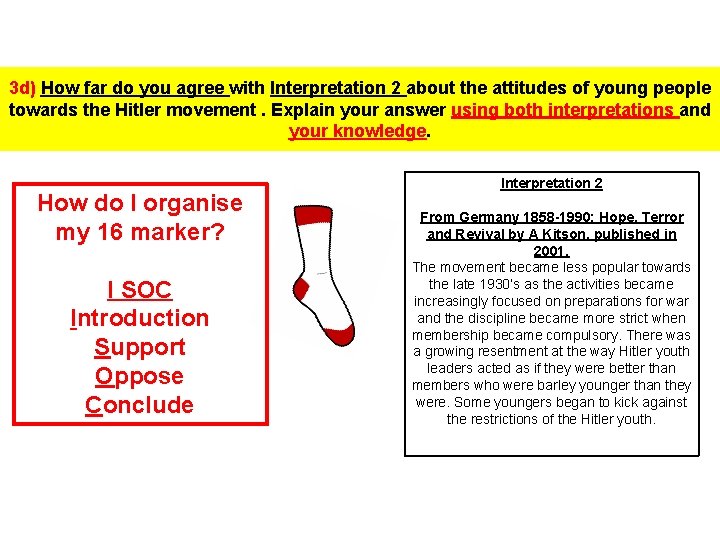
3 d) How far do you agree with Interpretation 2 about the attitudes of young people towards the Hitler movement. Explain your answer using both interpretations and your knowledge. How do I organise my 16 marker? I SOC Introduction Support Oppose Conclude Interpretation 2 From Germany 1858 -1990: Hope, Terror and Revival by A Kitson, published in 2001. The movement became less popular towards the late 1930’s as the activities became increasingly focused on preparations for war and the discipline became more strict when membership became compulsory. There was a growing resentment at the way Hitler youth leaders acted as if they were better than members who were barley younger than they were. Some youngers began to kick against the restrictions of the Hitler youth.
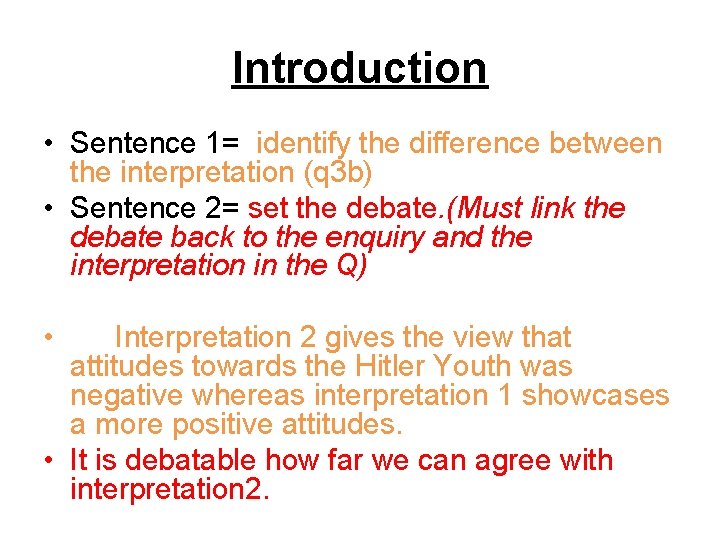
Introduction • Sentence 1= identify the difference between the interpretation (q 3 b) • Sentence 2= set the debate. (Must link the debate back to the enquiry and the interpretation in the Q) • Interpretation 2 gives the view that attitudes towards the Hitler Youth was negative whereas interpretation 1 showcases a more positive attitudes. • It is debatable how far we can agree with interpretation 2.
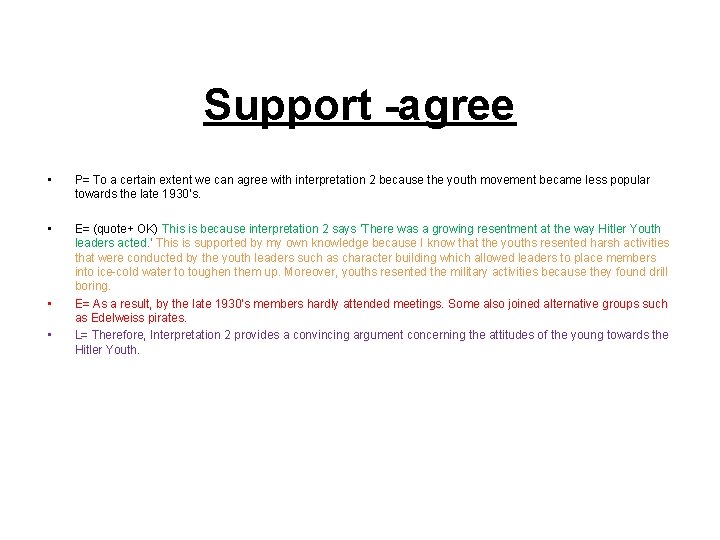
Support -agree • P= To a certain extent we can agree with interpretation 2 because the youth movement became less popular towards the late 1930’s. • E= (quote+ OK) This is because interpretation 2 says ‘There was a growing resentment at the way Hitler Youth leaders acted. ’ This is supported by my own knowledge because I know that the youths resented harsh activities that were conducted by the youth leaders such as character building which allowed leaders to place members into ice-cold water to toughen them up. Moreover, youths resented the military activities because they found drill boring. E= As a result, by the late 1930’s members hardly attended meetings. Some also joined alternative groups such as Edelweiss pirates. L= Therefore, Interpretation 2 provides a convincing argument concerning the attitudes of the young towards the Hitler Youth. • •
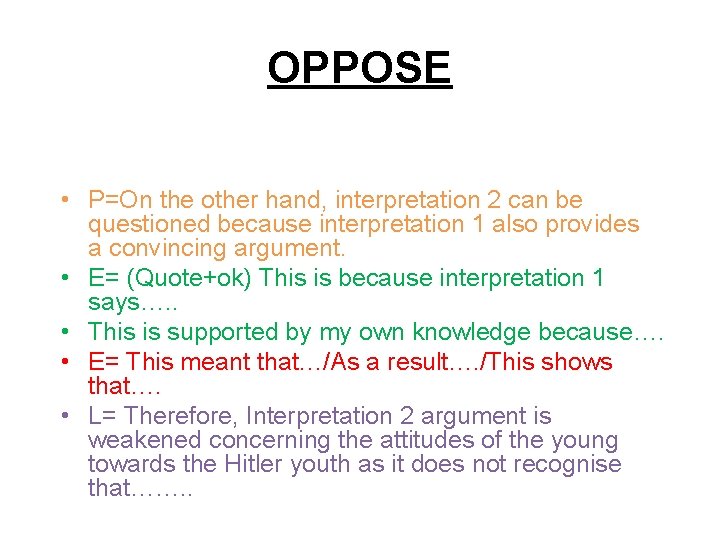
OPPOSE • P=On the other hand, interpretation 2 can be questioned because interpretation 1 also provides a convincing argument. • E= (Quote+ok) This is because interpretation 1 says…. . • This is supported by my own knowledge because…. • E= This meant that…/As a result…. /This shows that…. • L= Therefore, Interpretation 2 argument is weakened concerning the attitudes of the young towards the Hitler youth as it does not recognise that……. .
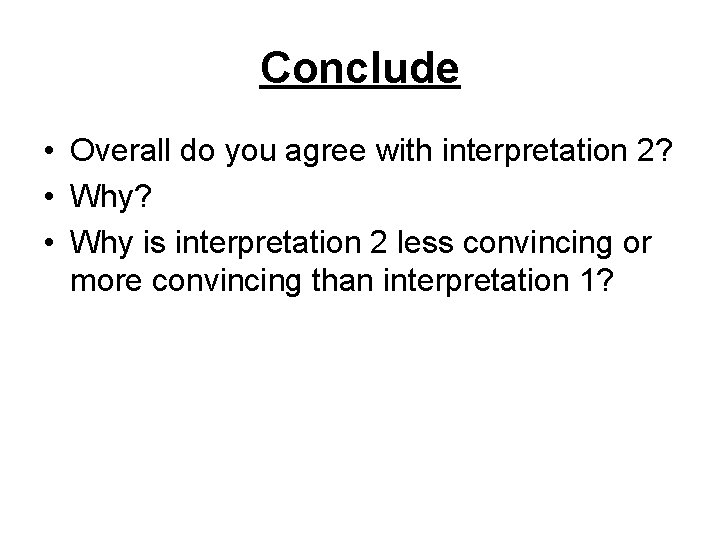
Conclude • Overall do you agree with interpretation 2? • Why is interpretation 2 less convincing or more convincing than interpretation 1?
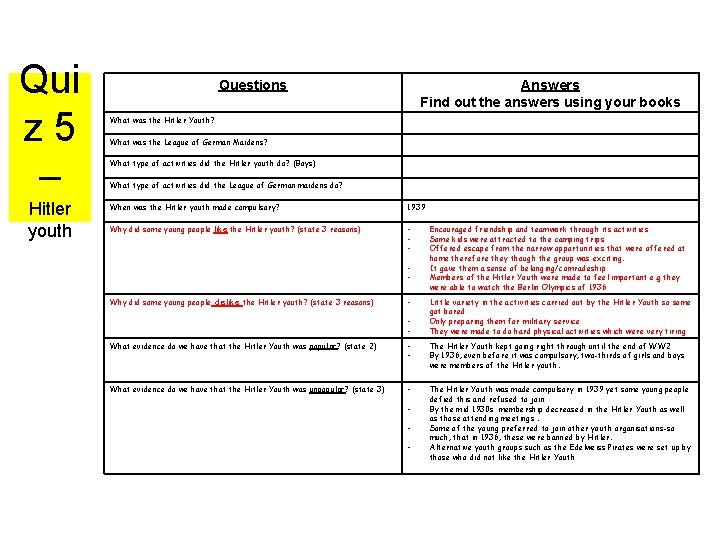
Qui z 5 – Hitler youth Questions Answers Find out the answers using your books What was the Hitler Youth? What was the League of German Maidens? What type of activities did the Hitler youth do? (Boys) What type of activities did the League of German maidens do? When was the Hitler youth made compulsory? 1939 Why did some young people like the Hitler youth? (state 3 reasons) • • • Why did some young people dislike the Hitler youth? (state 3 reasons) • • • Encouraged friendship and teamwork through its activities Some kids were attracted to the camping trips Offered escape from the narrow opportunities that were offered at home therefore they though the group was exciting. It gave them a sense of belonging/comradeship Members of the Hitler Youth were made to feel important e. g they were able to watch the Berlin Olympics of 1936 Little variety in the activities carried out by the Hitler Youth so some got bored Only preparing them for military service They were made to do hard physical activities which were very tiring What evidence do we have that the Hitler Youth was popular? (state 2) • • The Hitler Youth kept going right through until the end of WW 2 By 1936, even before it was compulsory, two-thirds of girls and boys were members of the Hitler youth. What evidence do we have that the Hitler Youth was unpopular? (state 3) • The Hitler Youth was made compulsory in 1939 yet some young people defied this and refused to join By the mid 1930 s membership decreased in the Hitler Youth as well as those attending meetings. Some of the young preferred to join other youth organisations-so much, that in 1936, these were banned by Hitler. Alternative youth groups such as the Edelweiss Pirates were set up by those who did not like the Hitler Youth • • •
Interpretation 1 From Germany 1918 -45 by J Cloake, published in 1997 Many young people were attached by the exciting and interesting activities of the youth movements. There were many outdoors events such as camping and hiking as well as sports. Some enjoyed the military aspects of the youth movements, the uniform, the marching and the discipline. Other young people liked the music that was a frequent part of cultural activities of the military parades. There was great comradeship among the Hitler youth. Interpretation 2 From Germany 1858 -1990: Hope, Terror and Revival by A Kitson, published in 2001. The movement became less popular towards the late 1930’s as the activities became increasingly focused on preparations for war and the discipline became more strict when membership became compulsory. There was a growing resentment at the way Hitler youth leaders acted as if they were better than members who were barley younger than they were. Some youngers began to kick against the restrictions of the Hitler youth.