
GCSE 9 1 BRITISH HISTORY ANGLOSAXON AND NORMAN
![GCSE [9 -1 ] BRITISH HISTORY ANGLO-SAXON AND NORMAN ENGLAND 1060 - 1100 Was](https://slidetodoc.com/presentation_image_h2/46dd80d483c3ec2b5b57946181dfdab4/image-1.jpg "GCSE [9 -1 ] BRITISH HISTORY ANGLO-SAXON AND NORMAN ENGLAND 1060 - 1100 Was")
GCSE [9 -1 ] BRITISH HISTORY ANGLO-SAXON AND NORMAN ENGLAND 1060 - 1100 Was England completely changed by the Norman Conquest?
History Interactive Teaching and Learning Resources These are sample slides. There are no audio, document links or internet links in this sample. See all of our resources at www. historyinteractive. co. uk History Interactive Teaching and Learning © 2013
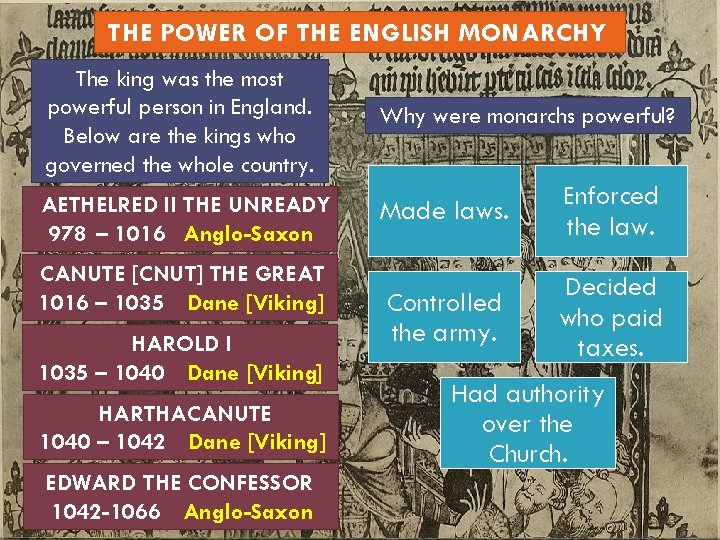
THE POWER OF THE ENGLISH • East Anglia had busy ports and. MONARCHY the people traded with Sweden. In 1939, archaeologists discovered an Anglo. East. The Anglia king was the most Saxon burial site of King Redwald at Sutton Hoo in Who controlled England? The died Picts around 627 AD. Redwald powerful person in. Suffolk. England. The Scots Why were monarchs powerful? Anglo-Saxon Kingdoms When the Vikings invaded Below. Byare the • kings who Kent was a very powerful kingdom when Saint Augustine around 600 AD there. ADwere five important Anglo- to England, they settled Kingdom of Northumbria Kingdom of East Anglia landed in 597 and converted some Anglo-Saxons Kingdom of Mercia Kingdom of Wessex Lindisfarne Kingdom of Kent governed the whole country. Kent Saxon kingdoms. For 300 years they foughtof one another mainly in the East and Christianity. The palace and church the kings of Kent Northumbria was the East Anglia had busy In 757 AD, Offa was Kings. Kent of Wessex became was a very Enforced were at like Canterbury. Jarrow AETHELRED II THE UNREADY for land power. At times, the strongest king would North. Powerful Vikings Made laws. largest kingdom. It ports and the people king ofkingdom Mercia. He king of the whole country. powerful when the law. Northumbria 978 – 1016 Anglo-Saxon claim to be 'bretwalda' which meant ruler of all England. Guthrum conquered the • Kings of Wessex became king of the whole country. It’s included part oflanded Scotland. traded with invaded and Sweden. controlled It’s most famous king was Saint Augustine in York He reformed the most famous king was Alfred the Great. The kingdoms began to expand merge until by the Saxon kingdoms of King Edwin gave a. THE great In 1939, archaeologists Wessex CANUTE [CNUT] GREAT East Anglia and Kent. He Alfred the Great. He 597 AD and converted army, builtmain a navy and his laws formed a. Mercia, base for much England Decided tenth century three kingdoms remained: Northumbria, East Anglia The today. Anglo-Saxons dealto of money to the discovered an Anglo 1016 –Anglo-Saxons 1035 Dane tried unite the whole ofbuilt the English law we Controlled know reformed the army, some to[Viking] who paid Wessex and Northumbria. The kings. Peterborough of Wessex and most of Mercia. Areas monastery at Jarrow. Saxon burial site of King country. After Offa’s a navy HAROLD and. The hispalace laws Christianity. the ofarmy. East and • In 757 AD, Offa was king Mercia. He invaded I taxes. gradually became the dominant rulers and eventually controlled by the Vikings Mercia Hereford Northumbria became the Redwald at Sutton Hoo death, Mercia gradually formed a base forkings much and church of the controlled East Anglia and Kent. He tried to Anglia unite the 1035 – 1040 Dane [Viking] Merica controlled all of England. Powerful Anglo-Saxon kings was called Danelaw. Oxford whole Mercia. London gradually most educated and in Suffolk. Redwald died declined when the power of the English law we country. After Offa’s death, of Kent were at Had authority declined when the power of Wessex rose. included Ethelbert of Kent, Redwald of East Anglia and Danelaw meant that Anglo. HARTHACANUTE learned place inrose. England. around 627 AD. Winchesterover. Canterbury of. Canterbury. Wessex know today. Kent the Wessex kings Edwin, Oswald and Oswy of Northumbria. Saxons and Vikings shared Wales 1040 – 1042 Dane [Viking]was • Northumbria the largest kingdom. It included part of The Celts Scotland. King Edwin gave a great. Church. deal of money to the ruling the country. Northumbria EDWARD THE CONFESSOR monastery at Jarrow. Northumbria became the most educated and learned place in England. 1042 -1066 Anglo-Saxon GCSE [9 -1] History Anglo-Saxon and Norman England The Celts Wales Da n ela w 7
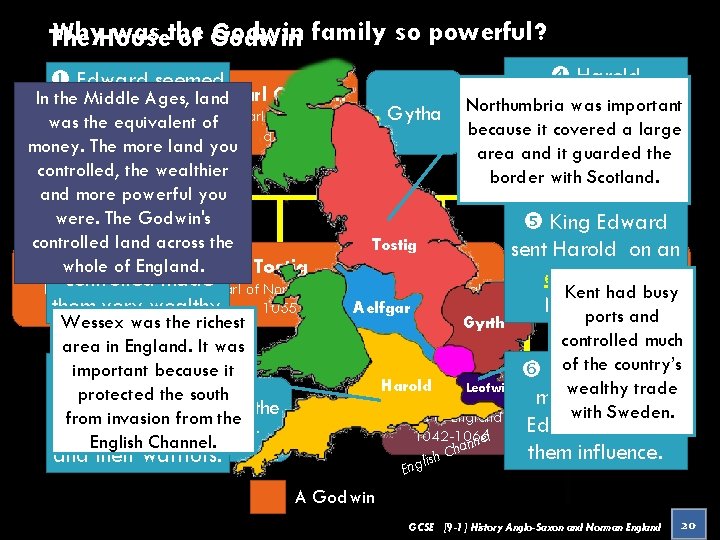
Why. House was the Godwin family so powerful? The of Godwin Edward seemed In the Middle Ages, land Earl Godwin happy for the was the equivalent of Earl of Wessex d. 1053 Godwin's to run money. The more landthe you countrytheforwealthier him. controlled, and more powerful you were. The land Godwin's The the controlled land across the Godwin's whole of England. Tostig Leofwine controlled made Earl of Northumbria Earl of Kent 1055 1057 very wealthy. them Wessex was the richest area in England. It was important because it They were Harold the south protected lords to many Edith the Godwinson from invasion from the powerful thegns Earl. English of Wessex Channel. Fair Gytha Harold Godwinson’s army Northumbria was important because defeated it covered athe large area and it guarded the Welsh in 1063. border with Scotland. Tostig Gyrth Earl of East Anglia Aelfgar 1057 Gyrth King Edward sent Harold on an Wulfnoth Held hostage embassy to by Kent had busy the Normans from Normandy. 1051. ports and controlled much of the country’s Edith Godwin Harold Leofwine wealthy trade Edward I married King with Sweden. Edith King of England 1042 -1066 nnel a h sh C i l g En 1053 warriors. and their Edward, giving them influence. A Godwin GCSE [9 -1] History Anglo-Saxon and Norman England 20
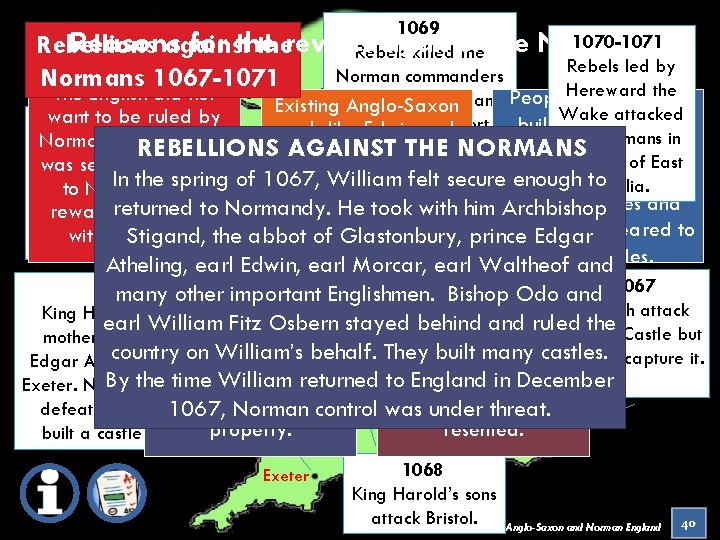
1069 1070 -1071 Rebellions against the Rebels killed the Rebels led by Norman commanders Normans 1067 -1071 Hereward the The English did not People resented the of York and Durham. Existing Anglo-Saxon Wake attacked want to be ruled by 1067 -1069 hadand support building of castles. earls like. They Edwin the Normans in Normans. English land Rebellion led by from Scotland REBELLIONS AGAINST THE NORMANS Castlesthe represented a Morcar had their Fens of East was seized and given Edric the. In. Wild Sweden. earldoms reduced symbol of Norman the spring of 1067, William felt insecure enough to Anglia. to Normans as a and Welsh kings. size. He Losing land power. Houses and returned to Normandy. took with him Archbishop reward for fighting Edric surrendered reduced their money farms were cleared to York with William at Stigand, the abbot of Glastonbury, prince Edgar in 1070. and power. Reasons for the revolts against the Normans buildand castles. Hastings. Atheling, earl Edwin, earl Morcar, earl Waltheof 1069 many other important Englishmen. Bishop Odo and 1067 Norman soldiers were William increased English attack King Harold’s sons, earl William Fitz Osbern stayed behind and ruled the West taxes to pay. Elyfor East the. Dover Castle but mother Gytha andcruel and unjust, Midlands country on William’s behalf. They built army. many. Anglia castles. Wales do not capture it. treating the English Norman The Edgar Atheling attack Eversham By the time William toheavy England December harshly, stealingreturned and geldintax of Exeter. Norman soldiers London damaging theircontrol. Bristol December defeated them and 1067, Norman was under 1066 threat. was resented. Dover built a castle there. property. Exeter 1068 King Harold’s sons attack Bristol. GCSE [9 -1] History Anglo-Saxon and Norman England 40
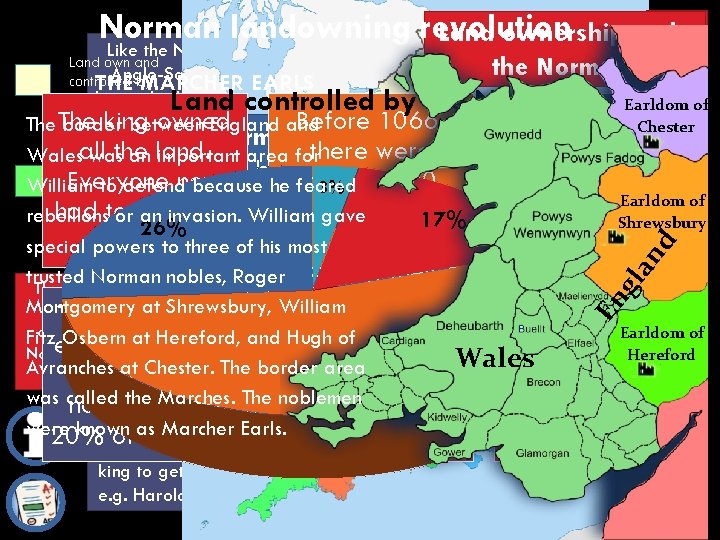
Norman landowning revolution Land ownership under Like the Normans, the Land own and Anglo-Saxons had a controlled by THE MARCHER EARLS hierarchy based on land William. thethe Anglo-Saxons Normans Land controlled by the Normans Earldom of Chester En gl an d ownership. king owned Before 1066, Anglo-Saxon The border between England Northumbria Ownership Land own by The Normans and Land all the land. there were lords had almost Wales was an William’s half important area for Anglo-Saxons Anglo-Saxon kings Ruledand by Tostig The revolts between 1068 1071 had brothers Odo Everyone now about 4000 all been William to defend because he feared 3% owned much of the land of Bayeux Earldom of taught William an important lesson; he could had tenure from Anglo-Saxon replaced by but could not and themselves Robert of invasion. rebellions or an William gave 17% Shrewsbury 26% Royal lands Mortain. control all of it. not trust the English earls. He asserted his William. thegns. Normans. special powers to three of his most authority by. Roger confiscating their. Mercia land, either by trusted Norman nobles, Powerful earls The other colours Barons East Anglia Ruled bythis Aelfarland controlled largegrabs forfeit, land or granting to his Montgomery at Shrewsbury, William are the areas The king’s royal. The Half the land Ruled by 5% earldoms. owned by other Earldom Less than of of Fitz Osbern at Hereford, and Hugh of close followers. By the time William died in Gyrth estates including Norman tenants-in. Hereford relationship between the controlled by Walesthe land was Church Avranches at forests Chester. The border area 1087, ofwas 250 landowners, only 6 chief. king royal 190 great tenants-inand hisout earls 54% owned by Anglo was called the Marches. The noblemen based on loyalty. Anglo-Saxons. now made up were chief was owned Wessex Kent -Saxons. However, sometimes were known as Marcher Earls. Ruled by Harold 20% of the land. by just 11 men. earls challenged the king to get more power e. g. Harold Godwinson. GCSE [9 -1] History Anglo-Saxon and Norman England 47
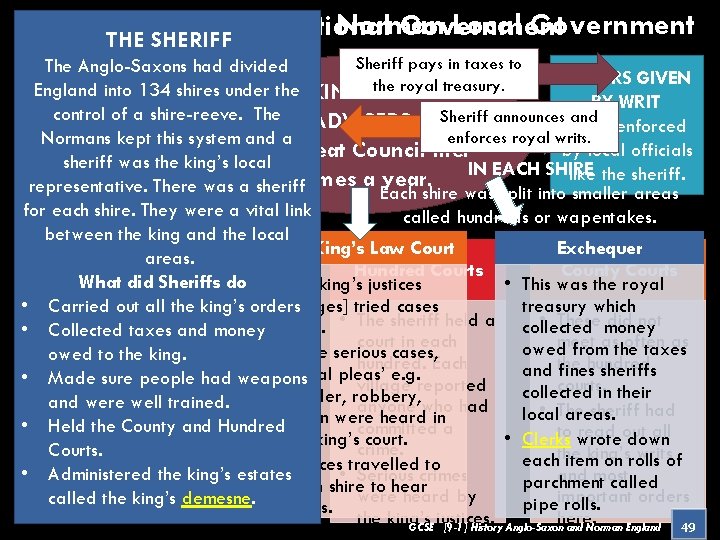
Norman Local Government Norman National Government THE SHERIFF THE Sheriff pays in taxes to The JUSTICAR Anglo-Saxons had divided ORDERS GIVEN He was the royal treasury. England into 134 shires under. THE the KING AND HIS BY WRIT second person in control of a shire-reeve. The ADVISERS Sheriff announces and Writs enforced charge and took enforces royal writs. Normans kept this system and a by local officials The Great Council met the sheriff king’s place was the king’s local IN EACH SHIRE like the sheriff. when the king 3 times a year. representative. There was a sheriff Each shire was split into smaller areas was overseas. for each shire. They were a vital link called hundreds or wapentakes. between the king and the local The Royal Household The King’s Law Court Exchequer areas. Hundred Courts County Courts What all didthe Sheriffs do • The king’s justices • Provided • This was the royal king’s needs and [judges] tried cases treasury which • Carried out all the king’s orders • The sheriff held a collected • These money did not travelled with • Collected taxeshim. and money here. court in each meet asthe often as owed from taxes • owed Constable – was in • More serious cases, to the king. hundred. Each the hundred and fines sheriffs charge of the army. ‘royal pleas’ e. g. • Made sure people had weapons village reported courts. collected in their murder, robbery, • and Chamberlain paid were well–trained. anyone who had • The sheriff had local areas. arson were heard in the king’s bills. • Held the County and Hundred committed a to wrote read out all the king’s court. • Clerks down • Courts. Chancellor – was in crime. the king’s writsof each item on rolls • Justices travelled to charge of the Great • Administered king’s estates • Serious crimes and most parchment called each shire to hear Seal. orders called the king’s demesne. cases. were heard by pipeimportant rolls. the king’s justices. here. 49 GCSE [9 -1] History Anglo-Saxon and Norman England
- Slides: 7