
GCE ENGLISH LANGUAGE AND LITERATURE UNIT 1 Unit
![Unit 1 Structuring Comparisons Principal Examiner’s Report: “The best responses this summer […] made](https://slidetodoc.com/presentation_image/166d8e9f43ce6fef7d3806fb19a3d4b9/image-11.jpg "Unit 1 Structuring Comparisons Principal Examiner’s Report: “The best responses this summer […] made")
- Slides: 29
GCE ENGLISH LANGUAGE AND LITERATURE UNIT 1
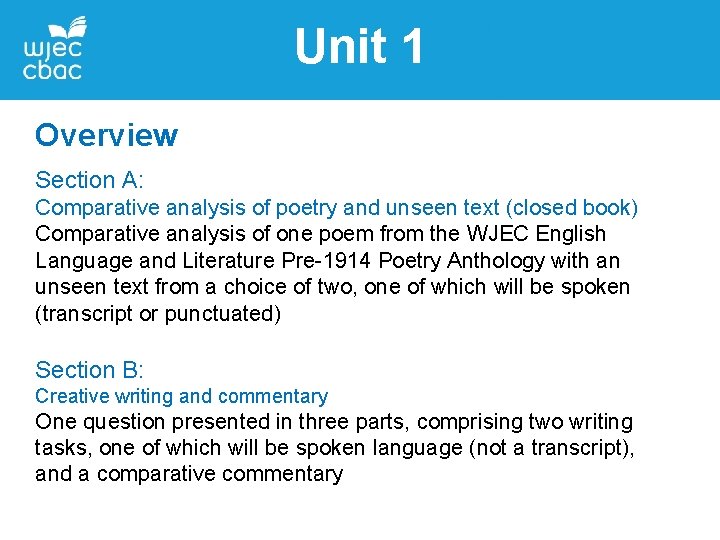
Unit 1 Overview Section A: Comparative analysis of poetry and unseen text (closed book) Comparative analysis of one poem from the WJEC English Language and Literature Pre-1914 Poetry Anthology with an unseen text from a choice of two, one of which will be spoken (transcript or punctuated) Section B: Creative writing and commentary One question presented in three parts, comprising two writing tasks, one of which will be spoken language (not a transcript), and a comparative commentary
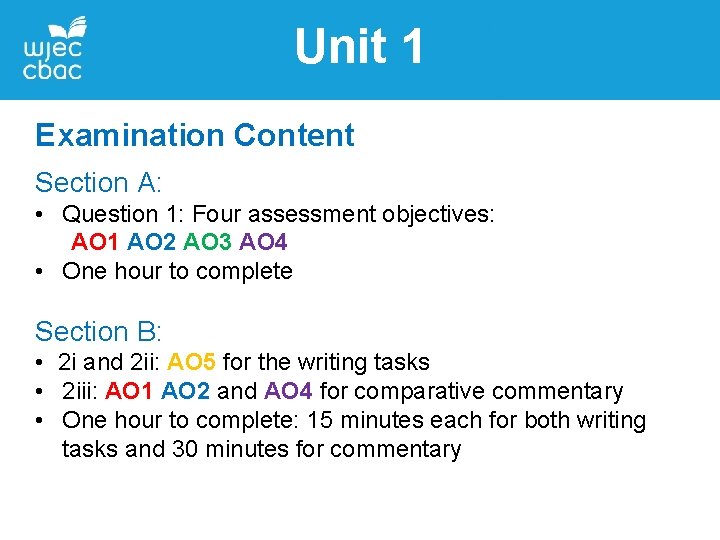
Unit 1 Examination Content Section A: • Question 1: Four assessment objectives: AO 1 AO 2 AO 3 AO 4 • One hour to complete Section B: • 2 i and 2 ii: AO 5 for the writing tasks • 2 iii: AO 1 AO 2 and AO 4 for comparative commentary • One hour to complete: 15 minutes each for both writing tasks and 30 minutes for commentary
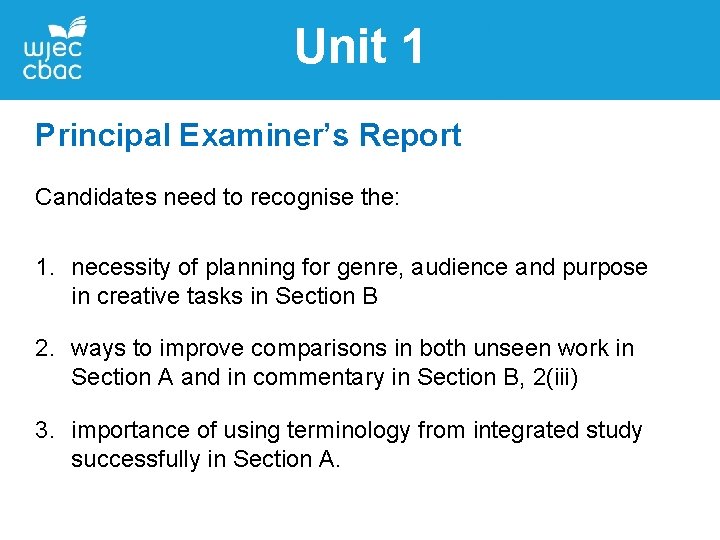
Unit 1 Principal Examiner’s Report Candidates need to recognise the: 1. necessity of planning for genre, audience and purpose in creative tasks in Section B 2. ways to improve comparisons in both unseen work in Section A and in commentary in Section B, 2(iii) 3. importance of using terminology from integrated study successfully in Section A.
Unit 1 Section B 2(i) and 2(ii)
Unit 1 Creative Writing Tasks The key to success here is demonstrating awareness of genre, audience and purpose • Band 2: The descriptors here outline candidates having ‘a growing understanding of form and some basic sense of audience’, and a ‘basic awareness of the generic conventions’ • Band 5: Here, candidates have a ‘confident awareness of the generic conventions’ and are ‘secure in terms of intended audience and purpose’.
Unit 1 How candidates move towards a confident understanding of genre, audience and purpose? • Despite the very real time pressures on candidates at this point in the paper, they would do well to remember the 200 word suggestion and to spend some time planning their writing rather than getting straight into it and writing too much. • A quick five minutes of planning and thinking about genre, audience and purpose will ensure they make the right choices for the task. • Editing, selecting and redrafting as they write is a key skill here and should be encouraged.
Unit 1 Task One: Making the correct choices for GAP • Consider the example tasks for Section B on the sheet provided. Complete a GAP CHOICES table for each task, outlining the intended genre, audience and purpose and then thinking forward to what language choices (linguistic / literary) you would make in your writing piece. • This can be used by students individually before they complete a short writing task in class, or could be used for whole classes as a starting point for discussion of genre, audience and purpose.
Unit 1 Task Two: Writing to task and for GAP • Look at the exemplar response to the same task and edit them, making changes, to more securely meet the demands of both the task itself and of genre, audience and purpose. • Write down three suggestions for this candidate for how they can improve their written piece
Unit 1 Exemplifying different approaches to structuring a comparison (Sections A and B)
Unit 1 Structuring Comparisons Principal Examiner’s Report: “The best responses this summer […] made thorough comparisons and contrasts between the texts (AO 4). Weaker responses […] failed to compare and contrast effectively. ” AO 4: 15 marks out of 60 for Section A
Unit 1 Structuring Comparisons Band descriptors for AO 4: Band 1/2 responses will show very limited, if any, evidence of comparison or contrast. The response may be organized in a simple linear form. Band 3 responses will select and discuss some of the more obvious points of comparison and contrast. Band 4/5 responses will feature astute links between texts. These will go beyond content and form to explore connections in style, attitudes and contexts.
Unit 1 Structuring Comparisons Making successful comparisons: “In the poem, Shakespeare presents his mistress as somewhat physically unattractive, using a noun phrase to comment on the ‘black wires’ which seem to grow on her head. However, in the unseen text, the writer describes the main female character using a syndetic list of adjectives, ‘beautiful, mysterious and attractive’. ” What could this candidate do to improve the way they compare texts?
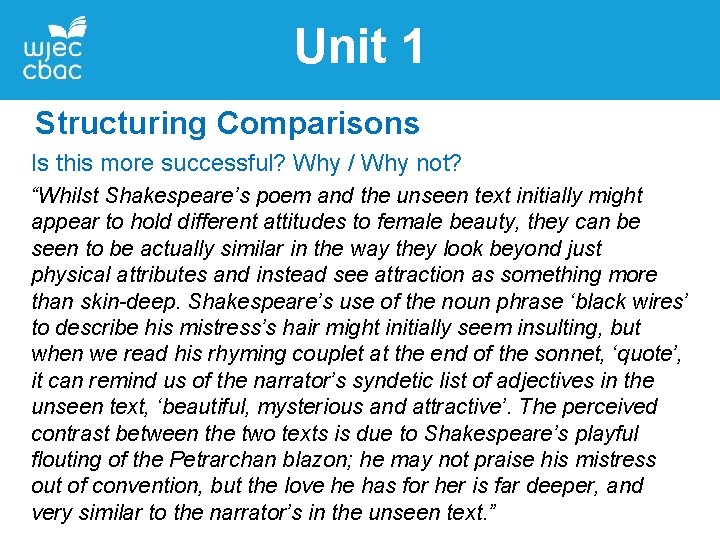
Unit 1 Structuring Comparisons Is this more successful? Why / Why not? “Whilst Shakespeare’s poem and the unseen text initially might appear to hold different attitudes to female beauty, they can be seen to be actually similar in the way they look beyond just physical attributes and instead see attraction as something more than skin-deep. Shakespeare’s use of the noun phrase ‘black wires’ to describe his mistress’s hair might initially seem insulting, but when we read his rhyming couplet at the end of the sonnet, ‘quote’, it can remind us of the narrator’s syndetic list of adjectives in the unseen text, ‘beautiful, mysterious and attractive’. The perceived contrast between the two texts is due to Shakespeare’s playful flouting of the Petrarchan blazon; he may not praise his mistress out of convention, but the love he has for her is far deeper, and very similar to the narrator’s in the unseen text. ”
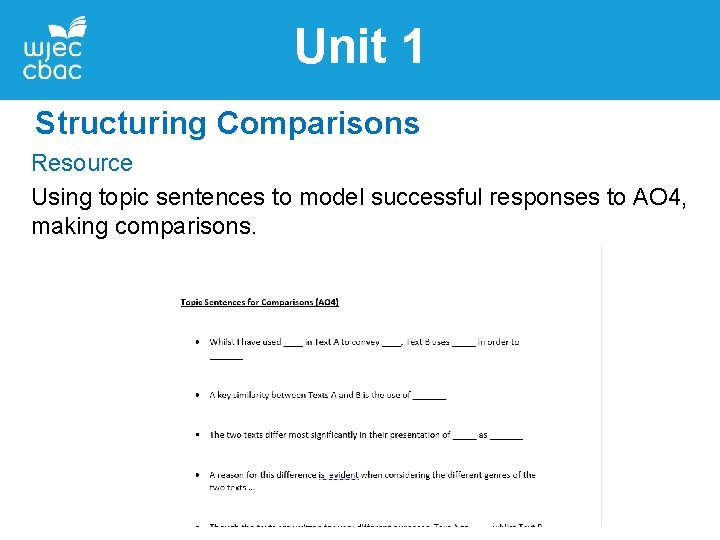
Unit 1 Structuring Comparisons Resource Using topic sentences to model successful responses to AO 4, making comparisons.
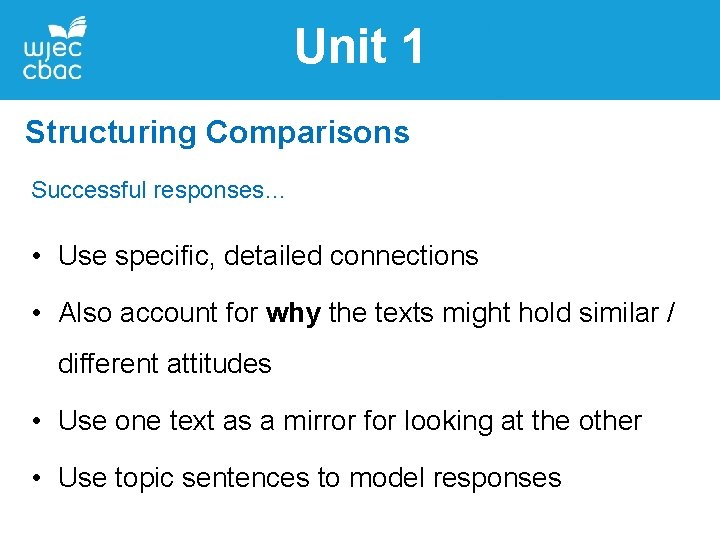
Unit 1 Structuring Comparisons Successful responses… • Use specific, detailed connections • Also account for why the texts might hold similar / different attitudes • Use one text as a mirror for looking at the other • Use topic sentences to model responses
Unit 1 Exploring the use of terminology from integrated study in Section A
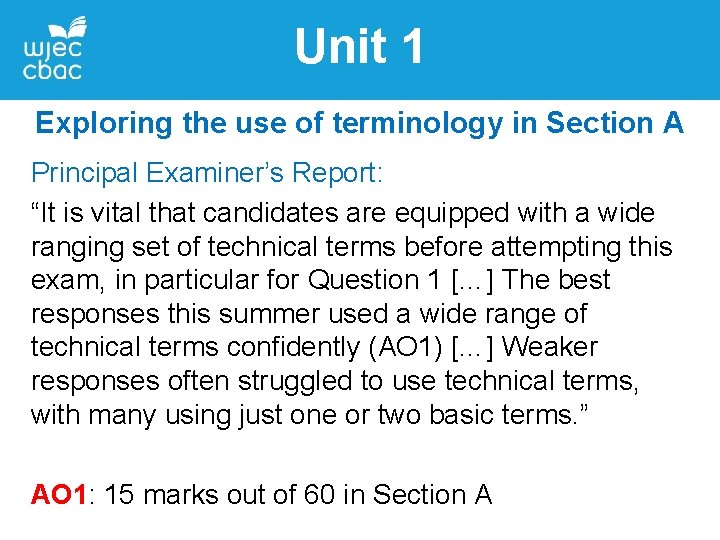
Unit 1 Exploring the use of terminology in Section A Principal Examiner’s Report: “It is vital that candidates are equipped with a wide ranging set of technical terms before attempting this exam, in particular for Question 1 […] The best responses this summer used a wide range of technical terms confidently (AO 1) […] Weaker responses often struggled to use technical terms, with many using just one or two basic terms. ” AO 1: 15 marks out of 60 in Section A
Unit 1 Exploring the use of terminology in Section A How candidates move through the assessment objective bands for AO 1? Two issues to highlight through exemplar scripts: • Accuracy and relevance of terminology used • Range of terminology from across the language frameworks used
Unit 1 Exploring the use of terminology in Section A Accuracy and relevance of terminology: Band 2 and 3 both highlight issues with accuracy and relevance, ‘some inaccuracy’ (Band 2) and ‘not always relevant’ (Band 3) whereas Band 4 and 5 focus on ‘secure use’ of terms, ‘relevant concepts’ (Band 4) and ‘accurate and precise’ and ‘purposeful application’ of terms (Band 5)
Unit 1 Exploring the use of terminology in Section A Range of terminology from across the frameworks used: • A key part of the AO 1 descriptor is ‘evidence of integrated study’ and candidates need to be aware that they should aim to cover all areas of the language frameworks evenly. • The terminology table resource (on website) and the language frameworks chart (provided) encourage candidates to move through form, grammar, lexis, imagery and sound; though centres may well have their own nuanced versions of this framework, the principle is the same – that there are levels of language when exploring a text and sometimes it is pertinent to look at the whole text for structure and form, and sometimes to look at morphemes, phonology. • Bands 2 and 3 both highlight issues with range, ‘basic evidence’ (Band 2) and ‘some evidence’ (Band 3) whereas Band 4 and 5 focus on ‘clear evidence’ of terms (Band 4) and ‘thorough knowledge, understanding and insights gained from integrated study’ (band 5)
Unit 1 Candidate 1
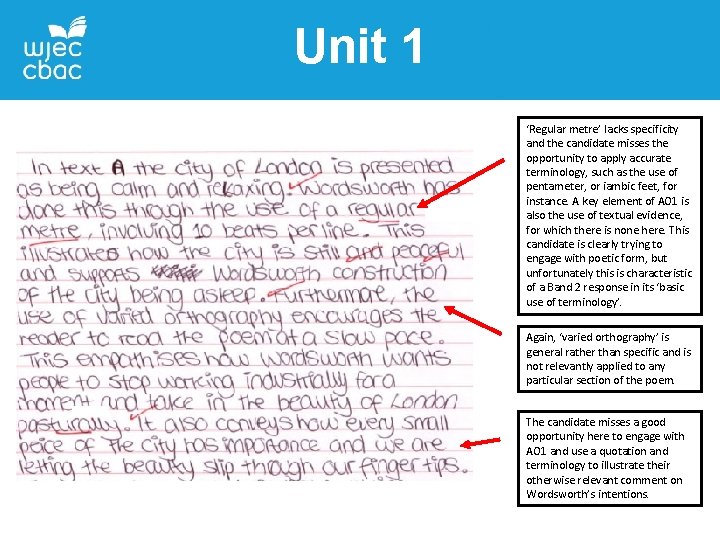
Unit 1 ‘Regular metre’ lacks specificity and the candidate misses the opportunity to apply accurate terminology, such as the use of pentameter, or iambic feet, for instance. A key element of AO 1 is also the use of textual evidence, for which there is none here. This candidate is clearly trying to engage with poetic form, but unfortunately this is characteristic of a Band 2 response in its ‘basic use of terminology’. Again, ‘varied orthography’ is general rather than specific and is not relevantly applied to any particular section of the poem. The candidate misses a good opportunity here to engage with AO 1 and use a quotation and terminology to illustrate their otherwise relevant comment on Wordsworth’s intentions.
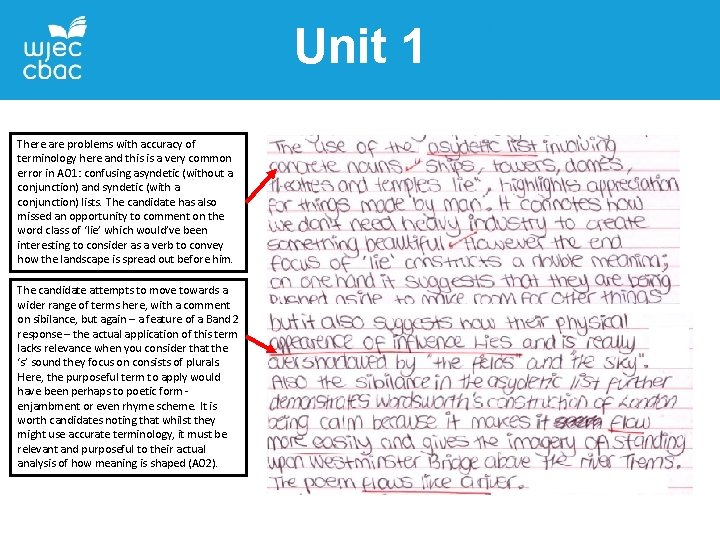
Unit 1 There are problems with accuracy of terminology here and this is a very common error in AO 1: confusing asyndetic (without a conjunction) and syndetic (with a conjunction) lists. The candidate has also missed an opportunity to comment on the word class of ‘lie’ which would’ve been interesting to consider as a verb to convey how the landscape is spread out before him. The candidate attempts to move towards a wider range of terms here, with a comment on sibilance, but again – a feature of a Band 2 response – the actual application of this term lacks relevance when you consider that the ‘s’ sound they focus on consists of plurals. Here, the purposeful term to apply would have been perhaps to poetic form enjambment or even rhyme scheme. It is worth candidates noting that whilst they might use accurate terminology, it must be relevant and purposeful to their actual analysis of how meaning is shaped (AO 2).
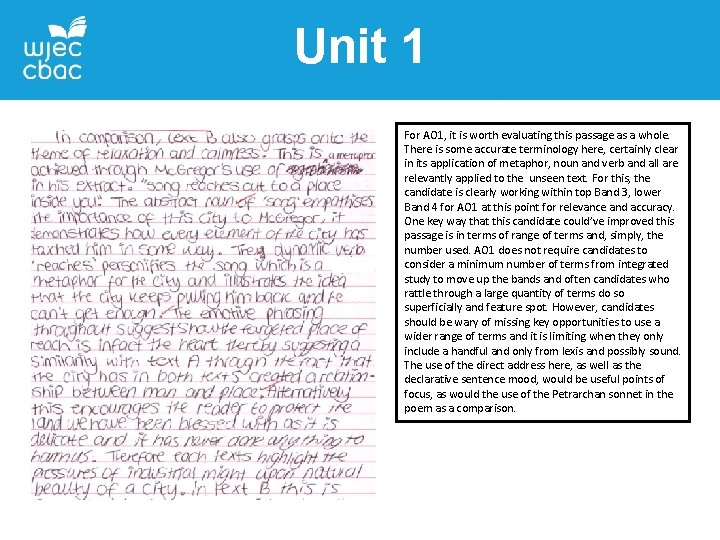
Unit 1 For AO 1, it is worth evaluating this passage as a whole. There is some accurate terminology here, certainly clear in its application of metaphor, noun and verb and all are relevantly applied to the unseen text. For this, the candidate is clearly working within top Band 3, lower Band 4 for AO 1 at this point for relevance and accuracy. One key way that this candidate could’ve improved this passage is in terms of range of terms and, simply, the number used. AO 1 does not require candidates to consider a minimum number of terms from integrated study to move up the bands and often candidates who rattle through a large quantity of terms do so superficially and feature spot. However, candidates should be wary of missing key opportunities to use a wider range of terms and it is limiting when they only include a handful and only from lexis and possibly sound. The use of the direct address here, as well as the declarative sentence mood, would be useful points of focus, as would the use of the Petrarchan sonnet in the poem as a comparison.
Unit 1 Candidate 2
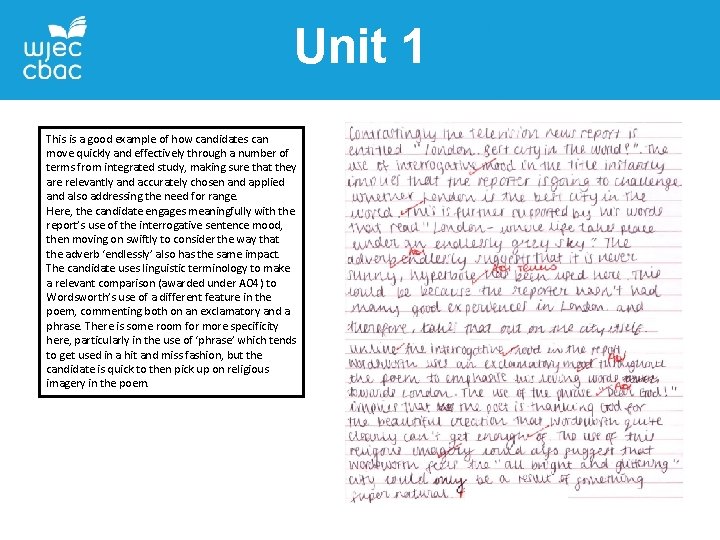
Unit 1 This is a good example of how candidates can move quickly and effectively through a number of terms from integrated study, making sure that they are relevantly and accurately chosen and applied and also addressing the need for range. Here, the candidate engages meaningfully with the report’s use of the interrogative sentence mood, then moving on swiftly to consider the way that the adverb ‘endlessly’ also has the same impact. The candidate uses linguistic terminology to make a relevant comparison (awarded under AO 4) to Wordsworth’s use of a different feature in the poem, commenting both on an exclamatory and a phrase. There is some room for more specificity here, particularly in the use of ‘phrase’ which tends to get used in a hit and miss fashion, but the candidate is quick to then pick up on religious imagery in the poem.
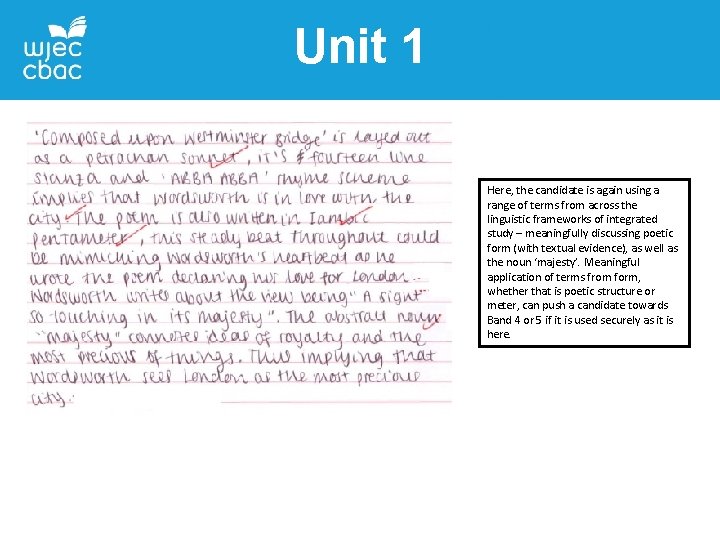
Unit 1 Here, the candidate is again using a range of terms from across the linguistic frameworks of integrated study – meaningfully discussing poetic form (with textual evidence), as well as the noun ‘majesty’. Meaningful application of terms from form, whether that is poetic structure or meter, can push a candidate towards Band 4 or 5 if it is used securely as it is here.
Unit 1 Exploring the use of terminology in Section A Strategies for learning terminology: • • Whole AS course has to be taught through terminology so that students are immersed in terms at every opportunity Initial teaching of terms needs to follow a logical order, making sure that students are fully secure on the parts of speech, before then moving on to phrase and sentence construction. Without knowing the difference between finite and non-finite verbs, for example, candidates will struggle to accurately identify noun phrases. Without appreciating how nouns and pronouns can act as subjects of a sentence, it is hard to look at passive and active voice, at syntax and at sentence types, for example. Students can employ a range of activities to consolidate their knowledge of terminology such as making flip books, posters, flashcards etc. Online resources, such as the grammar games on the WJEC Resources website, websites such as Englicious, and many language blogs, are excellent ways of consolidating terminology.