
GC 211 Data Structures Algorithm Analysis Tools Slides

- Slides: 19
GC 211: Data Structures Algorithm Analysis Tools Slides are borrowed from Mr. Mohammad Alqahtani
Algorithm Analysis: Motivation q A problem can be solved in many different ways § Single problem, many algorithms q Which of the several algorithms should I choose? § We use algorithm analysis to answer this question o Writing a working program is not good enough o The program may be inefficient! o If the program runs on a large data set, then the running time becomes an issue
What is Algorithm Analysis? q A methodology to predict the resources that the algorithm requires § Computer memory § Computational time q We’ll focus on computational time § It does not mean memory is not important § Generally, there is a trade-off between the two factors o Space-time trade-off is a common term
How to Analyse Algorithms? q Experimental Approach § Implement algorithms as programs and run them on computers § Not a good approach, though! o Results only for a limited set of test inputs o Difficult comparisons due to the experiment environments (need the same computers, same operating systems, etc. ) o Full implementation and execution of an algorithm § We need an approach which allows us to avoid experimental study
How to Analyse Algorithms? q Theoretical Approach § General methodology for analysing the running time o Considers all possible inputs o Evaluates algorithms in a way that is independent from the hardware and software environments o Analyses an algorithm without implementing it § Count only primitive operations used in an algorithm § Associate each algorithm with a function f(n) that characterises the running time of the algorithm as a function of the input size n o A good approximation of the total number of primitive operations
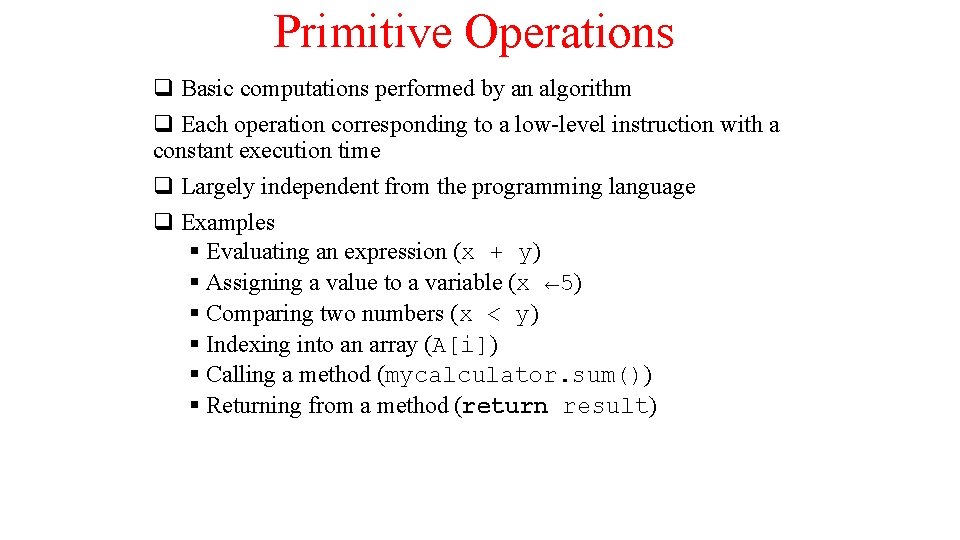
Primitive Operations q Basic computations performed by an algorithm q Each operation corresponding to a low-level instruction with a constant execution time q Largely independent from the programming language q Examples § Evaluating an expression (x + y) § Assigning a value to a variable (x ← 5) § Comparing two numbers (x < y) § Indexing into an array (A[i]) § Calling a method (mycalculator. sum()) § Returning from a method (return result)
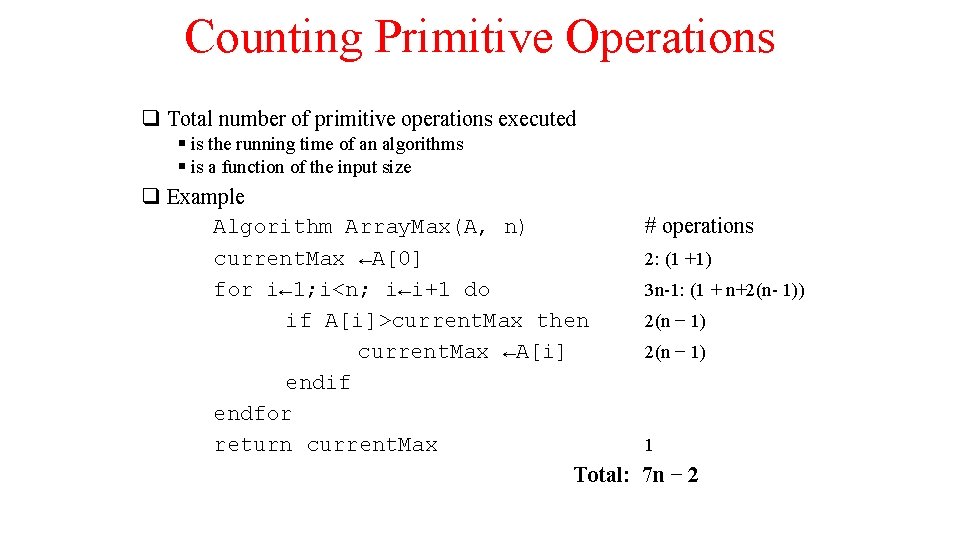
Counting Primitive Operations q Total number of primitive operations executed § is the running time of an algorithms § is a function of the input size q Example Algorithm Array. Max(A, n) current. Max ←A[0] for i← 1; i<n; i←i+1 do if A[i]>current. Max then current. Max ←A[i] endif endfor return current. Max Total: # operations 2: (1 +1) 3 n-1: (1 + n+2(n- 1)) 2(n − 1) 1 7 n − 2
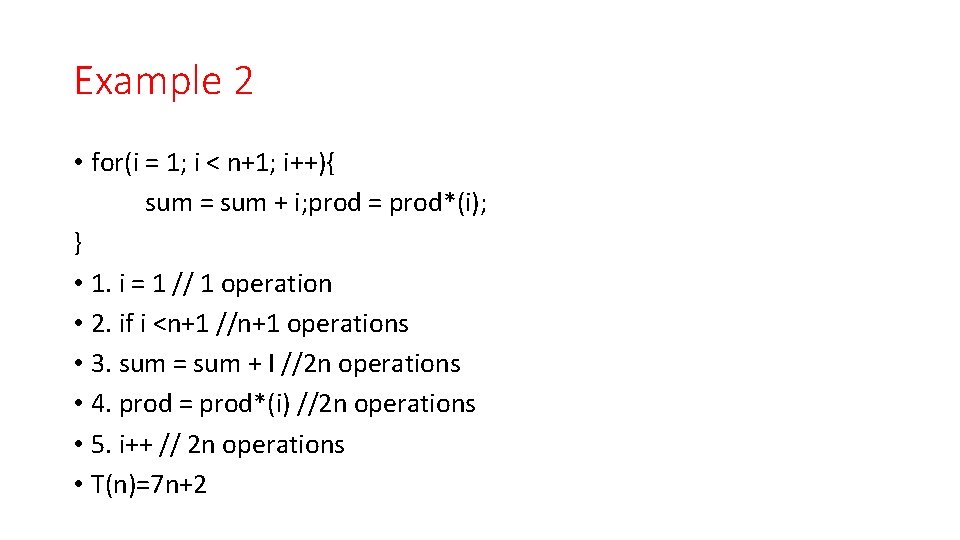
Example 2 • for(i = 1; i < n+1; i++){ sum = sum + i; prod = prod*(i); } • 1. i = 1 // 1 operation • 2. if i <n+1 //n+1 operations • 3. sum = sum + I //2 n operations • 4. prod = prod*(i) //2 n operations • 5. i++ // 2 n operations • T(n)=7 n+2
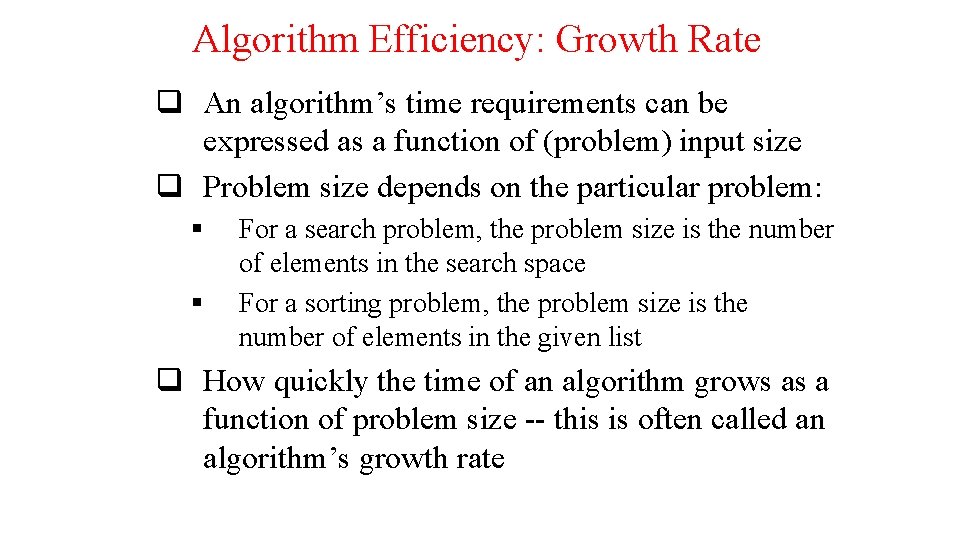
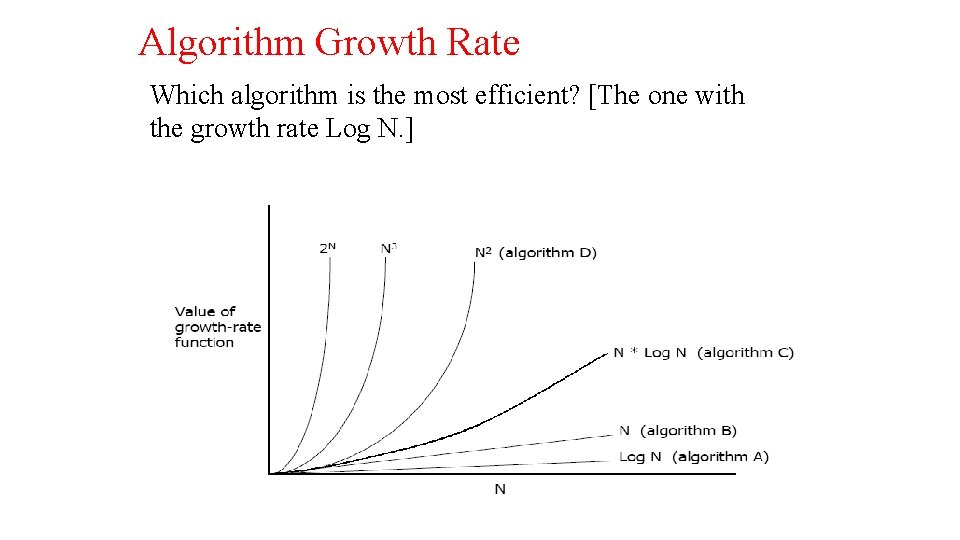
Algorithm Efficiency: Growth Rate q An algorithm’s time requirements can be expressed as a function of (problem) input size q Problem size depends on the particular problem: § § For a search problem, the problem size is the number of elements in the search space For a sorting problem, the problem size is the number of elements in the given list q How quickly the time of an algorithm grows as a function of problem size -- this is often called an algorithm’s growth rate
Algorithm Growth Rate Which algorithm is the most efficient? [The one with the growth rate Log N. ]
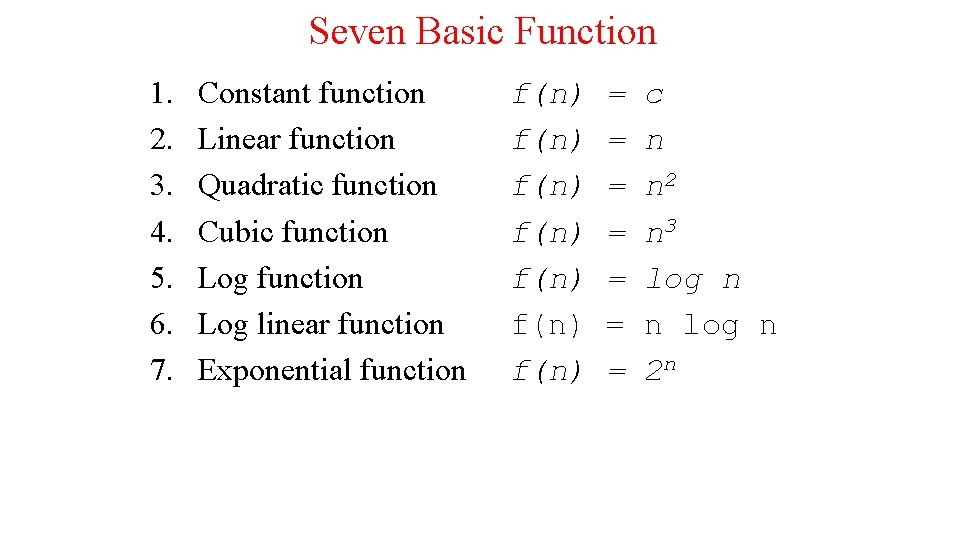
Algorithmic Time Complexity q Rather than counting the exact number of primitive operations, we approximate the runtime of an algorithm as a function of data size – time complexity q Algorithms A, B, C and D (previous slide) belong to different complexity classes q We’ll not cover complexity classes in detail q We’ll briefly discuss seven basic functions which are often used in complexity analysis
Seven Basic Function 1. 2. 3. 4. 5. 6. 7. Constant function Linear function Quadratic function Cubic function Log linear function Exponential function f(n) f(n) = = = = c n n 2 n 3 log n n log n 2 n
Algorithmic Runtime q Worst-case running time § measures the maximum number of primitive operations executed § The worst case can occur fairly often o e. g. in searching a database for a particular piece of information q Best-case running time § measures the minimum number of primitive operations executed o Finding a value in a list, where the value is at the first position o Sorting a list of values, where values are already in desired order q Average-case running time § the efficiency averaged on all possible inputs § maybe difficult to define what “average” means
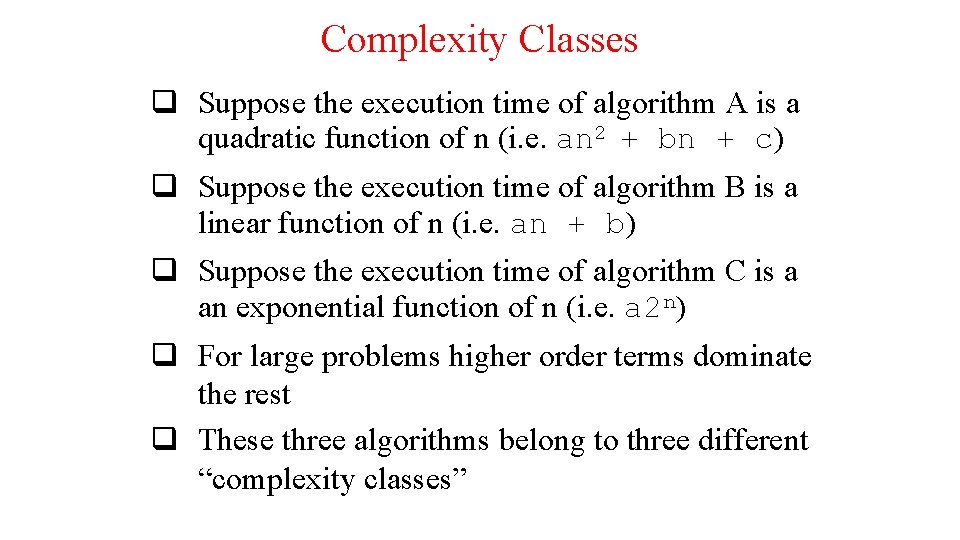
Complexity Classes q Suppose the execution time of algorithm A is a quadratic function of n (i. e. an 2 + bn + c) q Suppose the execution time of algorithm B is a linear function of n (i. e. an + b) q Suppose the execution time of algorithm C is a an exponential function of n (i. e. a 2 n) q For large problems higher order terms dominate the rest q These three algorithms belong to three different “complexity classes”
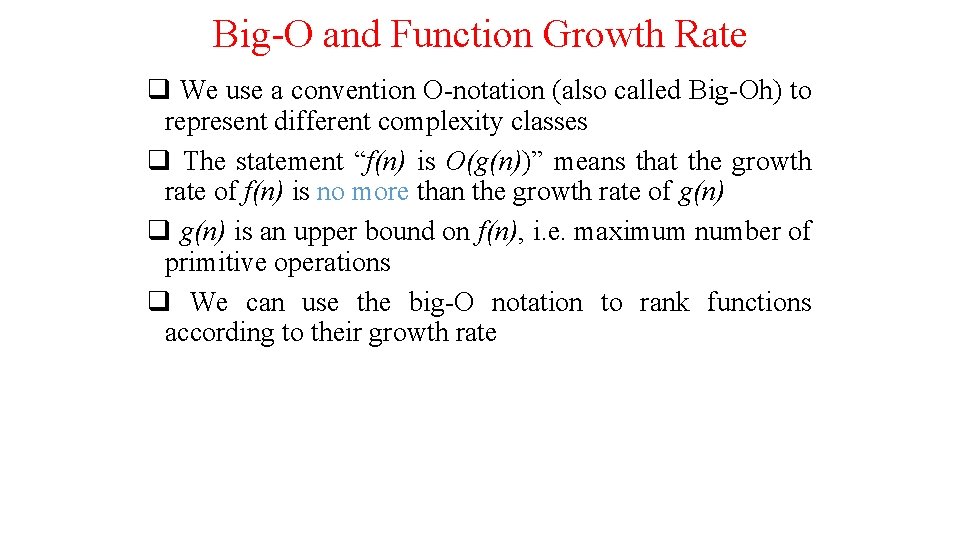
Big-O and Function Growth Rate q We use a convention O-notation (also called Big-Oh) to represent different complexity classes q The statement “f(n) is O(g(n))” means that the growth rate of f(n) is no more than the growth rate of g(n) q g(n) is an upper bound on f(n), i. e. maximum number of primitive operations q We can use the big-O notation to rank functions according to their growth rate
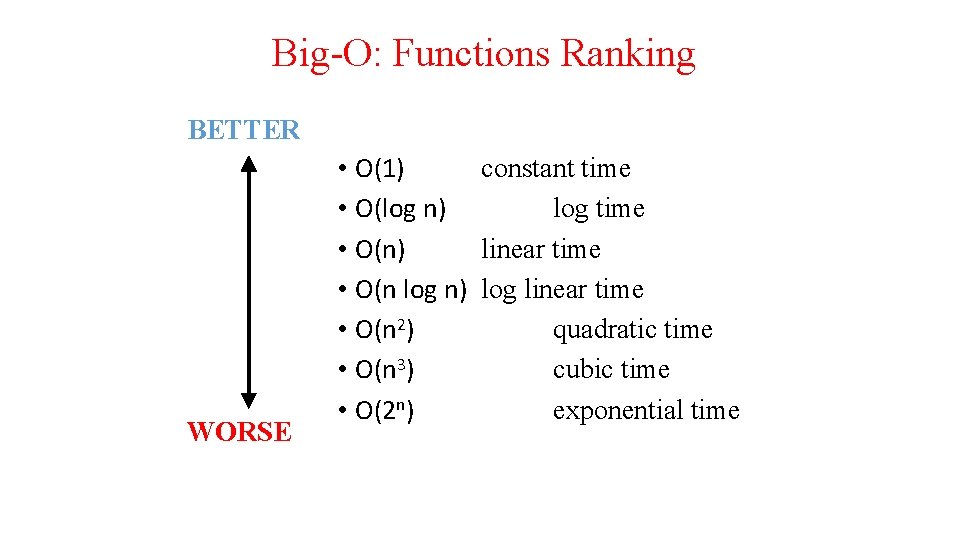
16 Big-O: Functions Ranking BETTER WORSE • O(1) constant time • O(log n) log time • O(n) linear time • O(n log n) log linear time • O(n 2) quadratic time • O(n 3) cubic time • O(2 n) exponential time
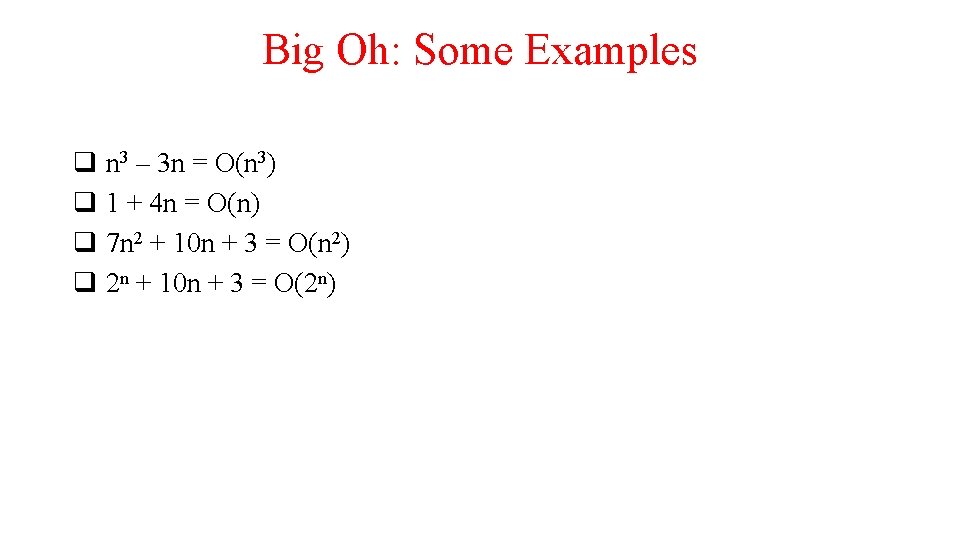
Big Oh: Some Examples q n 3 – 3 n = O(n 3) q 1 + 4 n = O(n) q 7 n 2 + 10 n + 3 = O(n 2) q 2 n + 10 n + 3 = O(2 n)
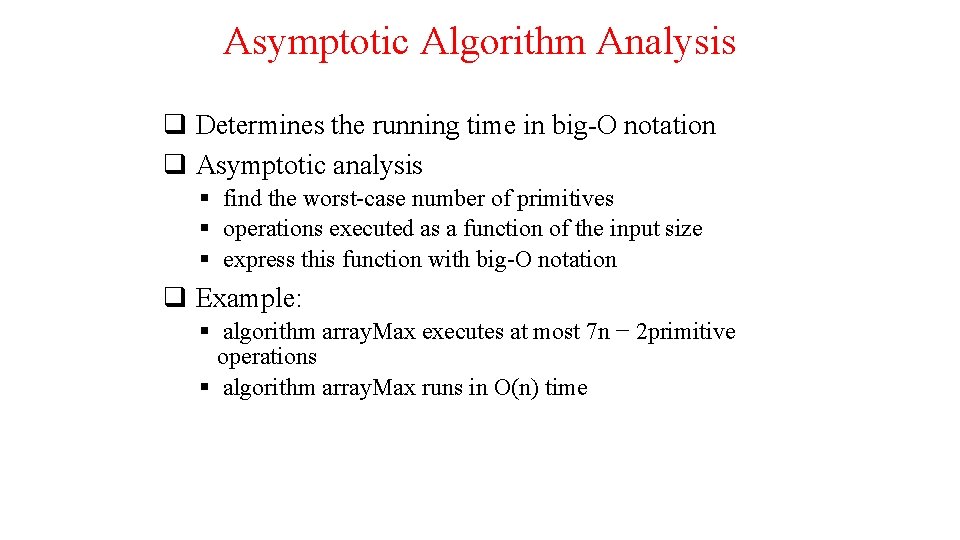
Asymptotic Algorithm Analysis q Determines the running time in big-O notation q Asymptotic analysis § find the worst-case number of primitives § operations executed as a function of the input size § express this function with big-O notation q Example: § algorithm array. Max executes at most 7 n − 2 primitive operations § algorithm array. Max runs in O(n) time
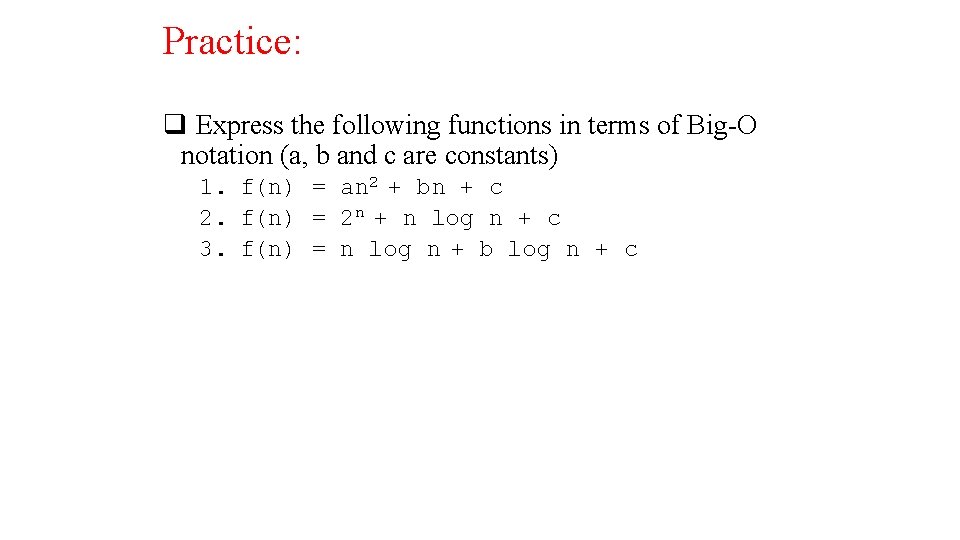
Practice: q Express the following functions in terms of Big-O notation (a, b and c are constants) 1. f(n) = an 2 + bn + c 2. f(n) = 2 n + n log n + c 3. f(n) = n log n + b log n + c