
Gawad sa Manlilikha ng Bayan or the National
Gawad sa Manlilikha ng Bayan or the National Living Treasures Award Institutionalized through Republic Act No. 7355.
Gamaba Award • search for the finest traditional artists of the land • adopts a program that will ensure the transfer of their skills to others • undertakes measures to promote a genuine appreciation of traditional craft and art • instill pride among our people about the skill of the Manlilikha ng Bayan.
Qualifications He/she/group is an inhabitant of an indigenous/traditional cultural community anywhere in the Philippines that has preserved indigenous customs, beliefs, rituals and traditions and/or has syncretized whatever external elements that have influenced it. He/she/group must have engaged in a folk art tradition that has been in existence and documented for at least fifty (50) years.
Qualifications He/she/group must have consistently performed or produced over a significant period, works of superior and distinctive quality. He/she/group must possess a mastery of tools and materials needed by the art, and must have an established reputation in the art as master and maker of works of extraordinary technical quality.
Qualifications He/she/group must have passed on and/or will pass on to other members of the community their skills in the folk art for which the community is traditionally known.

1993
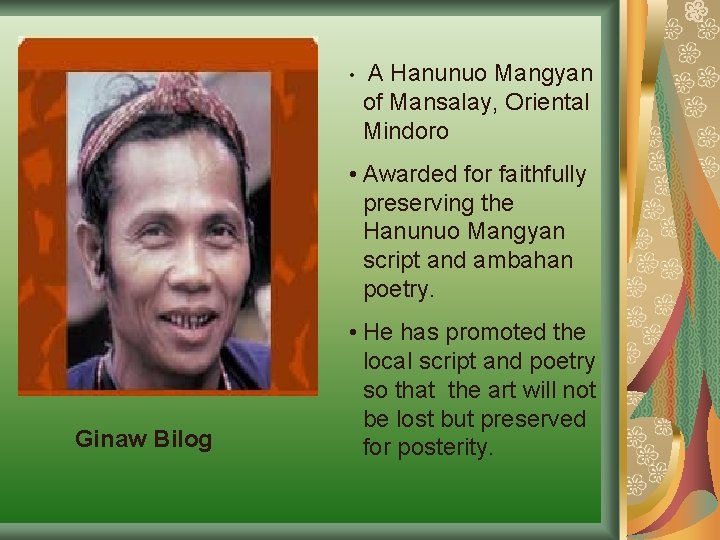
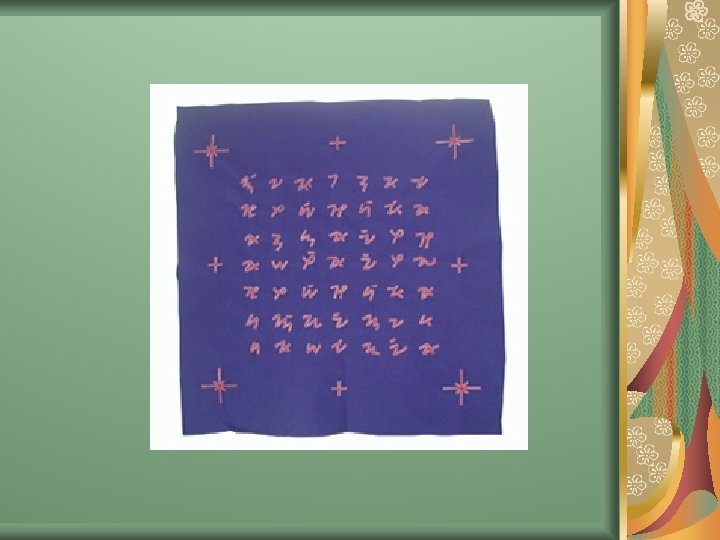
• A Hanunuo Mangyan of Mansalay, Oriental Mindoro • Awarded for faithfully preserving the Hanunuo Mangyan script and ambahan poetry. Ginaw Bilog • He has promoted the local script and poetry so that the art will not be lost but preserved for posterity.
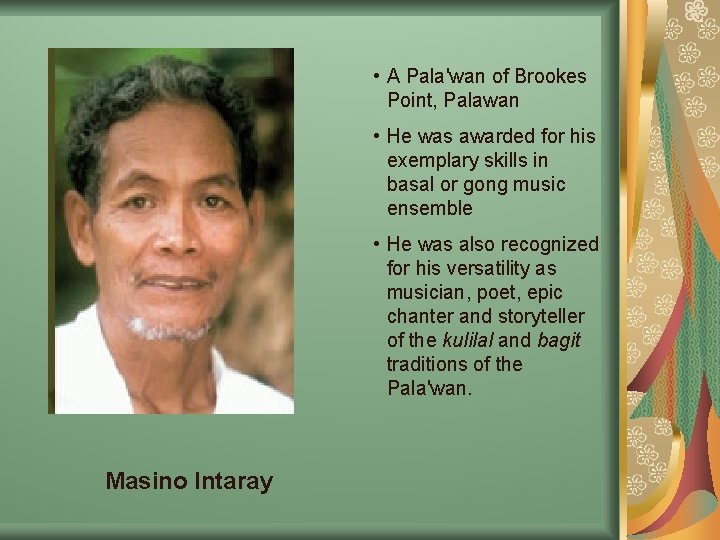
• A Pala'wan of Brookes Point, Palawan • He was awarded for his exemplary skills in basal or gong music ensemble • He was also recognized for his versatility as musician, poet, epic chanter and storyteller of the kulilal and bagit traditions of the Pala'wan. Masino Intaray
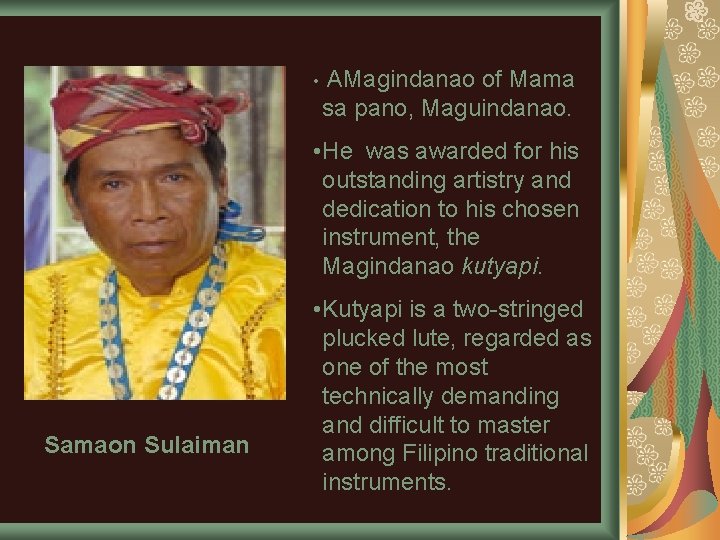
• AMagindanao of Mama sa pano, Maguindanao. • He was awarded for his outstanding artistry and dedication to his chosen instrument, the Magindanao kutyapi. Samaon Sulaiman • Kutyapi is a two-stringed plucked lute, regarded as one of the most technically demanding and difficult to master among Filipino traditional instruments.

1998 Awardees
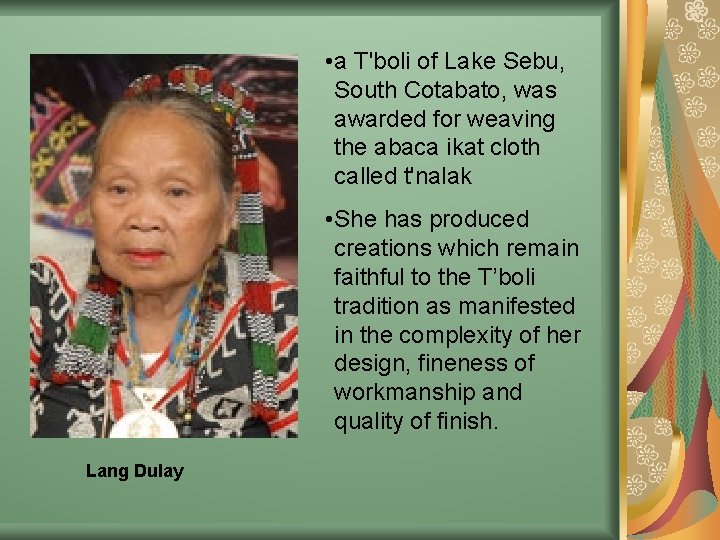
• a T'boli of Lake Sebu, South Cotabato, was awarded for weaving the abaca ikat cloth called t'nalak • She has produced creations which remain faithful to the T’boli tradition as manifested in the complexity of her design, fineness of workmanship and quality of finish. Lang Dulay
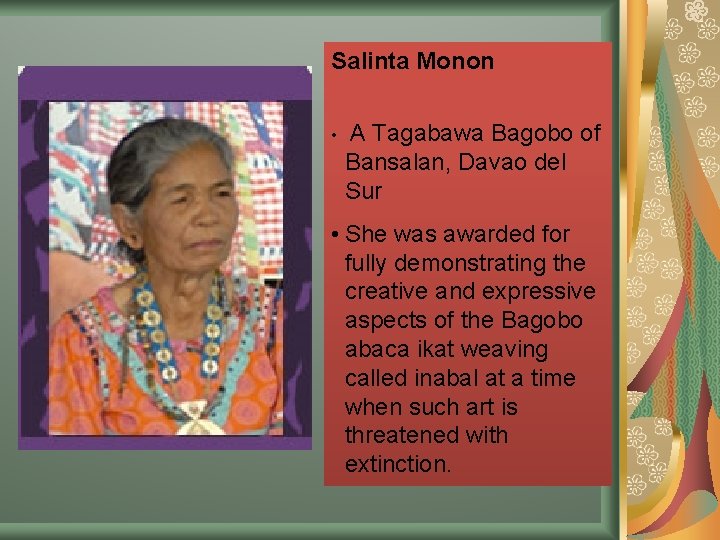
Salinta Monon • A Tagabawa Bagobo of Bansalan, Davao del Sur • She was awarded for fully demonstrating the creative and expressive aspects of the Bagobo abaca ikat weaving called inabal at a time when such art is threatened with extinction.

2000 Awardees
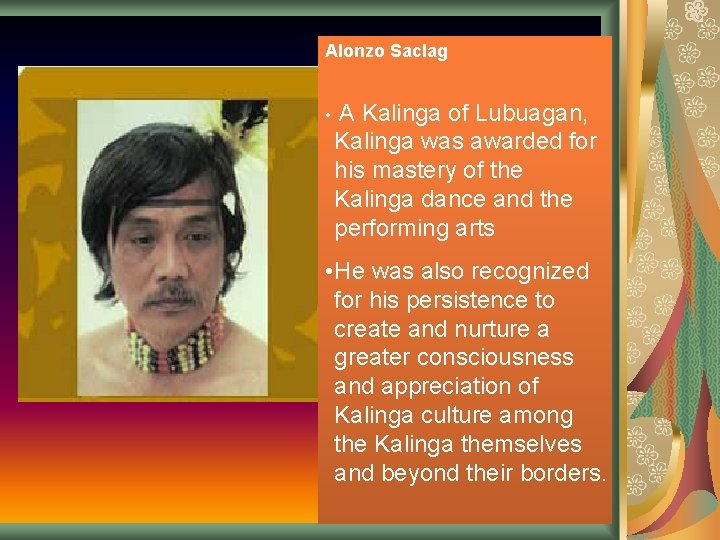
Alonzo Saclag • A Kalinga of Lubuagan, Kalinga was awarded for his mastery of the Kalinga dance and the performing arts • He was also recognized for his persistence to create and nurture a greater consciousness and appreciation of Kalinga culture among the Kalinga themselves and beyond their borders.
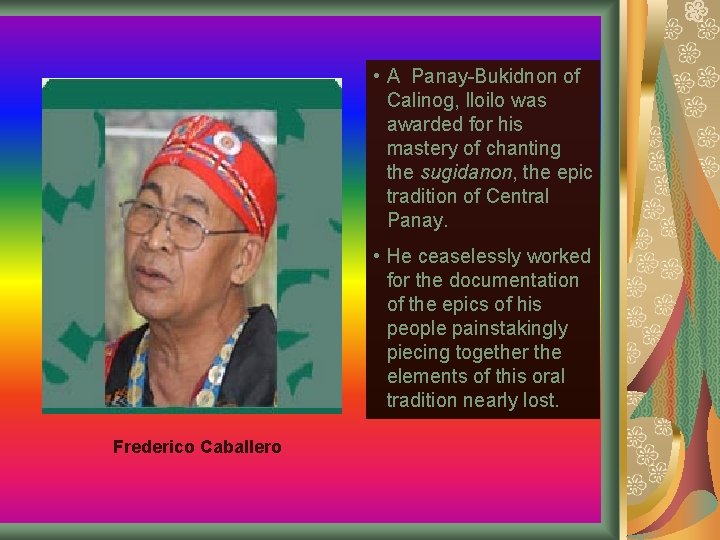
• A Panay-Bukidnon of Calinog, lloilo was awarded for his mastery of chanting the sugidanon, the epic tradition of Central Panay. • He ceaselessly worked for the documentation of the epics of his people painstakingly piecing together the elements of this oral tradition nearly lost. Frederico Caballero
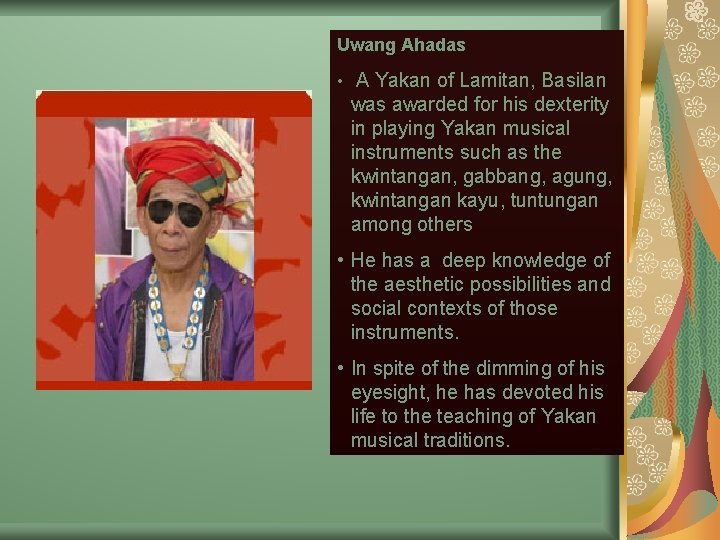
Uwang Ahadas • A Yakan of Lamitan, Basilan was awarded for his dexterity in playing Yakan musical instruments such as the kwintangan, gabbang, agung, kwintangan kayu, tuntungan among others • He has a deep knowledge of the aesthetic possibilities and social contexts of those instruments. • In spite of the dimming of his eyesight, he has devoted his life to the teaching of Yakan musical traditions.

2005 Awardees
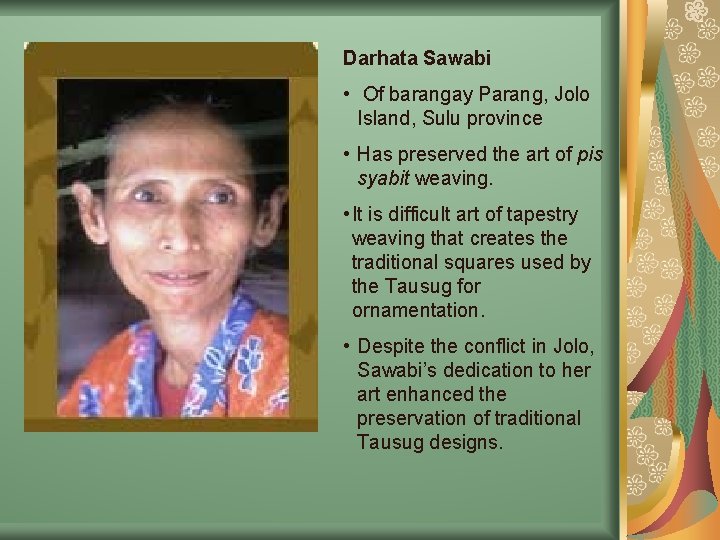
Darhata Sawabi • Of barangay Parang, Jolo Island, Sulu province • Has preserved the art of pis syabit weaving. • It is difficult art of tapestry weaving that creates the traditional squares used by the Tausug for ornamentation. • Despite the conflict in Jolo, Sawabi’s dedication to her art enhanced the preservation of traditional Tausug designs.
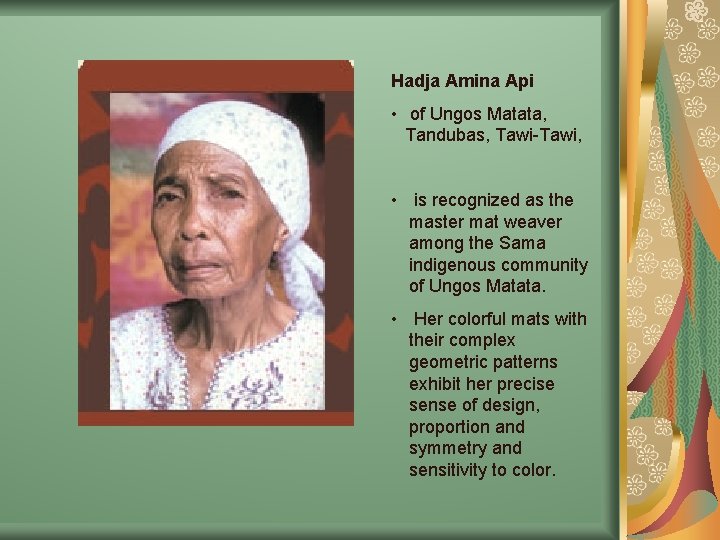
Hadja Amina Api • of Ungos Matata, Tandubas, Tawi-Tawi, • is recognized as the master mat weaver among the Sama indigenous community of Ungos Matata. • Her colorful mats with their complex geometric patterns exhibit her precise sense of design, proportion and symmetry and sensitivity to color.
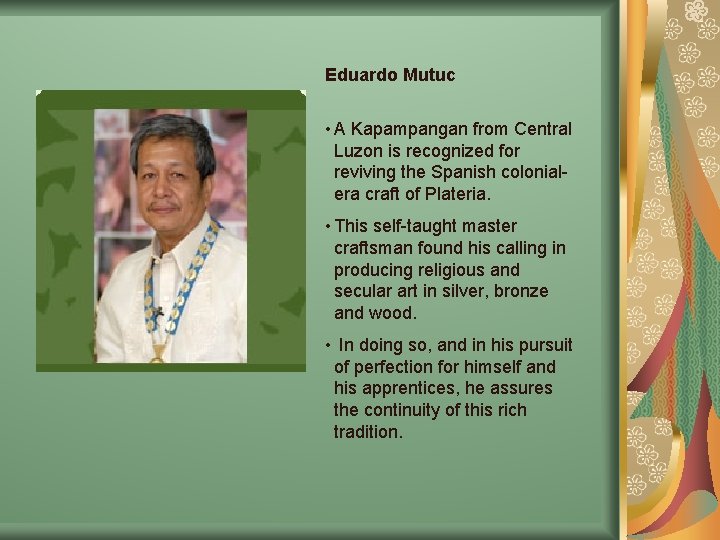
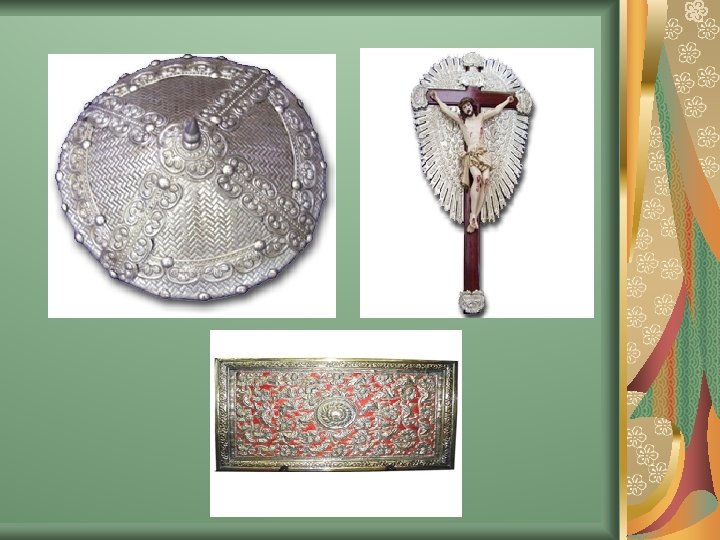
Eduardo Mutuc • A Kapampangan from Central Luzon is recognized for reviving the Spanish colonialera craft of Plateria. • This self-taught master craftsman found his calling in producing religious and secular art in silver, bronze and wood. • In doing so, and in his pursuit of perfection for himself and his apprentices, he assures the continuity of this rich tradition.
- Slides: 22