
Gavi Judith Kallenberg Head of Policy Duke Global
Gavi Judith Kallenberg, Head of Policy Duke Global Health Fellows 6 July 2016 www. gavi. org
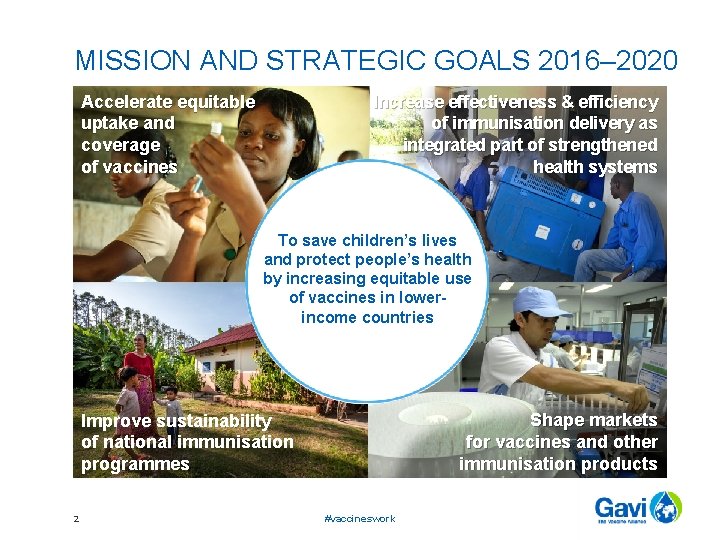
MISSION AND STRATEGIC GOALS 2016– 2020 Accelerate equitable uptake and coverage of vaccines Increase effectiveness & efficiency of immunisation delivery as integrated part of strengthened health systems To save children’s lives and protect people’s health by increasing equitable use of vaccines in lowerincome countries Shape markets for vaccines and other immunisation products Improve sustainability of national immunisation programmes 2 #vaccineswork
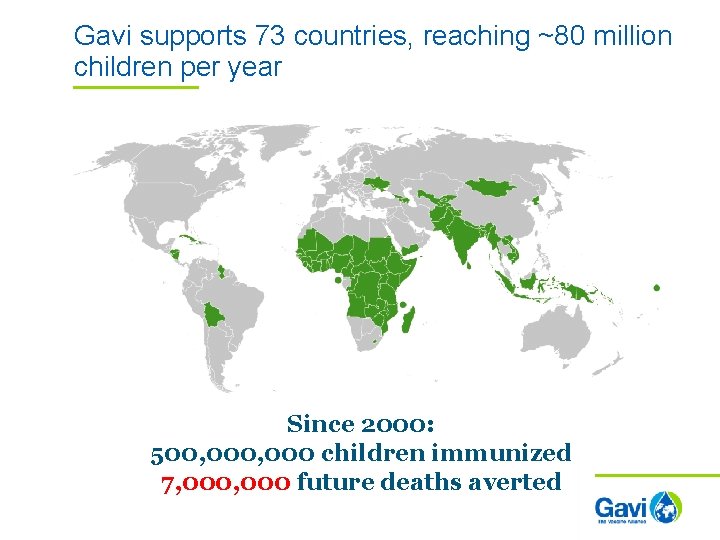
Gavi supports 73 countries, reaching ~80 million children per year Since 2000: 500, 000 children immunized 7, 000 future deaths averted
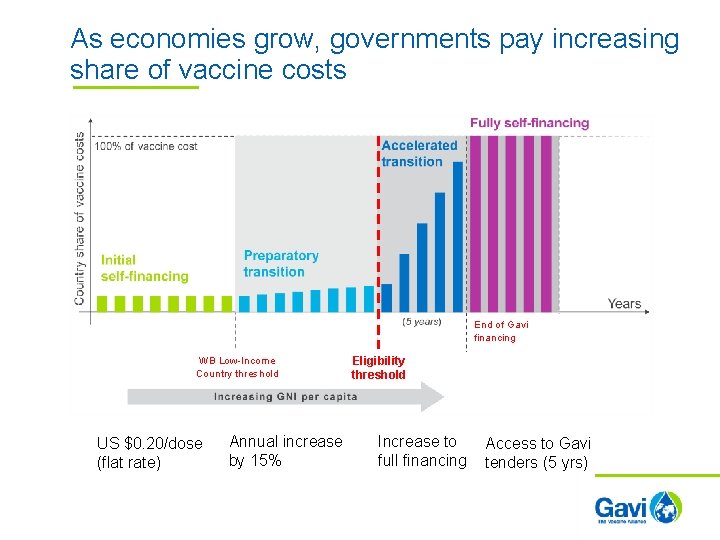
As economies grow, governments pay increasing share of vaccine costs End of Gavi financing WB Low-Income Country threshold US $0. 20/dose (flat rate) Annual increase by 15% Eligibility threshold Increase to full financing Access to Gavi tenders (5 yrs)
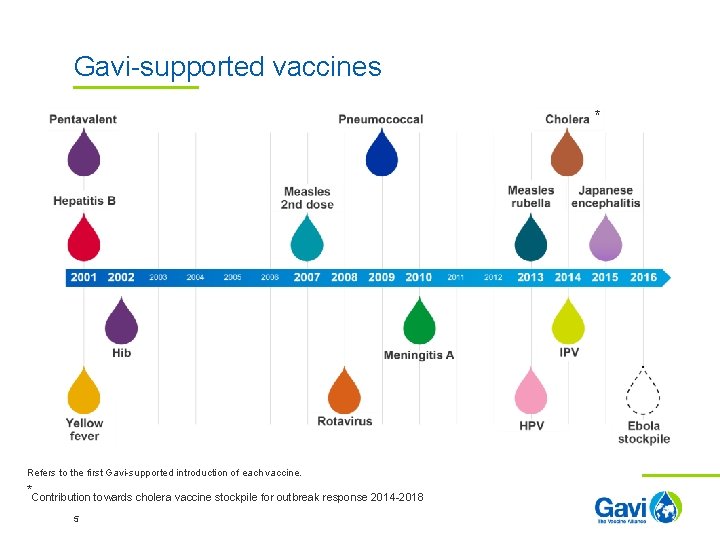
Gavi-supported vaccines * Refers to the first Gavi-supported introduction of each vaccine. Refers to the first Gavi-supported of each vaccine. *Contribution towards cholera vaccine stockpile for outbreak response 2014 -2018 5
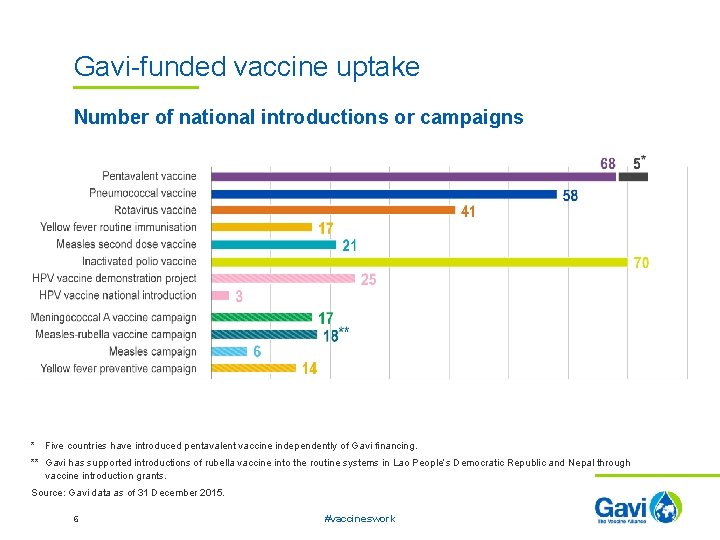
Gavi-funded vaccine uptake Number of national introductions or campaigns * Five countries have introduced pentavalent vaccine independently of Gavi financing. ** Gavi has supported introductions of rubella vaccine into the routine systems in Lao People’s Democratic Republic and Nepal through vaccine introduction grants. Source: Gavi data as of 31 December 2015. 6 #vaccineswork
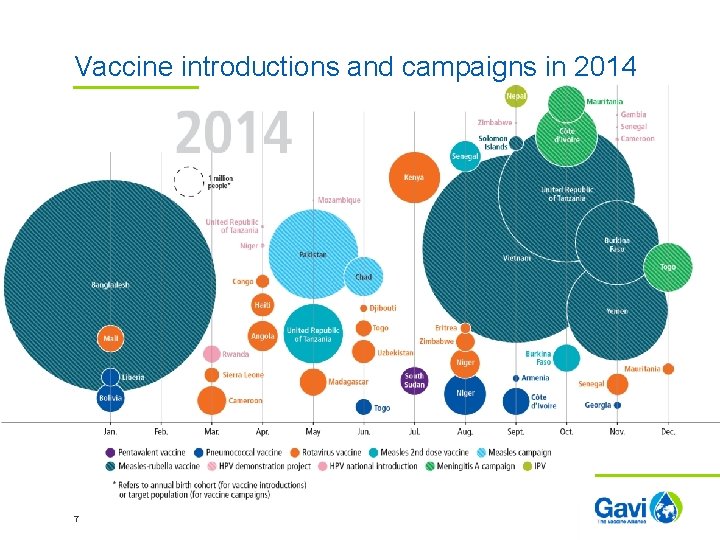
Vaccine introductions and campaigns in 2014 7
Vaccine Investment Strategy (VIS) Evidence-based approach to identifying new vaccines for Gavi support • Evidence review, analyses, stakeholder consultations, independent expert advice • Enabling predictable vaccine programming and investment decisions (rather than first-come-first-serve) • Ensuring predictability of Gavi programs to help long-term planning by countries, industry and donors 8
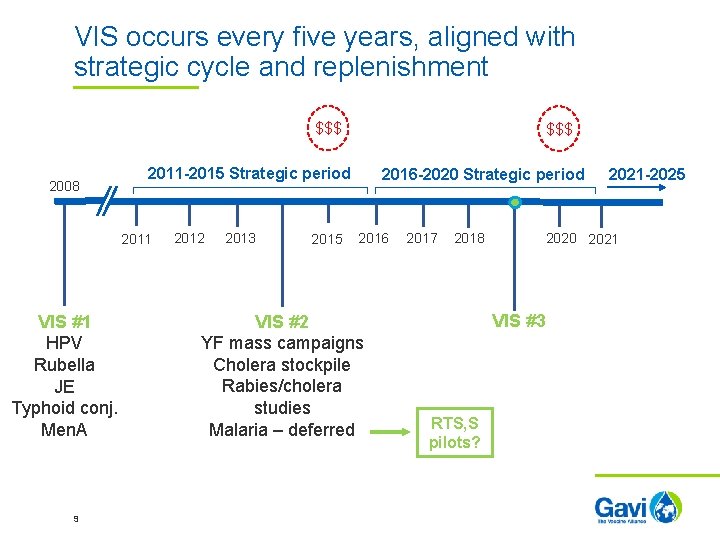
VIS occurs every five years, aligned with strategic cycle and replenishment $$$ 2008 2011 -2015 Strategic period 2011 VIS #1 HPV Rubella JE Typhoid conj. Men. A 9 $$$ 2012 2013 2015 2016 -2020 Strategic period 2016 VIS #2 YF mass campaigns Cholera stockpile Rabies/cholera studies Malaria – deferred 2017 2018 2020 2021 VIS #3 RTS, S pilots? 2021 -2025
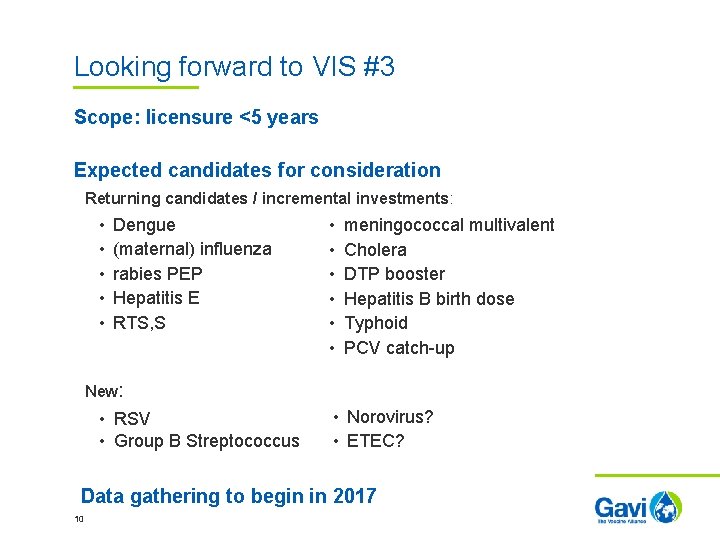
Looking forward to VIS #3 Scope: licensure <5 years Expected candidates for consideration Returning candidates / incremental investments: • • • Dengue (maternal) influenza rabies PEP Hepatitis E RTS, S • • • meningococcal multivalent Cholera DTP booster Hepatitis B birth dose Typhoid PCV catch-up New: • RSV • Group B Streptococcus • Norovirus? • ETEC? Data gathering to begin in 2017 10
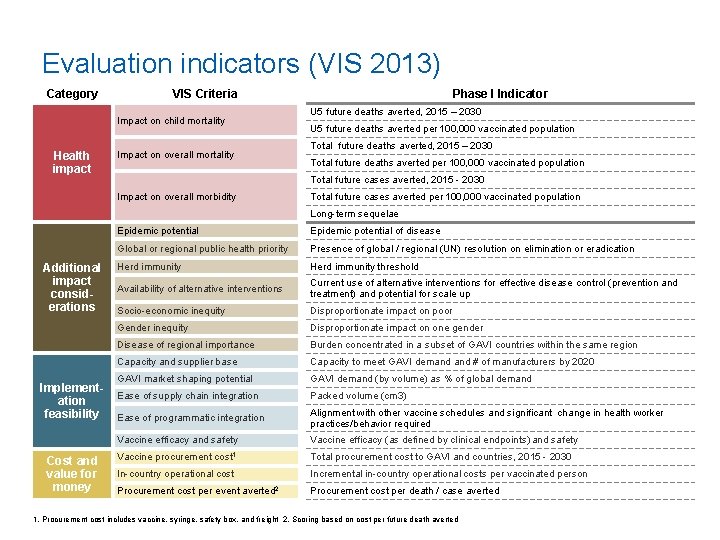
Evaluation indicators (VIS 2013) Category VIS Criteria Phase I Indicator U 5 future deaths averted, 2015 – 2030 Impact on child mortality Health impact U 5 future deaths averted per 100, 000 vaccinated population Total future deaths averted, 2015 – 2030 Impact on overall mortality Total future deaths averted per 100, 000 vaccinated population Total future cases averted, 2015 - 2030 Total future cases averted per 100, 000 vaccinated population Impact on overall morbidity Long-term sequelae Additional impact considerations Implementation feasibility Cost and value for money Epidemic potential of disease Global or regional public health priority Presence of global / regional (UN) resolution on elimination or eradication Herd immunity threshold Availability of alternative interventions Current use of alternative interventions for effective disease control (prevention and treatment) and potential for scale up Socio-economic inequity Disproportionate impact on poor Gender inequity Disproportionate impact on one gender Disease of regional importance Burden concentrated in a subset of GAVI countries within the same region Capacity and supplier base Capacity to meet GAVI demand # of manufacturers by 2020 GAVI market shaping potential GAVI demand (by volume) as % of global demand Ease of supply chain integration Packed volume (cm 3) Ease of programmatic integration Alignment with other vaccine schedules and significant change in health worker practices/behavior required Vaccine efficacy and safety Vaccine efficacy (as defined by clinical endpoints) and safety Vaccine procurement cost 1 Total procurement cost to GAVI and countries, 2015 - 2030 In-country operational cost Procurement cost per event Incremental in-country operational costs per vaccinated person averted 2 Procurement cost per death / case averted 1. Procurement cost includes vaccine, syringe, safety box, and freight 2. Scoring based on cost per future death averted
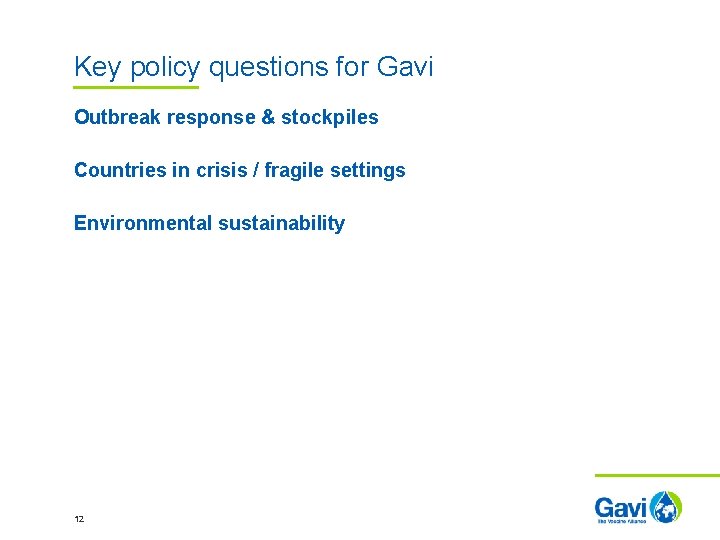
Key policy questions for Gavi Outbreak response & stockpiles Countries in crisis / fragile settings Environmental sustainability 12

THANK YOU www. gavi. org 13
- Slides: 13