
Gauss Quadrature Rule of Integration 1 TwoPoint Gaussian
![Solution First, change the limits of integration from [8, 30] to [-1, 1] by](https://slidetodoc.com/presentation_image_h2/3ed40a7ec6e639df5734e7550f9756ed/image-17.jpg "Solution First, change the limits of integration from [8, 30] to [-1, 1] by")
- Slides: 20
Gauss Quadrature Rule of Integration 1
Two-Point Gaussian Quadrature Rule 2
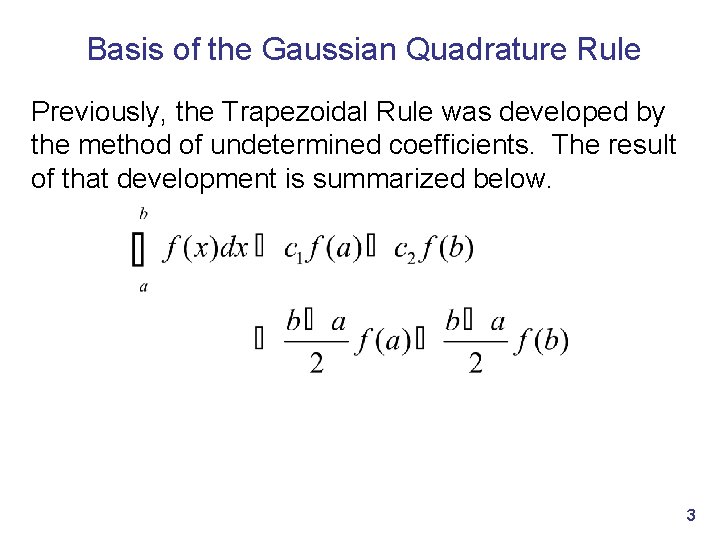
Basis of the Gaussian Quadrature Rule Previously, the Trapezoidal Rule was developed by the method of undetermined coefficients. The result of that development is summarized below. 3
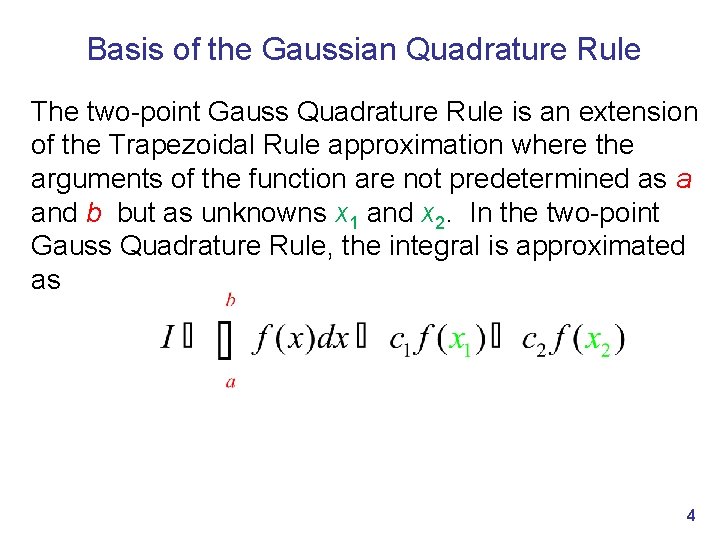
Basis of the Gaussian Quadrature Rule The two-point Gauss Quadrature Rule is an extension of the Trapezoidal Rule approximation where the arguments of the function are not predetermined as a and b but as unknowns x 1 and x 2. In the two-point Gauss Quadrature Rule, the integral is approximated as 4
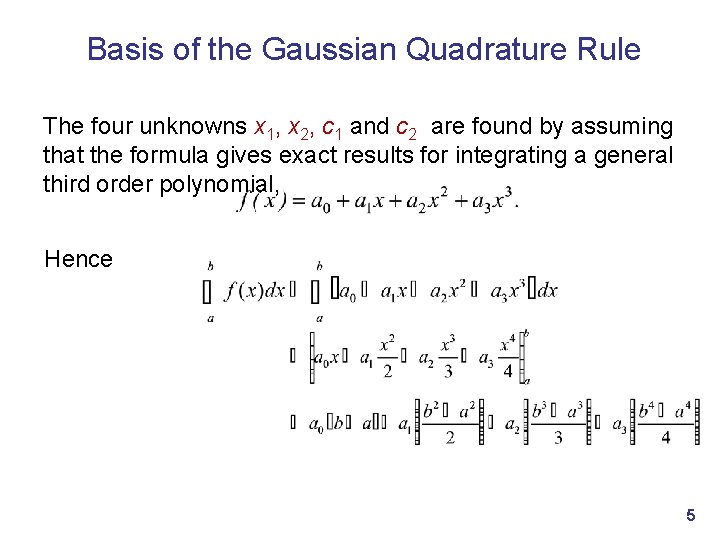
Basis of the Gaussian Quadrature Rule The four unknowns x 1, x 2, c 1 and c 2 are found by assuming that the formula gives exact results for integrating a general third order polynomial, Hence 5
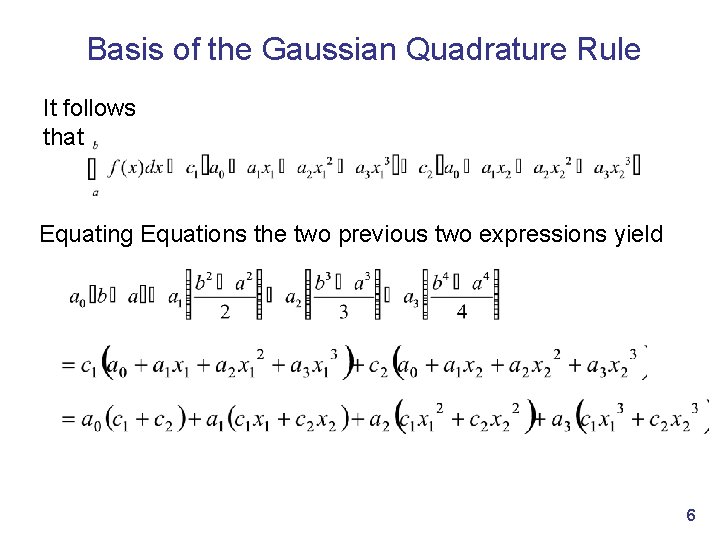
Basis of the Gaussian Quadrature Rule It follows that Equating Equations the two previous two expressions yield 6
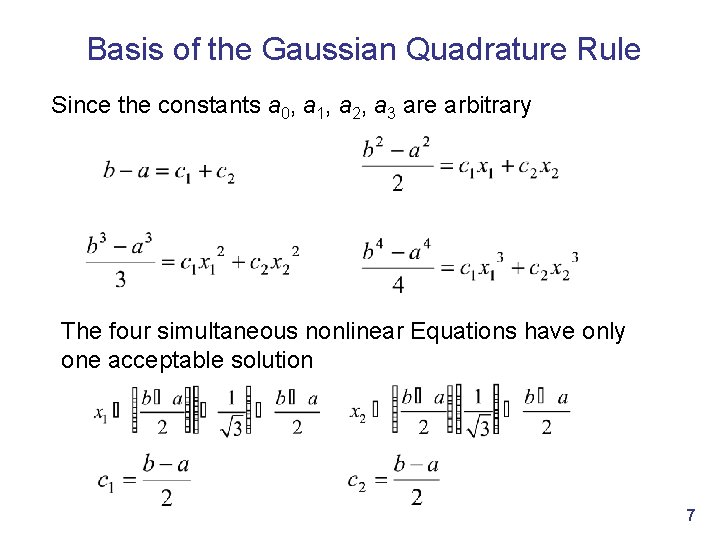
Basis of the Gaussian Quadrature Rule Since the constants a 0, a 1, a 2, a 3 are arbitrary The four simultaneous nonlinear Equations have only one acceptable solution 7
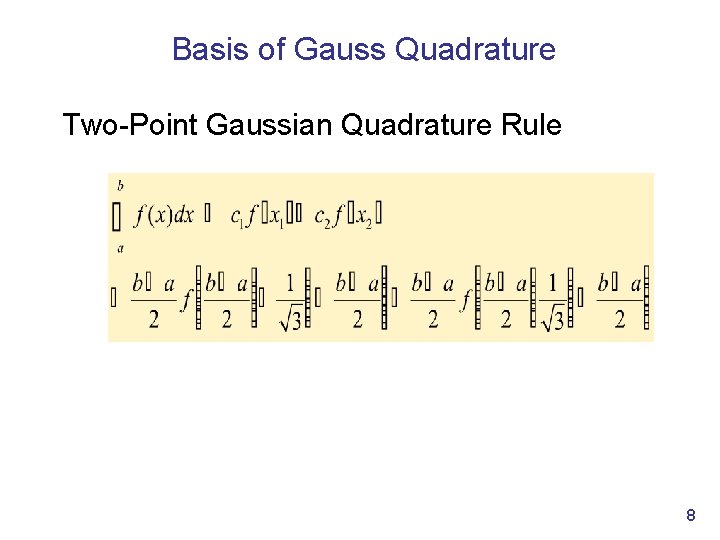
Basis of Gauss Quadrature Two-Point Gaussian Quadrature Rule 8
Higher Point Gaussian Quadrature Formulas 9
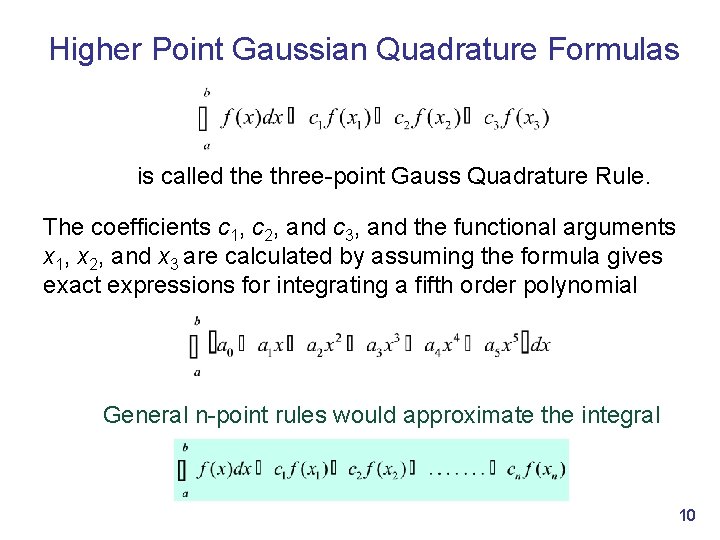
Higher Point Gaussian Quadrature Formulas is called the three-point Gauss Quadrature Rule. The coefficients c 1, c 2, and c 3, and the functional arguments x 1, x 2, and x 3 are calculated by assuming the formula gives exact expressions for integrating a fifth order polynomial General n-point rules would approximate the integral 10
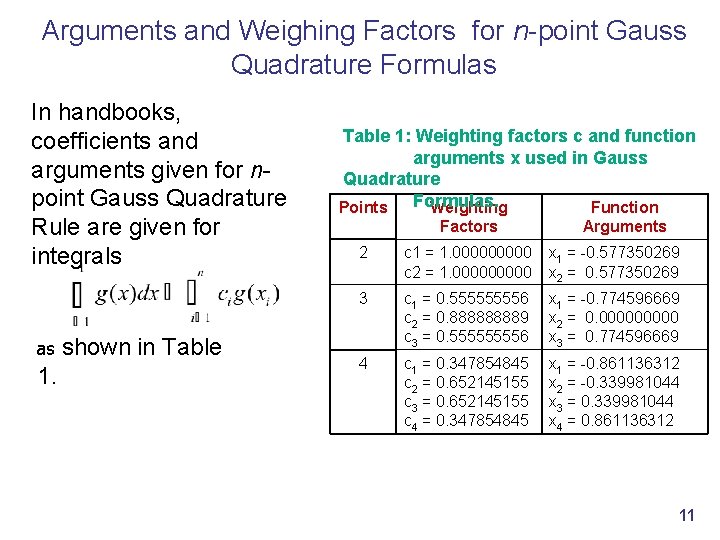
Arguments and Weighing Factors for n-point Gauss Quadrature Formulas In handbooks, coefficients and arguments given for npoint Gauss Quadrature Rule are given for integrals as 1. shown in Table 1: Weighting factors c and function arguments x used in Gauss Quadrature Formulas. Points Weighting Function Factors Arguments 2 c 1 = 1. 00000 c 2 = 1. 00000 x 1 = -0. 577350269 x 2 = 0. 577350269 3 c 1 = 0. 55556 c 2 = 0. 88889 c 3 = 0. 55556 x 1 = -0. 774596669 x 2 = 0. 00000 x 3 = 0. 774596669 4 c 1 = 0. 347854845 c 2 = 0. 652145155 c 3 = 0. 652145155 c 4 = 0. 347854845 x 1 = -0. 861136312 x 2 = -0. 339981044 x 3 = 0. 339981044 x 4 = 0. 861136312 11
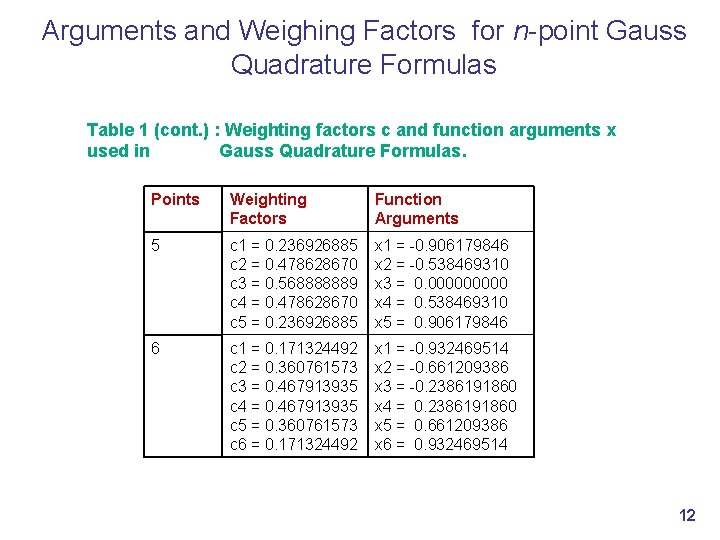
Arguments and Weighing Factors for n-point Gauss Quadrature Formulas Table 1 (cont. ) : Weighting factors c and function arguments x used in Gauss Quadrature Formulas. Points Weighting Factors Function Arguments 5 c 1 = 0. 236926885 c 2 = 0. 478628670 c 3 = 0. 568888889 c 4 = 0. 478628670 c 5 = 0. 236926885 x 1 = -0. 906179846 x 2 = -0. 538469310 x 3 = 0. 00000 x 4 = 0. 538469310 x 5 = 0. 906179846 6 c 1 = 0. 171324492 c 2 = 0. 360761573 c 3 = 0. 467913935 c 4 = 0. 467913935 c 5 = 0. 360761573 c 6 = 0. 171324492 x 1 = -0. 932469514 x 2 = -0. 661209386 x 3 = -0. 2386191860 x 4 = 0. 2386191860 x 5 = 0. 661209386 x 6 = 0. 932469514 12
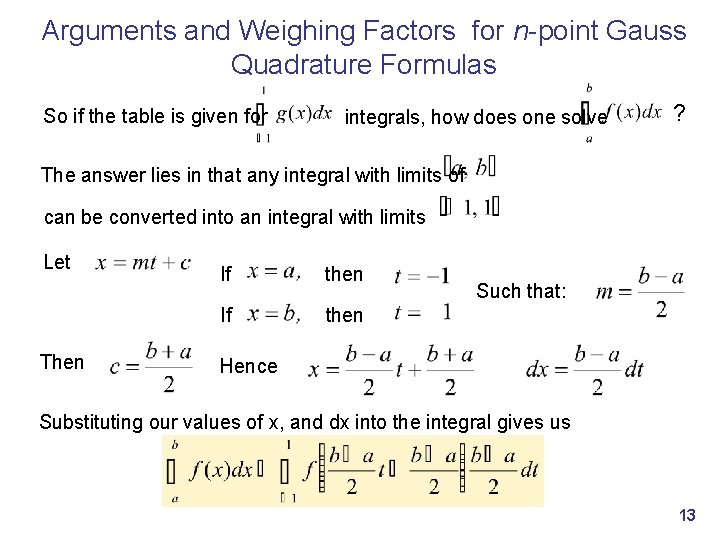
Arguments and Weighing Factors for n-point Gauss Quadrature Formulas So if the table is given for integrals, how does one solve ? The answer lies in that any integral with limits of can be converted into an integral with limits Let Then If then Such that: Hence Substituting our values of x, and dx into the integral gives us 13
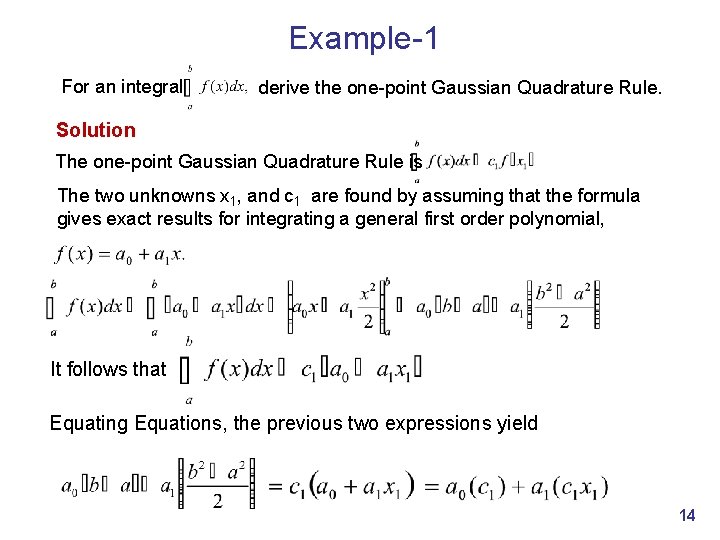
Example-1 For an integral derive the one-point Gaussian Quadrature Rule. Solution The one-point Gaussian Quadrature Rule is The two unknowns x 1, and c 1 are found by assuming that the formula gives exact results for integrating a general first order polynomial, It follows that Equating Equations, the previous two expressions yield 14
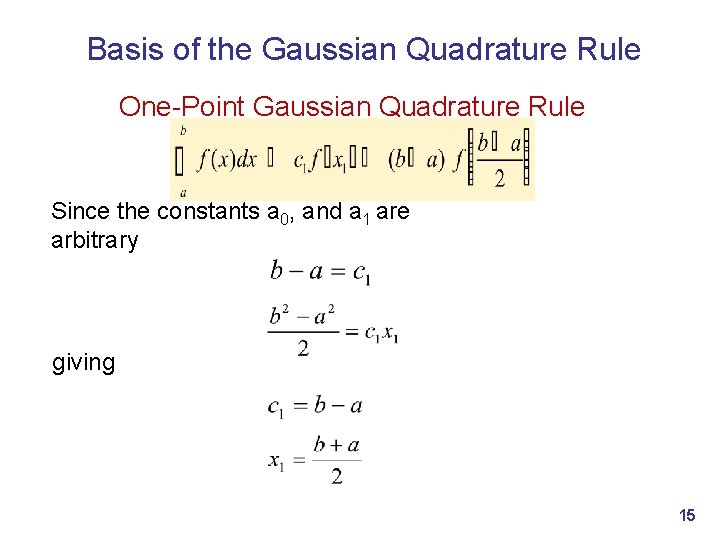
Basis of the Gaussian Quadrature Rule One-Point Gaussian Quadrature Rule Since the constants a 0, and a 1 are arbitrary giving 15
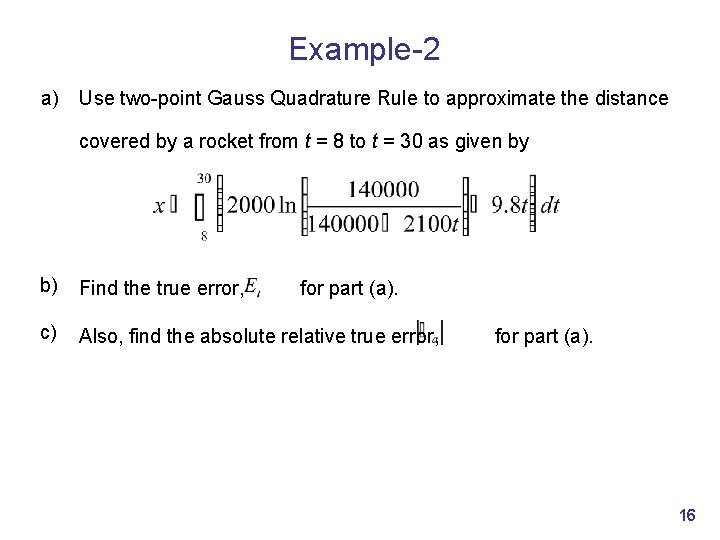
Example-2 a) Use two-point Gauss Quadrature Rule to approximate the distance covered by a rocket from t = 8 to t = 30 as given by b) Find the true error, c) Also, find the absolute relative true error, for part (a). 16
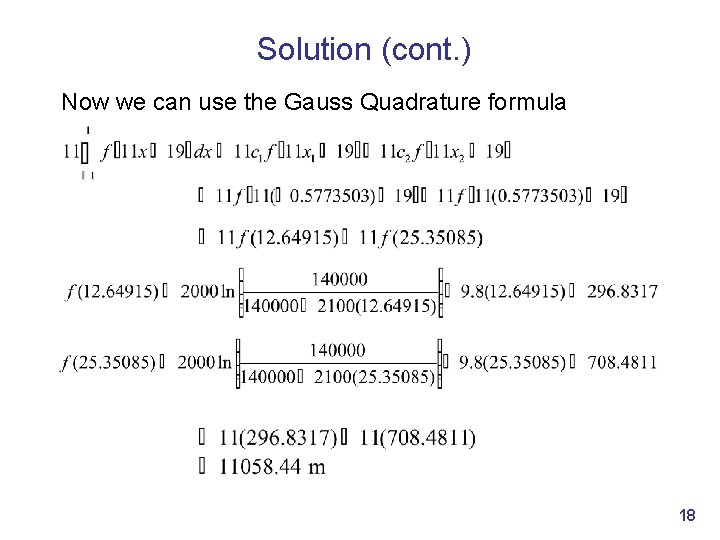
Solution First, change the limits of integration from [8, 30] to [-1, 1] by previous relations as follows Next, get weighting factors and function argument values from Ta for the two point rule, 17
Solution (cont. ) Now we can use the Gauss Quadrature formula 18
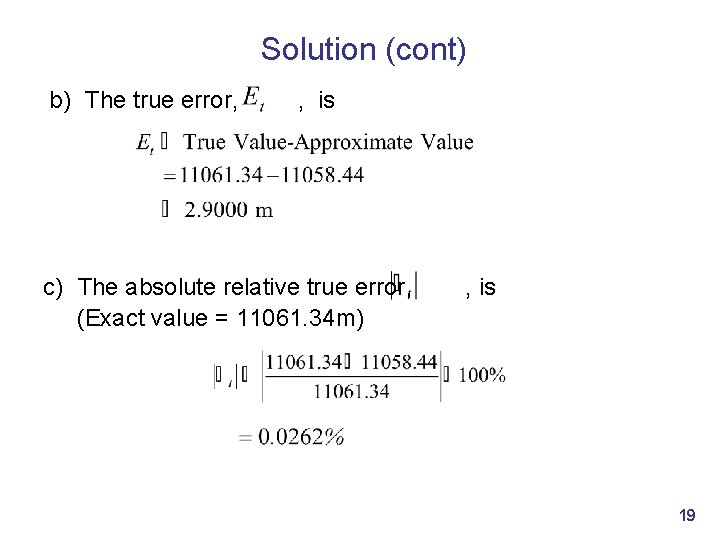
Solution (cont) b) The true error, , is c) The absolute relative true error, (Exact value = 11061. 34 m) , is 19
Additional Resources For all resources on this topic such as digital audiovisual lectures, primers, textbook chapters, multiple-choice tests, worksheets in MATLAB, MATHEMATICA, Math. Cad and MAPLE, blogs, related physical problems, please visit http: //numericalmethods. eng. usf. edu/topics/gauss_quadrature. html 20