
Gauss Jordan Elimination Method Example 1 Solve the
- Slides: 18
Gauss – Jordan Elimination Method: Example 1 Solve the following system of linear equations using the Gauss-Jordan elimination method Slide 1
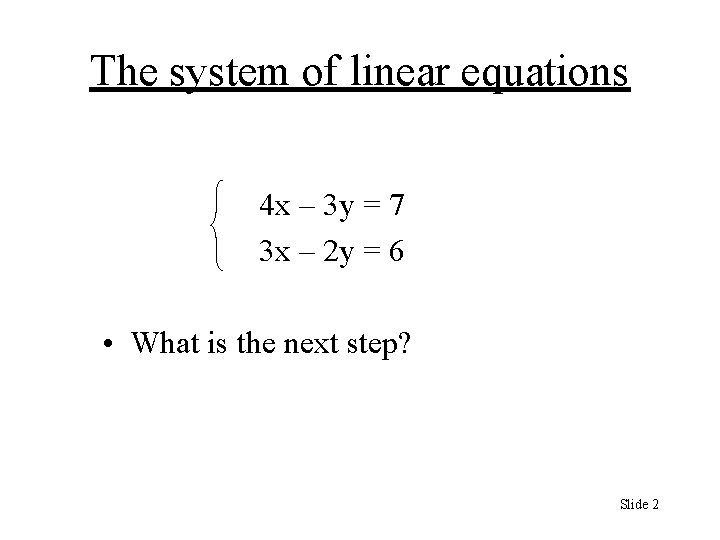
The system of linear equations 4 x – 3 y = 7 3 x – 2 y = 6 • What is the next step? Slide 2
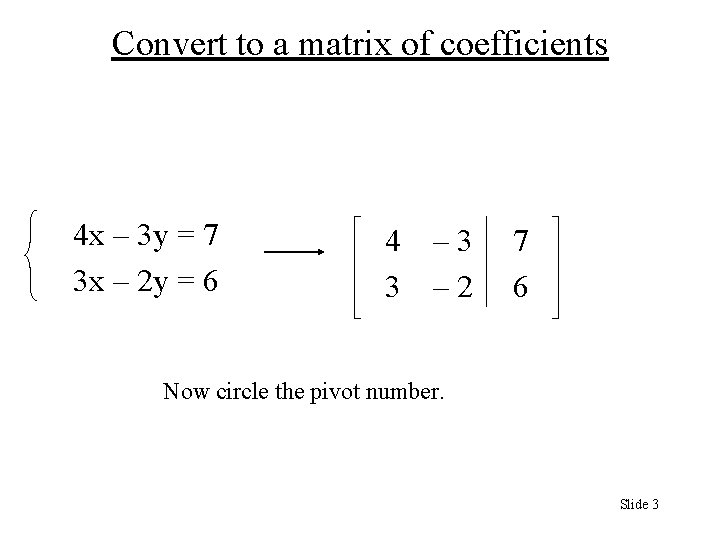
Convert to a matrix of coefficients 4 x – 3 y = 7 3 x – 2 y = 6 4 3 – 2 7 6 Now circle the pivot number. Slide 3
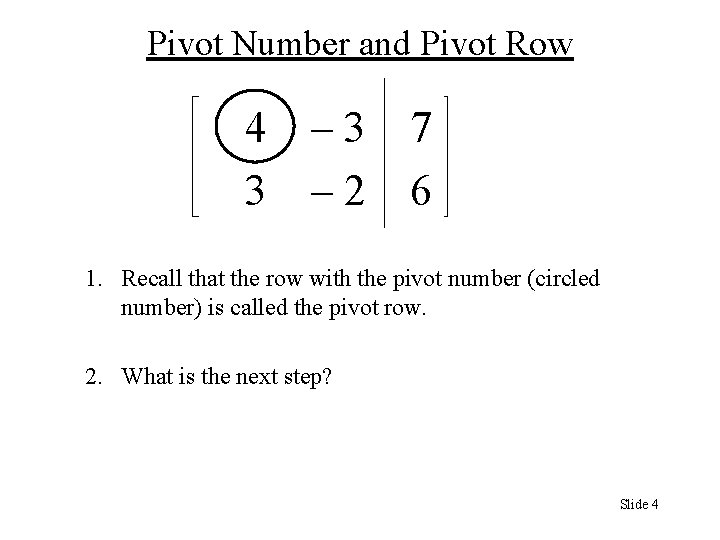
Pivot Number and Pivot Row 4 3 – 2 7 6 1. Recall that the row with the pivot number (circled number) is called the pivot row. 2. What is the next step? Slide 4
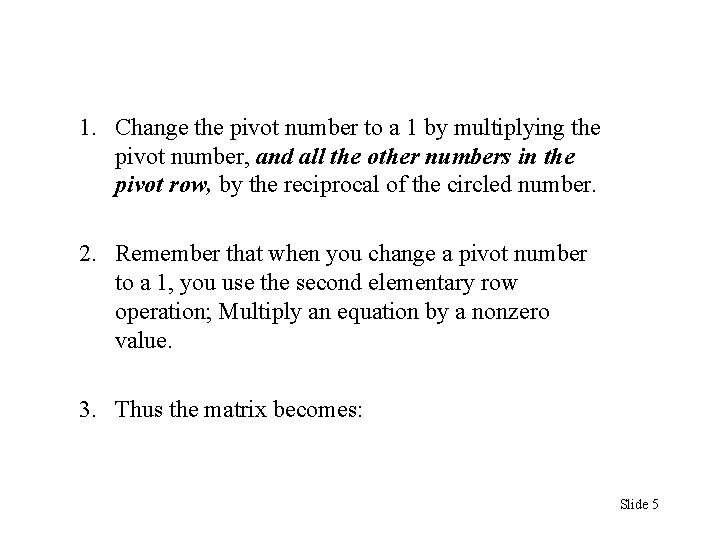
1. Change the pivot number to a 1 by multiplying the pivot number, and all the other numbers in the pivot row, by the reciprocal of the circled number. 2. Remember that when you change a pivot number to a 1, you use the second elementary row operation; Multiply an equation by a nonzero value. 3. Thus the matrix becomes: Slide 5
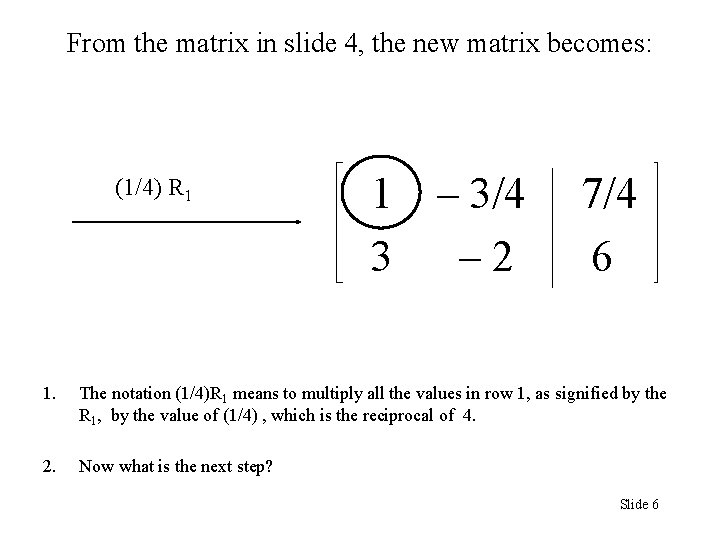
From the matrix in slide 4, the new matrix becomes: (1/4) R 1 1 3 – 3/4 – 2 7/4 6 1. The notation (1/4)R 1 means to multiply all the values in row 1, as signified by the R 1, by the value of (1/4) , which is the reciprocal of 4. 2. Now what is the next step? Slide 6
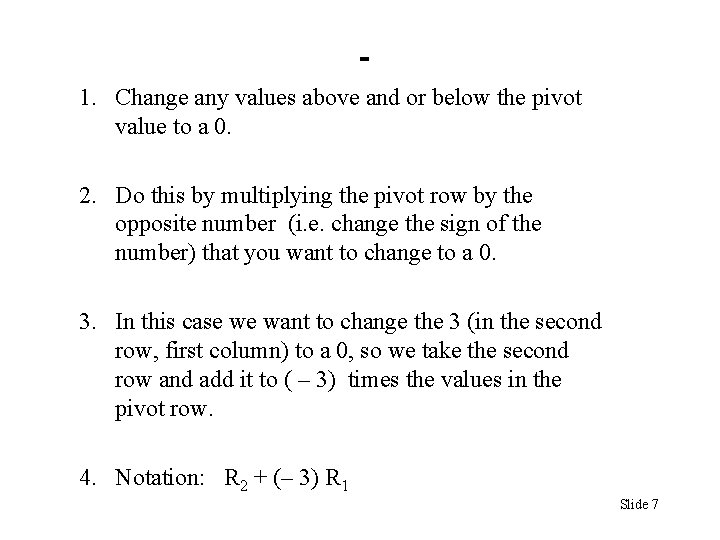
1. Change any values above and or below the pivot value to a 0. 2. Do this by multiplying the pivot row by the opposite number (i. e. change the sign of the number) that you want to change to a 0. 3. In this case we want to change the 3 (in the second row, first column) to a 0, so we take the second row and add it to ( – 3) times the values in the pivot row. 4. Notation: R 2 + (– 3) R 1 Slide 7
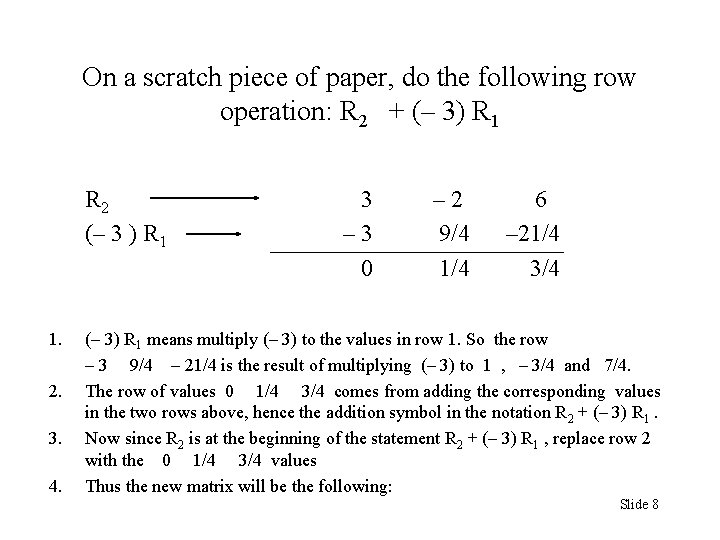
On a scratch piece of paper, do the following row operation: R 2 + (– 3) R 1 R 2 (– 3 ) R 1 1. 2. 3. 4. 3 – 3 0 – 2 9/4 1/4 6 – 21/4 3/4 (– 3) R 1 means multiply (– 3) to the values in row 1. So the row – 3 9/4 – 21/4 is the result of multiplying (– 3) to 1 , – 3/4 and 7/4. The row of values 0 1/4 3/4 comes from adding the corresponding values in the two rows above, hence the addition symbol in the notation R 2 + (– 3) R 1. Now since R 2 is at the beginning of the statement R 2 + (– 3) R 1 , replace row 2 with the 0 1/4 3/4 values Thus the new matrix will be the following: Slide 8
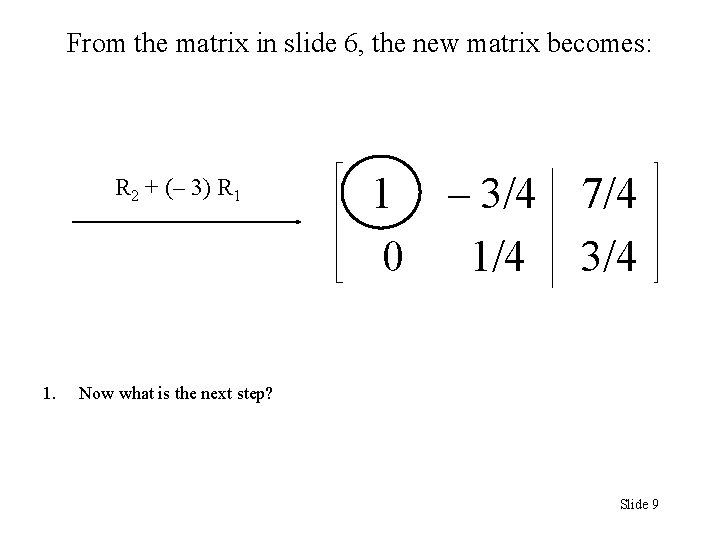
From the matrix in slide 6, the new matrix becomes: R 2 + (– 3) R 1 1. 1 0 – 3/4 1/4 7/4 3/4 Now what is the next step? Slide 9
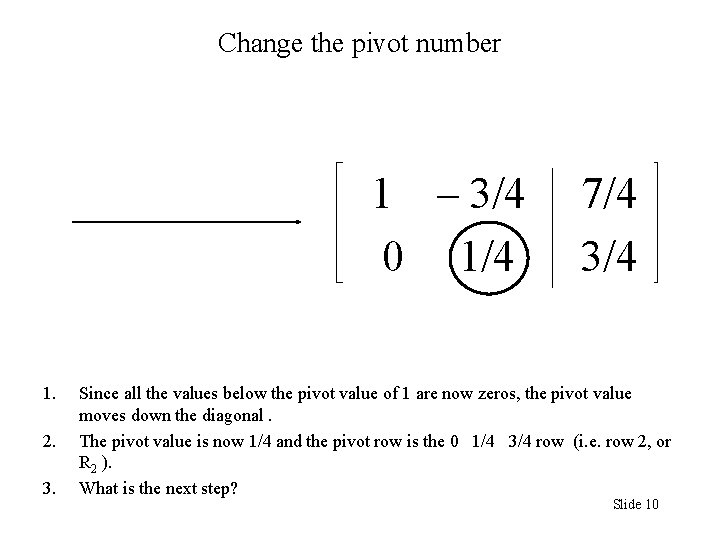
Change the pivot number 1 – 3/4 0 1/4 1. 2. 3. 7/4 3/4 Since all the values below the pivot value of 1 are now zeros, the pivot value moves down the diagonal. The pivot value is now 1/4 and the pivot row is the 0 1/4 3/4 row (i. e. row 2, or R 2 ). What is the next step? Slide 10
1. Change the pivot number to a 1 by multiplying the pivot number, and all the other numbers in the pivot row, by the reciprocal of the circled number. 2. Remember that when you change a pivot number to a 1, you use the second elementary row operation; Multiply an equation by a nonzero. 3. Thus the matrix becomes: Slide 11
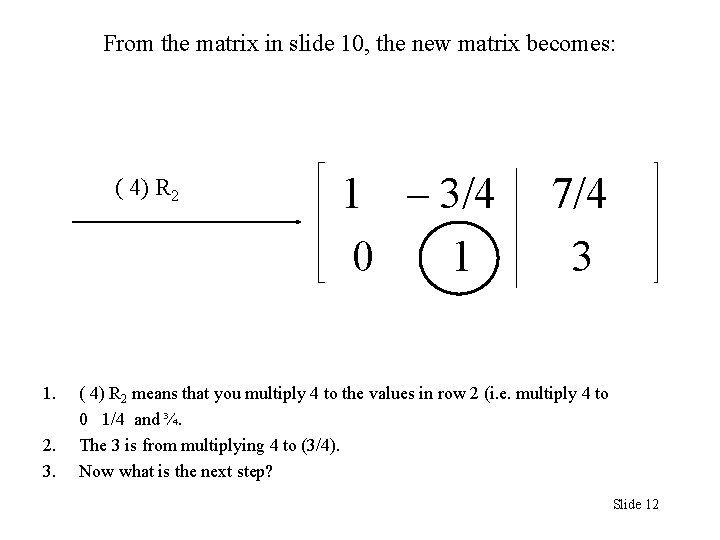
From the matrix in slide 10, the new matrix becomes: ( 4) R 2 1. 2. 3. 1 – 3/4 0 1 7/4 3 ( 4) R 2 means that you multiply 4 to the values in row 2 (i. e. multiply 4 to 0 1/4 and ¾. The 3 is from multiplying 4 to (3/4). Now what is the next step? Slide 12
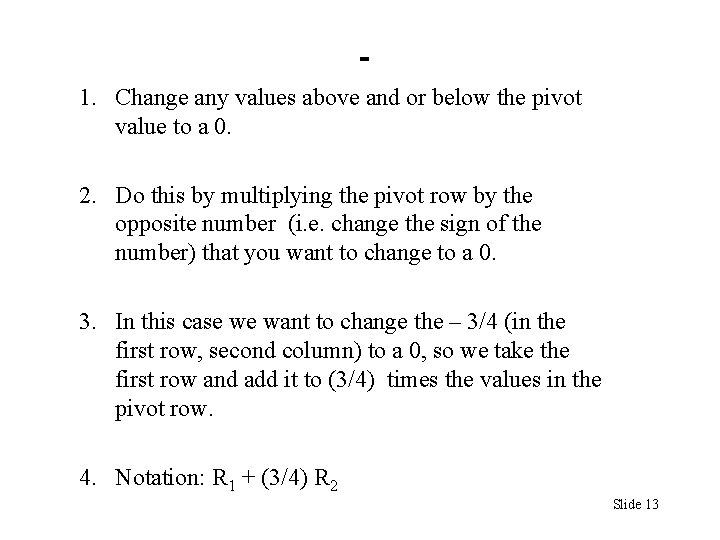
1. Change any values above and or below the pivot value to a 0. 2. Do this by multiplying the pivot row by the opposite number (i. e. change the sign of the number) that you want to change to a 0. 3. In this case we want to change the – 3/4 (in the first row, second column) to a 0, so we take the first row and add it to (3/4) times the values in the pivot row. 4. Notation: R 1 + (3/4) R 2 Slide 13
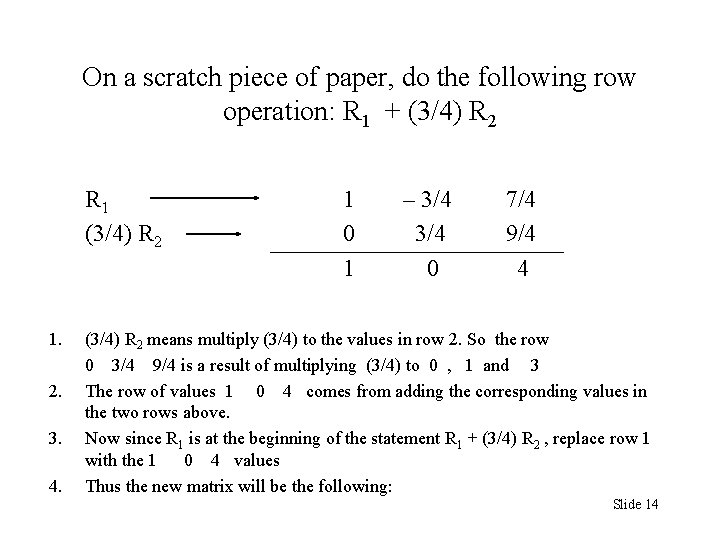
On a scratch piece of paper, do the following row operation: R 1 + (3/4) R 2 R 1 (3/4) R 2 1. 2. 3. 4. 1 0 1 – 3/4 0 7/4 9/4 4 (3/4) R 2 means multiply (3/4) to the values in row 2. So the row 0 3/4 9/4 is a result of multiplying (3/4) to 0 , 1 and 3 The row of values 1 0 4 comes from adding the corresponding values in the two rows above. Now since R 1 is at the beginning of the statement R 1 + (3/4) R 2 , replace row 1 with the 1 0 4 values Thus the new matrix will be the following: Slide 14
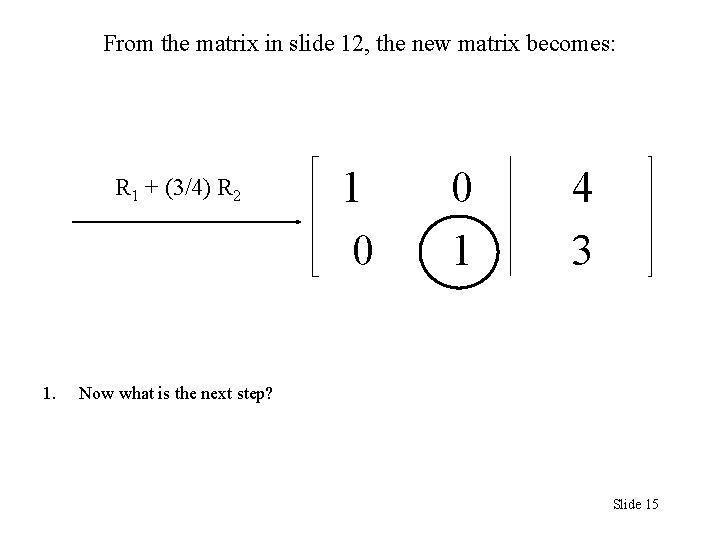
From the matrix in slide 12, the new matrix becomes: R 1 + (3/4) R 2 1. 1 0 0 1 4 3 Now what is the next step? Slide 15
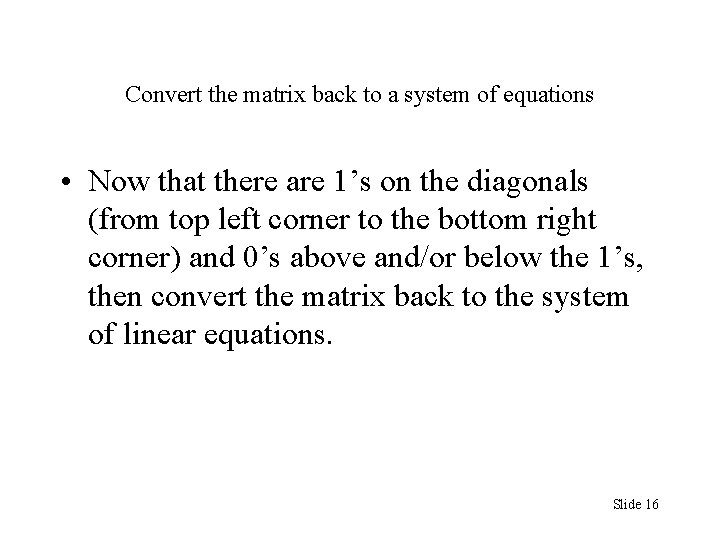
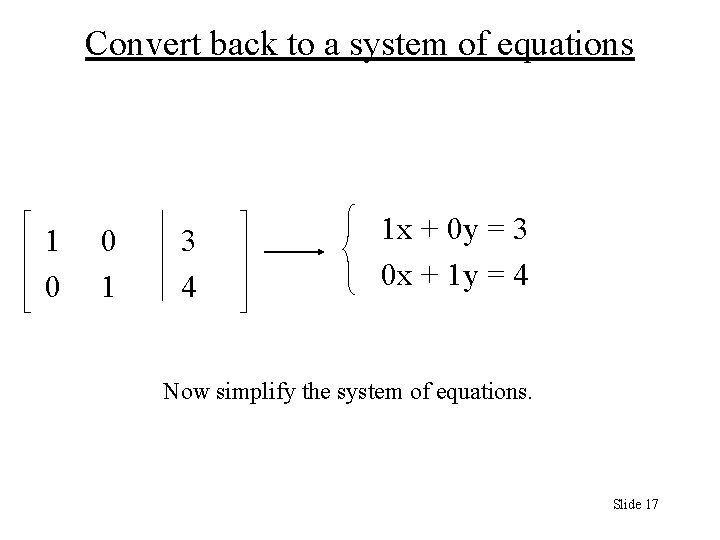
Convert the matrix back to a system of equations • Now that there are 1’s on the diagonals (from top left corner to the bottom right corner) and 0’s above and/or below the 1’s, then convert the matrix back to the system of linear equations. Slide 16
Convert back to a system of equations 1 0 0 1 3 4 1 x + 0 y = 3 0 x + 1 y = 4 Now simplify the system of equations. Slide 17
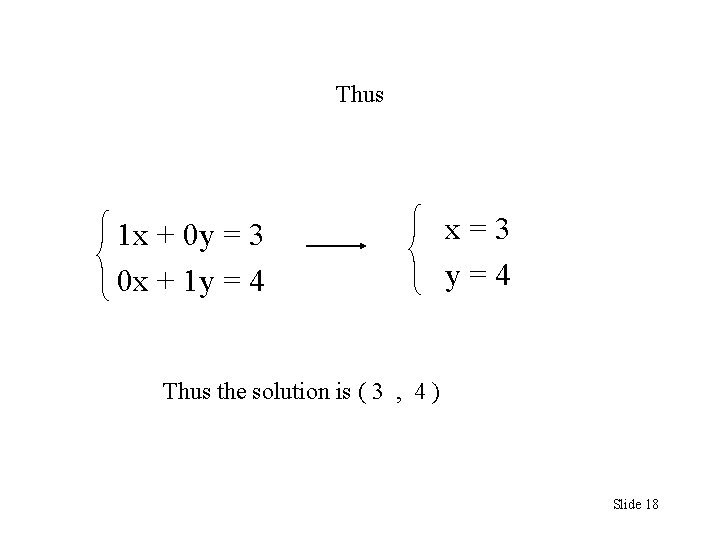
Thus 1 x + 0 y = 3 0 x + 1 y = 4 x=3 y=4 Thus the solution is ( 3 , 4 ) Slide 18