
Gauged Supergravities in Different Frames Dr Mario Trigiante

- Slides: 15
Gauged Supergravities in Different Frames Dr. Mario Trigiante (Politecnico di Torino) F. Cordaro, P. Frè, L. Gualtieri, P. Termonia, M. T. 9804056 Wit, Samtleben, M. T. 0311224; Dall’Agata, Inverso, M. T. 1209. 0760
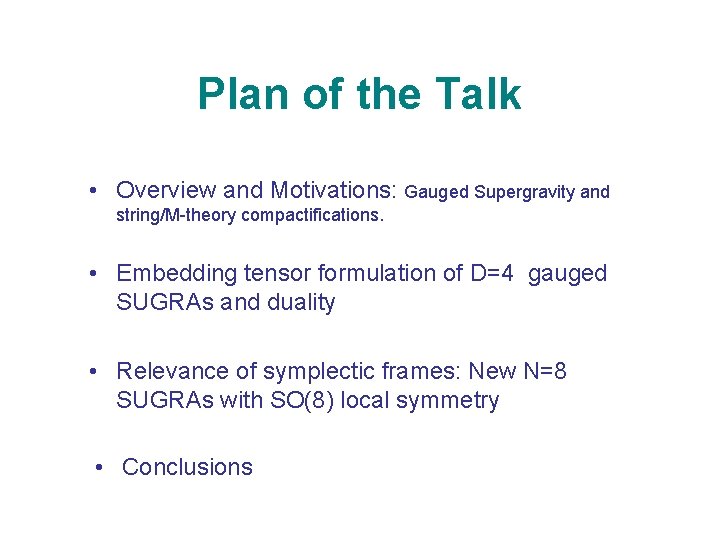
Plan of the Talk • Overview and Motivations: Gauged Supergravity and string/M-theory compactifications. • Embedding tensor formulation of D=4 gauged SUGRAs and duality • Relevance of symplectic frames: New N=8 SUGRAs with SO(8) local symmetry • Conclusions
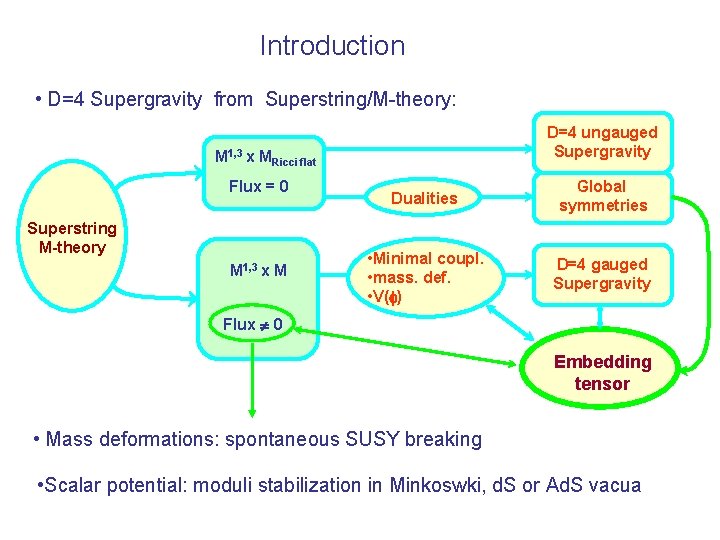
Introduction • D=4 Supergravity from Superstring/M-theory: D=4 ungauged Supergravity M 1, 3 x MRicci flat Flux = 0 Superstring M-theory M 1, 3 x M Dualities Global symmetries • Minimal coupl. • mass. def. • V(f) D=4 gauged Supergravity Flux ¹ 0 Embedding tensor • Mass deformations: spontaneous SUSY breaking • Scalar potential: moduli stabilization in Minkoswki, d. S or Ad. S vacua
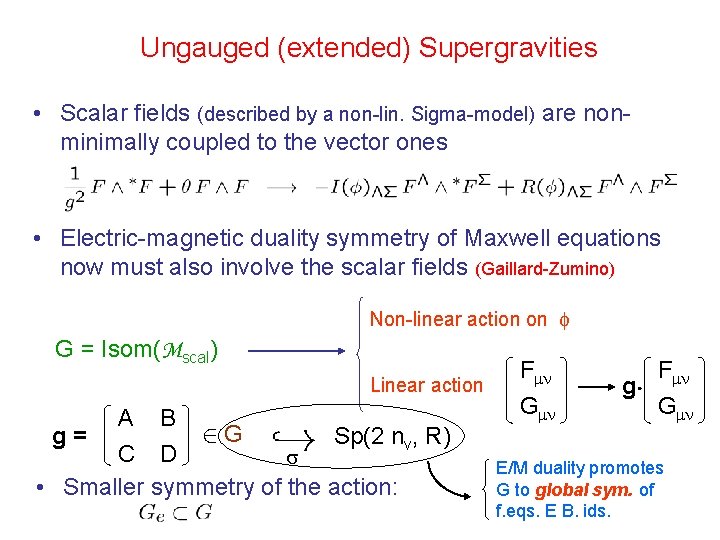
Ungauged (extended) Supergravities • Scalar fields (described by a non-lin. Sigma-model) are nonminimally coupled to the vector ones • Electric-magnetic duality symmetry of Maxwell equations now must also involve the scalar fields (Gaillard-Zumino) Non-linear action on G = Isom(Mscal) Linear action A B 2 G g= Sp(2 nv, R) C D • Smaller symmetry of the action: F G F g¢ G E/M duality promotes G to global sym. of f. eqs. E B. ids.
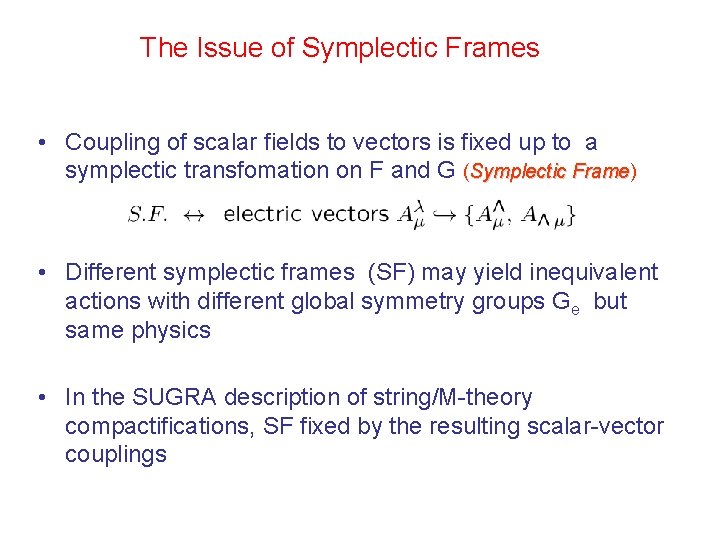
The Issue of Symplectic Frames • Coupling of scalar fields to vectors is fixed up to a symplectic transfomation on F and G (Symplectic Frame) Frame • Different symplectic frames (SF) may yield inequivalent actions with different global symmetry groups Ge but same physics • In the SUGRA description of string/M-theory compactifications, SF fixed by the resulting scalar-vector couplings
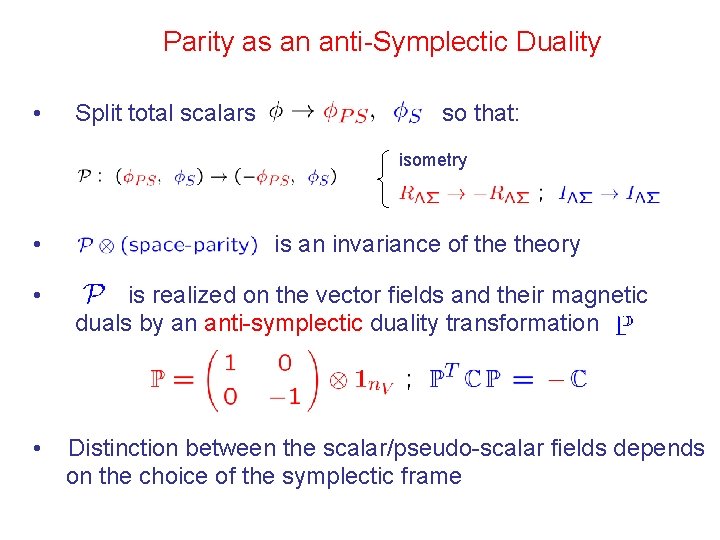
Parity as an anti-Symplectic Duality • Split total scalars so that: isometry • • • is an invariance of theory is realized on the vector fields and their magnetic duals by an anti-symplectic duality transformation Distinction between the scalar/pseudo-scalar fields depends on the choice of the symplectic frame
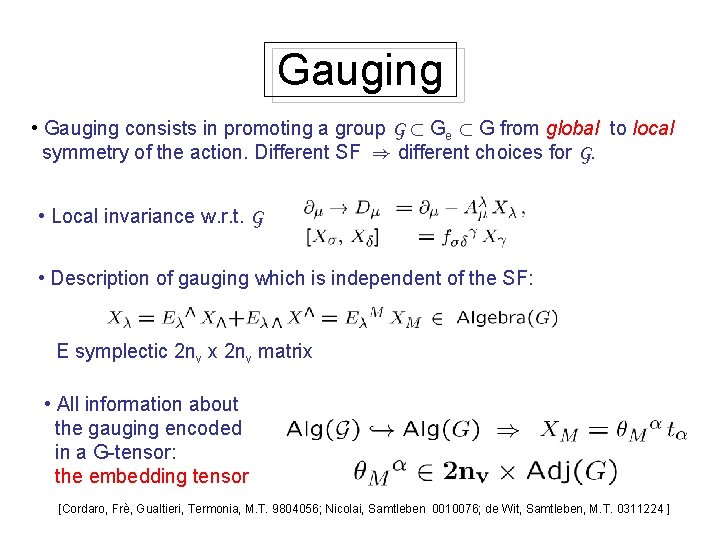
Gauging • Gauging consists in promoting a group G ½ Ge ½ G from global to local symmetry of the action. Different SF ) different choices for G. • Local invariance w. r. t. G • Description of gauging which is independent of the SF: E symplectic 2 nv x 2 nv matrix • All information about the gauging encoded in a G-tensor: the embedding tensor [Cordaro, Frè, Gualtieri, Termonia, M. T. 9804056; Nicolai, Samtleben 0010076; de Wit, Samtleben, M. T. 0311224 ]
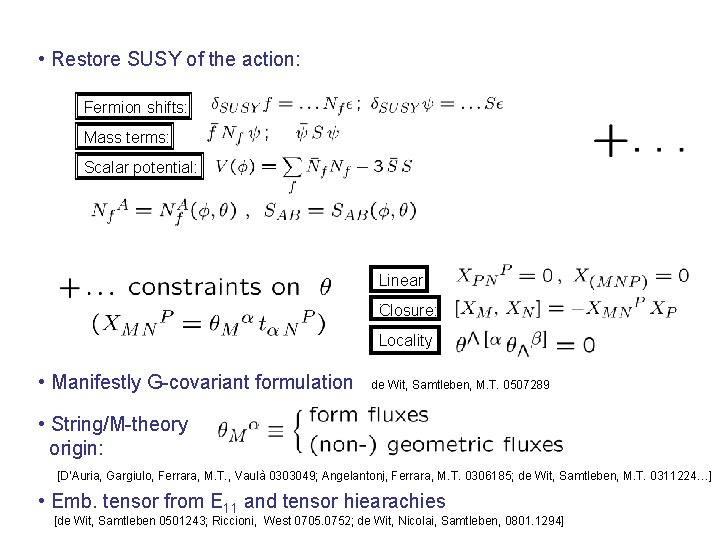
• Restore SUSY of the action: Fermion shifts: Mass terms: Scalar potential: Linear : Closure: Locality • Manifestly G-covariant formulation de Wit, Samtleben, M. T. 0507289 • String/M-theory origin: [D’Auria, Gargiulo, Ferrara, M. T. , Vaulà 0303049; Angelantonj, Ferrara, M. T. 0306185; de Wit, Samtleben, M. T. 0311224…] • Emb. tensor from E 11 and tensor hiearachies [de Wit, Samtleben 0501243; Riccioni, West 0705. 0752; de Wit, Nicolai, Samtleben, 0801. 1294]
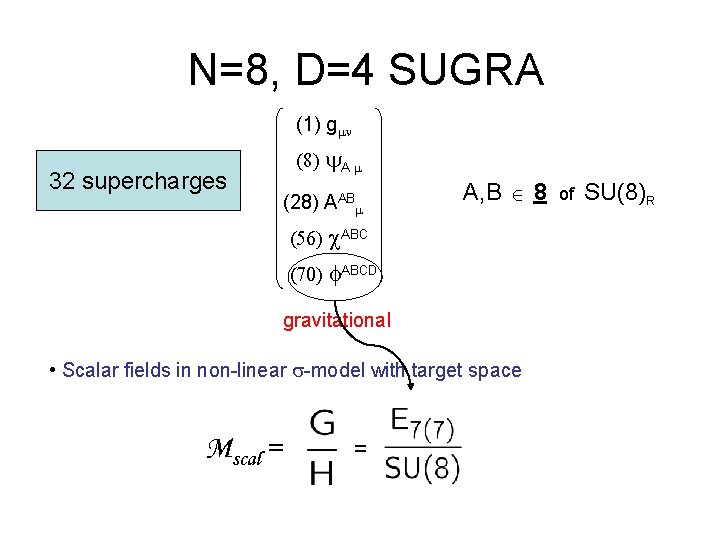
N=8, D=4 SUGRA (1) g 32 supercharges (8) A (28) AAB A, B 2 (56) ABC (70) ABCD gravitational • Scalar fields in non-linear -model with target space Mscal = = 8 of SU(8)R
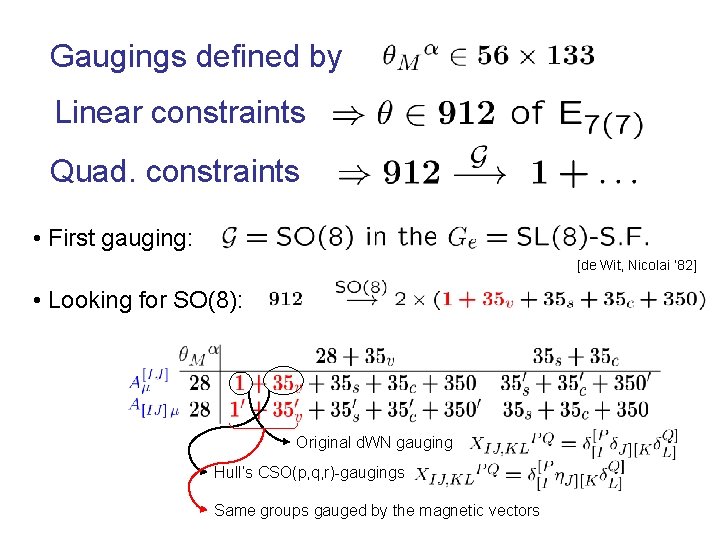
Gaugings defined by Linear constraints Quad. constraints • First gauging: [de Wit, Nicolai ’ 82] • Looking for SO(8): Original d. WN gauging Hull’s CSO(p, q, r)-gaugings Same groups gauged by the magnetic vectors
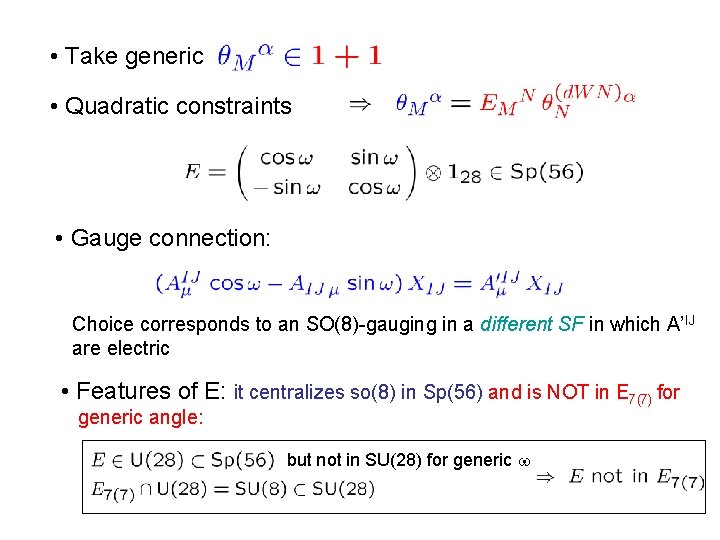
• Take generic • Quadratic constraints • Gauge connection: Choice corresponds to an SO(8)-gauging in a different SF in which A’IJ are electric • Features of E: it centralizes so(8) in Sp(56) and is NOT in E 7(7) for generic angle: but not in SU(28) for generic w
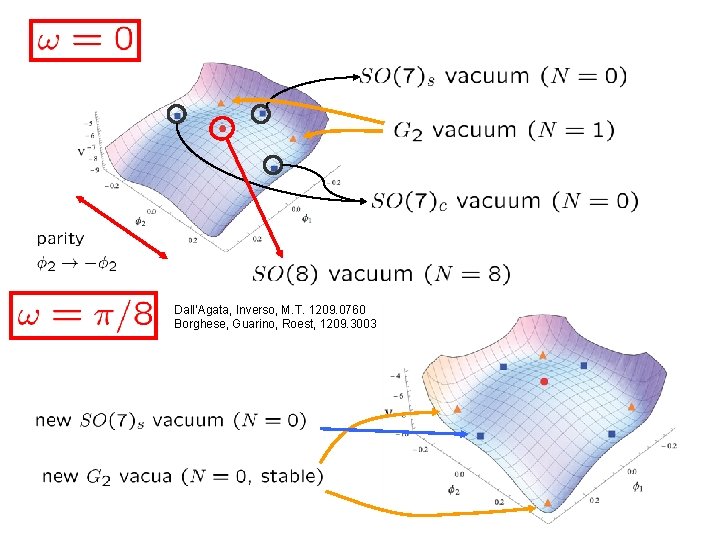
• w analogue of de Roo-Wagemann’s angle in N=4, N=2: parametrizes inequivalent theories. • Scalar potential: where and de Wit, Samtleben, M. T. 0705. 2101 • Vacua of original d. WN theory (w=0) studied by Warner and recently by Fischbacher (found several critical points, not complete yet) • Studied vacua with a G 2 residual symmetry: suffices to restrict to G 2 singlets
Dall’Agata, Inverso, M. T. 1209. 0760 Borghese, Guarino, Roest, 1209. 3003
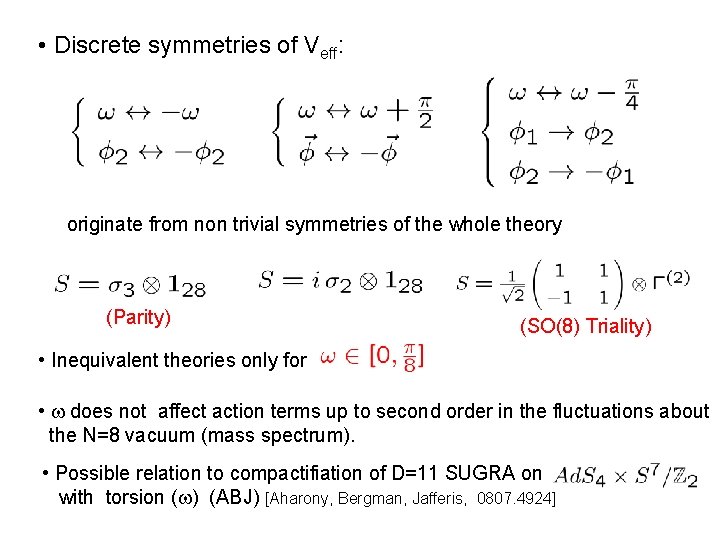
• Discrete symmetries of Veff: originate from non trivial symmetries of the whole theory (Parity) (SO(8) Triality) • Inequivalent theories only for • w does not affect action terms up to second order in the fluctuations about the N=8 vacuum (mass spectrum). • Possible relation to compactifiation of D=11 SUGRA on with torsion (w) (ABJ) [Aharony, Bergman, Jafferis, 0807. 4924]
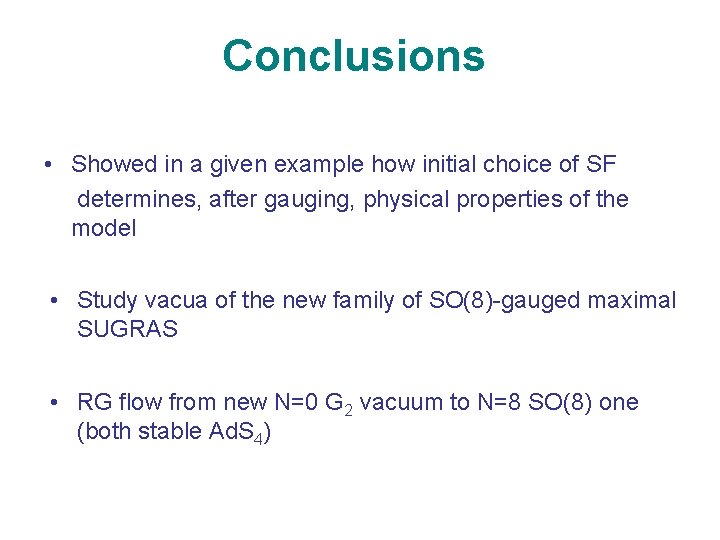
Conclusions • Showed in a given example how initial choice of SF determines, after gauging, physical properties of the model • Study vacua of the new family of SO(8)-gauged maximal SUGRAS • RG flow from new N=0 G 2 vacuum to N=8 SO(8) one (both stable Ad. S 4)