
GATING SYSTEM DESIGN 1 Principle of gating system


- Slides: 40
GATING SYSTEM DESIGN 1
Principle of gating system ü The term gating system refers to all passage ways through which the molten metal passes to enter the mold cavity. 2 ü Since the way in which liquid metal enters the mold has a decided influence upon the quality and soundness of a casting, the different passages for the molten metal are carefully designed and produced. ü A gating system should avoid sudden or right angle changes in direction. Sudden change in direction causes mold erosion, turbulence and gas pick-up.
ELEMENTS OF GATING SYSTEM The elements of gating systems are Pouring Basin Sprue Base Well Runner Ingate Riser
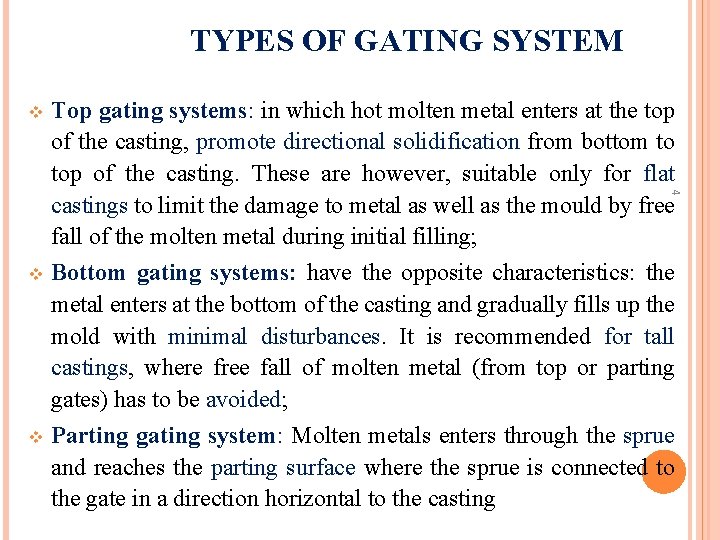
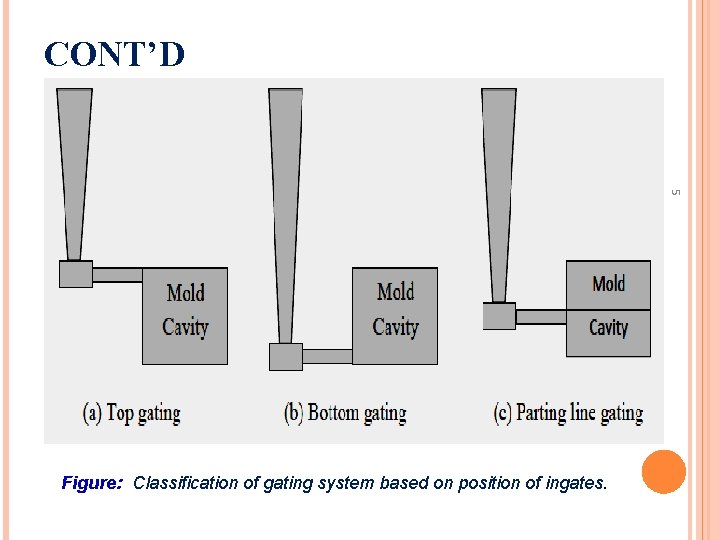
TYPES OF GATING SYSTEM v 4 Top gating systems: in which hot molten metal enters at the top of the casting, promote directional solidification from bottom to top of the casting. These are however, suitable only for flat castings to limit the damage to metal as well as the mould by free fall of the molten metal during initial filling; Bottom gating systems: have the opposite characteristics: the metal enters at the bottom of the casting and gradually fills up the mold with minimal disturbances. It is recommended for tall castings, where free fall of molten metal (from top or parting gates) has to be avoided; v Parting gating system: Molten metals enters through the sprue and reaches the parting surface where the sprue is connected to the gate in a direction horizontal to the casting v
CONT’D 5 Figure: Classification of gating system based on position of ingates.
DESIGN OF GATING SYSTEM Gating technique must be designed to take account of the weight and shape of the individual casting, the fluidity of 6 the metal and its relative susceptibility to oxidation. Although techniques vary widely according to these conditions, the basic objectives must be achieved at minimum cost in moulding and fettling time and in metal consumption.
CONTI… Any gating system designed should aim at providing a defect free casting. This can be achieved by considering following requirements. mould should be completely filled in the smallest possible time. 7 The metal should flow smoothly into the mould without any turbulence. A turbulence metal flow tends to form dross in the mould. Unwanted materials such as slag, dross and other mould materials should not be allowed to enter the mould cavity.
CONTI… The metal entry into the mould cavity should be properly controlled in such a way that aspiration of the atmospheric air is prevented. flow should be maintained in such a way that no gating or mould erosion takes place. The gating system should ensure that enough molten metal reaches the mould cavity. It should be economical and easy to implement and remove after casting solidification. 8 Metal
General Principles of Hydraulic Flow To obtain understanding of the fundamentals of metal flow in gating systems, two basic fluid flow equations are interest. The first of them is the “ Bernoulli’s Theorem”. and the second one is “Law of continuity” 9
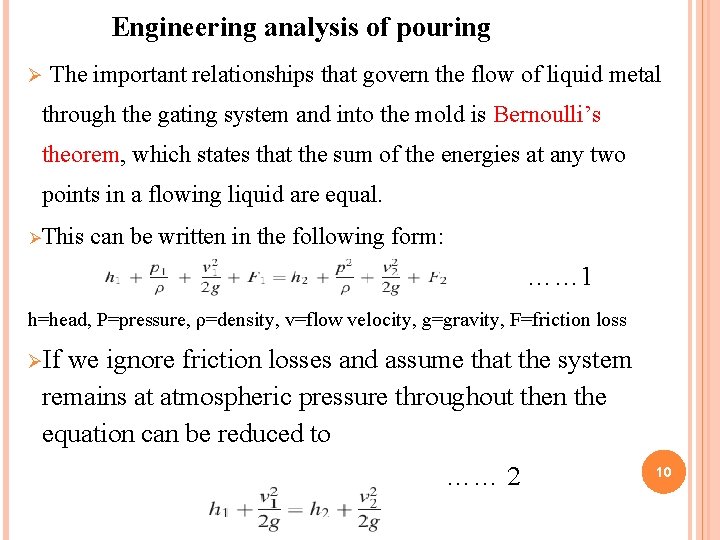
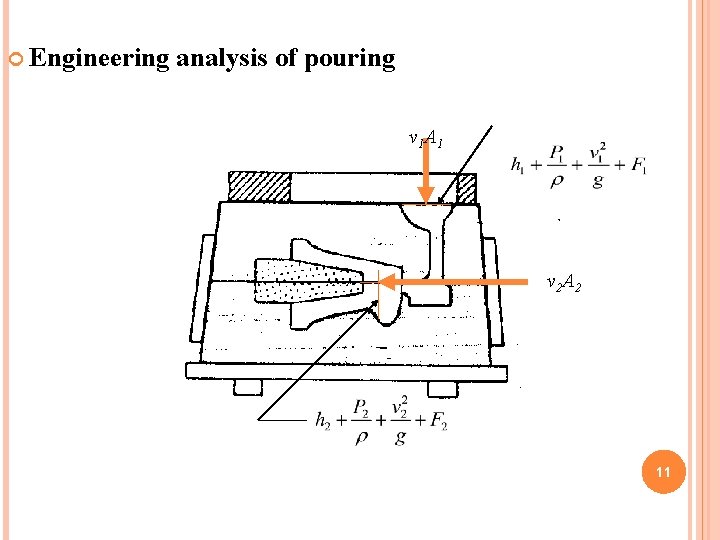
Engineering analysis of pouring Ø The important relationships that govern the flow of liquid metal through the gating system and into the mold is Bernoulli’s theorem, which states that the sum of the energies at any two points in a flowing liquid are equal. ØThis can be written in the following form: …… 1 h=head, P=pressure, ρ=density, v=flow velocity, g=gravity, F=friction loss ØIf we ignore friction losses and assume that the system remains at atmospheric pressure throughout then the equation can be reduced to …… 2 10
Engineering analysis of pouring v 1 A 1 v 2 A 2 11
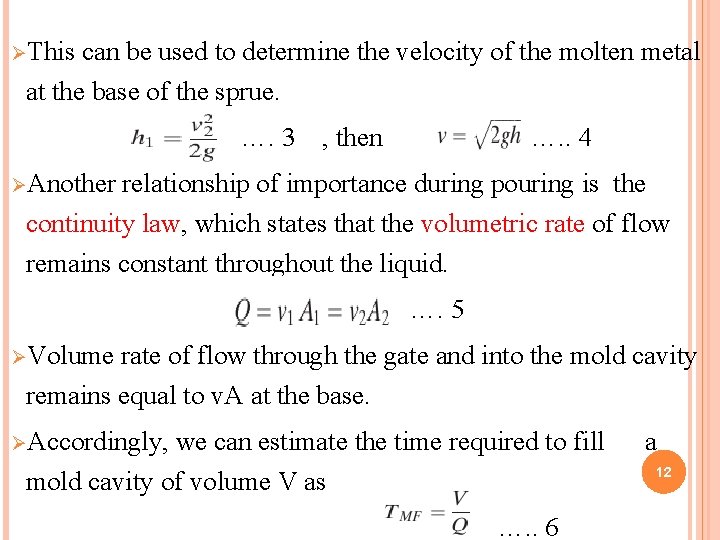
ØThis can be used to determine the velocity of the molten metal at the base of the sprue. …. 3 , then …. . 4 ØAnother relationship of importance during pouring is the continuity law, which states that the volumetric rate of flow remains constant throughout the liquid. …. 5 ØVolume rate of flow through the gate and into the mold cavity remains equal to v. A at the base. ØAccordingly, we can estimate the time required to fill mold cavity of volume V as …. . 6 a 12
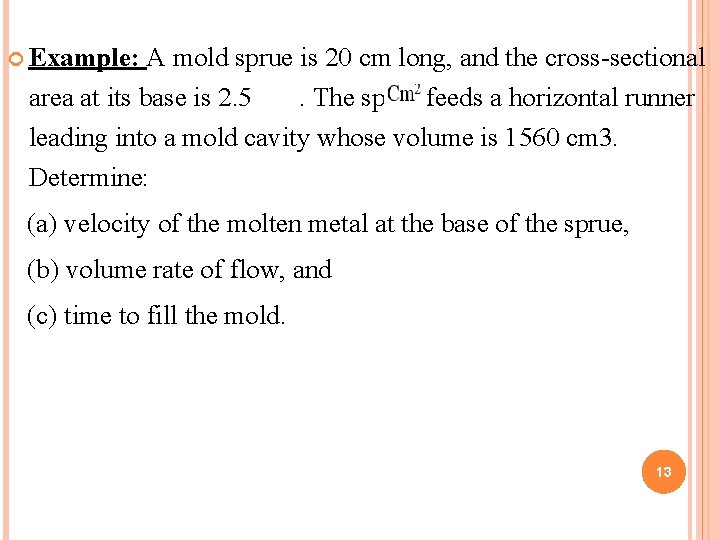
Example: A mold sprue is 20 cm long, and the cross-sectional area at its base is 2. 5. The sprue feeds a horizontal runner leading into a mold cavity whose volume is 1560 cm 3. Determine: (a) velocity of the molten metal at the base of the sprue, (b) volume rate of flow, and (c) time to fill the mold. 13
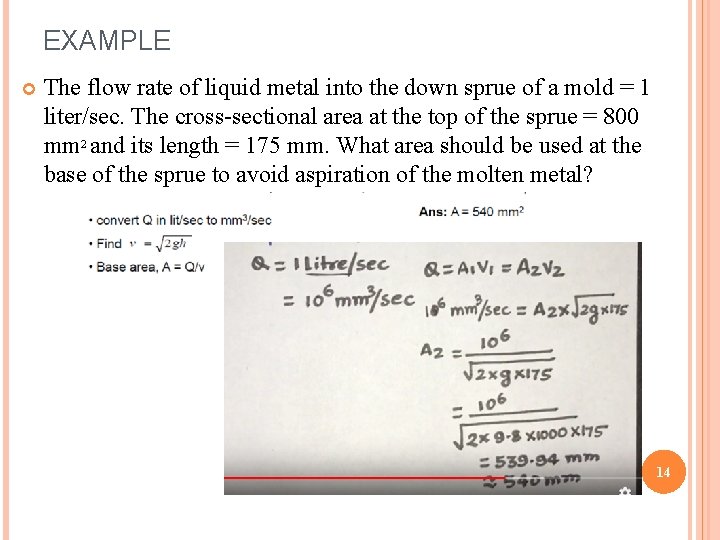
EXAMPLE The flow rate of liquid metal into the down sprue of a mold = 1 liter/sec. The cross-sectional area at the top of the sprue = 800 mm 2 and its length = 175 mm. What area should be used at the base of the sprue to avoid aspiration of the molten metal? 14
Gating System Design 1 -Pouring time 2 -Choke area 3 -Sprue 4 -Gating ratios Riser 15
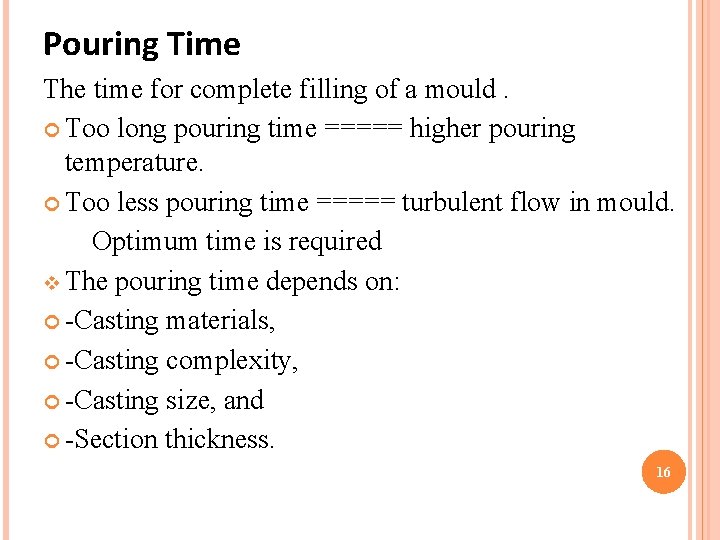
Pouring Time The time for complete filling of a mould. Too long pouring time ===== higher pouring temperature. Too less pouring time ===== turbulent flow in mould. Optimum time is required v The pouring time depends on: -Casting materials, -Casting complexity, -Casting size, and -Section thickness. 16
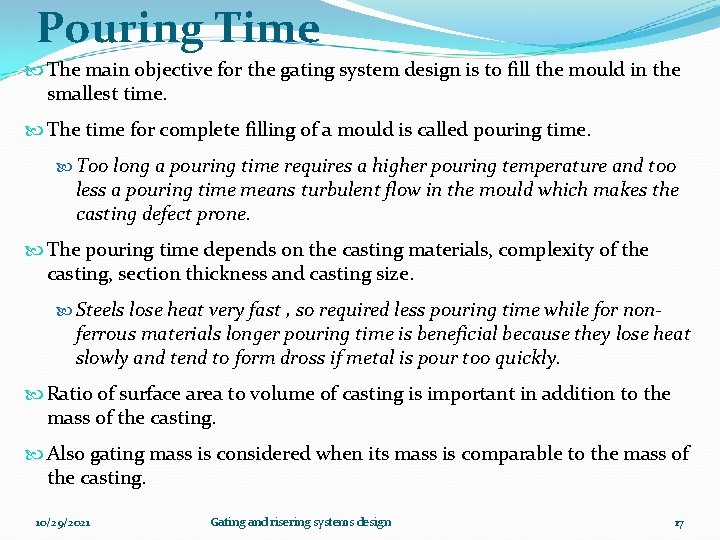
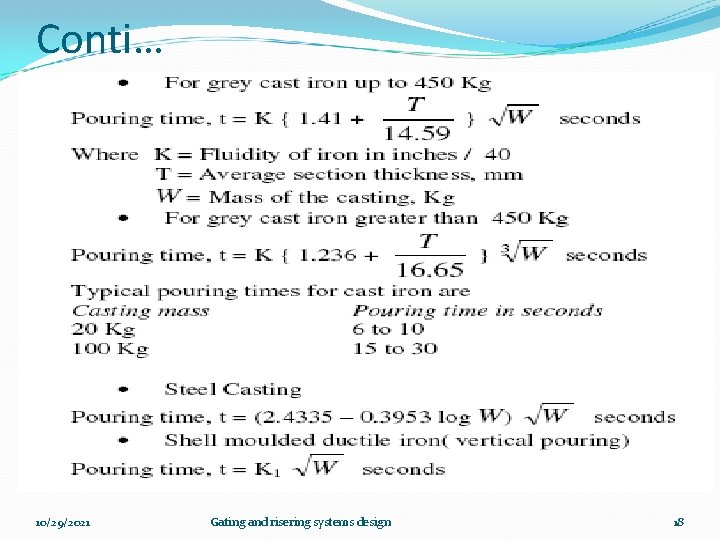
Pouring Time The main objective for the gating system design is to fill the mould in the smallest time. The time for complete filling of a mould is called pouring time. Too long a pouring time requires a higher pouring temperature and too less a pouring time means turbulent flow in the mould which makes the casting defect prone. The pouring time depends on the casting materials, complexity of the casting, section thickness and casting size. Steels lose heat very fast , so required less pouring time while for non- ferrous materials longer pouring time is beneficial because they lose heat slowly and tend to form dross if metal is pour too quickly. Ratio of surface area to volume of casting is important in addition to the mass of the casting. Also gating mass is considered when its mass is comparable to the mass of the casting. 10/29/2021 Gating and risering systems design 17
Conti… 10/29/2021 Gating and risering systems design 18
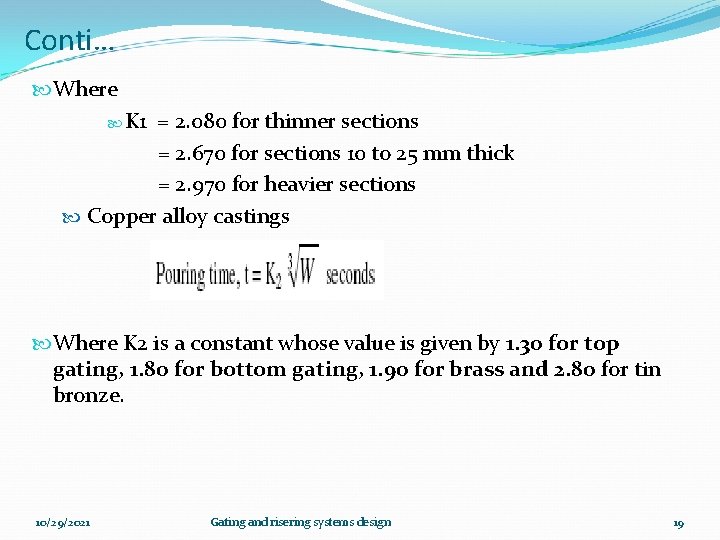
Conti… Where K 1 = 2. 080 for thinner sections = 2. 670 for sections 10 to 25 mm thick = 2. 970 for heavier sections Copper alloy castings Where K 2 is a constant whose value is given by 1. 30 for top gating, 1. 80 for bottom gating, 1. 90 for brass and 2. 80 for tin bronze. 10/29/2021 Gating and risering systems design 19
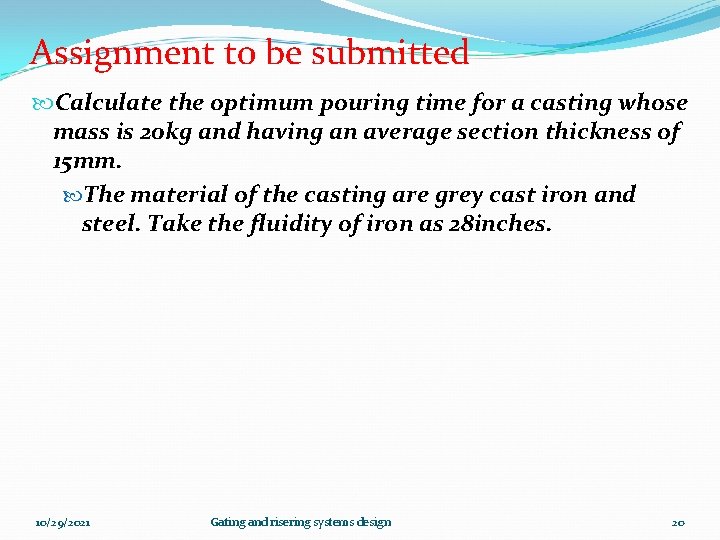
Assignment to be submitted Calculate the optimum pouring time for a casting whose mass is 20 kg and having an average section thickness of 15 mm. The material of the casting are grey cast iron and steel. Take the fluidity of iron as 28 inches. 10/29/2021 Gating and risering systems design 20
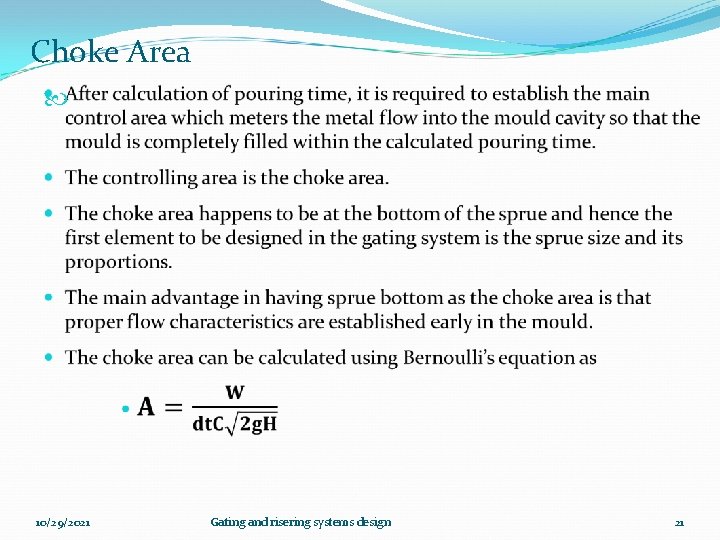
Choke Area 10/29/2021 Gating and risering systems design 21
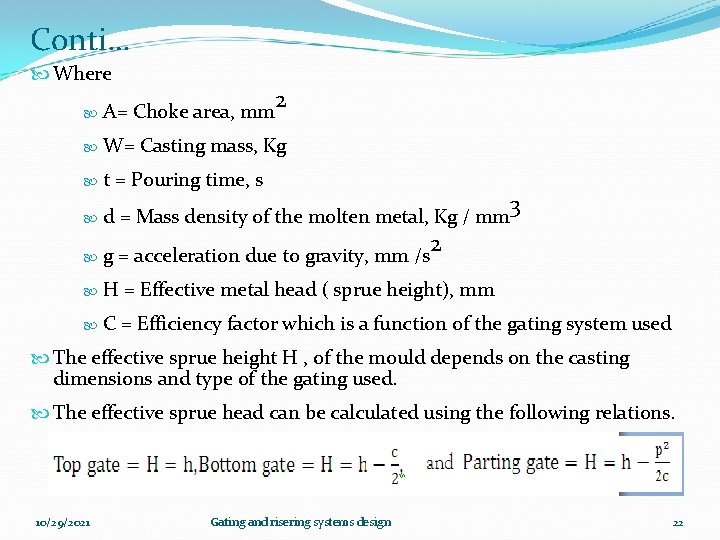
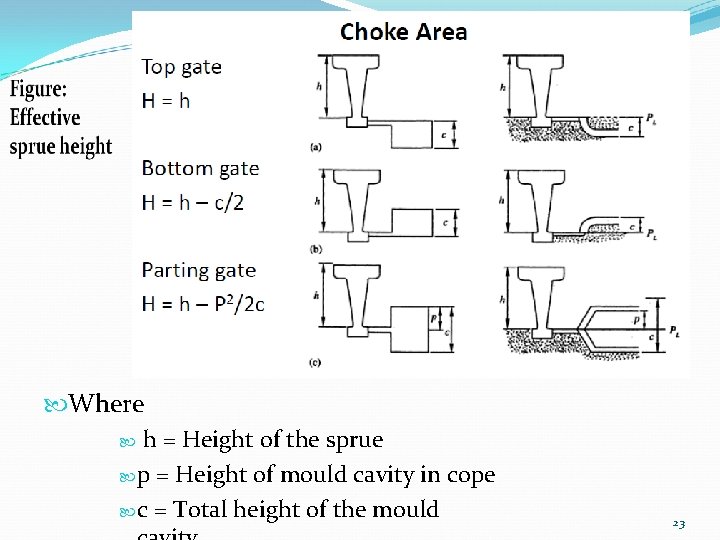
Conti… Where 2 A= Choke area, mm W= Casting mass, Kg t = Pouring time, s d = Mass density of the molten metal, Kg / mm g = acceleration due to gravity, mm /s H = Effective metal head ( sprue height), mm C = Efficiency factor which is a function of the gating system used 3 2 The effective sprue height H , of the mould depends on the casting dimensions and type of the gating used. The effective sprue head can be calculated using the following relations. 10/29/2021 Gating and risering systems design 22
Where h = Height of the sprue p = Height of mould cavity in cope c = Total height of the mould 23
Conti… The efficiency coefficient of the gating system depends on the various sections that are normally used in a gating system. The elements of a gating system should be circular in cross section Since They have lower surface area to volume ratio which would reduce heat loss and have less friction. Moreover, Streamlining the various gating elements would greatly increase volumetric efficiency of the gating system and Allow for smaller size gates and runners which would increase the casting yield. Whenever a runner changes direction or joins with another runner or gate, There is some loss in the metal head, all of which when taken properly into consideration would give the overall efficiency of the gating system. 10/29/2021 Gating and risering systems design 24
Average values of the efficiency factor are provided for typical gating systems in table below which may be used for calculating the gating. 10/29/2021 Gating and risering systems design 25
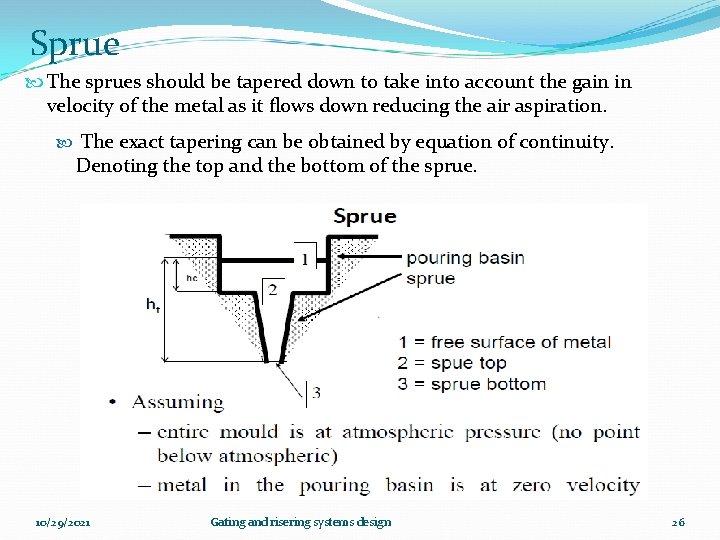
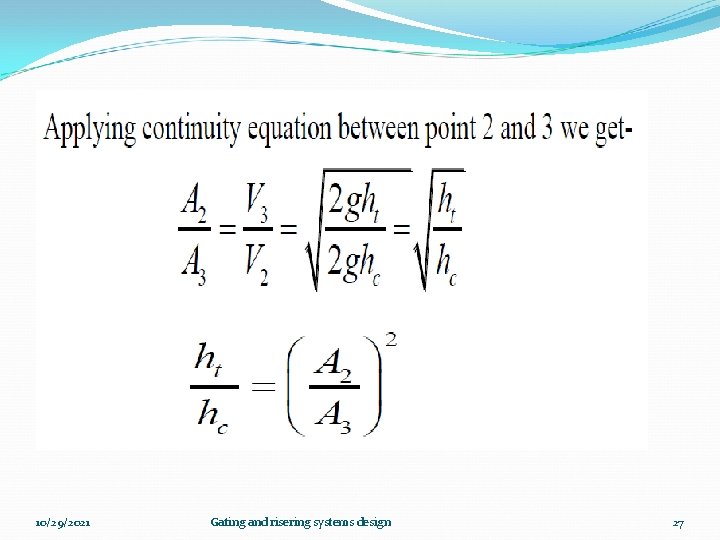
Sprue The sprues should be tapered down to take into account the gain in velocity of the metal as it flows down reducing the air aspiration. The exact tapering can be obtained by equation of continuity. Denoting the top and the bottom of the sprue. 10/29/2021 Gating and risering systems design 26
10/29/2021 Gating and risering systems design 27
Example A down sprue of 180 mm length has a diameter of 20 mm at its top end. The liquid metal in pouring cup is maintained up to 60 mm height. What should be the diameter of the down sprue at its lower end to avoid aspiration? 10/29/2021 Gating and risering systems design 28
Gating Ratios Gating ratio refers to the proportion of the cross sectional areas between the sprue, runner and ingates and is generally denoted as sprue area : runner area : ingate area. Depending on the choke area there can be two types of gating systems: Non-pressurized Pressurized A non –pressurized gating system having choke at the sprue base, has total runner area and ingate area higher than the sprue area. In this system there is no pressure existing in the metal flow system and thus it helps to reduce turbulence. This is particularly useful for casting drossy alloys such as aluminum alloys and magnesium alloys. These have tapered sprues, sprue base wells, and pouring basins. 10/29/2021 Gating and risering systems design 29
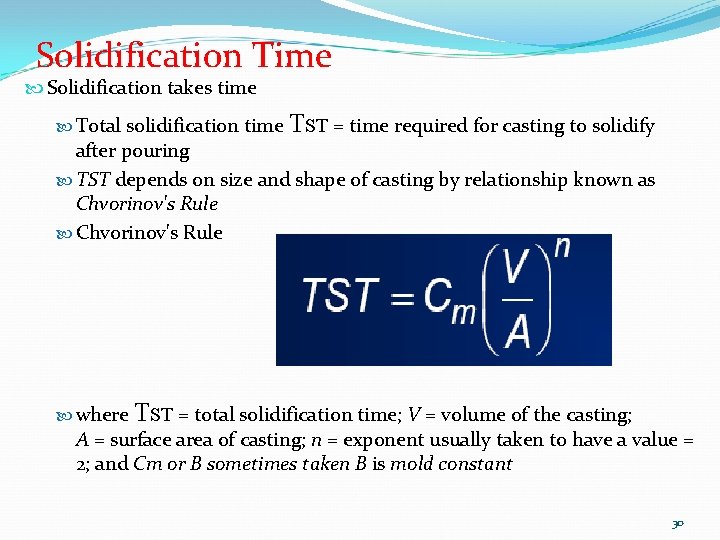
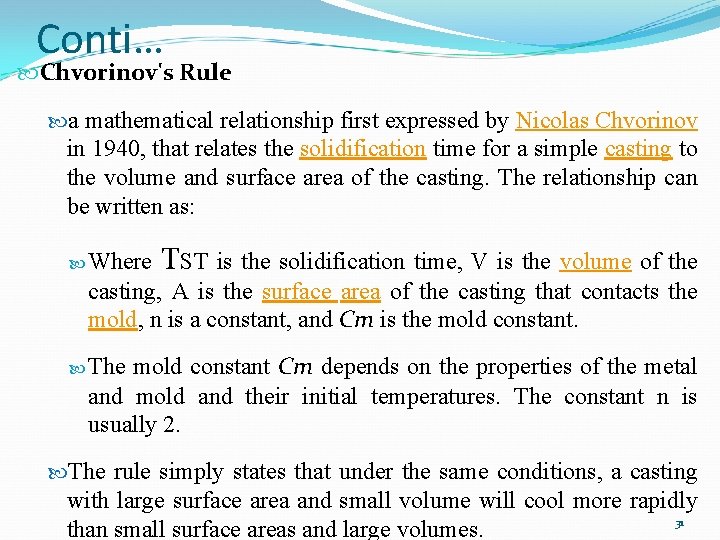
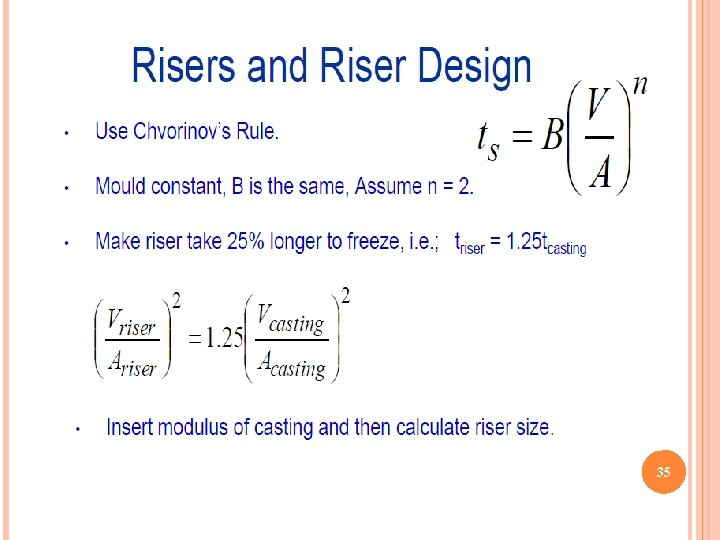
Solidification Time Solidification takes time Total solidification time TST = time required for casting to solidify after pouring TST depends on size and shape of casting by relationship known as Chvorinov's Rule where TST = total solidification time; V = volume of the casting; A = surface area of casting; n = exponent usually taken to have a value = 2; and Cm or B sometimes taken B is mold constant 30
Conti… Chvorinov's Rule a mathematical relationship first expressed by Nicolas Chvorinov in 1940, that relates the solidification time for a simple casting to the volume and surface area of the casting. The relationship can be written as: Where TST is the solidification time, V is the volume of the casting, A is the surface area of the casting that contacts the mold, n is a constant, and Cm is the mold constant Cm depends on the properties of the metal and mold and their initial temperatures. The constant n is usually 2. The rule simply states that under the same conditions, a casting with large surface area and small volume will cool more rapidly 31 than small surface areas and large volumes.
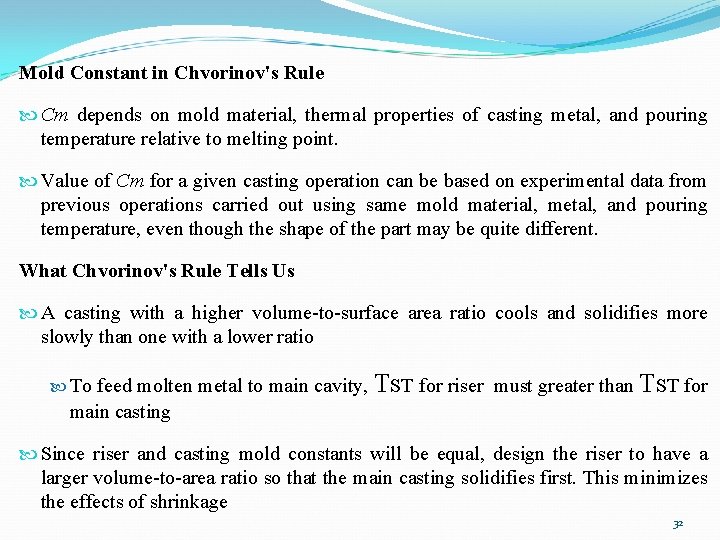
Mold Constant in Chvorinov's Rule Cm depends on mold material, thermal properties of casting metal, and pouring temperature relative to melting point. Value of Cm for a given casting operation can be based on experimental data from previous operations carried out using same mold material, metal, and pouring temperature, even though the shape of the part may be quite different. What Chvorinov's Rule Tells Us A casting with a higher volume-to-surface area ratio cools and solidifies more slowly than one with a lower ratio To feed molten metal to main cavity, TST for riser must greater than TST for main casting Since riser and casting mold constants will be equal, design the riser to have a larger volume-to-area ratio so that the main casting solidifies first. This minimizes the effects of shrinkage 32
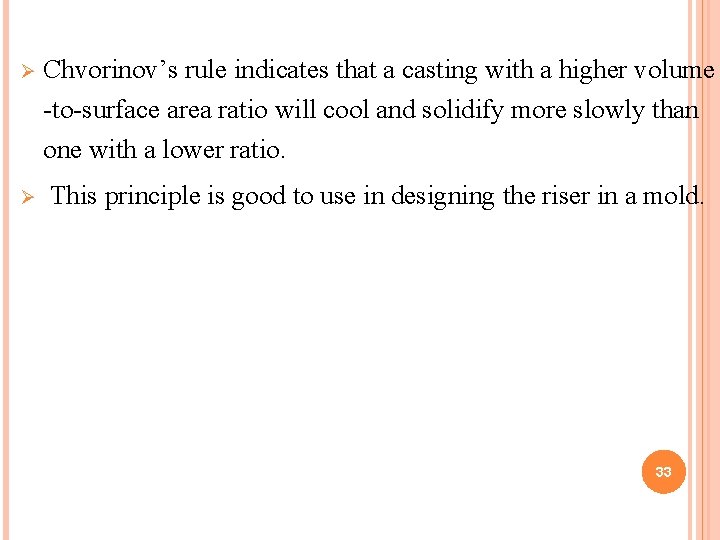
Ø Chvorinov’s rule indicates that a casting with a higher volume -to-surface area ratio will cool and solidify more slowly than one with a lower ratio. Ø This principle is good to use in designing the riser in a mold. 33
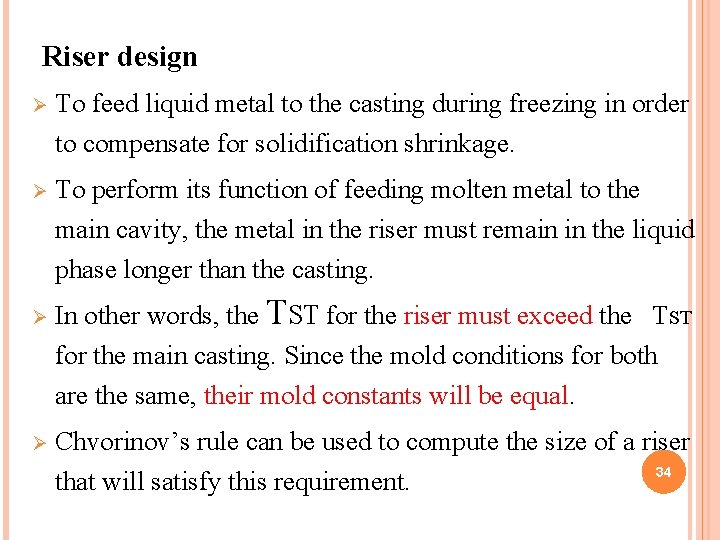
Riser design Ø To feed liquid metal to the casting during freezing in order to compensate for solidification shrinkage. Ø To perform its function of feeding molten metal to the main cavity, the metal in the riser must remain in the liquid phase longer than the casting. Ø Ø In other words, the TST for the riser must exceed the TST for the main casting. Since the mold conditions for both are the same, their mold constants will be equal. Chvorinov’s rule can be used to compute the size of a riser 34 that will satisfy this requirement.
35
36
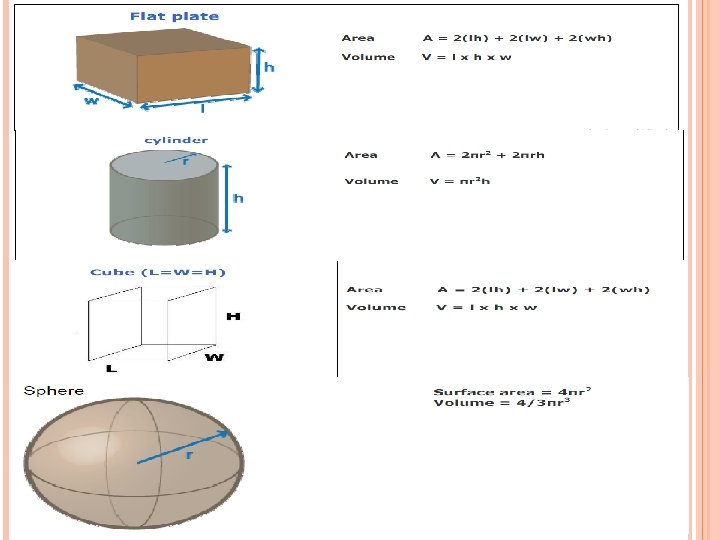
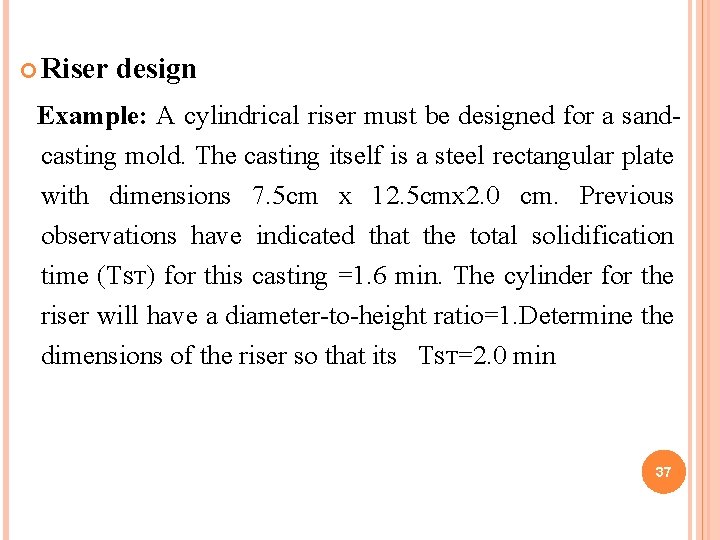
Riser design Example: A cylindrical riser must be designed for a sandcasting mold. The casting itself is a steel rectangular plate with dimensions 7. 5 cm x 12. 5 cmx 2. 0 cm. Previous observations have indicated that the total solidification time (TST) for this casting =1. 6 min. The cylinder for the riser will have a diameter-to-height ratio=1. Determine the dimensions of the riser so that its TST=2. 0 min 37
FLOW CHARACTERISTICS Turbulent flow Laminar flow Defined by the Reynolds number, Re 38
Reynold's Number Nature of flow in the gating system can be established by calculating Reynold's number Re = VD ρ /η RN = Reynold's number; V = Mean Velocity of flow; D = Diameter of tubular flow; η = Kinematics Viscosity/ Dynamic Viscosity; ρ = Fluid density. v Re is usually between 2000 and 20000. 39
Cont’d Laminar Less than Re = 2, 000 Turbulent More than Re = 20, 000 Mixture Re is between 2, 000 – 20, 000 Generally Ok for gating Excess turbulence causes: Inclusion of dross or slag; Air aspiration into the mold; Erosion of the mold walls. 40