
Gateway Initiated DualStack lite draftgundavellisoftwiregatewayinitdslite01 Authors Frank Brockners
Gateway Initiated Dual-Stack lite (draft-gundavelli-softwire-gateway-init-ds-lite-01) Authors Frank Brockners (fbrockne@cisco. com), Sri Gundavelli (sgundave@cisco. com)
Gateway-initiated Dual-Stack lite Objectives • IPv 4 -exhaust / IPv 6 transition solution for carriers that desire to continue to deliver IPv 4 services (and leverage NAT 44) – which use a tunnel-based access architecture (e. g. Mobile w/ MIP/PMIP, GTP; Broadband w/ PPP, Point-to-Point VLAN) – IPv 4 core & Private-IPv 4 -Exhaust/Overlapping-IPv 4/Non-Meaningful-IPv 4 – IPv 6 core & minimal IPv 4 support in SP infrastructure • Additional Requirements – No changes to End-System/Host/Handset (continue to support installed base) – Minimal changes to existing access architectures – IPv 4 and/or IPv 6 SP transport networks support
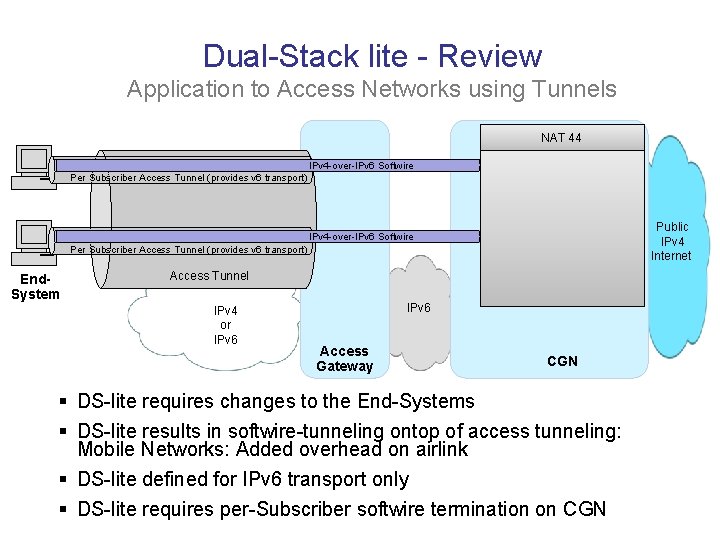
Dual-Stack lite - Review Application to Access Networks using Tunnels NAT 44 IPv 4 -over-IPv 6 Softwire Per Subscriber Access Tunnel (provides v 6 transport) Public IPv 4 Internet IPv 4 -over-IPv 6 Softwire Per Subscriber Access Tunnel (provides v 6 transport) End. System Access Tunnel IPv 4 or IPv 6 Access Gateway CGN § DS-lite requires changes to the End-Systems § DS-lite results in softwire-tunneling ontop of access tunneling: Mobile Networks: Added overhead on airlink § DS-lite defined for IPv 6 transport only § DS-lite requires per-Subscriber softwire termination on CGN
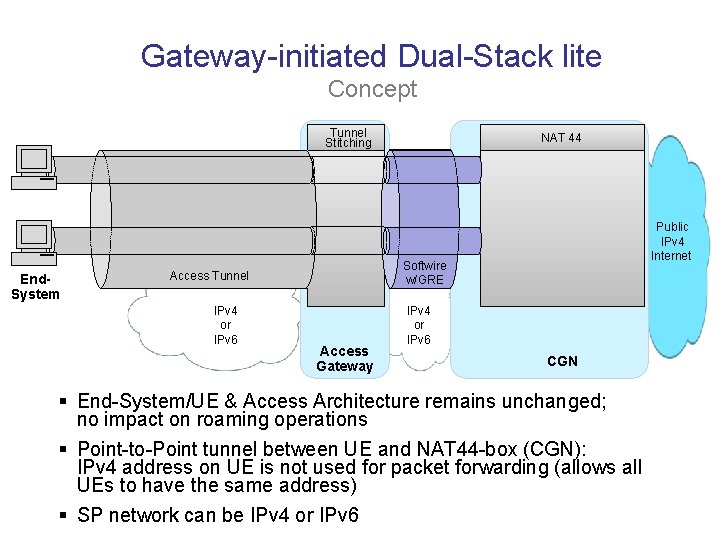
Gateway-initiated Dual-Stack lite Concept Tunnel Stitching End. System Public IPv 4 Internet Softwire w/GRE Access Tunnel IPv 4 or IPv 6 NAT 44 Access Gateway IPv 4 or IPv 6 CGN § End-System/UE & Access Architecture remains unchanged; no impact on roaming operations § Point-to-Point tunnel between UE and NAT 44 -box (CGN): IPv 4 address on UE is not used for packet forwarding (allows all UEs to have the same address) § SP network can be IPv 4 or IPv 6
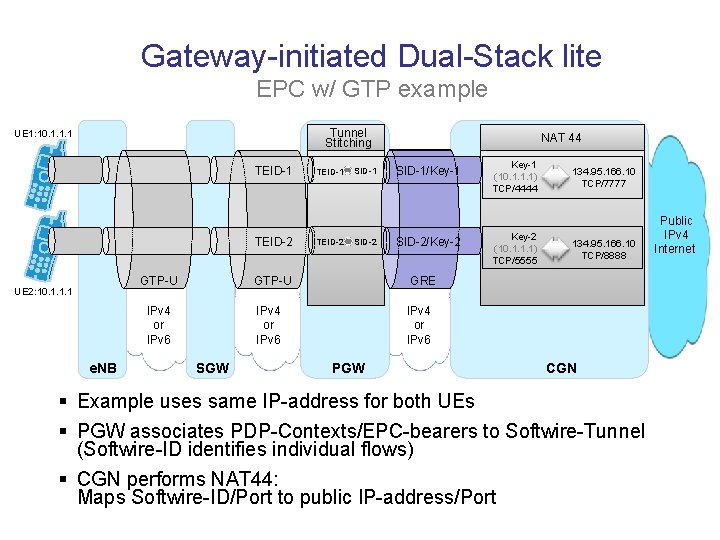
Gateway-initiated Dual-Stack lite EPC w/ GTP example Tunnel Stitching UE 1: 10. 1. 1. 1 TEID-2 GTP-U UE 2: 10. 1. 1. 1 IPv 4 or IPv 6 e. NB SGW TEID-1 TEID-2 SID-1 SID-2 NAT 44 SID-1/Key-1 SID-2/Key-2 GTP-U GRE IPv 4 or IPv 6 PGW Key-1 (10. 1. 1. 1) TCP/4444 Key-2 (10. 1. 1. 1) TCP/5555 134. 95. 166. 10 TCP/7777 134. 95. 166. 10 TCP/8888 CGN § Example uses same IP-address for both UEs § PGW associates PDP-Contexts/EPC-bearers to Softwire-Tunnel (Softwire-ID identifies individual flows) § CGN performs NAT 44: Maps Softwire-ID/Port to public IP-address/Port Public IPv 4 Internet
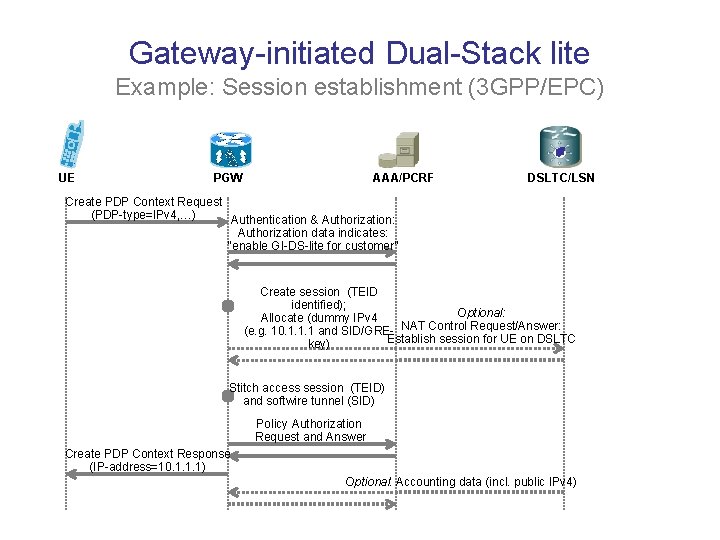
Gateway-initiated Dual-Stack lite Example: Session establishment (3 GPP/EPC) UE PGW AAA/PCRF DSLTC/LSN Create PDP Context Request (PDP-type=IPv 4, …) Authentication & Authorization: Authorization data indicates: “enable GI-DS-lite for customer” Create session (TEID identified); Optional: Allocate (dummy IPv 4 NAT Control Request/Answer: (e. g. 10. 1. 1. 1 and SID/GREEstablish session for UE on DSLTC key) Stitch access session (TEID) and softwire tunnel (SID) Policy Authorization Request and Answer Create PDP Context Response (IP-address=10. 1. 1. 1) Optional: Accounting data (incl. public IPv 4)
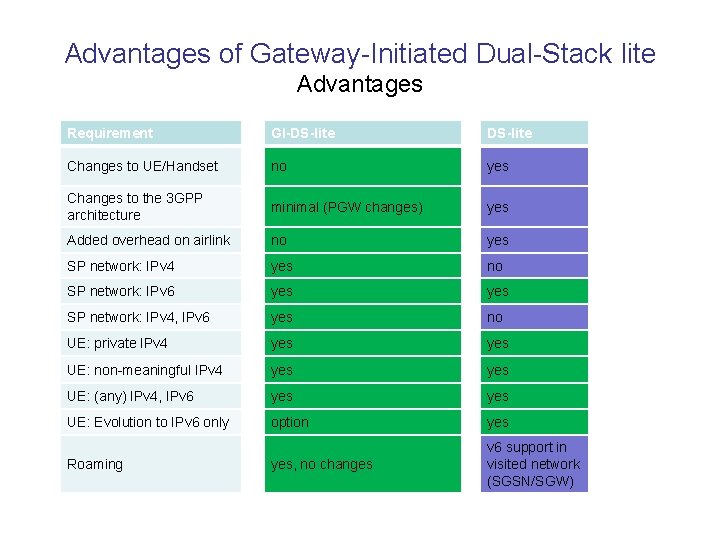
Advantages of Gateway-Initiated Dual-Stack lite Advantages Requirement GI-DS-lite Changes to UE/Handset no yes Changes to the 3 GPP architecture minimal (PGW changes) yes Added overhead on airlink no yes SP network: IPv 4 yes no SP network: IPv 6 yes SP network: IPv 4, IPv 6 yes no UE: private IPv 4 yes UE: non-meaningful IPv 4 yes UE: (any) IPv 4, IPv 6 yes UE: Evolution to IPv 6 only option yes, no changes v 6 support in visited network (SGSN/SGW) Roaming
Next Steps • Authors appreciate feedback from the WG • Adopt as WG document?
- Slides: 8