
Gate Logic TwoLevel Simplification Design Example Two Bit

Gate Logic: Two-Level Simplification Design Example: Two Bit Comparator Introduction Block Diagram and Truth Table A 4 -Variable K-map for each of the 3 output functions 2 -1
Gate Logic: Two-Level Simplification Design Example: Two Bit Comparator Introduction F 1 = F 2 = F 3 = 2 -2
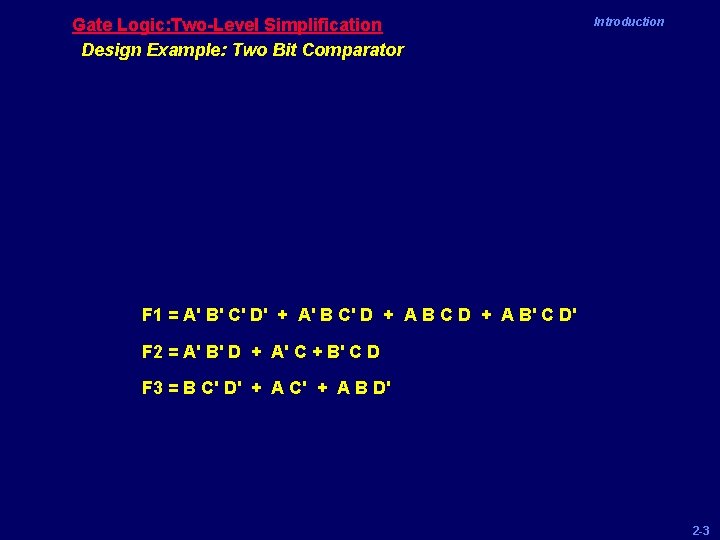
Gate Logic: Two-Level Simplification Design Example: Two Bit Comparator Introduction F 1 = A' B' C' D' + A' B C' D + A B C D + A B' C D' F 2 = A' B' D + A' C + B' C D F 3 = B C' D' + A C' + A B D' 2 -3
Gate Logic: Two-Level Simplification Introduction Design Example: Two Bit Adder Block Diagram and Truth Table A 4 -variable K-map for each of the 3 output functions 2 -4
Gate Logic: Two-Level Simplification Design Example (Continued) Introduction X= Z= Y= 2 -5
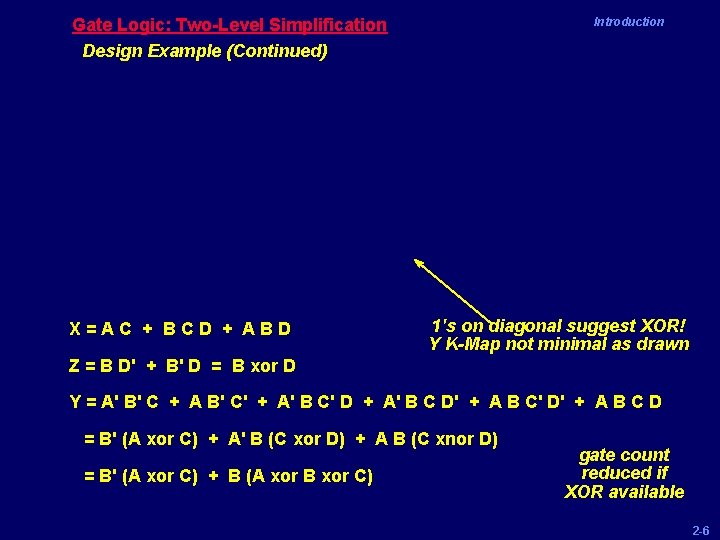
Gate Logic: Two-Level Simplification Design Example (Continued) X=AC + BCD + ABD Introduction 1's on diagonal suggest XOR! Y K-Map not minimal as drawn Z = B D' + B' D = B xor D Y = A' B' C + A B' C' + A' B C' D + A' B C D' + A B C' D' + A B C D = B' (A xor C) + A' B (C xor D) + A B (C xnor D) = B' (A xor C) + B (A xor B xor C) gate count reduced if XOR available 2 -6
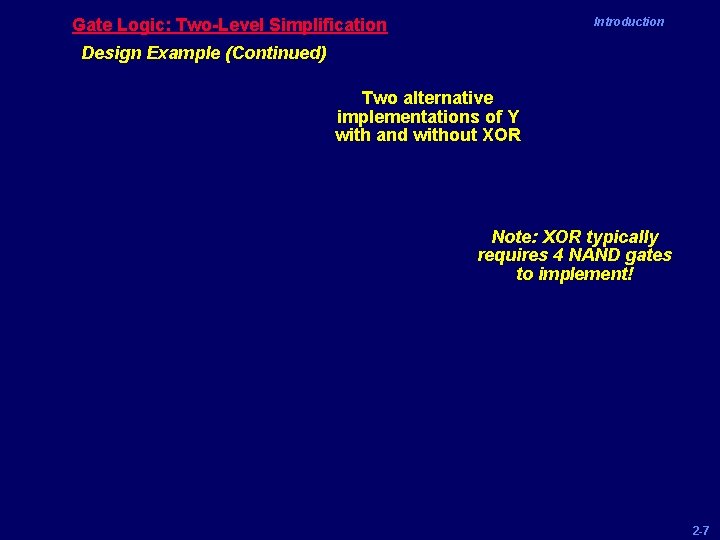
Gate Logic: Two-Level Simplification Introduction Design Example (Continued) Two alternative implementations of Y with and without XOR Note: XOR typically requires 4 NAND gates to implement! 2 -7
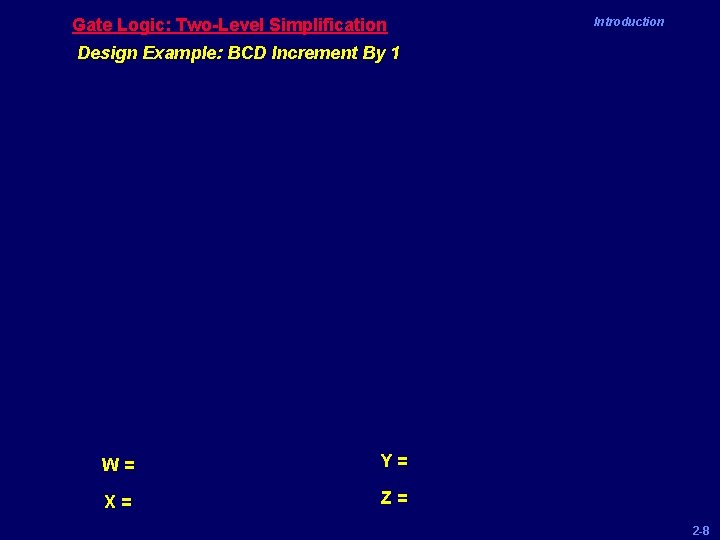
Gate Logic: Two-Level Simplification Introduction Design Example: BCD Increment By 1 W= Y= X= Z= 2 -8
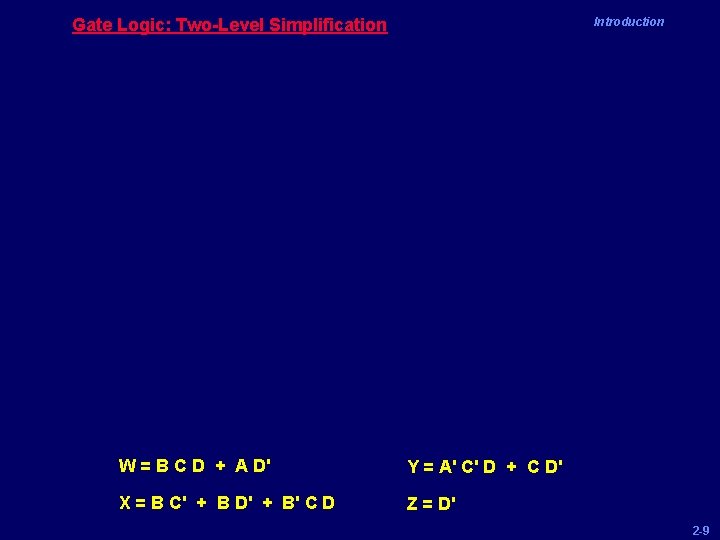
Gate Logic: Two-Level Simplification Introduction W = B C D + A D' Y = A' C' D + C D' X = B C' + B D' + B' C D Z = D' 2 -9

Gate Logic: Two Level Simplification Definition of Terms Introduction implicant: single element of the ON-set or any group of elements that can be combined together in a K-map prime implicant: implicant that cannot be combined with another implicant to eliminate a term essential prime implicant: if an element of the ON-set is covered by a single prime implicant, it is an essential prime Objective: grow implicants into prime implicants cover the ON-set with as few prime implicants as possible essential primes participate in ALL possible covers 2 -10
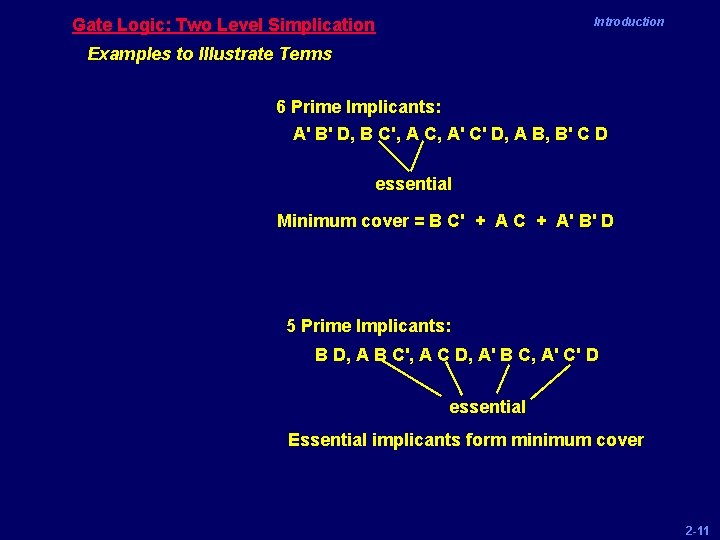
Gate Logic: Two Level Simplication Introduction Examples to Illustrate Terms 6 Prime Implicants: A' B' D, B C', A C, A' C' D, A B, B' C D essential Minimum cover = B C' + A C + A' B' D 5 Prime Implicants: B D, A B C', A C D, A' B C, A' C' D essential Essential implicants form minimum cover 2 -11
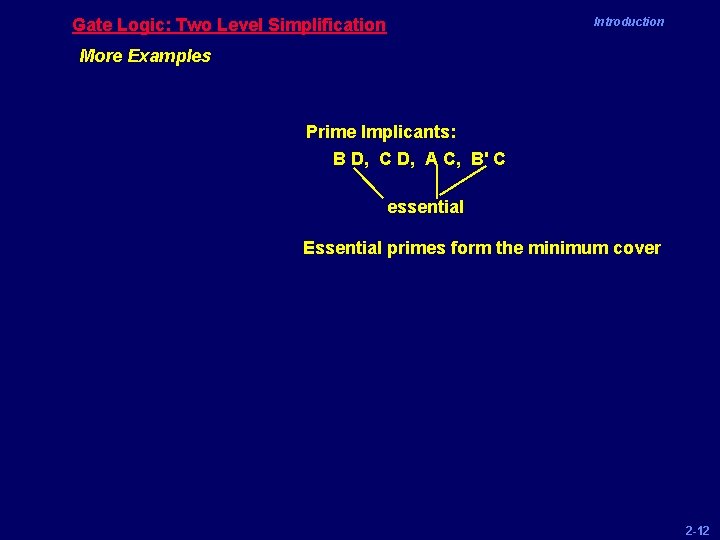
Gate Logic: Two Level Simplification Introduction More Examples Prime Implicants: B D, C D, A C, B' C essential Essential primes form the minimum cover 2 -12
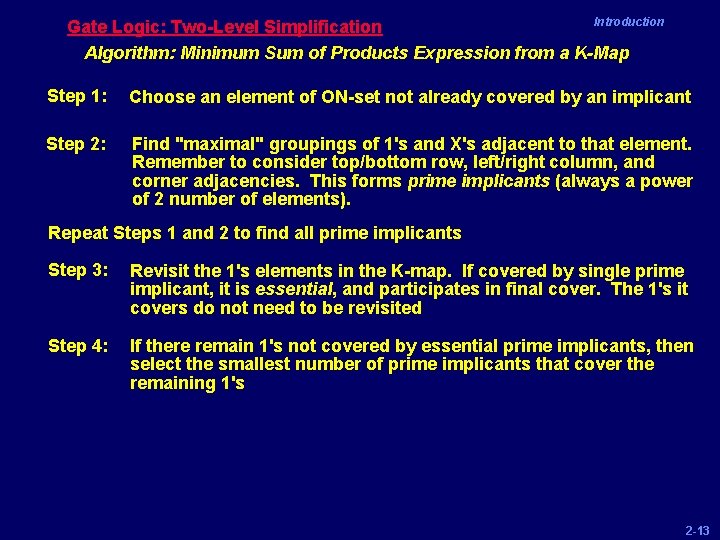
Introduction Gate Logic: Two-Level Simplification Algorithm: Minimum Sum of Products Expression from a K-Map Step 1: Choose an element of ON-set not already covered by an implicant Step 2: Find "maximal" groupings of 1's and X's adjacent to that element. Remember to consider top/bottom row, left/right column, and corner adjacencies. This forms prime implicants (always a power of 2 number of elements). Repeat Steps 1 and 2 to find all prime implicants Step 3: Revisit the 1's elements in the K-map. If covered by single prime implicant, it is essential, and participates in final cover. The 1's it covers do not need to be revisited Step 4: If there remain 1's not covered by essential prime implicants, then select the smallest number of prime implicants that cover the remaining 1's 2 -13
Gate Logic: Two Level Simplification Introduction Example: F(A, B, C, D) = Sm(4, 5, 6, 8, 9, 10, 13) + d(0, 7, 15) Initial K-map 2 -14
Gate Logic: Two Level Simplification Introduction Example: F(A, B, C, D) = Sm(4, 5, 6, 8, 9, 10, 13) + d(0, 7, 15) Initial K-map Primes around A' B C' D' 2 -15
Gate Logic: Two Level Simplification Introduction Example: F(A, B, C, D) = Sm(4, 5, 6, 8, 9, 10, 13) + d(0, 7, 15) Initial K-map Primes around A' B C' D' Primes around A B C' D 2 -16
Gate Logic: Two-Level Simplification Example Continued Introduction Primes around A B' C' D 2 -17

Gate Logic: Two-Level Simplification Example Continued Primes around A B' C' D Introduction Primes around A B' C' D' 2 -18
Gate Logic: Two-Level Simplification Example Continued Primes around A B' C' D' Introduction Essential Primes with Min Cover 2 -19
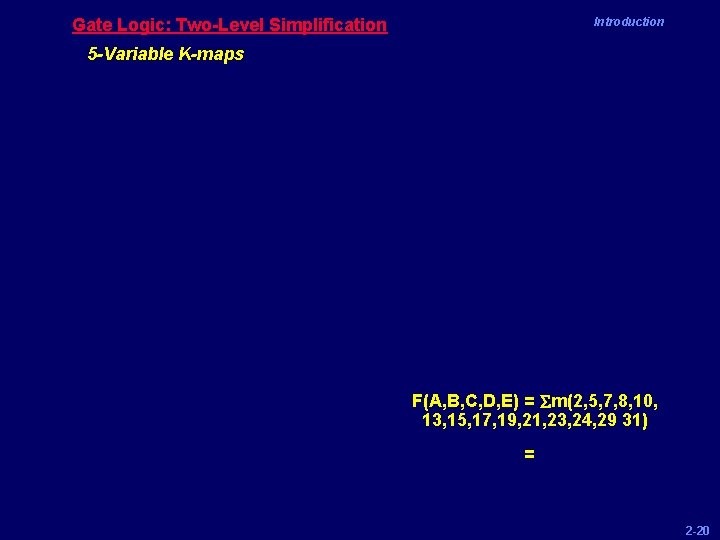
Gate Logic: Two-Level Simplification Introduction 5 -Variable K-maps F(A, B, C, D, E) = Sm(2, 5, 7, 8, 10, 13, 15, 17, 19, 21, 23, 24, 29 31) = 2 -20
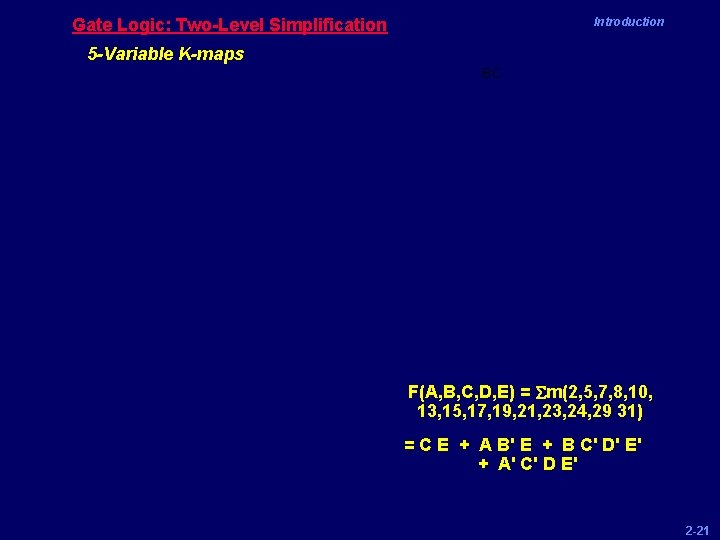
Gate Logic: Two-Level Simplification Introduction 5 -Variable K-maps BC F(A, B, C, D, E) = Sm(2, 5, 7, 8, 10, 13, 15, 17, 19, 21, 23, 24, 29 31) = C E + A B' E + B C' D' E' + A' C' D E' 2 -21
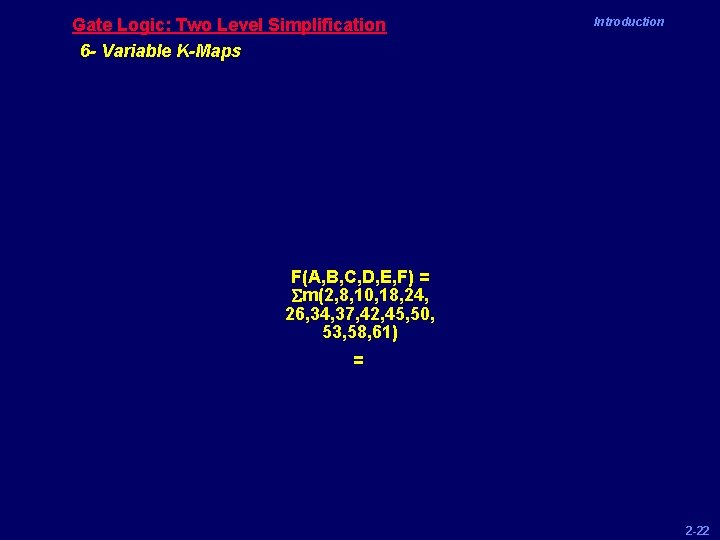
Gate Logic: Two Level Simplification 6 - Variable K-Maps Introduction F(A, B, C, D, E, F) = Sm(2, 8, 10, 18, 24, 26, 34, 37, 42, 45, 50, 53, 58, 61) = 2 -22
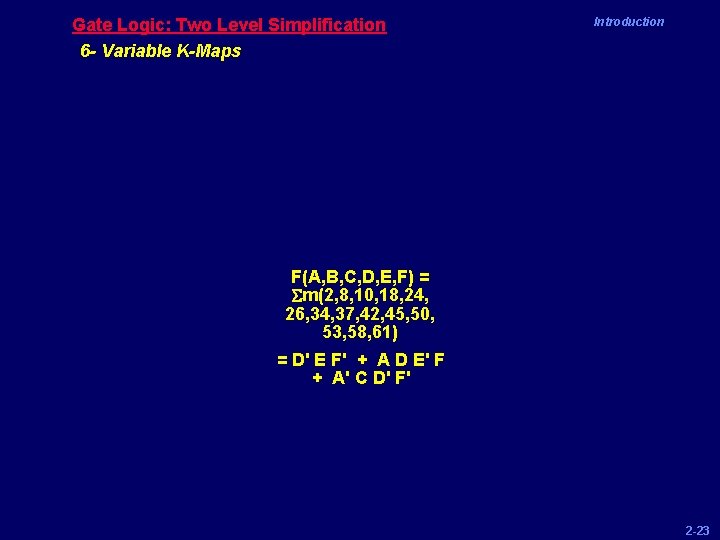
Gate Logic: Two Level Simplification 6 - Variable K-Maps Introduction F(A, B, C, D, E, F) = Sm(2, 8, 10, 18, 24, 26, 34, 37, 42, 45, 50, 53, 58, 61) = D' E F' + A D E' F + A' C D' F' 2 -23
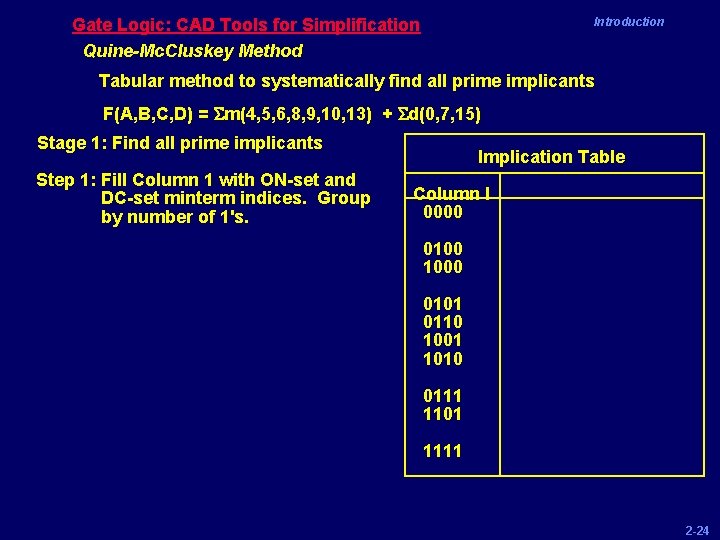
Gate Logic: CAD Tools for Simplification Quine-Mc. Cluskey Method Introduction Tabular method to systematically find all prime implicants F(A, B, C, D) = Sm(4, 5, 6, 8, 9, 10, 13) + Sd(0, 7, 15) Stage 1: Find all prime implicants Step 1: Fill Column 1 with ON-set and DC-set minterm indices. Group by number of 1's. Implication Table Column I 0000 0100 1000 0101 0110 1001 1010 0111 1101 1111 2 -24
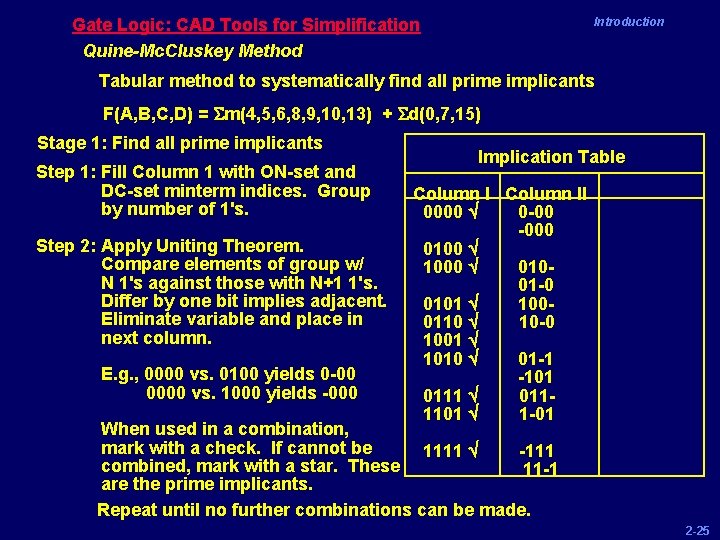
Gate Logic: CAD Tools for Simplification Quine-Mc. Cluskey Method Introduction Tabular method to systematically find all prime implicants F(A, B, C, D) = Sm(4, 5, 6, 8, 9, 10, 13) + Sd(0, 7, 15) Stage 1: Find all prime implicants Step 1: Fill Column 1 with ON-set and DC-set minterm indices. Group by number of 1's. Step 2: Apply Uniting Theorem. Compare elements of group w/ N 1's against those with N+1 1's. Differ by one bit implies adjacent. Eliminate variable and place in next column. E. g. , 0000 vs. 0100 yields 0 -00 0000 vs. 1000 yields -000 Implication Table Column II 0000 Ö 0 -00 -000 0100 Ö 1000 Ö 01001 -0 0101 Ö 1000110 Ö 10 -0 1001 Ö 1010 Ö 01 -1 -101 0111 Ö 0111101 Ö 1 -01 When used in a combination, mark with a check. If cannot be 1111 Ö -111 combined, mark with a star. These 11 -1 are the prime implicants. Repeat until no further combinations can be made. 2 -25
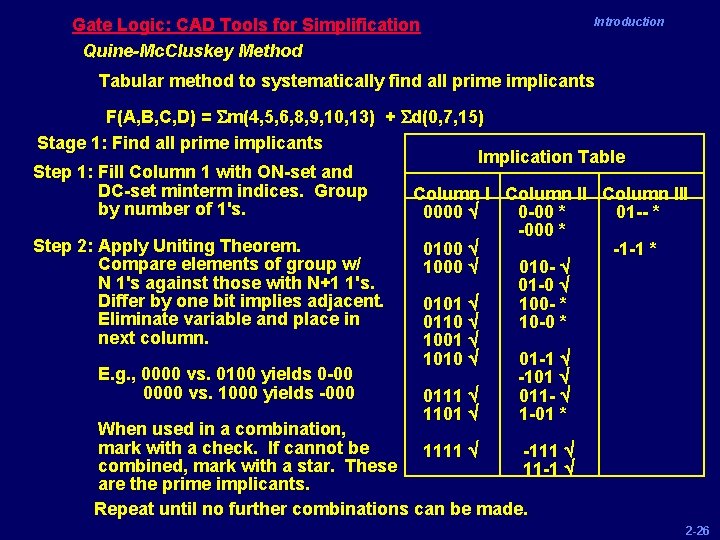
Gate Logic: CAD Tools for Simplification Quine-Mc. Cluskey Method Introduction Tabular method to systematically find all prime implicants F(A, B, C, D) = Sm(4, 5, 6, 8, 9, 10, 13) + Sd(0, 7, 15) Stage 1: Find all prime implicants Implication Table Step 1: Fill Column 1 with ON-set and DC-set minterm indices. Group Column III by number of 1's. 0000 Ö 0 -00 * 01 -- * -000 * Step 2: Apply Uniting Theorem. 0100 Ö -1 -1 * Compare elements of group w/ 1000 Ö 010 - Ö N 1's against those with N+1 1's. 01 -0 Ö Differ by one bit implies adjacent. 0101 Ö 100 - * Eliminate variable and place in 0110 Ö 10 -0 * next column. 1001 Ö 1010 Ö 01 -1 Ö E. g. , 0000 vs. 0100 yields 0 -00 -101 Ö 0000 vs. 1000 yields -000 0111 Ö 011 - Ö 1101 Ö 1 -01 * When used in a combination, mark with a check. If cannot be 1111 Ö -111 Ö combined, mark with a star. These 11 -1 Ö are the prime implicants. Repeat until no further combinations can be made. 2 -26
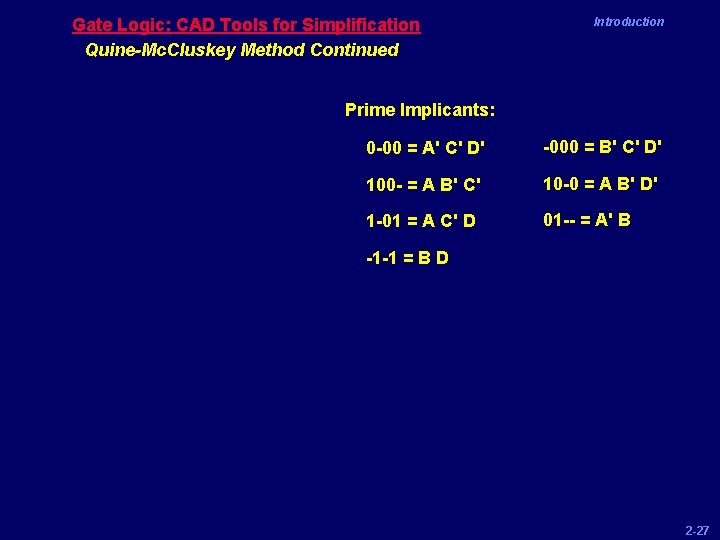
Gate Logic: CAD Tools for Simplification Quine-Mc. Cluskey Method Continued Introduction Prime Implicants: 0 -00 = A' C' D' -000 = B' C' D' 100 - = A B' C' 10 -0 = A B' D' 1 -01 = A C' D 01 -- = A' B -1 -1 = B D 2 -27
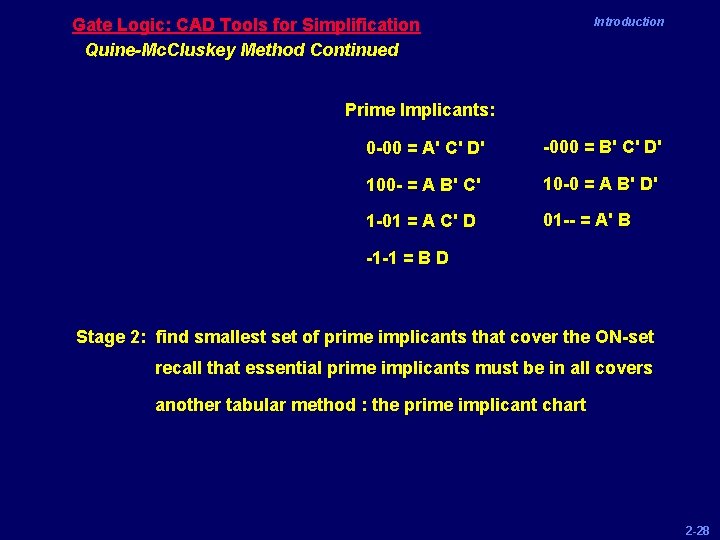
Gate Logic: CAD Tools for Simplification Quine-Mc. Cluskey Method Continued Introduction Prime Implicants: 0 -00 = A' C' D' -000 = B' C' D' 100 - = A B' C' 10 -0 = A B' D' 1 -01 = A C' D 01 -- = A' B -1 -1 = B D Stage 2: find smallest set of prime implicants that cover the ON-set recall that essential prime implicants must be in all covers another tabular method : the prime implicant chart 2 -28
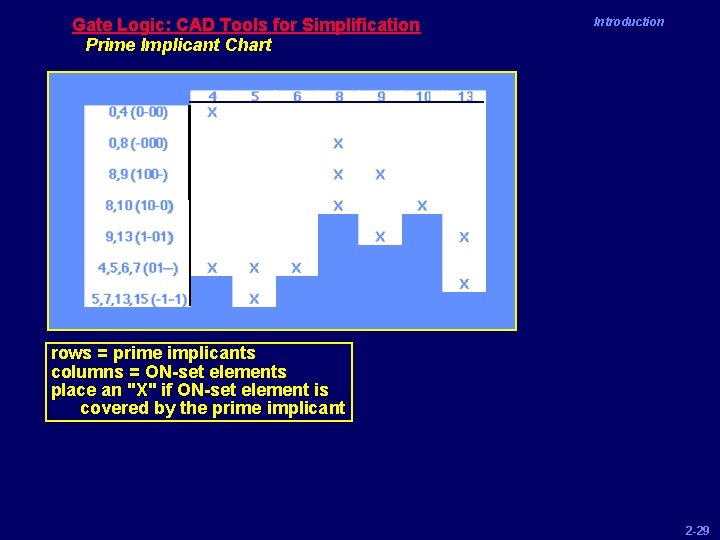
Gate Logic: CAD Tools for Simplification Prime Implicant Chart Introduction rows = prime implicants columns = ON-set elements place an "X" if ON-set element is covered by the prime implicant 2 -29
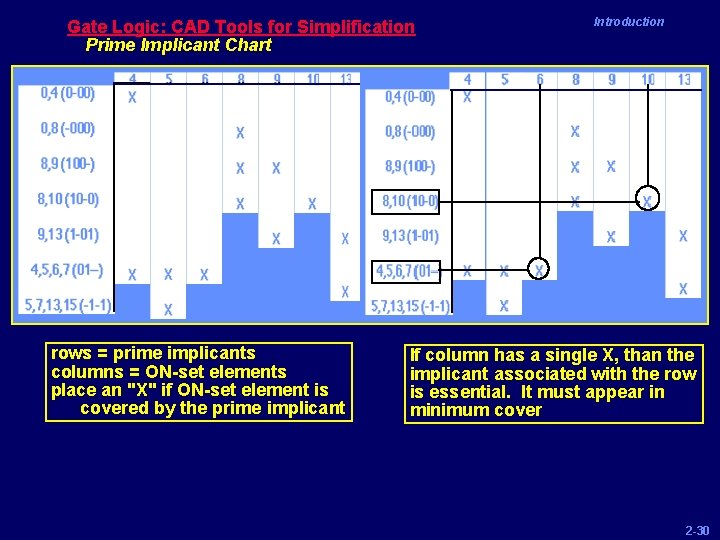
Gate Logic: CAD Tools for Simplification Prime Implicant Chart rows = prime implicants columns = ON-set elements place an "X" if ON-set element is covered by the prime implicant Introduction If column has a single X, than the implicant associated with the row is essential. It must appear in minimum cover 2 -30
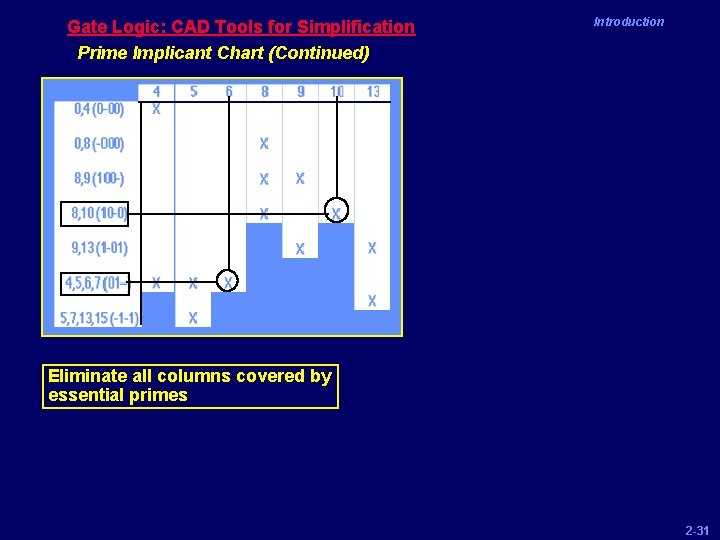
Gate Logic: CAD Tools for Simplification Prime Implicant Chart (Continued) Introduction Eliminate all columns covered by essential primes 2 -31
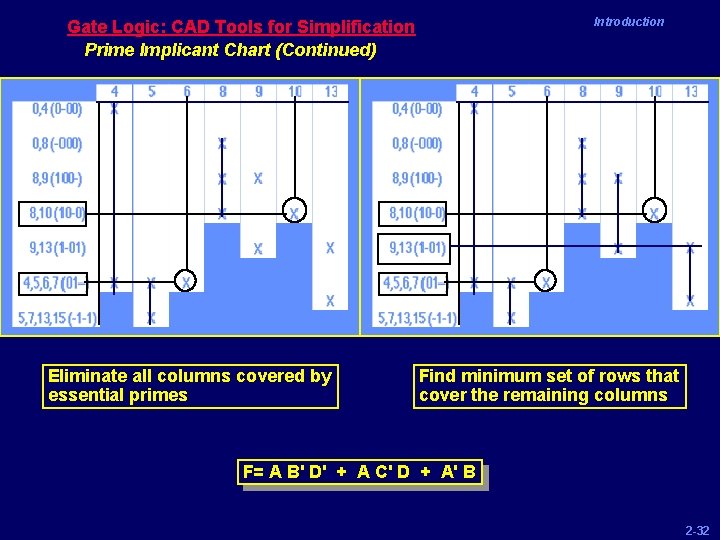
Introduction Gate Logic: CAD Tools for Simplification Prime Implicant Chart (Continued) Eliminate all columns covered by essential primes Find minimum set of rows that cover the remaining columns F= A B' D' + A C' D + A' B 2 -32
Gate Logic: CAD Tools for Simplification ESPRESSO Method Introduction Problem with Quine-Mc. Cluskey: the number of prime implicants grows rapidly with the number of inputs upper bound: 3 n /n, where n is the number of inputs finding a minimum cover is NP-complete, i. e. , a computational expensive process not likely to yield to any efficient algorithm Espresso: trades solution speed for minimality of answer don't generate all prime implicants (Quine-Mc. Cluskey Stage 1) judiciously select a subset of primes that still covers the ON-set operates in a fashion not unlike a human finding primes in a K-map 2 -33
Gate Logic: CAD Tools for Simplification Espresso Method: Overview Introduction 1. Expands implicants to their maximum size Implicants covered by an expanded implicant are removed from further consideration Quality of result depends on order of implicant expansion Heuristic methods used to determine order Step is called EXPAND 2. Irredundant cover (i. e. , no proper subset is also a cover) is extracted from the expanded primes Just like the Quine-Mc. Cluskey Prime Implicant Chart Step is called IRREDUNDANT COVER 3. Solution usually pretty good, but sometimes can be improved Might exist another cover with fewer terms or fewer literals Shrink prime implicants to smallest size that still covers ON-set Step is called REDUCE 4. Repeat sequence REDUCE/EXPAND/IRREDUNDANT COVER to find alternative prime implicants Keep doing this as long as new covers improve on last solution 5. A number of optimizations are tried, e. g. , identify and remove essential primes early in the process 2 -34
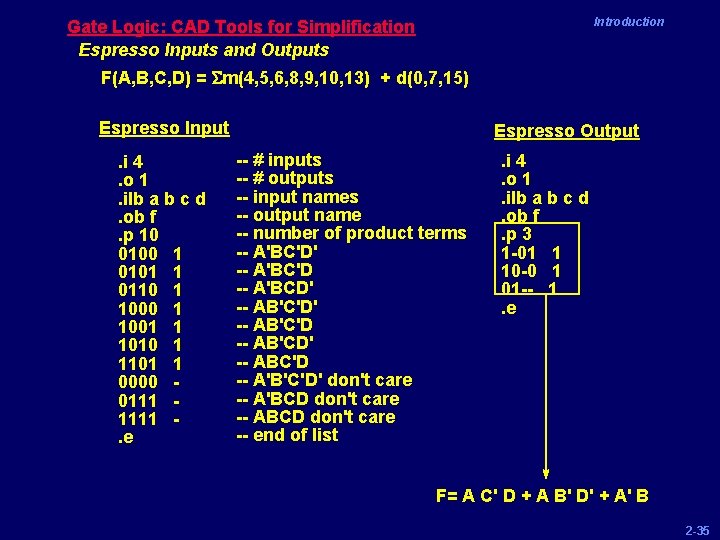
Introduction Gate Logic: CAD Tools for Simplification Espresso Inputs and Outputs F(A, B, C, D) = Sm(4, 5, 6, 8, 9, 10, 13) + d(0, 7, 15) Espresso Input. i 4. o 1. ilb a b c d. ob f. p 10 0100 1 0101 1 0110 1 1001 1 1010 1 1101 1 0000 0111 1111. e Espresso Output -- # inputs -- # outputs -- input names -- output name -- number of product terms -- A'BC'D' -- A'BC'D -- A'BCD' -- AB'C'D -- AB'CD' -- ABC'D -- A'B'C'D' don't care -- A'BCD don't care -- ABCD don't care -- end of list . i 4. o 1. ilb a b c d. ob f. p 3 1 -01 1 10 -0 1 01 -- 1. e F= A C' D + A B' D' + A' B 2 -35
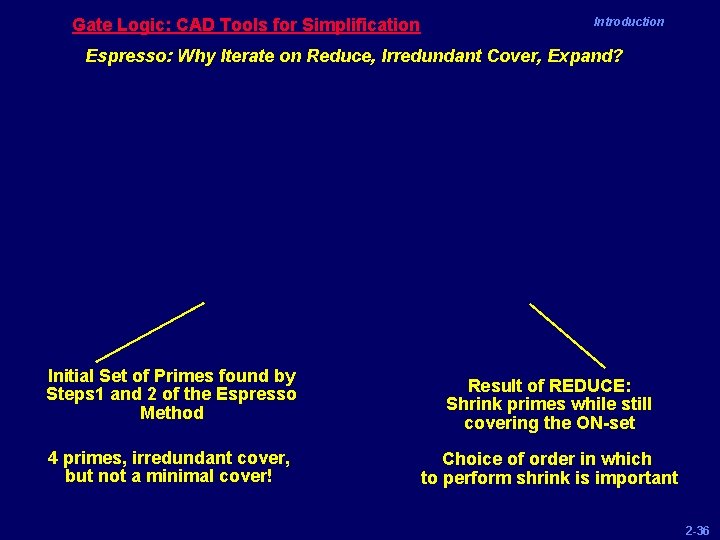
Gate Logic: CAD Tools for Simplification Introduction Espresso: Why Iterate on Reduce, Irredundant Cover, Expand? Initial Set of Primes found by Steps 1 and 2 of the Espresso Method 4 primes, irredundant cover, but not a minimal cover! Result of REDUCE: Shrink primes while still covering the ON-set Choice of order in which to perform shrink is important 2 -36
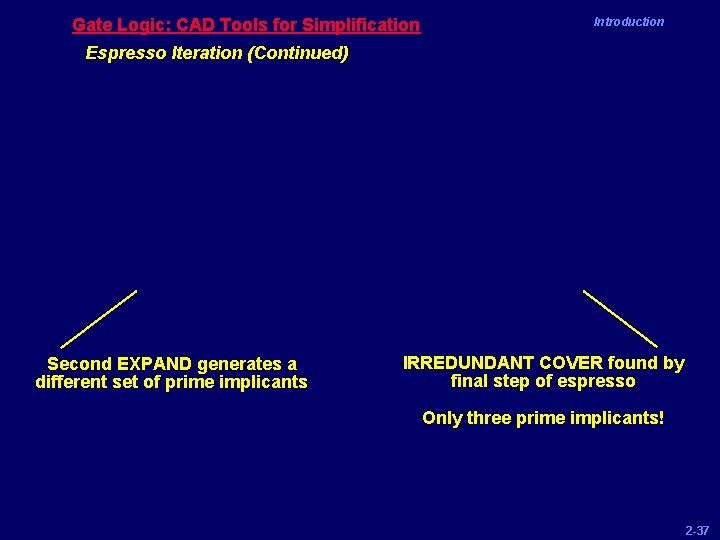
Gate Logic: CAD Tools for Simplification Introduction Espresso Iteration (Continued) Second EXPAND generates a different set of prime implicants IRREDUNDANT COVER found by final step of espresso Only three prime implicants! 2 -37

Introduction 2 -38
Practical Matters Introduction TTL Packaged Logic Small and Medium Scale Integration dual in-line package (DIP) Subfamilies of TTL Components have been designed so that they can be interconnected without too much concern about proper electrical operation 74 XX 74 HXX : high speed 74 LXX : low power 74 SXX : Schottsky TTL, faster than 74 HXX and same power as 74 LXX 74 LSXX : low power Schottsky TTL AS TTL : 2 times faster than S TTL ALS TTL : less power than LS TTL with higher speed Speed-Power Product compare the efficiency of logic families multiply the delay through a gate by the power it consumes smaller number - reduced delay and reduced power 2 -39

Introduction 2 -40
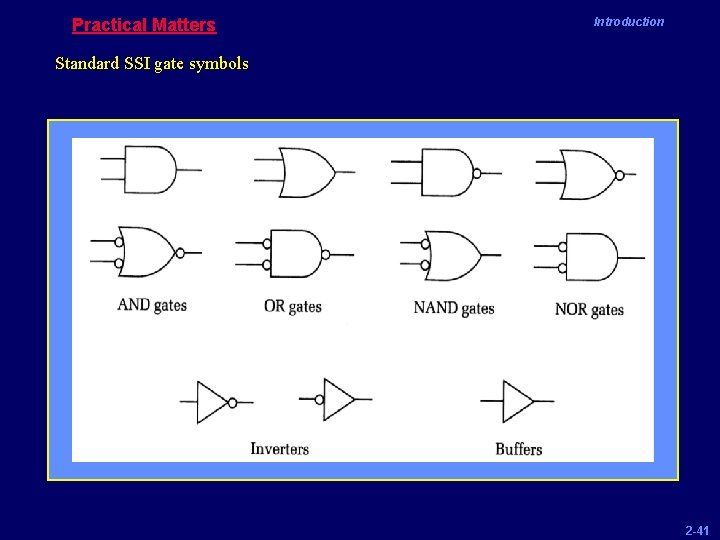
Practical Matters Introduction Standard SSI gate symbols 2 -41
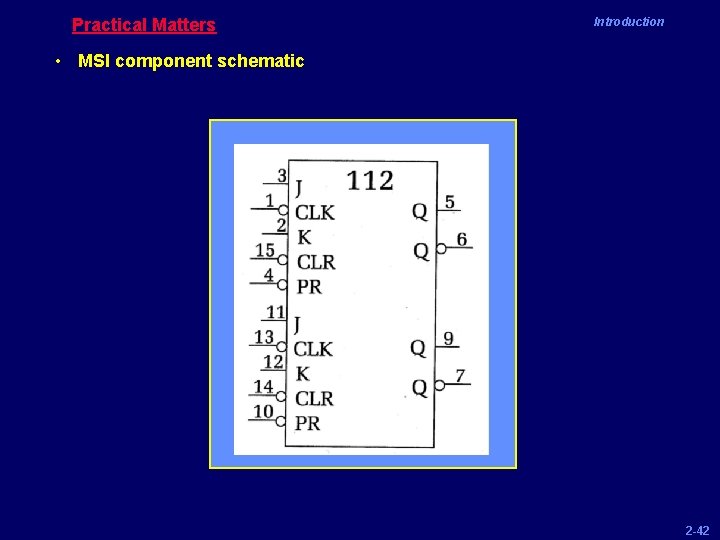
Practical Matters Introduction • MSI component schematic 2 -42

Practical Matters Introduction • Use of a detail letter 2 -43
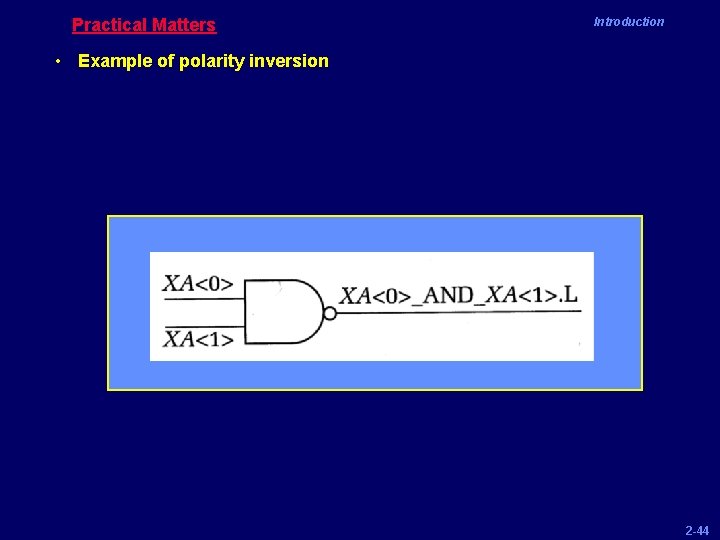
Practical Matters Introduction • Example of polarity inversion 2 -44
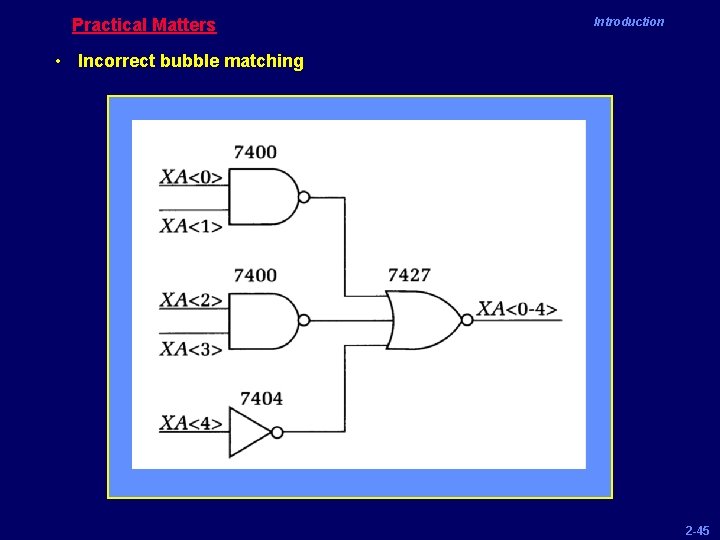
Practical Matters Introduction • Incorrect bubble matching 2 -45
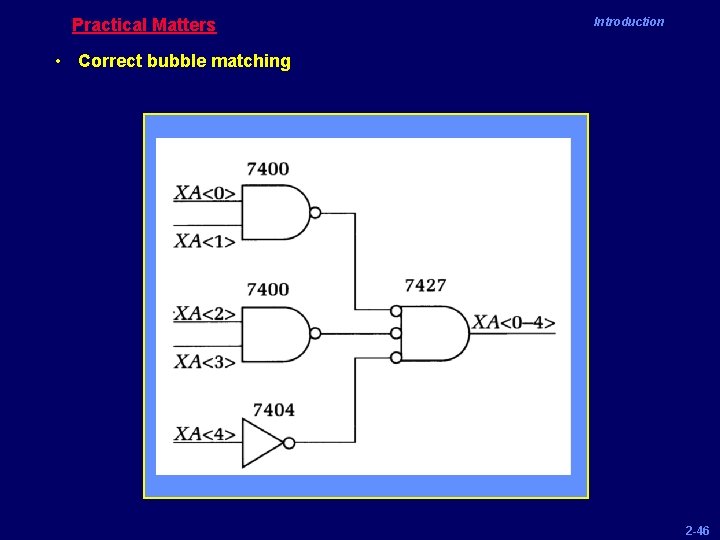
Practical Matters Introduction • Correct bubble matching 2 -46

Practical Matters Introduction • A case where polarity and bubbles don’t match 2 -47
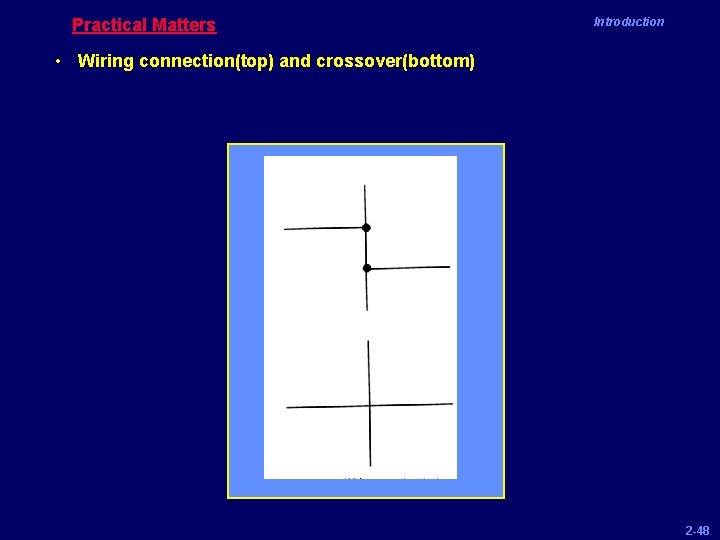
Practical Matters Introduction • Wiring connection(top) and crossover(bottom) 2 -48
Chapter Summary Introduction Primitive logic building blocks INVERTER, AND, OR, NAND, NOR, XNOR Canonical Forms Sum of Products, Products of Sums Incompletely specified functions/don't cares Logic Minimization Goal: two-level logic realizations with fewest gates and fewest number of gate inputs Obtained via Laws and Theorems of Boolean Algebra or Boolean Cubes and the Uniting Theorem or K-map Methods up to 6 variables or Quine-Mc. Cluskey Algorithm or Espresso CAD Tool 2 -49
- Slides: 49