
Gastrointestinal Problems Claire Nowlan MD Peptic Ulcers n
Gastrointestinal Problems Claire Nowlan MD
Peptic Ulcers n Ulceration of either the gastric or duodenal mucosa
Risk factors for Peptic Ulcers n H. Pylori (cause of 70%-90% of ulcers) n NSAIDs (Steroids and Bisphonates) Alcohol Smoking Ages 30 -50 Stress Medical conditions – Hyperparathyroidism – Zollinger Ellison Syndrome – Renal Dialysis n n n
Etiology Imbalence of Aggressive/protective factors n H. Pylori produces urease n – urea > ammonia and CO 2 – This invokes immune response and starts inflammation cascade – infection increases with age and poor socioeconomic conditions – only 20% of infected develop disease
Etiology n NSAIDs – reduced mucosal prostaglandin production, resulting in impaired prostaglandin dependent mucosal defense and repair mechanisms
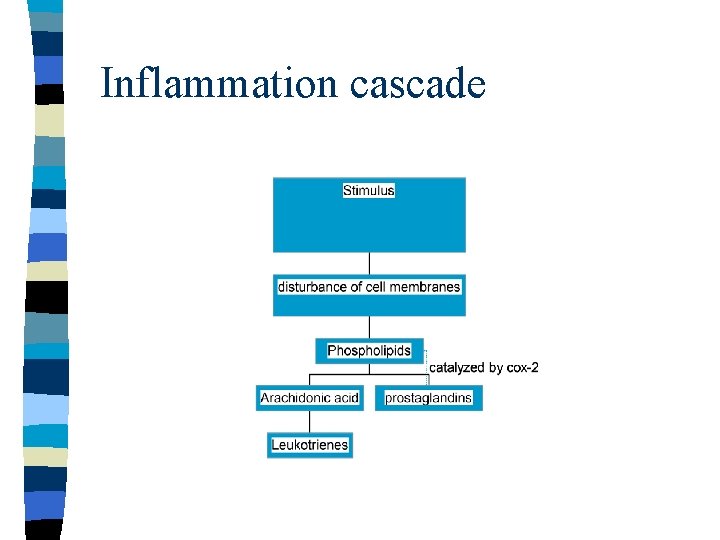
Inflammation cascade
Complications n Depends on depth of ulcer n More common in the elderly – Perforation – Hemorrhage - more serious if patient on anticoagulants – Pyloric stenosis – Carcinomatous transformation
Signs and Symptoms n Variable n Red flags - vomiting, bloody or tarry stools, new ab pains in an elderly person, signs of blood loss (pale, lightheaded, orthostatic hypotension)
Lab findings n Serology or 13 C 14 C urea breath tests for H. Pylori n Barium swallow n Endoscopy
Medical treatment Eradication of H. Pylori usually cures ulcer n Regiments – 7 to 14 days of: n – PPI (Omeprazole/Lansoprazole/Pantoprazole) – PLUS 2 antibiotics (Clarithromycin/Metronidazole/Amoxicillin/Tetracyc line) – PLUS/MINUS Pepto-Bismol n Stop NSAIDs
Dental Management If active, untreated disease - refer n If possible, NSAIDs should be avoided in patients with n – Previous GI bleeding – Previous peptic ulcers – Age > 75 years n Avoid longer courses of NSAIDs in – Age 60 - 75 – Patients on steroids n May use COX-2 selective inhibitors or preventive medication in above patients
Cyclo-oxygenase-2 (COX-2) inhibitors n Vioxx/Celebrex(not in patients with Sulfa allergy)/Mobicox n Similar efficacy to older NSAIDs n Early trials suggested decreased endoscopic ulceration n Recent trials show little if any efficacy (1. 8% rate of ulcers vs. 1. 3%) n No difference in dyspepsia
Medications to prevent NSAID associated peptic ulcers n Misoprostol 200 ug TID – Don’t use in fertile women n PPIs – Omeprazole 20 mg od – Lansoprazole 30 mg od – Pantoprazole 40 mg od
Irritable bowel Affects up to 30% of the population n Symptoms include n • • diarrhea constipation abdominal pain bloating Difficult to control symptoms n Treatment includes dietary changes, stress management, medications n
Pseudomembranous colitis A severe colitis that results from broad spectrum antibiotics killing healthy gut bacteria and allowing C. difficile to flourish (already present in 2% asymptomatic people, up to 50% of the elderly) n C. difficile binds to intestinal mucosa and alters cell permeability n Worst antibiotic – Clindamycin, amoxil and cephalosporins to a lesser extent n Symptoms usually develop 1 week later, can be as long as 8 weeks n
Pseudomembranous colitis Symptoms - Watery profuse diarrhea and low grade fever, if severe - bloody diarrhea, fever, abdominal pain and death n Diagnosis – enterotoxin A/B found in the stool sample n Medical Management n • Stopping the antibiotic cures up to 25% of patients • Flagyl or Vancomycin for 7 to 10 days • Hand washing
Pseudomembranous colitis n Dental management – Use broad spectrum antibiotics wisely especially in elderly patients or those with a previous history
Inflammatory Bowel Disease (IBD) n Inflammatory disease of the GI tract n Unknown origin n Patient experiences diarrhea, abdominal pain n Peak age of onset 20 to 40 years n Systemic findings –arthritis, iritis, uveitis, skin manifestations
Inflammatory Bowel Disease (IBD) n n n Ulcerative Colitis Limited to the large intestine Limited to mucosa Continuous lesions Remissions/ exacerbations common Rectal bleeding common n n n Crohn’s Disease Affects any portion of the bowel Transmural Segmental Usually slowly progressive Fever, weight loss common
Inflammatory Bowel Disease (IBD) Ulcerative Colitis n Complications hemorrhage, toxic megacolon, anemia, volume depletion, electrolyte imbalance, malignancy n Crohn’s Disease n Complications anemia, malabsorption, fistulae, stricture, abscess n Operations more common n
Inflammatory Bowel Disease (IBD) - lab findings n May see anemia, malabsorptions causing low B 12, folate, iron, albumin, and increased ESR n Really diagnosed with colonoscopy/biopsy
Medical management n Supportive therapy – Nutritional supplementation, bowel rest, replacing fluid and electrolytes n Antiinflammatory drugs • Sulfasalazine • 5 ASA • Steroids Immunosupressives/Antibiotics n Surgery – curative in UC n
Dental management - IBD n n n Precautions if on steroids Immunosupressants cause pancytopenia in 5% of patients, increase risk of lymphoma and oral infections Methotrexate can cause hypersensitivity pneumonia and hepatic fibrosis Cyclosporin cause renal damage Sulfsalazine associated with pulmonary, nephrotic damage
Dental management - IBD n Analgesics acetaminophen plus – NSAIDs OK – opioids fine, unless during acute severe exacerbation - can cause toxic megacolon n Only urgent care during exacerbation
- Slides: 24