
GASTROINTESTINAL BLOCK PATHOLOGY LECTURE 2015 Benign Tumors of
GASTROINTESTINAL BLOCK PATHOLOGY LECTURE 2015 Benign Tumors of Intestine Dr. Maha Arafah Dr. Ahmed Al Humaidi
LEARNING OBJECTIVES Know the classification of intestinal tumors (small intestine and colon) Know the definition of a polyp. Compare adenomatous polyps and hyperplastic polyps with respect to pathology (gross and microscopic features). Know the three subtypes of adenomatous polyps, eg, tubular adenoma, villous adenoma, tubulovillous adenoma. Describe the adenomatous polyp-cancer sequence and the features associated with risk of malignancy, eg, polyp size, histologic architecture, and severity of epithelial dysplasia. Describe the classification of the hereditary syndromes involving the GI tract and the syndromes associated with an increased risk of cancer (Peutz-Jeghers syndrome, familial adenomatous polyposis, and hereditary nonpolyposis colorectal carcinoma)
TUMORS OF THE SMALL AND LARGE INTESTINES Polyps Carcinoma Carcinoid tumor Lymphoma

Sigmoid colon: Most common site GI polyps, diverticula and cancer
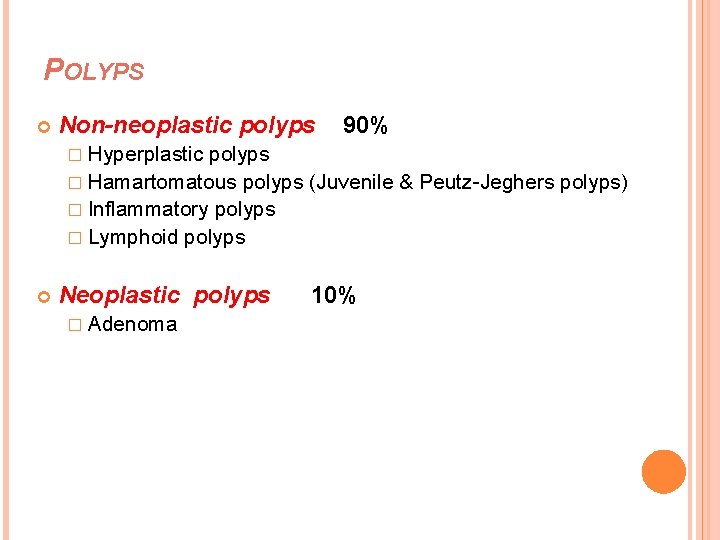
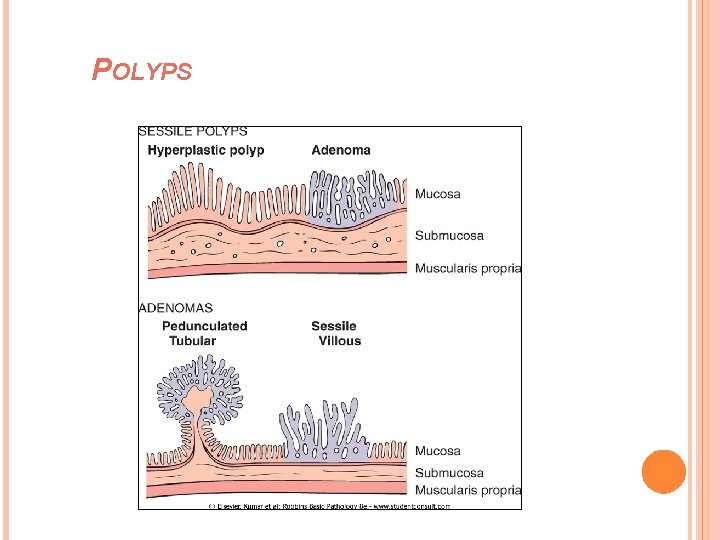
POLYPS Non-neoplastic polyps 90% � Hyperplastic polyps � Hamartomatous polyps (Juvenile & Peutz-Jeghers polyps) � Inflammatory polyps � Lymphoid polyps Neoplastic polyps � Adenoma 10%
POLYPS
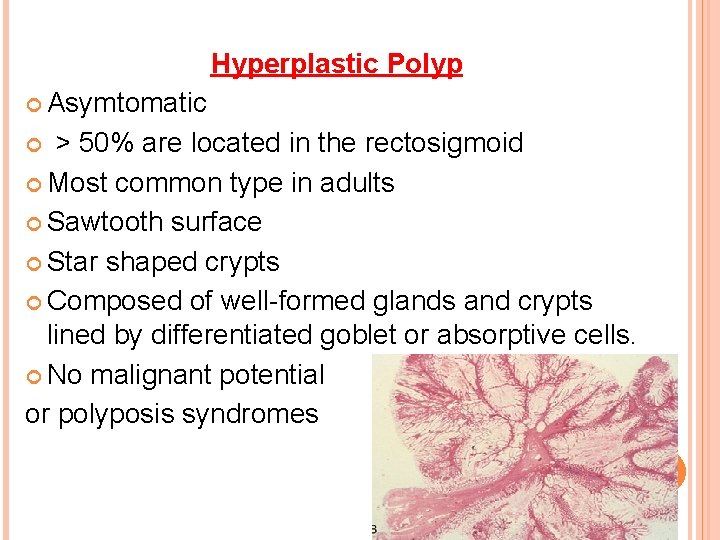
Hyperplastic Polyp Asymtomatic > 50% are located in the rectosigmoid Most common type in adults Sawtooth surface Star shaped crypts Composed of well-formed glands and crypts lined by differentiated goblet or absorptive cells. No malignant potential or polyposis syndromes
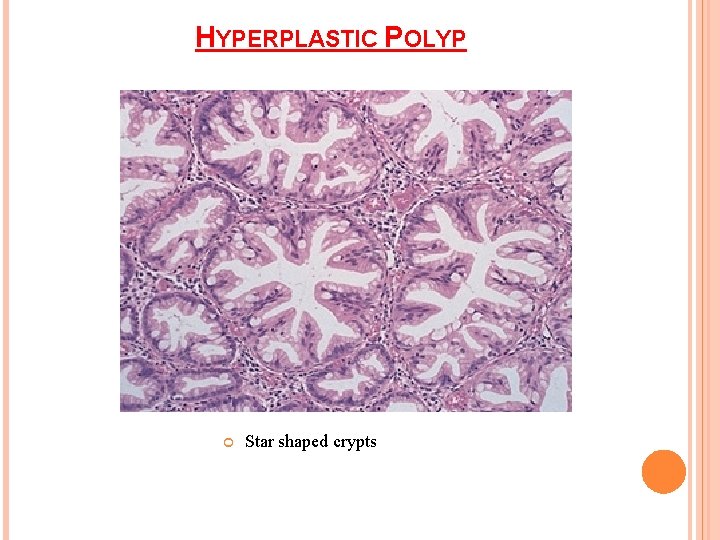
HYPERPLASTIC POLYP Star shaped crypts
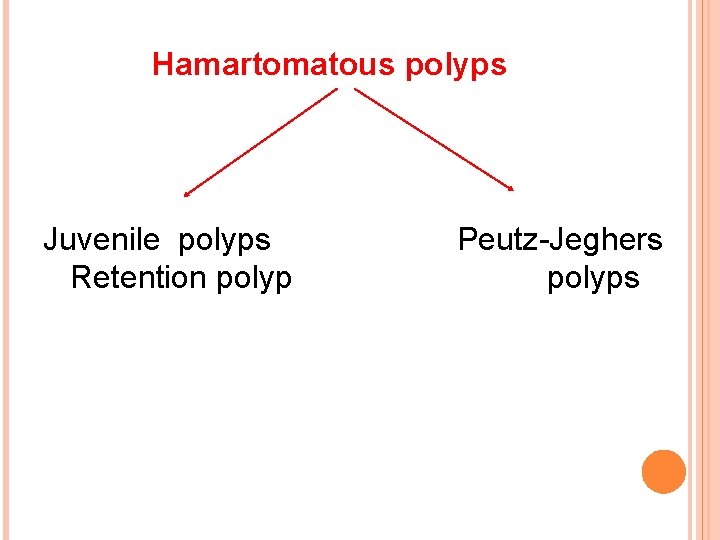
Hamartomatous polyps Juvenile polyps Peutz-Jeghers Retention polyps

NON-NEOPLASTIC POLYP Hamartomatous polyp Juvenile Polyps (retention polyp) Developmental malformations affecting the glands and lamina propria Commonly occur in children under 5 years old in the rectum. In adult called retention polyp. no malignant potential Juvenile polyposis Autosomal dominant or nonhereditary Cronkhite-Canada syndrome Nonhereditary polyposis syndrome Polyps plus ectodermal abnormalities of the nails
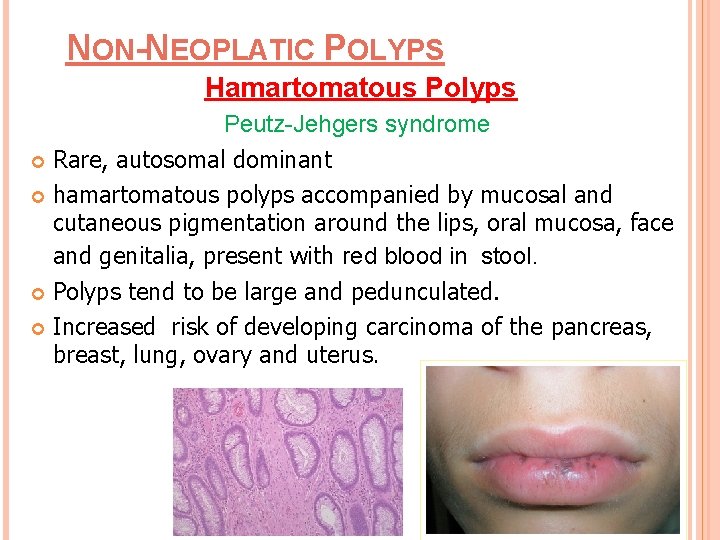
NON-NEOPLATIC POLYPS Hamartomatous Polyps Peutz-Jehgers syndrome Rare, autosomal dominant hamartomatous polyps accompanied by mucosal and cutaneous pigmentation around the lips, oral mucosa, face and genitalia, present with red blood in stool. Polyps tend to be large and pedunculated. Increased risk of developing carcinoma of the pancreas, breast, lung, ovary and uterus.
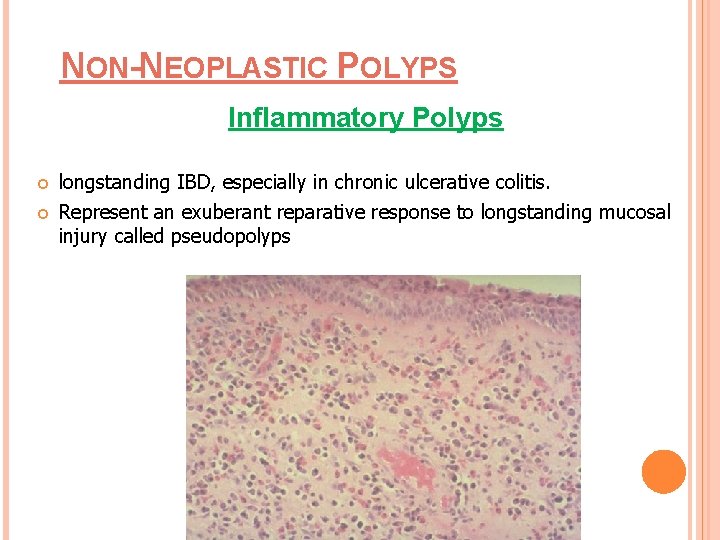
NON-NEOPLASTIC POLYPS Inflammatory Polyps longstanding IBD, especially in chronic ulcerative colitis. Represent an exuberant reparative response to longstanding mucosal injury called pseudopolyps

LYMPHOID POLYPS
NEOPLASTIC POLYPS (ADENOMAS) Adenomatous Polyp ( adenoma ) Occur mainly in large bowel. Sporadic and familial Vary from small pedunculated to large sessile Epithelium proliferation and dysplasia
NEOPLASTIC POLYPS (ADENOMAS) Adenomatous Polyp ( adenoma ) Divided into: Tubular adenoma: less than 25% villous architecture 2. Villous adenoma: villous architecture over 50% 3. Tubulovillous adenoma: villous architecture between 25 and 50%. 1.
![NEOPLASTIC POLYPS 1] Tubular adenoma Represents 75% of all neoplastic polyps. 75 % occur](http://slidetodoc.com/presentation_image/50e6b62b06c1c5d88aa438ed8dbaa252/image-16.jpg "NEOPLASTIC POLYPS 1] Tubular adenoma Represents 75% of all neoplastic polyps. 75 % occur")
NEOPLASTIC POLYPS 1] Tubular adenoma Represents 75% of all neoplastic polyps. 75 % occur in the distal colon and rectum Sigmoid colon most common site.
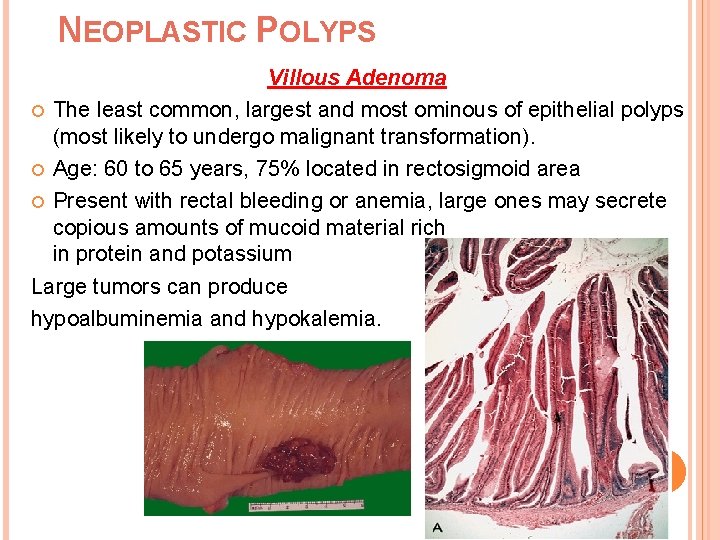
NEOPLASTIC POLYPS Villous Adenoma The least common, largest and most ominous of epithelial polyps (most likely to undergo malignant transformation). Age: 60 to 65 years, 75% located in rectosigmoid area Present with rectal bleeding or anemia, large ones may secrete copious amounts of mucoid material rich in protein and potassium Large tumors can produce hypoalbuminemia and hypokalemia.
![NEOPLASTIC POLYPS 3] Tubulovillous adenoma 20%– 30% of polyps Intermmediate in size, degree of](http://slidetodoc.com/presentation_image/50e6b62b06c1c5d88aa438ed8dbaa252/image-18.jpg "NEOPLASTIC POLYPS 3] Tubulovillous adenoma 20%– 30% of polyps Intermmediate in size, degree of")
NEOPLASTIC POLYPS 3] Tubulovillous adenoma 20%– 30% of polyps Intermmediate in size, degree of dysplasia and malignant potential between tubular and villous adenomas.

RELATIONSHIP OF NEOPLASTIC POLYPS TO CARCINOMA Adenoma to carcinoma sequence is documented by several genetic alterations.
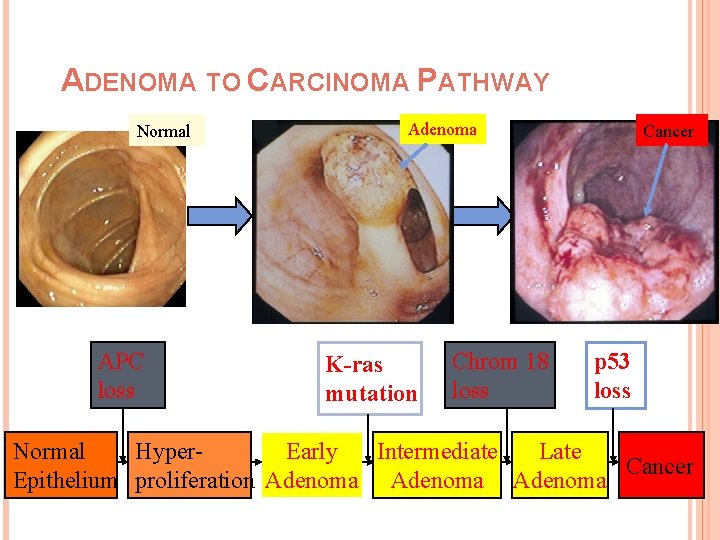
ADENOMA TO CARCINOMA PATHWAY Normal APC loss Adenoma K-ras mutation Chrom 18 loss Cancer p 53 loss Normal Hyper. Early Intermediate Late Cancer Epithelium proliferation Adenoma
RELATIONSHIP OF NEOPLASTIC POLYPS TO CARCINOMA The probability of carcinoma occuring in a neoplastic polyp is related to: 1. The size of the polyp. 2. The relative proportion of its villous features. 3. The presence of significant cytologic atypia (dysplasia) in the neoplastic cells. 4. Multiple polyps 5. Accumulation of genetic mutation
FAMILIAL POLYPOSIS SYNDROME Patients have genetic tendencies to develop neoplastic polyps. Familial polyposis coli (FPC) Gardener’s syndrome Turcot syndrome
FAMILIAL POLYPOSIS SYNDROME Familial polyposis coli (FPC) Genetic defect of Adenomatous polyposis coli (APC). APC gene located on the long arm of chromosome 5 (5 q 21). APC gene is a tumor suppressor gene Innumerable neoplastic polyps in the colon (500 to 2500) Polyps are also found elsewhere in alimentary tract The risk of colorectal cancer is 100% by midlife. Gardener’s syndrome Turcot syndrome
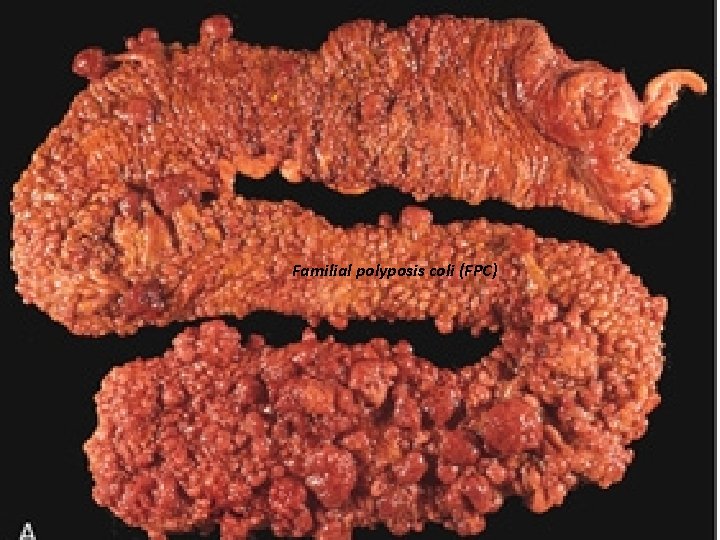
Familial polyposis coli (FPC)
FAMILIAL POLYPOSIS SYNDROME Gardener’s syndrome Polyposis coli, multiple osteomas, epidermal cysts, and fibromatosis. Turcot syndrome Polyposis coli, glioma and fibromatosis

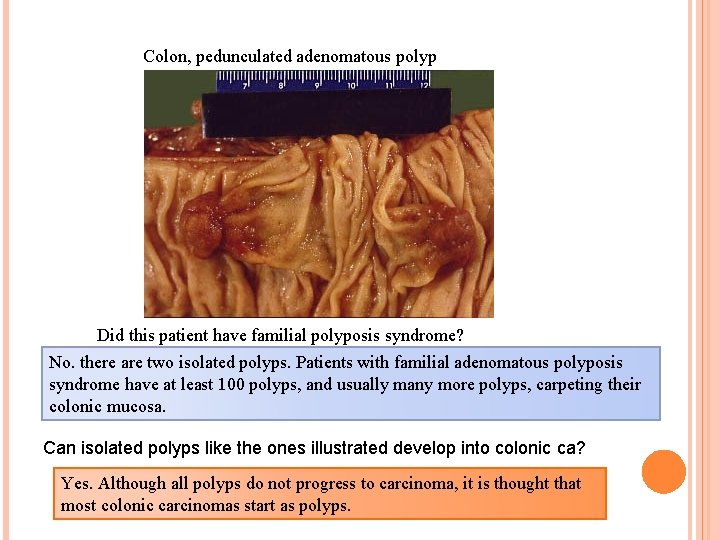
Colon, pedunculated adenomatous polyp Did this patient have familial polyposis syndrome? No. there are two isolated polyps. Patients with familial adenomatous polyposis syndrome have at least 100 polyps, and usually many more polyps, carpeting their colonic mucosa. Can isolated polyps like the ones illustrated develop into colonic ca? Yes. Although all polyps do not progress to carcinoma, it is thought that most colonic carcinomas start as polyps.

Colon, pedunculated adenomatous polyp Are all polyps neoplastic? No. Polyps can result from focal hyperplasia of the mucosa. Hyperplastic polyps do not have malignant potential What variables determine the likelihood of malignant change in a polyp? Three interrelated features determine the risk of cancerous transformation: polyp size, histologic architecture, and severity of dysplasia. (1) Cancer is rare in tubular adenomas less than 1 cm in diameter. (2) The likelihood of cancer is high (about 50%) in sessile villous adenomas that are greater than 4 cm in diameter. (3) Severe dysplasia is likely to progress to cancer. Such dysplasias are found in villous areas. Of all these, size is the most important factor.
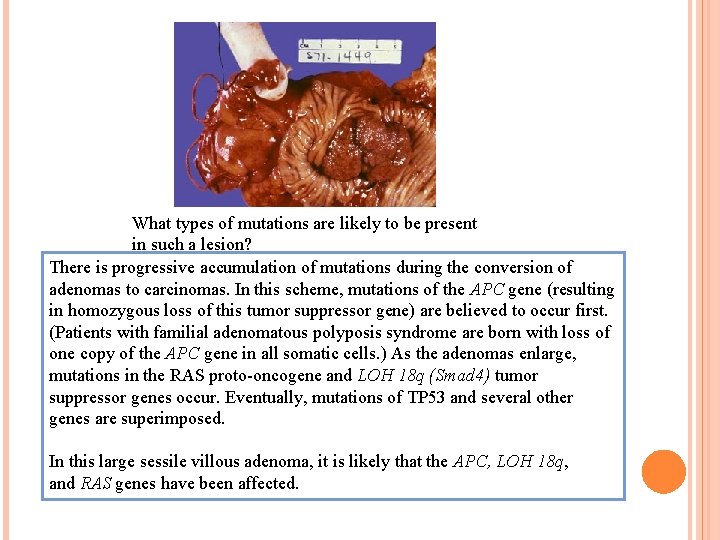
What types of mutations are likely to be present in such a lesion? There is progressive accumulation of mutations during the conversion of adenomas to carcinomas. In this scheme, mutations of the APC gene (resulting in homozygous loss of this tumor suppressor gene) are believed to occur first. (Patients with familial adenomatous polyposis syndrome are born with loss of one copy of the APC gene in all somatic cells. ) As the adenomas enlarge, mutations in the RAS proto-oncogene and LOH 18 q (Smad 4) tumor suppressor genes occur. Eventually, mutations of TP 53 and several other genes are superimposed. In this large sessile villous adenoma, it is likely that the APC, LOH 18 q, and RAS genes have been affected.
- Slides: 30