
Gastroesophageal Reflux in Infants Lindsey Albenberg DO Andrew
Gastroesophageal Reflux in Infants Lindsey Albenberg, DO Andrew Grossman, MD The Children’s Hospital of Philadelphia 2013 Resident Education Series Reviewed by Jyoti Ramakrishna, MD of the Professional Education Committee
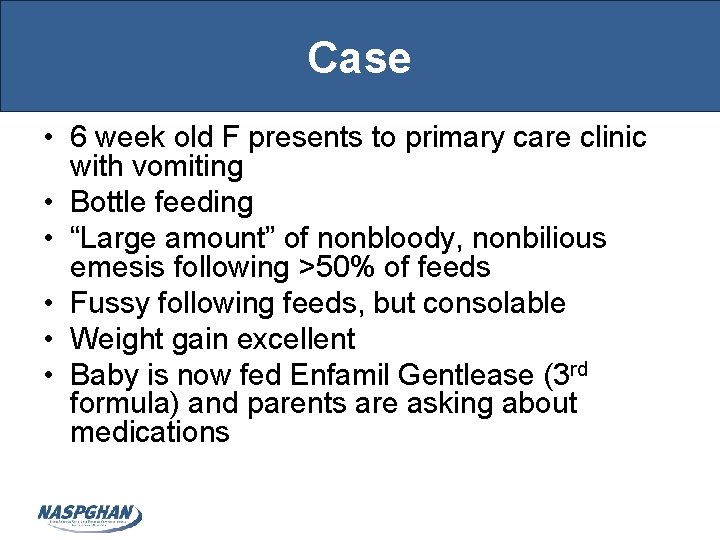
Case • 6 week old F presents to primary care clinic with vomiting • Bottle feeding • “Large amount” of nonbloody, nonbilious emesis following >50% of feeds • Fussy following feeds, but consolable • Weight gain excellent • Baby is now fed Enfamil Gentlease (3 rd formula) and parents are asking about medications
Objectives • To briefly review the definitions, natural history, and mechanisms of GER and GERD • To discuss the diagnosis of GERD in infants and the warning signs suggesting other more worrisome disorders • To discuss the management options for physiologic GER and for GERD
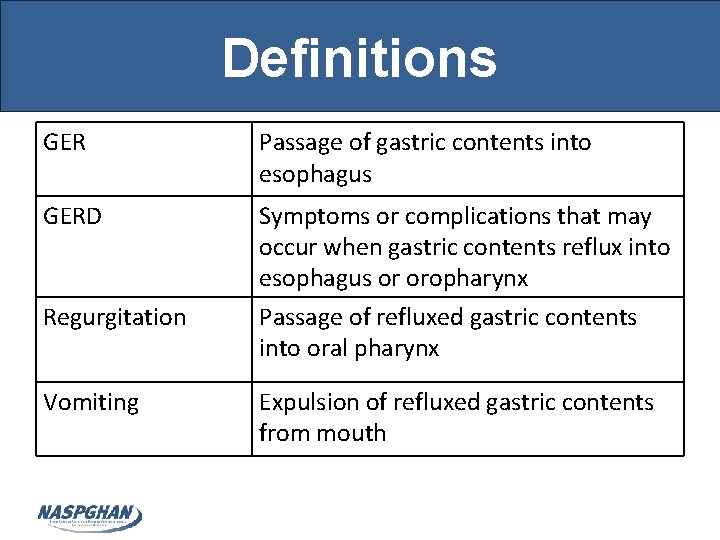
Definitions GER Passage of gastric contents into esophagus GERD Symptoms or complications that may occur when gastric contents reflux into esophagus or oropharynx Passage of refluxed gastric contents into oral pharynx Regurgitation Vomiting Expulsion of refluxed gastric contents from mouth

Mechanisms of GER in the Infant • Angle of His underdeveloped • Inadequate gastric accommodation • Supine position + gravity = GER

GER Prevalence • Nelson et al. Arch Pediatr Adolesc Med 1997 – Cross-sectional study of 19 pediatric practices in Chicago, IL – Survey parents of 948 pediatric patients (<13 months) – Excluded infants born prematurely, with chronic medical or developmental condition, or had been ill in the past two weeks
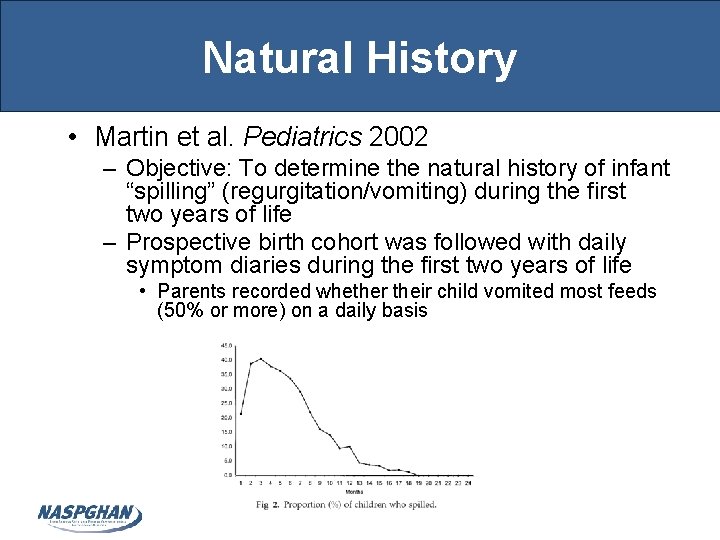
Natural History • Martin et al. Pediatrics 2002 – Objective: To determine the natural history of infant “spilling” (regurgitation/vomiting) during the first two years of life – Prospective birth cohort was followed with daily symptom diaries during the first two years of life • Parents recorded whether their child vomited most feeds (50% or more) on a daily basis
When to worry? • GER becomes GERD when reflux of gastric contents causes troublesome symptoms and/or complications • Physiologic GER can become GERD when: – Insufficient clearance and/or buffering of material refluxed into esophagus – Delayed gastric emptying – Anatomic abnormality (hiatal hernia) • Signs & symptoms suggesting GERD – FTT (with feeding difficulty) – Irritability – Dysphagia – Odynophagia – Arching
Diagnosis of GERD • Diagnosis is made clinically – Not easy! • Symptoms and signs are nonspecific and unreliable – Individual symptoms in children generally are not highly predictive of findings of GERD by objective studies • Major role of the history and physical is to exclude other more worrisome disorders that present with vomiting
Warning Signals In Vomiting Infant Requiring Further Investigation • Bilious or continuous vomiting • GI bleeding • Hepatosplenomegaly • Macro/microcephaly • Bulging fontanelle • Onset of vomiting after 6 months of life • Seizures • Failure to thrive • Abdominal tenderness, distention • Diarrhea, constipation • Fever • Lethargy Y Vandenplas and CD Rudolph et al, J Pediatr Gastroenterol Nutr 2009 • Documented or suspected genetic/metabolic syndrome
Diagnosis of GERD • Barium contrast radiography – Indication is detection of anatomic abnormalities – Neither sensitive nor specific for diagnosing GERD • Brief duration produces false-negatives • Frequent occurrence of non-pathological reflux during the examination produces false-positives
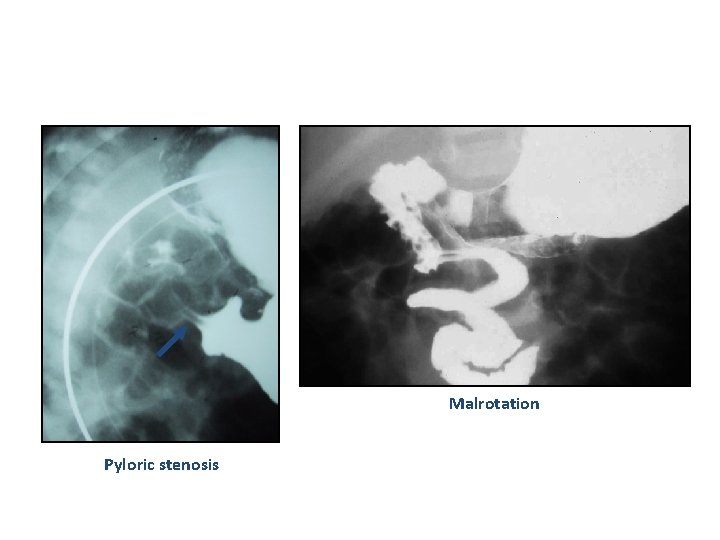
Malrotation Pyloric stenosis
Diagnosis of GERD • Esophageal p. H monitoring – Gold standard – Measures the frequency and duration of acid reflux episodes (drop in esophageal p. H < 4. 0) • Measures reflux index (RI) • Other parameters: total number of episodes, number of episodes lasting > 5 minutes, patient position during episode, awake vs. asleep
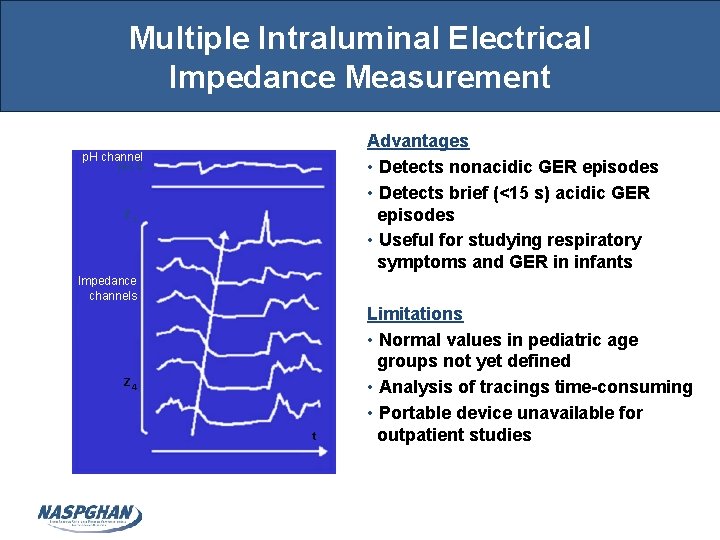
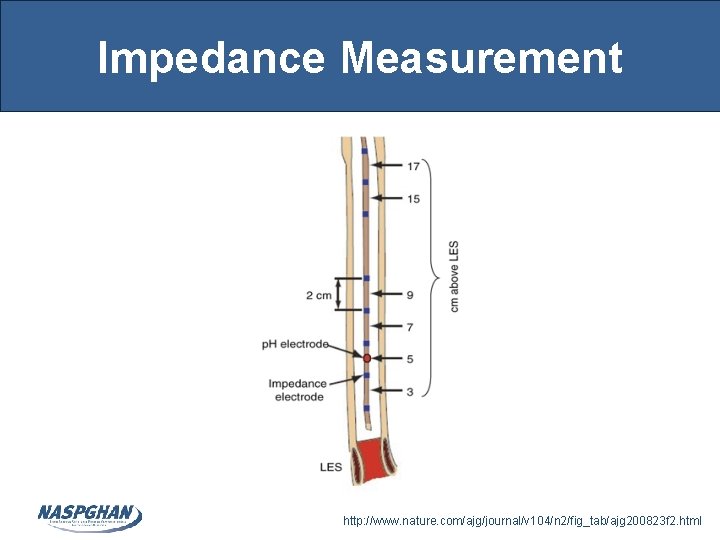
Multiple Intraluminal Electrical Impedance Measurement Advantages • Detects nonacidic GER episodes • Detects brief (<15 s) acidic GER episodes • Useful for studying respiratory symptoms and GER in infants p. H channel p. H 4 Z 1 Impedance channels Z 4 t Limitations • Normal values in pediatric age groups not yet defined • Analysis of tracings time-consuming • Portable device unavailable for outpatient studies
Impedance Measurement http: //www. nature. com/ajg/journal/v 104/n 2/fig_tab/ajg 200823 f 2. html
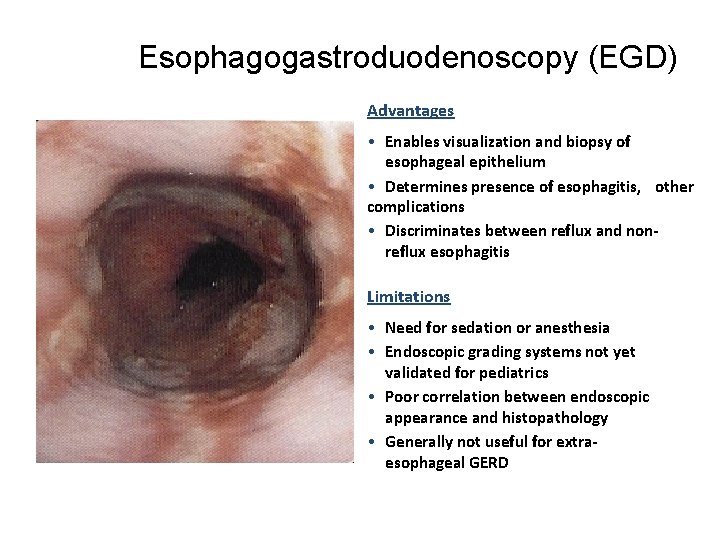
Esophagogastroduodenoscopy (EGD) Advantages • Enables visualization and biopsy of esophageal epithelium • Determines presence of esophagitis, other complications • Discriminates between reflux and nonreflux esophagitis Limitations • Need for sedation or anesthesia • Endoscopic grading systems not yet validated for pediatrics • Poor correlation between endoscopic appearance and histopathology • Generally not useful for extraesophageal GERD
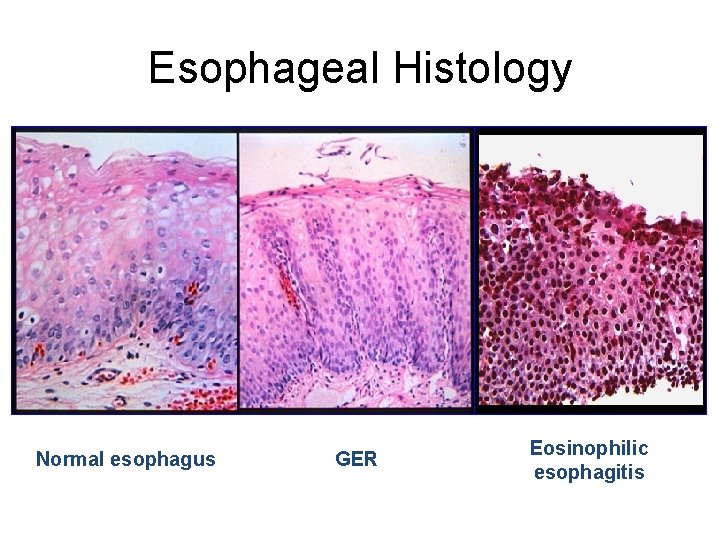
Esophageal Histology Normal esophagus GER Eosinophilic esophagitis
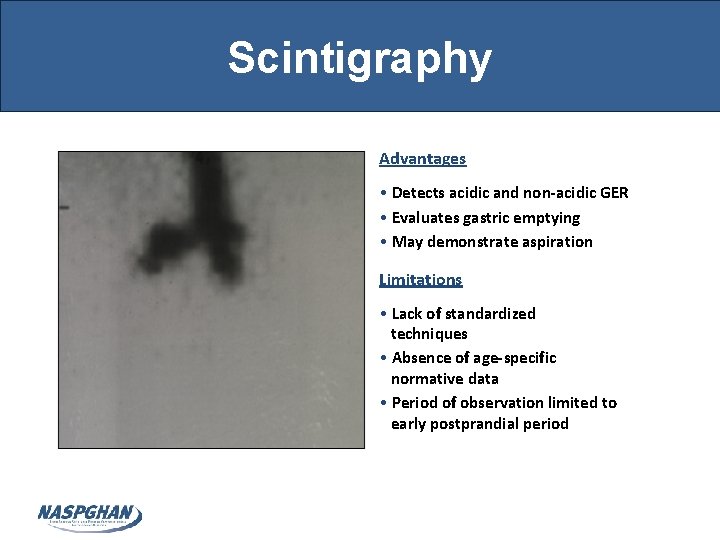
Scintigraphy Advantages • Detects acidic and non-acidic GER • Evaluates gastric emptying • May demonstrate aspiration Limitations • Lack of standardized techniques • Absence of age-specific normative data • Period of observation limited to early postprandial period
Treatment: Reassurance • The natural history of physiologic reflux in most infants is resolution as lower esophageal sphincter function matures • Parental education, guidance, and support are always required – Usually sufficient to manage healthy, thriving infants with symptoms consistent with physiologic GER • Often, the best approach is to sympathize with the family and present the natural history data
2009 Guidelines: Lifestyle Changes in Infants • Avoid overfeeding • Thicken formula (up to 1 tbsp per 1 -2 oz) • Avoid “carseat” positioning • Upright positioning after feeds (less effective than thickening feeds) • Consider 2 -4 week trial of hypoallergenic formula
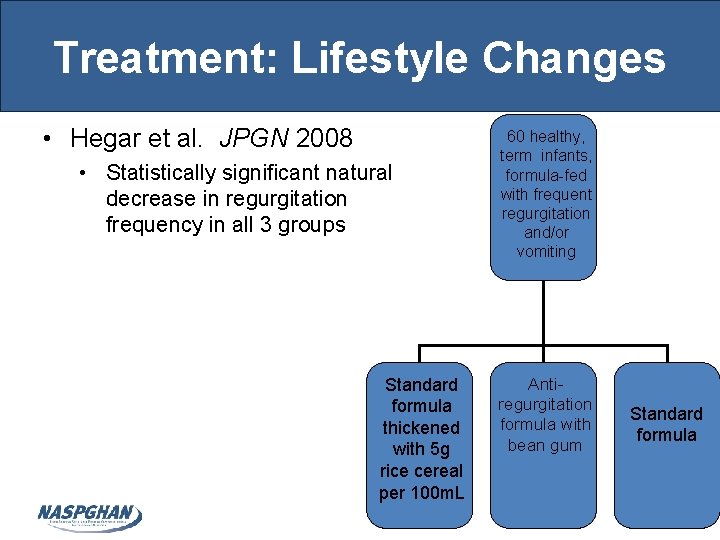
Treatment: Lifestyle Changes • Hegar et al. JPGN 2008 • Statistically significant natural decrease in regurgitation frequency in all 3 groups Standard formula thickened with 5 g rice cereal per 100 m. L 60 healthy, term infants, formula-fed with frequent regurgitation and/or vomiting Antiregurgitation formula with bean gum Standard formula 21
Treatment: Lifestyle Changes • The bottom-line: – The use of AR formula and formula with added thickener may result in the reduction of regurgitation—but how much of this is related to natural history? – Reduced volume feedings may be useful—but necessary to monitor caloric intake/weight gain
Treatment: Pharmacologic Therapies • Histamine-2 receptor antagonists – Decrease acid secretion by inhibiting histamine-2 receptors on parietal cells – Ranitidine has been shown, in infants, to reduce the time that gastric p. H is <4 – Pharmacokinetic studies in children show that gastric p. H begins to increase within 30 minutes of administration and lasts for 6 hours (TID or QID dosing) – Drawbacks • Tachyphylaxis • Side effects in infants: irritability, head-banging, headaches
Treatment: Pharmacologic Therapies • Proton Pump Inhibitors – Inhibit acid secretion by blocking Na-K-ATPase (the parietal cell proton pump) – Adult studies show that PPI’s produce higher and faster healing rates for esophagitis than H 2 RA’s • • Maintain gastric p. H at or above 4 for longer periods of time Inhibit meal-induced acid secretion Facilitate gastric emptying Effect does not diminish with chronic use – No PPI has been approved for use in children younger than 1 year of age! • Few pharmacokinetic data for PPIs in infants
Is There Evidence to Support Increase in the Use of PPIs in Infants? • Orenstein et al. J Pediatr 2009 – Multicenter, randomized, double-blind, placebocontrolled evaluating lansoprazole versus placebo – 162 infants (1 -12 months) with symptomatic GERD who remained symptomatic (crying, fussing, or irritability) following 1 week of conservative management – Similar efficacy for lansoprazole and placebo – Adverse events more common in lansoprazole group
PPI Safety Concerns Pediatrics • Acute gastroenteritis (OR 3. 58) • Community acquired pneumonia (OR 6. 39) • Clostridium difficile infection Adults • Pneumonia • Clostridium difficile infection • Bacterial gastroenteritis • Hip fracture in elderly Canani RB, Pediatrics 2006; 117: e 817 -e 820 Laheij RJ, JAMA 2004; 292: 1955 -1960 Dial S, JAMA 2005; 294: 2989 -2995 Yang YX, JAMA 2006; 296: 2947 -2953 Garcia Rodriqguez, Clin Gastro Hepatol 2007; 5: 1418 -23 Turco R, Aliment Pharmacol Ther 2010; 31: 754 -759
Available Prokinetic Agents Are Unproven or Ineffective • Cisapride: Withdrawn • Bethanechol: 1 randomized controlled trial (RCT) • Erythromycin: no RCT • Domperidone: available in Canada, no RCT • Metoclopramide § § § Esophageal p. H improvement in 1 of 6 RCT Clinical improvement in 1 of 4 RCT High incidence of adverse events (Black Box Warning) No evidence based justification for routine use of these agents
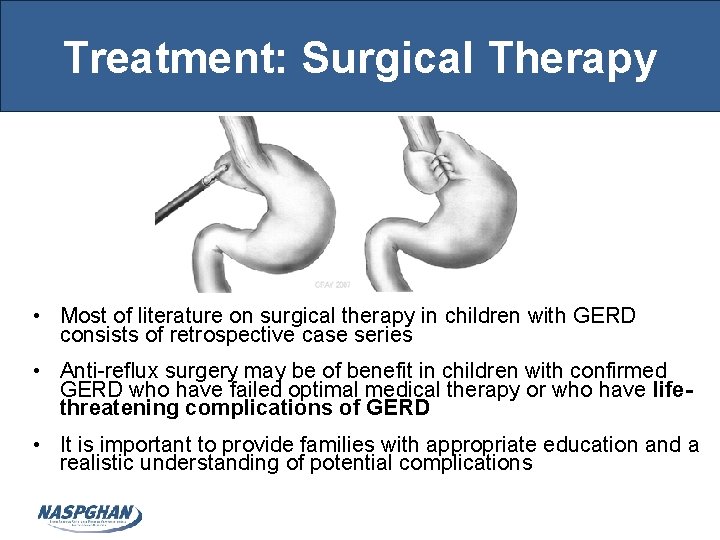
Treatment: Surgical Therapy • Most of literature on surgical therapy in children with GERD consists of retrospective case series • Anti-reflux surgery may be of benefit in children with confirmed GERD who have failed optimal medical therapy or who have lifethreatening complications of GERD • It is important to provide families with appropriate education and a realistic understanding of potential complications
Treatment: Surgical Therapy • Complications following antireflux surgery may be due to: – Alterations in fundic capacity – Altered gastric accommodation – Altered sensory responses • Complications may include: – Gas-bloat syndrome – Early satiety – Dumping syndrome – Post-operative retching
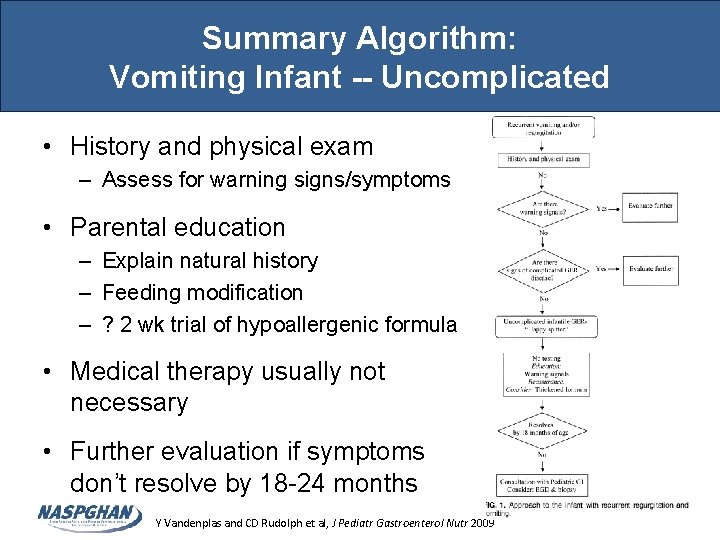
Summary Algorithm: Vomiting Infant -- Uncomplicated • History and physical exam – Assess for warning signs/symptoms • Parental education – Explain natural history – Feeding modification – ? 2 wk trial of hypoallergenic formula • Medical therapy usually not necessary • Further evaluation if symptoms don’t resolve by 18 -24 months Y Vandenplas and CD Rudolph et al, J Pediatr Gastroenterol Nutr 2009
Conclusions • GER is common in infants • GERD is relatively uncommon and is likely over diagnosed and over treated • Pharmacologic and surgical therapies have potential risks which should be considered
- Slides: 31