
Gastroesophageal reflux GOR and Gastroesophageal reflux disease GORD

- Slides: 10
Gastroesophageal reflux (GOR) and Gastroesophageal reflux disease (GORD) in children Dr C Macaulay Dr C Lemer Dr R Bhatt
Incidence • Common (affects at least 40% of infants) • Causes significant distress to parents • Difficult to differentiate between GOR and GORD • GORD refers to when this normal physiological process is severe enough to cause symptoms
Incidence • Starts before age of 8 weeks • Can be frequent episodes of regurgitation/vomitting • WILL resolve with time – In 90% of infants affected it resolves by 1 year of age • Does not usually need investigation
Children at Risk • • • Premature children Children with severe complex neurodisability Obesity Hiatus hernia Repaired oesophageal atresia or congenital diaphragmatic hernia
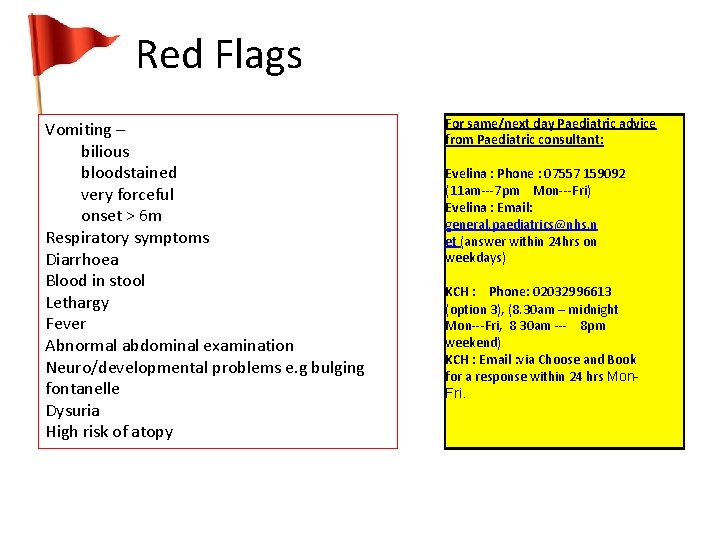
Red Flags Vomiting – bilious bloodstained very forceful onset > 6 m Respiratory symptoms Diarrhoea Blood in stool Lethargy Fever Abnormal abdominal examination Neuro/developmental problems e. g bulging fontanelle Dysuria High risk of atopy For same/next day Paediatric advice from Paediatric consultant: Evelina : Phone : 07557 159092 (11 am‐‐‐ 7 pm Mon‐‐‐Fri) Evelina : Email: general. paediatrics@nhs. n et (answer within 24 hrs on weekdays) KCH : Phone: 02032996613 (option 3), (8. 30 am – midnight Mon‐‐‐Fri, 8 30 am ‐‐‐ 8 pm weekend) KCH : Email : via Choose and Book for a response within 24 hrs Mon. Fri.
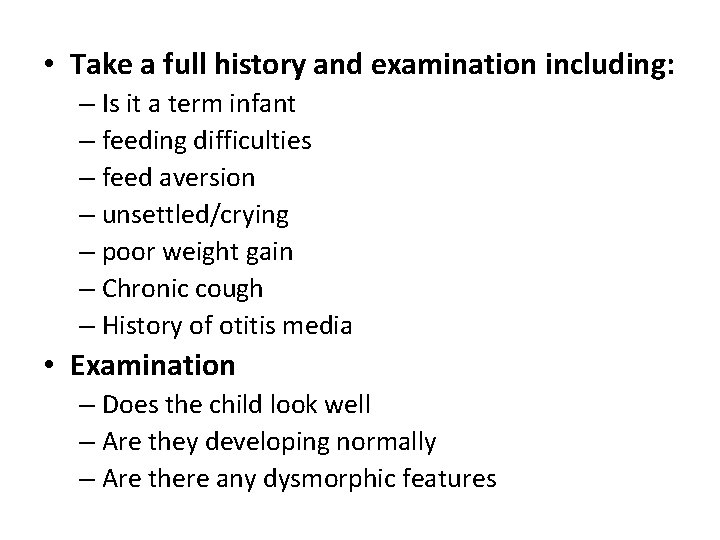
• Take a full history and examination including: – Is it a term infant – feeding difficulties – feed aversion – unsettled/crying – poor weight gain – Chronic cough – History of otitis media • Examination – Does the child look well – Are they developing normally – Are there any dysmorphic features
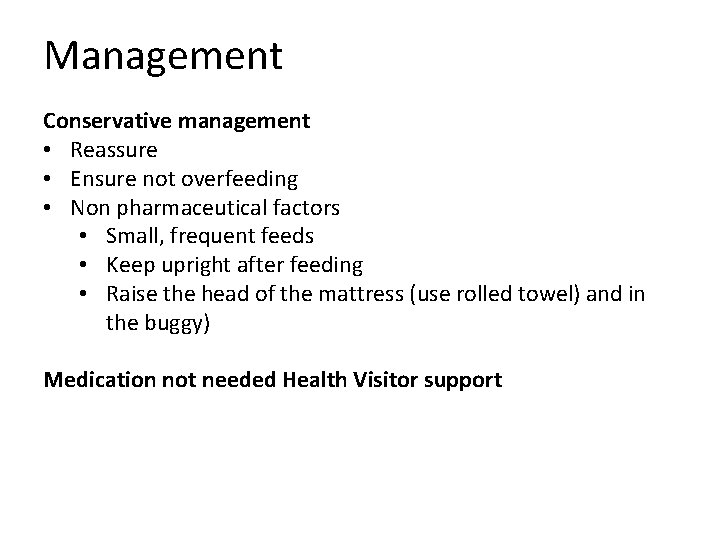
Management Conservative management • Reassure • Ensure not overfeeding • Non pharmaceutical factors • Small, frequent feeds • Keep upright after feeding • Raise the head of the mattress (use rolled towel) and in the buggy) Medication not needed Health Visitor support
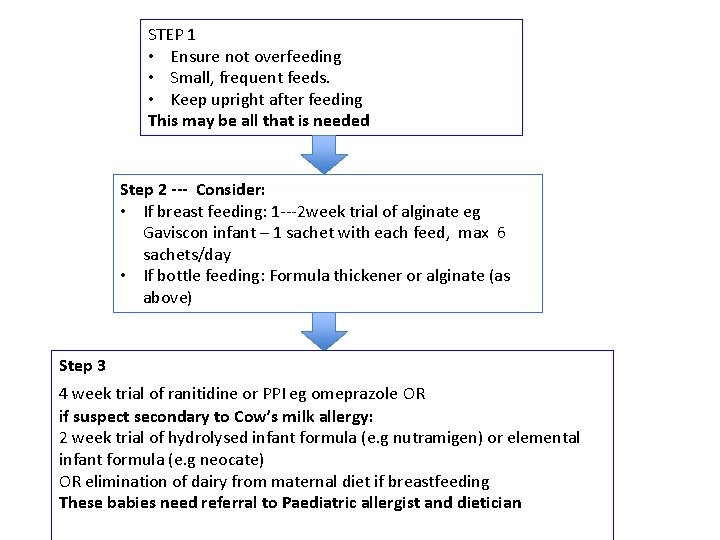
STEP 1 • Ensure not overfeeding • Small, frequent feeds. • Keep upright after feeding This may be all that is needed Step 2 ‐‐‐ Consider: • If breast feeding: 1‐‐‐ 2 week trial of alginate eg Gaviscon infant – 1 sachet with each feed, max 6 sachets/day • If bottle feeding: Formula thickener or alginate (as above) Step 3 4 week trial of ranitidine or PPI eg omeprazole OR if suspect secondary to Cow’s milk allergy: 2 week trial of hydrolysed infant formula (e. g nutramigen) or elemental infant formula (e. g neocate) OR elimination of dairy from maternal diet if breastfeeding These babies need referral to Paediatric allergist and dietician
Take home messages • • • Reflux is common It will resolve Are there other diagnoses to consider? Little evidence for treatments Does not require investigation unless red flags If there is any doubt discuss with paediatrics
Resources • https: //www. nice. org. uk/guidance/ng 1